Yesterday had been a good day

The re-imagined story …

‘A sound of breaking glass; she had been so close to sleep that at first she had thought she was dreaming.  But soon she heard the unmistakable sound of panic surge through the house.

She had done everything in her power for the man, three nights she sat with him until she felt that she could do so no longer and then it was decided to engage a nurse to take the night duty.

Yesterday had been a good day.  He had sat up in bed, even ate some toast and marmalade.  The doctor said the pneumonia wasn’t that bad, just on the right side.  Today had not been so good.

His condition had rapidly worsened.  She had tried to encourage him to sip a spoonful of broth, but he had taken no fluids all day; all she could do was keep his lips moistened.

She had sent word down to Morris Street, to let his wife know he had taken a turn for the worse.  Poor woman was worried out of her mind but what could she do with the little ones clinging to her skirts?

All day she had sat with him, her presence seemed to calm him, his ramblings were less wild when she held his hand.

“Sorry dad, I’m sorry dad,” he sobbed as he gripped the sweat soaked sheet.  He called for his mother and told Norah he loved her and the kids.

The facts …

At the time of the 1911 census James and Norah were living in Warmley, near Bristol where he worked as a pottery labourer in a brick and tile works. He was 24 and Norah was 21. They had a year old son Herbert and six month old twin daughters Norah and Kathleen. They had been married for five years.

By 1912 the family had returned to Swindon and were living at 16 Reading Street in the railway village where little Norah died aged 19 months old. She is buried in Radnor Street Cemetery in a large plot for infant burials B1317.

The inquest into the death of James Price took place at the Police Station at the top of Eastcott Hill. Norah told the court that her husband was 27 years of age, and a bombardier in the Reserve Battery of the Royal Field Artillery.  In private life he was a wagon painter.  She lived at 4, Morris Street, and her husband was billeted at 97 Lansdown Road.

The jury found that the deceased died from fracture of the base of the skull, due to leaping from the window while in a state of unsound mind.

Price JW

Gunner James William Price, aged 27 years, was buried on February 12, 1915 in plot B1777, a public grave where he lies with two others.

William George Driver – soldier

I am closing this month of remembrance with the story of William George Driver. Born in Torquay in 1892 William Driver had no obvious connections with Swindon but this is where he lies buried in an unmarked grave in Radnor Street Cemetery. Volunteers Jon and Kevin are presently making an application to the Commonwealth War Graves Commission to have his death recognised as being the result of his military service and to have an official headstone installed. We know this consultation is likely to take a long time so I am publishing William’s story now in hopeful anticipation.

William George Driver married Emily Dorothy Pretious at St. Anne’s Church, Wandsworth on August 21, 1911 and the couple had two children, George William and Patience. William and Emily were both 19 years old at the time of their wedding and William was working as a clerk in the Civil Service, although he apparently later set up business as a watchmaker and jeweller.

William enlisted at Hounslow on March 19, 1915. He served first in the Army Cyclist Corps and later transferred to the Yorks & Lancaster Regiment.

On William’s attestation papers there was no mention of any health problems but by January 1917 he was suffering from chronic bronchitis and asthma and by February he had been transferred to Bicester VAD Hospital. By June of that year he was in the 2nd General Hospital, Chelsea. His medical notes tell that he was admitted from the Expeditionary Force, France on January 1, 1917 with bronchitis & asthma. He looked ill and presented the usual signs and symptoms of an old standing Asthma & Bronchitis – his condition was not considered to have been caused by active service, climate or ordinary military service, although none of these symptoms had been evident when he enlisted. At the same time there was an enquiry received concerning his son. It appears that seven year old George William was in a home for Waifs and Strays at this time, so his wife was obviously in great distress.

Driver was discharged from the army on September 24, 1917 as unfit for military service suffering from Asthma & Emphysema aggravated by exposure on active service. By then William’s eyesight had also deteriorated and he was unable to resume his work as a watchmaker and jeweller. His service records show that he expressed a desire for outdoor employment in munitions work. He was awarded a pension of 11s 8d a week, which was later reduced to 11s.

William didn’t return to his wife who was then living in Plaistow, East London, but came instead to Swindon where he lodged with Mrs Howard at 49 Cambria Bridge Road.

William died aged 26 years old in the Victoria Hospital on November 14, 1918 from broncho pneumonia. He was buried on November 18, 1918 in grave plot C573.

In Loving Memory of a Name

The re-imagined story …

I was in my last year at school in 1983, trying to decide what I wanted to do with the rest of my life. I knew I definitely didn’t want to go into the Works like my dad, but then it looked as if the days of the mighty railway factory were numbered anyway. It had to be something interesting, something exciting.

What I would really have liked was to join XTC. For those of you who missed the 70s and early 80s for whatever reason, there was punk and prog pop, new wave and New Romantics and, if you came from Swindon, there was XTC.

What was it about them I liked? Was it their sense of fantasy and psychedelic wonderment, to steal a quip from founder member Andy Partridge? Or was it because they were cool and came from Swindon? It was exciting to know that the members of the band had walked the same streets I had. As Andy once said, ‘Swindon was a bit shit but there are worse places and everyone has to come from somewhere.’

I knew I didn’t have any musical talent, but I was sure there was a job I could do as part of the XTC entourage; a technician or press officer, or maybe a photographer, something like that.

In the summer of 1983 word went around school that the members of XTC would be filming a music video somewhere in Swindon for a track on their upcoming album. It came as no real surprise that they should chose the old cemetery, just the crazy kind of thing they would do. Here was my opportunity.

There was no special treatment for the guys the day they filmed at Radnor Street Cemetery. I was among a handful of fans there and as long as we kept out of the way, no one seemed to mind.

This would be my first foray into photography. I had a goodish camera, a present from my granddad. I got what I anticipated would be a couple of good shots of Colin wandering among the graves, looking contemplative and rock starry and several of Dave and Andy dressed in military uniforms and misbehaving in the background.

The cameraman spent a long-time getting shots of individual headstones and memorials, in particular a magnificent guardian angel, which became the opening shot of the video.

It was several weeks before my film came back from Boots the Chemist.

Even now, more than 30 years later, I can remember the heart squeezing disappointment as I opened the envelope and looked at the prints. My first photographic assignment, a total disaster. But as Colin blurred across the foreground, an image appeared in the background, close to the old mortuary building. At first, I assumed it must be the indistinct image of another fan, out for a glimpse of the band, but I began to see the outline of what looked to be a soldier, head bowed, wearing an old-fashioned army uniform and a tin helmet. He carried a kit bag on his back and held a rifle at his side. It was the silhouette of a Tommy from the First World War, there, but not there.
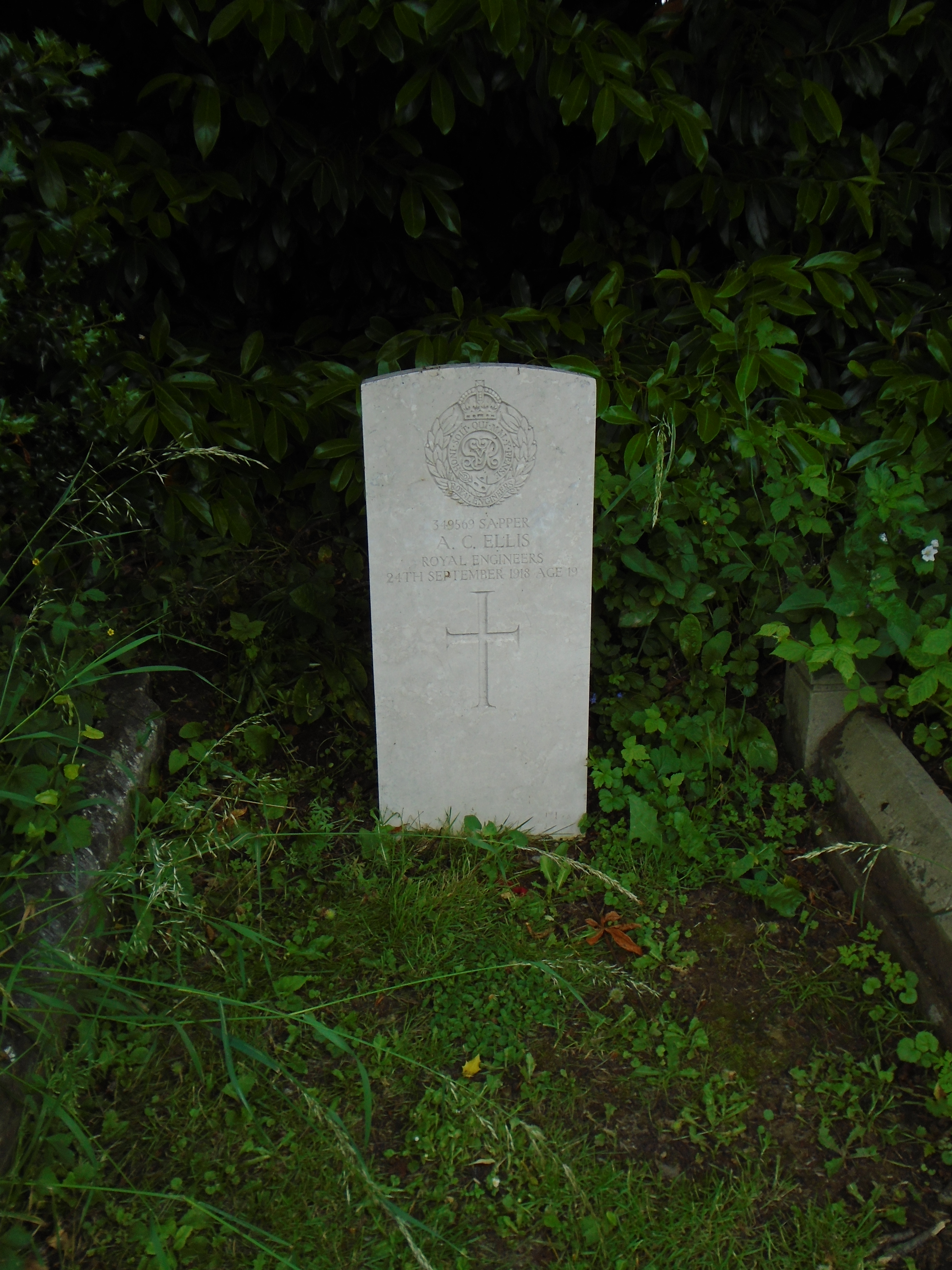
A.C. Ellis (1)

No one could see what I could see, not my parents, not my friends. And after a time I could no longer see the invisible soldier.

In Loving Memory of Name was written by Colin Moulding, but it turns out it wasn’t among his favourites in the band’s back catalogue. He was to later describe it as being about “moping ‘round a graveyard and just remembering the lives of the people there.”

It was several years before I returned to Radnor Street Cemetery. I stood in the place where I had watched Dave Gregory and Andy Partridge and taken my photographs. And then I walked around to the old mortuary building where I imagined I had seen the First World War soldier, there but not there.

I noticed for the first time the official Commonwealth War Graves headstone, discoloured and dirty. The inscription read Sapper A.C. Ellis, Royal Engineers, 24th September 1918 Age 19.


This image has an empty alt attribute; its file name is arthur-ellis.jpg

The Mummer album came after a long XTC hiatus. I recently returned to the cemetery after my own period in the wilderness. The guardian angel still looks good. And someone has propped up against the war grave headstone a small photograph of the young soldier.

chapel door

There, but not there. Photograph published courtesy of Andy Binks.

The facts …

Arthur Cecil Ellis was born in Swindon in 1899 the only surviving son of Thomas George Ellis, an engineer in the railway works, and his wife Annie Maria. He was baptised at St. Mark’s, the church in the railway village, on February 20, 1899 and for all his young life he lived at 38 Farnsby Street.

Arthur Cecil Ellis served in ‘C’ Company of the 6th Reserve Battalion of the Royal Engineers. The 6th Reserve Battalion was located at Irvine and was formed in January 1918 from what had been the reserve Field Companies grouped in Scottish Command.

Arthur died on September 24, 1918, according to the UK Register of Soldiers’ Effects 1901-1929 at Kilmarnock Hospital where he had £3 2s 9d (about £3.20) in pay owing to him, which would go to his mother Annie.

His body was returned to the family home at 38 Farnsby Street and he was buried at Radnor Street Cemetery on October 1st.

More than 50 years later, in the summer of 1969, Arthur’s sister, Dorothy, who worked as a dressmaker when Arthur went to war, died aged 74 and was buried with the teenage brother lost during the final weeks of the First World War.


https://www.youtube.com/watch?v=qC-PxpywwjA&list=RDqC-PxpywwjA&start_radio=1