George Barefoot – an investor in people

The re-imagined story …

I’ve lived in New Swindon all my life. I was born in my gran’s bedroom in Bristol Street and I’ve never known anywhere else. But I’m tired of the close-knit railway community where everyone knows everyone else’s business, and a life confined to the Works and the railway village. I’m weary of seeing the same faces day in, day out, I don’t want to marry a boilermaker or a fitter and live the same life my mum and my Gran have.

“But that’s the strength of this place,” said Gran. “It’s knowing Mrs so and so’s baby is poorly or that Mr whatsit needs help with his shopping.” Gran was settling in for a long session, I could sense it. I offered her a piece of cake.

“When me and your Gramps moved here, I thought we had made the biggest mistake of our lives. All that was here was the Works and the company houses and that was it. No market, no shops, no church even, nothing.”

She took a sip of her tea.

“Is there any sugar in this?”

“Two spoons, Gran.”

“Your Gramps wanted to move out of London. He thought the kids would have a better future here. He thought living in the country would be healthy.” She shook her head sadly.

“The company houses looked nice enough from the outside but the railway village was worse than any East End slum. That first winter we lived here there was an outbreak of typhus. Six children died in Bristol Street. We were fortunate.”

She twisted the wedding ring on her gnarled finger, worn thin by hard toil.

“Did you ever consider moving back to London?”

“It wasn’t that easy and your Gramps had a good job in the Works here. He kept telling me we’d stick it out a bit longer, give it a chance, he’d say.”

“So, what persuaded you to stick it out?”

“Your grandfather and the men he worked with, they made the difference. Men like George Barefoot, elected on to the Mechanics’ Institute Council. Those men were investors; investors in people, they weren’t interested in share prices and profit. They wanted to protect their families and improve their standard of living. They wanted health care in a time when people didn’t call out the doctor because they couldn’t afford to. They were good men and they made the difference.”

“I’m glad your Gramps and George Barefoot gave New Swindon a chance.”

Gran spooned out the sugar from the bottom of her cup.

“Is there anymore tea in that pot? And make sure you put some sugar in this time.”

The facts …

George Barefoot was born in Maidenhead in 1828. He married Margaret Elizabeth Williams, a dressmaker, at Holy Rood on December 23, 1848. George was transferred to Gloucester where on November 12, 1865 three of the couple’s children, John James, William Alfred and Mary Ellen, were christened at St James’s Church, Gloucester. The family’s address is given as Front Terrace. By 1869 the family had returned to Swindon.

That same year George Barefoot was elected on to the Mechanics’ Institute Council with 166 votes. The following year he was re-elected with an increased number of votes, topping the poll with 281. Election results continue to show his presence on the Council and in 1873 he is recorded as ‘George Barefoot Locomotive Department K shop 296 votes.

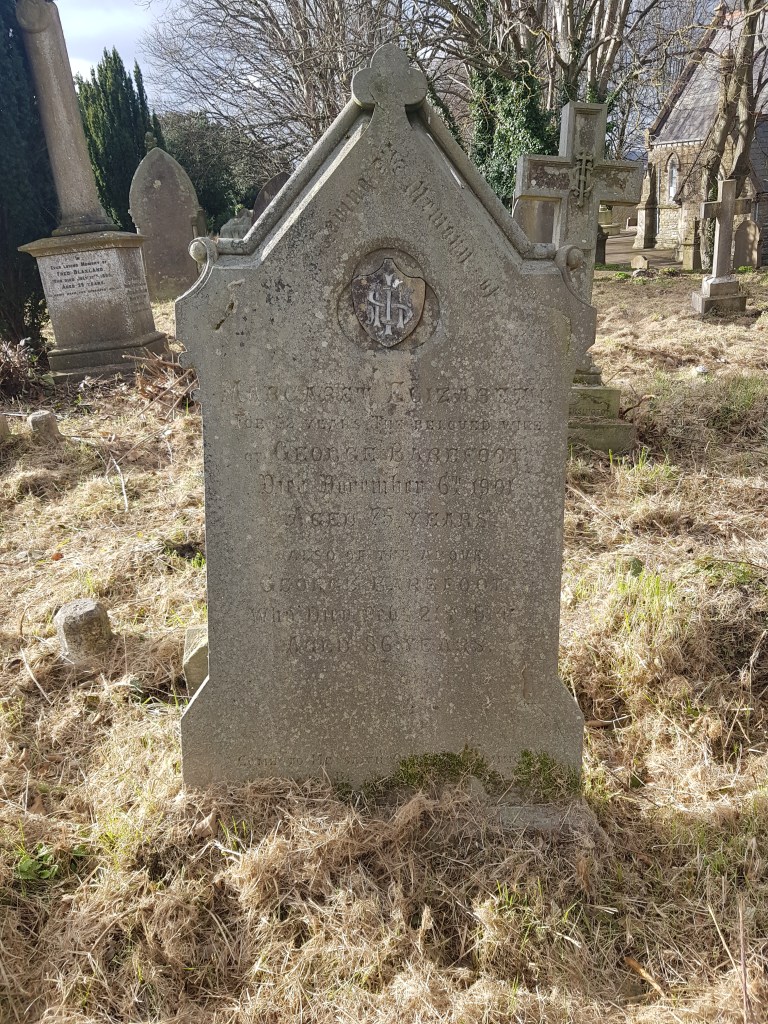
George Barefoot died at the age of 86 years. He was buried on February 26, 1914 in Radnor Street Cemetery in plot E7936

Death of Mr George Barefoot

The death took place on Saturday, at the residence of his son-in-law, Mr F. Edge, “Inglewood,” Deacon Street, Swindon, of Mr George Barefoot. The deceased gentleman who was very well known in Swindon, was born at Maidenhead in 1828, and commenced his working career as an office boy at Paddington Station. In 1847 he came to Swindon, being then at the age of 19, and was transferred for a few years to Gloucester, and finally returned to Swindon.

It is interesting to note that he was married at the old Parish Church by the then Vicar (the Rev. H.G. Baily), and he has, therefore, watched Swindon grow from what were practically two large villages into the large and enterprising town it is to-day.

He was a chargeman in the GWR Works for over 30 years, and he won the esteem and respect of all who knew him. In recognition of his faithful services the company granted him a pension on his retirement, and he went to live with his son-in-law and daughter.

He was always a prominent Conservative, and the late Sir Daniel Gooch used to speak of George Barefoot as his staunchest supporter in the Works. He had been a regular attendant at St. Mark’s Church.

A few weeks ago Mr. Barefoot had a stroke, and took to his bed, the end coming peacefully on Saturday. He leaves five children to mourn his death.

North Wilts Herald, Friday, February 27, 1914.
Albert Sykes – the father and founder of music in Swindon

The re-imagined story …

Mr Sykes asked me to sing All Things Bright and Beautiful. He listened very carefully; his head tilted on one side. There was a brief pause after I stopped.

“Well Ada,” he said, “I’m sure we can find a place for you in the chorus.”

I was so excited I could have given him a big hug, but that would have been entirely inappropriate. You didn’t hug a gentleman like Mr. Sykes.

My ma said I was born to sing. She said that I sang even as a baby in my crib. “You never wailed or screamed like the other babies,” she said, “you sang.”

I’ve been singing ever since. I especially love to sing in church. My favourite hymn is Rock of Ages, I love the rise and swell of the music. And I sing at my work, but I try not to be too enthusiastic as Mrs Morse has delicate hearing and she usually asks me to close the green baize door while I’m in the kitchen.

But I had never sung in public before and I never dreamed I would one day stand on the stage at the Mechanics’ and sing before an audience. I could scarce believe Mr. Sykes might even consider me.

It was my best friend Polly who suggested I audition for the chorus in the Mechanics’ Institution pantomime that year – Babes in the Wood, or Harlequin and the Cruel Uncle.

Opening night was just days away and this was to be our dress rehearsal. “Let’s put you next to Letitia, just follow her lead,” Mr Sykes had said at our last rehearsal. Letitia Jones was one of the principal singers in the chorus. She had a beautiful voice, a bit on the quiet side, I always thought, but melodious none the less.

Polly was waiting in the wings when I arrived. She was in conversation with Letitia and had her back towards me, but I could hear them talking as I approached.

“I hope Ada Firebrace doesn’t stand next to me again. She quite puts me off,” said Letitia.

“I never expected Mr. Sykes would engage her,” I heard Polly say. “I hoped he might tell her … you know … tell her what an awful voice she has. Then perhaps she would stop singing morning, noon and night.”

I stood stock still. Letitia had seen me walk across the stage and was grimacing and nodding at Polly with the intention of warning her that I approached. It was too late.

I never spoke to Polly again and I didn’t take part in the Mechanics’ Institution pantomime that year either. But I did save up my pennies and took some singing lessons with Mrs Sykes.

Ma says my voice is more beautiful than ever now. I have no desire to sing before an audience anymore, but I will always have kind memories of Mr Sykes.

The facts …

The Late Mr Albert Sykes

In accordance with the recommendation in the report, Mr Spencer proposed that a large portrait be obtained of the late Mr Albert Sykes, and placed in the Reading Room. Mr Sykes, he remarked, was a man who in his day and generation did a great work for New Swindon, and many men had been indebted to him for his musical tuition. Mr. Sykes was a useful man on the Council of the Institute, a capital librarian during the time he held that position, and he was also the father and founder of music in Swindon.

Mr A.W. James seconded the proposition, which was carried unanimously.

Mr Morris said he was pleased to know that the Council were thus going to recognise Mr Sykes’ services, and he hoped the same course would be adopted with regard to the late Mr J.H. Preece and the late Mr F.G. O’Connor.

The Swindon Advertiser, Saturday, May 5, 1894.

The two Sykes brothers were born in Leeds – Albert in 1823 and Joah in 1824. On the 1841 census they are living in Hunslet where their father John worked as a surveyor of roads. Albert was working as a mechanics’ apprentice while Joah was a potter’s apprentice.

Albert began work as a fitter and turner in the GWR factory in September 1847 later working as a shop clerk.

The 1851 census shows Joah still living in Hunslet with his wife and baby daughter. He is working as a whitesmith (someone who works with tin). Joah joined his brother in New Swindon around 1853 where he worked as a blacksmith in the railway factory.  At the time of the 1861 census he is living with his wife and their five children at 1 East Place in a property they share with Peter Vizard, his wife and two daughters; Thomas Toombs, his wife and their three children and a lodger by the name of Jeremiah Walker!

By 1871 Joah and his family are living at 25 Reading Street, which remained his home until his death in 1910.

On first coming to New Swindon Albert lived in Westcott Place. Then he spent 20 years living in Fleet Street before moving to Victoria Road where he and his wife opened a music school.

Both Joah and Albert were talented musicians. Joah played the oboe and both brothers were involved with musical events at the Mechanics’ Institute where Albert conducted the Mechanics’ Institutes’ Choral and Orchestral Union.

The two Sykes brothers are typical of those early settlers who left their home, their family and friends to move to New Swindon and once here immersed themselves in the life of the community.

Albert died on February 27, 1894. His funeral took place on March 3, 1894 and he is buried in plot E8362 with his wife Mary Hannah, son Albert and nephew Herbert Francis Sykes – Joah’s son.

Joah was elected to the Council of the Mechanics’ Institution in 1870. He was a member of the Liberal Association with a reputation for being a radical and he was a member of the Methodist Chapel in Faringdon Road.

Joah died on February 17, 1910. He is buried in plot E8364 close to his brother Albert, with his wife Ellen and two of their daughters. Emily is described on the 1901 census returns as being an ‘imbecile from birth’.

What can a headstone tell you?

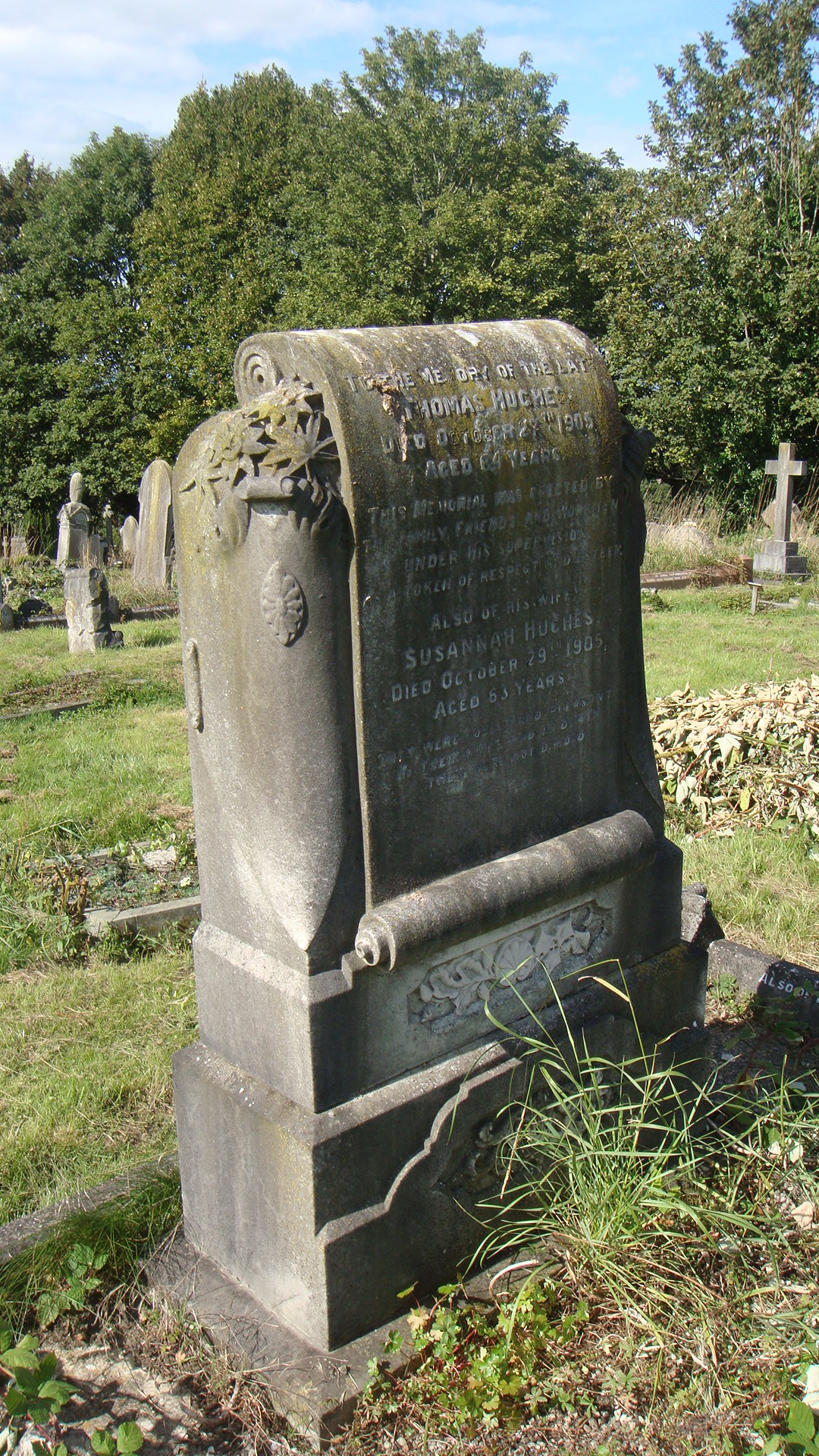
Thomas-and-Susan-Hughes

What can a headstone tell you? A surprising amount actually, and that doesn’t just include the inscription.

In older churchyards you might find skulls and crossed bones and dancing skeletons on headstones but you are unlikely to come across these symbols in Radnor Street Cemetery. There are angel monuments and angels carved in relief, but most of the iconography is more subdued.

The cemetery was established in response to several urgent needs. The rapid growth of the town saw diminishing space for burials in the existing churchyards (see Proposed Cemetery for Swindon) and a large and a growing congregation of Dissenters or Non-Conformists. This accounts for the non-denominational nature of the cemetery chapel (most municipal cemeteries have an Anglican and a Dissenters’ Chapel) and why the burial ground itself is unconsecrated ground.

So, what does the inscription on Thomas and Susannah Hughes’s headstone tell us?

To the memory of the late Thomas Hughes/Died October 27th 1905/Aged 64 years/This memorial was erected by the family friends and workmen under his supervision/a token of respect and esteem/also of his wife/Susannah Hughes/died October 29th 1905/aged 63 years/They were (illegible) and pleasant/(illegible) their lives and death/they were not divided

The headstone is in the shape of a scroll, which itself has various interpretations. It can signify a love of learning or a religious conviction. A scroll partially unfurled can indicate a premature death, although not in this case as both Thomas and his wife Susannah were in their 60s.

Acanthus leaves are a classical symbol dating from antiquity and represent both immortality and life’s prickly path. Ivy leaves represent friendship and immortality and oak leaves hospitality and endurance. The medallion shaped flower is most probably a sunflower, representing affection and remembrance while the Easter lily signifies resurrection.

The facts …

We regret to announce the death, on October 27th, after a very short illness, of Mr Thomas Hughes, foreman of the Erecting Shops at Swindon.

Mr Hughes was born at Smethwick, Staffordshire in 1841, and in 1855 was apprenticed to Messrs. James Watt & Co., late Boulton & Watt, Engineers, Soho Foundry, Smethwick, near Birmingham, as general engineer, machinist, turner, fitter and erector. He left Soho Foundry in 1862, after the completion of his apprenticeship, and joined the service of the London and North Western Railway at Crewe, where he stayed for only a short time, returning to Soho Foundry and eventually entering the service of the Great Western Railway Company at Swindon in 1866, as an erector. He was appointed foreman in 1876, and his position was one of the most important at Swindon, as he had full control of the erection of new engines, also of the erecting work in connection with repairs.

He was a man of marked ability in his profession, and was held in high esteem by the officials, particularly by the Chief Superintendent, who, at the opening meeting of the Junior Engineering Society on October 31st, alluded to the said incident in the following terms: – “This Society is unfortunate in a lost which we have sustained within the past  few days. I allude to the death of poor Foreman Hughes. He was a member of our Committee, and I am sure I express your views when I say he was one of your most respected members. I am proud to say that Tom Hughes was a friend of mine for a great number of years, and I can scarcely express to you the shock it gave me when I heard of his death.”

For a number of years Mr Hughes held the position of First Engineer in the Company’s Fire Brigade, and in this direction exhibited characteristic energy and interest. He was also a Member of the Council of the Mechanics’ Institution, to which he was devotedly attached. The case is a peculiarly sad one, as within a day or two of Mr Hughes’s death, his wife, who had been ailing for some time, passed away.

Great Western Railway Magazine December 1905.

Death of Mr Hughes

We regret to announce the death, which took place on Friday morning, at his residence, 8 Faringdon Street, Swindon, of Mr T. Hughes, a foreman in the GWR works. Deceased, who had only been ailing a short time, passed away somewhat suddenly. He had been a foreman in the GWR works – over the A Shop (New Work & Erectors), B Shop (Erectors), and P Shop, for 30 years, having been employed in the GWR Works 40 years. He was well known as a member of the Council of the Mechanics’ Institute, in which he took an active interest, especially in the Library and Reading Room, having been a member of the council for seven years. Deceased leaves a widow and grown up family, for whom the deepest sympathy will be felt, especially as Mrs Hughes is lying seriously ill. Mr Hughes was also a prominent member of the GWR Fire Brigade.

Death of Mrs Hughes

An extremely pathetic sequel to the death of Mr T. Hughes, a GWR foreman, which took place on Friday last, is the fact that his wife passed away yesterday morning. She had been ill for some time, and was lying prostrate when her husband died. The funeral takes place tomorrow, when the bodies of Mr & Mrs Hughes will be buried in the same grave in the Swindon cemetery.

Swindon Advertiser November, 1905

In 1871 Thomas and Susannah lived in a shared property at 24 Oxford Street. By the time of the 1881 census they had moved with their six children into one of the larger, foreman’s houses at 8 Faringdon Street where they remained for the rest of their married life.

They were buried on the same day, October 31, 1905 in plot D141. They share their grave with their eldest son Charles Thomas, who died in 1907 and their son in law, Ernest James John Tarrant, the husband of their daughter Alma Susan, who died in 1914.

Thomas-Hughes

Mr Thomas Hughes