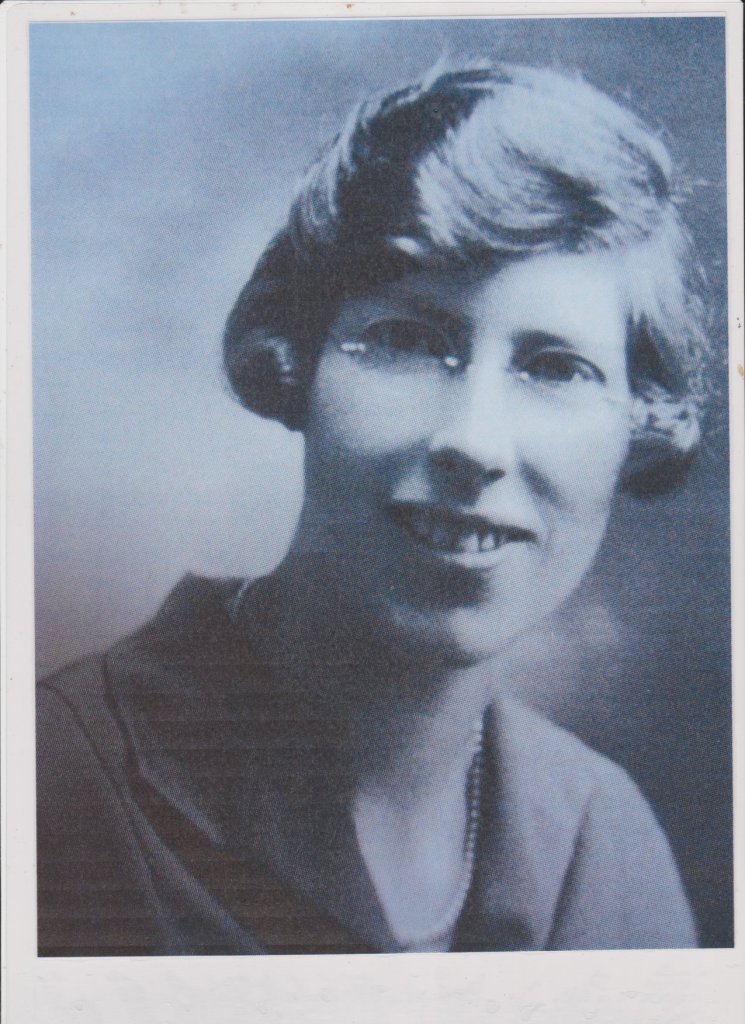
Miss Lorna Dawes and a life ‘inside’.

Some years ago, I attended a talk about life ‘inside’ given by Miss Lorna Dawes at the Central Community Centre. The talk was hosted by The Railwaymen’s Association who had been meeting regularly following the closure of the Works in 1986 with guest speakers delivering talks about all things railway related. To those of you unfamiliar with Swindon railway jargon ‘inside’ refers to working in the railway works and it has to be said it was a rare occasion to hear a woman talking about such a subject. The only other woman I had ever heard give such a talk was social and railway historian, Dr Rosa Matheson.

Lorna sat at a table at the front of the hall and without the aid of any photos or slides or whizzy technical gizmos, spoke about her time in the Works. Lorna had a small sheaf of notes in front of her and thus armed she set about informing and entertaining her audience. Of course, she knew all the railwaymen present and exchanged quips and jokes with them during the course of her presentation.

I soon gave up trying to take my own notes and just sat back and listened to this amazing woman.

Lorna was born on March 23, 1931, the daughter of iron moulder Albert Edward G. Dawes and his wife Mona and lived all her life in Tydeman Street, Gorse Hill. She started work as a messenger in the Works in April 1945, aged 14 years old.

Lorna had taken lessons in shorthand while still at school and later attained a certificate for 120 words per minute at evening school. However, her first job as a messenger presented few opportunities to sit down and take notes. She had to quickly learn her way around the vast railway factory, which in the 1940s covered 326 acres. Walking through the tunnel to access all areas was obviously the bane of the lives of the young women where the sludge and filth ruined their stockings.

Most days included a trip to Grays [bakery] in Bridge Street for small lardy cakes for the office staff and to collect the milk and make the drinks to go with those lardies.

Then there was collecting the absences book from the tunnel entrance, delivering the bank bag to London Street, taking messages to Bristol Street, Park House and the laboratory housed in the old school.

She then went on to describe the staff office work, which involved everything from filing accident reports in Park House to duties in the Booking Office and collecting rent owed on the company houses.

She mentioned the double length typewriters used to type charts of salaried staff promotions and wrote: “I enjoyed manipulating lines of names into spaces.” She was also able to fix minor repairs on the typewriters until the mechanic came from Bristol.

Lorna participated in the busy social life of the Works, playing tennis and badminton, representing the offices in tournaments.

Lorna was one of the earliest and most enthusiastic subscribers to Swindon Heritage, a local history magazine published between 2013-2017 with which I was involved. I would have loved to have told her story in the magazine but Lorna wasn’t ready then.

It was with great sadness that I learned about her recent death and regret that I had not captured her memories.

And then I had the good fortune to exchange emails with Yvonne Neal, a member of the Swindon branch of the Wiltshire Family History Society. Yvonne had been in touch with Lorna’s brother and quite remarkably the notes from that talk survive.

The handwritten notes cover more than 11 pages and include not only the big events but the more personal ones too, those of Christmas’s in the offices, weddings, birthdays and babies.

And then she wrote: “My story was due a book “Tempus” pub. but interviewer left post. Didn’t get published.” Perhaps she felt so let down she wasn’t going to go through the performance again with me.

I wish I had had one more conversation with Lorna, to thank her for her support and enthusiasm during the publication of Swindon Heritage and to persuade her to tell her story again. I’ve done my best here.

You may also like to read:

Lorna Dawes in her own words

Lorna Dawes in her own words – Pt. 2

Lorna Dawes in her own words – Pt. 3

Lorna Dawes and the Pinnock family

Freda and Irene Dening – winners of the Brunel Medal

The re-imagined story …

I always knew those girls would do well, especially little Irene. She was always so attentive and eager to learn.

Irene Dening

The turn of the century was an exciting time to be a woman; plenty of new opportunities to be had and women everywhere were pushing the boundaries that had constrained them for too many years.

I began my pupil teacher training at Queens Town Infants School in 1891. Among the girls who joined with me was Edith New who would go on to play a significant role in the Votes for Women campaign with Mrs Pankhurst and her daughters.

Queens Town School opened in 1880, an impressive red brick building built alongside the old canal. Perhaps not the most salubrious of settings, but the school served the Queens Town community well. By the time I began my pupil teacher training there ten years later a girls’ school had been built on the site.

However, there were still anomalies in the teaching profession. Women teachers who taught infants and girls were paid less than men who taught boys, an inequality that Miss New would later campaign to change. But the Swindon School Board was a progressive organisation that set high standards of which young Freda and Irene took best advantage.

When we gained our teaching certification Miss New moved to London, but I stayed closer to home. I followed the Dening sisters careers with great interest. So many of the girls I taught did well, but perhaps none more so than Freda and Irene Dening. I always knew those girls would do well, especially little Irene. Always so attentive and eager to learn.

Freda Dening

The facts …

Freda and Irene were born into a railway family. Their father Richard was a steam engine fitter and along with their brother Henry, the three children were all born in Swindon and grew up at 61 Hythe Road.

Freda entered the service of the GWR in 1912 when she was 15 and Irene joined the workforce in 1914 when she was about the same age.

Freda began work in the statistical section of the engineer’s office at Marlow House and was one of the first girls to be employed in the clerical department of the Swindon Works. She studied shorthand and typing at Swindon College, going on to become a shorthand typist in the Works. But her ambition didn’t stop there. She went on to study for three years covering accounting and business methods, the law of carriage by railway, the basis of railway rates and charges.

Her sister Irene was equally ambitious and worked as secretary to the Stores Superintendent. She also went on to study and both women won the prestigious Brunel Medal.

The Brunel Medal was awarded to Students in the railway department of the London School of Economics who, in not more than four years, obtained three first class passes in examinations held in connection with courses approved for the purpose.

The women’s elder brother Henry was also awarded the Brunel Medal, so they were a pretty extraordinary family.

In an interview with the Swindon Advertiser Freda said:

“I really loved my job and it opened many doors to opportunity that my sister and I would not of otherwise had. There were very few women in the railways in those days and it was a fascinating place to be.”

But there were sacrifices to be made. Neither women married nor had children. Of course, this may have been by choice. These days an ambitious woman would probably expect to be able to have it all – as an ambitious man can!

Freda retired early to care for her elderly parents while Irene had a career that spanned nearly 45 years.

Both sisters ended their days in the Cheriton Nursing Home. Irene died on February 25, 1982 aged 81 and Freda on March 18, 1994 aged 96. Their cremated remains are buried here with their parents.

My thanks go to Dr Rosa Matheson who first drew my attention to the Dening sisters in her magnificent book The Fair Sex: Women in the Great Western Railway.

Herbert Pinnegar – killed at work aged 14

Emma Pinnegar’s five sons all followed their father into the railway works. Francis and Ernest became fitters, Nelson a blacksmith and Levi a coppersmith. Her youngest son Herbert had been employed just a few months when he was killed at work one Monday afternoon.

Herbert was working in D Shop “cutting of tyres for the wheels of railway carriages.” He was rather short sighted, according to the newspaper report, and working with heavy machinery. Do you suppose he was wearing glasses? I doubt it. Do you suppose anyone was supervising him? I doubt it.

In Swindon Works – The Legend, Dr. Rosa Matheson devotes a chapter to accidents. She writes: “The causes of accidents could be put down to a number of things – workers’ carelessness, difficult and horrendous conditions, over work, inexperience, lack of supervision, inattention, youth, old age, bad luck.”

It would seem young Herbert ticked a number of these boxes.

The railways brought employment and prosperity to Swindon; the railways brought life and they also brought death. Emma’s husband had been killed ten years previously walking home to Purton along the railway line. It appears he had been doing some shopping in Swindon that evening after work – it was the week before Christmas.

Fatality at Swindon

A terrible fatal accident occurred in the D Shop of the GWR Works on Monday afternoon. A lad named Pinnegar, aged about 14, was engaged upon a machine for the cutting of tyres for the wheels of railway carriages. Pinnegar, who was rather short sighted, was looking down to see if his work was placed in a right position, when going too near the large wheel, he was knocked down between the chisel and another part of the machine. The top of the poor boy’s head was cut completely off. Death, of course, was instantaneous. Deceased’s father, about six years ago, was killed on the railway while returning home from work.

The Bristol Mercury, Wednesday, September 16, 1891.

Herbert was buried in Radnor Street Cemetery in grave plot B1592, a public grave. He is buried with three other unrelated persons.

Fatal Railway Accidents Near Swindon – Between twelve and one o’clock on Saturday morning the stoker on a goods engine passing the Rifle Butts, between Swindon and Purton, saw what he thought to be the body of a man lying by the side of the rails. On search being made the body of a man named Frank Pinniger, a boilersmith in the Great Western Railway Works, but living at Purton, was found. He had been in Swindon shopping on the previous night, and left Rodbourn Lane about eleven o’clock to walk to his home down the line. The night was rough and windy, and it is supposed he was struck by the 11.20 mail train from Swindon. His body was removed to the mortuary at Swindon to await an inquest. Deceased was between 40 and 50 years of age, and leaves a wife and eight children.

The Stroud News and Gloucestershire Advertiser Friday, December 24, 1880.

Frank was buried on December 24, in St. Mark’s graveyard ‘by Coroner’s Order.’

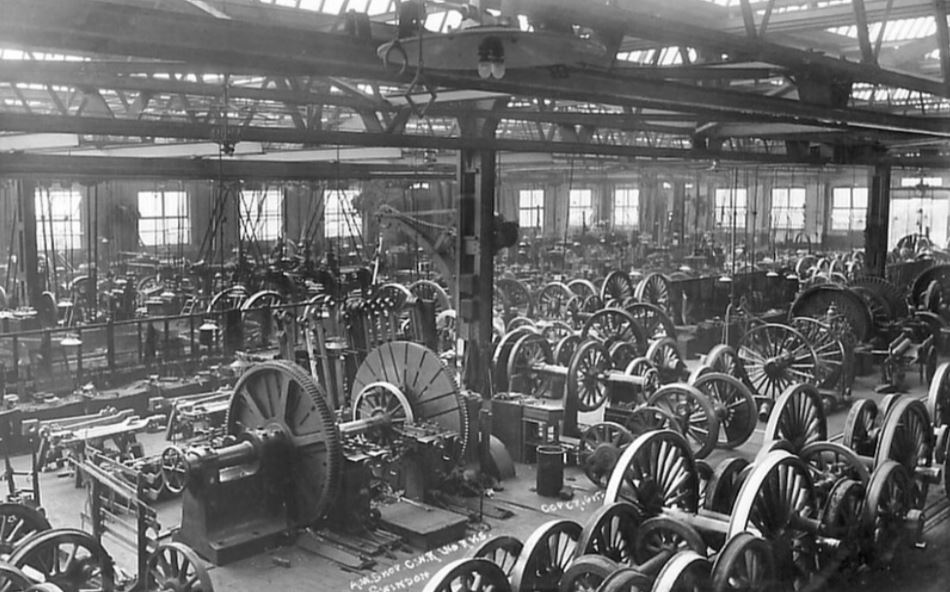
A William Hooper image of A W Shop taken in 1907 and published courtesy of Local Studies, Swindon Central Library.

George Albert Hallard – Swindon Veteran of Industry

It was said that an apprenticeship served in the Great Western Railway Works was a passport to a job anywhere in the world. Some of the long past railway men might argue that it didn’t necessarily guarantee a job in the Swindon Works though! Skilled, newly qualified men went up a pay scale and the GWR only retained those where vacancies existed in specific shops.

In Doing Time Inside – Apprenticeship and Training in GWR’s Swindon Works Dr. Rosa Matheson reproduces the regulations under which apprentices were employed in the GWR Carriage Works in Swindon in both 1892 and 1908. Apprentices were not taken on under 15 nor over 16½ years of age (later revised to 15½ and 17 years). All candidates had to complete a one month trial without wages before being accepted.

In 1892 a working day began at 6 am and finished at 5.30 pm with a 45 minute breakfast break and an hour for lunch. The daily rate for an apprentice in his first year was 10d. He was expected to ‘commence work punctually at 8 am and to make, as a rule, full time (54) hours during the week.’

One such apprentice was George Albert Hallard who began his months trial on February 20, 1879 aged 15.

George Albert Hallard was born in Bristol in 1864, the eldest of 8 children. His father George was an Erector, Engineer, Fitter and by 1881 the family were living at 38 Westcott Place, next to the Falcon Inn.

George Albert Hallard married Marcella Ellen Kirkham in 1889. At the time of the 1891 census the couple were living at 13 Conduit Street, Plumstead, London but by 1901 they had returned to Swindon and a home in Birch Street.

George Albert Hallard was one of 228 men who retired under the 66 year retirement age limit in 1931.

Mr G.A. Hallard, of 70, Jennings Street, chargeman fitter and turner in “W” Shop, worked in the GWR works for 38 years and was chargeman for about 27. He was apprenticed in the works and then obtained a position in London. He then returned to Swindon. Mr. Hallard’s father, who is 91 years of age, also worked in the works for many years.

Swindon Veterans of Industry – North Wilts Herald, Friday, January 2, 1931.

George Albert Hallard died aged 77 years in Ogbourne Hospital. His home address was 70 Jennings Street. His funeral took place on December 12, 1941 when he was buried in grave plot C745 with his wife Marcella who died in 1903.

W Shop where George Albert Hallard worked for more than 27 years. Image published courtesy of Local Studies, Swindon Central Library.