Laudanum was the 19th century go-to drug for – well, pretty much anything really. The opium tincture was used to relieve everything from diarrhoea and the common cold to heart disease. It was a pain suppressant, induced sleep and was very, very addictive.
It was also very popular in Victorian artistic circles. One of the many victims of laudanum addiction was Elizabeth Siddal (1829-1862) a talented artist in her own right but better known as the muse, mistress and eventual wife of Pre-Raphaelite artist Dante Gabriel Rossetti. Lizzie died of a suspected overdose of laudanum following the birth of her stillborn daughter.
Laudanum was readily available, cheaper than a bottle of gin and in Swindon in 1888 could be bought over the counter by a 14-year-old girl, apparently.
This is the story of Henry Simpson who also died from an overdose of laudanum taken to relieve back pain.
Henry Simpson was born in Lechlade in about 1837, the son of plasterer John Simpson and his wife Sarah. Henry married Ellen Clifford in 1857 and throughout his life worked as a slater and plasterer, eventually adding grocer to his list of occupations, so obviously a hardworking man. The couple had two children, a daughter Lydia and a son William. In 1861 the family were living in Kempsford. By 1871 they had moved to Poulton in Wiltshire and by 1881 they had arrived in Swindon and were living at 21 Oriel Street, described on the census returns of that year as a Grocer Shop.
Death Through an Over-dose of Laudanum at New Swindon
Yesterday (Friday) Mr W.E.N. Browne (Coroner for North Wilts) held enquiry at the “Whale” Inn, Princes-street, New Swindon, touching the death of Henry Simpson, plasterer, who was found dead in bed on Thursday morning at his residence in Oriel-street. Mr. J. Maylott was chosen foreman of the jury.
After viewing the body, the first witness called was Richard James Page, who stated that he had lodged with deceased for 10 years. Deceased was at work on Wednesday last, but went home in the afternoon, complaining of pains in his back. He had been suffering all the week. On the previous Saturday someone recommended deceased to take a dose of laudanum to ease the pain. Deceased obtained a bottle, and on Sunday evening he took 30 drops in some water. Witness counted the drops. Deceased then went to bed, and got up as usual on Monday morning. He took about the same quantity of laudanum again on Monday night. Witness did not see the bottle again until Thursday. It was then empty, but was quite full when deceased bought it.
Minnie Browning, 14, a young girl residing in Oriel-street, proved going to Mr Smith, chemist, of New Swindon, and obtaining a bottle of laudanum and some opodeldoc, for which she paid 1s, and told the chemist it was for Mr. Simpson.
Hannah Browning gave evidence, stating that she was called to deceased’s house on Thursday morning about 11 o’clock, and between twelve and one she was asked to go and call deceased, as he had not got up. She did so but received no answer. She went half an hour afterwards and went into the room, and saw deceased in bed. She felt his hand and found it quite warm, but stiff. She then sent for some one, and she felt sure he was dead.
Dr Arnold, MB, FRCS, LRCP, stated that he was called to see deceased about three o’clock on Thursday afternoon. He found him dead, lying in the position of natural sleep. He examined the body of deceased, but found no marks of violence. In his opinion deceased had taken an over-dose of laudanum. The bottle produced would hold about eight drachms. Two drachms would be sufficient to kill a man who was not used to taking it.
The jury returned a verdict that deceased came by his death through taking an overdose of laudanum.
The Swindon Advertiser, Saturday, July 21, 1888.
From the evidence given at the inquest by Richard Page it was stated that Henry was suffering from back pain, causing him to take to his bed. Perhaps today the verdict arrived at by the jury might have been a more empathetic ‘accidental overdose.’
Henry was buried in grave plot B1575 on July 23, 1888. This was most probably a public grave at the time of his death but was subsequently purchased in 1948 for the burial of Edward Richard Green and his wife Emma Selina who died in 1952.
Administration of Henry’s will was granted to Ellen and his personal effects were valued at £147 6s 9d. Ellen moved to Chester after Henry’s death where she lived with her daughter Lydia and son-in-law Charles Arthur White. She died at their home on June 14, 1890 and was buried in Overleigh Old Cemetery, Chester.
For those of you interested in the story of Elizabeth Siddal you can read more here. This is one of the many portraits Rossetti painted of her.

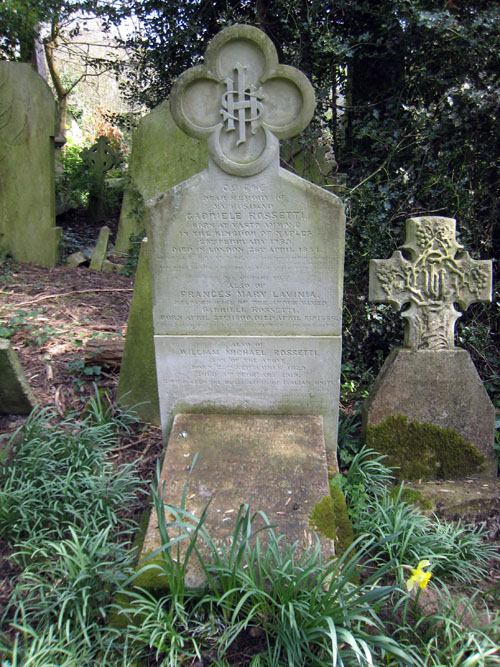
Elizabeth was buried in the Rossetti family plot in Highgate Cemetery.
 Radnor Street Cemetery