The national news this weekend has been dominated by the announced closure of the Tata Steelworks in Port Talbot, South Wales with the loss of more than 4,000 jobs, half that number going within the next 18 months. Steel production in Port Talbot dates back more than a century with 20,000 employed there during the peak of production in the 1960s. The people of Port Talbot are fearful for the future of their town and the prospects for their young people.
Does all this sound rather familiar? Here in Swindon, where the railway factory closed in 1986, we now have a whole generation who never knew Swindon when it was a railway town.
For the children of Rodbourne who attend Even Swindon School the history of the railway works is kept alive, but is this the same for other schools in the town where local history has a low priority on the national curriculum.
Once upon a time (and yes, this is beginning to sound like a fairy tale) whole families were employed in the Works. Take the Griffin family for example.
Phillip James Griffin was employed as a clerk in the railway factory and all four of his sons followed him ‘inside.’ Eldest son Frank Aldworth Griffin entered service in the Works as a clerk, passing his probationary period satisfactorily along with the Paddington examination on May 17, 1898. He was followed by Phillip William Griffin who embarked upon a 7 year Fitting and Turning Apprenticeship on his 14th birthday in 1899. Ralph Ernest Griffin was 15 years old when he began a Fitting and Turning Apprenticeship on April 16, 1903 and youngest brother Cyril Arthur started work on September 8, 1908 as an office boy aged 14.
The four brothers never married; Frank, Ralph and Cyril lived with their widowed mother Caroline in Clifton Street. Only Phillip William Griffin moved away, and when the time came he returned home to be buried with the family in Radnor Street Cemetery, the last resting place for so many of the railway men and their families.
Cyril died in 1934 and was buried with his parents in grave plot A742.
Frank, Ralph and Phillip Griffin are buried together in grave plot D440.
Clara Ellison had taught at Even Swindon School for 25 years when she resigned in 1908. Then aged 48 she might have expected to remain in post for a few more years. There is no mention that she was suffering from poor health so we have to ask did her husband’s bankruptcy case influence the members of the Swindon School Board?
Clara Illidge Shelton was born in 1860 in Birmingham, the daughter of William Shelton, a cab driver, and his wife Elizabeth. By the time of the 1881 census Clara was living in Eastbourne where she was employed as an assistant school mistress and lodged with William Cole and his family.
On December 1, 1883 Clara (by then living at 34 Wellington Street, Swindon) married John Ellison, a brass finisher in the Works, at St. Mark’s Church. Even Swindon Infant School was built in 1884, which is the earliest date at which Clara could have been teaching there. By 1891 the couple were living at 17 Linslade Street where John describes himself as a Brass Finisher and Clara as a School Board Teacher. They had two young sons, Gerald 6, and Wilfrid 4. Clara’s widowed mother Elizabeth lived with the family.
But was there a prejudicial attitude to Mrs Ellison prior to the events of 1908? In 1896 Mr Henry Day (Head Teacher at Even Swindon Mixed School) and Mrs Clara Ellison (Mistress at Even Swindon Infant School) both applied for an increase in their salaries. The School Management Committee initially recommended that they both receive a £10 annual increase whereupon Committee member Mr McRae immediately opposed both applications. In the case of Mr Day there was no seconder but Mr Keene also raised an objection in the case of Mrs Ellison. Some discussion followed when another member, Mr Sewell, entered a protest against Mrs Ellison holding the post, and ‘keeping a single girl out of work.’
But then came the matter of John Ellison’s bankruptcy in 1908 and a recommendation by the Teaching Staff Sub-Committee “that Mrs Ellison, head mistress of the Even Swindon Infant School be given three months’ notice to terminate her engagement.” Swindon Advertiser, Friday, May 22, 1908.
By August 1908 John’s bankruptcy examination was closed and Clara had resigned.
Even Swindon School published courtesy of Local Studies, Swindon Central Library
Presentation – On Wednesday afternoon, at the Even Swindon Infant School, Mrs Ellison, late headmistress, was the recipient of a very handsome pair of bronzes, given to her by the teachers (past and present) on the occasion of resigning her position as headmistress, which post she has held for 25 years. In making the presentation, Miss Witt said how very much they all felt the parting, but they hoped Mrs Ellison would be spared many years to enjoy the rest so thoroughly earned. – In reply, Mrs Ellison, thanking them, said how much she would value their beautiful present, and the very happy time spent amongst them would never be forgotten by her. She wished them every success, and trusted they would all work as happily together in the future as they had always done in the past.
Swindon Advertiser, Thursday, August 20, 1908.
Clara died the following year and was buried on October 1, 1909 in grave plot D128, a public grave, which she shares with her husband who died in 1924 and one other, probably unrelated, person.
Mr Day, my head teacher at Even Swindon School, spoke up for me. He said there was a lack of supervision in the family home, that my mother couldn’t cope after my father left her, that I was seldom in school and had fallen behind in my education.
I wanted to be a fireman when I left school. I didn’t know how you went about it though. Was it like the army, did you have to enlist somewhere? Or did you have to do an apprenticeship like in the Works? Did your dad have to put your name down somewhere – well that wasn’t going to happen. Sometimes I’d wait outside the fire station – you probably don’t remember the old station in Cromwell Street – just in case there was a call out.
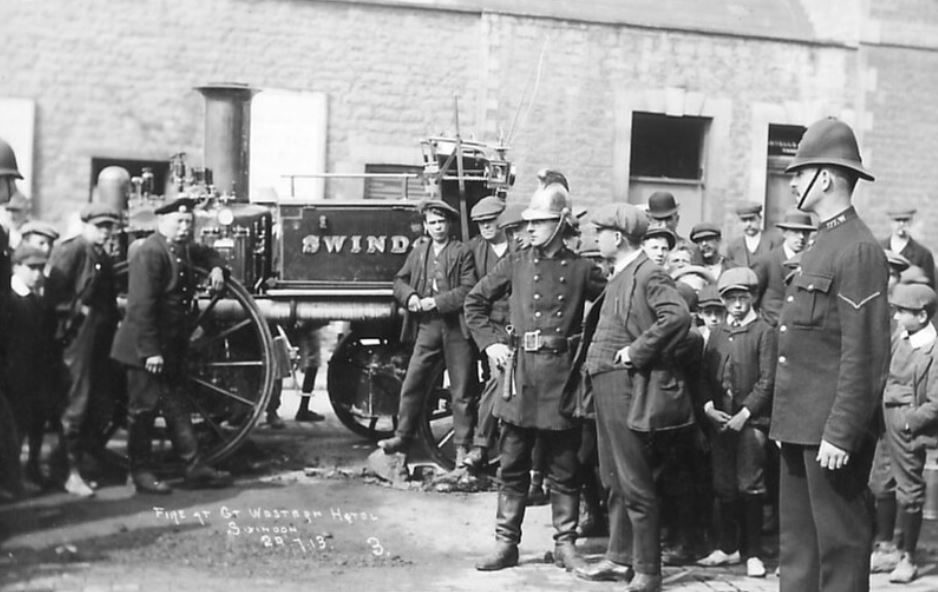
I remember Mr Maidment. He attended the fire at the Great Western Hotel garage. I’m one of the boys in the photograph. What a blaze that was. They thought it had been caused by the heat from the laundry next door.
The facts …
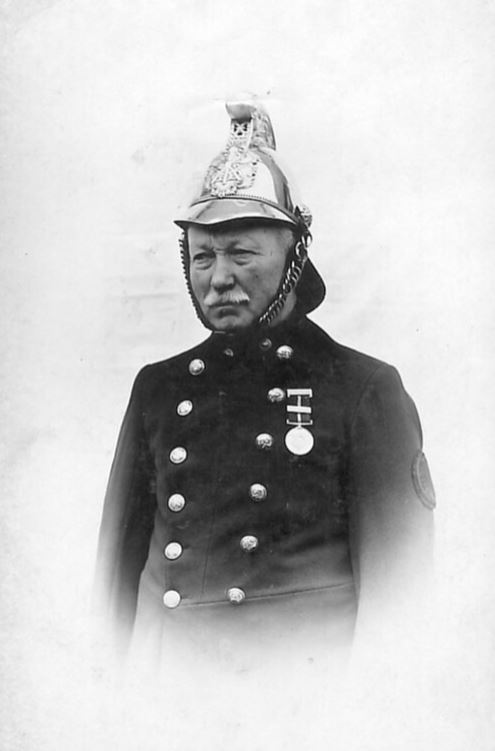
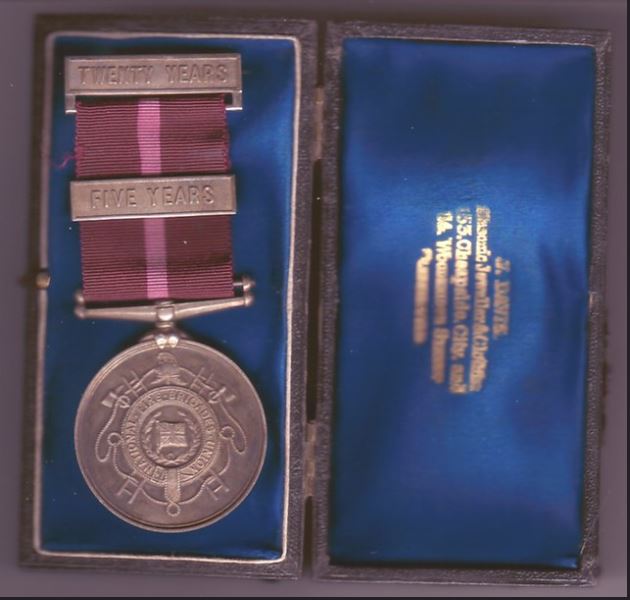
Sidney James Maidment is pictured proudly wearing his long service medal awarded for 25 years’ service in the Swindon Fire Brigade. Yet despite a funeral service attended by representatives from Swindon Corporation and the Fire Brigade, Sidney Maidment was buried in a public grave with three other unrelated people.
Theatre Tragedy
Swindon Attendant’s Sudden Death
Veteran Fireman
There was a tragic incident at the Empire Theatre, Swindon, on Monday evening. Mr Sidney James Maidment, of 2, Rolleston Street, had for the past 22 years acted as evening bar attendant, and he went to the Theatre as usual on Monday. He was seen to go into the circle bar, and was then apparently in his usual health. Some ten minutes or a quarter of an hour later, Mr. R. Manners, son of Mr. Alfred Manners, had occasion to go to the bar. Noticing that the electric light had not been switched on, Mr Manners opened the door and went in, and was startled to find Maidment lying motionless on the floor. Apparently deceased had fallen down on entering the bar, and he lay there lifeless. Death is attributed to heart failure.
A doctor was summoned, but life was extinct, and the body was removed on the borough ambulance to deceased’s home. He had been at home ill for several weeks, and only returned to his duties quite recently.
Deceased had been in the employ of the Swindon Corporation for many years as steam-roller driver, being the oldest driver. He was also for many years a member of the Swindon Fire Brigade, holding the position of engineer. He was a member of the Brigade before it was taken over by the Corporation, and in the old days he used to drive the horses when the engine was conveyed by that means to outbreaks of fire.
Deceased, who was 65 years of age, was a widower, his wife having died some years ago. He leaves a grown-up family of two sons and three daughters. There was no inquest, as deceased had been attended by Dr. Rattray.
The Funeral
The remains of the late Mr Maidment were laid to rest yesterday afternoon amid very impressive scenes. The Swindon fire engine was used as a hearse, and the brigade turned out in practically full force, under Capt. Baker. Many of the deceased’s colleagues, who served in the brigade with him were present to pay a last tribute. There were numerous wreaths, which were placed on the coffin and on the engine. Large crowds lined the route from Rolleston street to St. Paul’s Church.
The cortege was met at the church by the Vicar (the Rev. Alan Leslie), who conducted the service. Afterwards the procession was reformed and made its way to the Cemetery, where the curate of St. Paul’s (the Rev N.S. Willis) performed the last rites.
The mourners were: Mr Sidney W. Maidment and Stanley G. Maidment (sons), Misses Kate E. Maidment, Gladys Maidment, and Maud Maidment (daughters), Mr. H. Boreham, Mrs M.G. Maidment, Mrs. S.G. Maidment, Mrs Oakley, Mrs Titchener, Mr. W. Oakley, Mr and Mrs Anger, Mr Trevor Matthews, Councillor H.R. Hustings, and representatives of the Empire Theatre staff and of the High Street and Prospect Working Men’s clubs. Messrs J.J. Hamp and J. Boulton also attended at the graveside to pay a tribute of respect to an old employee of the Corporation. Past members of the Fire Brigade present included ex-Captains Reeves and Cox, and ex-Firemen Wiltshire, Ludlow, Eden, Woolford, and Hinton. The bearers were Firemen Frampton, W. Smith, and Ludlow, and Engineer Rogers.
North Wilts Herald, Friday, October 31, 1924.
Sidney James Maidment pictured left attending the fire at the Great Western Hotel in 1913. Image published courtesy of P.A. Williams Local Studies, Swindon Central Library.
Sidney James Maidment’s long service medal published courtesy of P.A. Williams, Local Studies, Swindon Central Library.


 Radnor Street Cemetery