The following article was published in Swindon Heritage Magazine in the Summer 2015 edition. Swindon Heritage was co founded by Graham Carter, Mark Sutton and myself in 2013. During a five year period we produced 20 editions of the magazine plus a Battle of Britain 75th anniversary commemorative issue in 2015.
Sadly, Mark died in 2022, but his work to remember the Swindon men who served in the First World War continues at Radnor Street Cemetery.
A memorial to 19 Swindon men who died during the First World War might also have been lost forever – but for the diligence of Gorse Hill resident Paul Jevder.
Paul, who lives in St Paul’s Road, put out an appeal for the impressive marble memorial to be given an appropriate new home after he found it under a pile of rubbish on his property.
He had been clearing the ground in preparation for some building work when he made the discovery.
Swindon Heritage co-founder Mark Sutton was the first caller to answer Paul’s appeal, and dozens of other people also phoned, some looking for more information, but many recommending that Paul get in contact with Mark.
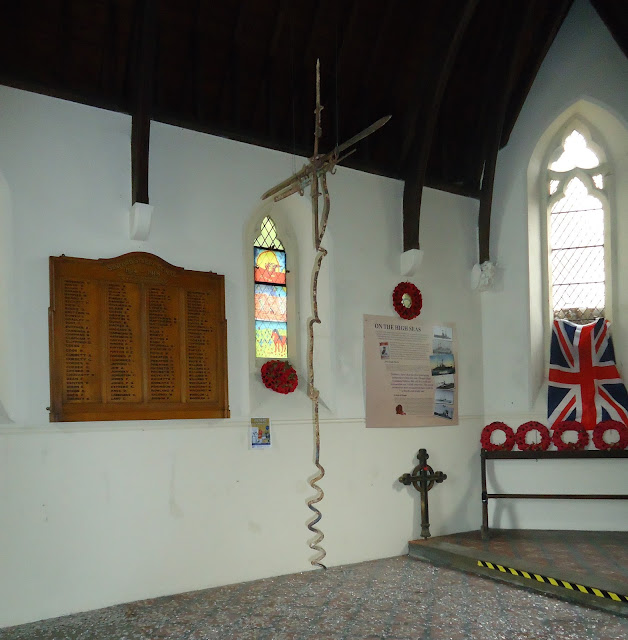
Within hours the memorial had been loaded into a van and moved to the chapel at Radnor Street Cemetery, which is already the home of several other memorials to the town’s war dead, including another from Gorse Hill. That one commemorates members of the working men’s club, although none of the names are duplicated.
It seems Gorse Hill folk were particularly keen to remember the area’s heroes because St Barnabas Church also has its own war memorial, made of wood, inside the church.
The newly found memorial is dedicated to the memory of former members of a ‘sabbath school’ who died in the war – and this was almost certainly attached to the former Wesleyan Chapel in Cricklade Road, because that building backs on to Paul’s property.
The chapel, along with associated land, has been earmarked for development into flats, and it is thought the memorial, which is slightly chipped but otherwise in good condition, may have become displaced during work to prepare for that.
Thanks to his extensive research into Swindon’s military history, all the names listed on the memorial are familiar to Mark Sutton, who also owns medals and photographs associated with many of them including the ‘dead man’s penny’ (officially called a memorial plaque) that was issued to the family of Walter Thatcher after his death.
Walter, who lived at 4 King Edward Terrace in Gorse Hill, joined the Wiltshire Yeomanry in 1915, aged just 18, and ended up on the Western Front.
As with most of the Yeomanry, he was absorbed into the 6th Wiltshire Regiment, and was sadly killed on the Bapaume-Cambrai Road on March 23, 1918, during the big German offensives of that year.
He has no known grave, but is remembered on the Arras Memorial.
Two of Walter’s brothers also served.
Mark’s researches over the years also traced a photograph of another of those on the Gorse Hill memorial, Augustus Strange, who lived at 199 Cricklade Road, a stone’s throw from where the memorial was found.
Serving with the Royal Engineers, Augustus died two weeks before the end of the war, on October 29, 1918.
“It was nice to be able to tell Paul about some of the men listed,” said Mark, “including one, Sidney Curtis, who lived in the house opposite Paul’s.
“We’re really grateful to him for making sure it has been recovered and seeing it went to a proper home.
“It will now be safe at in Radnor Street, and anybody will be able to come and see it from time to time as the cemetery chapel is sometimes open for events, and during this summer is the meeting place for guided walks we are running on the second Sunday of every month.”
And Paul, who lived in Cyprus as a child and whose family are Turkish Cypriots, will have understood the relevance of a war memorial, having witnessed, at first hand, the bitter division of the island in 1974.
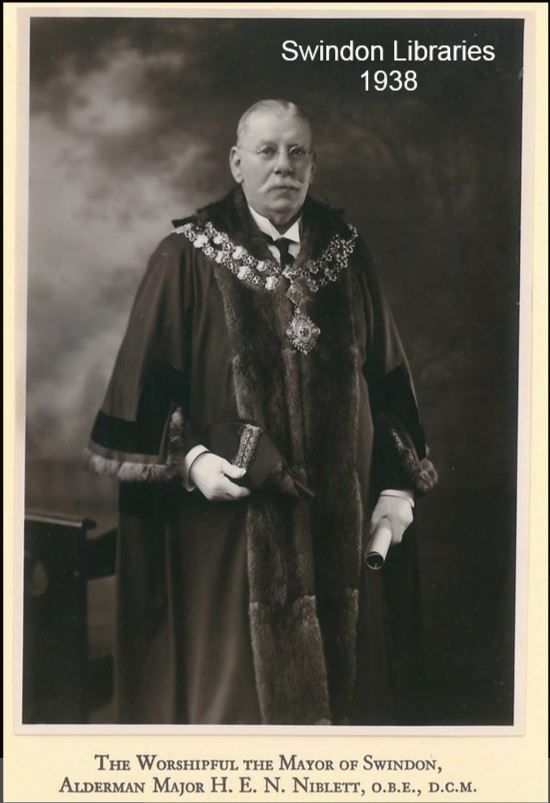
Sometimes I come across such a detailed obituary there seems little I could add to the subject’s life history. Not wishing to rewrite this fulsome account, here is the story of Major Henry Edward Newton Niblett – Mayor of Swindon 1937-38.
Death of Major H.E.N. Niblett
A Fine Record of Public and Military Service
Major H.E.N. Niblett, gallant soldier, an ex-Mayor of Swindon, friend of the poor and the blind, and lover of children, died early on Saturday at the age of 78. He had been ill for just about a month.
Though prominent in many spheres of public and social life in Swindon – and he proved his ability as a local administrator on the Town Council – he was first and last a soldier.
He disliked fuss and show, although he was a stickler for conformity to established rules and proper observance of traditional ceremonial.
He never wanted praise. He disliked it. In fact, it was his last wish that there should be no flowers, no mourning, and no paeans of praise – he knew well that they so often lack sincerity.
He leaves a widow, two sons and two daughters. The sons are Mr A.H. Niblett, who was disabled in the Great War, and Mr R.N. Niblett who lives at Stratton. The daughters are Mrs B.H. Brewer, of Stratton, and Mrs D. Tasker of Andover.
26 Years in India
Born in September, 1861, Major Niblett entered the Army when 22 years of age and remained in the service until April, 1912. During this time he spent 26 years in India and was recalled at the outbreak of war in 1914. It was on 29 May, `920, that he retired with the rank of Major.
His military life was a varied and distinctive one. He served in the Nile Expedition 1884-85 with a Camel Corps and was present at the relief of Gordon.
From 1895 to 1898 inclusive, he was on the Indian frontier and served throughout the Great War.
His honours and medals make a formidable list. They comprise the OBE (military) awarded at the end of the Great War, Distinguished Conduct Medal awarded in 1885; Egyptian medal with bars for Nile, 1884-85, Abou Klea; Indian frontier with bars for Chitral, 1895, Punjab frontier 1897-98, and Tirah.
In the Great War he saw a deal of service in Mesopotamia, where he remained from 1916-1920. His distinctions in this connection comprise two medals with Palms. He also had the Indian Coronation medal 1912, the Good Conduct Medal, Meritorious Service Medal and the Khedive’s Star 1884-85. On four occasions he was mentioned in despatches – once from Egypt in 1885, again from the Indian frontier in 1898, and twice during the Great War.
Masonic Honours
Equally imposing were his honours in Freemasonry and which were: P.M. Lodge, “St. John 486 E.C.,” Calcutta, 1896; D.G.S.B. Bengal, 1896, Royal Arch; P.Z. Holy Zion, Calcutta, 1898, D.G.D.C., Bengal, 1898, also member of Mark Masters and Ark Lodges; founder of first lodge in Baghdad, Iraq.
His early days were spent at Minchinhampton Common and in London. He was in Ireland on eviction and protection duty during the boycott trouble in 1882.
He was a member of the Swindon Town Council for nearly 14 years. Mayor of Swindon 1937-1938, it was during his term of office that the Duke of Gloucester opened the new Civic offices.
One of the oldest and most popular members of Ashford-road club, Major Niblett did work of immense value among the poor, the blind, and the children of the town. He took a keen interest in the hospital, the carnival, and ex-Servicemen, and was an active worked for “The Swindon Advertiser” Poor Kiddies’ Outing.
Major Niblett will be sadly missed and widespread sympathy goes out to Mrs. Niblett, who does much good work in the town, and to her family.
The Funeral
Friends, neighbours, and representatives of various local organisations, attended the funeral on Wednesday.
He was buried with military honours. His coffin, carried on a gun carriage drawn by an Army tractor, was enshrouded with the Union Jack, and bore only one floral tribute – that of a cross shaped wreath of lilies. Six Army Warrant Officers acted as bearers. The service was held at St. Saviour’s Church, Ashford-road, Swindon, and the interment was at Radnor-street Cemetery. The Rev. J.F. Tickner officiated. At the graveside, a bugler played the Last Post and Reveille.
Family mourners were: Mrs. S.J. Niblett (widow); Mr A.H. Niblett (elder son); Mr R.N. Niblett (younger son); Mrs. D. Tasker (elder daughter); Mrs. B.H. Brewer (younger daughter); Mrs N. Boulton (sister-in-law); Mr B.H. Brewer (son-in-law); Mrs R.N. Niblett (daughter-in-law); Miss J. Niblett (grandchild); Miss D. Boulton (niece).
Public Mourners
Representing the Swindon Town Council were: The Mayor (Counc. H.R. Hustings); Messrs. T.C. Newman, J. Belcher, H.H. Wheeler, F.E. Allen, T. Manning, F.E. Drinkwater, A.J. Gray, A. Snow, C. Macpherson. G.H. Hunt, L. Dodson, Mrs May George, D. Murray John (Town Clerk).
The Swindon Conservative Association were represented by: Sir Noel Arkell, and Mr. P. Smith. Representing the Swindon branch of the British Legion were: Lieut.-Col. B.L. Birley, DSO. Messrs R.W. Rice, W.H. Marshall, H.C. Preater, and Corporal Smith.
The Swindon branch of the South African War Veterans’ Association: Messrs. H. Warman, J. Stanton, G. Payton, F. Little, and P. Scott. The Old Contemptibles’ Association: Mr JA. Cresswell and E.M. Ockwell. The local Blind Association by R.L. Robins (president) and Petty Officer J. Walters, of the Royal Navy; Mr K.N. Knapp (Swindon and North Wilts Victoria Hospital); Mrs McGregor Johnson (Women’s branch of the Swindon Conservation Association).
Representing the Junior Imperial League of the Constitutional Association were Messrs. Coun. C.W.J. Streetly, W. Gregory, Mr and Mrs James, and Mr Fred Bishop. Ashford Club: Messrs G. Cottrell and A. Collins. Representing the Gloucestershire Regiment Association was Mr T. Twitchell.
The Mayoress, Mrs H.R. Hustings, and Mrs D. Murray John represented the local branch of the NSPCC.
Among numerous other mourners were: Mr C.A. Plaister, Mr H. Watkins, Mr T.J. Gay, Mr W.H. Masters, Mr H. Baker, Mr W. Clark, Mr G. Hays, Mr W.J. Mantell, Mr D.W. Jones, W. Seaward, C. Parkhouse, W.O. Lavington, F. Pointer, Sergeant-Major T.F. Culley, Mrs. A.C. Booth and Major A. Wingfield.
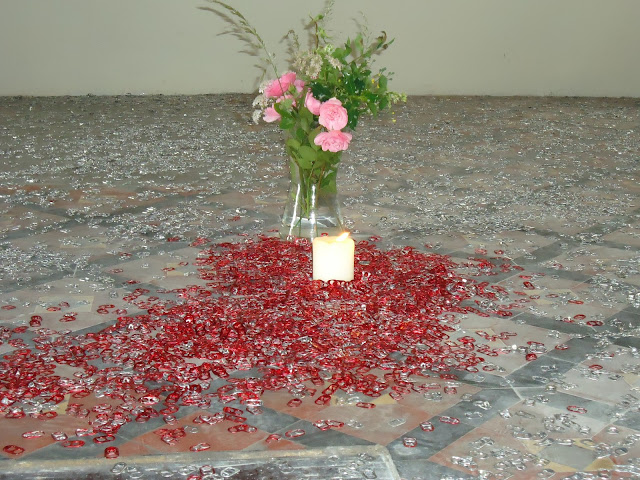
At the centenary of the First World War a number of commemorative events were held at Radnor Street Cemetery. On July 1, 2016 Dr Mike Pringle kept a vigil in the cemetery chapel with an art installation he had created called The Sword of Damocles. The can ring pulls scattered on the chapel floor represent the lives lost that day in 1916.
Many words have been written about July 1, 1916, the first day of what would later be called the Battle of the Somme. As we continue to remember the fallen of that battle, I am going to let the photographs of one man’s memorial speak for itself.
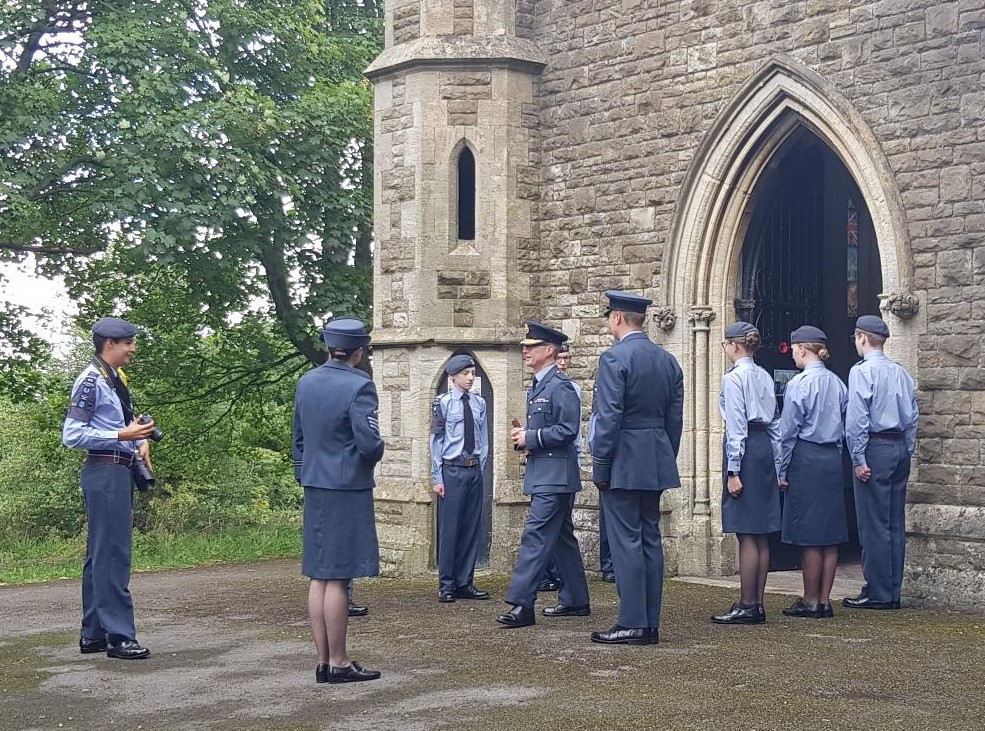
The rain clouds parted and the sun made a plucky appearance during our guided walk yesterday when we were delighted to welcome Air Commodore Tony Keeling OBE, Commandant Royal Air Force Air Cadets, to Radnor Street Cemetery.
Following the closure of the RAFA Club in Belle Vue Road the propeller mounted on the front of the building faced an uncertain future. Then a group of concerned Swindonians, among them Carole and David Bent, Neil Robinson, Toby Robson and Graham Carter, stepped in to rescue it.
At Sunday’s event Air Commodore Keeling cut the ribbon and led the assembled visitors into the chapel to view the propeller, now mounted above the door. Cemetery volunteer Kevin, a member of the Eyes On Hands On team, gave an informative talk about the history of the Airspeed Oxford to a packed chapel, as you can see from Andy’s photographs. Then, accompanied by fellow officers and air cadets, Air Commodore Keeling joined us on our walk.
Guest speaker, Paul Gentleman, gave an account of the career of Wing Commander John Starr who is remembered on his brother’s (Squadron Leader Harold Starr) grave. Paul and his wife Caroline along with Noel Beauchamp have been researching the life and times of the two Starr brothers for several years. Paul, Caroline and Noel, in association with Green Rook and Swindon Heritage, organised the Swindon Remembers event to commemorate the Battle of Britain 75th anniversary held in the cemetery in 2015.
Our visitors at Sunday’s event donated generously to the memorial plaque for Mark Sutton. This will be unveiled at the Remembrance Day Service, an event Mark established many years ago.
Here are some photos of the day captured by Andy and myself.
Swindon certainly pushed the boat out when King George V and Queen Mary came to town. The streets were all decorated and the people turned out in their thousands, cheering and waving their handkerchiefs as the royal car travelled down Regent Street.
The King’s first port of call on that April day in 1924 was to lay a wreath at the cenotaph, a gesture that gained him the respect of even the most anti royalist for the King was not that popular in some quarters so soon after the Great War. But not in our family – we were Royalists through and through – and after that visit in 1924 people used to call my Pops ‘Your Majesty.’
The Royal couple visited the Victoria Hospital and the Medical Fund building, but the highlight of the day for us was their tour of the Railway Works. I was working in the Carriage and Wagon Works, making luggage rack netting and we knew the Queen was going to be brought around. I don’t think I have ever been so nervous in all my life. She stood right behind me, watching me work. She smelt lovely, lilies of the valley. I didn’t dare look round, even when I heard her say ‘what nimble fingers you have young lady.’
But the star of our family show was my Pops, George Bayliss. Some 75 old railwaymen who had worked for the GWR for more than 50 years were introduced to the King and Queen that day and the King actually spoke to my Pops. It was all there, published in the Adver. He asked him how old he was – “I am 69, your Majesty, and I have had 58 years’ service,” to which the King replied “I hope to be as good a man as you are when I am your age.”
Afterwards a photograph was taken to commemorate the occasion. You can’t miss my Pops, sitting in the front row in his spotless white ducks, the white jacket and trousers worn by railwaymen in the old days. Pops took it all in his stride, but for me it was the proudest day of my life. The Queen admired my work and my Pops got to talk to the King. I wish I had a copy of that photograph.
The facts …
George was born in 1855 in Newark on Trent, Nottinghamshire the son of John Bayliss, a boiler maker and his wife Hannah. By 1881 he was living in Swindon and lodging at 17 Harding Street with Samuel Shallcroft and his wife and two daughters. He was 25 years old and working as an engine fitter.
George married Henrietta Kirby in 1882 and at the time of the census in 1891 they were living at 14 Charles Street, Rodbourne with their children William, Frederick, Walter, Lilian, Mabel and Edith. A seventh child, Beatrice May was born in 1893.
By 1901 the family had moved to 189 Rodbourne Lane, George’s home until his death in December 1926 aged 71 years old. George Bayliss was buried on December 11, 1926 in plot D760.
The home of George Bayliss in Rodbourne Road
The couple were non conformists and had children baptised on the Highworth Primitive Methodist Circuit and the Regent Primitive Methodist Circuit. George would no doubt have been happy to be buried in Radnor Street Cemetery where the burial ground was unconsecrated and the cemetery chapel non denominational.
Swindon Advertiser.
“He (Bayliss) is one of the old brigade and was conspicuous by the fact that he wore the old time white jacket and trousers. Though not worn nowadays, Mr Bayliss will not discard the old style and has a clean suit every week. His Majesty chatted with him for a few minutes and said to him “I hope to be as good a man as you are when I am your age.”
The photograph titled Swindon Works Veterans Inspected by Their Majesties the King and Queen on April 28th 1924 is published courtesy of Local Studies, Swindon Central Library, although the general consensus is that this is probably not the original. Carefully examination has revealed a couple of super imposed images, presumably those of men unable to attend on the day.
This article was written by Graham Carter, Swindon Advertiser columnist, and published in the Autumn 2016 edition of the Swindon Heritage Magazine.
Milton Road Baths published courtesy of Local Studies, Swindon Central Library.
Grandpa, the man who saved the Medical Fund
Swindon’s GWR Medical Fund was famously a blueprint for the National Health Service when it was introduced in 1948, but what is often overlooked is the crisis that seemed destined to destroy the organisation during the First World War.
And while the name of George W. Brunger isn’t often remembered as one of the visionaries of a railway town with a health service more than a century ahead of its time, as chairman for 29 years and its last, then he deserves a special place in Swindon’s history.
And George’s granddaughter, Maggie, along with her elder brother Alan, who spent hours recording ‘Grandpa’s’ oral memoirs’ before his death in 1964, have been piecing together the family history.
It tells of how George, who had previously only been an ordinary member of the Medical Fund, stumbled on a crisis meeting at Milton Road Baths – now the Health Hydro – and took control of its destiny.
“Grandpa was returning home from a union meeting in London,” said Maggie. “After disembarking from the train in Swindon, he was walking home when he heard a commotion coming from the Medical Fund building, and decided to go in.”
Formed in 1847, the Medical Fund provided a comprehensive ‘cradle to grave’ service and operated its own hospital, but exactly a century ago, in the last weeks of 1916 faced a huge dilemma because of the First World War.
Many local men were occupied with the Railway Works’ contribution to the war effort, George himself working as a fitter in AE Shop, making heaving guns. But many of the town’s men were away on active service, so subscriptions were critically low, and the crisis meeting was called to find solutions for an organisation that had exhausted its credit at the bank, so its cheques for doctors’ salaries were bouncing.
With the management committee and members arguing over a proposal to increase subscription rates, the closure of the Medical Fund altogether was a very real prospect.
“Grandpa entered the meeting, which was in uproar, and pointed out that they would stay there all night and still not get anywhere. So he suggested that a special committee be appointed to investigate their problems, and report back to members.
“His motion was passed unanimously, with seven people nominated; and Grandpa was the seventh.”
After a few weeks’ deliberation, the special committee reported in February 1917, in a hall that was packed to overflowing.
Surprisingly, it recommended only a penny-a-week increase in subscriptions, rather than the threepence suggested by the management committee, whose view was backed up by the Medical Fund’s lawyer.
When the members overwhelmingly supported the penny plan, it was effectively a vote of no confidence in the management committee, and most of them resigned.
George felt obliged to stand for election to the new committee of 15, and after the man he proposed as chairman refused the post, he put himself forward, and was elected.
Then aged 35, he would remain chairman until the Medical Fund was dissolved to make way for the introduction of the National Health in 1948, apart from when he took a year off and was vice-chairman in 1924.
In interviews with his grandson, Alan, in later years, he revealed that many of the ideas adopted by the Medical Fund during his time as chairman were his own.
Aneurin Bevan, the Minister of Health who was in charge of introducing the NHS, naturally interviewed George during visits to see how the Swindon model worked, and they must have had discussions about the handling of doctors, which was a key issue when the NHS was eventually formed.
A major cause of the Medical Fund’s financial problems were the huge salaries commanded by the three senior doctors they employed who were based at Park House in the Railway Village. George’s novel solution was actually to increase the salaries of junior doctors, while slashing those of the senior ones, including Dr Swinhoe, at the top of the pyramid.
His dealings with the Medical Fund inevitably brought George into contact – but also conflict – with management.
As a humble fitter – his union activities prevented him from progressing up the managerial ladder – he found himself in meetings with the railway company’s Swindon top-brass, but stood his ground.
He was once ordered to remove his hat when meeting FW Hawksworth, but told the Chief Mechanical Engineer: “I haven’t come here to undress!”
George had come from humble beginnings, but showed himself to be a committed and fearless young man.
Born in Maidstone in 1881, when he was 17 he lied about his age, claiming to be 18, so he could enlist in the Royal Engineers.
He quickly found himself in South Africa with the outbreak of the Boer War, the following year, and, apart from a long spell recovering from dysentery, fought much of the campaign, receiving clasps on his medals from six key battles, including the reliefs of Mafeking and Ladysmith.
After the war he stayed in South Africa to work in the diamond-mining boom, but returned to Britain in 1906, and soon married a local Maidstone girl Lillian Price.
They were married on Boxing Day 1906, but instead of honeymooning, after the ceremony they took the train to Swindon to begin a new life.
Arriving at 9.30pm, with snow on the ground, they walked from the railway station to their lodgings in Rodbourne, with a canary in a cage among the wedding presents they carried with them.
They later set up a permanent home at 40 Kingshill Road.
Always a union man, and an official for the Amalgamated Engineering Union (now the AUEW), George was also one of the founders of the Labour Party in Swindon, and served the party on the Town Council from 1919 to 1932.
As Chairman of the Housing Sub-committee in 1922 he oversaw the building of Swindon’s first (and one of the country’s first) council housing estates, at Pinehurst.
Such was the demand for houses that the queue of people outside the Brungers’ home in Kingshill, applying directly to George to move them up the list, led to the family calling the front room ‘the office’.
“He would have been mayor,” said Maggie, who lives in the United States but has been on an extended visit to her home town. “But my grandmother, who was very retiring, wouldn’t have it.”
He retired from both the Railway Works and the Medical Fund in 1947.
Maggie was 16 when he died, and missed the funeral because she was taking O Level exams on the day. Remarkably, his death occurred the day after Maggie’s brother Alan left Swindon to emigrate to Canada.
“He was a lovely old man,” said Maggie. “And of course to me he was always an old man. He was not a big talker, but he was well respected.
“I remember his black leather boots, which he kept by the fireplace, his red hair and his big hands. Every time I go up the beautiful stairs in the Health Hydro, I like to think of him grasping the rails.”
These days the committee room where George presided is often empty, while the smaller of the building’s two swimming pools is also closed, perhaps permanently.
The building was once a jewel in Swindon’s crown, and says as much about the vision and approach of Swindon’s leaders in past times – men like George Brunger – as the Mechanics’ Institute.
With its washing baths, swimming baths and even Turkish and Russian baths, it represented arguably the best leisure facilities enjoyed by any British workers at the time, as well as the medical facilities and services also available to members of the Medical Fund and their families.
But the building faces an uncertain future, just as it did, exactly a century ago, when destiny brought George Brunger, with perfect timing, to its doors.
Graham Carter
George Brunger died at St Margaret’s Hospital in June 1964 and is buried in grave plot C956, which he shares with his wife Lillian who died in 1955.
George William Brunger
Swindon Heritage was a quarterly local history magazine co-founded by Graham Carter, the late Mark Sutton and myself and was published from 2013-2017. Back copies are still available at the Swindon Library Shop, Swindon Central Library and at the cemetery chapel during our guided walks.
On our guided cemetery walks I frequently speak about the wartime work of Swindon’s women, in particular Elsie Wootten White, a Swindon school teacher who was a member of the Swindon Prisoners of War Committee during the First World War. However, this was only part of the White family’s war story.
Edwin Gordon White was born in Swindon in 1892 and baptised at St. Mark’s Church on March 12. He was the son of Frank James, a machineman in the Works, and Susan White and with his parents and sister Elsie lived at 29 Guppy Street, Rodbourne.
By the time of the 1911 census Susan was widowed and living with Elsie and Edwin at 61 Graham Street, the last home Edwin would know. Aged 19 Edwin worked as Laboratory Assistant and part time student in Swindon’s secondary school.
Unfortunately Edwin’s military records do not survive, but we do know that he was awarded the Military Cross, a medal granted in recognition of an act or acts of exemplary gallantry during active operations against the enemy on land.
The citation was published in the Wiltshire Times on Saturday October 5, 1918 – five months after his death.
Conspicuous Gallantry
Wiltshire Officers Decorated
The King has been pleased to approve the Military Cross to the undermentioned in recognition of their gallantry and devotion to duty in the field:-
T./Lt. (A./Capt.) Edwin Gordon White Wilts Regt.
For conspicuous gallantry and devotion to duty during a raid. Though badly wounded, he continued to direct operations as long as possible, thus greatly adding to the spirit and moral of his platoon. His personal reconnaissance work, carried out for five days before the raid with the greatest keenness and untiring energy, greatly added to the success of the operation.
The Wiltshire Times, Saturday, October 5, 1918.
Edwin died of wounds on May 7, 1918. He was 26 years old and is buried at Montecchio Precalcino Communal Cemetery Extension in Italy. The inscription on his headstone reads:
Only son of Mrs S. White
Ever in the thoughts of those who loved him RIP
He is also remembered on his mother and sister’s headstone in Radnor Street Cemetery.
The newspaper article provides a pretty comprehensive account of William’s service. His military records reveal that he enlisted in the 4th Wilts on September 14, 1914 aged 46 and served at home until January 2, 1916. On January 3, 1916, having transferred to the 22nd Wessex & Welsh Btn the Rifle Brigade, he was sent to the Western Front where he served for 325 days. On November 24, 1916, he was posted to Salonika where he served for 1 year and 215 days before being posted home on June 27, 1918, having previously transferred to the Royal Engineers.
William was discharged on August 10, 1918 as being no longer physically fit for War Service. He was 49 years and 11 months old and suffering from valvular disease of the heart (VDH).
He was awarded a weekly pension of 27 shillings for four weeks after which it dropped to just over 13 shillings, to be renewed after 48 weeks.
William had previously worked for more than twenty years as a Rivetter’s Holder Up in the GWR Works, a physically demanding job that he was now no longer strong enough to do.
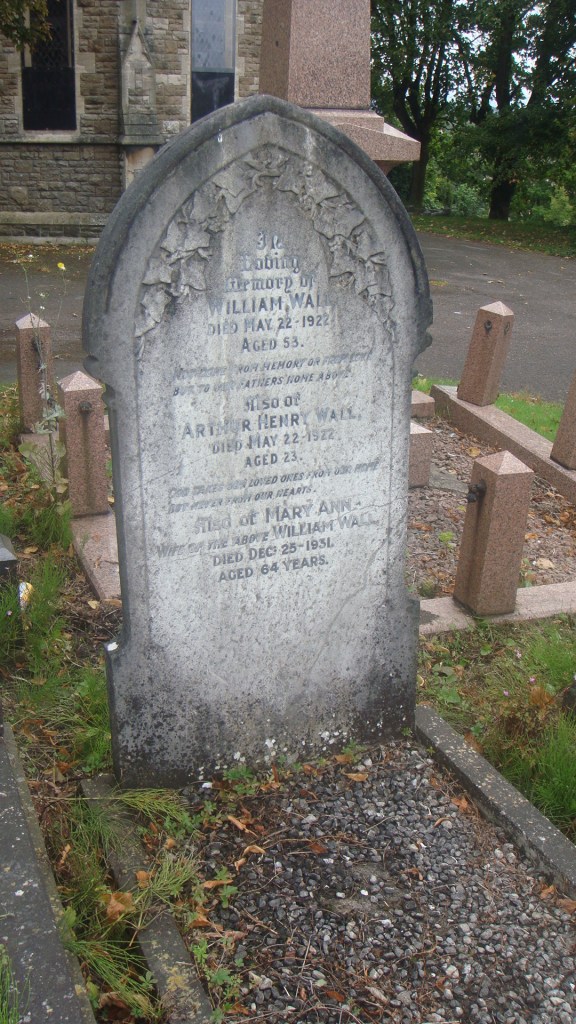
William died on May 22, 1922 just hours before his son Arthur also died.
When Arthur Henry Wall enlisted at the Devizes recruitment office he stated that he was 19 years old and worked as a boilermaker. In fact he was only 16 years old and two years below the minimum age for enlistment.
He served a period of 140 days from January 12, 1915 to May 31, 1915 at home but on June 1, 1916 was posted to France, aged 17. However, on July 10 Arthur’s true age was detected and he was sent back to England as ‘underage and physically unfit for service.’
He spent the next year posted in England but on June 28, 1916 he returned to France and served more than 300 days. By now serving with the Bedfordshires, Arthur was gassed on May 12, 1918 and ten days later returned to England.
On November 23, 1918, he was discharged suffering from Defective Vision, Dyspnoea (a symptom of aortic insufficiency) and headache.
He was awarded a pension of 11 shillings a week from November 24, 1918 to be reviewed in 26 weeks’ time. In 1920, by now a married man, Arthur wrote to the Record Officer of the Bedfordshire Regiment asking if he could apply for further money under the Army Order 325/19 but was informed that only soldiers serving from the date of the pay increase on September 13, 1919 were entitled.
Like his father, Arthur also died of heart disease, a direct result of his military service.
United in Death
Father and Son Buried at the Same Time
The burial of a father and a son who died on the same day took place at Radnor Street Cemetery, Swindon. The deceased were Mr William Wall, 35 Linslade Street, Swindon, and his son, Mr Arthur Henry Wall, 36 Jennings Street. Both had served in the war, and their death was directly attributable to the hardships endured on active service. The father, who was 53 years of age, served in the Army for 12 years, and during the war he was in Egypt, Greece, Serbia and Italy – first with the Wilts Regiment then the Rifle Brigade and was later attached to the Royal Engineers. In August, 1918 he was discharged as unfit for further service. His death occurred on May 22nd, just a few hours before his son passed away.
The latter was 23 years of age. When only 16 he joined the Wilts Regiment, and was later transferred to the Bedfords, and then to the 1st Herts. He saw service in France and Belgium, and was badly gassed in May, 1918. In November of the same year he was discharged.
It is a pathetic fact that although he did not know his father was so ill he had a sort of premonition that they would die at the same time, and expressed a wish that they might be buried together.
Wiltshire Times and Trowbridge Advertiser June 17, 1922.
Father and son were buried in plot E8206 where Mary Ann, William’s wife and Arthur’s mother, joined them following her death in 1931.
If you are wondering why they do not have a Commonwealth War Graves Commission headstone it is because their deaths occurred after August 31, 1921 the date on which the First World War officially ended.
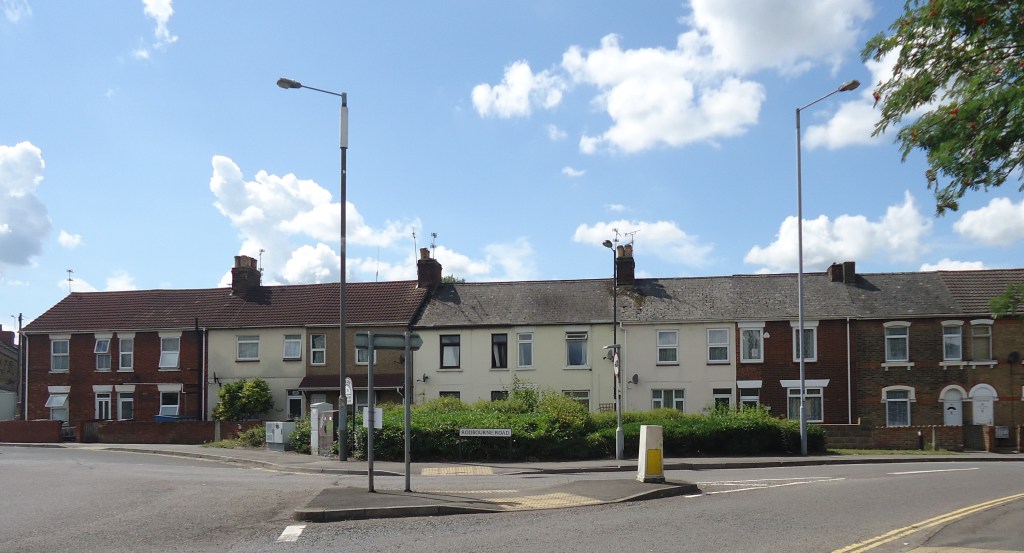
The houses in Medgbury Road looked exactly like ours in Derby. I don’t know why I was surprised. We were exchanging a home in a northern railway town for one in Wiltshire, of course there would be similarities. I just didn’t take account of how many there would be though.
The old canal ran alongside Medgbury Road, silted up and no longer in use, while row upon row of red brick terrace houses stretched back to the railway line.
We were moving to Swindon to make a new start. I don’t know how we thought that would be possible. To begin with we had a kind of excitement, but I soon realised we lacked imagination. Perhaps it was the grief. We were no different to anyone else; how could we have ever thought it would be otherwise?
Every household, every family had someone employed in the railway works and in 1920 everyone had been touched by four long years of war.
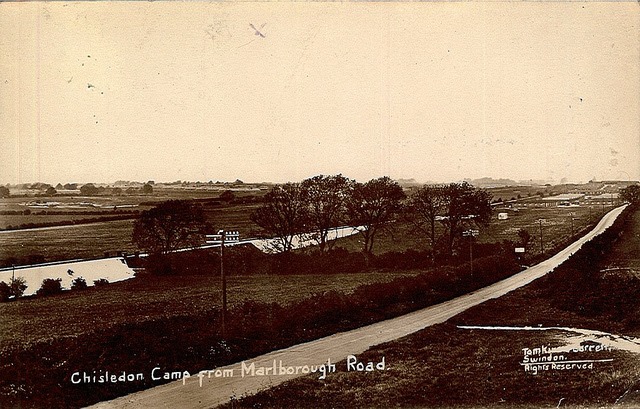
When my new neighbour told me about the Chiseldon Camp accident it felt as if it had happened just yesterday, so intense was her grief.
“We knew them all. You did in a street like this. Watched them grow up, start school, start work,” she said. “It was the Easter weekend, the year after the war ended. The boys were off to Liddington Castle for the day. They took a few sandwiches and some pop. It was all so innocent. Just a day out in the country. A few games with their friends.
“One of the boys suggested walking over to the practise trenches at the Chiseldon Camp. They split into two groups and just seven of the boys chose to go on to the Military Camp.
“Albert Townsend watched his mate Fred pick up something that looked like a rolling pin, and roll it down a bank,” she pulled a handkerchief from her apron pocket. “Three of the boys were killed outright, only one of the seven escaped injury.”
There was talk of setting up a memorial in the cemetery, she told me, raising a public subscription, but people just didn’t have the money in those first years after the war. There were already a growing number of memorials appearing across the town commemorating too many dead. But the boys’ story would long be remembered and the mothers of Medgbury Road would never forget.
We lived in Medgbury Road for a year and then we moved back to Derby. How did we ever think we could forget? Why would we want to?
The facts …
The funeral of Frederick Cosway 14, Frederick Rawlinson also 14 and 13-year-old Stanley Palmer, the adopted son of Elizabeth and Henry Holt, took place on April 24 1919 and wasattended by what was described as ‘an immense throng’ of people.
The funeral procession started from the boys’ homes along a route lined with spectators and proceeded to the Central Mission Hall in Clarence Street. The congregation numbered approximately 800 with many more standing outside the hall.
The report of the funeral continued:
“Two of the coffins were conveyed in shillibiers and the third on a handbier. There was a great profusion of flowers. The chief mourners followed in carriages. They included the parents and other relatives of the deceased lads. Between 30 and 40 lads, companions of the deceased, followed on foot.
As the procession wended its way to the Cemetery rain commenced falling heavily, but it proved to be a storm of short duration. The interment took place in the Cemetery in the presence of several thousand spectators, and the service, which was conducted by Pastor Spargo, will long be remembered by all who took part.”
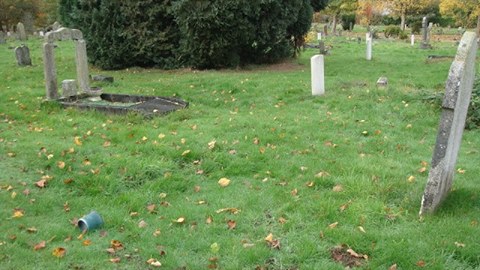
The three boys were buried together in plot C728. Today there is no memorial to mark the spot.
‘He woke up gently, sliding smoothly into a new day. It wasn’t usually like this. Sometimes he woke up with a jolt, ready to jump out of bed, as if he could. Sometimes he suddenly found himself awake, his heart beating rapidly, his breath coming in gasps. Sometimes he just lay there, eyes open, awake, absent. But today felt different. Today he turned over in bed and snuggled down beneath the blankets.
The bedroom was cold. He’d known colder. He’d known bone aching cold when every joint was immobilised, every muscle mortified. But he liked this cold. It reminded him of childhood. Ice on the inside of the window; a house full of noise, children getting ready for school, his father already at work.
“Charlie are you up yet?” he was always the last one, reluctant to leave his bed.
Today his mother tapped softly on the bedroom door; checking if he was awake, checking if he was alive. He understood her dilemma. Should she wake him or should she let him sleep on?
“Morning Ma,” he called.
The door opened.
“Cuppa tea boy.”
Nearly 37 years old but he would always be her boy. When he was a child he had to share her, but now she was his alone; making up for lost time.
His father hadn’t recognised him when he opened the door of 60 Stafford Street. Four years as a prisoner of war had altered him immeasurably. But as the cold January air swept around him and into the house she knew it was her boy returned. She had never given up hope.
Today he felt a little better, a little stronger. Today he would take a slow walk into town. He would call in at the Town Hall and sign the register of returning soldiers. He hoped Miss Handley might be there. He would so like to see her, say thank you for the food parcels that had kept the prisoners of war alive’.
The facts …
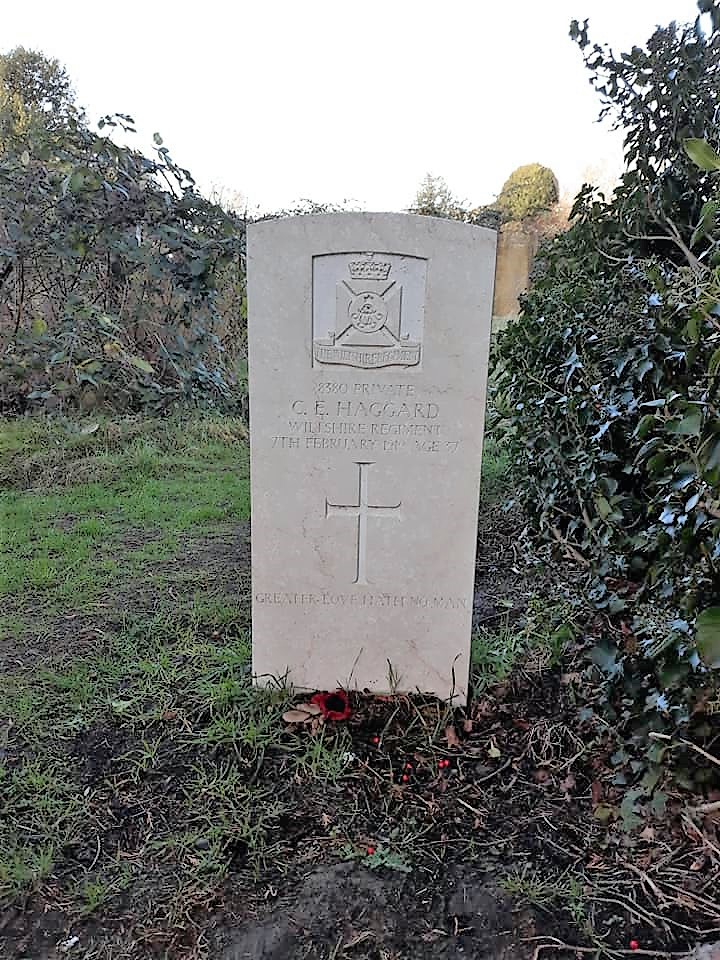
Charles Haggard was born April 30, 1882 at the Old Red Lion Inn in Minety where his father Samuel was the innkeeper. His parents were in their early 20s and already had four children, George, Alice, Kate and Thomas.
By 1901 the family had moved to 60 Stafford Street, Swindon and on the census returns for that year 18-year-old Charles described himself as a Steam Engine Tender Maker, Fitter & Turner – of course he still had two years left to serve of his apprenticeship.
By 1911 he had left a life ‘inside’ (which is how everyone referred to working in the railway factory) and joined the army where he served as a Private in the 1st Wiltshire Regiment. Charles was taken prisoner on October 24, 1914 at the Battle of Mons and was held prisoner at Krossen-on-Order for the duration of the war.
On February 7, 1919 Charles spent the day in Shrivenham visiting friends. He arrived back in Swindon sometime between 9 and 10 pm where he met his father in Manchester Road.
At the inquest Charles’s father said his son seemed very cheerful as they began the walk home to Stafford Street.
When they reached Deacon Street Charles called out “Wait a minute, dad,” and went to catch hold of the palisading, but fell backwards. His father knew he was dead.
Mr A.L. Forrester, Coroner for North Wilts, held an inquest at St Saviour’s Schools, Ashford Road, Swindon where Dr Beatty testified that he had made a post mortem examination of the body and found athroma of the valves of the heart. The cause of death was aortic disease of the heart, a condition worsened by starvation and exposure during his time as a prisoner of war. Charles had been home less than three weeks.
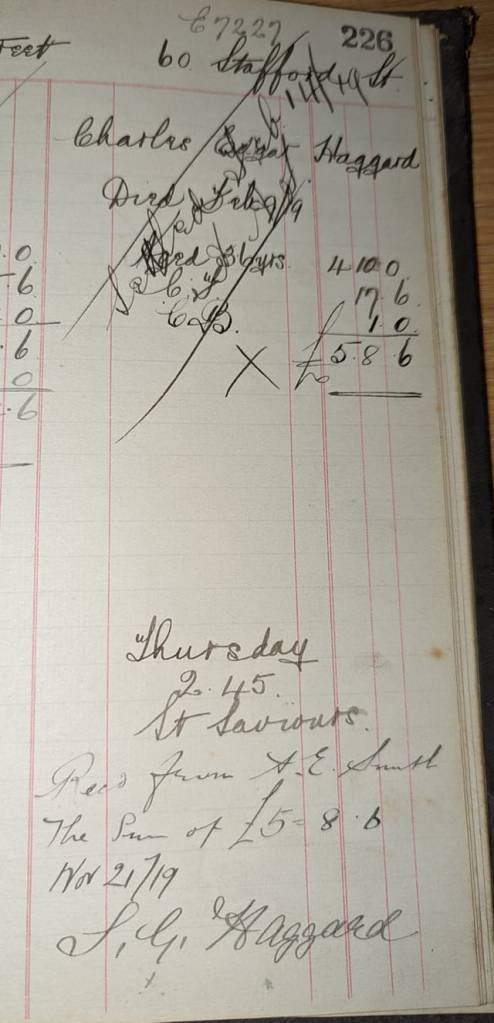
He is buried in plot E7227 with his brothers George and Thomas.
Image of funeral account provided by A.E. Smith & Son, Funeral Directors







 Radnor Street Cemetery