Charles and Millicent Blackford of Poulton Street, Gorse Hill

This is the last resting place of Charles and Millicent Blackford.

Charles Herbert Blackford was born on August 8, 1898 in Malmesbury, one of wheelwright and carpenter Daniel Blackford, and his wife Kate’s four children. Millicent was born in Polperro, Cornwall on January 5, 1897, the daughter of fisherman Richard Libby and his wife Ellen.

Charles enlisted with the Royal Naval Reserve in 1916 and served for three years during the First World War. Upon demobilisation Charles joined the GWR. Using the UK Railway Employment Records it is possible to follow Charles’ career on the railways.

He began work as an engine cleaner in January 1919 before quickly becoming a fireman. An entry dated December 14 1920 records that he was making the fire upon engine 3412 when his hand was pinned against a piece of coal. Top of middle finger on his right hand was crushed.

By 1939 Charles was working as a temporary Acting Driver at Didcot, after which he worked as a driver in Swindon. During the Second World War he was working as a temporary Relief Supervisor.

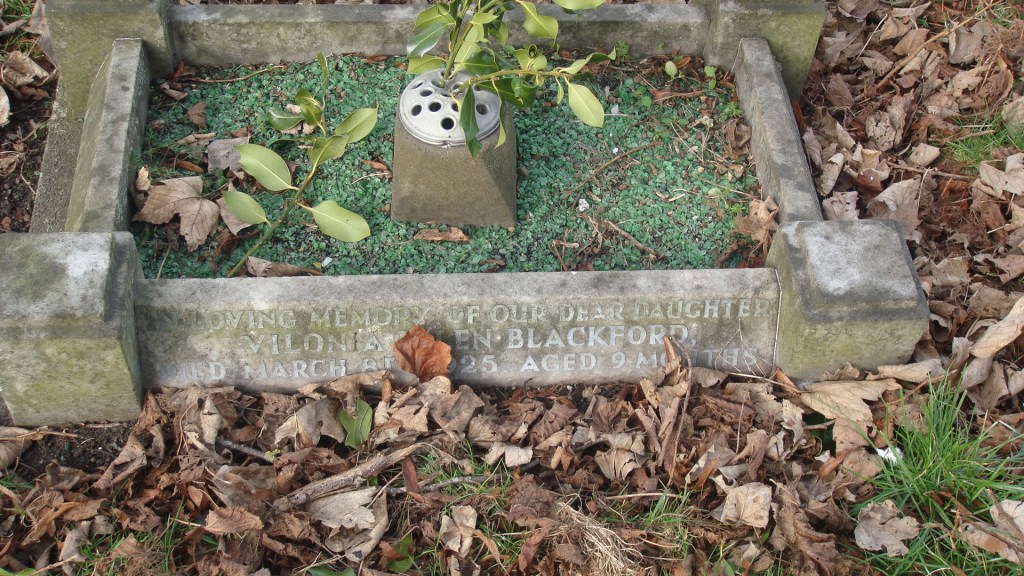
Charles married Millicent Libby in the June quarter of 1923 and the couple had two children, Vilonia and Royston. Vilonia died in infancy. Royston followed his father into the railway works as a coach finisher. Charles and Millicent lived at 23 Poulton Street, Gorse Hill until the time of Charles’ death in 1962. (Millicent may have remained at that address after his death.)
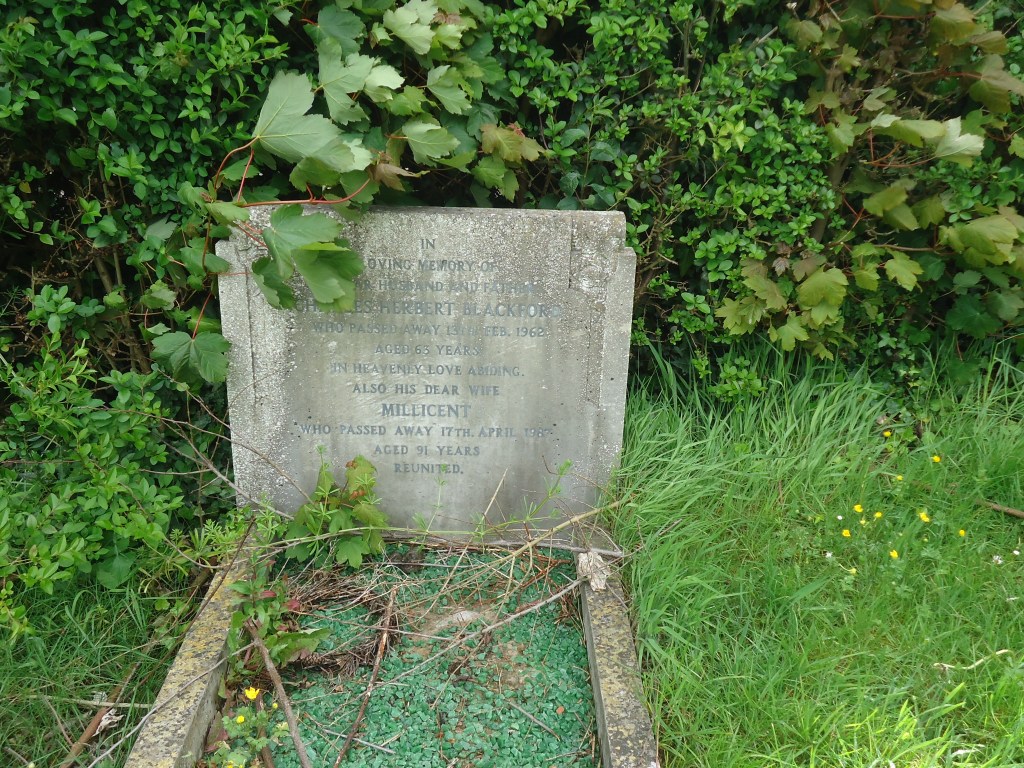
Charles died in February 1962. Millicent survived him by 25 years. She died in 1987 at the age of 91. They are buried together in grave plot C3351-0. This area of the cemetery has experienced some renumbering of the plots, but Charles and Millicent’s grave has an elegant headstone and is easy to find.

The burial of infants depended very much on the parent’s financial situation.  In the past some babies were buried in a family plot, their names added to the memorial at a later date. Others were placed in a communal grave with other babies. Vilonia is buried in this beautiful little grave, close to the path leading to the cemetery chapel.
Heber Cox – a new life of opportunity

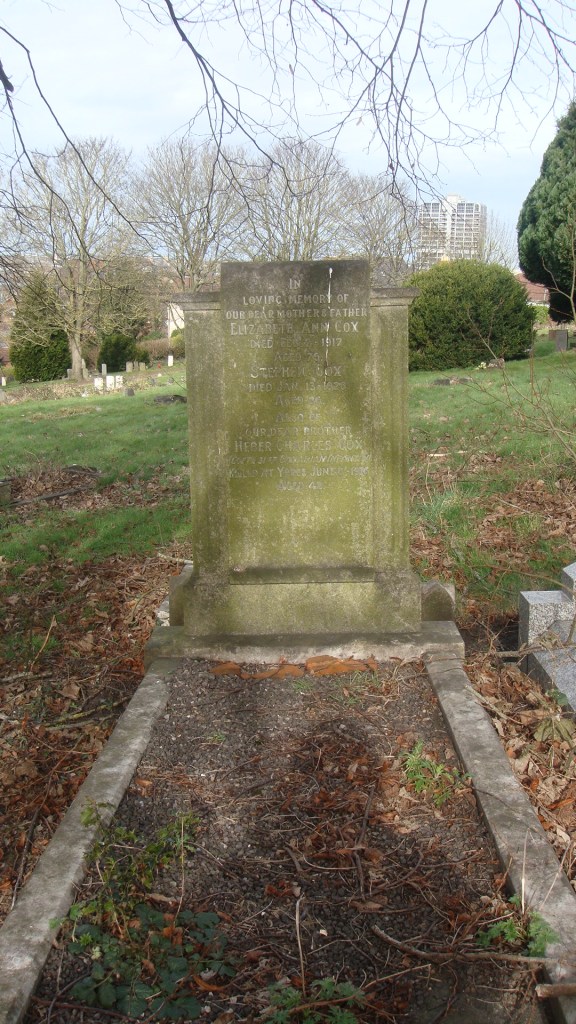
This is the final resting place of Stephen and Elizabeth Cox.  Elizabeth died in 1917 and Stephen in 1926.

Stephen was born in Aldbourne and Elizabeth in Marlborough but by 1871 they had moved to Swindon and between the years 1871 to at least 1881 they managed a beer house in Queen Street.

At the time of the 1891 census Stephen was farming at The Wharf in Stratton with the help of his son Heber.  When Stephen retired the couple moved to 32 Guppy Street in Rodbourne where they were living in 1901.

In 1908 Heber set sail upon the Sardinia, bound for Canada.  On the ships schedule Heber, then aged 34, describes himself as a farmer and states his ultimate destination as Calgary, all set, no doubt for a new life of opportunity.

But on November 14, 1914 and by then aged 40 and still single, Heber enlisted with the Canadian Overseas Expeditionary Force.  He served in the 31st Canadian Infantry and was killed in action at Ypres on June 6, 1916.  His name is mentioned on the Menin Gate memorial and here in Radnor Street on his parents’ headstone.

Private Frederick William Darling

Unfortunately Frederick William Darling’s military records have not survived. We do know, however, that he served with the Royal Army Ordnance Corps in France during the First World War. The RAOC was responsible for supplying weapons, ammunition and equipment to the British Army. It has to be asked if his wartime experiences contributed to the state of his mental health and the onset of neurasthenia.

Neurasthenia is described as an ill-defined medical condition characterized by lassitude, fatigue, headache, and irritability, associated chiefly with emotional disturbance.

Frederick was born on March 22, 1888 the son of Richard and Louisa Darling and baptised at St. Marks Church on April 16. Frederick William was one of eight children and grew up in Horsell Street. His father worked as a blacksmith in the GWR Works as did Frederick and his elder brother Charles.

Frederick married Ella F. Wills at the church of the Holy Apostles, Charlton Kings, Gloucester on August 1, 1921. The couple later moved to Cardiff where Frederick died on September 2, 1927.

Cardiff Man’s End

Neurasthenic Poisoned By Gas

Dr R.J. Smith, the Cardiff Coroner, on Monday enquired into the death of Frederick William Darling (39), a blacksmith, who was found dead near a gas oven. Darling had suffered for two years with neurasthenia, and his widow, Mrs Ella Fanny Darling, informed the Coroner that he was in Whitchurch Mental Hospital last May, but was discharged on probation in July, when he seemed much better. During the war he served with the Royal Army Ordnance Corps.

Cecil Elder deposed to finding Darling in a house at Bloom Street, Canton, Cardiff and Dr. Pittard said death was due to coal gas poisoning.

A note left by Darling, addressed to his mother, read: “Don’t worry; I cannot live this life any longer.”

The Coroner returned a verdict of “Suicide while of unsound mind,” and expressed sympathy with the relatives.

Frederick was buried on September 7, 1927 in grave plot C1889. He is buried with his parents Richard, who died in 1926 and Louisa who died in 1945.

Arthur Lancelot Darling was Frederick’s younger brother. He was born on June 14, 1894. Aged 16 he was working as a machineman in the Works.

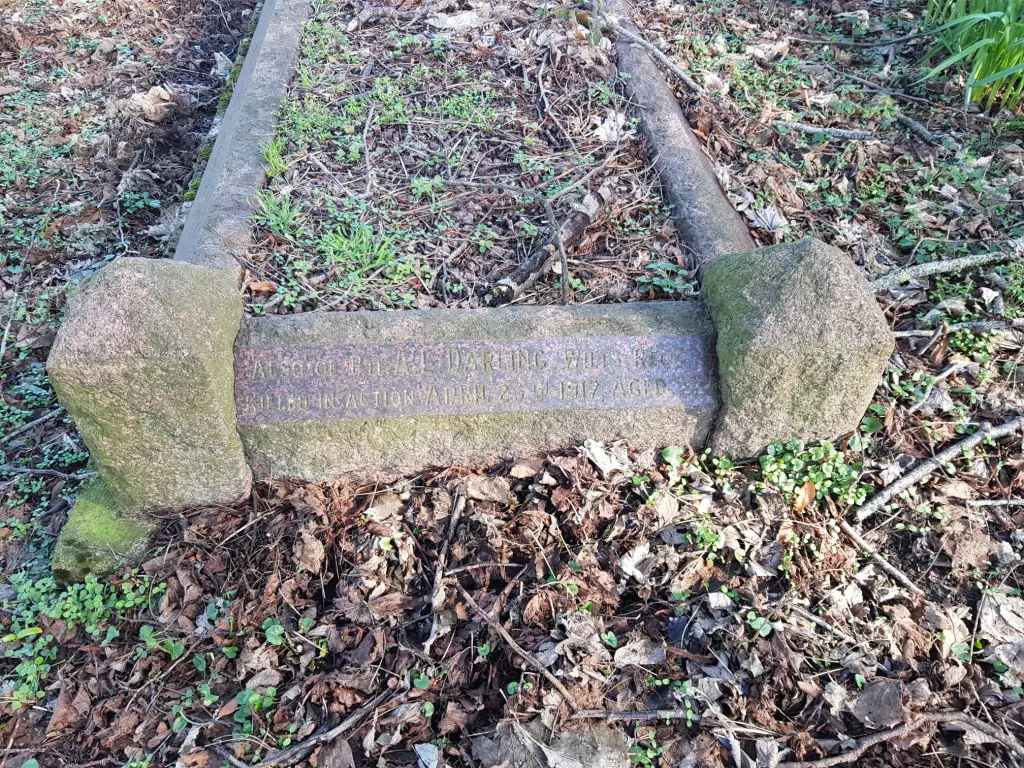
Arthur served in the 7th Battalion of the Wiltshire Regiment and was killed in action in Salonika on April 24, 1917. He was 22 years old. There was no body to bury – he was presumed dead. Arthur is commemorated on the Dorian Memorial in Greece and on his parent’s grave in Radnor Street Cemetery.

Stoker Tom Pictor

Tom Pictor was the eldest of John and Emma Pictor’s seven children. He was baptised at St. Mark’s Church on September 1, 1878 and grew up in the Westcott Place/Rushey Platt area where his father worked variously as a timber yard labourer, a railway labourer and a railway watchman.

Tom joined the navy on January 1, 1895 for a period of 12 years. By 1901 22 year old Tom was working as a steamship stoker. His naval records state that his date of birth was July 26, 1876, although his baptismal records and the census returns suggest he might have been two years younger than this. A physical description states Tom was 5ft 5½ ins tall with dark hair and a dark complexion, hazel eyes and tattooed rings on his fingers. In 1907 he joined the Royal Fleet Reserve from which he was discharged on January 8, 1912, declared medically unfit. However, he re-joined the RFR twelve months later.

Tom served on a number of ships including Vivid II, the Stokers and Engine Room Artificers School based at Devonport. The last ship on which Tom served was HMS Teutonic. Built for the White Star Line in Belfast in 1887 and launched in 1889, the Teutonic was one of the first armed merchant cruisers. The Teutonic served as an ocean liner travelling between Liverpool and New York City but reverted back to military use during times of war. During the Boer War, HMS Teutonic served as a troop transport ship and in 1914 it served as a convoy escort and troop transport ship. It was while the ship was berthed in Liverpool dock in December 1915 that Tom’s fatal accident occurred. His records indicate that during 1915 Tom served three periods of detention for being absent without leave.

Drowning Coincidence

Under somewhat similar circumstances two men employed on Government vessels whilst lying in the Canada Dock fell into the water on different dates and died from the effects of immersion. Inquests were held today.

In the first case the deceased man was Tom Pictor (44), a stoker, whose mother resides at Swindon. On Saturday night Pictor, when stepping from the gangway on to the ship slipped backwards and fell into the water and was drowned.

The second case was that concerning Thomas Henry Evans, aged 47, greaser in the Royal Navy, who belonged to Southampton. On the night of the 18th he was going on board his ship when he fell into the Canada Dock. He was rescued, and taken to hospital, where he died on Saturday from pneumonia.

“Death from drowning” was the verdict in each case.

The Liverpool Echo, Monday, December 6, 1915.

Tom Pictor was buried on December 9, 1915 in grave plot B1812, a public grave, which he shares with two others. The burial registers indicate he was 37 years old.

Pte. William Henry Thomas – art student

What did the future have in store for William Henry Thomas? It could have been so different. His mother Amy died in 1903. She at least was spared the horror of the First World War. The last time Henry saw his son he was an art student.

William Henry Thomas was born in 1888, the only son of Henry William and Amy Thomas and baptised at St Paul’s Church on March 25. He grew up at The Eagle Hotel where his father was licensed victualler. The Eagle stood on the corner of Regent Street and College Street and was demolished during the redevelopment of the area.

Read more about the Eagle here.

A Swindon Soldier’s Death

The distressing news is to hand of the death – killed in action on May 25th – of Pte. William Henry Thomas, of the H.A.C. He was the only son of Mr H.W. Thomas, of 63 Bath Road, Swindon, and was 29 years of age. Previous to joining the Army, about 18 months ago, Pte. Thomas had been studying art in London. He had been at the front since November last.

North Wilts Herald, Friday, June 1, 1917.

Until 9 April 1917, the Allied front line ran practically through the village of St. Laurent-Blangy. The trench (known to the Germans as Mindel Trench and called in 1918 McLaren Trench) was taken by the 9th (Scottish) Division on 9 April 1917, and the cemetery was made by the side of the trench after the battle. It was used by fighting units and field ambulances until September 1918, and was at times called Stirling Camp and St. Laurent-Blangy Forward Cemetery. Mindel Trench British Cemetery contains 191 burials of the First World War, nine of which are unidentified. The cemetery was designed by N A Rew.

From the Commonwealth War Graves website.

Thomas W.H. William Henry

Private 5116 A Company 1st Battalion

Honourable Artillery Company

Died of Wounds 25 May 1917 29 years old

Son of H.W. and Amy Thomas of 63 Bath Road

C24 Midel Trench British Cemetery St Laurent Blangy

One of the bells in Christ Church was bought by his father in memory of him in 1923.

Tell Them of Us by Mark Sutton

Radnor Street Cemetery volunteers

This Thursday morning you are likely to find members of the Radnor Street Cemetery volunteers busy in the cemetery. Here are a few words from Kevin explaining some of the work the volunteers undertake.

‘There are currently seven volunteers working in Radnor Street Cemetery. These include Jon, Jonathan, Brian, Pauline, Val, Jo and myself.

We are volunteering in an official capacity for the CWGC as part of their Eyes On Hands On project. The Commission is responsible for 103 plots at the cemetery, 90 WWI and 13 WWII, of these there are 101 Commonwealth and 12 private. Basically, it is up to us to look after these plots and feedback any concerns to the Commission such as illegibility, damage, unsafe leaning etc.

We are authorised to softly clean the Commonwealth headstones, using just water and brushes, and carry out light weeding, grass trimming etc. For the private memorials we should only carry out only light weeding and not clean the headstones, but feed back to the Commission.

Of the casualties at the cemetery a lot of them died from illness, but there are also those who died in accidents or more sadly those who took their own lives often following the horrors they had experienced.

We have recently been photographing all of the headstones and memorials for the Commission website. The Commission now try and include photographs on their casualty database, which people can search.

Outside of the Commission’s responsibility there are also many private family plots at the cemetery that we have come across that make reference to loved family members lost during the two wars.

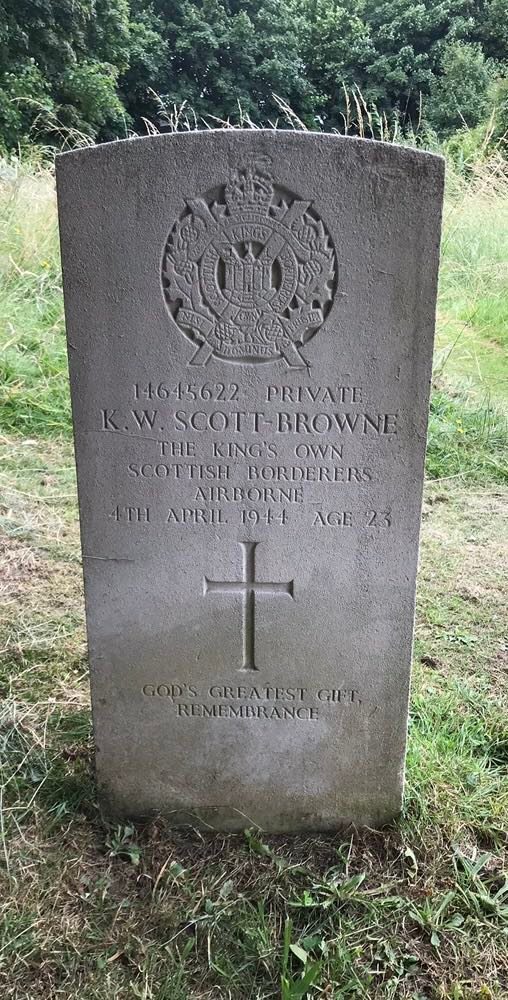
The first two images show a little bit about the Eyes On Hands On project. The next photo is a private plot commemorating 2nd Lt W.S. Hunter, Royal West Kent Regiment. The second photo is a Commonwealth headstone marking the grave of Pte K.W. Scott-Browne, sadly killed in a flying accident whilst training for D Day. The last photo is a family grave for Mildred Cook, commemorating her husband Hubert James Cook, killed in action during WWI.’

Read more about the work of the Commonwealth War Graves Commission here.

The aspirational Percival Seymour Scott

The re-imagined story …

When I was growing up in Swindon there was a ‘can do’ atmosphere in the town. If you wanted to make something of your life you could, yes even those from disadvantaged families.

From the very early days Swindon was an ambitious town with a self belief that permeated all aspects of life. It was taught in the schools and colleges; preached in the churches and chapels and honed and forged in the Works.

It was said an apprenticeship in the Works was the hallmark of excellence and recognised across the world.

Take George and Eliza Scott’s boy. He grew up in Ashford Road, one of the many roads of ubiquitous red brick terrace houses that crept up Kingshill, but what an exciting life he led. They must have been so proud of him. I’m sure they would say it was worth all the sacrifices they made.

The facts …

George Albert Scott and Eliza Seymour were married in the Providence Baptist Chapel on July 9, 1892. George was 26 and worked as an Engine Fitter and Turner in the GWR Works. He was born in Bristol in 1866 and first appears in Swindon on the 1881 census living with his mother Caroline and stepfather Charles Jefferies at 10 Queen Street. Aged 15 years old, George had already begun an apprenticeship as an engine fitter.

Eliza was born in Lechlade in 1871. In 1891, the year before her marriage, Eliza was living with her parents at 124 Stafford Street. Her father John was a grocer and Eliza worked as a dressmaker.

The newlyweds set up home in Ashford Road where the family would live for more than 70 years. They had three children, Percival born in 1896, Ivy in 1898 and Gwendoline in 1906. The 1911 census records the couple’s only son Percival 15, was a part time student whilst working as an Office Boy in the Works.

In 1915 Percival joined the Royal Navy for the duration of hostilities (the First World War). His naval records describe him as 6ft ½ ins tall with black hair, brown eyes and a dark complexion. At the beginning of 1918 he transferred to the newly created RAF. 

In 1920 Percival married Elsie Holbrow, the daughter of another railwayman Samuel Holbrow and his wife Minnie. The following year Percival’s name appears on the Ship’s Register of the SS Highland Glen bound for South America where Elsie would join him at their home in Buenos Aires, Argentina.

The couple apparently made return visits to Swindon and are recorded as passengers on the Asturias in 1926, their destination 47 Deacon Street (the home of Elsie’s parents), their permanent residence Argentina. They were too late to see Percival’s mother Eliza who died in 1922.

Elsie died in Buenos Aires just three years later on January 29, 1929 aged 32. Her details are recorded on her parents’ headstone.

George Scott married for a second time in 1924. He died in 1928 aged 62 years and was buried with his first wife Eliza in Radnor Street Cemetery plot E7492. His second wife Margaret died in 1973 and was buried in the same grave.

Percival remained in South America until at least the 1960s when he is recorded as living in Peru but he died closer to Swindon at his home The Hermitage, Combeland Road in Minehead on November 5, 1979.

Ernest Abraham Rivers and a home fit for heroes – Tell Them of Us

And then there were those who came back – to a home fit for heroes.

Ernest Abraham Rivers was born in 1882 the second youngest child of James and Elizabeth Rivers’ large family. Ernest worked as a bricklayer and builder and married Eliza Painter on August 5, 1903. Eliza was born in 1882, the middle child of John Painter and his wife Hannah. Ernest and Eliza went on to have their own large family; their eldest son George Rivers (sometimes known as Painter) was born on October 13 1902, ten months before they married.

The family lived at 23 Prospect Hill when the 1911 census reveals they had five children, George 8, Raymond 7, Lancelot 5, Avis 3 and six months old Edna. They would go on to have another four children – Eileen born in 1913, Myrtle in 1915, Winifred in 1916 and Eric who was born in the summer of 1918.

On August 4, 1914 Britain declared war on Germany and at the end of 1915 Ernest joined the Royal Engineers leaving a wife and seven children behind in Swindon. Unfortunately, his service records are incomplete but it seems unlikely that he ever saw service overseas. Following his attestation he was sent to the army reserve before being mobilised to the Royal Engineers Depot W. Lancs. It was here that he served for 1 year 108 days before being discharged as no longer physically fit for War Service, suffering from a prolapse rectum, apparently a pre-existing condition that dated back to 1913.

Ernest returned to Swindon and his job as a bricklayer but in 1918 tragedy hit the family with the death of Eliza aged just 37. She left behind nine children including a baby just a few months old.  There was no money for a private grave plot and Eliza was buried on November 13 in a public grave in Radnor Street Cemetery with four other unrelated people.

In 1939 war loomed large again. Ernest was living at 23 Prospect Hill with his two unmarried daughters. He had never remarried. That same year, youngest son Eric married Emily F. Gadd but sadly they would not have a happy ever after ending either. Gunner Eric Rivers, a member of the Field Rgt Royal Artillery, was killed on February 21, 1945. He was buried in Jonkerbos War Cemetery, Nijmegen Part 2, Belgium.

Ernest Abraham Rivers died in February 1951 aged 68. His last address was 23 Prospect Hill, the home he had shared with Eliza all those years ago. He was buried on February 24, 1951 in a public grave plot B1940, with four other unrelated people.

We continue to gather around the Cross of Sacrifice in Radnor Street Cemetery each Remembrance Day to remember those who sacrificed their lives in two world wars and those who died in more recent conflicts. And we remember those who returned but whose lives were never the same again – Tell Them of Us.

William Dorling Bavin – Swindon’s War Record

William Dorling Bavin wrote the definitive book recording the story of Swindon during the First World War. Commissioned by Swindon Borough Council and published in 1922 Bavin compiled a complete record of local activities, charitable and otherwise, in connection with the war. It is a book which has been the source material for so many others and to mark the centenary of the First World War a facsimile copy was published by Local Studies, Swindon Central Library and is available from the Library Shop.

W.D. Bavin was born in Lincoln in 1871 and spent his early career as an assistant tutor at Westminster Training College, London and later as an instructor of pupil teachers at Bath Technical College. In 1897 he was appointed the first head of the Swindon Pupil Teacher Centre for teachers at Swindon Board Schools.

His other appointments included head of Swindon Higher Grade Elementary School and headmaster of Sanford Street Boys School.

William D. Bavin married twice. His first wife Jessie died in 1915 and his second wife Helen in 1959. Bavin died in 1948 and is buried with both his wives.

Swindon J.P.

Death of Mr W.D. Bavin

After a short illness the death occurred in the Victoria Hospital this morning of Mr W.D. Bavin, aged 76, of 160 Goddard-avenue, Swindon a retired headmaster of Sanford-street Boys’ School.

Starting his career as a pupil teacher in 1889 at Lincoln he completed his training at Westminster Training College and was then engaged as a resident tutor.

Two and a half years later he took up an appointment at Bath Technical College as head of the pupil teachers’ centre department and was then appointed head of the Pupil Teachers’ Centre which opened in Swindon in 1897.

In 1903 he became head of the Swindon Higher Elementary School and in 1919 was transferred to the headmastership of Sanford-street Boys’ School when his elementary school was converted into a secondary school.

For some years he was the National Union of Teachers’ representative on the Education Committee and was vice-chairman of the Swindon Juvenile Employment Sub-Committee. He was also founder and chairman of the After-Care Committee.

His activities for youth had not been confined to school service however. He was founder and treasurer of the Swindon Triangle Boys’ Club, and for many years was the president of the local Sunday School Union.

Mr Bavin was also the author of various works on mathematics and local history and his record of Swindon’s part in the 1914-1918 war received compliments from universities in America, France, Scotland and Wales. He wrote two volumes on teaching for Sunday School teachers and since 1918 had written the annual Sunday School Union handbook.

He was a Borough magistrate

Swindon Advertiser January, 1948.

W.D. Bavin

The Richman brothers – Tell Them of Us

The re-imagined story …

The late Autumn sunshine glances across the cemetery. Everyone says how unseasonably warm it is this year. The Scouts who stood around the Cross of Sacrifice on Remembrance Day struggled in their uniforms. One little chap fainted. He hit the ground with such a thud. Never seen that happen before. November is usually a bleak month; the weather bitter, the memories more so.

I’ve walked past this grave so many times over the years, but do you know what, I can’t remember what once stood atop the memorial. Perhaps they placed an angel here after Isabel died. I wonder if her father ever got to meet his little daughter. Most probably it would have been a cross though, I think. What happened to it? Did it topple over during a winter storm?

The cemetery volunteers will be around in a little while. I see them most Thursdays. They do a fantastic job keeping the war graves clear. And not only the official ones but the monuments like this one, too. Today the distinctive feature about the dilapidated memorial is the inscription:

In Loving Memory of Private Alfred George Richman 5th Wilts Rgt Husband of F.E. Richman Died in Mesopotamia Feb 19, 1917 Aged 32.

Private Archibald David Richman Machine Gun Corps Died in France Feb 4th 1918 Aged 21 sons of D. & S.J. Richman.

I remember the Richman family like it was only yesterday. But can I remember what stood on the top of this monument? Perhaps it will come to me later.

The facts …

When David Richman completed the 1911 census returns he recorded that he and his wife Sarah Jane had been married 28 years. They had five children, all of whom were living. By the time of the next census in 1921 they had lost two sons.

In 1911 Alfred George Richman lived at 18 Plymouth Street. He was 26 years old and worked as a branch manager in a grocery store. He had been married to Frances Edith just under a year. They would go on to have three children, Kenneth and Raymond and little Isabel who was born in 1916 and died in 1917. In 1911 Archibald David was just 14 years old. He lived with his parents and his elder brother and younger sister at 10 St Margarets Road, working as a grocery apprentice alongside his father. Another elder brother Frank was also married. He worked as a railway clerk in the GWR Works and was married to Annie Mary. They lived at 86 Kent Road with their baby daughter Phyllis Irene.

Archibald David Richman is buried in the Hazebrouck Communal Cemetery, one of 877 Commonwealth burials of the First World War (17 of them unidentified).

Alfred George Richman is buried in Amara War Cemetery in modern day Iraq where his name is recorded on Panel No. 39 XXVII E.

Those buried in grave C1575E are Fanny Withey, Sarah Jane Richman’s sister. She died in January 1910 and her burial took place in Radnor Street Cemetery on January 31, 1910. Isabel Annie Richman is buried in the same plot. She was buried on March 14, 1917 the daughter of Alfred George and Frances Edith Richman. She was just 15 months old.