Major H.E.N. Niblett – A Fine Record of Public and Military Service

Sometimes I come across such a detailed obituary there seems little I could add to the subject’s life history. Not wishing to rewrite this fulsome account, here is the story of Major Henry Edward Newton Niblett – Mayor of Swindon 1937-38.
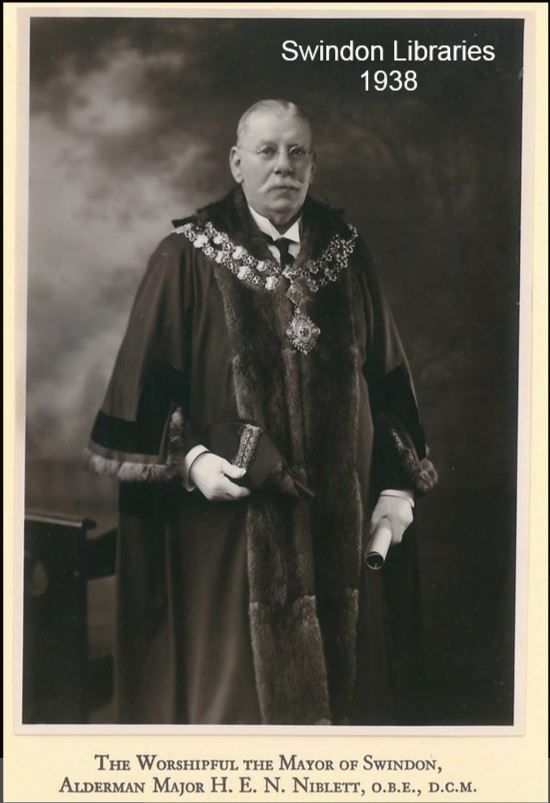
Death of Major H.E.N. Niblett

A Fine Record of Public and Military Service

Major H.E.N. Niblett, gallant soldier, an ex-Mayor of Swindon, friend of the poor and the blind, and lover of children, died early on Saturday at the age of 78. He had been ill for just about a month.

Though prominent in many spheres of public and social life in Swindon – and he proved his ability as a local administrator on the Town Council – he was first and last a soldier.

He disliked fuss and show, although he was a stickler for conformity to established rules and proper observance of traditional ceremonial.

He never wanted praise. He disliked it. In fact, it was his last wish that there should be no flowers, no mourning, and no paeans of praise – he knew well that they so often lack sincerity.

He leaves a widow, two sons and two daughters. The sons are Mr A.H. Niblett, who was disabled in the Great War, and Mr R.N. Niblett who lives at Stratton. The daughters are Mrs B.H. Brewer, of Stratton, and Mrs D. Tasker of Andover.

26 Years in India

Born in September, 1861, Major Niblett entered the Army when 22 years of age and remained in the service until April, 1912. During this time he spent 26 years in India and was recalled at the outbreak of war in 1914. It was on 29 May, `920, that he retired with the rank of Major.

His military life was a varied and distinctive one. He served in the Nile Expedition 1884-85 with a Camel Corps and was present at the relief of Gordon.

From 1895 to 1898 inclusive, he was on the Indian frontier and served throughout the Great War.

His honours and medals make a formidable list. They comprise the OBE (military) awarded at the end of the Great War, Distinguished Conduct Medal awarded in 1885; Egyptian medal with bars for Nile, 1884-85, Abou Klea; Indian frontier with bars for Chitral, 1895, Punjab frontier 1897-98, and Tirah.

In the Great War he saw a deal of service in Mesopotamia, where he remained from 1916-1920. His distinctions in this connection comprise two medals with Palms. He also had the Indian Coronation medal 1912, the Good Conduct Medal, Meritorious Service Medal and the Khedive’s Star 1884-85. On four occasions he was mentioned in despatches – once from Egypt in 1885, again from the Indian frontier in 1898, and twice during the Great War.

Masonic Honours

Equally imposing were his honours in Freemasonry and which were: P.M. Lodge, “St. John 486 E.C.,” Calcutta, 1896; D.G.S.B. Bengal, 1896, Royal Arch; P.Z. Holy Zion, Calcutta, 1898, D.G.D.C., Bengal, 1898, also member of Mark Masters and Ark Lodges; founder of first lodge in Baghdad, Iraq.

His early days were spent at Minchinhampton Common and in London. He was in Ireland on eviction and protection duty during the boycott trouble in 1882.

He was a member of the Swindon Town Council for nearly 14 years. Mayor of Swindon 1937-1938, it was during his term of office that the Duke of Gloucester opened the new Civic offices.

One of the oldest and most popular members of Ashford-road club, Major Niblett did work of immense value among the poor, the blind, and the children of the town. He took a keen interest in the hospital, the carnival, and ex-Servicemen, and was an active worked for “The Swindon Advertiser” Poor Kiddies’ Outing.

Major Niblett will be sadly missed and widespread sympathy goes out to Mrs. Niblett, who does much good work in the town, and to her family.

The Funeral

Friends, neighbours, and representatives of various local organisations, attended the funeral on Wednesday.

He was buried with military honours. His coffin, carried on a gun carriage drawn by an Army tractor, was enshrouded with the Union Jack, and bore only one floral tribute – that of a cross shaped wreath of lilies. Six Army Warrant Officers acted as bearers. The service was held at St. Saviour’s Church, Ashford-road, Swindon, and the interment was at Radnor-street Cemetery. The Rev. J.F. Tickner officiated. At the graveside, a bugler played the Last Post and Reveille.

Family mourners were: Mrs. S.J. Niblett (widow); Mr A.H. Niblett (elder son); Mr R.N. Niblett (younger son); Mrs. D. Tasker (elder daughter); Mrs. B.H. Brewer (younger daughter); Mrs N. Boulton (sister-in-law); Mr B.H. Brewer (son-in-law); Mrs R.N. Niblett (daughter-in-law); Miss J. Niblett (grandchild); Miss D. Boulton (niece).

Public Mourners

Representing the Swindon Town Council were: The Mayor (Counc. H.R. Hustings); Messrs. T.C. Newman, J. Belcher, H.H. Wheeler, F.E. Allen, T. Manning, F.E. Drinkwater, A.J. Gray, A. Snow, C. Macpherson. G.H. Hunt, L. Dodson, Mrs May George, D. Murray John (Town Clerk).

The Swindon Conservative Association were represented by: Sir Noel Arkell, and Mr. P. Smith. Representing the Swindon branch of the British Legion were: Lieut.-Col. B.L. Birley, DSO. Messrs R.W. Rice, W.H. Marshall, H.C. Preater, and Corporal Smith.

The Swindon branch of the South African War Veterans’ Association: Messrs. H. Warman, J. Stanton, G. Payton, F. Little, and P. Scott. The Old Contemptibles’ Association: Mr JA. Cresswell and E.M. Ockwell. The local Blind Association by R.L. Robins (president) and Petty Officer J. Walters, of the Royal Navy; Mr K.N. Knapp (Swindon and North Wilts Victoria Hospital); Mrs McGregor Johnson (Women’s branch of the Swindon Conservation Association).

Representing the Junior Imperial League of the Constitutional Association were Messrs. Coun. C.W.J. Streetly, W. Gregory, Mr and Mrs James, and Mr Fred Bishop. Ashford Club: Messrs G. Cottrell and A. Collins. Representing the Gloucestershire Regiment Association was Mr T. Twitchell.

The Mayoress, Mrs H.R. Hustings, and Mrs D. Murray John represented the local branch of the NSPCC.

Among numerous other mourners were: Mr C.A. Plaister, Mr H. Watkins, Mr T.J. Gay, Mr W.H. Masters, Mr H. Baker, Mr W. Clark, Mr G. Hays, Mr W.J. Mantell, Mr D.W. Jones, W. Seaward, C. Parkhouse, W.O. Lavington, F. Pointer, Sergeant-Major T.F. Culley, Mrs. A.C. Booth and Major A. Wingfield.

North Wilts Herald, Friday, 15 March, 1940.

Arthur Jefferies Lewis White – Prominent GWR Official and Swindon F.C.’s Chairman

Arthur Jefferies Lewis White was born on November 23, 1872, the son of Richard Lewis and Elizabeth Corbett White. He entered employment in the GWR on January 3, 1887, a month after his 15th birthday. A year later at a GWR Board Meeting to consider the promotion of the Lad Clerks Arthur was described as shorthand writer with previous office experience. He was already on a career path that would see him become Chief Clerk and Chief Accountant to Charles B. Collett, Chief Mechanical Engineer.

Arthur married Emily Sendell at Christ Church on October 2, 1917. He was 44 years old and she was 42.

A keen musician and mandolin player, Arthur White was chairman of the Great Western Railway Amateur Operatic and Dramatic Society and President of the Swindon Great Western Railway Social and Education Silver Band. He was a director of the New Swindon Permanent Building Society and a Freemason and member of the Sussex Lodge of Emulation, No. 355. He was also a writer and wrote several books about the Swindon Railway Works. But it is probably fair to say his greatest love (after his wife, of course) was football.

Arthur White was elected Chairman of the directors of Swindon Town Football Club in the 1910-11 season and served for nearly 20 years. The obituary published in the North Wilts Herald on Friday November 1, 1929 declared his pride of the club knew no bounds.

Swindon Town Football Club 1910-11 squad – the year in which Arthur J.L. White was elected Chairman

Arthur Jefferies Lewis White died at his home at 13 Okus road, Swindon after suffering a year of poor health.

The funeral service at St. Saviours Church was attended by a great many mourners and the North Wilts Herald reports that:

Practically every shop in the GWR Works was represented, and directors, players and officials of the Swindon Town Football Club also attended.

A guard of honour was formed by the local Freemasons, who led the procession and behind the coffin walked the family mourners, representatives of the Great Western Railway, the different societies with which Mr White was connected and the Town footballers.

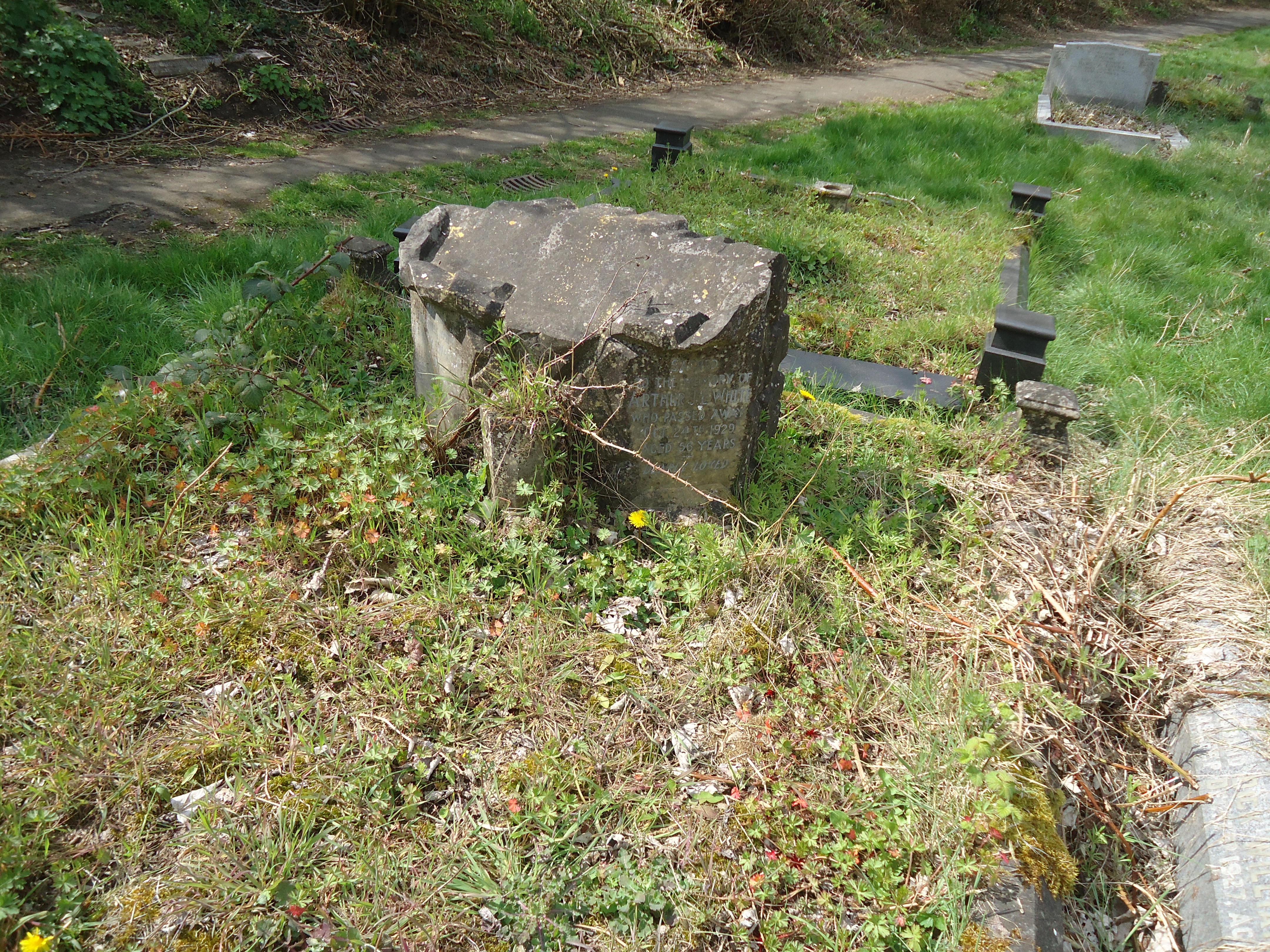
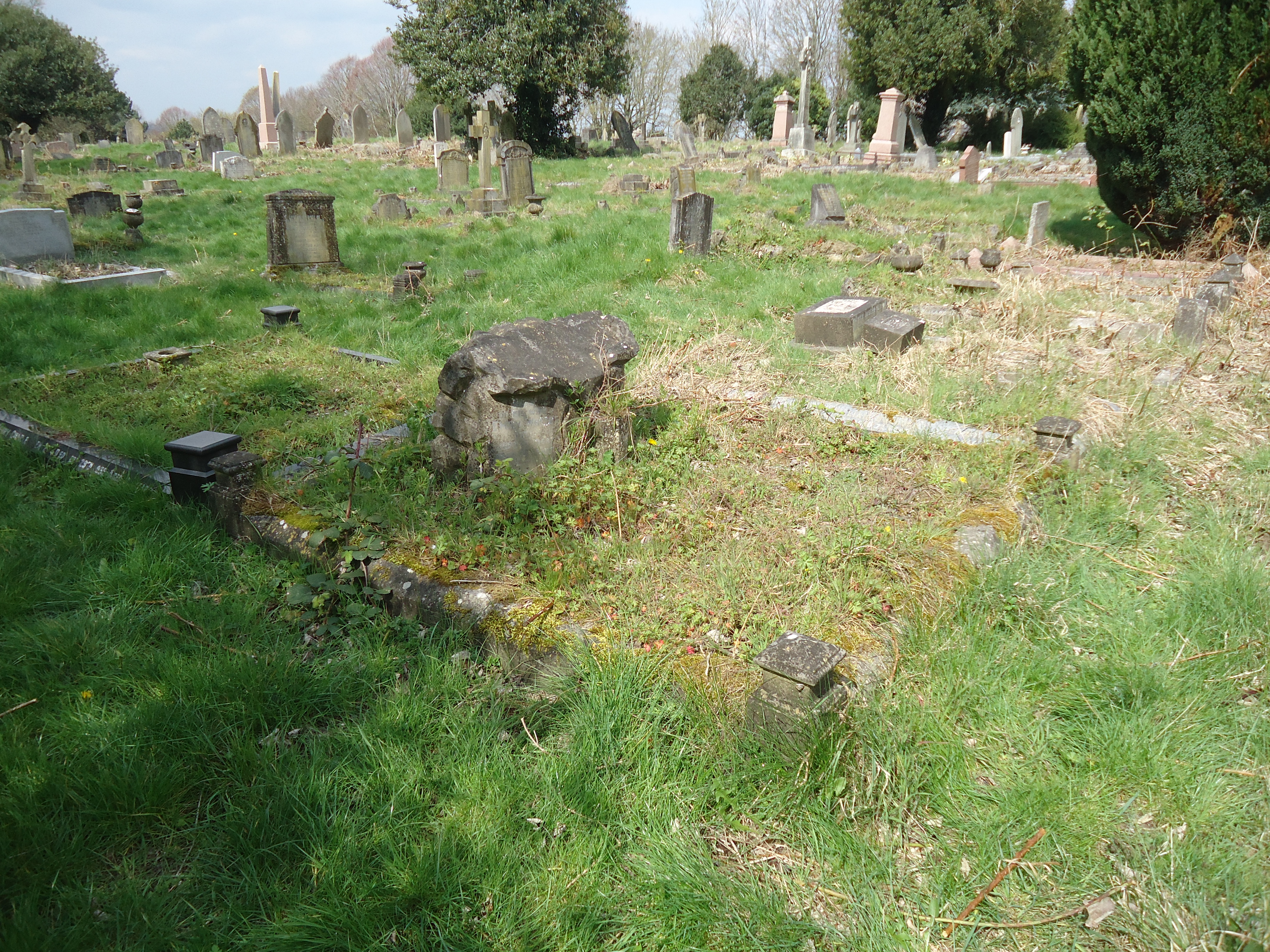
Arthur Jefferies Lewis White was buried in grave plot E8134. His wife Emily survived him by nearly 40 years. She died aged 92 years of age at the Cheriton Nursing Home and was buried in the neighbouring plot E8134A.

Thomas Charles Newman – Mayor of Swindon

This pristine art deco gravestone proudly boasts the achievements of Thomas Charles Newman, Alderman and Mayor of Swindon in 1923.

Mr Newman served on the council for 32 years and during his Mayoral year welcomed King George V and Queen Mary on their first visit to Swindon.

Other less glamorous duties he performed that same year including opening the sewage works at Rodbourne and the hard tennis courts at Town Gardens.

Thomas Charles Newman was born in Swindon in 1878 and was educated at Sanford Street Schools.

He began his career in the printing trade as a printer’s devil (an apprentice who runs errands in a printing office) and went on to become a master printer and proprietor of the Borough Press Ltd.

He was chairman of the committee in charge of the new Civic Offices built close to his old home in Euclid Street and he had many interests outside of politics. He was involved with Swindon Town Football Club and the Wiltshire Football Association along with many other local organisations. He enjoyed gardening, singing and various sports, in particular angling.

Thomas Charles Newman died on October 14, 1941 and an obituary published in the Advertiser described him as an extremely popular and generous man who assisted in every way the town’s many causes, and took a special interest in housing and unemployment questions.

His funeral took place at Sanford Street Congregational Church on Saturday, October 18. A prominent freemason, Masonic honours were accorded at his funeral and 60 Freemasons headed the funeral cortege from Sanford Street up here to Radnor Street Cemetery.

Thomas was buried with his daughter Sybil who had died ten years previously aged 15. They were later joined by his wife Frederica who died in 1963, their son Leslie who died in 1989 and his wife Doris who died in 1983. The last member of the family to be buried here was grandson John Charles Newman who died in 2005.

He’d been gone a long time – Arthur Jeffreys Lewis White

The re-imagined story …

You saw it happen so often in those days, a mother or father would die suddenly, but to lose both parents within a matter of three years was heart-breaking for those poor children. Little Arthur was just four years old when his mother died and only seven when he lost his father.

I would have happily taken that little boy into our home. It would have been what his mother would have wanted. We were close, the two of us. But his father had obviously made provision for his family.

It would have been hard on those children had their father not been a Freemason. The girls received a good education and Walter, the brother just a couple of years older than Arthur, went into the railway factory before moving to Wolverhampton and a job as a fitter in the GWR Stafford Road works. But I never knew what had happened to that little boy.

I often thought about young Arthur then one day there was a knock on my door and who do you think was standing there but him. My, he had grown into a handsome young man – I could see something of his mother in him. He came in for a cup of tea and a piece of my sponge cake and he told me he was about to start work as a clerk in the Works, following in his father’s footsteps.

He had been to the burial ground at St. Mark’s to visit his parents’ grave, but things looked very different to how he remembered them and he came away without paying his respects. Perhaps someone could help him find the grave? He’s been gone a long time.

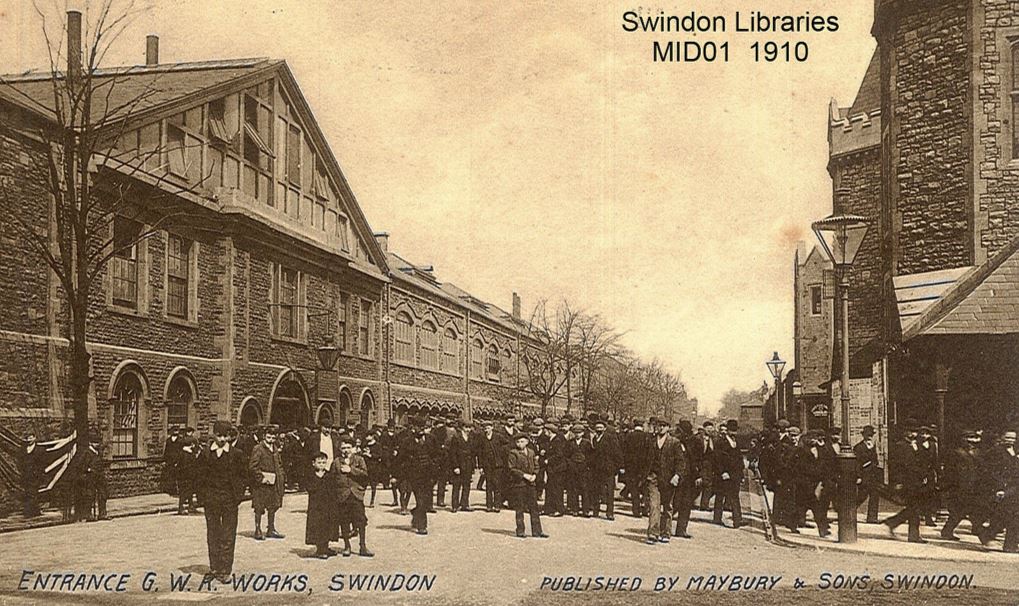
This image has an empty alt attribute; its file name is london-street.jpg

The facts …

When Arthur White’s father Richard Lewis White died in 1879 it seems likely it was members of Swindon’s Freemasonry who provided for the young boy and his family of siblings. 

Richard Lewis White, secretary and chief accountant for the GWR locomotive and carriage department, was a member of The Gooch Lodge when he died in 1879, leaving behind six orphaned children from his first marriage. 

The first clue to what happened to the children comes in a newspaper article published in the Western Daily Press, Bristol on Wednesday, September 17, 1879:-

Somerset and Wilts Freemasonry – The balloting papers for the election of daughters of Freemasons to the Royal Masonic Institution for Girls have just been issued. The election will take place at the Freemasons’ Tavern, London, on Saturday October 11th. There are 48 candidates on the list, and 18 vacancies in the school. Among the candidates are one from Somerset and one from Wilts. The Somerset candidate is Mabel Jane Sampson, whose father, Thos. Sampson, nurseryman and farmer, was initiated, in the Lodge of Brotherly Love, No. 329, Yeovil, on the 16th March, 1859. The Wiltshire candidate is Adelaide Louisa White, ten years of age, whose father, Richard Lewis White, a clerk on the Great Western Railway, died on the 6th of February last. He was initiated in the Gooch Lodge, No. 1,395, New Swindon, on the 4th of April, 1870, of which he became Worshipful Master. He was also Past Provincial Grand Sword Bearer of Wilts.’

Adelaide was one of the successful candidates, polling 1,118 votes and at the time of the 1881 census she is recorded as a pupil at the Royal Masonic Institution for Girls, Battersea. In the same census Eleanor, aged 17, is recorded as a pupil at Queen’s College, a private school in Islington and 12-year-old Walter is a pupil at The College, Beach Road, Weston Super Mare.

Arthur’s eldest brother Richard Corbett White died in 1877 aged 15 while his sister Frances worked first as a domestic servant and then a dressmaker at the time of her marriage in 1893. 

Arthur J L White and Emily White

And what of little Arthur who was just four when his mother died and seven when his father died. 

The first definite sighting of Arthur is on January 4, 1887 when he enters the GWR employment as a Lad Clerk and it is possible to track his employment record in the Swindon Works. By 1902 he is Assistant Chief Clerk and in 1918 he is promoted to Chief Clerk. His annual salary rose from £45 in 1889 to £1,000 in 1924, so the boy orphaned as a seven-year-old did well. And like his father he also became a Freemason, joining the Royal Sussex Lodge of Emulation in 1919.

Arthur married Emily Sendell in October 1917. He was 45 and she was 41. They did not have any children.

Arthur died on October 24, 1929 at his home in Okus Road. He left effects valued at more than £4,000 to his widow Emily. He was buried in plot E8134 in Radnor Street Cemetery on October 29, 1929, where Emily joined him when she died in 1968 aged 92.

Arthur J L White and Emily White (2)

Images of London Street published courtesy of Local Studies, Swindon Central Library.

Edwin Browne – Past Master of Gooch Lodge

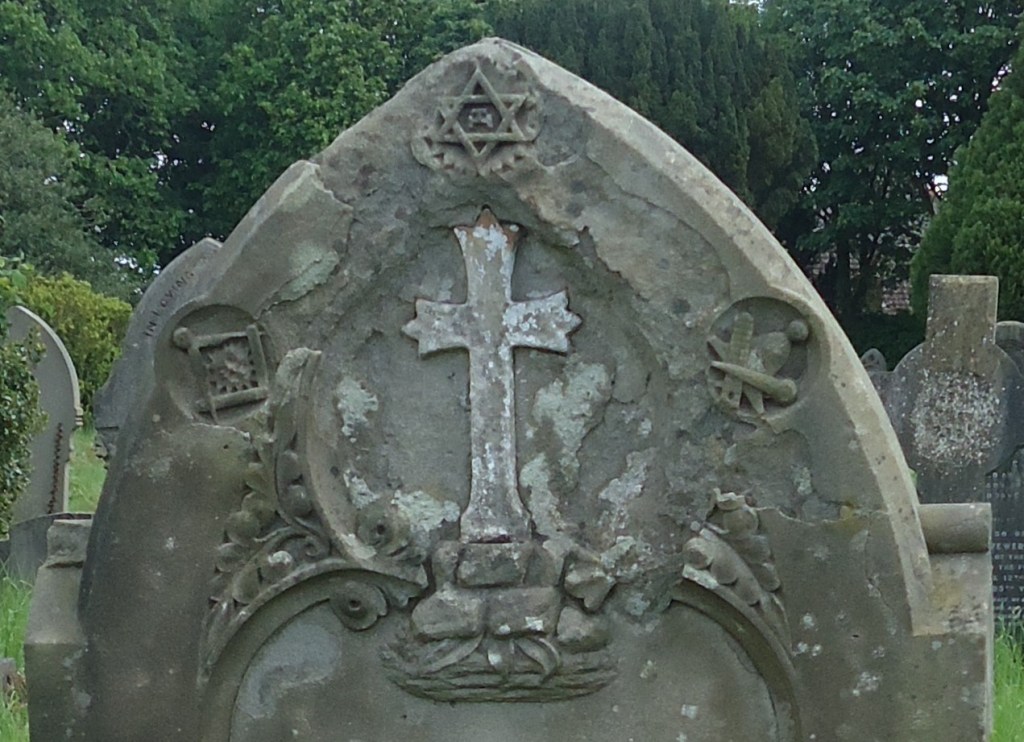
This headstone is decorated with numerous symbols, clearly indicating that Edwin Browne, who is buried here, was a Freemason.

Edwin was born in Newbury, Berkshire in 1833. By 1851 he was living with his widowed mother Mary at No. 2 Kimbers Alms Houses in Newbury where his mother is described as an ‘Almswoman’. Seventeen-year-old Edwin was working as a Postmaster’s Assistant but a year later he had left Newbury and was in Swindon where in October 1852 he began work as a clerk in the GWR Works stores.

But he was soon on the move again. In 1860 he married Anna Maria Heathcote at St. Peter & St Paul’s Church, in Aston and at the time of the 1861 census they were living in Coleman Street, Wolverhampton with their daughter Emily Vine Browne.

They remained in Wolverhampton for at least six years where two more daughters were born, Annie Amelia and Florence Lucy. Their first-born daughter Emily died in 1867 and is buried in Merridale Cemetery, Wolverhampton.

By the time of the 1871 census the family were living at 24 Prospect, Swindon before moving to 3 Church Place where Edwin died on June 2, 1885.

Research has revealed that Edwin was initiated into the Gooch Lodge on July 4, 1870 when the Lodge was only recently established. He would serve as Past Master of Gooch Lodge and PPSGO of Wiltshire.

Edwin died at his home 3 Church Place on June 2, 1885 and was buried in plot E8435 on June 5. He was 51 years old. The headstone leaves plenty of space for more inscriptions, but Edwin lies here alone.

Edwin’s second daughter Annie Amelia married Henry Simpson, a Steam Engine Fireman, in Wolverhampton in 1891. She died in Newport, Monmouthshire in 1961.

Youngest daughter Florence Lucy married Sidney Herbert Webber and remained living in Swindon. She is buried with her husband, two daughters and a son in Christ Church Burial Ground.

Edwin’s wife Annie Maria Browne remarried in 1900 in Cirencester and died there in 1913.

Mr Edwin Browne, deputy chief store-keeper to the Great Western Railway Company, died in a sudden manner on Tuesday, from heart disease, at his residence in Church Place, New Swindon. Mr Browne, who has been many years in Swindon, was generally liked by all with whom he came in contact. He was an enthusiastic Mason, being P.M. of 1295 and 355, and a P.P.S.G.O. of Wilts. The Masonic brethren of the deceased attended the funeral yester (Friday) afternoon at the Cemetery.

The Swindon Advertiser, Saturday, June 6, 1885.

Consecration of the Gooch Lodge, No. 1295

The interesting ceremony of the consecration and dedication of the Gooch Lodge, No. 1295, which had been looked forward to by the brethren in the province with a considerable degree of interest, took place at the Queen’s Royal Hotel, Swindon, on Saturday last. A very considerable number of brethren attended from London, Bath, Bristol, Gloucestershire, and several lodges in the province. Brother H. Muggeridge, as presiding officer on the occasion of the consecration, took the chair, and at once proceeded with the ceremony of consecration and dedication, which he most effectively and impressively performed. His opening address was a great treat and was listed to with much attention. The oration by the P.G.C. Brother the Rev. C. Raikes Davy also received great attention, being an exhortation to adhere to and promote the well-known objects of the Masonic Order – Charity, Benevolence, Good Will, etc.

The Lodge was afterwards formally dedicated and consecrated.

The installation of Brother Kinneir was then performed by Brother Sir D. Gooch, and the following officers were installed and invested:- Bros. J.J. New, S.W.; H.C. Tombs, Treasurer; F.J. New, S.D.; C. Lidsley, I.G.; H.J. Birch, J.W.; T. Coall, Secretary; W. Hall, J.D.; J. Burrows, Tyler.

The Banquet, to which upwards of 60 brethren sat down, was presided over by Brother Henry Kinneir, now W.M. 1295, supported on his right by the V.W. the D.P.G.M., and Brother Muggeridge, and on his left by the R.W. the P.G.M. of Berks and Bucks (Bro. Sir D. Gooch), Brother Rev. C.R. Davy, P.C.G., etc. the repast was served by Brother Westmacott, at the Goddard Arms, the resources of whose establishment were fully equal to doing honour to such an auspicious event. After the cloth was removed, the usual loyal and Masonic toasts were eloquently proposed and heartily responded to, song and glees most pleasantly alternating with the toasts.

The whole ceremony passed off with great eclat, and many brethren who came from a distance and had witnessed the consecration ceremony congratulated the members of the Gooch Lodge most warmly on a successfully inauguration.

Extracts from a much longer report published in the North Wilts Herald, Monday February 14, 1870.

James Lott – Ironmongers

James Lott opened his ironmongery business in around 1873. By 1881 he was living above the shop at 91 Regent Street with his wife Ellen and their four young children. However, the changeable fortunes of James Lott saw him forced to declare himself bankrupt in 1889.

But by 1891 business was booming again when James was based at numbers 50 and 51 Regent Street. In 1907 he was advertising “the most varied and up-to-date stock of Brushes, Copper Flower Vases and Kettles, Cutlery, Electro-plated Goods, Curb Fenders, Fire Irons and Brasses, Expanding Wood Trellis, Wire Netting, Garden Arches and Tools, General and Furnishing Ironmongery of every description.”

The 1911 census lists him as living above his shop at 5 Temple Street with his wife Ellen and youngest daughter Maud, an elementary school teacher. Temple Street today is unrecognisable from the busy shopping thoroughfare it once was linking Commercial Road with Regent Street. Temple Street has been the scene of several major reconstruction projects in the past 100 years. Today it is the site of work in progress on a Premier Inn due for completion later this year. Pictured below is the large gap left following the demolition of the Baptist Tabernacle.

This image of the site of the demolished Baptist Tabernacle is published courtesy of Local Studies, Swindon Central Library.

And it is still possible to find evidence of James Lott’s work in the pavements around town.

Death of Mr J. Lott

An Old and Respected Swindon Tradesman

The death has occurred of Mr J. Lott, head of the firm of Messrs. Lott & Sons, of Regent street, Swindon.

Mr Lott was one of the oldest tradesman in Swindon. Born near Holsworthy in Devon he came to the railway town in the early ‘70s, and by his energy and enterprise built up the present extensive business.

Mr Lott was connected with the Gooch Lodge of Freemasons, of which he was a Past Master, and was much respected in the town.

The funeral has been fixed for Monday. Mr. Lott was 76 years of age.

Swindon Advertiser Saturday, 10 December, 1921.

Late Mr J. Lott,

Masonic Funeral at Swindon Yesterday

The funeral of Mr J. Lott, of Swindon, took place yesterday afternoon. The Rev. J.E. Rogers officiated, and the masonic ovation at the graveside was delivered by the Rev. W.L. Waugh, Provincial Grand Chaplain.

The mourners were Mr. J.D. Lott and Mr C.R. Lott (sons), Mr E.W. Lott and Master Stanley Smith (grandsons), Mr J.W. Smith (son-in-law), Mr E.W. Daniel (Hendon) and Mr J. Daniel (nephews), Mr A.S. Deacon, Ald. E. Jones, Mr S. Chappell, Mr T. Butler, Mr F.C. Phelps, Mr A.R. Bray (Bristol), Mr W.E. Chappell, Mr J. Wilmer and Mr H. Mitchcock.

The Freemasons, of which deceased was a Past Provincial Grand Officer, were represented by Brs. A.E. Bottomley, D.C.A Morrison, H.J. Hamp, E.O. Twitcher, A.G. While, J.S. Protheroe, T. Mundy and D.A. Lane. Deceased’s employees also attended.

The floral tributes included one from the widow, and others from sons, sons and daughters-in-law and grandchildren, the Wiltshire Lodge of Freemasons and the staff at Regent street.