In the beginning Gorse Hill barely stretched from the railway line to St. Barnabas’s Church with the Duke of Edinburgh pub and Baptist and Methodist Chapels in between. Taking its name from Gorse Hill House which once stood on Cricklade Road, early development was called the Gorse Hill Farm Estate and began in about 1885.
If you are of a certain age you may remember Turn, Turn, Turn, a song released by The Byrds in 1965. The lyrics were written in 1959 by Peter Seeger and are taken from the book of Ecclesiastes Chapter 3 verses 1-8.
So, what do you think? Is there a time to be born and a time to die.
Emma Flower died in March 1912. She had lived to see her only surviving child, Edwin Brian Flower, marry. She was 49 years old. A tragedy to die at that age both now and then. Had she suffered a long, painful illness, in which case it might have been a time to die?
Emma Head was born in 1861 the daughter of John Head and his wife Hannah. She married Edwin Flower at the church in South Marston on Christmas Eve 1888. At the time of the 1891 census the young couple and their baby son were living at 36 Avening Street, Gorse Hill. By 1911 the family had moved to 23 Florence Street where their son Edwin Brian was married from on October 21, 1911 and where Emma would die five months later. She was buried on March 14, 1912 in grave plot B3209 where she lies alone. Her husband Edwin married again in 1913 to widow Jane Martha Stone (nee Head) most probably Emma’s elder sister.
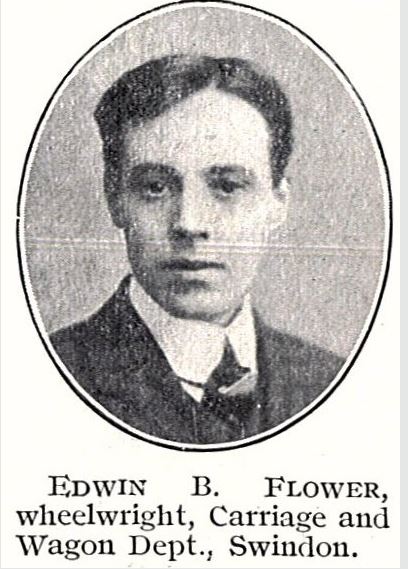
Edwin Brian Flower was the only one of Emma’s three children to survive childhood. He was born on September 23, 1889 and lived in Gorse Hill all his life. At the age of 13 he started work as an office boy/messenger in the Carriage Works, later transferring to the Wheelwright Shop. He married Ethel Woodman in 1911 and they had a daughter Iris Minnie born the following year. By 1917 Edwin was serving with the 9th Light Railway Operating Company as a Sapper in the Royal Engineers. He was killed in action on October 4, 1917 aged 28 and is buried in the Rocquingny-Equancourt Road, British Cemetery, Manancourt. Was it his time to die?
John Norman and his wife Eliza Loveday had a very long courtship. John appears on the 1891 census as boarding with the Loveday family at 26 Victoria Street North. John is 25 and working as a carpenter, Eliza Jane is also 25 and working as a dressmaker. The couple didn’t marry until the winter of 1906.
John Glover Norman was born in Chedworth, Gloucestershire in 1863 the son of Isaac Norman, a woodman and agricultural labourer, and his wife Mary. He completed his carpentry apprenticeship with a Chedworth carpenter but by the end of the 1880s he had moved to Swindon where he set up in business as a builder.
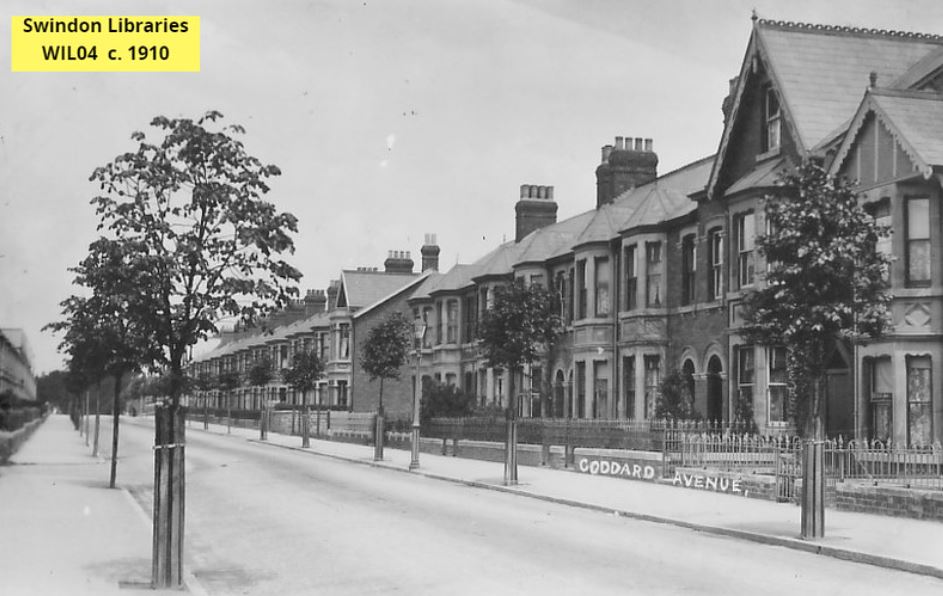
In 1898 and 1899 he was working in Goddard Avenue. He also built several properties in Westlecot Road and in 1906 he built 13 houses in the Mall. John built some classy properties but business was not straightforward and in the Spring of 1909 John Glover Norman was declared bankrupt.
At the time of the 1911 census, following his bankruptcy, John and Eliza are living in Victoria Road with a whole clutch of Loveday relatives. Eliza’s widowed mother lives with them as does two of Eliza’s nephews – Frederick Wm Loveday aged 22 a Law Clerk who describes himself as out of work, and Ernest Albert Loveday who was 24 and a carpenter, so most probably working with John. John and Eliza had two children, Beryl and a son Garnet.
John recovered from the bankruptcy crisis of 1909 and was soon back in business in Gorse Hill where he built a lot of properties including 44 houses in Caulfield Street and between 1926 – 1933 he built more than 60 houses in a road that would eventually bear his name – Norman Road.
John died in the Westlecot Manor Nursing Home in February 1954. He is buried in grave plot E8331 with his wife Eliza Jane, her mother Jane and 14 year old Dorothy Frances Reason the daughter of Eliza’s sister Mabel.
William Hooper image of Goddard Avenue taken around 1910 and published courtesy of Local Studies, Swindon Central Library.
In the 1970s and 80s West Swindon was built as a cluster of village centres – it seemed to be a plan particularly favoured by Swindonians. In the 1840s there was the Railway Village followed by development in Even Swindon and then a satellite suburb Gorse Hill built in the late 1890s and 1900s. And it seemed that once people put down roots they seldom moved away. Take, for example, Nellie Bull, daughter of George and Maria Bull.
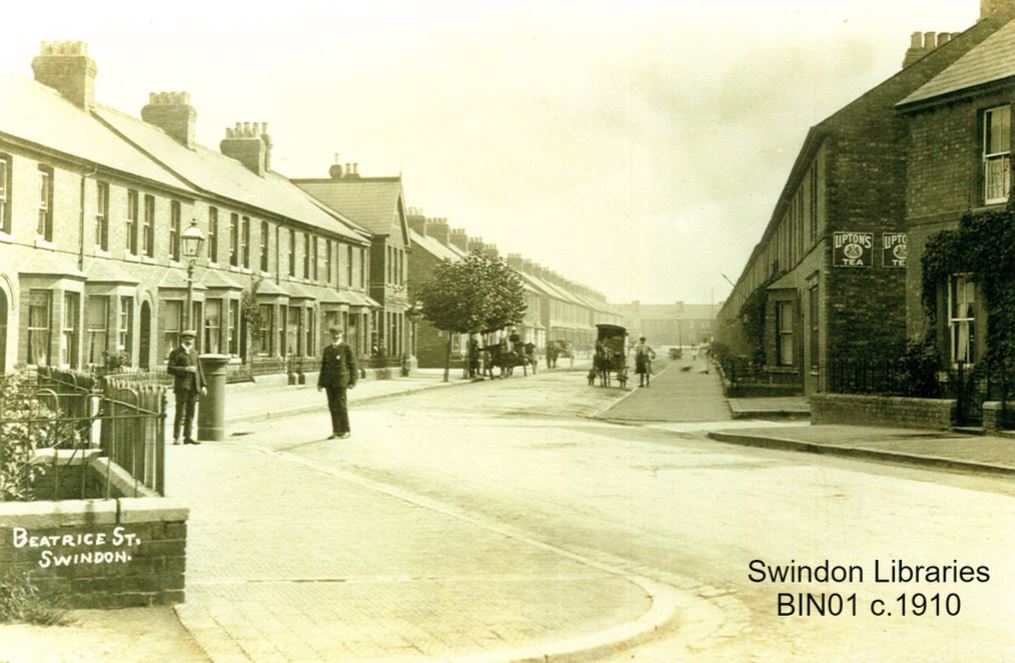
This image of Beatrice Street taken in around 1910 is available to view with a selection of Gorse Hill photos at Local Studies, Swindon Central Library.
Nellie and her brother George grew up in spanking, brand new Gorse Hill in the 1890s. In 1891 they lived at 70 Hinton Street, built in 1890 by entrepreneur James Hinton, Swindon Mayor in 1903/4 who also once owned the land on which the cemetery was built. By 1901 the family had moved to 119 Beatrice Street, another new build, and it was here that William George Bacon came to lodge with them. On Christmas Day that same year he and Nellie were married at St. Mark’s Church.
The young couple continued to live with Nellie’s parents in Beatrice Street where their baby daughter Nellie Gladys was baptised at St. Barnabas’ Church in 1902. They were still living at 119 Beatrice Street when Berty was born two years later, although he was baptised at St. Luke’s Church, Barton Hill, Bristol. By 1909 the family were at 7 Suffolk Street, just around the corner, when George Stanley was baptised at St. John’s the Evangelist. In 1939 William and Nellie were living at 33 Beatrice Street with their daughter Nellie and her husband Percival and Anna (Maria) Bull.
This stylish headstone with discreet art deco features marks Nellie and William’s last resting place, the only time they left Gorse Hill. William James Bacon died on June 18, 1948 at his home, 33 Beatrice Street. Nellie died March 2, 1956 at 33 Beatrice Street.
If you’d like to know more about Swindon’s 1980s West Swindon development – West Swindon – What the eye doesn’t see by Angela Atkinson,Roger Ogle and me is available from Hobnob Press, Bert’s Books, Amazon and other Swindon bookstores.
The First World War was all about loss; loss of life and loss of prospects. Landed property was lost with the death of an heir; local businesses were lost when sons did not return, and in this case, families fell on hardship with the loss of a breadwinner.
Within the records of the UK World War I Pension Ledgers and Index Cards 1914-1923 published on Ancestry are claims mostly made by service personnel incapacitated by their military service, and war widows. However, Thomas Henry Harding, the father of Lance Cpl. T.N. Harding, made an application declaring he was a dependant of his son.
Thomas Neate Harding was baptised on July 15, 1888 in the parish of Holy Trinity, Slad. He was the only child of Thomas Henry Harding, a labourer, and his wife Caroline.
The family moved to Argyle Street, Gorse Hill, Swindon three years after Thomas’s birth. By the time of the 1911 census both father and son were employed in the GWR Works. Thomas Henry Harding worked as a wood sawyer and 23 year old Thomas Neate Harding as a Blacksmith’s Striker.
Caroline Harding died in March 1913 and is buried in a public grave in Radnor Street Cemetery. So now father and son carried on alone at home.
At the outbreak of war in 1914 Thomas Henry Harding was about 54 years old, his son 26. Thomas Neate Harding was not one of the early volunteers to join the army. Perhaps his responsibilities at home were too great. But with the introduction of conscription in 1916 he would eventually be called up, enlisting in July 1917 with the Royal Engineers and serving with the Inland Waterways and Docks.
Thomas Neate Harding died on February 12, 1920 at the Northern Hospital, Liverpool. He was 32 years old. His father made an application to the War Office for the cost of his son’s funeral expenses.
Administration of Thomas Neate Harding’s will was granted to his father in April 1920. His effects were valued at £173 7s 1d.
Thomas Neate Harding was buried in a public grave plot number B1271. The same grave in which his mother Caroline was buried.
Lance Corporal Thomas N. Harding is commemorated on plaque in St. Barnabas Church, Gorse Hill.
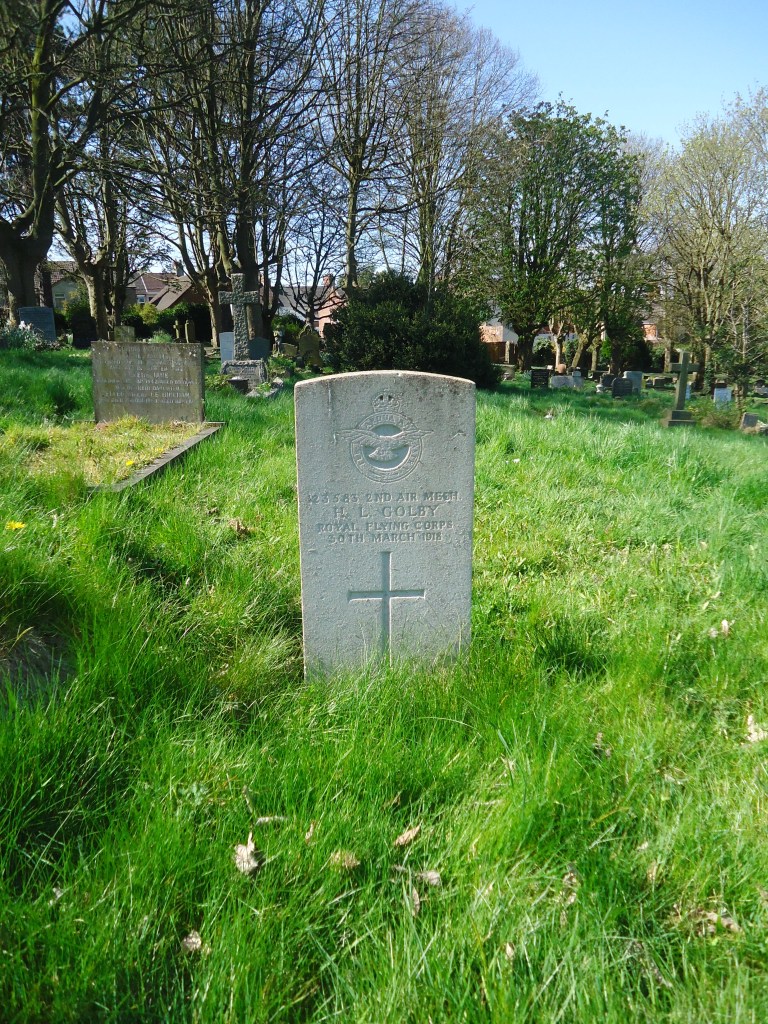
Horace Lett Golby was born on April 18, 1887 the youngest of five children. He grew up living at various addresses in Gorse Hill where his father James worked as a house painter. As a 15 year old boy he began a 6 year carpentry apprenticeship in the GWR Works.
On April 5, 1915 he married Ethel Florence Phillip at the parish church in Seend, Wiltshire, the bride’s home parish. He was 28 and she was 25. Their daughter Dorothy Mary was born on January 22, 1916 and later baptised in the church where her parents had married.
Most of Horace’s military records are lost. All we know is that he served as an Air Mechanic 2nd Class in the Royal Flying Corps, the precursor of the RAF. He died on March 30, 1918 at the Military Isolation Hospital in Aldershot. The Army Registers of Soldier’s Effects reveal he left £7 8s 6d to his widow.
We know nothing about his military service, nor about the kind of man he was. What were his hobbies, did he play football or cricket, did he like gardening? A life sacrificed in war, but still remembered 105 years later.
Horace was buried on April 3, 1918. He shares a grave with his mother Mary who died in December 1913 and his father who died in 1939.
“Yes, used to live in King Street, before his wife died.”
“No, I don’t remember him.”
“Yes you do – we always thought she was a lot older than him. Turned out there was only two years in it. We talked about it.”
“Did we?”
“He married again just a few months after she died. Don’t you remember?”
“No, I can’t say I do.”
“He moved up to Gorse Hill. We all reckoned his new wife had a bob or two.”
“Oh yes, I remember now. She was older than him.”
“No, that was his dead wife. His last wife was much younger than him. Give me strength – I think you’re losing your marbles.”
“No, I do remember him now. Moses Willoughby. Used to live in King Street. Moved to Gorse Hill.”
“Yes, that’s him. Well he’s dead.”
Early 20th century photograph of Cricklade Road published courtesy of Mr. T. Midwinter and Local Studies, Swindon Central Library.
The facts …
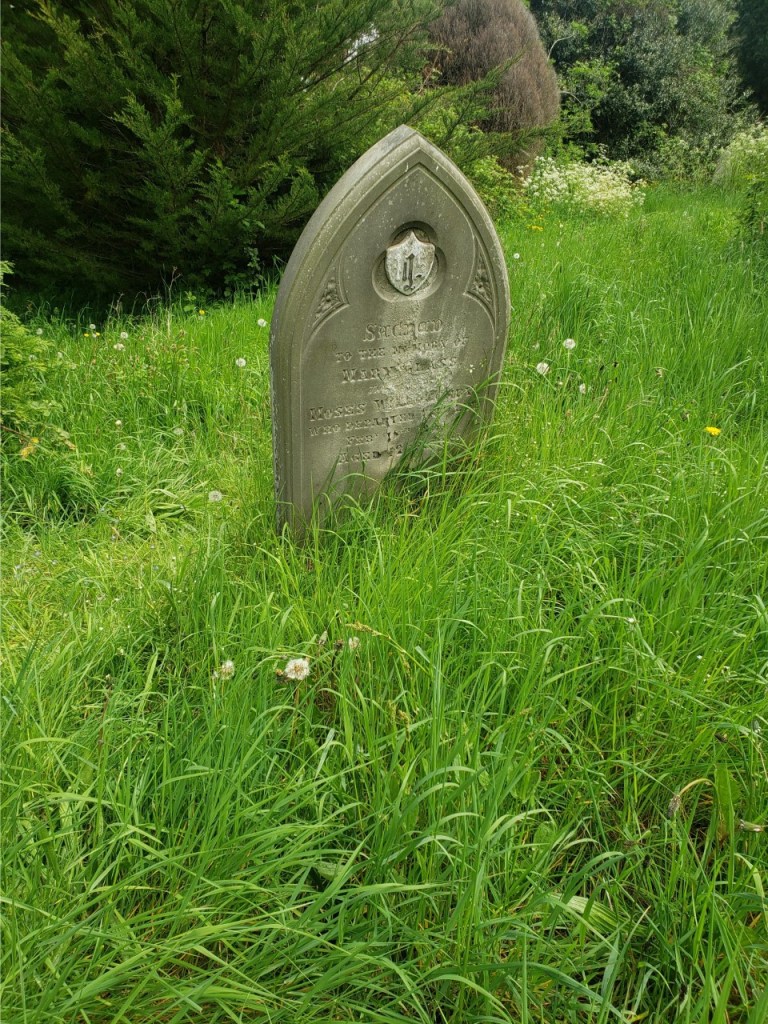
Thanks to the numerous genealogical resources available online it is now possible to piece together the history of those buried in Radnor Street Cemetery, even when the inscription on the headstone has deteriorated.
Moses Willoughby was born on October 22, 1818 and baptised in Highworth. He was the son of Charles and Ann Willoughby and grew up in Eastrop.
He married his first wife Ann Lay in Highworth on November 21, 1840. Their son John was baptised in Highworth on February 6, 1842.
Ann died in 1847. On the 1851 census Moses, 28 was working as an agricultural labourer and living at Bailey’s Piece, Highworth with his ten year old son John.
In 1855 he married for a second time. His bride was Mary Glass and the couple married in the parish church at Purton. They had a daughter Emily Kate baptised at Highworth on June 22, 1857. However, at the time of the census in 1861 there is no mention of Emily Kate, nor John, although he could well have left home/married by then.
By 1871 the couple had moved to Swindon and were living in Cetus Buildings on the canal side where Moses continued to work as a farm labourer. Moses declared that he was 46 and Mary 48.
At the time of the 1881 census Moses was employed as a factory labourer, almost certainly in the railway works. He states that he is 60 and Mary is 62.
Mary died at their home 3 King Street in February 1890, she was 72 years old. The funeral took place on February 19 when Mary was interred in plot A790.
On July 16, 1890Moses married for the third time. His wife was Mary Ann Haskins, a 49 year old spinster. At the time of the 1891 census the couple were living at 255 Cricklade Road, Gorse Hill. Moses was still working as a General Labourer in the GWR Works and they had two lodgers, both labourers in the Works.
Moses died on March 9, 1892. He left effects valued at £84 0s 7d to his widow Mary Ann Willoughby. He was buried three days later in Radnor Street Cemetery in plot A790, which he shares with his second wife.
Attempts to trace John Willoughby and his half sister Emily Kate have so far been unsuccessful.
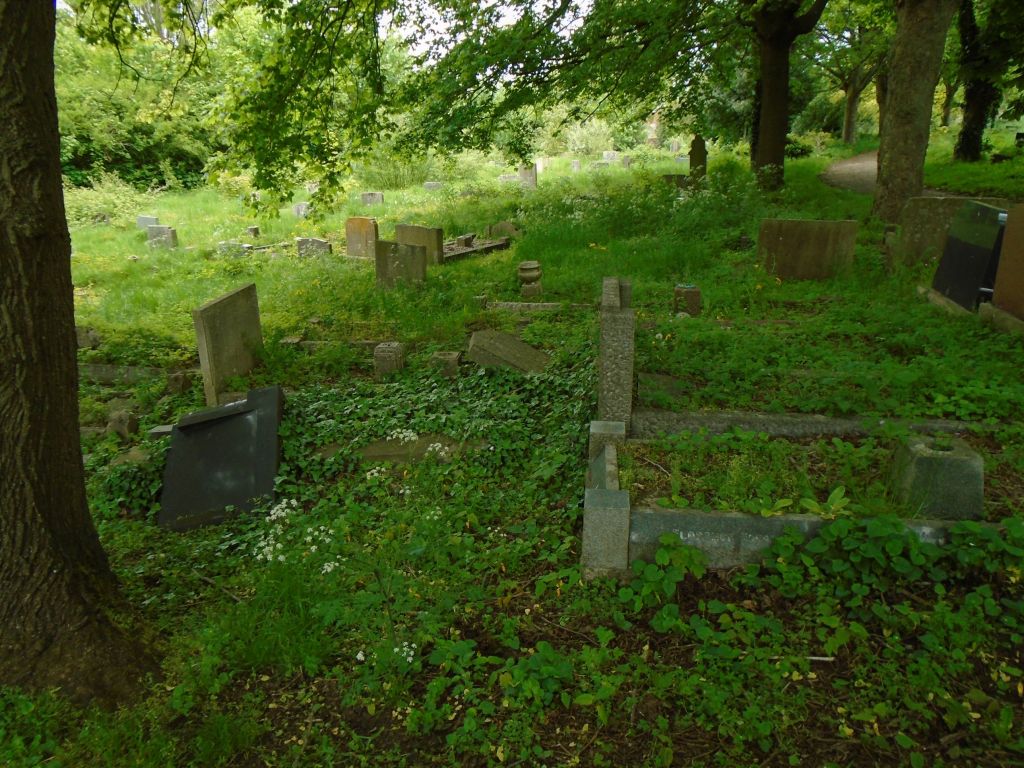
On my way to conduct a guided cemetery walk for the Old Town Belles WI group recently, I met a woman who emerged from Section Lower C where the grass is as high as an elephant’s eye (to misquote the famous song from Oklahoma).
Ilse was visiting from the Netherlands on a week long, whistle-stop, family history tour of Wiltshire. She had spent the morning in Box and the afternoon in Gorse Hill before a quick visit to the cemetery.
She had no cemetery map and had by happenstance arrived at Section Lower C. She had hoped there would be numbers on the graves, but sadly that is usually not the case. She did have a grave number she had taken from a well-known website, but it was one that I had an ‘mmmn’ about – you know what I mean? However, Radnor Street Cemetery burial registers record the grave numbers which range from a single digit up to a four digit number and always preceded by a letter (and occasionally with a letter at the end e.g. D12A). But this was a five digit number without any letter. Mmmn!
Ilse wrote her email address and the name of her great-aunt on the back of my notes and today I’ve done some research for her. As I suspected the number she had was not a Radnor Street Cemetery grave plot number – but, guess what? Where she was exploring in the wilder reaches of Section Lower C was exactly where her great aunt (and great-great-grandmother) are buried. What a coincidence!
She has a wealth of family stories, which I am hoping she will share with me when she gets home. One of these was of how her great aunt met her husband-to-be when her hat blew off on Swindon station platform and he rescued it. Ilse says she has family photographs – obviously not of the hat retrieval incident – but what others might be revealed! What a fortuitous meeting. (And the guided walk with the Old Town Belles was most enjoyable as well).
Section Lower C
An overall view of the cemetery and a scan of Section Lower C where Ilse was searching.
Silas Fry and his wife Lydia were a pretty dynamic couple. When Silas died in 1925 the North Wilts Herald published a lengthy obituary detailing his many accomplishments, which included his work as a member of Swindon Town Council, his membership of the old Gorse Hill Cricket Club and his lifelong membership of the Primitive Methodist Church.
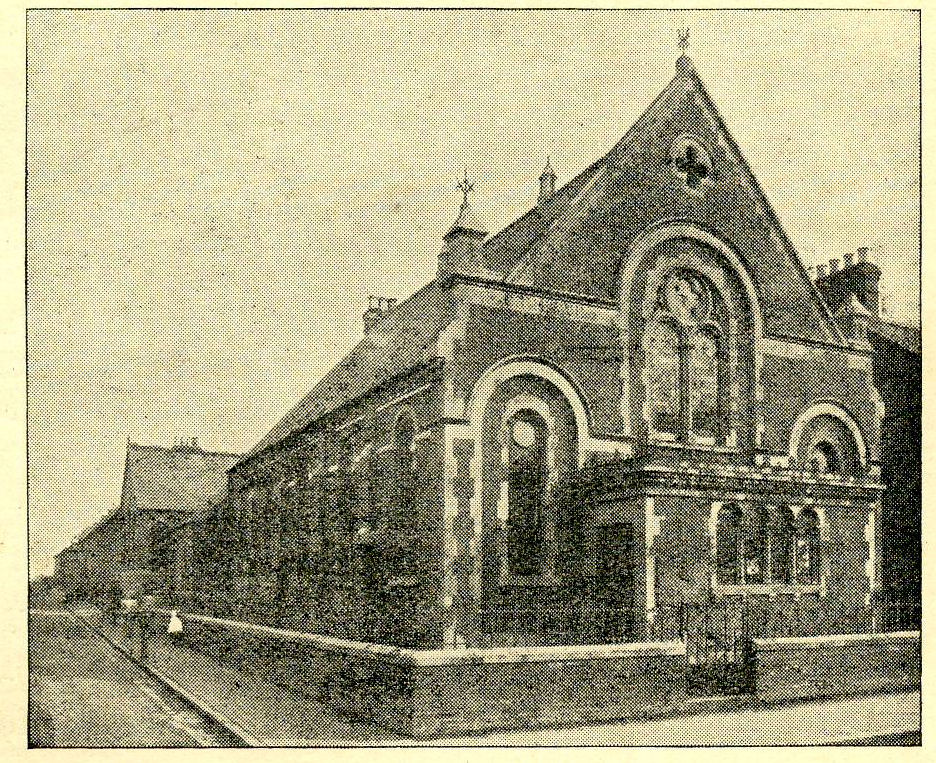
Primitive Methodist Chapel, Cricklade Road, Gorse Hill
Silas was born in 1874, the son of Oliver Fry, newsagent/grocer and Primitive Methodist preacher, and his first wife Esther Ayliffe. He grew up in Gorse Hill and never moved away, living with his wife Lydia at first 110 Chapel Street and then 71 Cricklade Road where he died on June 14, 1925.
Death of a Swindon Councillor
Mr Silas Fry’s Many Activities
The Funeral
The death occurred on Sunday of Mr Silas Fry, a member of the Swindon Town Council and a well known figure in many departments of public life in the town.
A few months ago Mr Fry, who was 51 years of age, underwent a serious operation at a Swindon nursing home, and he made such good progress afterwards that strong hopes were entertained that he would make a complete recovery, but he suffered a relapse.
A son of Mr Oliver Fry, who was prominently identified with local government affairs, deceased was at one time a member of the Swindon and Highworth Board of Guardians, and on his retirement from that body he was succeeded by his wife, who is still an active and useful member. In November 1922, Mr Fry was elected to the Town Council as one of the representatives of North Ward, and in that capacity he rendered much useful public service. He served on the Watch and Pleasure Grounds Committee, being this year’s vice chairman, and other committees of which he was a member were the Sewage and Allotments, Works and Streets, General Purposes and Emergency, and the Swindon and District Hospital Board.
Deceased had been organist at the Gorse Hill Primitive Methodist Church since he was nine years of age, and when the services were conducted in the old chapel, now used as the Salvation Army Barracks. He was also Superintendent of the Sunday School, and president of the local Christian Endeavour. For 20 years Mr Fry was choirmaster, succeeding the late Mr J.J. Henly. He was also one of the pioneers of the old Gorse Hill Perseverance Cricket Club, which afterwards became the Gorse Hill Primitive Methodist. He was a keen cricketer, and played until four years ago.
Extracts from theNorth Wilts Herald, Friday, June 19, 1925.
Image published courtesy of Local Studies, Swindon Central Library
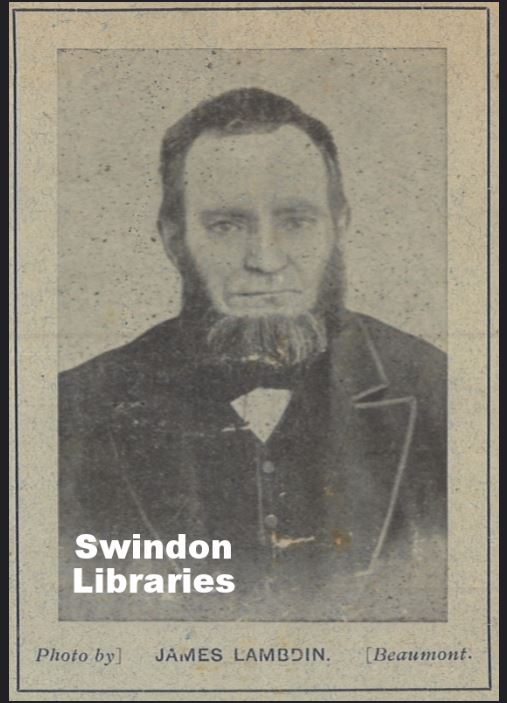
James Lambdin died suddenly and, it would appear, without making a will. Perhaps he had no worldly goods to leave. His life had been spent spreading the word of God.
James was born in Aldbourne in 1850, the son of Joseph and Sarah Lambdin. By the age of 10 years old he was working as an agricultural labourer. He later moved to Swindon and a job in the railway works, but it is his service in the Wesleyan Methodist Church that he is remembered for.
James married twice. His first wife, Faithfull Maria Dew, whom he married in 1874, died two years later aged just 22 years old. She was buried in the churchyard at St. Mark’s.
In 1878 he married Eliza Burt. The couple made their home first in Stratton St. Margaret (1881) and then in Gorse Hill living at 24 Hinton Street (1891) and 21 Avening Street (1901). They had one child, a daughter Beatrice, born in 1886.
A pamphlet produced after his death was entitled – Memoirs of James Lambdin – The Singing Ploughboy who became a Great Preacher and 30 years a Class Leader at Gorse Hill, Swindon.
The Angel Reaper has passed over the Bath Road Wesleyan Circuit, and taken away one of the staunchest adherents, Mr James Lambdin, of Gorse Hill. Mr Lambdin was a highly respected member of the Wesleyan body and looked up to throughout the whole circuit and was widely known for his wise exposition of the Scriptures.
He was a native of Aldbourne, and only the Sunday previous to his lamented death, he went to his birthplace to fulfil a preaching engagement. The day before that he had called upon one of his class members who was almost at the point of death, and the following day week, he himself had taken that journey from whence no traveller returns.
His illness was very short but painful, and his last words were a benediction for his fellow class members and workers. The loss is being felt very keenly throughout the circuit. Last Sunday morning, the preacher at Cricklade Road, a very old and devoted layman, was completely overcome with grief, and the evening congregation were greatly impressed by an impromptu memorial service.
I hear a whisper that a short memoir with a photograph will be prepared shortly.
The Swindon Advertiser, Friday, February 28, 1908.
James Lambdin was buried in Radnor Street Cemetery on February 27, 1908 in grave plot B2912. His wife Eliza survived him by more 19 years and was buried with him on February 3, 1927. The inscription on the modest headstone reads ‘To the revered memory of James Lambdin – Promoted Feb 23, 1908’










 Radnor Street Cemetery