Lydia Fry – For Services Rendered

Following the horrors of the First World War an increasing number of women began to take their place on the political stage at both national and local level.

Lydia Fry was already serving as a member of the Swindon and Highworth Poor Law Board of Guardians, before standing at the Town Council elections in December 1919.

Lydia was born in 1871, the fourth child and only daughter of agricultural labourer Richard Wilson and his wife Fanny.

She spent her childhood at Buscot, Berkshire but by 1891 Richard, Fanny and Lydia were living at 35 Bright Street in Gorse Hill. Richard worked as a platelayer labourer on the railway and Lydia was a shirt seamstress.

In 1892 Lydia married Silas Fry. Their first daughter Esther was born in December of that year. A second daughter Miriam was born in 1893. In 1901 the family lived at 110 Chapel Street and from around 1911 until the death of Silas in 1925 at 71 Cricklade Road.
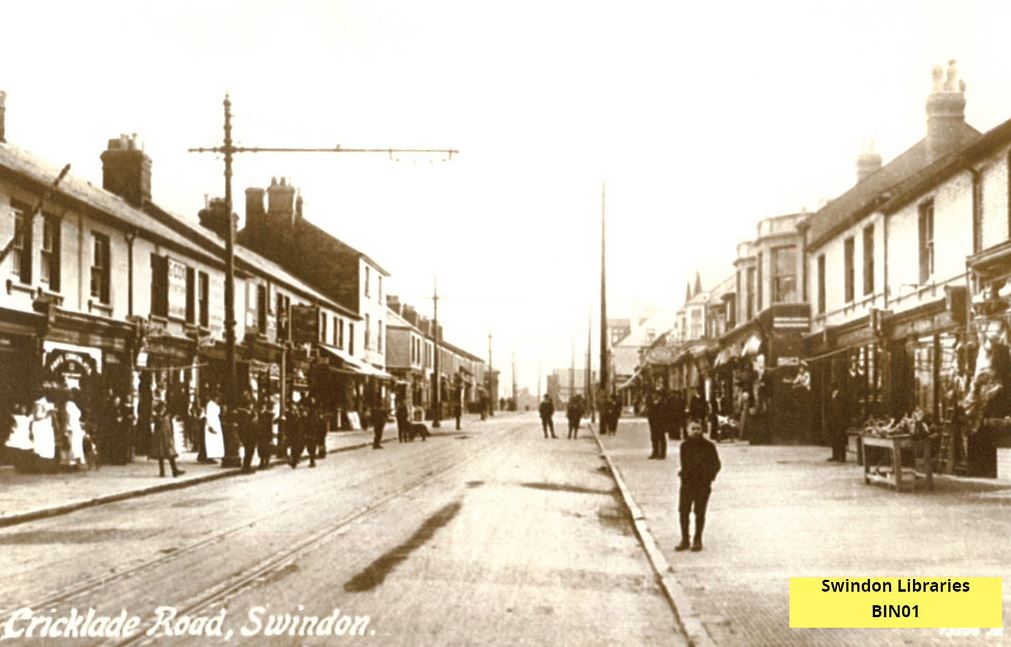
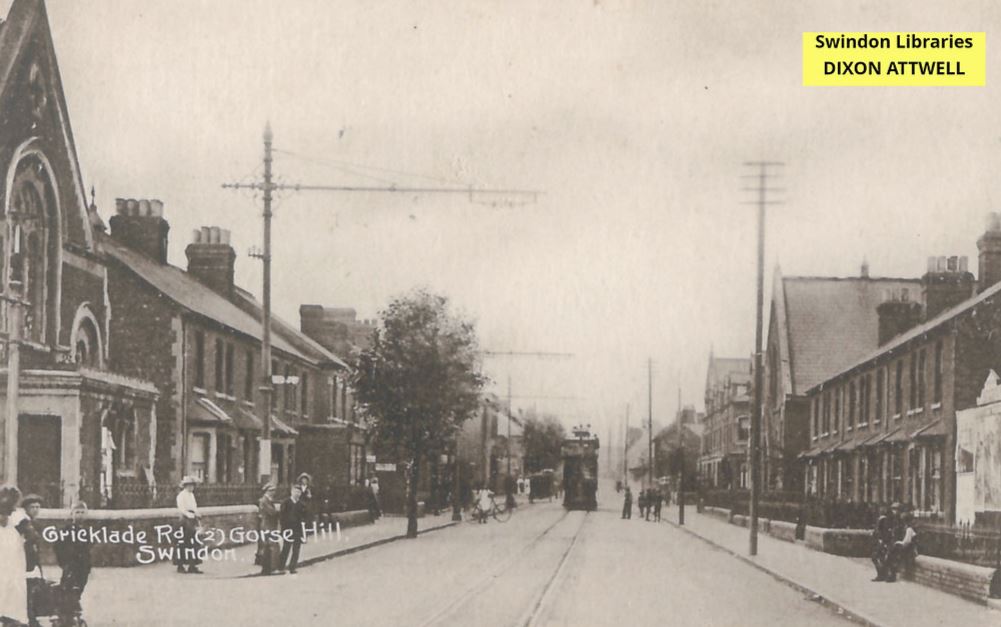
Image of Cricklade Road, Gorse Hill published courtesy of Andy Binks, Local Studies, Swindon Central Library.

When Silas died in 1925 the North Wilts Herald published a fulsome obituary detailing his many accomplishments. However, when Lydia died on April 24, 1941 only a brief account of her funeral was published in the same newspaper. There was no mention of her political career or her public service. Fortunately, in 1924 the North Wilts Herald published this account of Lydia’s life and work, written by W. Bramwell Hill.

For Services Rendered

Mrs Silas Fry’s Good Record

By W Bramwell Hill

Public service of all kinds has its times of difficulty, and, frequently, of irritation. You are not your own. You are bought with the price of the lurid light of criticism, half truth, misunderstanding, and misrepresentation. Happily that is not the only state. Such work does on occasion know a transition into the realm of tangible reward, even though the true reward is in the race well run, and the game well played, with patience and imperturbability of fine motive as the fairy hand-maidens of high endeavour. For what they receive in the unalloyed joy of doing a great work, whatever the sphere, multitudes toil on and in their toil rejoice.

To such a band the subject of our brief sketch this week belongs.

Mrs Silas Fry, of Cricklade Road, Gorse Hill, wife of Councillor S. Fry, is a lady well known for a splendid record of faithful work in her own area. Her chief activities have been in connection with the Swindon and Highworth Board of Guardians (of which she has been a member for some 17 years, I believe) and the Cricklade Road Primitive Methodist Sunday School. It is quite possible – yea, it is more than probable – that the energy for the one task has been found in the service of the other. In the realm of the Sunday School she has put in no fewer than 26 years of successive service, and during the recent Sunday School rally held amid the sylvan setting of Bassett Down House (by kind permission of Mrs Arnold Forster) Mrs. Fry was presented with a diploma of honour, the gift of the Connexional Sunday School Union.

Mrs Fry’s record, by the way, is largely confined to one school – Cricklade Road. In young people’s work, in the choir, the Christian Endeavour movement, as a representative to the Quarterly Board, as well as being a most effective speaker, she is well known. In these times of women’s recognition a certain appropriateness is found in the projection of the good record of Mrs Fry, who, in co-operation with her husband, has put in a vast amount of unostentatious service for the public weal.

North Wilts Herald, Friday, June 6, 1924.

Lydia Elizabeth Fry died aged 69 years at 24 Dudmore Road. She was buried on April 27, 1940 in grave plot D808 she shares with her husband Silas.

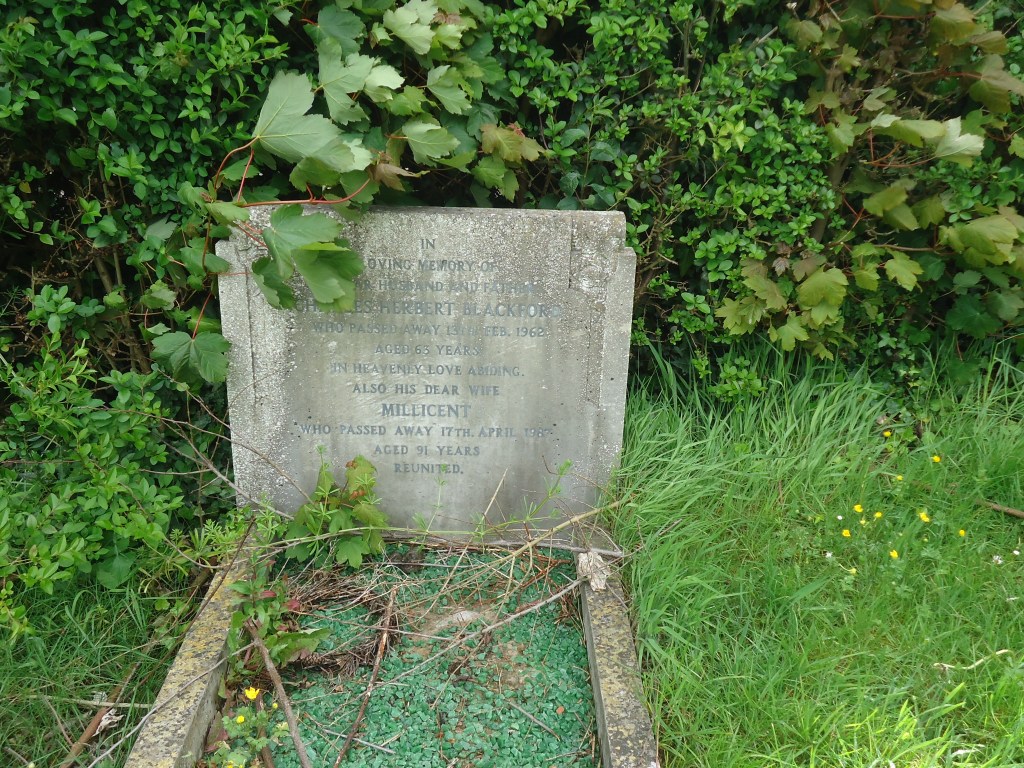
Charles and Millicent Blackford of Poulton Street, Gorse Hill

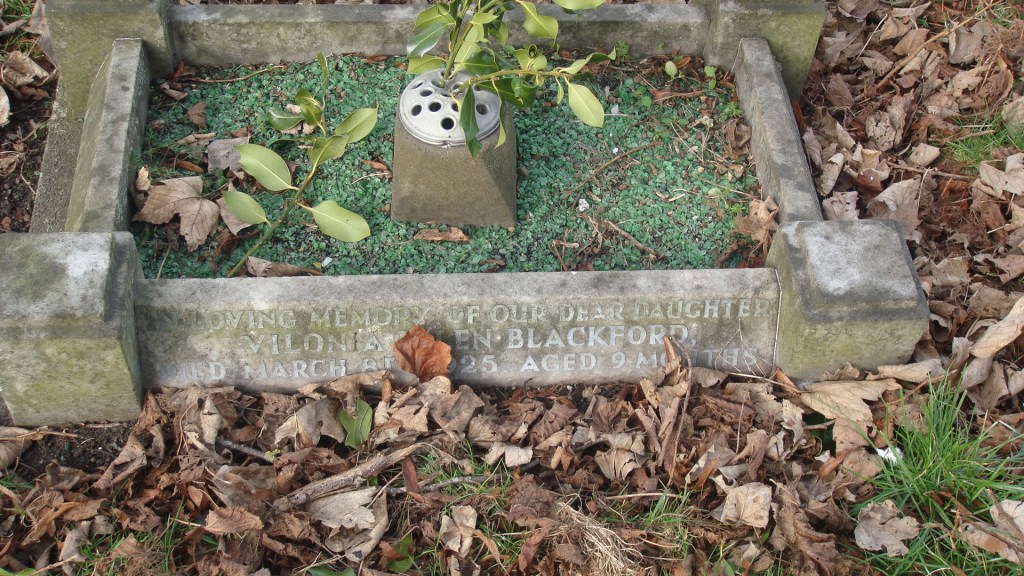
This is the last resting place of Charles and Millicent Blackford.

Charles Herbert Blackford was born on August 8, 1898 in Malmesbury, one of wheelwright and carpenter Daniel Blackford, and his wife Kate’s four children. Millicent was born in Polperro, Cornwall on January 5, 1897, the daughter of fisherman Richard Libby and his wife Ellen.

Charles enlisted with the Royal Naval Reserve in 1916 and served for three years during the First World War. Upon demobilisation Charles joined the GWR. Using the UK Railway Employment Records it is possible to follow Charles’ career on the railways.

He began work as an engine cleaner in January 1919 before quickly becoming a fireman. An entry dated December 14 1920 records that he was making the fire upon engine 3412 when his hand was pinned against a piece of coal. Top of middle finger on his right hand was crushed.

By 1939 Charles was working as a temporary Acting Driver at Didcot, after which he worked as a driver in Swindon. During the Second World War he was working as a temporary Relief Supervisor.

Charles married Millicent Libby in the June quarter of 1923 and the couple had two children, Vilonia and Royston. Vilonia died in infancy. Royston followed his father into the railway works as a coach finisher. Charles and Millicent lived at 23 Poulton Street, Gorse Hill until the time of Charles’ death in 1962. (Millicent may have remained at that address after his death.)

Charles died in February 1962. Millicent survived him by 25 years. She died in 1987 at the age of 91. They are buried together in grave plot C3351-0. This area of the cemetery has experienced some renumbering of the plots, but Charles and Millicent’s grave has an elegant headstone and is easy to find.

The burial of infants depended very much on the parent’s financial situation.  In the past some babies were buried in a family plot, their names added to the memorial at a later date. Others were placed in a communal grave with other babies. Vilonia is buried in this beautiful little grave, close to the path leading to the cemetery chapel.

Lorna Dawes – in her own words Pt 3

Today’s blogpost concludes a series of articles written by Miss Lorna Dawes about her time working ‘Inside’ the GWR Works. These pieces first appeared in the Wiltshire Family History Society newsletter and are published here with the kind consent of Yvonne Neal.

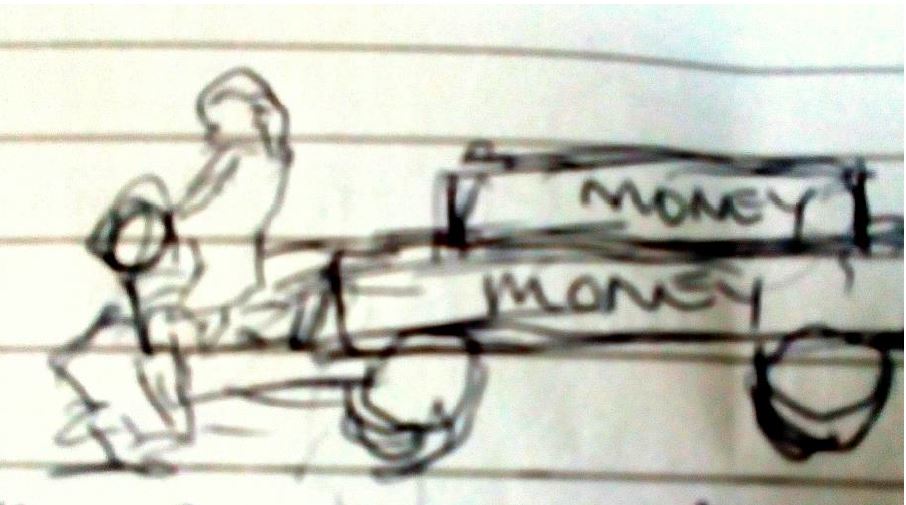
In later years wages were brought from the bank by a man on an open bogie pulling two large boxes contained the cash.

I never heard an attempt to rob.

Lorna’s own sketch

The workmen queued up to be paid but the foremen were paid individually, and I used to go one week to the Loco Works, one week to the Carriage Works, accompanied by a man carrying the box of envelopes and money. We had to go to every shop office and many were upstairs above the workshop. In one workshop on the Loco side the noise almost took your breath away, and had the effect of freezing movement. So much so that you almost couldn’t put one foot in front of the other. In fact, deafness affected quite a few of the workers there. On a wet day, we hated it being the Loco side because of the oil and water hazard. This also applied to the tunnel on a wet day.

Disciplinary hearings were held with all the legal representatives and full reports. I typed some myself.

Long service awards, laid down by years: various items to choose e.g. camera, watch etc. Can’t tell you when this began, but was another of my involvements. I do know there were sometimes upsets because ‘one day out’ meant no award. Large ceremonies took place in the Training School with the Works Manager present.

There was a team of office cleaners. Many were elderly women and some came through the Works from Rodbourne. There was quite a lot of brass to clean! These cleaners did two shifts, early morning, possibly starting at 6.00 a.m., and again in the evening. Seemed a lot – 2 shifts.

There were quite a few cats in the workshops and offices. Unbelievably, a cat had a little of kittens behind a moulding box in the Foundry. The men were really concerned and told everyone to be careful. My Dad was there at the time. When the Works were closed for Trip, it wasn’t unknown for men to gain access to fee the cats.

When the library at the Mechanics closed, the books were sold off and I bought three – about Tibet and Nepal.

In my early days I travelled to work by bus and there were special buses laid on at the Works entrance.

My Dad had no ‘fixed’ bathroom at home and went to ‘the Baths’ after working in the Foundry.

In later years air conditioning fans were introduced in the Foundry but, when my Dad worked there, the only aid, especially on a hot summer’s day, was buckets of water – with something added – BRAN.

Another job I had on Welfare consisted of finding lodgings for men attending Diesel Training School in Emlyn Square. At that time Swindon didn’t have much call for accommodation, apart from hotels, but we found nice places and two were in Beatrice Street.

I guess it was turpentine in those days as we dreaded the window cleaners (rail gang) coming. The smell hung on.

A man from Bristol came to service the typewriters but we had to do our own temporary repairs. One was to tie loose ‘type’ arms with cotton and it did work until the engineer came.

Spring was heralded when an older man messenger, who travelled the Works on a bicycle (such were the distances) came to us in the offices with bunches of pussy willows picked in the concentration yard.

Workers played all sports at the GWR Sports Ground in Shrivenham Road. Teams of clerks and workers against one another. Snooker and billiards were played in the Mechanics.

Weekly repertory meetings were also held in the Mechanics. One group did long spells of different plays each week.

Other activities included:

GWR Male Voice Choir

National Savings Group – a large silver cup was fought over

First Aid Classes and competitions – all lines competed.

Arts and Crafts (Mechanics) from all over the GWR.

GWR Music Festival

Mass x-rays

Blood donations

As for stationery – masses of ‘scrap pads’ were produced and available.

Women were employed in the sewing room, laundry, canteens, casualty centres as well as clerks.

I had to accompany new entrants, and female illness cases, to Park House and ‘sat in’. I also collected water samples and remember one ‘donation’ was in a large-sized HP sauce bottle – full up!

You may also like to read:

Miss Lorna Dawes and a life ‘inside’

Lorna Dawes – in her own words

Lorna Dawes – in her own words Pt 2

Lorna Dawes – in her own words

Last year I published on this blog an article about Miss Lorna Dawes and her memories of working ‘inside’ (that is inside the GWR Works). Yvonne Neal, of the Swindon branch of the Wiltshire Family History Society, has managed to collate the articles Lorna wrote for that Society’s newsletter and has kindly given me permission to print them here. Yvonne also contacted Lorna’s brother Ken who has supplied this photograph of his sister. So, published here in three instalments is a piece of Swindon’s history – Lorna’s story – in her own words.

GWR Memories – Lorna Dawes

Swindon Railway Works grew over many years and became the site of a fantastic organisation, with many sub-sections and with everything needed to support and organise the volume of work, i.e. possibly more than one locomotive a week. Even had its own window cleaners, clock man and master clocks connection to Greenwich time, ambulance, fire engine etc. all in situ.

As a shy 14 year old, I came for interview with my mother, but really wanted to work in a flower nursery, not that there was any work experience in those days.

I joined an army of boy and girl office messengers, some in the main offices and others in workshop offices, dealing with immediate personnel. I ended up in No. 13 Staff Office (see further information below); the hub of the Works and in control of quite a few events all over the West and Wales. One small element was the letting of railway houses and cottages, which included a crossing cottage in the west, which carried the comment ‘water in churns’. It set me wondering at the possible difficulties.

I’ve realised lately that, whilst someone must have introduced me to my job, I actually ended up running it all myself as regards programming. It was extremely busy and most of it physical as I went to so many areas and hardly stopped. It was a job I loved and led on to all kinds of interests, so I never regretted it and I’ve always had friends.

The whole background was a pride-based one and it wasn’t unusual for new engines to bring an admiring crowd along the lines.

The messengers went on to apprenticeships for the boys and office jobs for some of them also, as well as clerical posts for the girls.

I had already started shorthand and typing privately, and it became a condition of work to proceed so I went to night school three nights a week 7.00 pm to 9.00 pm at the college in Sanford Street, which included Commerce, English and Arithmetic. The work-related ones were sometimes taught by men (Clerks) from the Works. I managed 130 wpm shorthand and really loved it.

The only way I was ever given ‘instructions’ was as part of a bell system for individuals, and I was about four or five rings to go to an officer at post time. For instance:

Early morning:   sorted copies of last night’s post and distributed

Every morning:  Bank bags to Railway Bank on London Street

                                Sometimes called into the Railway Union Group in next street, or Railway Club, Bridge Street.

                                On return every day, collected Time Book at main entrance. This contained information on anyone leaving/returning from outside the Works.

                                Then round the offices obtaining signatures to cover reasons given i.e. dentist, surgery, etc.

                                Then made coffee, individual cups for about 25, and washed up downstairs.

I was responsible for obtaining and distributing dusters, towels, soap, string etc. to ‘my’ office, around 25, and sometimes to General Stores, which was between the Main Offices and the Station. It was a large building with three floors and I had to find the correct location.

The Stationery Office and another office was accessed by crossing all the lines in front of the Engine Shed where engines were being shunted and men cleaning. (Graded – cleaner, fireman and then driver.) The Stationery Office had typing paper, some water-marked, ink pens and also confetti from punch cards!

The Duplicating Office was in the wall of the Body Shop. Here there was the traverser hazard and I quite often had to divert. I had to go there a lot and quite often in a rush with special or urgent notices. Printing was slow and with a hand roller, one at a time, which meant I had to wait around.

At Park House I saw drivers with piles of coloured wool which were used to give vital eyesight checks. Yes!! Also went into the cellar for old files, some were accident originals.

At the Mechanics Institute, I had to transport books to and fro between ‘Officers’ who read and vetted books before they were put on display in the Mechanics Library (may be something no one knew).

I took ‘travellers’ to the Loco or Carriage Works and also interviewees to the Carriage Canteen.

Sometimes I was sent to the Loco Canteen, for clerks who needed sandwiches because they had unexpectedly to work overtime. The Loco Canteen was underground and in electric light.

The Works had its own Telephone Exchange – push/pull units.

The Head Messenger’s office, Mr Bill Ferris, was where the postal boxes were kept.

The Storehouse consisted of three floors and was to the rear of the offices. Very creepy there as it was quite often empty except for files.

I also had to go to the Laboratory at Church Place.

The Drawing Offices were on the third floor, main building – you could see Purton from the landings.

The above were my duties, and places I had to go in the mornings. In the afternoons:

                                Make tea and wash-up.

                                Get post signed and despatched – that was very busy

                                Works Cash Office

                                Visit to the fourth floor – no lift, exhausting!

                                Mileage Office – SPL, toilet for older women in this office!

                                Extra jobs would include advertisers and lardies

A little story: I was sent in search of saccharines (sweeteners) for a desperate officer one day after Bank duty!

These are all rough memories but my work seemed to get more and more interesting all the time.

I spoke before about No. 13 Office. The layout in 1945 was:

Boss of Staff Office – Percy Mills

Deputy – Ted Click – in the corner was my bit of desk and a cupboard

Four typists – I was one here, later. One of the typists was a big fan of WEA Hikers and I joined. Another was the daughter of Louis Page, Football Manager. She took me to the Isle of Man, with two others, when I was around 14½.

Then there were row of Clerks.

More than once I passed F.W. Hawksworth, Chief Mechanical and Electrical Engineer, in the tunnel. My wages in 1945 were 18/- a week. (approx. 90p).

I probably have enough to fill my own book with my very wide GWR experiences and, in fact, Rosa Matheson has used a lot of my information. I once gave an hour’s talk to the Railway Lounge Group.

To be continued …

You may also like to read:

Miss Lorna Dawes and a life ‘inside’.

William Henry Gladwin – accordionist

William Henry Gladwin (known as Bill) was born in Malmesbury in 1883, the eldest of three children. His father died when Bill was a child and his mother married two years later. Her second husband was Albert Lea and they went on to have a further six children.

Bill was well known for playing his accordion, even taking it with him to the trenches of the First World War. One of the family stories is that along with entertaining his fellow soldiers, the German soldiers could also be heard singing along to his accordion.

Bill never married or had children, but was much loved by his large family, close to brothers and sisters, nephews and nieces, which makes the circumstance of his burial so surprising and still the cause of a deep family sadness to this day.

Bill was struck by a bus and killed after coming out of Bright Street Club in Gorse Hill on February 19, 1954. His burial took place a few days later, attended by members of his family.

Bill was buried in a public grave. This burial is when a person has insufficient funds to pay for the cost of the funeral and the expense is met by the local authority.

Bill’s surviving family members still find the circumstances of his burial upsetting and surprising and have numerous questions that sadly remain unanswered. They wonder why the large extended family didn’t club together to cover the cost.

Bill left a will in which his effects were valued at £32 14s 9d.

Many thanks to Mandy who told this story on one of our cemetery walks.

Florence Jane Maddocks – Vicar’s wife

There is no doubt Florence Maddocks played an important role in the Gorse Hill community as the wife of Rev Maddocks at St Barnabas Church.

Florence was born in Manchester on January 6, 1856, the daughter of a solicitor’s clerk, William Sherratt, and his wife Sarah Jane. She married Philip Maddocks at St Mary’s Church, Birkenhead, Cheshire on July 6, 1880.

At the time of the 1881 census Philip was curate at St Peter’s Church, Burnley but for some reason Florence was boarding with her baby daughter Florence at the home of Charles Behenna and his wife Winifred at St Oswald in Cheshire.

Ten years later the Rev Maddocks was living at St Barnabas Vicarage, 268 Cricklade Road with his wife Florence and their ten year old daughter Florence Ida Louise. A son, Cyril, was born the following year but died in 1895 aged three years old. A second daughter, Philippa, was born in 1897.

It is sad and frustrating that so little can be discovered about a woman who played such an active role in the Gorse Hill community. Perhaps someone out there knows more about her.

The Late Mrs Maddocks

Funeral on Saturday

Amidst every manifestation of sorrow and regret on all sides, the funeral took place on Saturday last of Mrs Maddocks, wife of the Rev. Philip Maddocks (Vicar of St. Barnabas, Gorse Hill), who painfully sudden death was recorded in our columns last week. The mortal remains of the deceased lady were laid to rest in Swindon Cemetery, alongside the grave of her only son, Cyril, who fell asleep on Feb. 25, 1895, at the age of three years.

Holy Communion was celebrated in St. Barnabas Church, Gorse Hill, at ten o’clock, by the Rev. G.J. Saywell, curate: The organist, Mr. James Gaskell, played “No shadows yonder,” from A.R. Gaul’s “Holy City,” and also a selection from a Requiem of Anderton’s.

The funeral service took place at 12.45 in the same church, and the sacred edifice was crowded with parishioners and friends, anxious to take part in the solemn service. Canon the Hon. M. Ponsonby (Vicar of St Mark’s Church, and Rural Dean), officiated, assisted by the Rev. G.J. Saywell.

After the service at the church, the funeral procession wended its way to the Cemetery, where the last sad rites were performed at the graveside by Canon Ponsonby. Rain fell heavily during the long journey from Gorse Hill, but the sun shone out brightly as Canon Ponsonby solemnly delivered the committal sentences.

The coffin was of polished oak, with massive brass furniture, and the breast-plate born the following inscription:- “Florence Jane Maddocks, died 2nd April, 1902, aged 46 years.” The funeral arrangements were most satisfactorily carried out by Messrs Chandler Bros., of Swindon.

The floral tributes were most numerous and beautiful, and covered the space of two graves.

At St. Barnabas Church yesterday, the services were conducted by the Rev. G.J. Saywell, who made fitting allusion to the great blow the Vicar and the whole parish had received.

Extracts from the Swindon Advertiser, Monday, April 7, 1902.

Henry Charles Cook – builder

St Margaret’s Road published courtesy of P.A. Williams and Local Studies, Swindon Central Library.

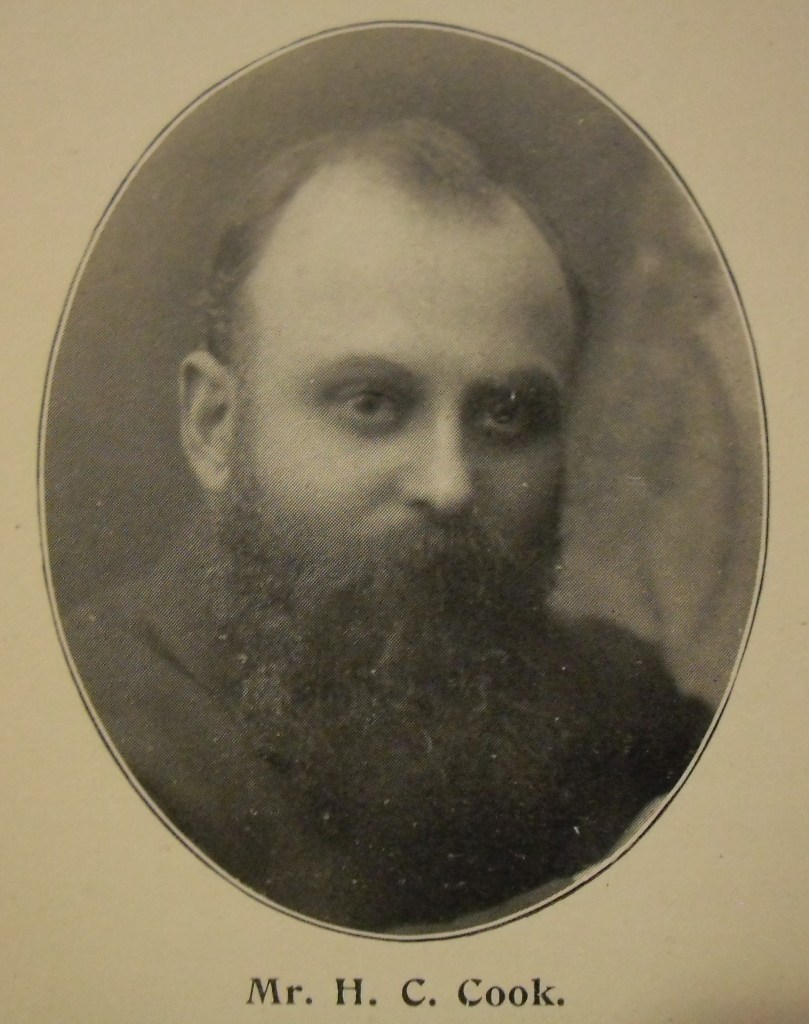
Henry Charles Cook was born in Bledington, Gloucestershire in 1860 the son of Charles Cook, a carrier, and his wife Jemima. By 1881 Henry had moved to Swindon with his mother and her second husband Thomas Smith where the family lived at 19 Prospect Hill. Henry, then aged 21, was working as a plumber and glazier. In 1882 Henry married Elizabeth Jane Carpenter and the couple went on to have three children, William, Daisy and Frederick.

Henry’s building business was soon up and running with projects in progress by 1884. He built numerous properties in Gorse Hill including houses in Florence Street, Omdurman Street and in 1907 he built property in Osbourne Terrace, a new street off Ferndale Road. But he didn’t confine himself to this area of town. In 1897 he was building in St Margaret’s Road and Goddard Avenue and in 1903 he built 23 houses in Devizes Road. During the 1920s Henry’s firm returned to Gorse Hill where they built more than 25 houses in Harcourt Road and another 9 properties just round the corner in Cobden Road.

And like so many men of his generation, Henry took an active part in the civic, political and religious life of the town.

Elizabeth died in 1925 aged 66 and was buried on June 13 in Radnor Street Cemetery plot E8273. Henry died at his home, 59 Broome Manor Lane, ten years later. He was buried with his wife on August 14, 1935.

Death of Mr H.C. Cook

Well Known Swindon Methodist

The death occurred on Saturday night, at his residence, 59, Broome Manor lane, Swindon, of Mr Henry Charles Cook, who for 50 years had been prominent in the business and civic life of Swindon. He was 75 years of age.

Mr Cook came to Swindon as a youth and was apprenticed to the decorating trade. He began in business on his own account as a very young man, later taking up building, and was in business in the town for over 60 years, for a great part of that time at his present premises in Wood Street.

Mr Cook had been an Alderman of the Borough and had served capably as chairman of the Education Committee. He was also active in Methodist circles in the town, being attached to the Regent Street church; he was Circuit Steward for many years, and was a splendid delegate to conference. He was an ex-president of the Swindon Liberal Association.

Mrs Cook died ten years ago, and there are left three children – Mr W.H. Cook, chemist, of Faringdon; Mrs J.B. Hodges, of Andover; and Mr F.C. Cook of Wood street, Swindon.

The Funeral

The funeral took place on Wednesday. The service took place at the Regent Street Methodist Church, and was conducted by the Rev. T. Allison Brown, the interment being at Radnor Street Cemetery.

The principal mourners were Mr and Mrs W.H. Cook Faringdon (son and daughter in law), Mr and Mrs J.B. Hodges, Andover (son in law and daughter), Mr S.C. Cook, Swindon, (son), Mrs Button and Mrs Cull, Swindon (sisters), Mr B.W. Cook, Faringdon, (grandson), Mr K.L.W. Cook, Swindon, (grandson), Messrs W.H. Kent, F. Tucker, W. Smith, E. Liddiard and Covey.

Messrs A.E. Smith and Son, Gordon Road, Swindon, had charge of the funeral arrangements.

Extracts published from North Wilts Herald, Friday, 16 August, 1935

Goddard Avenue published courtesy of P.A. Williams and Local Studies, Swindon Central Library.

You might also like to read

James Spackman – a well known builder and contractor

Thomas and John George – leaving their mark on Swindon

Florence Martha Hinton

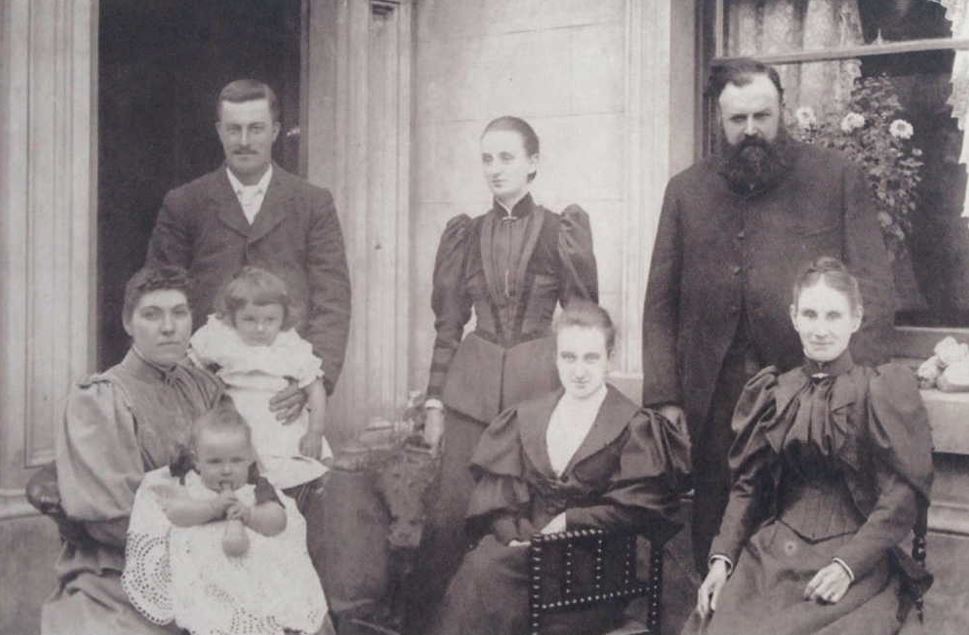
James Hinton pictured with his son’s family (left) and his second wife and two daughters (right)

What job opportunities would have been available to the young Florence Hinton? Unlike the daughters of the railway workers, she would hardly have joined the growing female workforce in the Carriage and Wagon Works. Of course, she might have been employed in one of her father’s several businesses but it seems more likely that she devoted her time to voluntary work with the Wesleyan Methodist community in Gorse Hill.

Florence Martha Hinton was born on December 21, 1872, the elder daughter of James Hinton and his second wife Sarah. Florence was baptised on January 9, 1879 with her sister Mary Ann at a Wesleyan Methodist church in nearby Farringdon.

James Hinton was a typical Victorian entrepreneur. During his lifetime he had several successful careers and was a prosperous landowner, a local politician and served as Mayor of Swindon in 1903/4. When he died in 1907 James Hinton left £18,910 worth approximately £2m today. But what kind of life did his daughter Florrie lead?

We discover most about Florrie’s life from a detailed obituary published in the Swindon Advertiser at the time of her death.

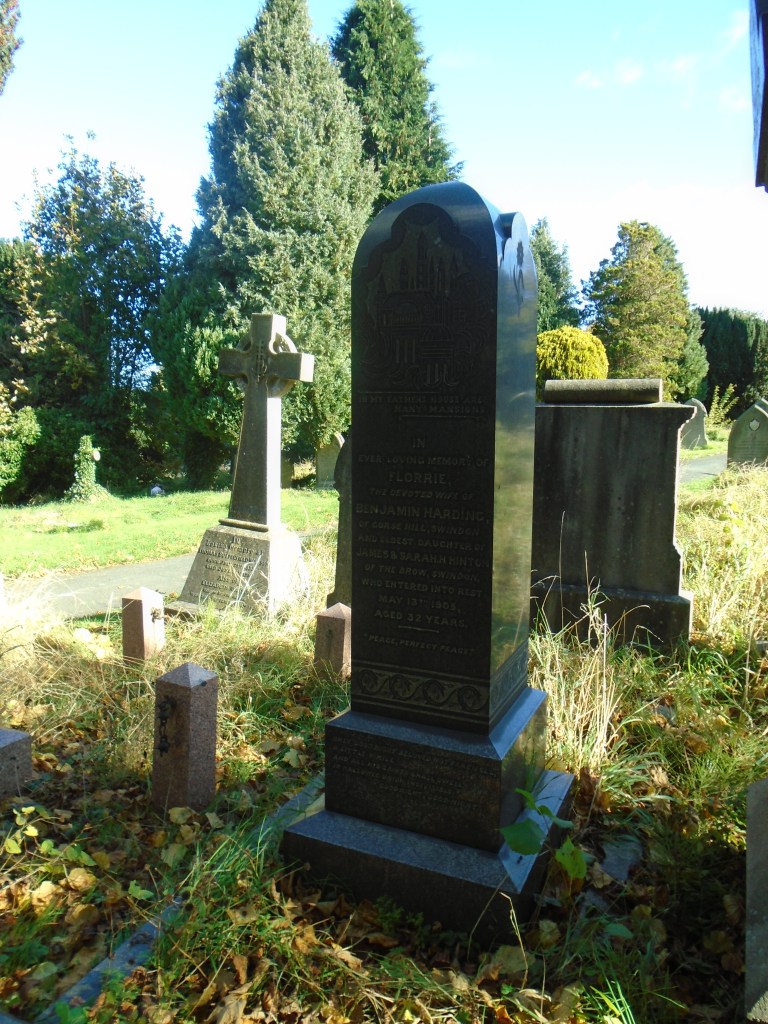
Florrie married Benjamin Harding, another business man and local politician, at the Presbyterian Church, Swindon on October 30, 1895. At the time of the 1901 census the couple were living at 35 Cricklade Road, Gorse Hill. Benjamin describes himself as a corn dealer and the couple employed 19-year-old Jane Gage as a servant.

At the time of her death in 1905 Florrie and Benjamin were at “Parkfield,” St Brannocks Road, Ilfracombe in Devon but her body was returned to Swindon for burial. The funeral took place from her parent’s home, The Brow, Victoria Road on what was described as a beautiful day where “a very large number of people attended the funeral on foot” and proceeded to Radnor Street Cemetery. The funeral service took place in the cemetery chapel which was filled with some of the mourners having to stand outside. The funeral report continued:

“At the graveside the ceremony was even more impressive, since the large crowd waiting patiently without was able to participate in the service.”

Among the mourners were members of the Gorse Hill Wesleyan Choir and the Wesleyan Sewing Meeting along with many Gorse Hill residents “the scene of so many of the deceased lady’s ungrudging labours, and where she was held in such loving esteem by all who knew her.”

Florrie was buried in plot E8278, close to the cemetery chapel. Her father James died two years later and is buried in the adjacent plot E8279 where her mother was also buried when she died in 1926.

Within four years Benjamin had remarried and was living in Gorse Hill with his second wife Ethel and their two children. He died in 1934 and was buried with Florrie.

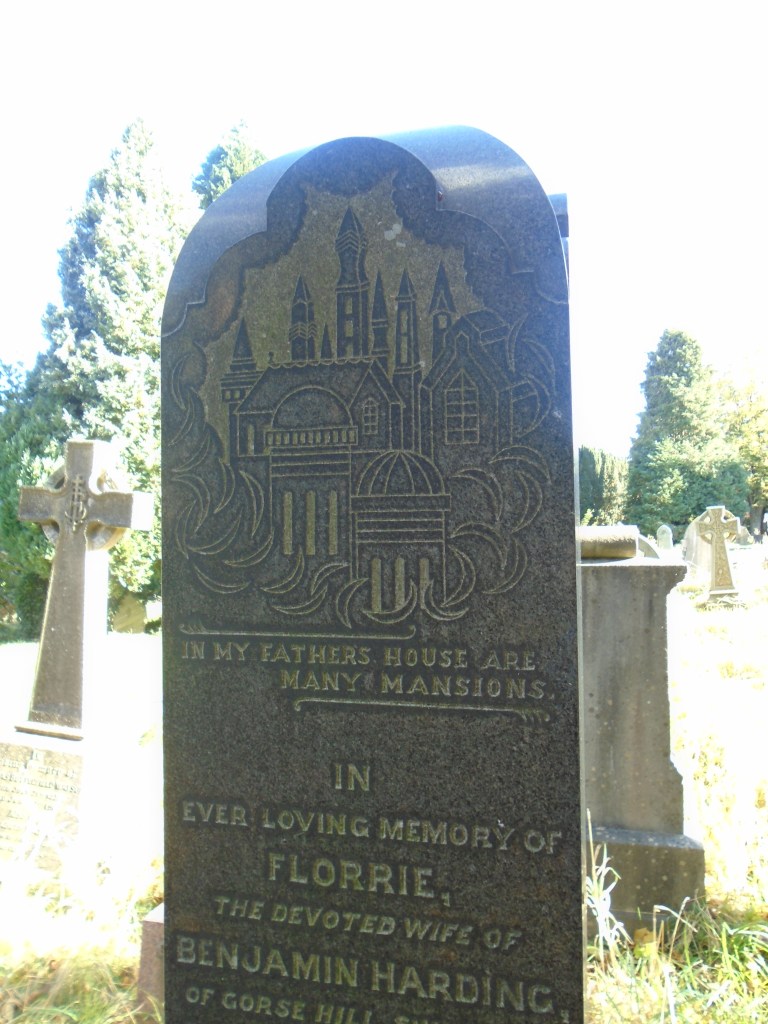
The elaborate, black marble monument has an engraving of towers and rooftops and an inscription that reads “In my Father’s House are many mansions.” Florrie is also remembered in Gorse Hill in the naming of a street built by her father – Florence Street.

James Hinton – a return visit

So, what did James Hinton ever do for us? Not me personally, but Swindon in general. Here is a quick resume of the roles he played in both his personal life and his public one.

Published courtesy of Local Studies, Swindon Central Library.

He was born in 1842 in Newport Street, Swindon but grew up on the family farm at Wanborough. In 1860 he married Sarah Ann May and the following year the couple were living in Lambourn where he worked as a Corn, Seed and Flour Factor. He next worked as a butcher, first in Longcot and then in Wroughton. Sarah died in 1870 and after his second marriage to Sarah Honor Whiteman he moved back to Swindon and emerged on the Swindon scene as a businessman of considerable influence.  A builder and brick maker he soon became an auctioneer with premises in Regents Circus. He was a railway entrepreneur, a Freemason and a Forester, New Swindon Local Board member, Alderman and Mayor of Swindon in 1903. 

But his biggest legacy has to be the numerous properties he built across the town, which still survive to this day. Perhaps his two largest building projects were the development in Kingshill where he laid out the Mount Pleasant housing estate in 1877, building 35 houses in 1878. In 1879 he laid out land between Dixon, Stafford and Clifton Streets where he continued to build in 1883 and 1884. In 1881 he built a brick kiln in Kingshill, obviously to keep up with the demand for bricks while work continued. In 1889 he began work on the Gorse Hill Farm housing estate, meanwhile continuing with further projects across both New and Old Swindon.

published courtesy of Local Studies, Swindon Central Library

There can be no denying that James Hinton made a tidy penny for himself. After his death in 1907 his effects were valued at £18,910 4s 1d (worth today approximately £2.1m) but without his investment in the fabric of the town it is questionable that it would have developed so extensively or so rapidly as it did in the 1870/80s.

James Hinton died in 1907 and is buried in Radnor Street Cemetery with his wife Sarah who died in 1928.