Nellie May Page – killed in WWII air raid

The cities of London and Bristol were heavily bombed during the Second World War yet Swindon, somewhere in between, went relatively unscathed. Despite its dominance within the railway industry it appears that Swindon was not on the Luftwaffe radar. There is a theory that Hitler was preserving the railway network for when he invaded Britain.

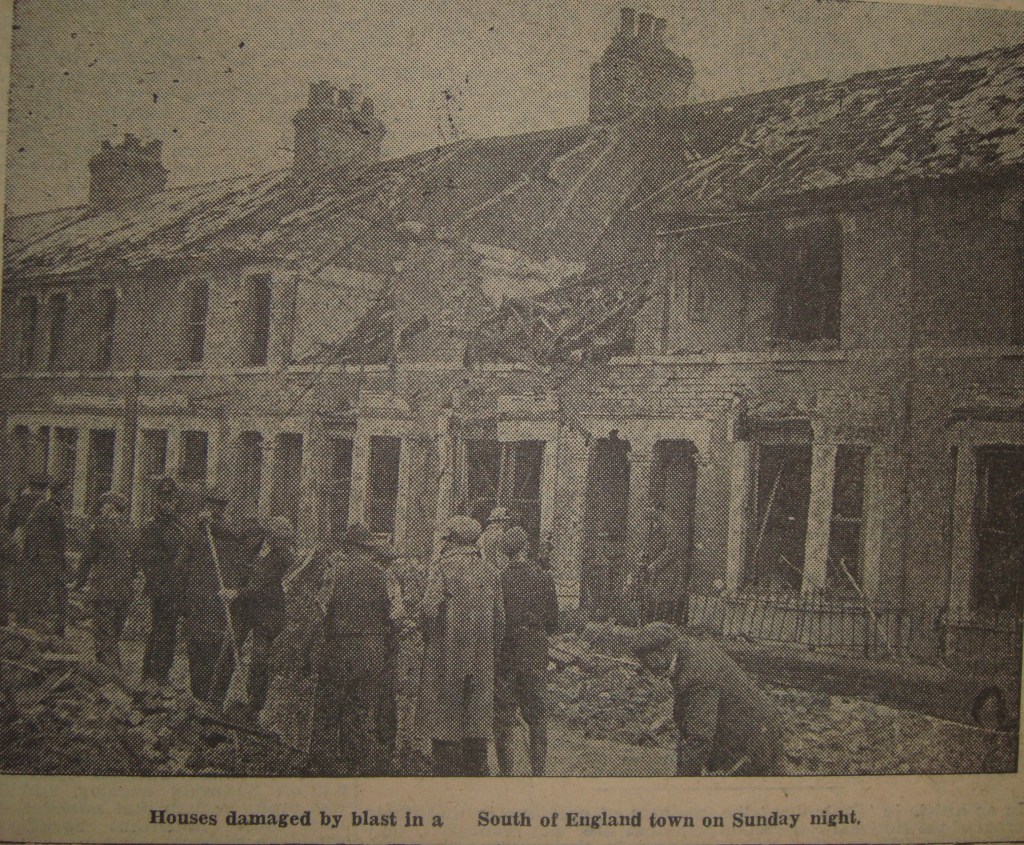
On the night of October 20, 1940 a lone bomber dropped three bombs (two high-explosive and an incendiary bomb) on the town, causing significant damage on Rosebery and Graham Streets in Broad Town. There were 10 confirmed fatalities, including Nellie May Page who lived at 35 Graham Street but was visiting friends in Rosebery Street that fateful night.

Workers’ Houses Wrecked

People Killed by Bombs in South of England Town

Having regard to the damage to working class houses caused by two heavy high explosive bombs that dropped on a town in the South on Sunday night, the casualties were comparatively few.

In one street six adjoining houses collapsed when a heavy bomb crashed through the roof of one. The second bomb dropped in the middle of a road in an adjoining street, leaving another huge crater and almost completely demolishing three houses.

The explosion threw the uppermost part of about a dozen houses out of the perpendicular. Pieces of masonry, rafter timber and other debris were rained down over a wide radius, holing roofs in many places and doing extensive damage.

Despite this damage fatal casualties were few. One of the persons killed was Mrs. Nellie May Page aged 47, who was visiting friends at the time. Her daughter, Miss Sylvia Joan Page, who was with her, was taken to hospital suffering from severe head injuries and shock.

Fractured Gas Main

An oil bomb which struck the rear of one house, partially wrecked the scullery and living room. A fire was started here, but it was dealt with very effectively by the fire-fighting services, and extinguished before it could get a hold. Gas from a fractured gas main also caught alight, but here again the brigade quickly had the situation in hand.

The situation provided a severe test for the various ARP services and police, but they all acquitted themselves remarkably well. Demolition and rescue squads, as well as first-aid parties and medical men, were at hand extricating residents trapped deep down in the wreckage and attending to the injured.

In Good Spirit

Gallant work was done by wardens and ambulance men, and they recount how two young girls were liberated, almost unscathed, from beneath a completely wrecked house. Falling beams had apparently prevented them from being crushed to death, and the rescuers were surprised to find that they were not only unhurt but in good spirit. One asked for a drink and when offered a flask of water observed, with a smile, “Is that the best you can do?”

Generally, the inhabitants displayed great fortitude and calmness, and seemed to be more concerned about the welfare of their neighbours than of their own interests.

Rapid headway was made in clearing away the debris. There were plenty of volunteers for the work of salving furniture and other belongs, and, in the same way, those whose homes were not so severely damaged found plenty of helpers to assist in covering up broken windows and doorways.

Extracts for the North Wilts Herald  Friday 25 October 1940.

Wartime publishing restrictions prevented newspapers from identifying the town and street names.

Nellie was born on June 4, 1893, the youngest of five children. Her father William James Hopkins worked in the Carriage and Wagon Works. When Nellie was baptised at St. Saviours on July 16, 1893 William and his wife Emma and their children were living at 78 William Street.

Nellie married at St. Marks on September 25, 1915 during the First World War when her husband Francis Vernon Page was serving in the RAMC.

Nellie was buried in grave plot E7491 with her husband Francis who died in December 1935.

William Henry Selby – honourable in all his dealings

Many of the men who built Swindon were incomers to the town, but William Henry Selby was homegrown.

William Henry Selby was baptised at Holy Rood, the old Swindon parish church in the Lawn, on April 27, 1834, the son of Thomas Selby, bricklayer and his wife Mary. On the 1841 census the 7 year old boy is living in Dammas Lane with his parents and four siblings, Daniel 8, John 5, Jane 4 and 3 months old George.

William followed his father into the building trade, working as a stonemason. In 1863 he married Mary Ann Saddington, a domestic servant working for the Goddard family at the Lawn at the time of her marriage. In 1871 the census reveals the couple were living at William’s boyhood home with his widowed mother and their own three children. William would live his whole life in the house where he was born.

William’s name first appears in trade directories in the 1870s and across the years his sons Albert Henry and George Alexander Selby would join him in the business. Between 1896 and 1900 the family business built more than 50 houses across both Old and New Swindon from St. Margaret’s Road and Goddard Avenue to Graham Street and Rosebery Street.

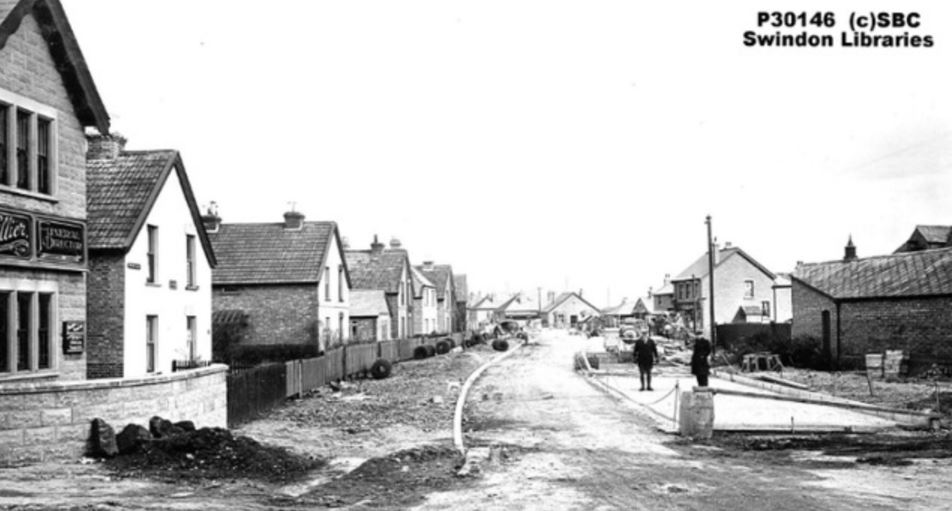
Image of St Margaret’s Road published courtesy of Local Studies, Swindon Central Library.

William died April 14, 1899 aged 66 years. He was buried in plot E8088 on April 19, which he shares with his son George Alexander who died in 1923 and Julia Barnett, possibly a family member, who died in 1953 aged 91 years.

Death of Mr W.H. Selby

Another link between the Swindon of the past and that of the present has been snapped by the painfully sudden death of Mr W.H. Selby, builder. Mr Selby had not enjoyed the best of health of late, but he moved about with his wonted activity, and his friends did not entertain any forebodings. About 9.30 on Friday night, however, Mr. Selby was taken ill in Victoria Street, and within a few minutes he had breathed his last. He was assisted in the direction of his home as far as the Goddard Arms Hotel, where, in view of his condition, it was thought advisable to complete the journey in a cab. Mr Selby was accordingly driven home, where he expired in the course of half an hour, his death having been brought about by a paralytic stroke. The deceased’s figure was very familiar in Swindon, and the news of his death will be heard with great regret. Three generations of Mr Selby’s ancestors have been associated with Swindon, and have carried on successful businesses as builders in the town; and Mr Selby himself well perpetuated the tradition, winning much respect as a tradesman of the best type, upright, faithful, and honorable in all his dealings. Deceased was an enthusiastic horticulturist, and did a lot of hard work as a member of the Swindon Horticultural Society. His chief hobby was fruit and flower growing, and the success of his efforts in this direction may be gauged by the fact that he has won numerous prizes at the Crystal Palace shows against the strongest opposition. His local triumphs have been almost innumerable.

The interment took place on Wednesday at the Cemetery amid many tokens of sorrow and regret. The cortege left deceased’s residence at three o’clock, and proceeded to Christ Church, where the service was read by the Rev N.E. Howe (vicar). The procession then wended its way to the Cemetery, where the last solemn rites were performed by Mr. Howe. The principal mourners were Mr. T. Selby (brother) and Mrs T. Selby, Miss Annie Selby (sister). Messrs Albert, George and Lewis Selby (sons), Miss Louisa Selby (daughter), and Mr and Mrs Smith (cousins). A large number of friends followed. Wreaths were sent by the family, Mr Wheeler, Mr and Mrs F. Williams, Mr and Mrs Fenton, Mr and Mrs Day, Mr and Mrs White, Mr and Mrs Croad, Mr and Mrs D. Lane, Mr and Mrs Cockbill, Miss Kinneir, and the Committee of the Swindon Horticultural Society. The coffin was of polished panelled elm, with massive brass fittings, bearing the inscription, “William Henry Selby, died April 14th, aged 65 years.” The funeral arrangements were satisfactorily carried out by Mr F.J. Williams, acting for Mr. J. Williams.

North Wilts Herald, Friday, April 21, 1899.


Whitworth Road and the Broadway pictured during the 1930s when William Henry Selby’s firm was building a house for N.L. Selby in 1937. Published courtesy of Local Studies, Swindon Central Library.