Mark Sutton

Join us tomorrow (Sunday November 12 at 2 pm) for a Service of Remembrance in Radnor Street Cemetery when we will commemorate all those who have died in war and as a result of their military service. We will also be unveiling a plaque dedicated to Mark Sutton.

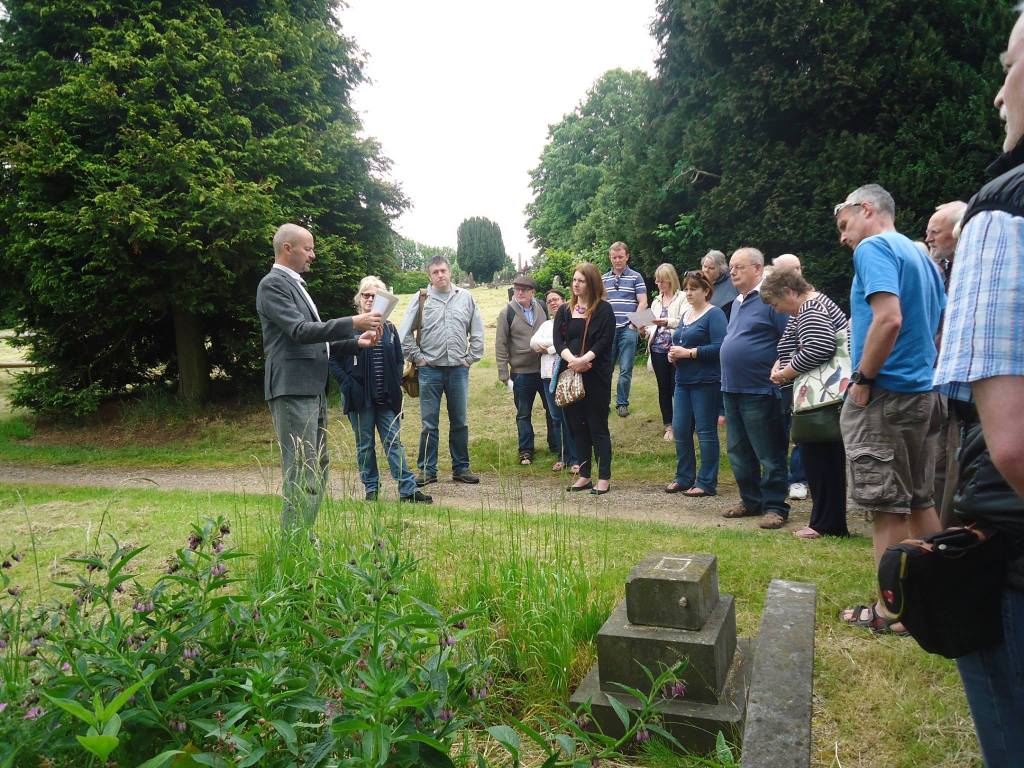
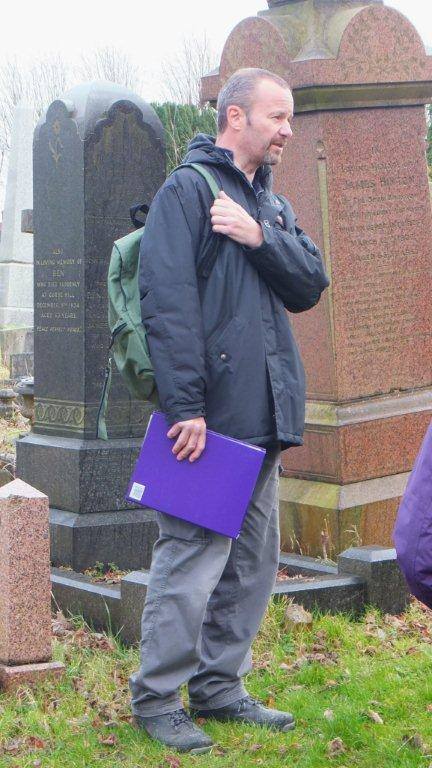
Radnor Street Cemetery was a very special place to Mark. For many years he conducted guided walks around the war graves, remembering the Swindon men who served in the Great War.

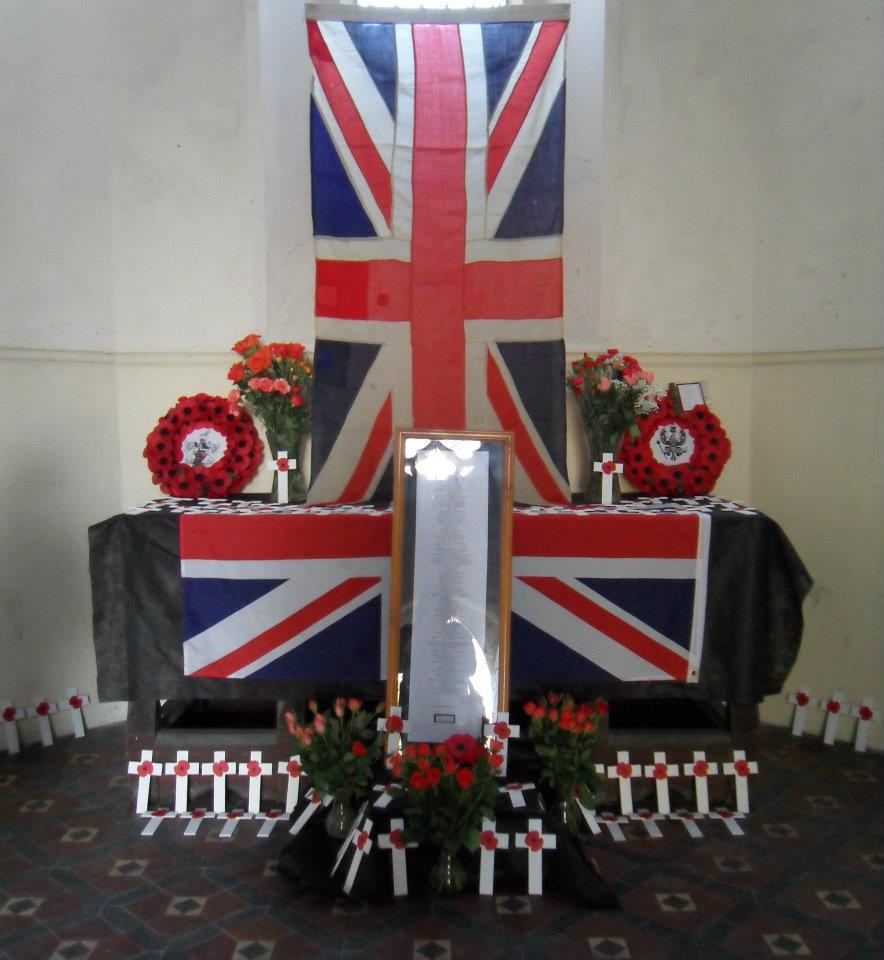
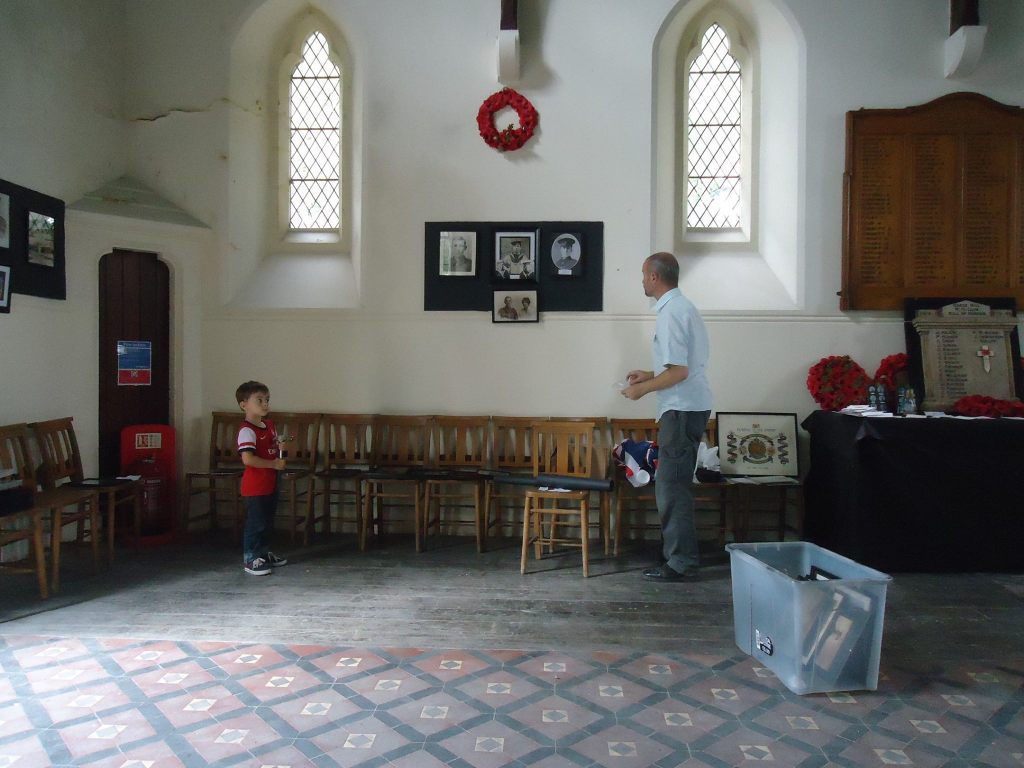
He organised the Remembrance Day Service at the cemetery conducted first by his father Dennis and later by the clergy from St. Marks, and he maintained the cemetery chapel where he saw the installation of several memorial plaques.

Mark was an inspiration and a friend and will always be remembered here at Radnor Street Cemetery.

Air Mechanic 1st Grade Charles Henry Wiltshire

This is the last resting place of Charles Henry Wiltshire, one of 104 war graves here in Radnor Street Cemetery.

Charles was born in 1897, the youngest of ten children. His father William was an engine driver and in 1901 the family lived at 32 Regent Circus. In 1911 the family were living at 57 Eastcott Hill. On the census of that year Mary Ann declared that the couple had been married 32 years and 2 of their 10 children had previously died. She could hardly have anticipated the war that was to follow and the loss of yet another child.

Charles’s service records date from May 1, 1916 when he enlisted as an 18 year old. At the time of his death he was an Air Mechanic First Class in the Royal Naval Air Service.

Charles was invalided out of the Royal Naval Air Service on September 1, 1917. His service records state that he was suffering from tuberculosis caused by his military service. He died on October 16, 1918 at the family home, 39 Commercial Road. He was buried on October 22 in grave plot A2459 and later awarded an official Commonwealth War Graves headstone. He is buried with his father William who had died in 1913 and escaped the fear of seeing his young son in service during war time.

Charles’s mother, Mary Ann, was buried with her husband and son following her death in 1927. The last person to be buried in this grave was Winifred Jessie Wiltshire, William and Mary Ann’s daughter, who died in 1948 following yet another world war.

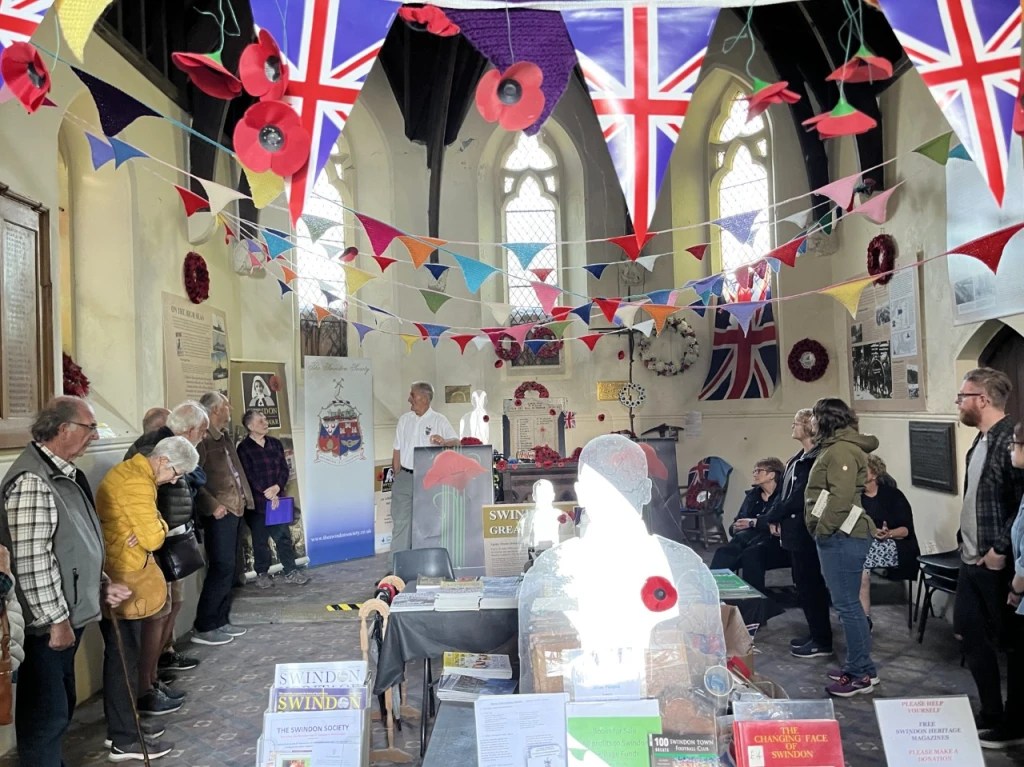
The story of Charles Wiltshire was remembered at our recent special event at the cemetery.

You may like to read:

The Airspeed Oxford propeller unveiled

#TellThemofUs

#MarkSutton

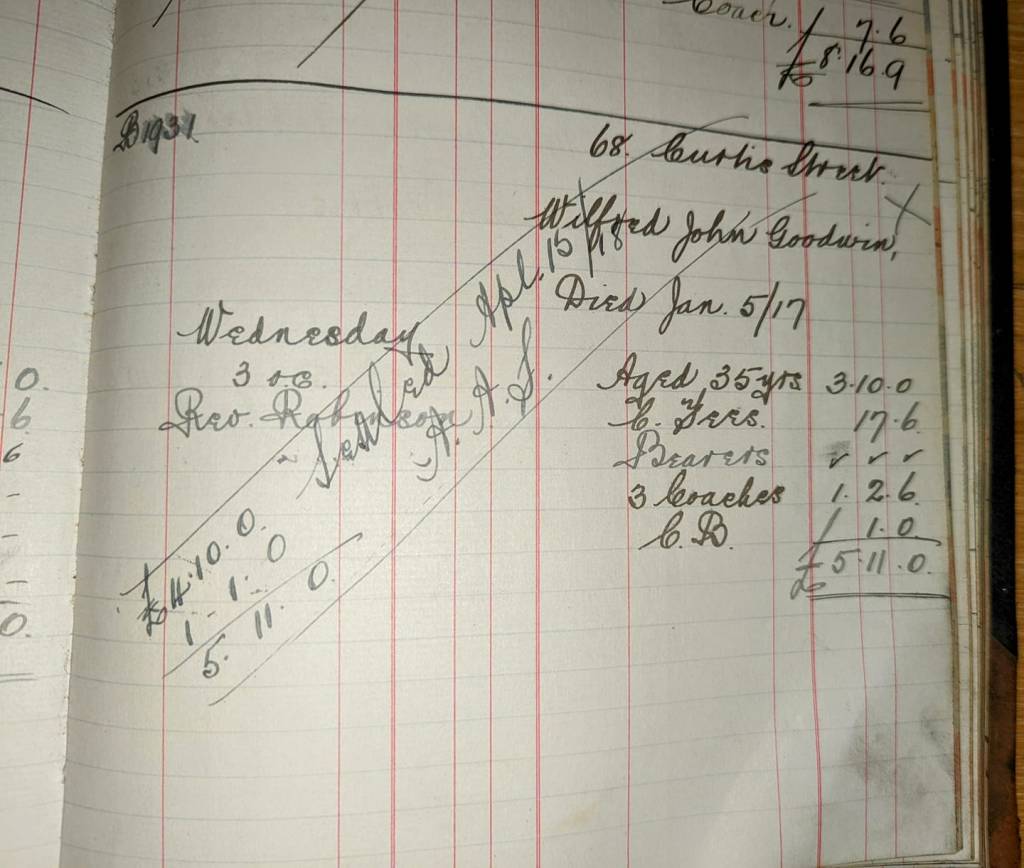
Lance Sergeant John Wilfred Goodwin – Tell Them of Us

Following yesterday’s Remembrance Day service in Radnor Street Cemetery we continue with our series of stories – Tell Them of Us.

Sometimes it can be frustratingly difficult to find out much information about the soldiers buried beneath the Commonwealth War Graves headstones in Radnor Street Cemetery.

Local and military historian Mark Sutton had a vast knowledge of all aspects of the Great War and during our guided cemetery walks was able to describe details about the action in which the soldiers had been involved. Quoting from his book Tell Them of Us Mark tells us that John Wilfred Goodwin was a Lance Sergeant in the Welsh Horse Yeomanry and that he died on January 5, 1918 aged 35 years.

John Wilfred Goodwin was baptised at St John the Evangelist, Farnworth, Lancashire on February 12, 1882, the eldest of James and Elizabeth’s five sons. James worked as a grocer and in 1891 he was Manager at the Co-operative Stores in Bisley, Gloucestershire.

In 1899 John Wilfred enlisted with the Royal Artillery. He was 18 years old. However, by the time of the 1911 census, twelve years later, he had left the army and was lodging at 68 Curtis Street and working as a grocery assistant.

As a former member of the regular army he would have been on the reservist list and recalled for service when war broke out in 1914. Unfortunately his military records have not survived, but we do know that he was discharged on Jul 21, 1916 due to a disability.

John’s last address in January 1918 was at his former lodgings 68 Curtis Street. The funeral took place on January 9 when John was buried in grave plot B1931. His initials were incorrectly recorded as W.J. Goodwin in the burial registers, but even a search under this name does not reveal any further information.

We would like to purchase the death certificate of the people we research, but sadly with the amount of research we conduct this is impossible.

John’s youngest brother, Samuel Colin Roy Goodwin, served with the Somerset Light Infantry and survived the war. He later emigrated to Australia following elder brother Josiah, and served as a Leading Aircraftman with the 13 Aircraft Depot, Melbourne during WWII.

Image kindly provided from the funeral records of A.E. Smith & Son, Funeral Directors

#TellThemofUs

#Mark Sutton

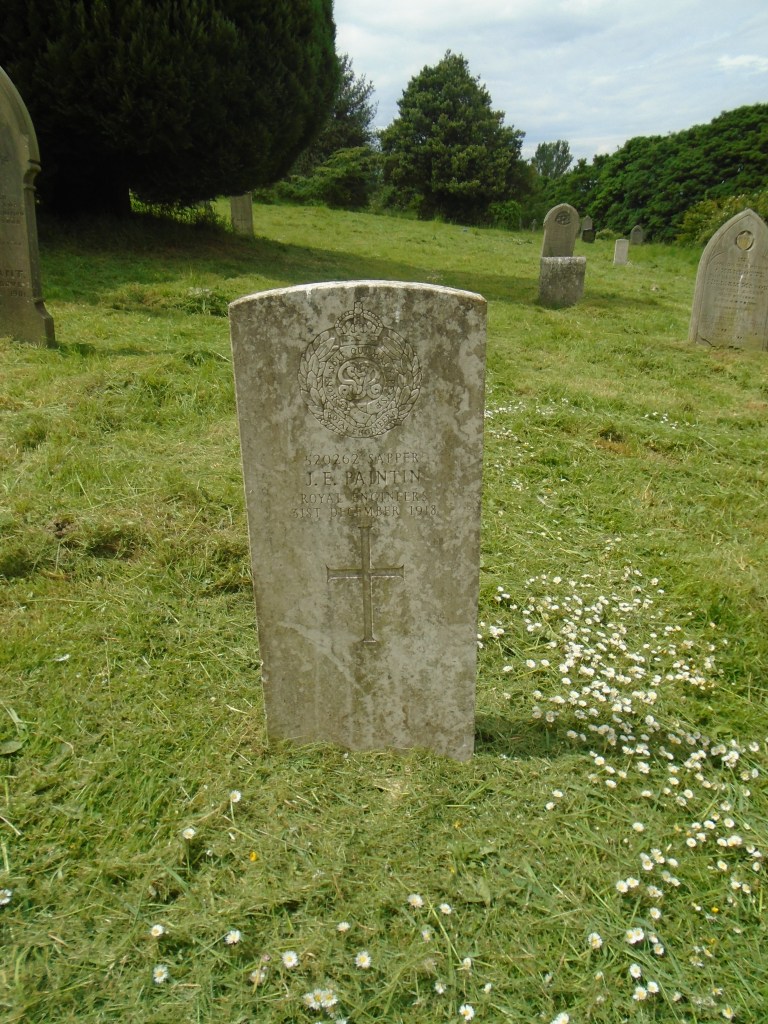
Sapper J.E. Paintin – Tell Them of Us

John Edward Paintin was born on September 6, 1883 and baptised at the ancient church of St. Aldgate, Pembroke Square, Oxford. He was the second of six children born to John Edward Paintin Snr and his wife Julia Betsey.

In the summer of 1906 John Edward jnr married Florence Alice Hazlewood. In 1911 the couple lived with their two young children (a baby had recently died) at 54 Sunningwell Road, Oxford. But by 1913 the family had moved to Swindon and were living at 84 Beatrice Street. John had arrived in Swindon not in search of a job in the GWR Works but as an attendant in the Electric Palace [cinema] in Gorse Hill. A daughter Dorothy Lorna Mary was born on May 3, 1913 and baptised on July 12 at St. Barnabas Church, Gorse Hill. A last child, Gordon, was born and died in 1917.

It is likely John was conscripted in 1916 but unfortunately his military records have not survived and we only know the briefest details about his service from the UK Army Register of Soldiers’ Effects 1901-1929. He died on December 31, 1918 at the Military Hospital, Chiseldon. The hospital was established at the training camp in June 1915 and was soon receiving casualties from the battlefields in France and Flanders. The hospital opened with six wards and 24 beds but was soon extended and supplemented with tented accommodation. By 1917 an additional hospital was built on the site, reserved for patients suffering from sexually transmitted diseases and known locally as the ‘Bad Boys’ Camp.’

John Edward Paintin was buried in Radnor Street Cemetery on January 6, 1918 in a public grave with four others. His last address is given as 15 Handel Street. He was 35 years old.

Florence Alice quickly remarried, as did many young war widows with a family to support, but she was sadly misled by her second husband. Austin Oliver Rogers was a Corporal in the South African Native Labour Corps and the couple met while he lodged with Florence awaiting demobilisation. They married on April 7, 1919 and sailed for South Africa that September. But when they arrived at Barberton in the Eastern Transvaal, Florence discovered Austin’s circumstances were not as he had described. He had promised her that he was well off and that he could provide for her and her children, giving her boys a college education. But the reality was quite different. Austin and his widowed mother lived as tenants on a small farm. The marriage broke down because Austin’s mother refused to accept Florence and her children.

Florence left the family home, placing her children in lodgings, but despite her best efforts and working two jobs her three younger children ended up in a children’s home. Florence died in 1925 in the Johannesburg General Hospital as a result of pneumonia contracted in hospital following an appendectomy.

The two sons that John barely knew both joined the military in their adopted home of South Africa. Edward James joined the SAMC Active Citizen Force later enlisting with the South African Permanent Force.

Swindon Society Summer Outing

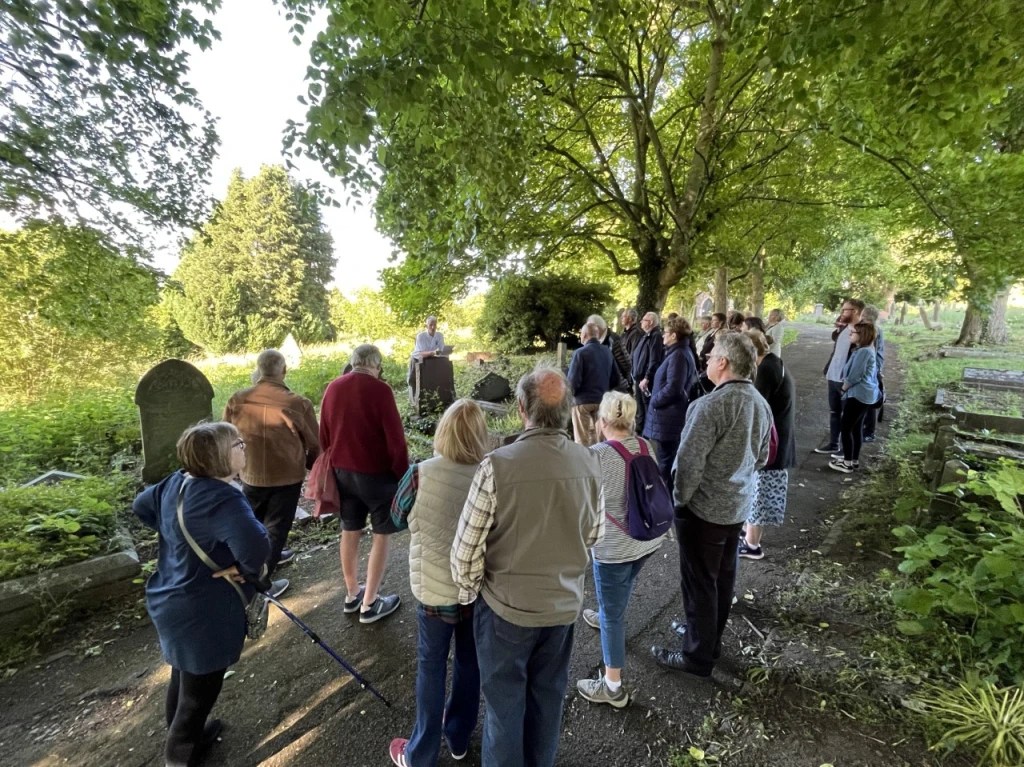
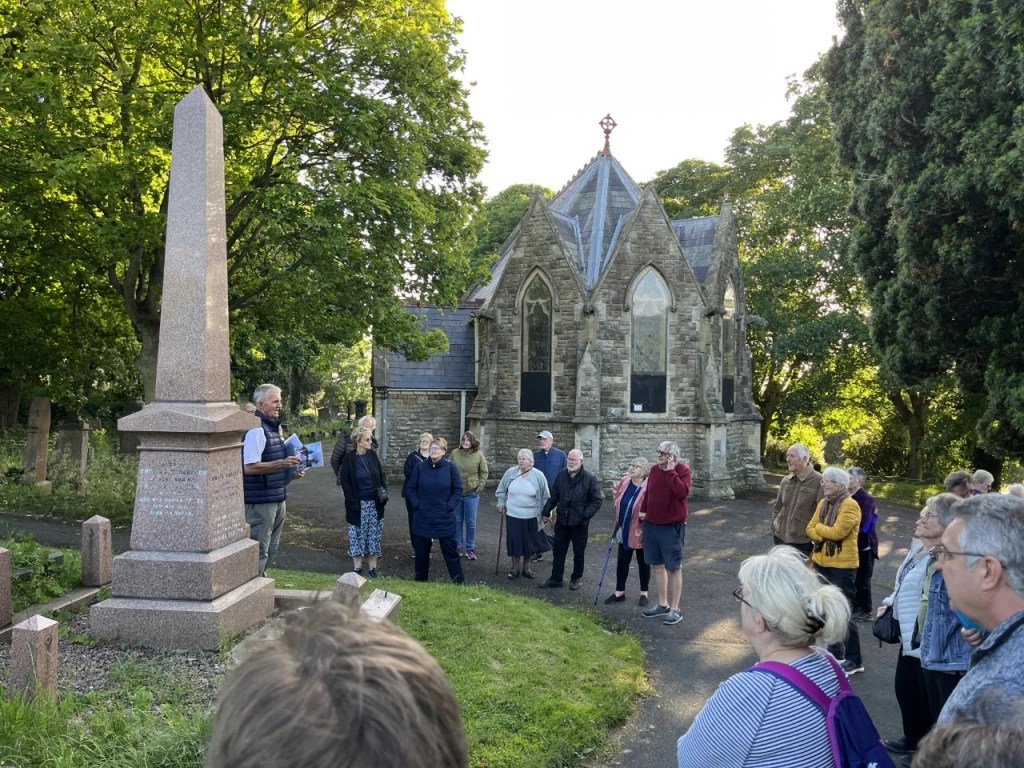
We were delighted to welcome members of the Swindon Society to a guided cemetery walk yesterday evening. And although there was a chill in the air, it was a sunny evening with beautiful views across the cemetery. There is always a different atmosphere during a summer evening cemetery walk, something we have not attempted for several years now. Perhaps it is an event we will consider holding again.

The Swindon Society celebrates its 50th anniversary in September. While other local history groups in Swindon are struggling with falling numbers post Covid restrictions, the Swindon Society is thriving. Yesterday marked the end of their season of talks for a brief summer break before gearing up for their 50th celebrations.

More than 30 members joined us for our walk and heard stories about Emily Peddle, W.J. Nurden (the latest CWG headstone to be erected in the cemetery) and William Harvie inventor of the amazing Multiple Cake Cutting Machine. We later adjourned to the Ashford Road Club who kindly provided tea and biscuits alongside their usual bar facilities.

Thank you to Graham Carter for the photographs.

James ‘Raggy’ Powell – one of nature’s princes.

The re-imagined story …

My father loved a bargain. Our house was full of them. But sadly, everything he bought home was broken and he wasn’t what you’d call ‘handy.’ In a town full of men who could make and mend anything, usually ‘on the quiet’ in the Works, my father was the exception.

“They can see you coming,” my mother said. She was the fixer in our house.

My mother loved a bargain too and as fast as the battered and broken objects came into our house, mother got rid of them.

“Is that Raggy on his rounds,” she would call to me at play in the street. “Ask him to stop by.”

Raggy regularly came round the streets with his horse and cart, ringing his bell, buying the flotsam and jetsam of people’s lives.  He would take most items, a bit like my father, and he always gave mother a fair price. He particularly liked a painting in a broken frame she sold him. That was the only thing father was ever really angry about, that painting of the Old Parish Church.

“I was going to mend the frame and hang it in the front room.”

Mother raised her eyebrow. We both knew he would never have got the job done and the painting would have stood in his shed behind the door forever.

“And if you don’t do something with the marble maiden in the garden, I’ll see what Raggy will give me for that as well,” mother threatened. “Blooming thing gives me the creeps.”

Image published courtesy of Local Studies, Swindon Central Library.

The facts …

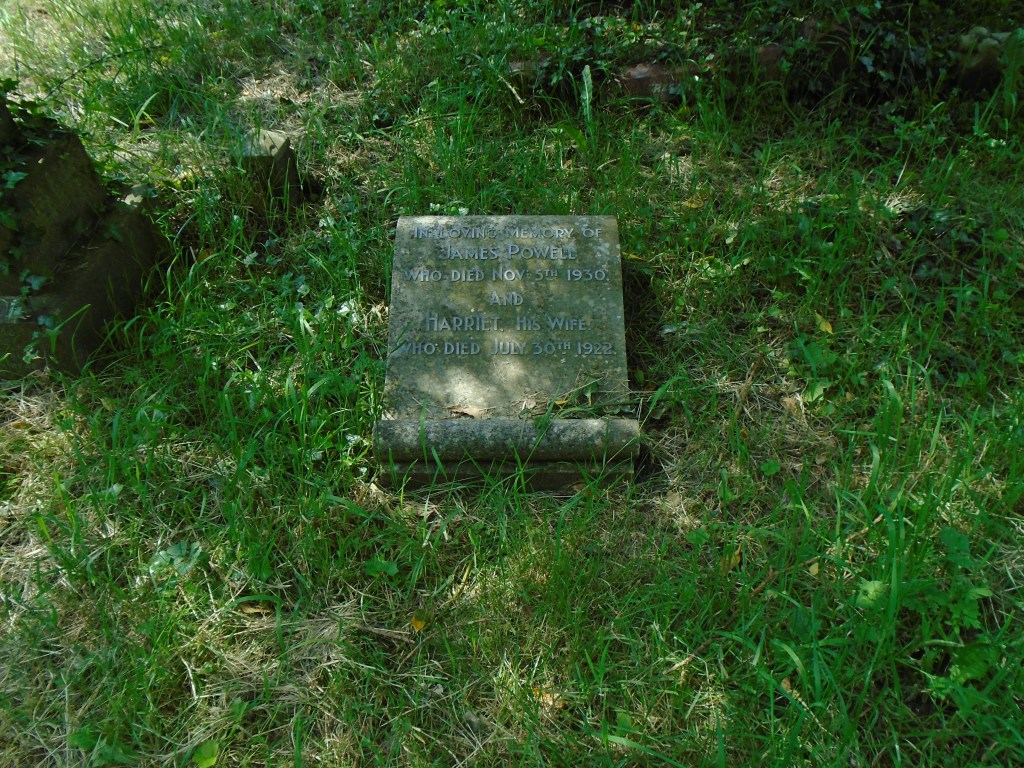
Little is known of the early life of James Powell who was born in Dublin in about 1850. It was previously thought he had not arrived in Swindon until the 1890s but he is found living at 15 Rolleston Street with his parents and five boarders at the time of the 1871 census. Then aged 21, James was working as a hawker, another word for an itinerate street seller. James never moved far from the town centre. In 1881 he and his first wife Theresa lived over a green grocer’s shop at No 1 Byron Street. Theresa Clancey Powell died in 1889 and she is also buried in Radnor Street Cemetery.

By the 1890s James had set up home in Regent Close where he worked as a Marine Store Dealer. This was the name given to a licensed broker who bought and sold used rags, timber and general waste material; a rag and bone man, an occupation that earned him the nickname Raggy. In 1891 he married his second wife Harriet Maggs, a widow with two children, and it is with her that he is buried in Radnor Street Cemetery.

James had received little education but he constantly sought to improve himself by attending lectures at the Mechanics’ Institution and he turned to that other great champion of the people, Reuben George, who taught him how to read.

Although James was uneducated he appreciated the pieces of artwork he came across on his rounds, repairing broken frames and putting the paintings in good order before donating them to Swindon’s first museum housed in a former Catholic Church called Victoria Hall in Regent Street. Paintings by local artists George Puckey, John Hood and David Gaddon, donated by James still form part of the collection once housed in the Swindon Museum and Art Gallery in Bath Road.

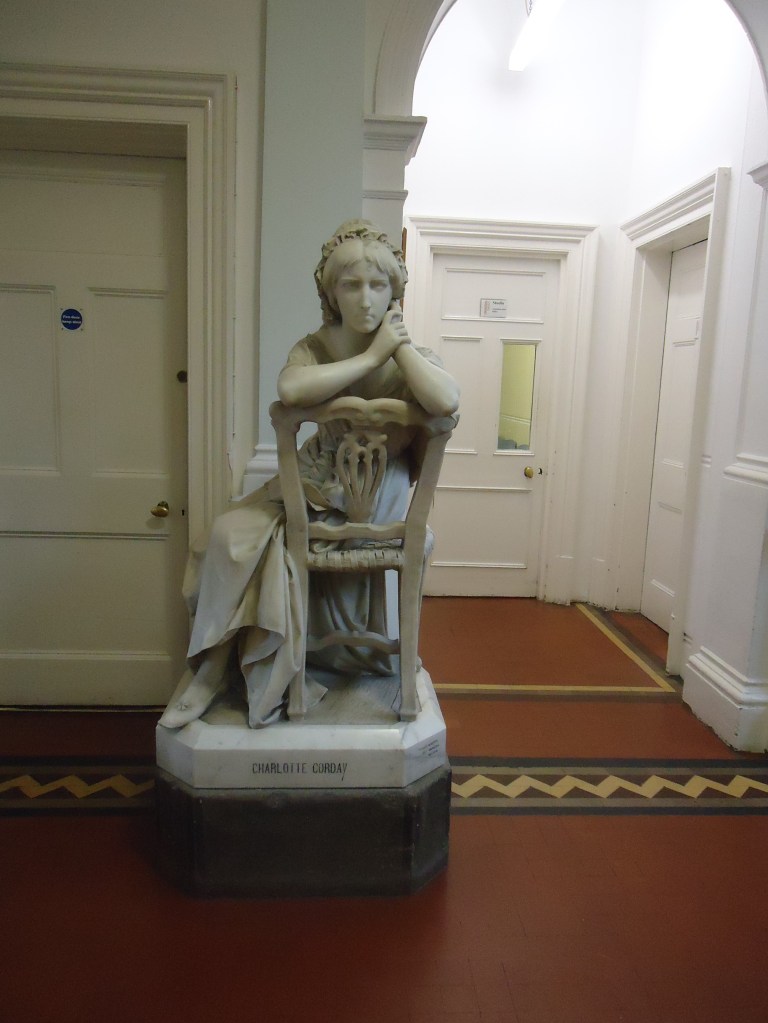
Perhaps one of the most extraordinary objects donated to the people of Swindon by James is the statue that stands in the foyer of the Town Hall. The white Carrara marble statue by Italian sculptor Pasquale Miglioretti depicts Charlotte Corday who in 1793 stabbed and murdered Jean-Paul Marat, a radical journalist during the period of the French Revolution. How James came across this work of art on his Swindon rounds remains unknown but it surely deserves a more prominent position where more people can see it.

Charlotte Corday

James stood for election following the incorporation of the Borough of Swindon in 1901 and served as a councillor for both the North and West Wards until the 1920s. One of his fellow Councillors later described him as ‘one of nature’s princes.’

He was an Alderman and also made a Freeman of the Borough in 1920 along with George Churchward, Chief Mechanical Engineer of the Great Western Railway, the first two men to be so honoured.

James owned various tracts of land, which he later gifted to the people of Swindon. A parcel of land in Savernake Street was given ‘for the benefit of scholars’ along with a plot in Gorse Hill.

James Powell was at the very heart of fund raising in Swindon during the Great War, arranging flag days and working with the Central Cinema and the Empire Theatre, organising family events. In 1917 he arranged numerous tea parties held in Town Gardens for members of The Social Club for the Wives and Mothers of Members of the Armed Forces.

In Loving Memory of a Name

The re-imagined story …

I was in my last year at school in 1983, trying to decide what I wanted to do with the rest of my life. I knew I definitely didn’t want to go into the Works like my dad, but then it looked as if the days of the mighty railway factory were numbered anyway. It had to be something interesting, something exciting.

What I would really have liked was to join XTC. For those of you who missed the 70s and early 80s for whatever reason, there was punk and prog pop, new wave and New Romantics and, if you came from Swindon, there was XTC.

What was it about them I liked? Was it their sense of fantasy and psychedelic wonderment, to steal a quip from founder member Andy Partridge? Or was it because they were cool and came from Swindon? It was exciting to know that the members of the band had walked the same streets I had. As Andy once said, ‘Swindon was a bit shit but there are worse places and everyone has to come from somewhere.’

I knew I didn’t have any musical talent, but I was sure there was a job I could do as part of the XTC entourage; a technician or press officer, or maybe a photographer, something like that.

In the summer of 1983 word went around school that the members of XTC would be filming a music video somewhere in Swindon for a track on their upcoming album. It came as no real surprise that they should chose the old cemetery, just the crazy kind of thing they would do. Here was my opportunity.

There was no special treatment for the guys the day they filmed at Radnor Street Cemetery. I was among a handful of fans there and as long as we kept out of the way, no one seemed to mind.

This would be my first foray into photography. I had a goodish camera, a present from my granddad. I got what I anticipated would be a couple of good shots of Colin wandering among the graves, looking contemplative and rock starry and several of Dave and Andy dressed in military uniforms and misbehaving in the background.

The cameraman spent a long-time getting shots of individual headstones and memorials, in particular a magnificent guardian angel, which became the opening shot of the video.

It was several weeks before my film came back from Boots the Chemist.

Even now, more than 30 years later, I can remember the heart squeezing disappointment as I opened the envelope and looked at the prints. My first photographic assignment, a total disaster. But as Colin blurred across the foreground, an image appeared in the background, close to the old mortuary building. At first, I assumed it must be the indistinct image of another fan, out for a glimpse of the band, but I began to see the outline of what looked to be a soldier, head bowed, wearing an old-fashioned army uniform and a tin helmet. He carried a kit bag on his back and held a rifle at his side. It was the silhouette of a Tommy from the First World War, there, but not there.
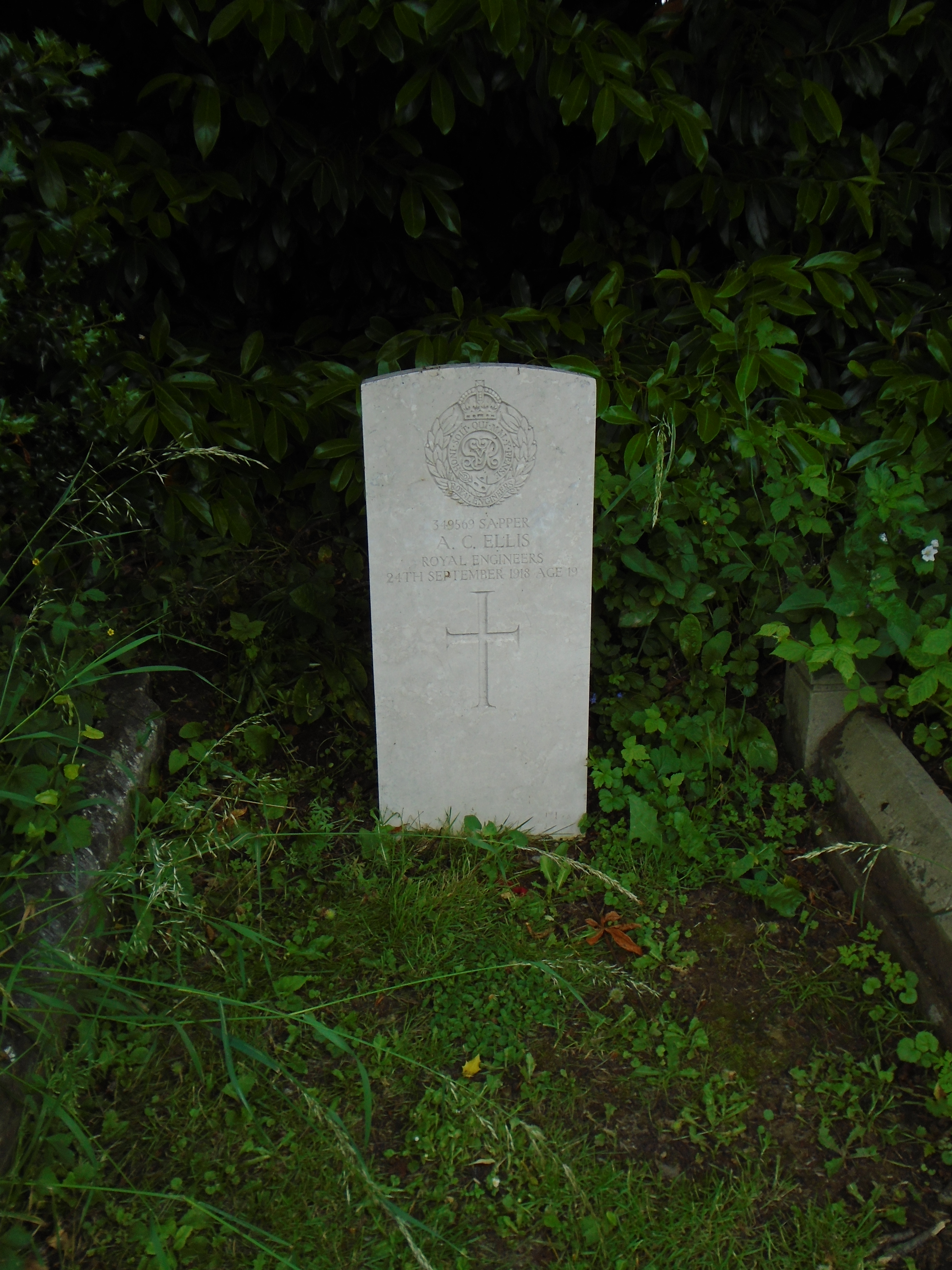
A.C. Ellis (1)

No one could see what I could see, not my parents, not my friends. And after a time I could no longer see the invisible soldier.

In Loving Memory of Name was written by Colin Moulding, but it turns out it wasn’t among his favourites in the band’s back catalogue. He was to later describe it as being about “moping ‘round a graveyard and just remembering the lives of the people there.”

It was several years before I returned to Radnor Street Cemetery. I stood in the place where I had watched Dave Gregory and Andy Partridge and taken my photographs. And then I walked around to the old mortuary building where I imagined I had seen the First World War soldier, there but not there.

I noticed for the first time the official Commonwealth War Graves headstone, discoloured and dirty. The inscription read Sapper A.C. Ellis, Royal Engineers, 24th September 1918 Age 19.


This image has an empty alt attribute; its file name is arthur-ellis.jpg

The Mummer album came after a long XTC hiatus. I recently returned to the cemetery after my own period in the wilderness. The guardian angel still looks good. And someone has propped up against the war grave headstone a small photograph of the young soldier.

chapel door

There, but not there. Photograph published courtesy of Andy Binks.

The facts …

Arthur Cecil Ellis was born in Swindon in 1899 the only surviving son of Thomas George Ellis, an engineer in the railway works, and his wife Annie Maria. He was baptised at St. Mark’s, the church in the railway village, on February 20, 1899 and for all his young life he lived at 38 Farnsby Street.

Arthur Cecil Ellis served in ‘C’ Company of the 6th Reserve Battalion of the Royal Engineers. The 6th Reserve Battalion was located at Irvine and was formed in January 1918 from what had been the reserve Field Companies grouped in Scottish Command.

Arthur died on September 24, 1918, according to the UK Register of Soldiers’ Effects 1901-1929 at Kilmarnock Hospital where he had £3 2s 9d (about £3.20) in pay owing to him, which would go to his mother Annie.

His body was returned to the family home at 38 Farnsby Street and he was buried at Radnor Street Cemetery on October 1st.

More than 50 years later, in the summer of 1969, Arthur’s sister, Dorothy, who worked as a dressmaker when Arthur went to war, died aged 74 and was buried with the teenage brother lost during the final weeks of the First World War.


https://www.youtube.com/watch?v=qC-PxpywwjA&list=RDqC-PxpywwjA&start_radio=1