The re-imagined story …
Number 13 Wellington Street was perfect, just perfect. I knew it would be. I had a look at the property as soon as I heard it was going on the market; only from the outside, that is.
Eric took some persuading.
“It wouldn’t hurt to ask for a viewing.”
“We won’t be able to afford it Lil. It’s got four bedrooms. Why set yourself up for a disappointment?”
The house belonged to Mr Goudge who worked in the offices at the Works. He was a fair and honest man. I hoped the house would sell at a price we could afford with the help of a small mortgage.
We had been saving hard, well as hard as you can with two children and another on the way. Eric was earning good money as a fitter in the Works and mum didn’t take much money off us in the way of board. But now she was expecting another child and the house in Reading Street was just too small to accommodate all of us.
A clerk from Mr Kinneir’s office met us at No 13. The front garden had a neat little square of grass surrounded by rose bushes all neatly pruned back for the winter, the iron palisades freshly painted. As we were led through the gate and up to the front door, I imagined myself turning the key in the lock.
It was beautiful inside. At the front of the house a drawing room led off from the hall with a dining room at the back. The kitchen overlooked the back garden.
Mrs Goudge was there to greet us. She showed us upstairs. The boys’ bedroom was at the back of the house, her two daughters slept in the smaller one at the front. Both rooms were light and airy; the girls’ room was so pretty with pink rosebud wallpaper.
“We’ll be leaving the gas fittings and the Venetian blinds,” she told us.
We ended up renting a little house in Westcott Place. I made it home. I even papered the second bedroom; pink rosebuds for the girls. We were very happy living there, but I often used to take a walk down Wellington Street and ponder on what might have been.

The facts …
Joseph Goudge was born on November 8, 1842 in Westminster, the son of James, a dressing case maker, and his wife Annie Elizabeth. Joseph was baptised at St John the Evangelist, Westminster on December 11.
By 1859 16-year-old Joseph was living in Swindon where he entered the employment of the GWR as a clerk on August 1. Two years later he is recorded on the 1861 census as lodging at Belle Vue Villas with George Dicks and his wife Jane.
Joseph married Mary Hall on June 10. 1868 at Christ Church, Swindon. The couple had six children, but sadly one died in childhood.
The couple lived first at 32 Prospect before buying the Wellington Street property. By 1891 they were living at 4, Brunswick Terrace, Bath Road (later known as 94 Bath Road) which remained their home.
Joseph progressed up the career ladder from clerk to accountant. He served as Education Secretary of the Mechanics’ Institute and also as Secretary of the New Swindon Improvement Company. He worked within the co-operative and trade union movements in the town and was also a Freemason and member of Gooch Lodge. He was a talented calligrapher and produced certificates, memorials and testimonials.
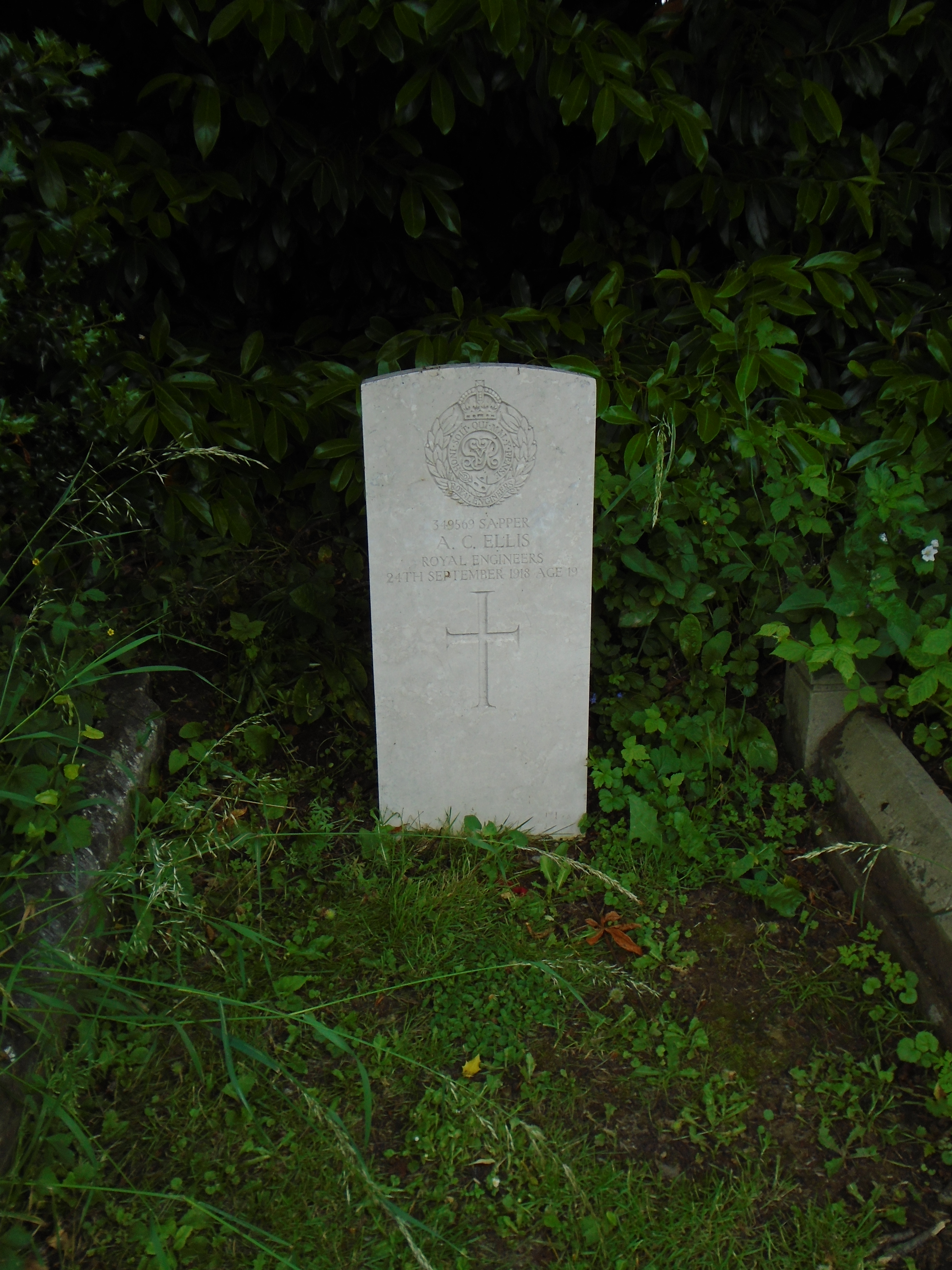
Mary died on January 1, 1916 and Joseph on Christmas Eve, 1916. They are buried together in plot A1065.
Among the staff.
Swindon. – The clerical staff of the chief Locomotive Superintendent has recently, in consequence of retirement under the age limit of Mr. Joseph Goudge, lost one of its most valued and capable members. Mr Goudge, who was born in 1842, entered the Company’s service on 1st August, 1859, and undertook increasingly important work, eventually having charge of the Chief Superintendent’s statistical office. In this capacity he rendered valuable service in the preparation of statistics affecting the Locomotive and Carriage Department in connection with legal and parliamentary business, and working arrangements with other companies. One of his many other important duties was that of examining candidates for clerkships in the department.
Mr. Goudge had the honour of taking up the Freedom of the City of London in the Haberdashers’ Company in 1863, on the same day, curiously, as a brother of the late Mr. William Dean. It is interesting to note that Mr. Goudge’s three sons gained various scholarships in connection with that Company and at public schools, finally winning open scholarships at Oxford.
Mr. Goudge joined the Volunteers on the formation of that body, and served for ten years. Always an earnest advocate of educational work he became a member of the Council of the Mechanics@ Institute in 1867, was appointed educational secretary and continued so for twenty-five years.
The deep respect and esteem in which Mr. Goudge was held by his colleagues was expressed in a tangible manner by the presentation of a cheque and illuminated address signed amongst others, by the Chief Superintendent and his assistants, the Stores Superintendent and other officials.
Great Western Railway Magazine May 1908
No 13 Wellington Street.
The House has a flower garden in front, with iron palisading, and contains an entrance hall, dining room, drawing room, 4 bedrooms, kitchen, and pantry. Outside are wash-house, with copper, closet, and coal house, and there is a Garden, with backway. The House has a frontage of about 20 feet, and is of the estimated rental value of £30 per annum, exclusive of rates. The gas fittings and Venetian blinds will be included in the sale.
The above, being situate in a favourite locality, where Houses are much in demand, forms a desirable House for investment or occupation. The same is in a good state of repair, and early possession will be given.
To view, apply to Mr Joseph Goudge the owner, and for further particulars to Messrs Kinneir and Tombs Solicitors Swindon or to The Auctioneers Faringdon Street.
Swindon Advertiser 6 December 1890




 Radnor Street Cemetery