Lilium Lancifolium Warren – Forewoman

I’m on a roll with women who have unusual names. Meet Lilium Lancifolium Warren. And whilst census enumerators might record her name as Lilian L. she always took pains to spell it correctly and in full.

This is a Lilium Lancifolium (also known as the Tiger Lily). It is a plant native to Asia and the Russian Far East. Unscented and with distinctive orange and black flowers, the Lilium Lancifolium flowers in July. I wonder if Lilium Lancifolium’s parents were keen gardeners.

Lilium Lancifolium Warren was baptised at St. Mark’s Church on July 3, 1881, the daughter of Albert Warren, a goods guard, and his wife Marcellina.

Lilium Lancifolium began work as a French polisher in the GWR Locomotive, Carriage and Wagon Department on February 1, 1897 aged 17. During a long career in the Works she was recorded as Forewoman in 10A Shop in 1931. She never married, although her name occurs as a witness at several family weddings, spelt correctly and in full.

She appears on the 1939 List still working as a Forewoman Polisher in the GWR, living at 53 Princes Street with her niece Olive May Warren.

She died aged 85 in 1965 by which time she had moved out to the new suburb of Penhill where she lived in a bungalow in Somerford Close. Administration of her estate was left to her niece, Olive by then married, and her sister Catherine.

Lilium Lancifolium Warren was buried in grave plot C83 on January 31, 1965 where she joined her brother Herbert William who died in 1897 and her parents, Marcellina who died in 1921 and Albert who died in 1929.
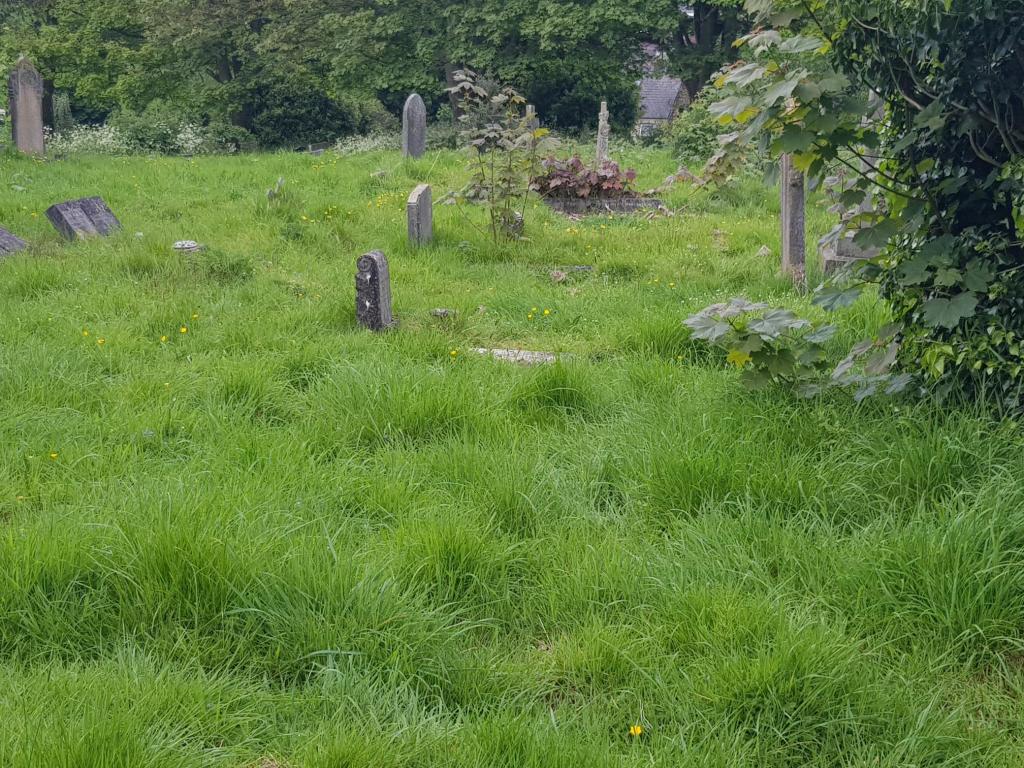
The Warren family grave is somewhere in this area. It may be an unmarked grave or it could be a kerbstone memorial that has sunk and become overgrown.
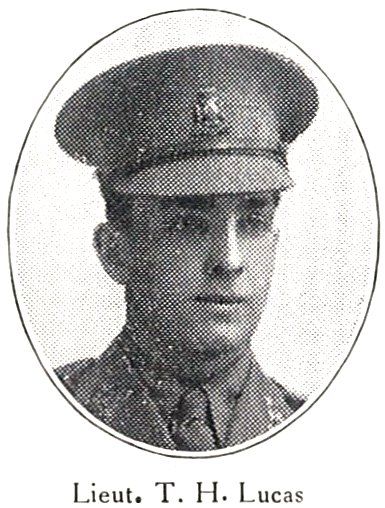
Thomas Henry Lucas – Lieutenant in the RAF

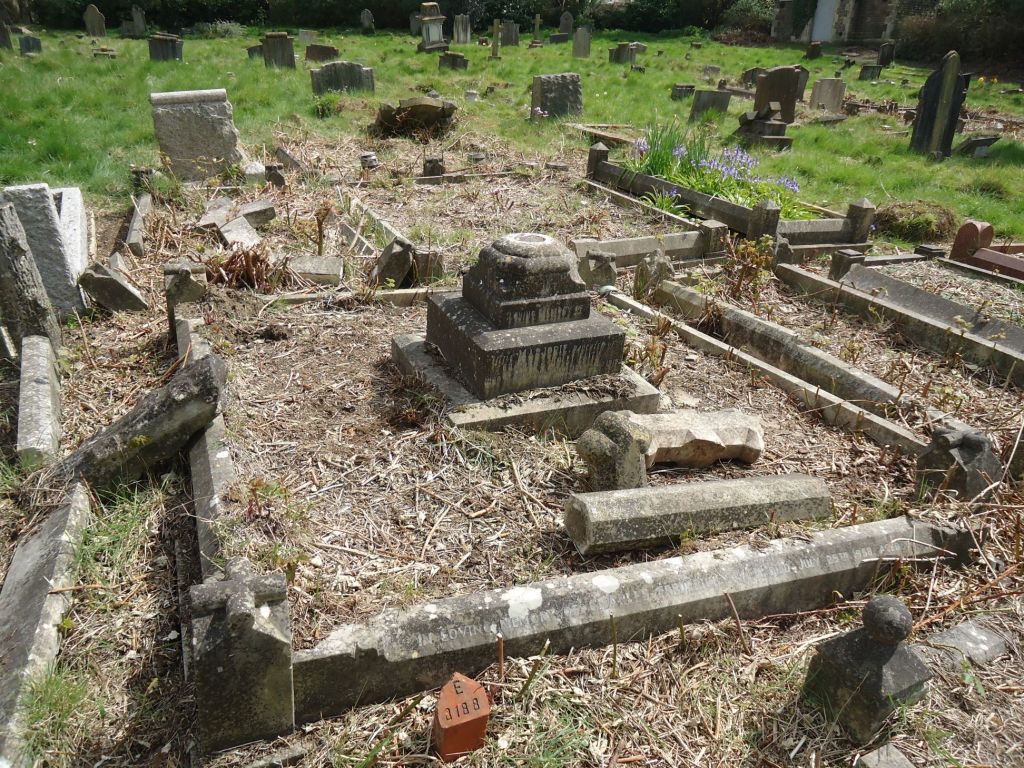
Graves appear and disappear with the passing seasons here in Radnor Street Cemetery. At the moment the grass is tall and the brambles rampant, but in the autumn the Borough Council will come and mow and perhaps this large family grave will reappear again.

Research has revealed several stories associated with this double grave, which extends across plots E8188 and E8189. The first story involves not a burial but a dedication on the kerbstone surround of the plot.

To the dear memory of Thomas Henry Lucas Lieutenant RAF Killed whilst flying in Egypt May 15, 1918 aged 27 years.

Thomas Henry was born in November, 1890 the son of William and Minnie Lucas, and baptised at St. John the Evangelist (a Chapel of Ease in the parish of St. Mark’s) on January 25, 1891. In May 1905 he began a 6½ year apprenticeship as a Coach Finisher in the Carriage & Wagon Works, later transferring to the Coach Body Making Shop.

Some of his military records survive and we know that he served with the Hampshire Regiment and also the Royal Air Force. He was killed in action on May 15, 1918 and is buried in the Cairo War Memorial Cemetery, Egypt. Were his grieving parents able to visit his grave? It is unlikely.

Thomas’s will was proved in 1919 when his address was given as 6 Lorne Terrace, Station Road. Administration went to his father William, a chargeman in the Works. His effects were valued at £360.

The first burial in this plot took place on January 3, 1920, that of five year old Marjorie Violet L. Faith, the daughter of Charles Frederick Faith and Violet Frances Euphemia Faith nee Lucas. (Charles was buried in this plot when he died in 1958).

Thomas’s parents William Henry and Minnie Sarah were buried here in 1942 and 1951 respectively, but there is one last story to tell.

The household at 6 Station Road was always a large and busy one. In 1901 William and Minnie Lucas lived there with their three children Violet 17, Minnie 14 and 10 year old Thomas. There were also two boarders living with them and on census night they had four visitors as well. And then there was their 18 year old domestic servant Mary Ann Gee. Mary Ann never married and remained with the family for many years. At the time of her death in 1948 she lived with William and Minnie at 67 County Road. She died that same year when she was also buried with them.

Swindon Veterans of Industry

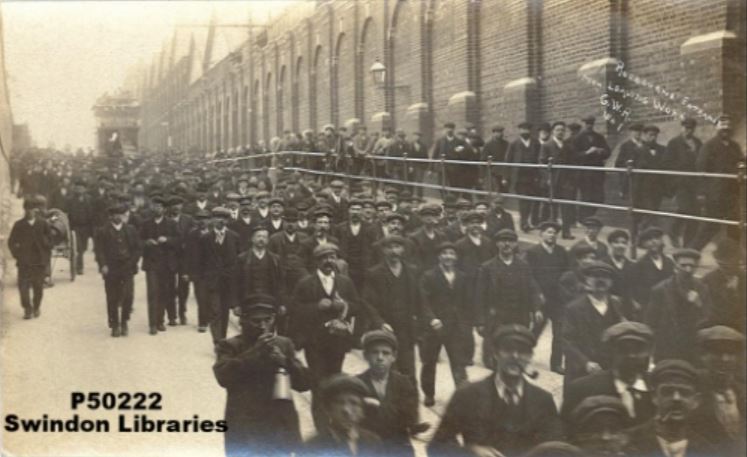
In the 1880s and 90s it was not unusual to find men like Robert Laxon still employed in Swindon’s GWR Works into their 80s. However, by the 1930s there was a state pension and an official retirement age. In December 1930 more than 200 men retired from the Great Western Railway Works, an event of such importance to warrant a detailed article in the first January edition of the North Wilts Herald published in 1931.

The names and address of those men forced to retire under the introduction of the 66 years age limit were recorded in appreciation of their long years employed in the Works. Men who had joined the company in the 1880s and 90s; men like Tom Solven who had completed 52½ years’ service and George Edge, of 39, Medgbury Road, 43 years a chargeman wagon builder. Chargemen in the Locomotive Department such as E.P. Cave, a fitter who lived in Pleydell Road, G.A. Hallard, turner, 70 Jennings Street and G.F. Randell, fitter, 19 William Street.

Mr William George Woodward, 43, Havelock street, retires after 50 years’ service in the GWR works, and he has spent the whole of that time in one shop – No 7 Finishing Shop, Carriage Department.

A native of Oaksey, Mr Woodward came to Swindon on 11 October, 1880, and started work as a machineman in the factory. He was made chargeman 32 years ago last July.

He has served under three Chief Mechanical Engineers, the late Major William Dean, Mr. G.J. Churchward and Mr. C.B. Collett. His first foreman was Mr. Thomas Rose. He has seen the number of employees in his particular shop grow from 50 to between 300 and 400.

Mr. Woodward has a vivid recollection of a bit of the first work he did during his initial year in Swindon. It was to help clear the line between the railway station and the transfer sheds during the great snowstorm in January, 1881. Greatly interested in Friendly Society work, Mr. Woodward has been a member of the Oddfellows Society for many years. He has been for 19 years secretary of the juvenile branch, and 17 years secretary of the Stratton St. Margaret lodge.

Last Saturday he was appointed secretary to the Widows’ Hope lodge – one of the oldest and largest in the Swindon district – to fill the vacancy caused by the death of Mr. A.C. Nethercot. He is Past Grand Master of the Swindon District, and was one of the delegates who attended the Centenary A.M.C. of the Order at Southampton in 1910.

Perhaps for many of the men it was a relief to no longer have to work. But no doubt for others it was more akin to a bereavement. What would they do with their time?

Home time – men leaving the Works. Image published courtesy of Local Studies, Swindon Central Library.

William George Woodward’s retirement was not a long one. He died in December 1939 and was buried in grave plot D573 with his father-in-law Harry Ball who died in 1928 aged 96. William’s wife Hannah died in 1960 and was buried with them both.

Tom Tindle – on the move

Today many families live at opposite ends of the country (and the world) and we tend to think of this as a modern phenomenon brought about by improved methods of transport. But people have always travelled to where there was work and Radnor Street Cemetery has many residents who came to Swindon and a job in the Great Western Railway Works.

Tom Tindle, or to give him his full name Tom Henry William Tindle, was born in York on April 18, 1855, the eldest of six children. In 1871 the family were living in Ashford in Kent, but when you look at the birth places of Tom’s siblings you can see they had also lived in Scarborough and London before settling down in Ashford, Kent.

Tom married Phillis Sarah J. Alderton, an elementary school teacher, at St George the Martyr in Southwark on April 24, 1878 when they both lived in the Old Kent Road area.

By 1881 the young couple were living in Stratton St. Margaret. Tom worked as a Coach Body Maker. He joined the Great Western Railway on May 23, 1887 as a Carriage Body Maker later becoming a foreman. By 1891 they had moved to 37 Regent Street where Phillis describes herself as a postmistress. In 1901 they lived at 10 Victoria Road with their four children. Phillis 18 and Nellie 14 were both working as pupil teachers. The boys Stuart 12 and Tom 5 were still at school. The 1911 census provides us with the additional information that Tom and Phillis had 6 children and that sadly 2 had previously died.

Tom lived in Swindon until at least 1920 when his address was 166 Victoria Road. He died in 1933 by which time he was living in Luton. The family returned the body to Swindon where he was buried with his daughter Phillis who died in 1905.

His wife Phillis out-lived him by eleven years. When she died in 1944 she was living in Bournemouth.

Caroline Shaw – French polisher

Caroline was born in Trevethin, Monmouthshire in 1859. Her family moved to Swindon in the 1860s following the opening of the Rolling Mills where her father Thomas worked as a Puddler. The family lived first at Bath Street (later renamed Bathampton Street). At the time of the 1881 census Thomas and his wife Sarah lived at 45 Westcott Place with their 9 children. Caroline aged 21 was the eldest and states her occupation as ‘Polisher GWR.’ The youngest child was 3 months old James.

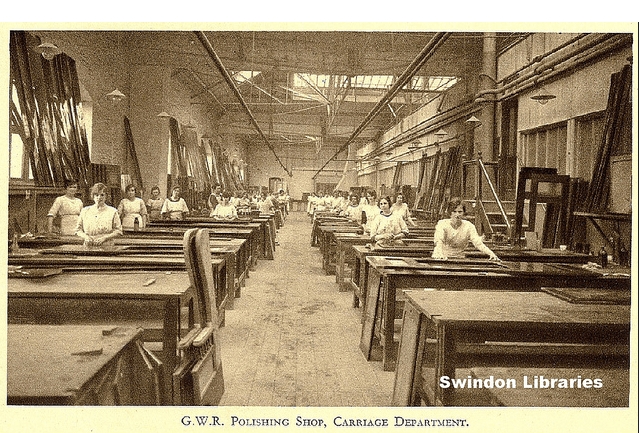
During 1874 and 1875 increasing numbers of women entered the GWR Works employed in the newly created upholstery department. Joseph Armstrong, Locomotive, Carriage and Wagon Superintendent 1864-77, had extended the Carriage Works on London Street and created a separate upholstery department for the employment of girls and unmarried women only. Caroline Shaw started work on November 3, 1875 as a French polisher. French polishing involved stripping back to the basic wood, making good any damage, brushing and sanding and building up the polish again. The women worked on anything made of wood from panels and partitions to toilet seats. Caroline was employed until July 1, 1887 – a week before her wedding on July 9.

Image published courtesy of Local Studies, Swindon Central Library.

Caroline married Henry Whale, a boilersmith, who also lived in Westcott Place, and the couple began their married life at 2 West End Terrace. Caroline never moved far away from Westcott Place, that long road that stretches from Faringdon Road to the bottom of Kingshill. The 1901 census records them living at 152 Westcott Place with their children Carry 12, Mabel 11, Harry 9, Milly 7 and five year old Polly. By 1911 they were at 165 Westcott Place, the home where Henry died in 1930 and Caroline in 1939.

Caroline and Henry are buried with Caroline’s parents Thomas and Sarah Shaw in plot C1107.

You may also like to read:

Celia Morkot – the first woman employed in the Works