When I began researching the Henderson family grave I suspected this might be a story that would run and run.
First there was the account of how James Henderson averted a train collision with Royalty on board the “Lord of the Isles” loco. Next came Noel’s story about the Musical Stones of Skiddaw. Today we have an account of James Henderson’s career upon his retirement complete with a photograph of the man himself!
Swindon. – On November 7 Mr James Henderson, who for the last twenty years has been an inspector attached to the Locomotive Running Department, retired from the service, and was made the recipient of a handsome testimonial, subscribed to by the officers and staff, and a large number of enginemen and firemen, throughout the system. Mr. Henderson joined the GW Railway as a fireman at Paddington in 1865, and acted in that capacity on the engine “Lord of the Isles,” which frequently worked royal trains between Windsor and Paddington. He quickly reached the position of driver, and from 1874 until his removal to Swindon as inspector was a familiar figure on express broad-gauge engines. Mr W.H. Waister, in making the presentation, which consisted of a solid silver cigar case and a purse of gold, stated that during the time Mr. Henderson had been inspector he had won the respect and esteem of all the staff. It is interesting to note that during the Olympic Regatta at Henley in August last Mr. Henderson was presented with a silver cup and an illuminated address by the Traffic Department staff in appreciation of his work there, he having taken charge of the locomotive arrangements during the Henley Regatta for a number of years.
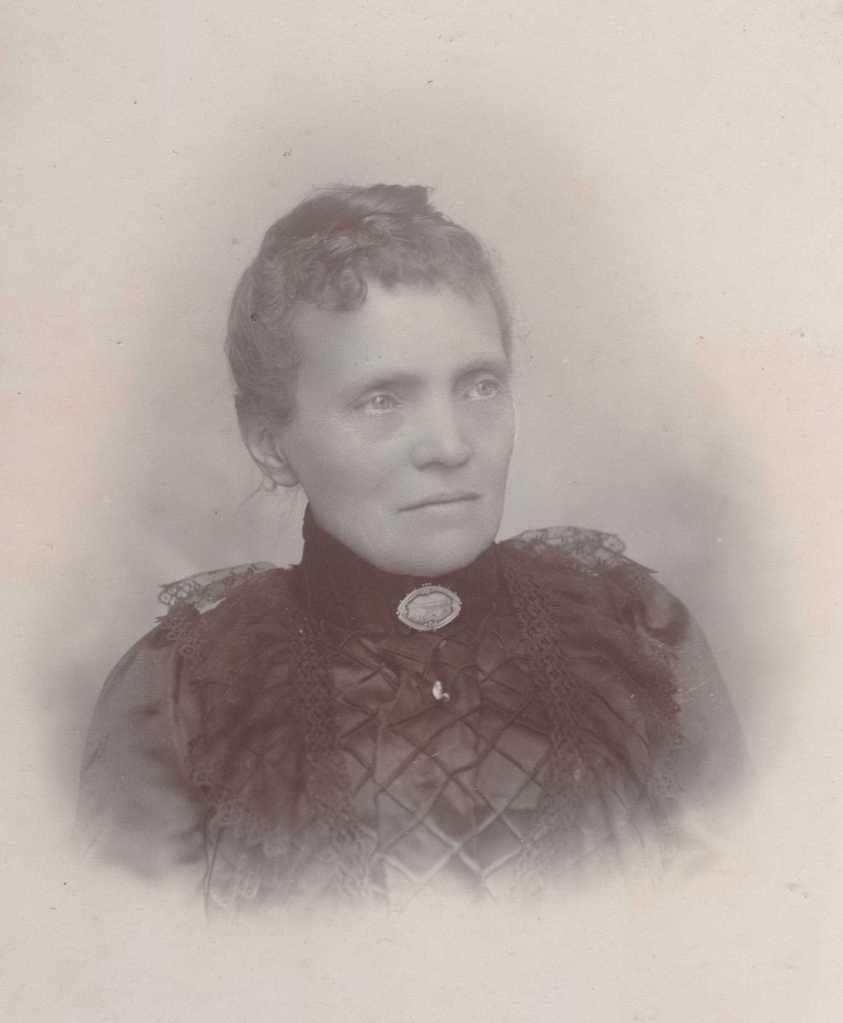
When I begin my research I never know how much I can actually find out about any given person. This time I found an obituary, a career profile and several family photographs, although unfortunately none of Sarah Annie Witcomb.
Sarah Annie Witcomb was born in Trevethin, Monmouthshire in about 1863. She was the second of Alfred and Sarah Witcomb’s seven children. By 1864 the family had moved to Swindon and in 1871 they were living at 3 Brunel Street where Alfred worked as a Forgeman in the Works. By 1881 they had moved to 31 Carfax Street where they would remain for more than 35 years until Alfred’s death in 1916.
As you can read in the obituary, Sarah became a teacher and eventually moved away from Swindon. She was one of four siblings who all entered the teaching profession.
The Late Miss Witcomb – The remains of Miss Sarah A. Witcomb, eldest daughter of the late Mr Alfred Witcomb, were laid to rest in Swindon Cemetery on Wednesday. Miss Witcomb’s end came with unexpected suddenness. She felt very deeply the recent death of her father, and an attack of influenza, resulting in heart failure, caused her death. As a young teacher in Swindon, there are many who will remember her, from when a pupil teacher she worked under Mrs Watson at College Street School. After leaving Southlands Training College she worked for a few years at Peckham, leaving there to take up a headship at Barking, Essex. Here the last 26 years of her active life have been spent as head mistress of a girls’ school of over 500 scholars.
The first portion of the burial service was held in the Wesleyan Chapel, Faringdon Street of which in her early days the deceased had been a member. The Rev. John Hall and Mr Godber were the officiating ministers. As the mourners entered the building the hymn, “Now the labourer’s task is o’er,” was sung. The hymn during the service was “Rock of Ages,” and as the procession left the chapel “O Rest in the Lord” was played by the Organist (Mr. H.C. Reynolds). The committal at the graveside was impressively performed by the Rev. John Hall.
Amongst those who attended to pay a last tribute to Miss Witcomb were Mr. G. Jackson (Essex County Council), representing the Barking Education Committee, and Mr W. Weston, an old and esteemed associate in former Sunday School work in Swindon.
Extract from the North Wilts Herald, Friday, October 13, 1916.
Family historians on Ancestry have shared photographs of Alfred, Sarah and another daughter Mary Jane.
Alfred Witcomb
Sarah Witcomb
Mary Jane (teacher)
Alfred died in July 1916 aged 75 years and was buried in grave plot E8161. Sarah Anne died just three months later, aged 53 and was buried with her father. Alfred’s wife Sarah died in April 1918 aged 77 years and was buried with her husband and daughter.
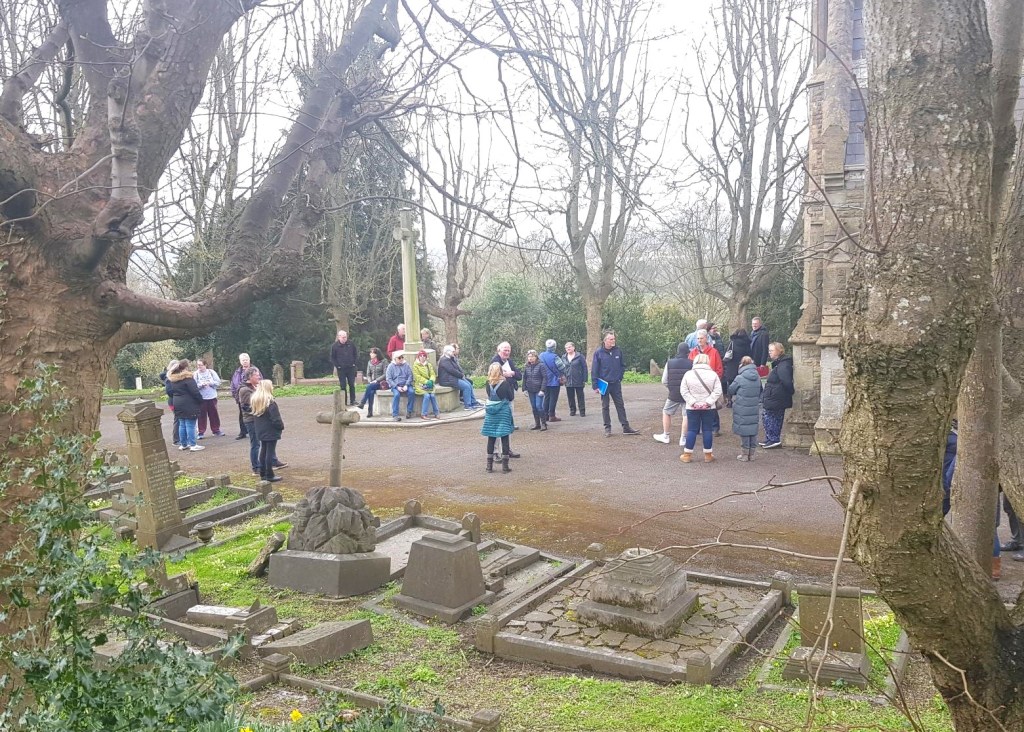
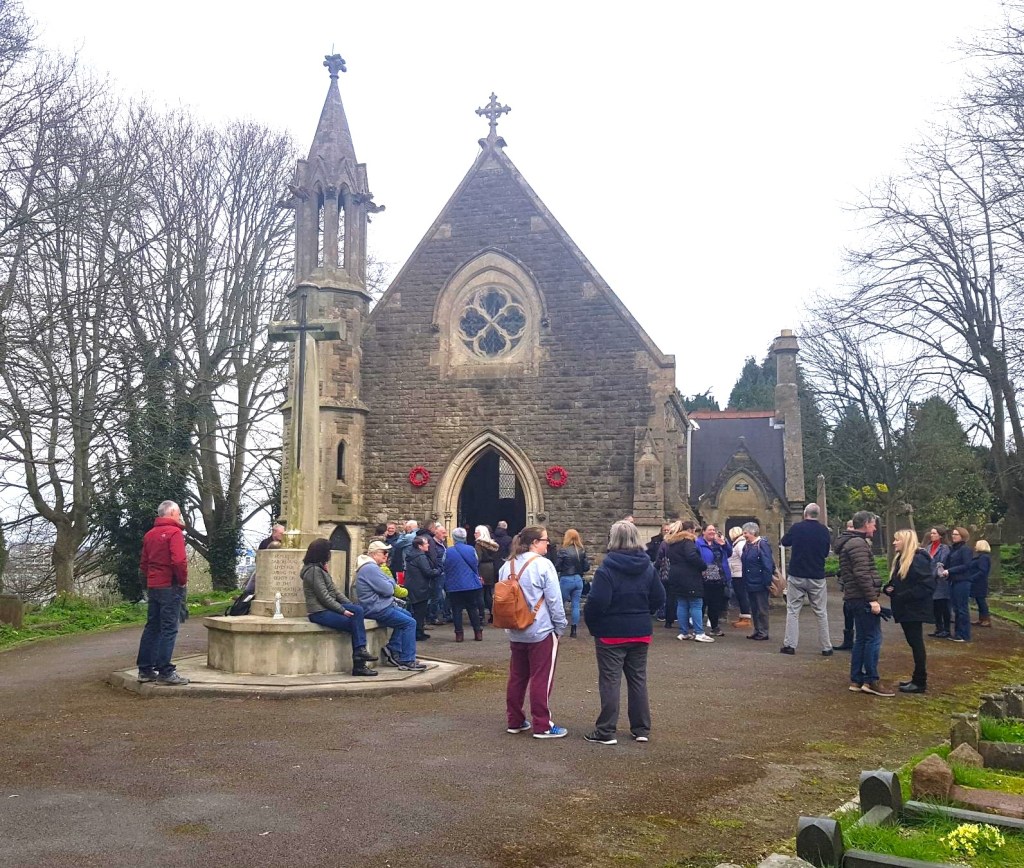
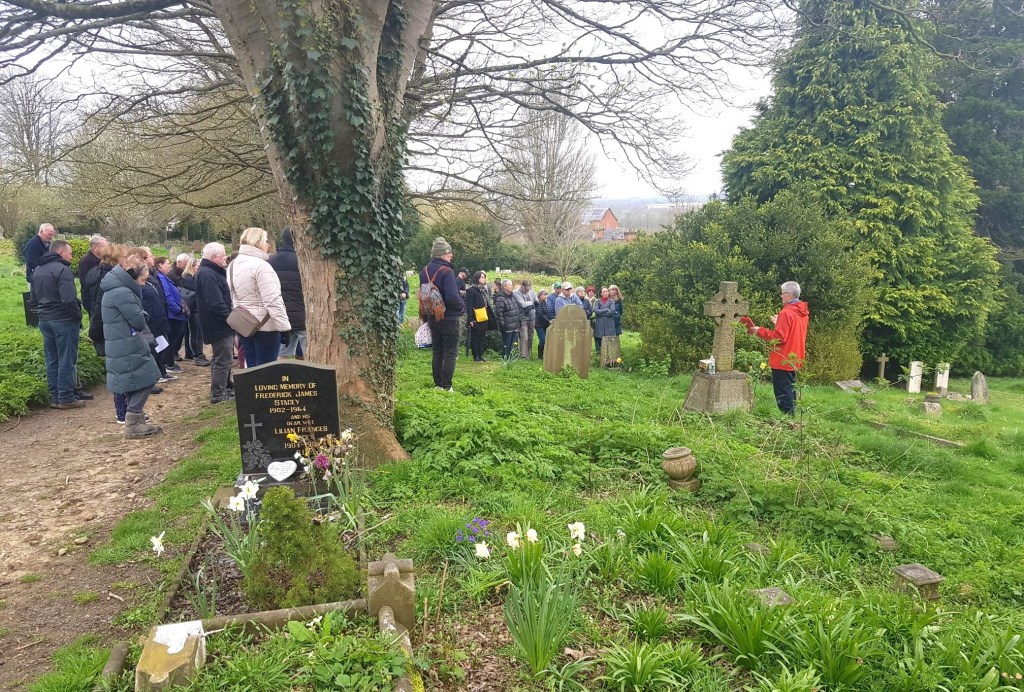
A large number of people attended our last Radnor Street Cemetery walk as you can see from the photograph below. However, perhaps surprisingly, far fewer attended the walks we organised at St Marks several years ago.
Among those buried in the churchyard by the railway track are Engineer William Frederick Gooch the younger brother of Sir Daniel Gooch, employed as Manager at the Swindon GWR Works at the time of the 1861 census.
A hugely influential man in the early history of the Works and the Railway Village was Works Manager Minard C. Rea. who died in 1857. His memorial is published below.
And, probably most famously, is the memorial to Joseph Armstrong, Locomotive, Carriage and Wagon Superintendent at the Great Western Railway 1864-1877.
The churchyard was closed to new burials in 1881 – after a mere 36 years it was already full. The new Swindon Cemetery on Kingshill, better known today as Radnor Street Cemetery, opened on August 6 that same year.
Poet Laureate John Betjeman was a big fan of St. Mark’s.
‘The parishioners of St Philip and St Jacob in Bristol entreated the Great Western to build a church for their workers; directors stumped up money, subscriptions were raised, land was presented and by 1845, St Mark’s church was built.
There it stands today close beside the line on the Bristol side of the station. A stone building, all spikes and prickles outside, designed by Gilbert Scott who was then a young man and who lived to build hundreds of rather dull copy-book churches all over Britain, and to build St Pancras Hotel, the Foreign Office in London and to restore many cathedrals.
One cannot call it a convenient site. Whistles and passing trains disturb the services, engine smoke blackens the leaves and tombstones, and eats into the carved stonework of the steeple. But it is a strong church and though it is not much to look at, it is for me the most loved church in England. For not carved stones nor screen and beautiful altars, nor lofty arcades nor gilded canopies, but the priests who minister and the people who worship make a church strong. If ever I feel England is Pagan, and that the poor old Church of England is tottering to its grave, I revisit St Mark’s, Swindon. That corrects the impression at once. A simple and definite faith is taught; St Mark’s and its daughter churches are crowded. Swindon, so ugly to look at to the eyes of the architectural student, glows golden as the New Jerusalem to eyes that look beyond the brick and stone…
Extracts published from First and Last Loves a collection of essays on architecture published in 1952.
With so many interesting stories to tell we were a little surprised that these walks did not prove more popular. Perhaps it is because Radnor Street Cemetery has an extra special place in the hearts and memories of 21st century Swindonians.
Photograph from our most recent guided cemetery walk at Radnor Street Cemetery
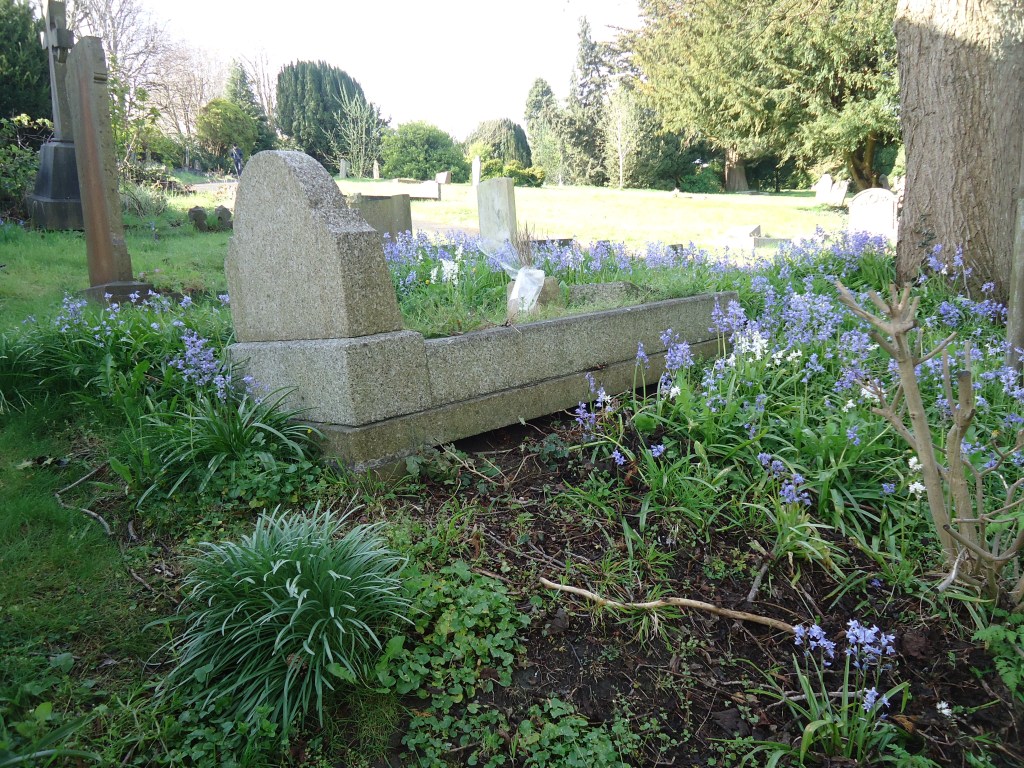
This grave always looks particularly beautiful at this time of year, although sadly my photographs don’t do it justice. This is the grave of Eliza Chirgwin and her husband Richard James Chirgwin, just by the Dixon Street cemetery gate, close to their former home at No. 27. I have long meant to research this couple and every year when the bluebells bloom I resolve yet again to see what I can find out about them, and there is a surprisingly extensive amount.
Richard James Chirgwin was born on September 20, 1850 at Phillack, Cornwall, the youngest child of George, an engineer, and his wife Honor. He married Eliza Callaway in 1873 and by the time of the 1881 census the couple were living at 19 Read Street where Richard James worked as an Engine Fitter in the GWR Works.
You can read more about Eliza and Richard in the obituaries published in the North Wilts Herald (see below) and if you should pass through the Dixon Street gate while the bluebells are in bloom you might like to pause awhile, as I usually do.
Death of Mrs R.J. Chirgwin – Mr Richard J. Chirgwin, J.P., of 27 Dixon Street, has suffered a great loss by the sudden death of his wife. The deceased lady was 77 years of age. She was about the house as usual on Wednesday, although her health had not been good of late. Early in the evening she went upstairs, intending to take a short rest, but she had a seizure, and before her husband, who was downstairs at the time, could reach her she had passed away. Dr. Lavery was fetched, but he could only pronounce life extinct. Both Mr and Mrs Chirgwin have been well known residents in Swindon for the past half a century, and they celebrated their golden wedding on December 23rd last. They are both natives of Cornwall, and came to Swindon 50 years ago. Mr. Chirgwin was for many years employed in the GWR Works but has been living in retirement for a number of years. There are two daughters. One is the wife of Mr Joseph Williams, who holds an appointment on the United Havana Railway in Cuba. The other daughter is Mrs. Anderson, wife of Mr Walter Anderson, Headmaster of Lethbridge Road Schools. The funeral will take place tomorrow.
North Wilts Herald, Friday, November 28, 1924.
A Swindon Social Worker
Death & Funeral of Mr R.J. Chirgwin, J.P.
Public Tributes
While on a visit to Exmouth, Mr Richard James Chirgwin of 2[7], Dixon Street, Swindon, passed away in his sleep, and the town has thus lost a devoted worker in social and religious causes. He had been in indifferent health for some time, and on medical advice had recently given up a number of his activities.
Mr Chirgwin was a native of Cornwall, but early went to live in South Wales, and after staying there six years came to Swindon in 1873, as an employee in the GWR Works. He gradually worked his way up, and at the time of his retirement four years ago was a leading foreman.
He was a very active Liberal, and had taken a prominent part in the work of the Party in Swindon and district for many years. He was a borough magistrate for a number of years, and was a very regular attendant at sittings of the Bench. Mr Chirgwin was well known in educational circles, and at one time was a tutor at the science classes before the Technical School was built. He was keenly interested in the work of the Workers’ Educational Association, and attended the meetings of the local branch until quite recently. He was also very fond of their summer rambles, and was a lover of long walks.
The deceased had occupied every position open to a layman in the Wesleyan Methodist Church. He had been a local preacher for 55 years, and last year, in company with Messrs. T.B. Jefferies, W. Chilton, E. Ransome, J. Clark, J.P., and T. Hiscocks, he received a special certificate from the Connexional Local Preachers’ Association. He began preaching in Cornwall in 1871, and frequently occupied the pulpit while in Wales. In Swindon he did service as a fully-qualified local preacher until 1924, when, on medical advice, he had to give up some of his preaching work. He was local secretary for the Aged Local Preachers’ Fund for 30 years, and also held the office of President of the Free Church Council for a time.
Mrs Chirgwin pre-deceased her husband three years ago, just after they had celebrated their golden wedding.
At Swindon Borough Police Court on Monday the Chairman (Mr. W.E. Morse) said he had to record the passing away of a member of their bench, Mr R.J. Chirgwin, who, as long as he (Mr Morse) could remember, had been a well-known citizen of Swindon. Five-and-a-half years ago he was appointed a magistrate, and he was always very regular in his attendance and diligent in the duties he was called upon to perform. He (Mr Morse) thought it would be the desire of the justices and the Court that a letter of condolence be sent to the members of the family of deceased.
This was carried in silence, all in Court standing.
The Funeral
The funeral took place on Wednesday in the presence of a large company at the Faringdon Street Wesleyan Church by the Rev. H.B. Turner (Bath Road).
The Rev W. Kelson (Superintendent Minister of the Swindon Wesleyan Circuit) conducted the service, being assisted by the Rev. W.B. Turner (Bath road), the Rev Montague Ashdown and Pastor Stocking.
The Hymns sung were “O God, the Rock of Ages,” and “Who fathoms the Eternal Thought.”
Voluntaries on the organ were played by Mr. Cassell.
Mr Kelson said when he first came to Swindon he and Mr Chirgwin were comparative strangers, but he had been able to enter into Mr Chirgwin’s life from the very first. Mr. Chirgwin had attained the most worthy objects in life. He was a man – a man after the type of the Supreme Man whom he came to know in his early years.
His religion was not merely an emotional one. It occupied all his heart, and also his mind. One could not wish to come into contact with a better character. His heart was warmed with the love of Christ, and his intellect had passed into his religion as well as his soul. He was not afraid to die.
His was a life of social and religious activity. There were a great many in Swindon who could speak of him with the highest appreciation of his services and all had a great esteem for him. His religion was comprehensive, a life embracing thing. They did not mourn for the life which had just been taken from them. Mr Chirgwin was a man who passed worthily through life: his end was peaceful, and his latter days were serene, which was fitting for one who took such an interest in life until the last.
Mr. Kelson referred to Mr Chirgwin’s debating powers, and added that although he regarded life seriously, he had learnt to smile at life’s troubles.
Not only the church with which he was so closely associated but also the town of Swindon would be greatly the poorer by his death.
The interment took place at the Swindon cemetery, the chief mourners being: Mr and Mrs Joseph Williams (son-in-law and daughter), Mr and Mrs Walter Anderson (son-in-law and daughter), Mr Kenneth Anderson, Miss D. Gibbs, Mrs C. Clack (niece), Mr and Mrs Ronald Clack, and Miss L. Symons (niece).
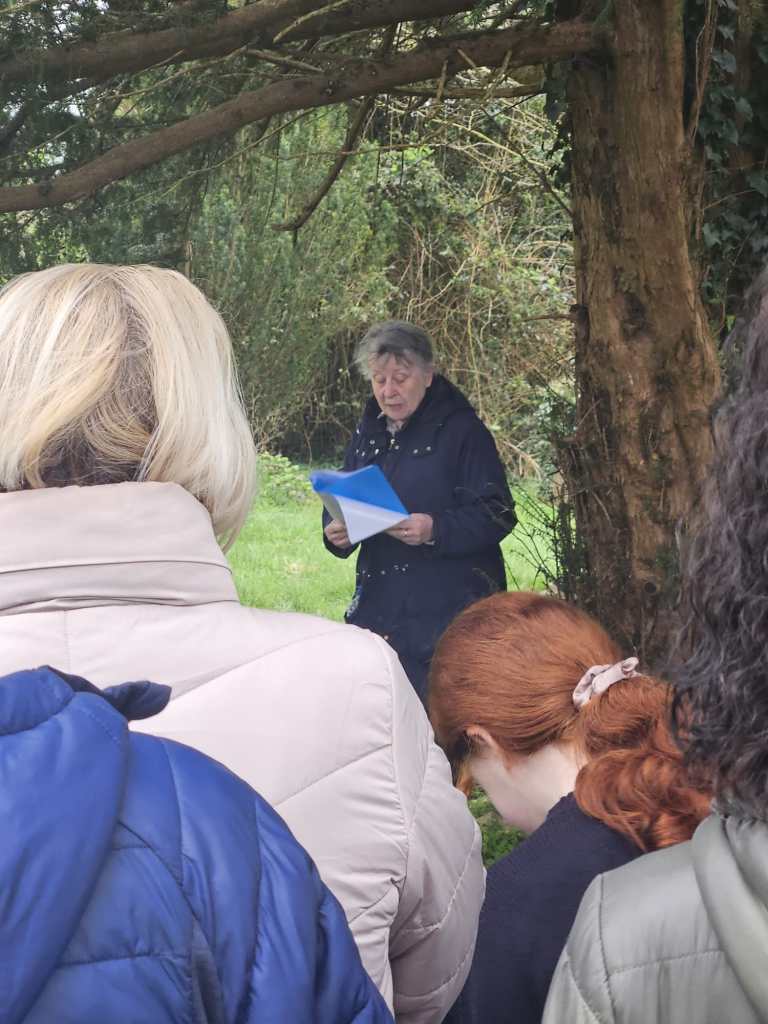
Many thanks to everyone who joined us for the first of this season’s walks. The weather was kind and the rain held off.
We were joined by members of the Menham family as Andy spoke about Swindon Town football legend Bob Menham. Kevin followed by telling us of the military career of his son Reginald Menham and reading a poignant letter taken from Mark Sutton‘s book Tell Them of Us.
There were lots of fascinating conversations as visitors shared their family history stories with us. It was lovely to meet Clare and I hope you found your family grave. I look forward to receiving your information and photographs to publish here.
Our next walk will take place on Sunday April 28. Meet at the chapel for 2 pm.
Today’s story is one for the railway enthusiasts among you and another example of the fascinating ordinary people who lie in Radnor Street Cemetery.
Swindon Inspector’s Reminiscences
How a Railway Disaster was Averted
An interesting incident has been recalled by the frontispiece in the Great Western Railway Magazine for April, showing the “Lord of the Isles,” bedecked to draw the royal train, conveying the Shah of Persia, on the occasion of his visit to England in 1873. The name of the fireman was given as Hetherington, but it transpires that Mr James Henderson (late inspector at Swindon), is the man referred to. An exciting occurrence attended the journey of the royal train, and is related in this month’s magazine by Mr. Henderson thus:-
“I have good reasons for remembering the day the photograph was taken – June 24th, 1873. We left Paddington with the Shah of Persia, the late King Edward with Queen Alexandra, and the late Czar of Russia and his Consort on the train, attended by many distinguished persons. In honour of the Shah’s visit, a great review was being held at Windsor, and many excursion trains were being run. All went well with the train until we were passing through Slough Station. At that time there was no “locking gear” there, and trains had to pass from the down main line and go through the down platform road to reach Windsor. At the western end of the platform there was a pair of points turned by hand, which led either to Windsor, or across the Windsor Branch to the main line. On passing through Slough Station I noticed that these points were wrong, being set for the main line instead of for Windsor. I shouted to my driver. “Whoa, mate, the points are wrong,” and we stopped the train just in time to avert a collision with an empty train coming from Windsor. We put the train back over the points, and I jumped down and turned the points myself, the man whose duty it was to attend to them being so overcome that he was unable to do any more work.
Mr Tyrrell (then Superintendent of the Line), was on the platform, and witnessed the whole affair. He got on to the engine and rode with us to Windsor. After we started from Slough he enquired from my driver who had first noticed that the points were wrongly set, and the engineman, who was Jos. Groves, replied, “My fireman, sir.” Mr Tyrrell turned to me and expressed his pleasure at my having observed the position of the points. Subsequently I was sent to Swindon to see Mr. Joseph Armstrong, (late Locomotive Superintendent), who promised that I should receive recognition for the occurrence. Shortly afterwards I was promoted to be a driver, and before long made a driver on the broad gauge expresses, being the youngest man ever promoted to that position. Many people wondered at the time at my early promotion, but it was the prevention of that collision that led to it. It may be imagined that the occasion on which the photograph was taken stands out as a red-letter day in my life.
“I may say that during my service with the Company I had the good fortune to be the means of preventing five other collisions with passenger trains.”
The Evening Swindon Advertiser, Saturday, June 1, 1912.
James Henderson died aged 89 years at his home, 51 Rolleston Street. He was buried on November 14, 1934 in grave plot A2526.
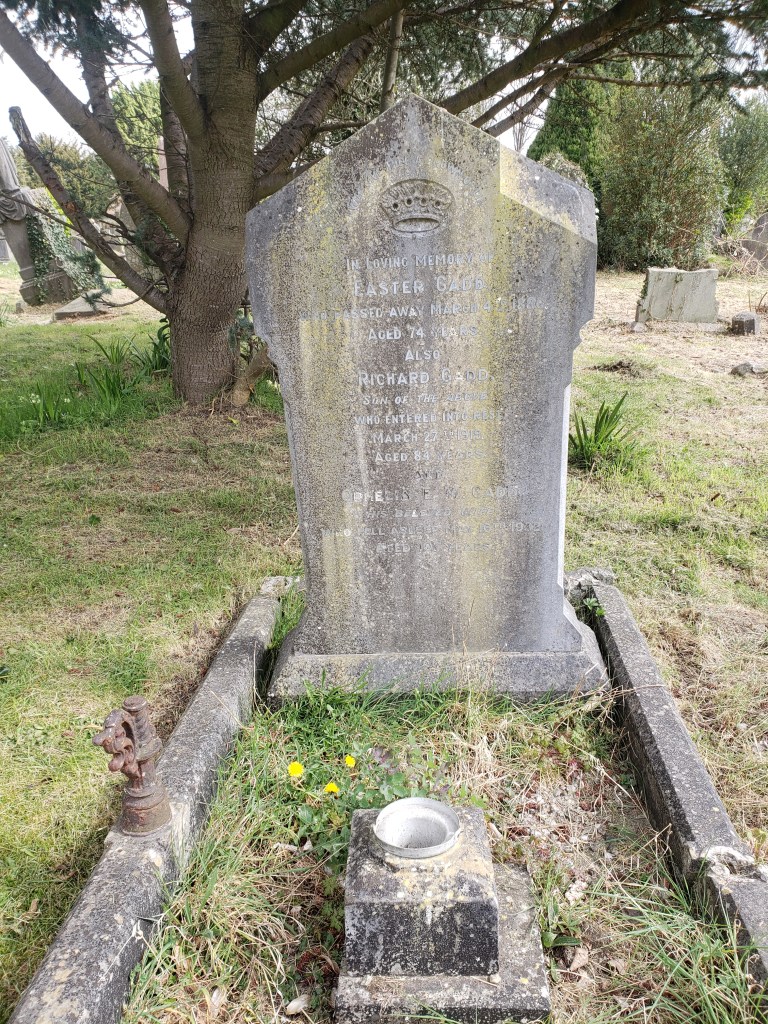
Easter Gadd is an obvious character to research this Easter weekend.
I’ve often paused at this headstone and wondered what the upstanding Mr Gadd might have looked like and what his profession might have been. Something in the legal profession I imagined, or possibly a vicar with such an appropriate name, a character stepped straight out of a Dickens novel.
But Easter Gadd was not a man but a woman.
Easter was born on August 27, 1811, the daughter of Henry and Mary Pascall and baptised at George Street Independent Church, Croydon, Surrey in October.
She married Richard Gadd at St John’s Church, Croydon by licence on April 5, 1833 (which just so happened to be Good Friday that year) and most clearly signed her name as Easter. I mention this as there appears to be a certain amount of confusion as to the spelling of her name on official documents, especially census returns, when she is frequently recorded as Easther or Esther.
But when she was baptised, married and died her name was most definitely recorded as Easter.
Richard and Ophelia Gadd and their five children
When Easter died in 1886, she was living with her son Richard and his family. Richard, it can be assumed, arranged for his mother’s headstone to be erected and had overseen the spelling of her name. Now I have the utmost faith in the accuracy of the spelling on the gravestone and I’ll tell you why – Richard’s immaculate attention to detail.
Richard Gadd was born in Croydon on July 1, 1834. His father died on May 17, 1835 and at the time of the 1841 census Easter was living with her brother-in-law Charles Gadd and his family in Lambeth, South London.
By 1851 she had moved to Hulme, Manchester and was living with her widowed brother William Pascall and his daughter where she is described as ‘housekeeper.’ The enumerator records her name as Esther (because he obviously knew better!)
Easter remains living with William for more than ten years and after that with various nephews and nieces until the census of 1881 when she is living at Lima Terrace, Ashton upon Mersey (today a part of Greater Manchester) with Henry Pascall who is confusingly described as her son (like we need any more confusion in this story). By the way, the census enumerator spells her name as Esther. I’m beginning to wonder if Easter was a bit of a chatterbox and confused these men as they recorded her details.
Sometime after this date Easter moved to Swindon to live with her son Richard and his family. Richard had settled in Swindon in 1853 when he started work as a clerk in the GWR Works.
Richard left the employ of the GWR sometime in the 1860s when he is recorded in Harrod’s Directory as an architectural & mechanical draughtsman living in Prospect Place. However, by 1891 he was back at the Works working as an accountant where he remained until he retired in 1899.
At the time of the 1881 census Richard lived at 35 Prospect with his wife Ophelia, their son William, who was a railway draughtsman, and their two daughters Annie Ophelia and Edna Mary.
Easter died shortly after moving to Swindon. Her funeral took place on March 10, 1886 when she was buried in plot E8427 where she was later joined by Richard and Ophelia.
Now why am I so certain Richard has spelled his mother’s name correctly? Well, it is because of the 1911 census returns. On this document the head of the household completed the form themselves unlike in previous censuses when an enumerator did it for them.
Richard and Ophelia Gadd in old age with their two daughters
As you would hopefully expect of an accountant, Richard completes the form with meticulous accuracy. He states that his age is 76 9/12 (that is 76 years and 9 months). Ophelia was 80 8/12 and their daughter Edna Mary 47 4/12. (The young domestic servant Mary Coxhead is recorded as 15 years old. Perhaps he didn’t know her date of birth or maybe he didn’t ask!) He declared that he and Ophelia have had 5 children, all of whom are living, and that they have been married 56 3/12 years.
Now a man like that will definitely get the spelling of his mother’s name correct on her gravestone.
Three of Richard and Ophelia’s children are buried in the neighbouring grave plot E8428. William who died in 1944 aged 85; Annie Ophelia who died in 1955 aged 86 and Edna Mary who died in 1958 aged 94.
Images of Richard and Ophelia Gadd and their family are published courtesy of an Ancestry public family tree.
The GWR Works was a dangerous place in which to work and until the construction of the main entrance tunnel it was even a dangerous place to get inside.
The original Workmen’s East Gate Works entrance was a route that involved crossing the mainline track and was the scene of numerous fatal accidents. There were 3 deaths in a single month in 1869, the year before the tunnel opened.
Joseph Armstrong, the first Locomotive, Carriage and Wagon Superintendent ushered in a period of rapid expansion during the 1870s which included the construction of the Carriage Works and a new, safer route into the railway factory. The main entrance into the Works was built on Bristol Street, opposite the Mechanics’ Institution and consisted of a tunnel measuring approximately 100 yards [91.4m] that ran northwards beneath the mainline track.
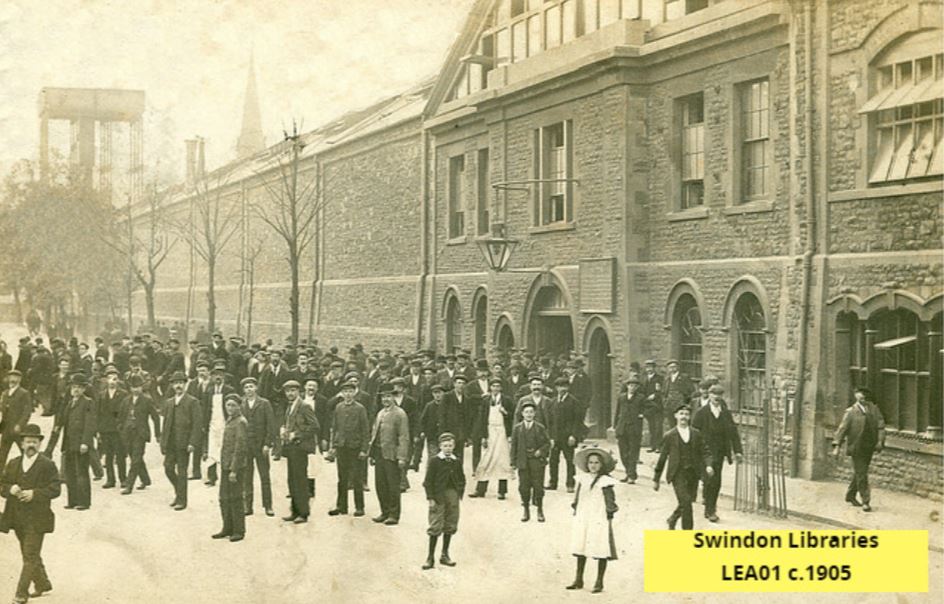
Contemporary photographs record the hundreds of men streaming out of the tunnel at the end of the working day, however, even after the tunnel opened on February 5, 1870 accidents continued to occur as men still cut across the railway line to work.
In 1905 William Dicks was struck down and killed going back to work on Saturday January 14. The report of the inquest published in the Wiltshire Times makes for gruesome reading.
Fatal Accident
Man Killed at the Works
A shocking fatality occurred on the Great Western Railway at Swindon on Saturday. William Dicks, an employe in the locomotive works had just returned from breakfast and crossed the rails in order to reach the check office. He failed to notice the approach of an engine which was out on its trial trip, and though his workmates tried to warn him of his danger, it was without avail, and he was knocked down by the locomotive and injured so terribly that he died on his removal to the hospital. Both his legs were severed, and his head was frightfully battered. Deceased, who was 52 years of age, was well known as a clarionist. [clarinetist].
At the inquest on Monday it was stated that deceased had no business to cross the line, a tunnel being provided for the men. – Dr Swinhoe said the man was practically cut in half.
The Coroner said he thought they could only return a verdict of “Accidental death” but they might add a rider to the effect that notice boards should be fixed in prominent places to warn the men not to cross the line. The Company certainly took every precaution in protecting employes, and the men should use the tunnels which had been provided for their express use.
The jury concurred, and returned a verdict accordingly.
The Wiltshire Times, Saturday January 21, 1905.
William Dicks was buried on January 18, 1905 in grave plot C1445, a public grave, which he shares with his wife Jane who died in 1909, and one other person
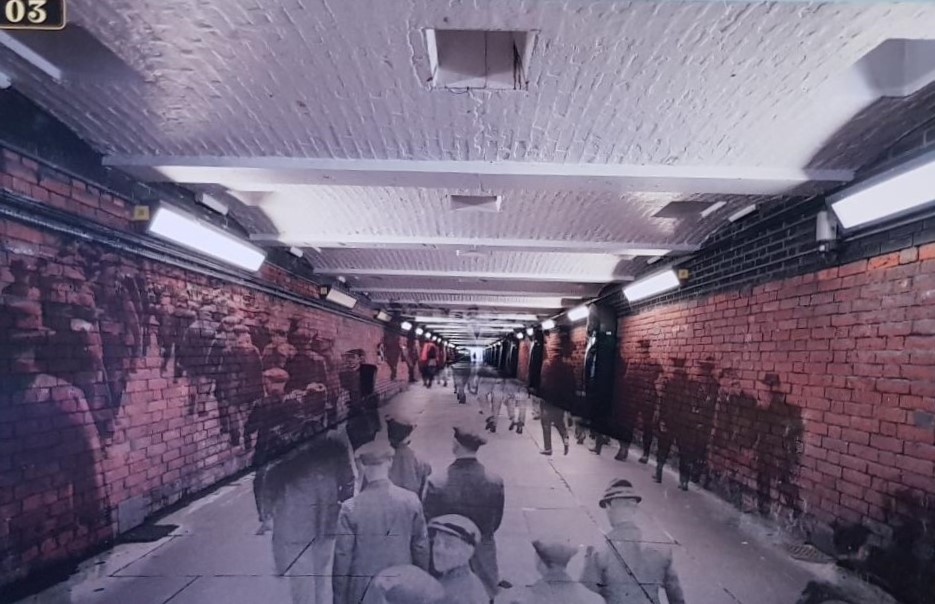
Today the Grade II listed former Carriage Works is the subject of a Heritage Action Zone project. Work has included improvements to the Sheppard Street underpass, London Street and the Bristol Street tunnel has also received a makeover. New interpretation boards at the entrance tell the story of the railway factory and the railway families who made New Swindon.
Image dated c1905 published courtesy of Kevin Leakey
Image dated c1950 published courtesy of Local Studies, Swindon Central Library.
Ghostly railway workers superimposed on a photo of the tunnel – see new interpretation boards at the tunnel entrance
Arthur Jefferies Lewis White was born on November 23, 1872, the son of Richard Lewis and Elizabeth Corbett White. He entered employment in the GWR on January 3, 1887, a month after his 15th birthday. A year later at a GWR Board Meeting to consider the promotion of the Lad Clerks Arthur was described as shorthand writer with previous office experience. He was already on a career path that would see him become Chief Clerk and Chief Accountant to Charles B. Collett, Chief Mechanical Engineer.
Arthur married Emily Sendell at Christ Church on October 2, 1917. He was 44 years old and she was 42.
A keen musician and mandolin player, Arthur White was chairman of the Great Western Railway Amateur Operatic and Dramatic Society and President of the Swindon Great Western Railway Social and Education Silver Band. He was a director of the New Swindon Permanent Building Society and a Freemason and member of the Sussex Lodge of Emulation, No. 355. He was also a writer and wrote several books about the Swindon Railway Works. But it is probably fair to say his greatest love (after his wife, of course) was football.
Arthur White was elected Chairman of the directors of Swindon Town Football Club in the 1910-11 season and served for nearly 20 years. The obituary published in the North Wilts Herald on Friday November 1, 1929 declared his pride of the club knew no bounds.
Swindon Town Football Club 1910-11 squad – the year in which Arthur J.L. White was elected Chairman
Arthur Jefferies Lewis White died at his home at 13 Okus road, Swindon after suffering a year of poor health.
The funeral service at St. Saviours Church was attended by a great many mourners and the North Wilts Herald reports that:
Practically every shop in the GWR Works was represented, and directors, players and officials of the Swindon Town Football Club also attended.
A guard of honour was formed by the local Freemasons, who led the procession and behind the coffin walked the family mourners, representatives of the Great Western Railway, the different societies with which Mr White was connected and the Town footballers.
Arthur Jefferies Lewis White was buried in grave plot E8134. His wife Emily survived him by nearly 40 years. She died aged 92 years of age at the Cheriton Nursing Home and was buried in the neighbouring plot E8134A.
This is the story of two boys born 20 years apart – William Batley Pitts, the natural son of Robert and Elizabeth Pitts, the other Archibald Kenneth Poulton, their adopted son.
Today railway safety is heavily promoted and Network Rail has a series of safety campaign videos on their website aimed at everyone from the very young to the distracted commuter.
You might expect railway safety to have been a priority in Swindon of all places, but perhaps it wasn’t so in 1893.
On September 1, 1893, a group of boys were playing on the level foot crossing close to the residence of William Dean, Chief Locomotive Superintendent at the GWR Works. The horrific accident was described in great detail during the inquest held at the Cricketer’s Arms the following day.
Shocking Accident on the GWR at New Swindon – On Friday evening, the 1st inst., about six o’clock, a shocking accident occurred on the GWR at the level foot crossing near the subway close to Major Dean’s house. The victim was a lad 12 years of age, name William Batley Pitts, son of Robert Pitts, of 19 Clifton Street, Swindon. It appears that the lad had been at play with others near the foot crossing close to the residence of Mr Dean, the chief locomotive superintendent. A goods train passed on the down line, and as soon as he thought the line was clear the boy attempted to run his hoop across the line when he was struck by the up Cornish express, of the approach of which he was not apparently aware. The poor lad was cut to pieces and the train carried his body 23 yards before throwing it off the line. When picked up the boy was terribly mutilated. A lad named Smith witnessed the sad occurrence, and rushed to Major Dean’s house, close by, for assistance. Dr. Pearman and PC Pinchen were soon on the spot, and had the scattered portions of the poor child’s body collected and conveyed to the GWR Medical Fund Hospital. The Coroner was communicated with, and the inquest was held this morning at the Cricketer’s Arms, a verdict of accidental death being returned by the jury.
Swindon Advertiser Saturday, September 2, 1893.
William was buried on September 5, 1893 in plot B2193, a privately purchased grave. Thirty years later he was joined by Archibald Kenneth Poulton, the boy his parents adopted long after William’s death.
At the beginning of the 20th century adoption was frequently an informal affair. Perhaps he was related in some way, a nephew, maybe a grandson. It is now not possible to trace how little Archibald ended up with the Pitts family. He died in 1924 and was buried with William in grave plot B2193 on April 22.












 Radnor Street Cemetery