Edwin Browne – Past Master of Gooch Lodge

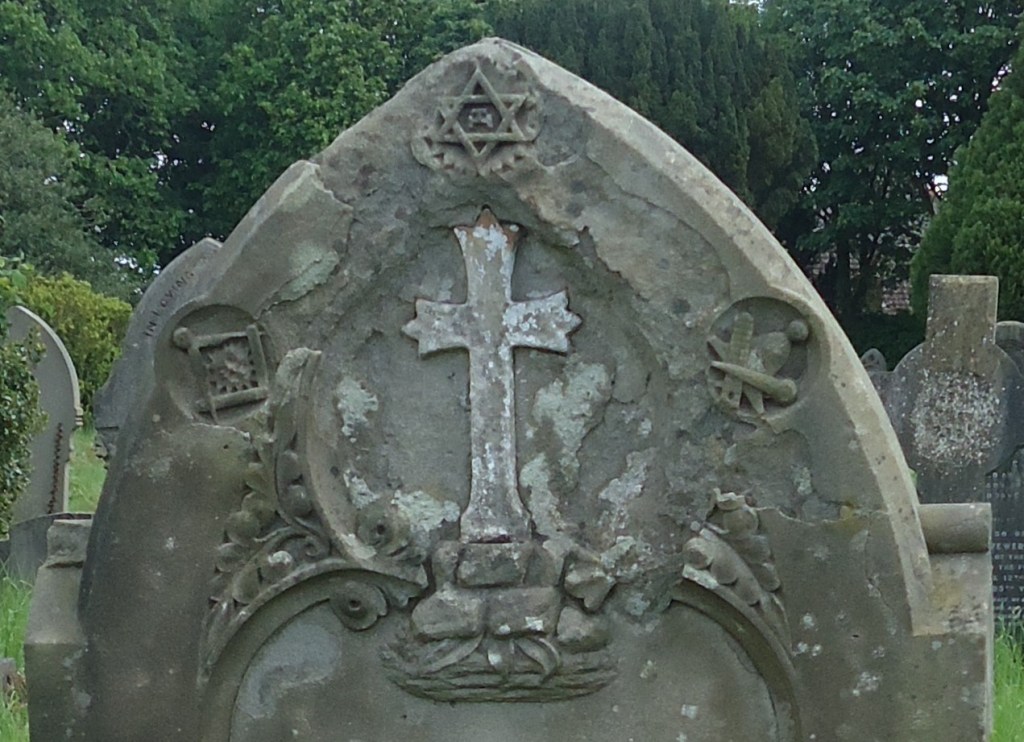
This headstone is decorated with numerous symbols, clearly indicating that Edwin Browne, who is buried here, was a Freemason.

Edwin was born in Newbury, Berkshire in 1833. By 1851 he was living with his widowed mother Mary at No. 2 Kimbers Alms Houses in Newbury where his mother is described as an ‘Almswoman’. Seventeen-year-old Edwin was working as a Postmaster’s Assistant but a year later he had left Newbury and was in Swindon where in October 1852 he began work as a clerk in the GWR Works stores.

But he was soon on the move again. In 1860 he married Anna Maria Heathcote at St. Peter & St Paul’s Church, in Aston and at the time of the 1861 census they were living in Coleman Street, Wolverhampton with their daughter Emily Vine Browne.

They remained in Wolverhampton for at least six years where two more daughters were born, Annie Amelia and Florence Lucy. Their first-born daughter Emily died in 1867 and is buried in Merridale Cemetery, Wolverhampton.

By the time of the 1871 census the family were living at 24 Prospect, Swindon before moving to 3 Church Place where Edwin died on June 2, 1885.

Research has revealed that Edwin was initiated into the Gooch Lodge on July 4, 1870 when the Lodge was only recently established. He would serve as Past Master of Gooch Lodge and PPSGO of Wiltshire.

Edwin died at his home 3 Church Place on June 2, 1885 and was buried in plot E8435 on June 5. He was 51 years old. The headstone leaves plenty of space for more inscriptions, but Edwin lies here alone.

Edwin’s second daughter Annie Amelia married Henry Simpson, a Steam Engine Fireman, in Wolverhampton in 1891. She died in Newport, Monmouthshire in 1961.

Youngest daughter Florence Lucy married Sidney Herbert Webber and remained living in Swindon. She is buried with her husband, two daughters and a son in Christ Church Burial Ground.

Edwin’s wife Annie Maria Browne remarried in 1900 in Cirencester and died there in 1913.

Mr Edwin Browne, deputy chief store-keeper to the Great Western Railway Company, died in a sudden manner on Tuesday, from heart disease, at his residence in Church Place, New Swindon. Mr Browne, who has been many years in Swindon, was generally liked by all with whom he came in contact. He was an enthusiastic Mason, being P.M. of 1295 and 355, and a P.P.S.G.O. of Wilts. The Masonic brethren of the deceased attended the funeral yester (Friday) afternoon at the Cemetery.

The Swindon Advertiser, Saturday, June 6, 1885.

Consecration of the Gooch Lodge, No. 1295

The interesting ceremony of the consecration and dedication of the Gooch Lodge, No. 1295, which had been looked forward to by the brethren in the province with a considerable degree of interest, took place at the Queen’s Royal Hotel, Swindon, on Saturday last. A very considerable number of brethren attended from London, Bath, Bristol, Gloucestershire, and several lodges in the province. Brother H. Muggeridge, as presiding officer on the occasion of the consecration, took the chair, and at once proceeded with the ceremony of consecration and dedication, which he most effectively and impressively performed. His opening address was a great treat and was listed to with much attention. The oration by the P.G.C. Brother the Rev. C. Raikes Davy also received great attention, being an exhortation to adhere to and promote the well-known objects of the Masonic Order – Charity, Benevolence, Good Will, etc.

The Lodge was afterwards formally dedicated and consecrated.

The installation of Brother Kinneir was then performed by Brother Sir D. Gooch, and the following officers were installed and invested:- Bros. J.J. New, S.W.; H.C. Tombs, Treasurer; F.J. New, S.D.; C. Lidsley, I.G.; H.J. Birch, J.W.; T. Coall, Secretary; W. Hall, J.D.; J. Burrows, Tyler.

The Banquet, to which upwards of 60 brethren sat down, was presided over by Brother Henry Kinneir, now W.M. 1295, supported on his right by the V.W. the D.P.G.M., and Brother Muggeridge, and on his left by the R.W. the P.G.M. of Berks and Bucks (Bro. Sir D. Gooch), Brother Rev. C.R. Davy, P.C.G., etc. the repast was served by Brother Westmacott, at the Goddard Arms, the resources of whose establishment were fully equal to doing honour to such an auspicious event. After the cloth was removed, the usual loyal and Masonic toasts were eloquently proposed and heartily responded to, song and glees most pleasantly alternating with the toasts.

The whole ceremony passed off with great eclat, and many brethren who came from a distance and had witnessed the consecration ceremony congratulated the members of the Gooch Lodge most warmly on a successfully inauguration.

Extracts from a much longer report published in the North Wilts Herald, Monday February 14, 1870.
George Henry Barefoot – like father, like son.

There is nothing I can add to the history of George Henry Barefoot that isn’t already mentioned in this detailed obituary (see below). Born in 1850 he was the first generation of Swindon-born railwaymen. Like his father he entered fully into the life of the railway town, supporting and working with the Mechanics’ Institution.

Published courtesy of Local Studies, Swindon Central Library.

Death of Mr G.H. Barefoot

A Sudden End

A well-known resident of Swindon passed away on Saturday night, when Mr George Henry Barefoot, foreman of the coppersmiths in the GWR Works, expired with painful suddenness after having pursued his daily avocation throughout the morning. Deceased went home to dinner in the ordinary way and partook of a meal. He then suggested to his niece, who had been keeping house for him at 19, William Street, since the death of his wife 11 months ago, that they should go to the football match together. He washed and changed, but on coming downstairs he complained of pains in the head and commenced vomiting. His condition grew worse, and Drs. Gilmore and Mason, of the GWR Medical Fund staff, bestowed upon him constant attention, but the end came at 10.45 p.m. The late Mr Barefoot had suffered from diabetes for two years, but he appeared to have completely recovered from this malady, and his death arose from an unexpected and a tragic relapse.

Born at Swindon in October, 1850, Mr Barefoot had attained the age of 61 years and his is a rare case of a man of advanced years predeceasing his father. Mr George Barefoot, who, at the great age of 83 years, is still hale and hearty and vigorous.

In January, 1864, deceased entered the locomotive department of the Great Western Railway at Gloucester – whither he went as a child for a few months – as an apprentice to the trade of a copper and tin-smith. He was transferred to the Swindon Works whilst still an apprentice in 1868, and continued to remain there up to his death. Being a workman of exceptional ability, he was promoted to a foremanship in 1900 in succession to Mr Laxon, and enjoyed the esteem of everyone with whom he was associated.

Mr Barefoot was a Forester and an Odd-Fellow, but, apart from his Works career, he was during his long residence in Swindon chiefly identified with the evolution of the GWR Mechanics’ Institute, which he had been instrumental in helping forward for a considerable period. He was a member of the Council for no less than 26 years, and when he had to retire upon his preferment to the status of a foreman 11 years ago it was realised that his services were so valuable that he quickly returned to take part in the deliberations of that body as a foremen’s representative.

He acted as secretary to the Juvenile Fete for about 13 years and at the time when the Institute were prominently concerned in conducting the education of the town Mr Barefoot was much to the fore.

In his young days he was more fortunate than most lads, for he received a good foundation of knowledge at Sir Thomas Rich’s Grammar School at Gloucester, and this advantage was of practical use to him throughout his career.

For many years he acted as MC of the Institute dancing class, acting in that capacity before the time of Mr A. Warburton, at whose death he again undertook the work, and it is interesting that he is the immediate predecessor of Mr F.H. Howard in conducting the class.

The late Mr Barefoot married Miss Mary Ann Berry, a native of Swindon, who, as stated above, died nearly twelve months ago. A family of four remains – one son and three daughters. All are married, and the former – Mr A.G. Barefoot resides at Birmingham, whilst the three daughters are Mrs G.F. Randell (Swindon), Mrs H. Moody (Australia), and Mrs H. Bryant (Swindon). The greatest sympathy will be extended to them in their unexpected bereavement.

Funeral

The funeral, which took place on Wednesday, was an impressive tribute to one who enjoyed high esteem. Leaving deceased’s late residence in William Street promptly at 2.20, the long procession was headed by a hand bier bearing beautiful floral offerings, and then followed the shillibier and eight carriages, while the followers on foot, who walked in double file, numbered quite 140.

The cortege wended its way to St. Mark’s Church, where deceased had been a worshipper, and which was almost filled with mourners.  The service here was taken by the Rev K.M.S. Graeme (curate), who also performed the last rites at the Cemetery, where in spite of the miserable weather, a good number, apart from the followers were present. Deceased was buried with his wife and adjacent to the grave containing his mother’s remains.

Long list of mourners…

Mr A Tyler represented the Stores Department clerical staff. K Shop of the Works, of which deceased had charge, was specially closed for the occasion, and considerably more than 100 men took a respectful part in the sad ceremony.

The coffin was of polished elm with brass fittings, and it bore the following inscription:

George Henry Barefoot

Died Jan. 7th, 1911

Aged 61 years.

A long list of floral tributes, including:-

A token of sympathy and esteem from the men and boys of K. Shop.

A token of respect from the GWR Foremen’s Association.

The funeral arrangements were in the hands of Messrs H. Smith & Son, Gordon Road.

Extracts from North Wilts Herald, Friday, January 13, 1911.

George Henry Barefoot was buried in Radnor Street Cemetery on January 11, 1911 in grave plot E7793 which he shares with his wife Mary Ann and in the neighbouring plot to his mother Mary Elizabeth Barefoot and later his father, George Barefoot.

You might also like to read:

George Barefoot – an investor in people

Jason Johnson – a homegrown railwayman

Here we have Jason Johnson who served alongside Robert Laxon on the Medical Fund Committee from 1853-1859.

Jason was a homegrown railway man, and in the early days there weren’t too many of them around.

Jason was born in nearby Baydon in 1819. Jason married Emma Adams in 1846 and by 1851 they were among the early residents to move into Taunton Street. According to the 1851 census returns Emma was 21, which would have made her just 17 when they married. You have to be a bit flexible when reading census returns – until civil registration was introduced in 1837 people were not always certain of their birthdate, and of course people told fibs for all manner of reasons. A wife older than her husband might shave off a few years. A child born out of wedlock might have a year added to their age and a boy out at work might also add a year to qualify for a higher rate of pay.

Jason’s job ‘Inside,’ which was the local term for the railway works, was that of blacksmith.

In 1861 the couple lived at 30 Taunton Street with their six children. Ten years later and they had moved to 27 Gloucester Street. During the intervening 10 years Emma had five more babies with one last one born in 1874.

The boys all went into the Works; Arthur and Alfred worked as blacksmiths; John and Daniel as coach body makers while Thomas worked as a railway clerk.

Jason died at his home 19 Gloucester Street on December 2, 1891 and left effects to the value of £404.

You might also like to read:

Robert Laxon – first secretary of the Medical Fund

Robert Laxon – first secretary of the Medical Fund

I was surprised to find these two decorative headstones when I started researching Robert Laxon and Jason Johnson, two of the early settlers in the railway village. I had wrongly made the assumption that they would not have left enough money to pay for something like this. But the more I looked into their lives the more interesting I found these two men.

This is the last resting place of Robert Laxon who died at his home No 2 Faringdon Street on January 16, 1890 aged 86.

Robert was born in Lowestoft on May 10, 1804 and grew up in Gt Yarmouth, Norfolk. By 1835 he had married his wife Maria (who is buried here with him) and the couple were living in the parish of St Pancras in London.

The couple had a large family – two sons and six daughters, the youngest three children were born in Swindon. Robert’s sons, Robert and Frederick both became coppersmiths while the girls worked as dressmakers and tailoresses. Matilda had worked as a Pupil Teacher and in the 1871 census Maria describes herself as a bookseller, but eventually all the women earned their living by sewing.

The UK Railway Employment Records state that Robert’s service with the GWR began in December 1838 at Paddington where he worked as a coppersmith and that he was Foreman in K Shop of the Loco factory by June 24, 1843, the first to hold that position.

Robert held another first – in 1853 he was the first secretary of the Medical Fund. He also belonged to both the Oddfellows and the Ancient Order of Foresters, two Friendly Societies, which provided insurance, pensions and a banking service for members, so he was a careful and a canny man. When he died he left £878.

The employment records state that Robert left the GWR employment on January 16, 1890 – the date that he died. Did he continue working until his death? It is quite possible.

Robert Laxon pictured in old age

Death of an Old Forester. – On Thursday last, there passed from our midst, one of the oldest Foresters in Wiltshire, in the person of Bro. Robert Laxon, at the ripe old age of 85 years. Bro. Laxon was one of the founders of Forestry in Swindon, being one of the opening members of Court Briton’s Pride, No. 1597, of which Court he remained a member till the time of his death. For nearly 50 years he took an active part in the work of Forestry, not only in Swindon, but in the district round about. Bro. Laxon honourably filled the various offices of his Court for many years, holding the important office of treasurer. On Tuesday last, by the wish of his friends, he was accorded a Forester’s funeral. The brethren met at the Court House, the Union Hotel, at 2 o’clock, and having donned the funeral regalia of the Order, marched to Bro. Laxon’s house; the procession being headed by the D.C.R. Bro. T. Smith and Bro. J. Mitchel, P.D.C.R. At the house the workmen from the K shop (where Bro. Laxon was foreman), the foremen from the GWR Works, and other friends joined the procession, which numbered upwards of 100. At the grave the Forester’s funeral service was read by the D.C.R., Bro. T. Smith. Afterwards the brethren marched back to the Court House, where they separated. Bro. Dean, D.S., Bro. Baker, D.T., and Bro. G. Thomas were unavoidably absent.

In the year 1840 Mr R. Laxon was employed by the firm of Braithwaits, the engineers in London. The GWR Company being in want of a coppersmith, borrowed Mr Laxon from the above firm, to work for them at Paddington. After a month or two the railway company took him into their employ entirely. For some time he remained at Paddington, eventually being sent by the company to work at Swindon in the year 1844 (the Swindon Works being then in its infancy). Mr Laxon was placed in charge of the coppersmiths shop, their being two coppersmiths and one apprentice employed here at that time. After a short time, Mr Laxon was made foreman, which honoured position he has held till the time of his death.

Swindon Advertiser, January 25, 1890.

You might also like to read:

Jason Johnson – a homegrown railwayman

James and Elizabeth Murgatroyd – two of Swindon’s ordinary people

Swindon Borough Council have been busy at Radnor Street Cemetery in recent weeks and have cleared a great swathe of brambles from Section E, a particularly difficult area to navigate. Section E has probably the greatest collection of headstones and memorials in the cemetery and as Noel, Andy and I took a walk, Andy’s eye was drawn to the grave of James and Elizabeth Murgatroyd.

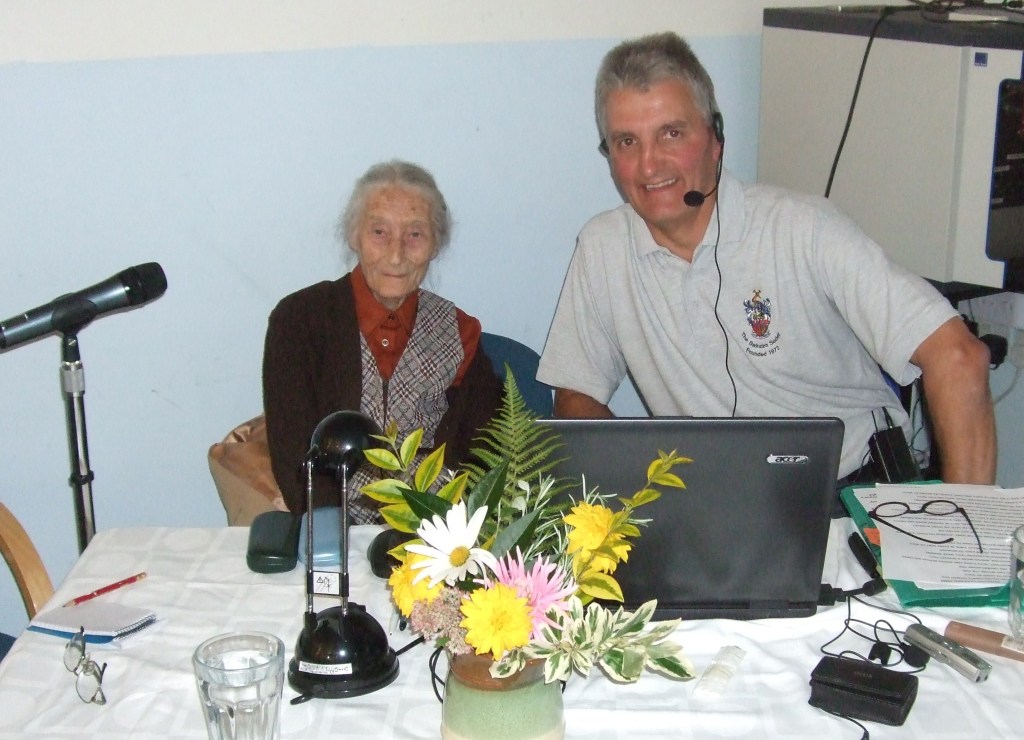
Joyce Murgatroyd was a great friend of Andy’s for many years. Teacher, artist, poet, musician and repository of Swindon’s history, Joyce died in 2017 aged 100 years.

I have written about Joyce’s family, including her great grandmother Sarah Peaple and cousin Elsie Morse but have never looked into the history of her husband Henry Murgatroyd’s, family.

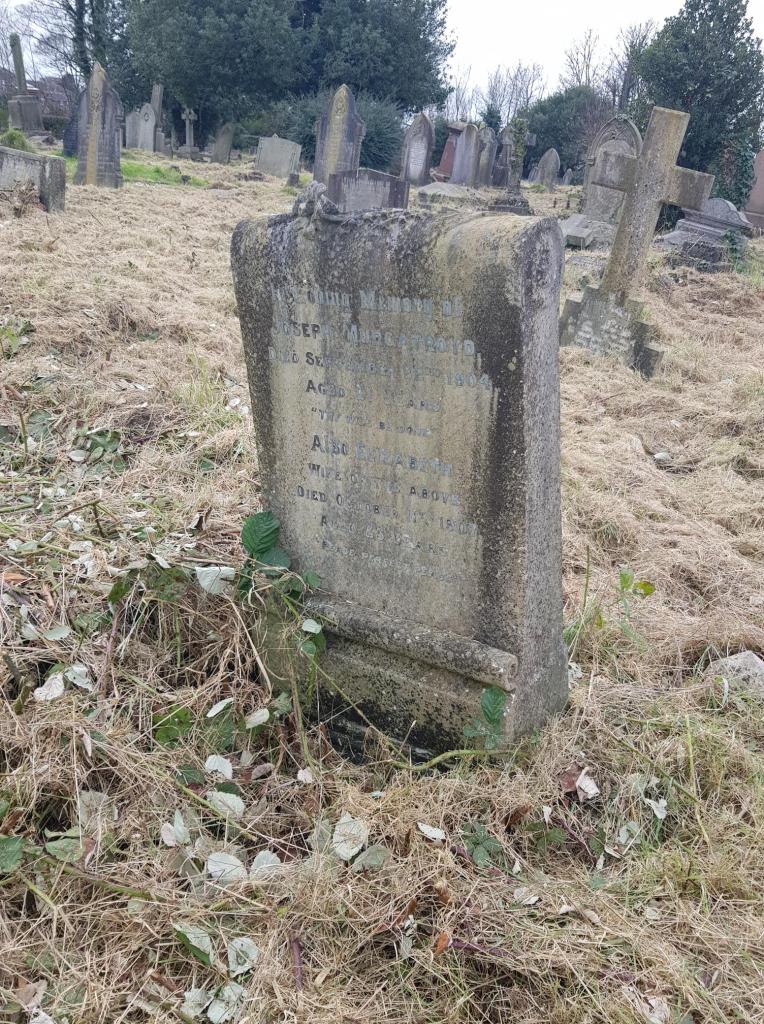
The headstone we discovered was that of Joseph Murgatroyd, born in Bradford in 1823. He married Elizabeth Dewhirst at St. Peter’s Church, Bradford on August 26, 1844. At the time of the 1851 census Joseph and Elizabeth were living in Okehampton Street, Exeter where Joseph’s occupation was engineer. They had two children Alfred, 5 and Priscilla, 3. It seems as if they may have already lived in Swindon at some point as this is where Priscilla was born.

By 1861 they were living at No 7, Alliance Terrace, Bridge Road, Swindon where Joseph was a Fitter & Turner at the Engine Factory. Their eldest son had died by that time – now their family comprised three children, Priscilla 13, Alfred Edwin 3 and one year old Sarah.

In 1871 they were living at 8 York Place before moving to 12 Sheppard Street, which would remain Joseph’s home until he died. His funeral took place on September 21, 1904 when he was buried in plot E7809. Elizabeth died in 1907 at her son’s home, 54 Eastcott Hill. Her funeral took place on October 15 when she was buried with Joseph. Their son Alfred Edwin, his wife Ellen and their daughter Annie Irene are buried in E7810, the neighbouring plot.

Joyce and Andy pictured together getting ready for a Swindon Society presentation in 2012.

Sadly, I did not establish a link to Joyce and Henry Murgatroyd, but I have been able to add another account to the Radnor Street Cemetery archives remembering Swindon’s ordinary people.

John and Alice Hayes

This story was submitted by their great-granddaughter.


‘John Henry Hayes was born 2 Nov 1872 to parents William (ox carter) and Mary of 27 The Street, Broad Hinton. He was the 7th of 8 children, having 3 brothers and 4 sisters.

Living in a rural community he initially trained as a blacksmith before entering the Great Western Railway as a springsmith. (1911 census gives his occupation as Blacksmith Striker GW Railway).

Circa 1898 John Henry, aka Jack, married Alice Maude Mary (nee Pyke born 1879 Wroughton).

They moved to 50 Summers St. Swindon and he became a churchwarden at the Rodbourne Road Methodist Chapel.  My father remembers having to play quietly on Sundays whilst his stern granny read her bible. He also remembers she didn’t cook on a Sunday so there were only ‘cold cuts’ for lunch.

I understand he taught other railway employees in his front room. I don’t know whether this was religious studies or reading/writing.

Their family expanded and by the 1911 census they had 3 living and 2 deceased children. To my knowledge there were a further 2 girls and a boy, 6 in all surviving to adulthood.

My grandfather, imaginatively named Thistle Ewart aka Tom, was his second child. He, together with his only child my father Barrie John, and myself all in our turn ‘went inside’ GWR/BREL.  We have a 4 generation plaque on the wall at Steam.

John Henry lost his wife in 1939 and passed away 11 Feb 1951.  He was buried at Radnor Street Cemetery Swindon, plot C4160′

The attached photo is of John Henry and Alice taken in approx. 1934.

*The couple share their grave with Alice’s mother Jane who died in November 1926. Her last address was given as 50 Summers Street.

George Henry Flewellen – one of the best known locomotive railway inspectors on the GWR

George Henry Flewellen was born on August 4, 1861, the youngest of John and Betsy Flewellen’s five children and grew up in the hamlet of Ford, Wiveliscombe Somerset. He began working for the GWR in June 1878. At the time of the 1881 he was living in Bristol with his mother and stepfather. Aged 19 George worked for the GWR as an engine cleaner.

On August 12, 1889 he married Ada Elizabeth Horton at St Luke’s Church, Bristol.  By 1891 the Flewellen family were living in Devonport and George states his occupation as railway engine driver. The couple had two children who survived childhood, Henry born in Bristol in about 1895 and Winifred born in Taunton in about 1897. By the time of the 1911 census the family had settled in Swindon and were living at 23 County Road.

This photograph was taken by Swindon photographer William Hooper, it is believed, in the garden at the back of his studio at 6 Cromwell Street. It was taken on the occasion of the marriage of Henry John Flewellen and his bride Elsie M. Parker in 1917. This may have been a regular ‘professional’ assignment for Hooper, but I wonder if the two families were possibly friends of Hooper’s through his membership of the Open Brethren Movement.

The groom’s father, George Henry Flewellen, is pictured standing left, his hand on the shoulder of the seated woman in front of him, his wife, Ada.

The photograph is kindly published by P.A. Williams on the Local Studies, Swindon Central Library flickr page, among more than 1,131 images by William Hooper and other local photographers.

George had a long and illustrious career in the GWR (see below). He retired in 1926 and enjoyed a retirement of some 15 years, relatively unusual as many old railwaymen died within a year or two of finishing work.

Inspector George Henry Flewellen, who retired on August 4, is one of the best known locomotive railway inspectors on the G.W.R., which company he has served since 1878, when he commenced as an engine cleaner. He had thus completed 48 years’ service. Mr. Flewellen had been associated with many of the most notable developments in locomotive operation and train running on the G.W.R. He was on the City of Truro when it gained the world’s highest authenticated speed record, touching 102.3 m.p.h. down Wellington Bank with an Ocean Mail special. This was in May, 1904. He continued on the same train, but with the old single locomotive, No. 3065, Duke of Connaught, which ran the 118 ½ miles from Bristol, to Paddington, via Bath, in 99 min. 46 sec. start-to-stop, incidentally covering the 81 ¾ miles from Wootten Bassett to Westbourne Park in 62 min. 55 sec., maximum speed 91.8 m.p.h. He was in charge when H.M. the King drove the engine Windsor Castle for a short distance in 1924. The photograph reproduced shows him standing alongside the engine which inaugurated the Swindon-Paddington run at an average speed of 61.8 m.p.h.

newspaper cutting

George and Ada’s last home together was 23 Wills Avenue. George died at St Margarets Hospital, Stratton and was buried in Radnor Street Cemetery on April 30, 1941. He was 79 years old. Ada died less than two years later, also at St. Margarets Hospital. She was 77 years old. She was buried with her husband in grave plot C4863 on December 22, 1942.

You might also like to read:

William and Mary Hooper rock up at Stonehenge

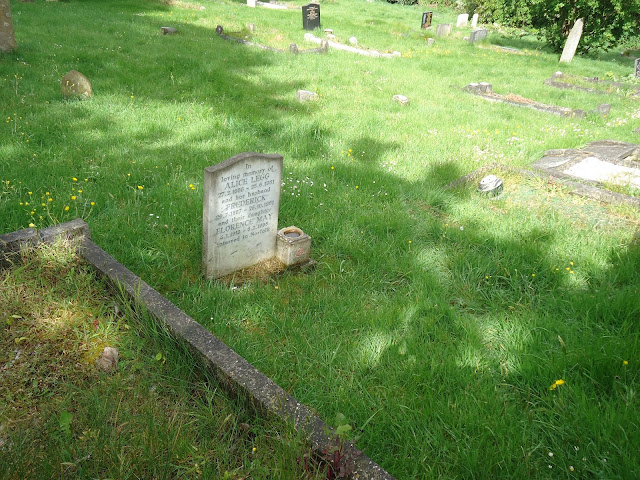
Alice and Frederick Legg

This is the story of Alice and Frederick Legg.

Alice Legg was not a local girl. She was born in Wimbledon in 1886, the daughter of Frederick and Catherine Lovegrove.

Her first job was as a kitchen maid at a private girl’s school in Wimbledon. The duties of a kitchen maid were many and varied and involved a lot of cleaning and some cooking under the supervision of the cook. In this her first job, Alice was roughly the same age as the pupils at the school.

At the time of her marriage in 1911 Alice was working as a domestic servant for a Wine & Spirit retailer. Her husband Frederick was born in 1887, possibly in Faringdon.

They married at All Saints Church, Wimbledon on June 5, 1911. Both Alice and Frederick give their address as 65 Norman Road. The UK Railway Employment Records state that Frederick had begun working for the GWR here in Swindon on May 29, 1911 as a Boilermakers Helper, just weeks before his wedding.

Frederick later worked as Watchman in the Loco Manager’s office. He left the Works on Jan 4, 1943. The couple’s last home together was at 75 Okus Road.

Alice died at the Isolation Hospital. Frederick died at 432 Ferndale Road, most probably the home of one of their children.

The couple died within months of one another. Alice in June 1961 and Frederick in October of the same year.

Alice and Frederick’s story was kindly given to me by a Radnor Street Cemetery follower who joined one of our guided cemetery walks some years ago.

Edith and Samuel Whiteman in pictures

It is always a wonderful surprise to find images and family memories about those buried in Radnor Street Cemetery. This week I came across a photograph on the fantastic Local Studies Flickr page and a comprehensive, illustrated family tree on Ancestry posted by Steve Clements.

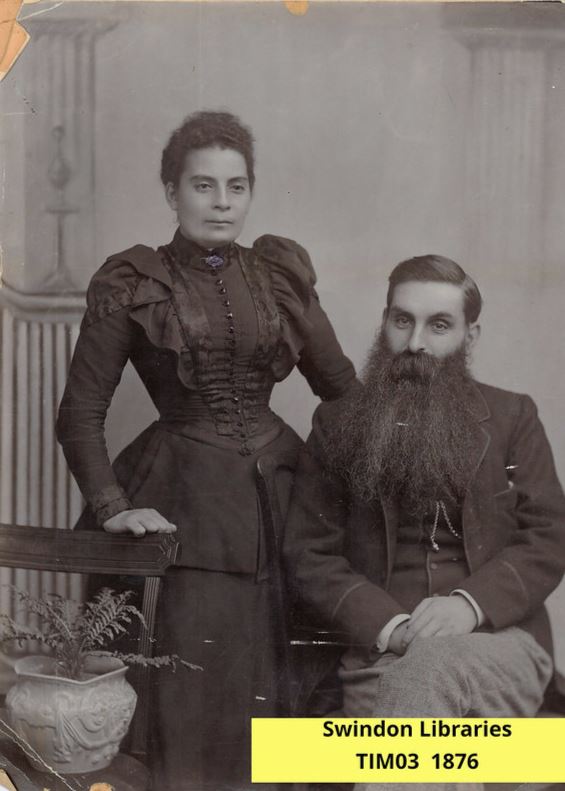
My first find was a studio portrait of Edith Jemima nee Ricketts and her husband Samuel John Whiteman published courtesy of Brian Timbrell. The couple look young, despite Samuel’s impressive beard, and I wonder if this photograph might have been taken on the occasion of their marriage (look at Edith’s nipped in waist!). Edith and Samuel were married at St. Stephen’s Church, Kensington on April 17, 1876. They were both 24 years old.

Samuel was born in 1851 in Chippenham, the son of George, a smith, and his wife Elizabeth. Edith was also born in 1851 in Down Ampney, Gloucestershire, the daughter of Richard Ricketts and his wife Elizabeth.

At the time of the 1881 census the couple lived 8 Read Street with their two children Edith and Francis (a second son Lancelot was born in 1883) and two boarders Robert Dean and Caroline Hewer who were possibly members of Edith’s extended family from Down Ampney. Samuel worked as a clerk in the GWR Works. In later years Edith worked from home as a dressmaker.

The couple lived at various addresses across Swindon – in 1891 they were at 178 Clifton Street and in 1901 at 51 Curtis Street. In 1911 they lived with their daughter and her family at 14 Curtis Street before moving to 7 Curtis Street where Edith died in 1923. She was buried on August 1 in a public grave, plot C482. Samuel outlived Edith by a further 16 years. He died in 1939 and was buried on November 11 in a public grave, plot C696. His last address was 4 Temple Street.

Edith and Samuel pictured with their little granddaughter Eileen Edith Young

Sadly, as both these graves are public plots there is no headstone on either of them, so it is especially pleasing to remember Edith and Samuel with photographs.

A Veteran Forester

Death of Mr S.J. Whiteman of Swindon

The funeral took place on Saturday of Mr Samuel John Whiteman, aged 88 years, of 4 Temple street. He had been in ill health for some six years and had been confined to his bed for the past 12 months.

Mr Whiteman was born at Chippenham and came to Swindon when a young man. When 19 he entered the service of the GWR Co., being employed as a clerk in the Q Shop, and later in the Accounts Department. He retired from the Works some 35 years ago, and was for some years in the employ of Mr. L. J. Chappell, then owner of the Swindon Motor Coy., retiring on his 72nd birthday.

Mrs Whiteman died 16 years ago. He is survived by one daughter and two sons, also three grandchildren and five great-grandchildren.

Mr Whiteman was one of the oldest members of Court Briton’s Pride, North Wilts District A.O.F.

The first portion of the service was held at St. Paul’s Church by the Rev. M.C. Melville (curate) and the interment was at Radnor Street Cemetery.

The Chief mourners were: Mr Frank Whiteman and Mr Lancelot Whiteman (sons), Mr R. Dean (brother-in-law), Mr J. Dean (nephew), Mr E.H. Elliott and Mr B.W. Phillips (friends).

The funeral arrangements were carried out by Messrs A.E. Smith and Son, of Gordon road.

North Wilts Herald, Friday, 17 November, 1939.

David Watson – railway and political pioneer

The re-imagined story …

When David Watson heard about the new railway town being built in Wiltshire, he decided to apply for a job.

He packed his apprenticeship indentures in a leather pouch, kissed his wife and his two daughters goodbye and set off from his home in Scotland. He intended making the journey of 500 miles on foot.

That was the story handed down through generations of railwaymen. Today such an epic effort is unfathomable. In 1843 the railway network was in its infancy and the road system was basic and hazardous. Today a journey by car travelling on the M6 would taken an estimated 7 and a half hours and even a train journey would take more than 8 hours. How long did it take David Watson and which route did he follow? Did he hitch a ride with a passing carter or did he travel part the way by stagecoach? Did he stop to sleep on route at a roadside inn or did he shelter in the hedgerow over night? Did he really walk 500 miles?

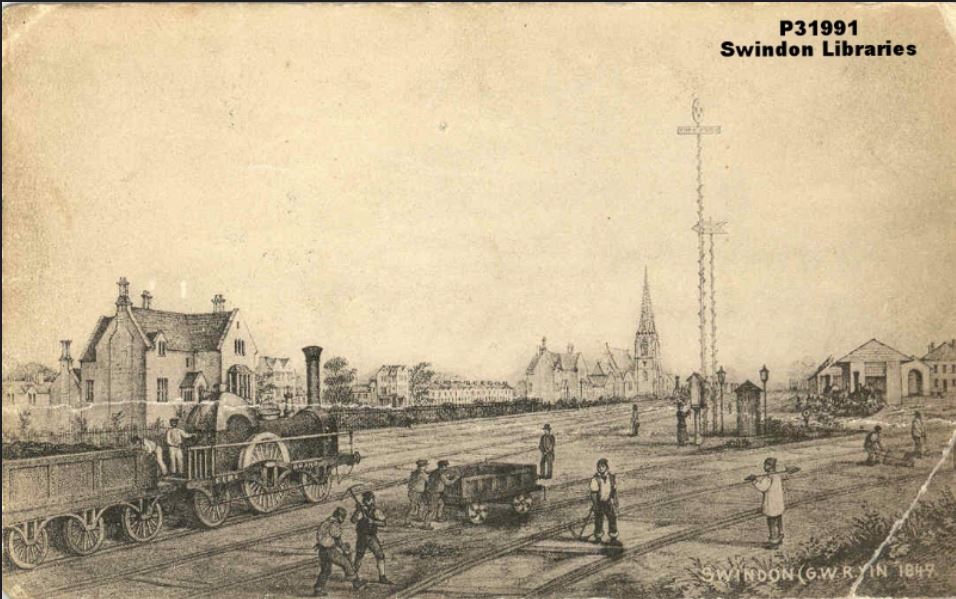
New Swindon 1847

The facts …

Death of Mr David Watson

A Swindon Octogenarian

The news of the death of Mr. David Watson which occurred on Wednesday at the residence of his son, Mr. Alex. Watson, 24 Cambria Place, will be received with keen regret by a host of friends amongst the older generation of Swindonians. Mr. Watson was 89 years old about a month ago, but, notwithstanding his great age, he had until recently been a familiar figure in that part of the town near his home. As recently as a week before his death, the old gentleman was seen out, but on Friday he had an attack of bronchitis, to which he succumbed shortly after noon on Wednesday.

A fine, burly figure of a Scotsman, Mr. Watson was born at Cragie, near Glasgow, in 1824. Serving his apprenticeship as a fitter in Dundee, he came to Swindon as long ago as 1843, and obtained employment in the GWR Factory. For about 30 years, the old gentleman, whose hearty and genial manner soon won him a large circle of friends, was chargeman over the fitters in the R Shop, and even after advancing years compelled him to give up the chargemanship he continued to work “Inside.” Indeed, it was only 11 years ago, in ’99, when Mr Watson had reached the age of 79 years, that he finally left the GWR Company’s employ, thus severing a 56 years’ connection with the Railway Company.

Mr Watson had been a member of the ASE for about 71 years, being superannuated by that Society when he gave up work. One of the first members of the Mechanics’ Institution and Medical Fund Society he was President of the latter on one occasion in the “fifties.”

In politics, the deceased was an ardent Liberal. During the whole of his residence in Swindon he had staunchly supported the Progressive cause, and took a prominent and active part in local contest in the old days.

Mr Watson, it might be mentioned, was one of the earliest contributors to the columns of the “Advertiser.” He was living in Swindon when this paper was founded in 1854, and he was a friend of the late Mr. William Morris, the founder, and, for nearly forty years, editor of this paper. Amongst his most treasured possessions was an old copy of the Swindon Advertiser, dated June 31st 1859, containing a report of a speech given by Mr Watson when presiding over a “Bobbie Burns” Centenary dinner at the Union Hotel, Swindon.

Mr Watson leaves three sons and two daughters out of a family of eleven, to mourn his loss.

The funeral of deceased will take place in Swindon Cemetery tomorrow (Saturday) afternoon.

The Swindon Advertiser, Friday, April 15, 1910.

At the time of the 1851 census David and Elizabeth and their five children were living at 7 Reading Street. By 1881 the widowed David was living at 31 Sheppard Street, his four sons were all working as engine fitters in the railway factory.

David Watson aged 89 of 24 Cambria Place was buried in grave plot B2967 on April 16, 1910. He was later joined by his son Alexander and daughter-in-law Eliza.

You might also like to read:

Elizabeth Lyall Embling – the first woman to be buried in Radnor Street Cemetery.