A Swindon Time Capsule

If you’re looking for a last minute Christmas gift for a history loving member of the family then I can recommend A Swindon Time Capsule.

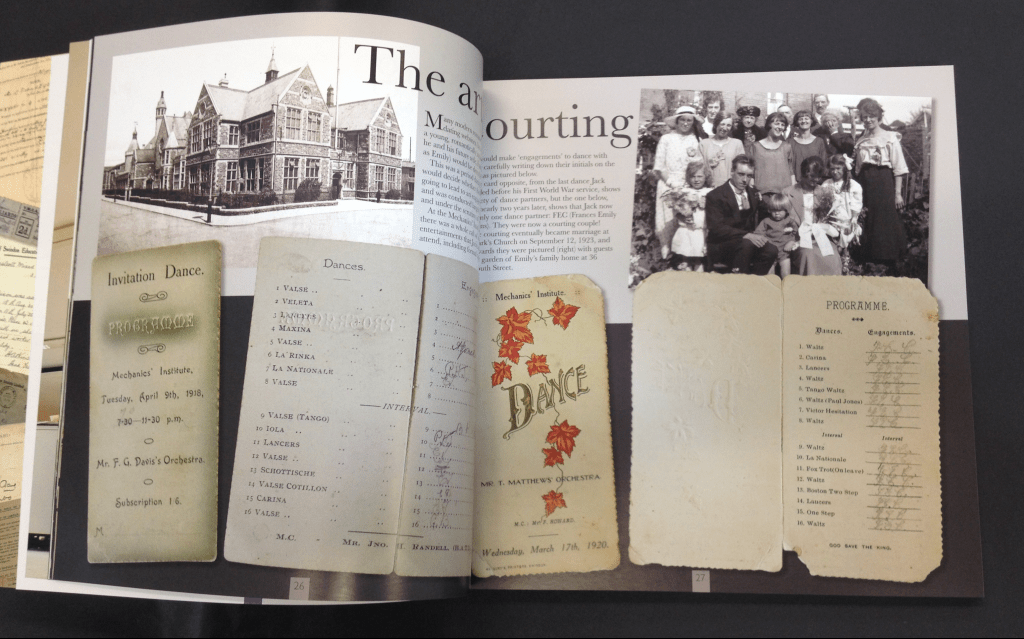
In 2018 the Swindon Heritage team in partnership with Mike Attwell and Local Studies, Swindon Central Library (supported by funding from the HLF) produced an *award winning book entitled A Swindon Time Capsule: Working Class Life 1899-1984.

The book came about following a donation to the Swindon collection made by Mike Attwell when he cleared his family home following the death of his mother Audrey.

Audrey was the daughter of Jack Dixon, a second generation Swindonian whose grandparents George and Mary Hemsley and Francis and Martha Dixon migrated from the North East of England between the years 1840-1850.

George Hemsley worked as a fitter and turner and Francis Dixon as a boilermaker who with their wives were pioneer residents in the new railway town. Both men were active members of the New Swindon society, George was a member of the Liberal & Radical Association and co-founder of the New Swindon Industrial Co-operative Society. For more about George’s life see.

Francis Stephenson Dixon married Martha Charlton at the church of St. Andrew, Newcastle on May 21, 1843. By the time of the 1851 census they were living in Taunton Street with their two children, John 7 and 11 months old Ann.

And like so many of the early railway settlers in Swindon, members of the Hemsley and Dixon families found their final resting place in Radnor Street Cemetery. Francis died at his home, 10 Faringdon Street, on January 2, 1884 aged 63. The cause of death is recorded as cardiac disease. He was buried on January 3 in plot D8283 where his wife Martha followed him the following year.

The Dixon-Attwell family, apparently threw nothing away. As a result ordinary ephemera such as clothing catalogues and dance cards have survived along with apprenticeship indentures and military service records and provide a unique example of everyday life from 1899-1984. A selection from this vast collection can be viewed here.

*In 2019 a Swindon Time Capsule won the Alan Ball award, which rewards local organisations for their work to promote and share local history. Copies of the book are available from the Library Shop.

Thomas Messenger – Fatal Accident in the GWR Works

On Friday December 14, 1894 Thomas Messenger was involved in a fatal accident in the Timber Yard at the GWR Works. Back home in Linslade Street his wife Emma went into labour. Thomas died two days later. He was 31 years old and according to the report made to the Great Western Railway Board he had been employed in the Company for 5 years and 5 months, his daily rate of pay was 3s 2d.

Fatal Accident in the GWR Works – On Tuesday morning, Mr. Coroner Browne and a jury, of whom Mr W.J. Deavin was foreman, held an inquest at the Cricketers’ Arms, New Swindon, on the body of Thomas Messenger, aged 31 years, a labourer, employed in the Great Western Railway Works timber yard department. Mr T.O. Hogarth and Mr H. Hayward were present to watch the case on behalf of the GWR Company.

From the evidence adduced, it appeared that deceased was on Friday morning employed with other men in stacking timber. A “skid” – a piece of timber weighing some 7 cwt. – was used for sliding the timber on to a stock in order to save labour. Deceased placed the skid too far over the corner and it rebounded and stuck him in the head, causing a fracture of the skull.

A verdict of accidental death was returned. The jury gave their fees to, and also made a subscription on behalf of deceased’s widow, who is left with three children, and was confined on the morning of the accident. The sum handed to the widow was £1.

Wilts and Gloucestershire Standard, Saturday, December 22, 1894.

Thomas was buried on December 19 in a public grave plot B2264. His father, also named Thomas, was buried with him in 1902. They share the grave with a baby and an elderly widow, both unrelated.

Thomas and Emma had been married less than two years. Emma had already been widowed once before, left with two little daughters Martha and Amelia. Now she was on her own again with another child. The baby was baptised at the parish church in Latton on January 27, 1895. She was named Thomasina Polly Strong Messenger. Emma went on to marry for a third time in 1901. She died in 1943, aged 82.

Thomasina married, raised two children and died in High Wycombe in 1973, aged 79.

No 1 Shop, Timber Yard pictured in 1928. Image published courtesy of STEAM Museum.

Edith Gay Little and the wooden memorial

wooden grave

The re-imagined story …

He knew exactly what type of memorial he wanted for Edith, and he would make it himself.

He sketched it out on the table in the front room at 59 Station Road. A large cross, something that would stand proud and obvious.

In Memory of Edith Gay, the beloved wife of Edward Little. He practised the style of lettering he would use. He wanted something elegant. No, that was too ornate. He rejected his first attempt. The next was too difficult to read. Eventually he settled on a simple script, something Edith would have liked.

Would he leave a space for his own name to be added in the future? He decided not to. He couldn’t trust anyone else to choose the right script or to execute the work to a sufficiently high standard. This memorial was a symbol of his love. He didn’t want it spoilt by some ham fisted amateur.

He sat in the silent house; the late summer afternoon sunshine streamed through the window. He’d make a start now, he decided. He had a nice piece of seasoned timber in the shed.

Little

The facts …

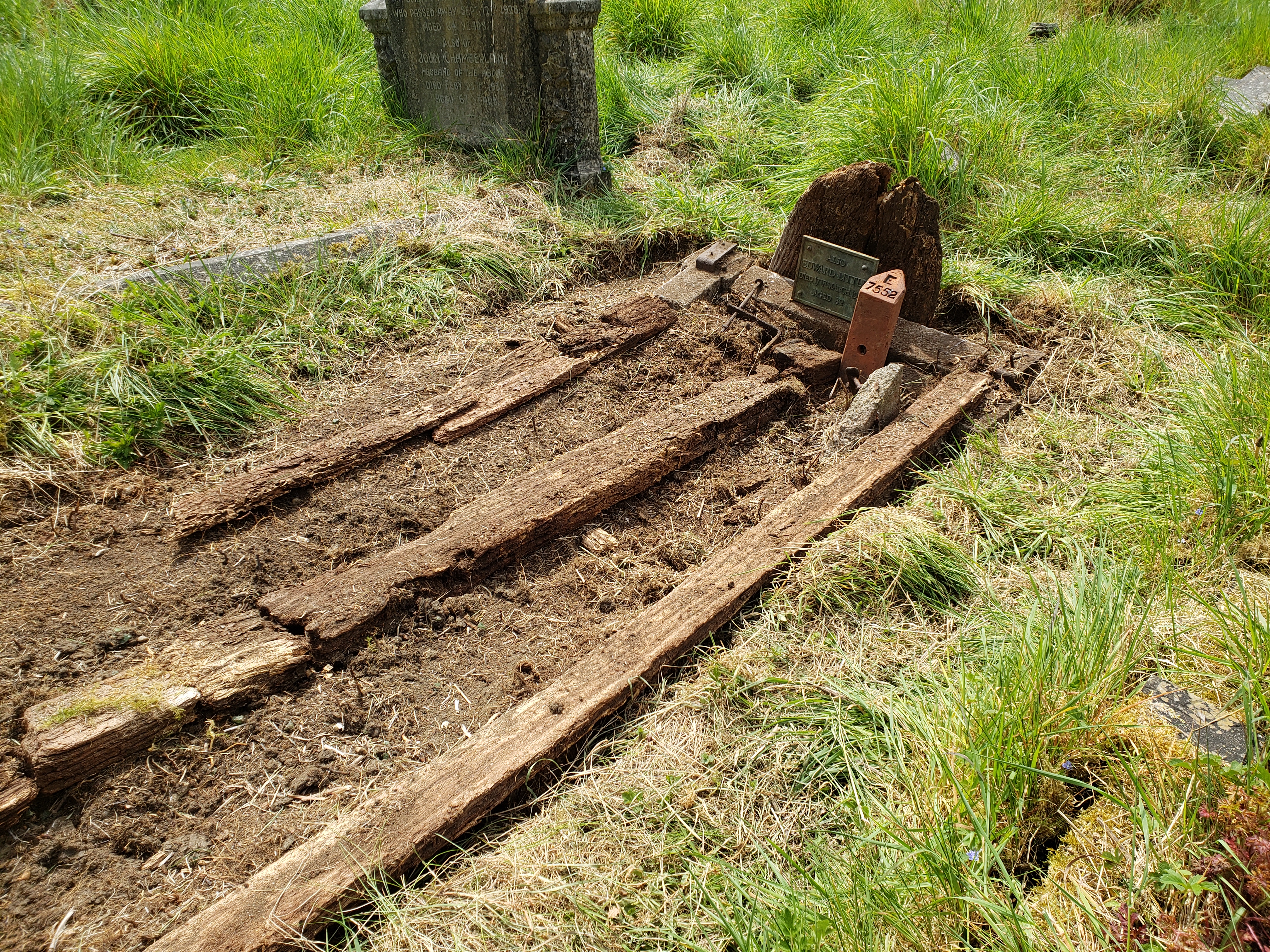
I first discovered this memorial more than ten years ago and each spring when the guided walks resume, I always have difficulty finding this grave again. And every year I wonder if it has managed to survive another winter, because this extremely unusual memorial is a wooden one.

It marks the grave of Edith Gay Little, a former nurse, who died on August 23, 1928 at the Great Western Railway Medical Fund Hospital.

Edith’s husband was Edward Little and I believe it was he who made this wooden memorial. Edward was employed as a bodymaker in the carriage and wagon works at the Midland & South Western Junction Railway at Cirencester. He was promoted to chargehand and eventually foreman and by 1923 was based in Swindon.

Edward was no stranger to Swindon as it was here that he married his first wife, Elizabeth Ann Bindon, at St Paul’s Church on August 21, 1897. Elizabeth died in 1909 aged 38 and was buried ‘under Coroner’s warrant’ in South Cerney where they were living at the time.

On September 22, 1911 Edward married for the second time. By now he was 41 and his bride Edith Gay Smith was 43. The couple married at Holy Trinity Church, Trowbridge.

Unfortunately, there are no known photographs of this memorial when it was new. How distinctive it must have looked, standing out against the surrounding white gravestones. I imagine Edward would have visited the grave regularly, polishing and treating the wood to preserve it.

It would appear that Edward had no children by either of his wives. He retired from the railway works in 1935 and continued to live at 59 Station Road, the home he had shared with Edith.

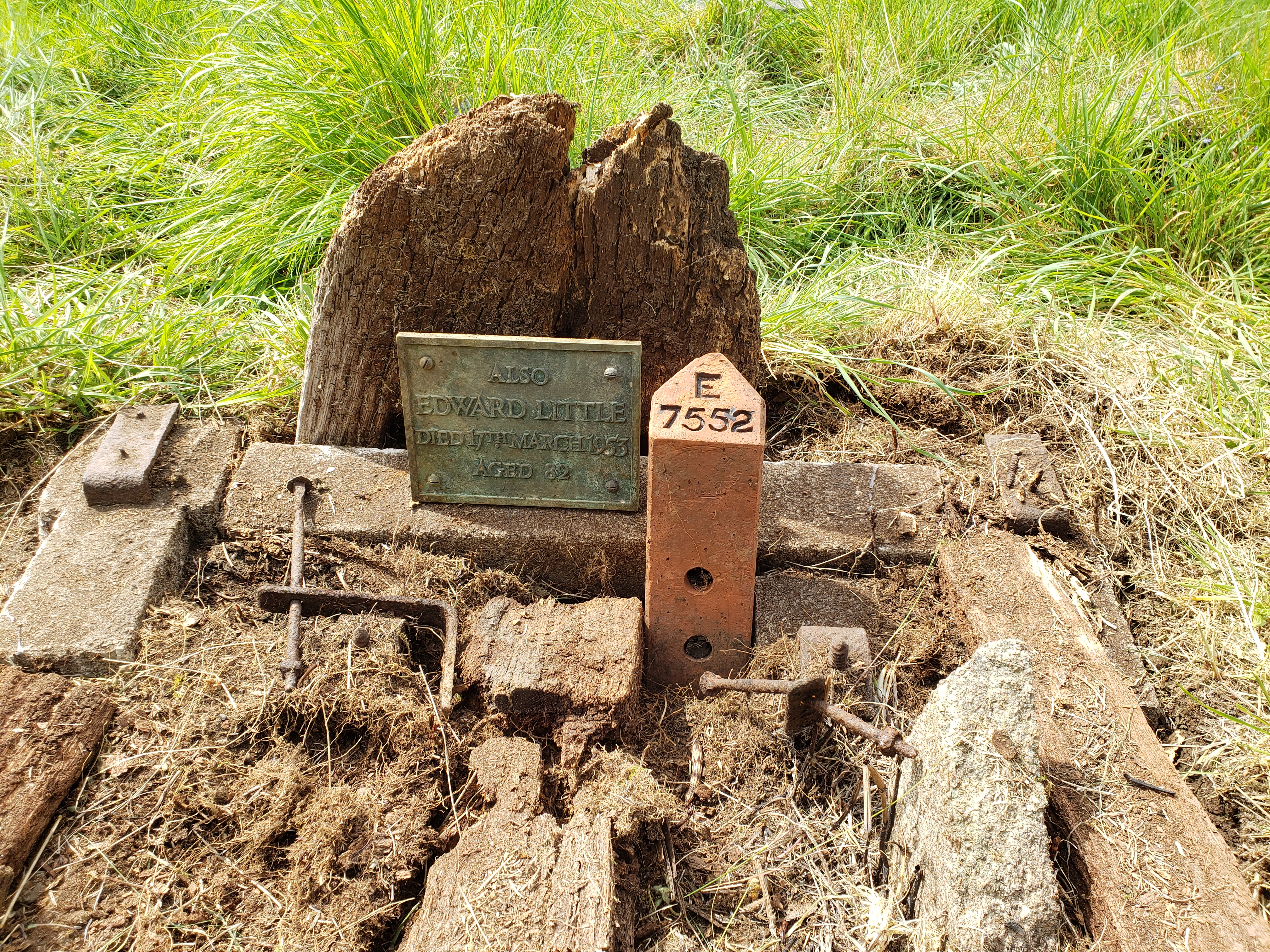
Sadly, he ended his days in Roundway, the psychiatric hospital in Devizes, where he died on March 17, 1953. Probate was proved at Oxford and his effects, valued at £2,369 16s 5d, were placed in the hands of Lloyds Bank.

He was buried with Edith. With no one left to come and polish the wooden memorial it now lies at the mercy of the elements.

This week Radnor Street Cemetery volunteers Kevin and Brian managed to locate and reveal the wooden grave. They even found a memorial plaque to Edward, the man who I believe was the maker of this unique and poignant memorial.

Little (2)

William and Arthur Henry Wall – died on the same day

The newspaper article provides a pretty comprehensive account of William’s service. His military records reveal that he enlisted in the 4th Wilts on September 14, 1914 aged 46 and served at home until January 2, 1916. On January 3, 1916, having transferred to the 22nd Wessex & Welsh Btn the Rifle Brigade, he was sent to the Western Front where he served for 325 days. On November 24, 1916, he was posted to Salonika where he served for 1 year and 215 days before being posted home on June 27, 1918, having previously transferred to the Royal Engineers.

William was discharged on August 10, 1918 as being no longer physically fit for War Service. He was 49 years and 11 months old and suffering from valvular disease of the heart (VDH).

He was awarded a weekly pension of 27 shillings for four weeks after which it dropped to just over 13 shillings, to be renewed after 48 weeks.

William had previously worked for more than twenty years as a Rivetter’s Holder Up in the GWR Works, a physically demanding job that he was now no longer strong enough to do.

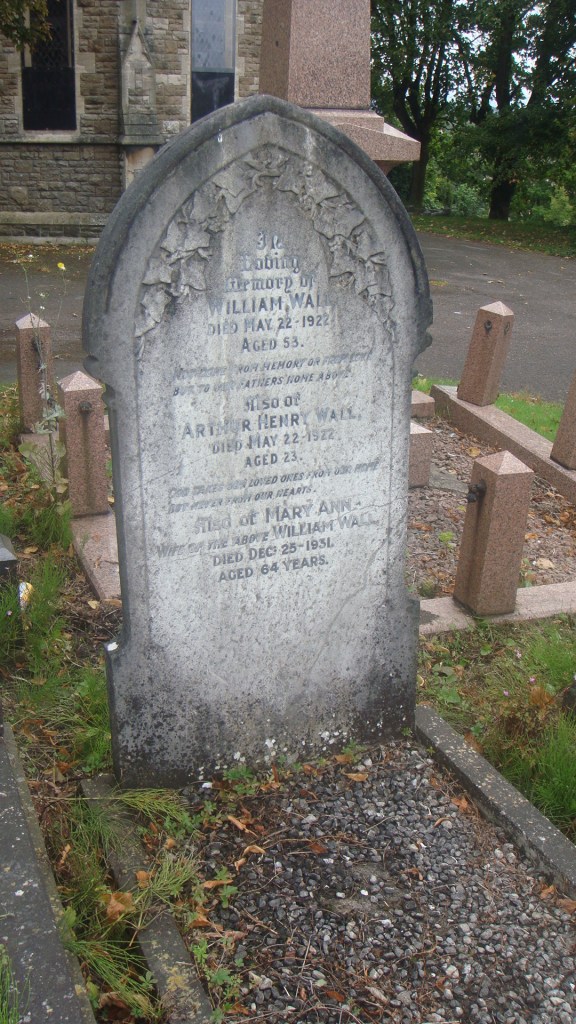
William died on May 22, 1922 just hours before his son Arthur also died.

When Arthur Henry Wall enlisted at the Devizes recruitment office he stated that he was 19 years old and worked as a boilermaker. In fact he was only 16 years old and two years below the minimum age for enlistment.

He served a period of 140 days from January 12, 1915 to May 31, 1915 at home but on June 1, 1916 was posted to France, aged 17. However, on July 10 Arthur’s true age was detected and he was sent back to England as ‘underage and physically unfit for service.’

He spent the next year posted in England but on June 28, 1916 he returned to France and served more than 300 days. By now serving with the Bedfordshires, Arthur was gassed on May 12, 1918 and ten days later returned to England.

On November 23, 1918, he was discharged suffering from Defective Vision, Dyspnoea (a symptom of aortic insufficiency) and headache.

He was awarded a pension of 11 shillings a week from November 24, 1918 to be reviewed in 26 weeks’ time. In 1920, by now a married man, Arthur wrote to the Record Officer of the Bedfordshire Regiment asking if he could apply for further money under the Army Order 325/19 but was informed that only soldiers serving from the date of the pay increase on September 13, 1919 were entitled.

Like his father, Arthur also died of heart disease, a direct result of his military service.

United in Death

Father and Son Buried at the Same Time

The burial of a father and a son who died on the same day took place at Radnor Street Cemetery, Swindon. The deceased were Mr William Wall, 35 Linslade Street, Swindon, and his son, Mr Arthur Henry Wall, 36 Jennings Street. Both had served in the war, and their death was directly attributable to the hardships endured on active service. The father, who was 53 years of age, served in the Army for 12 years, and during the war he was in Egypt, Greece, Serbia and Italy – first with the Wilts Regiment then the Rifle Brigade and was later attached to the Royal Engineers. In August, 1918 he was discharged as unfit for further service. His death occurred on May 22nd, just a few hours before his son passed away.

The latter was 23 years of age. When only 16 he joined the Wilts Regiment, and was later transferred to the Bedfords, and then to the 1st Herts. He saw service in France and Belgium, and was badly gassed in May, 1918. In November of the same year he was discharged.

It is a pathetic fact that although he did not know his father was so ill he had a sort of premonition that they would die at the same time, and expressed a wish that they might be buried together.

Wiltshire Times and Trowbridge Advertiser June 17, 1922.

Father and son were buried in plot E8206 where Mary Ann, William’s wife and Arthur’s mother, joined them following her death in 1931.

If you are wondering why they do not have a Commonwealth War Graves Commission headstone it is because their deaths occurred after August 31, 1921 the date on which the First World War officially ended.

First published on October 9, 2021.

Tell Them of Us – Pte. R.A. Cook – promoted for gallantry

Continuing a series remembering Swindon’s sons who served in the First and Second World Wars.

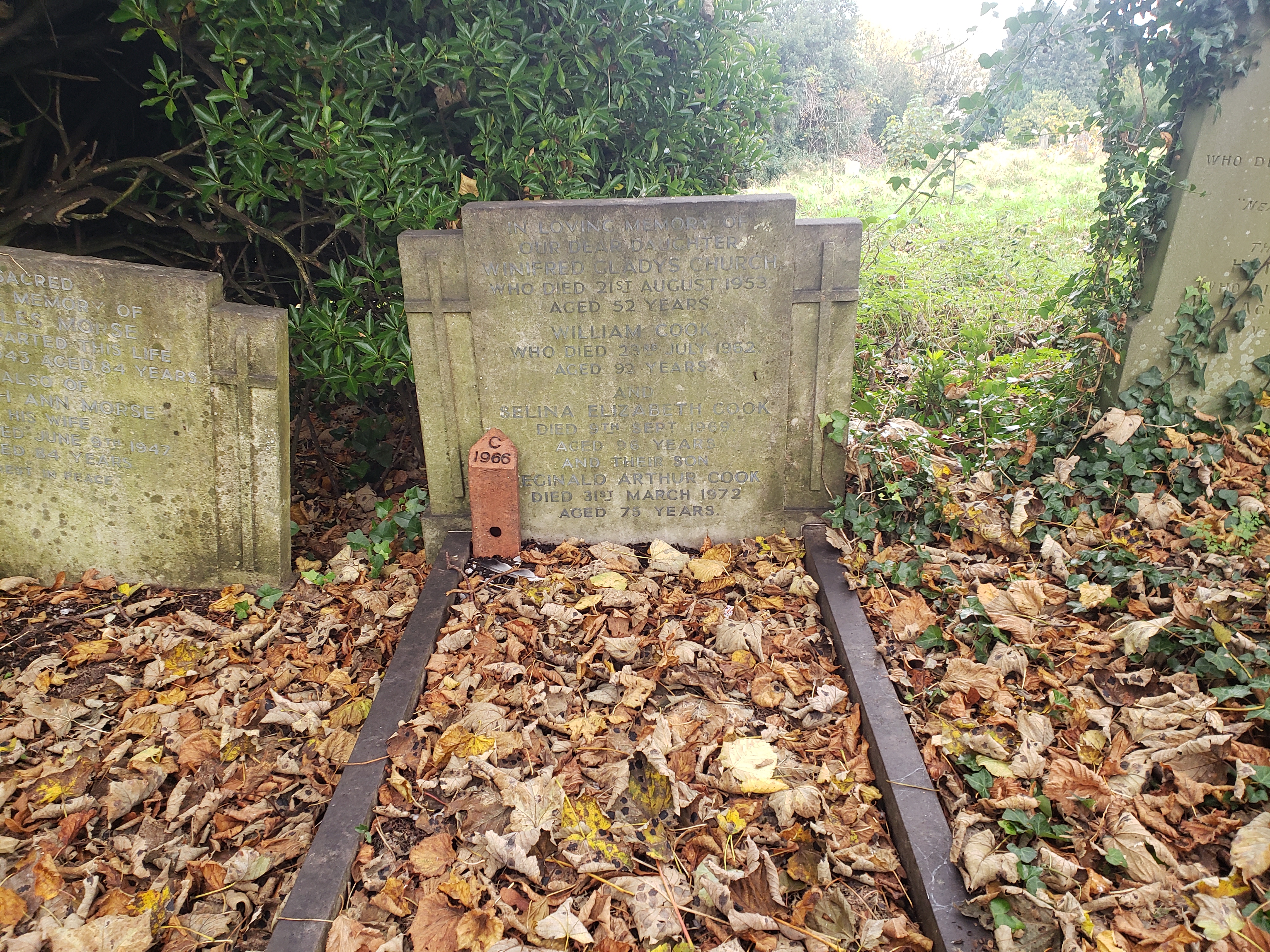
Reginald Arthur Cook was born in Swindon on September 8, 1896 the son of William and Selina Cook. Reginald entered the employment of the GWR shortly after his 14th birthday and stayed with the company until his retirement. His only absence was during the First World War when he served on the Western Front and was promoted for an act of gallantry.

Swindon Soldier Promoted for Gallantry

Pte. R.A. Cook, the only son of Mr. W. Cook, Cemetery Superintendent, Radnor Street, Swindon, has been promoted to the rank of lance-corporal for gallant conduct.

Major-General H.D.E. Parsons, Director of Ordnance Services, British Armies in France, has written to Pte. Cook, dated October 19th, as follows: “Your name has been brought to my notice by your Commanding Officer for ‘gallant conduct in snatching an enemy stick-grenade, that had become ignited, from another man, and throwing it into a shell hole some ten yards away, thus saving the man’s life at grave risk of your own. The report reflects credit on yourself and the Army Ordnance Corps.”

Lce. Copl. Cook is 21 years of age, and is a native of Swindon. On leaving school he entered the GWR Works as a clerk. He joined the Army on October 6th, 1915, and proceeded to Woolwich for training, but after being there three weeks he was transferred to France, where he has been ever since. He is now home on leave, and will return to France on December 21st.

North Wilts Herald, Friday, December 14, 1917.

Reginald returned home to Swindon at the end of the war and lived with his parents at 63 Kent Road where he died on March 31, 1972. Reginald never married and was buried with his parents and his only sister Winifred Gladys, in the cemetery where his father once worked as Cemetery Superintendent.

Nash family – confectioners

The re-imagined story …

I used to love to go shopping. And do you know what my favourite shop was – Nash the confectioners, and not only when I was a child either. Sometimes I would call in when I was a grown up too, a young clerk in the Works, before I married and had children of my own. You don’t see sweet shops like that anymore, you don’t see sweets like that either, jars and jars of handmade confectionery.

It was a sad day when the last of the Nash family shops closed. Perhaps they couldn’t compete with the big manufacturers, the producers of those bags of gummy, plastic tasting sweets that tempt the children at the supermarket checkouts. Soulless places, those supermarkets. My granddaughter offered to take me to Asda Walmart on a shopping trip. Bah – that’s not a shopping trip, that’s a descent into Hades, I told her.

What I would give to take a walk down Regent Street again? Not the Regent Street of today but the old one, when ladies got dressed up to go down town. My first stop would be a wander around McIlroys and then a visit to Nash’s and a quarter of – now what would I choose, aniseed balls or pear drops, or maybe a bag of toffee, although my teeth are probably not up to that now. Happy days.

Regent Street

The facts …

William Nash was born on April 23, 1840 at Badbury the son of William and Jane Nash. His father died two months before William’s birth, leaving Jane to raise four young boys alone until she remarried in 1844. At the time of the 1851 census 11 year old William is living in Badbury with his mother, step-father William Jordan, his two brothers Thomas and George Nash and three half sisters Sarah, Ann and Emma Jordan.

William married at St. Mark’s Church on December 25, 1863. He was 23 and working as a labourer, his bride was 21 year old Elizabeth Hunt. The couple began their married life in London where their first child, Edmund William Nash was born. It seems likely that this is also where William saw the prospects of a career in the confectionery trade. Elizabeth’s brother and sister had both married into the Leach family, headed by Thomas Leach who had a confectionery business in Southwark.

On his return to Swindon William worked as a labourer in the railway works and Elizabeth as a mangler. In 1871 the couple lived at 2 Havelock Street with their growing family – Edmund 5, Clara 4, Thomas E. 2 and 8 month old Elizabeth M. It appears that the Nash couple were both prudent and focused, both working and saving to fulfil their ambition to open their confectionery business.

By the time of the 1881 census William had achieved this ambition. The family lived over their first shop at 32 Bridge Street. By then there were seven children, the youngest 4 month old Lily. Elizabeth’s sister Martha Hunt lived with the family working as an assistant in the shop.

And so the Nash empire expanded with shops at 64 and 65 Regent Street and 17 Regent Street as well as the original premises at 32 Bridge Street. Other family run shops opened at 104 Cricklade Road, 10 Wood Street, 32 Regent Circus and 167 Rodbourne Road, the last of the shops which eventually closed in the 1970s. The Nash family were famous for their award winning ice cream and also their bargain pack of assorted sweets – Penny Big Lots.

Death of Mr W. Nash – Mr W. Nash of Lypeatt House, Goddard Avenue, Swindon, died on October 29th after a long and painful illness. He will be remembered by many, having been formerly in business as a sweet manufacturer. He married a daughter of the late Mr Thomas Hunt, of Broad Town, who was well known in Primitive Methodist circles. He leaves a widow, six daughters and two sons. The funeral took place on Monday November 4th the cortege leaving Goddard Avenue at 3 o’clock for the Primitive Methodist Chapel, Prospect Place. The Rev. H. Pope Officiated at the chapel and also at the Cemetery.

Extracts from the North Wilts Herald, Friday, November 15, 1918.

William and Elizabeth Nash are buried together in plot E7604

Grateful thanks to Katie Brammer for sharing her family history research. Katie has been discovering the graves of her Nash family ancestors with the help of Radnor Street Cemetery volunteer Jon. This is the grave of William and Elizabeth Nash.

WANTED, a respectable GENERAL SERVANT, about 18, able to do plain cooking; sleeping out preferred; good character – Apply, Nash, Confectioner, Bridge Street, Swindon.

The Swindon Advertiser, Friday, September 2, 1904.

Samuel Gray – Lardy cakes

Samuel Gray was born in the village of Shaw and baptised on October 19, 1879 at All Saints Church, Lydiard Millicent. Samuel was the eldest son of Samuel Gray, a labourer in the GWR Works, and his wife Harriet. The family lived in the Elms, Shaw at the time of the 1881 census.

Samuel married Harriet Ellen Pile in the March quarter of 1903. By the time of the 1911 census the family were living in Shanklin on the Isle of Wight where Samuel worked as a Baker. In 1916 the family returned to Swindon.

Three years later Samuel bought a small property at 9 Bridge Street for £500 where he established his bakery and the legendary lardy cakes (see Miss Lorna Dawes and a life ‘inside.’) In the 1940s Grays had seven shops employing 120 staff.

Harriett died at the Cheriton Nursing Home, Westlecot Road on December 4, 1947 and was buried in Radnor Street Cemetery in plot C4898. Samuel died on April 19, 1963 aged 83 and was buried with his wife.

Deaths

Gray. – April 19, 1963, at 9 Downs View Road, Swindon, Samuel Gray aged 83 years. Funeral Wednesday, April 24: service at Immanuel Congregational Church, Upham Road, at 3.15 p.m.; interment Radnor Street Cemetery. Flowers to Smith’s Funeral Chapels, Gordon Road. (Tel. 22023).

Freemason founder of Swindon bakery concern is buried

The funeral of a prominent Swindon baker, Mr. Samuel Gray (83), took place at Immanuel Congregational Church, Upham Road, Swindon, yesterday.

Mr. Gray, managing director of Grays (Swindon) Ltd., of Bridge Street, and the Downland Bakery Ltd., died at his home 9 Downs View Road, Swindon.

For many years a member of Westlecott Bowling Club and a former president of Swindon Master Bakers’ Federation, Mr Gray founded the bakery firm 44 years ago. Since then it has grown into a large family concern.

He was a Freemason and was Past Master of Pleydell Lodge, Past Master of the Swindon Keystone Lodge of Mark Master Masons, a member of Wiltshire Chapter and Preceptor of Chiseldon Freemasonry Class.

The service was conducted by the Minister at Immanuel Church, the Rev. F. Ross Brown and was followed by interment at Radnor Street cemetery, Swindon.

Extract taken from The Swindon Advertiser, April, 1963.

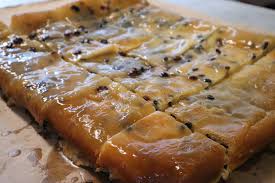
Samuel’s son Cyril worked in his father’s bakery from the age of 13 and in the 1980s he was recorded as being the oldest working baker in Britain by the National Association of Master Bakers. In 2013 he gave his recipe for Gray’s famous lardy cake to Mark Child for publication in The Swindon Book where you can find it on page 145. As Cyril instructed – lardy cake is best eaten on the day it is made.

The recipe for the lardy cake is said to originate from Wiltshire although neighbouring West Country counties also lay claim. References to the lardy date back to the mid 19th century and as the name suggests is a lard based cake.

I have recently been contacted by Robert Gray, Samuel’s grandson, who has kindly sent me the following photographs of Samuel and (Harriett) Ellen.

John Hudson Read – Driver of the Royal Train

The re-imagined story …

Father spread the newspaper across the kitchen table. It took him some time to find the report he sought as Mr Morris had seen fit to hide it on the fifth page of his periodical. The attempt on the Queen’s life had happened two days previously and was old news by then.

Father cleared his throat before speaking. In his melodious Welsh voice he announced – ‘An attempt to shoot the Queen was made on Thursday evening at Windsor station.’

Father had a magnificent voice. I loved to hear him sing in the Baptist Chapel in Cambria Place where we attended every Sunday. Mind he had some keen competition, lot of good Welsh voices there were there.

Mother was less enthusiastic. ‘Likes to hear the sound of his own voice,” she said, which I thought was a compliment – until I grew older.

That evening he read to us the report of the attempt on the Queen’s life. In his rich tenor voice he presented the scene – the poorly clad, starving clerk and the brave Eton schoolboy who belted him round the head, the crowds, the police – it was like something out of a Penny Dreadful!

We later learnt that the Royal Train on which the royal party travelled that day was driven by a Mr. John Hudson Read. And then would you believe it, two years later he moved into the house next door to us. There’s famous he was. I used to tell the story to my children but they were less impressed. I suppose it was old news by then.

The facts …

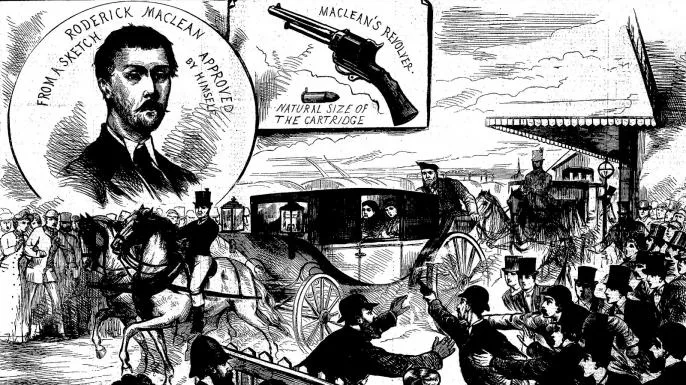
Attempt to shoot the Queen

An attempt to shoot the Queen was made on Thursday evening at Windsor station. The name of the miscreant is said to be Robert Maclean, who was poorly clad, and who states that he is a clerk out of employment.

The particulars of the foolhardy act are as follow :- The Queen, who had been spending a couple of days at Buckingham Palace, left London in the afternoon for Windsor Castle. The Royal train arrived at Windsor about half past five o’clock, a large crowd having assembled to witness the arrival of the Sovereign. On alighting from the train her Majesty at once entered a carriage which was in waiting to convey her to the Castle, when just as she was about to drive oft a man who had been standing with others at the entrance to the station yard suddenly fired a revolver at the Royal carriage, but happily the shot did not take effect.

The fellow was about to fire a second time, when the pistol was wrenched from his grasp by a bystander, and he was at once seized by the police, who, however, had some difficulty in preventing him being lynched by the crowd. It is stated that at the moment the pistol was fired the crowd was cheering the Queen, who, it is thought, did not hear the report; but of course her Majesty was quickly apprised of the attempt which had been made upon her life, and, with her usual solicitude for others, she at once caused inquiries to be made as to whether any one had been struck by the pistol-charge.

Some doubt exists as to whether a bullet was really fired or not, as no trace of one has been found. The pistol, which was a six chambered one, was found to be loaded with two blank cartridges and two containing bullets. Several other cartridges were found on the person of the would be assassin. Maclean is thought to be of unsound mind.

This is the sixth outrage which has been perpetrated on the person of the Sovereign. The first occurred in June, 1840, when the Queen was fired at by Oxford. The next was in May, 1842, the would be assassin being John Francis. Two months later a man named Beau presented a pistol at her, but without firing it. In June, 1850, her Majesty was struck in the face by a fellow named Pate as she was walking out; and in 1872 a lad named Arthur O’Connor presented an unloaded pistol at her as she was entering Buckingham Palace.

The Prisoner Before the Magistrates,

Windsor, Friday afternoon.

The prisoner was driven to the Town-hall in an open fly at half-past one to-day, in charge of Supt. Hayes and a plain clothes official. He has a very wretched look, and is a man very much of the Lefroy type. He looks unclean and unshaven, and has a slight black moustache. He was immediately taken before the bench of magistrates, the Mayor of Windsor presiding Mr Stevens, solicitor to the Treasury prosecuted on behalf of the Public Prosecutor. Amongst the magistrates present were Alderman Chamberlain, and Mr G. Poole.

In reply to the Mayor, the prisoner said in a most off-handed manner and in a firm voice that his name was “Maclean-Roderic Maclean.” Supt. Hayes was then sworn. – Mr Stevenson said he was instructed to prosecute by the Secretary of State.- Supt. Hayes that her Majesty arrived at the station at 5-25 yesterday. She was accompanied by the Princess Beatrice, and Mr Brown was sitting behind the carriage. As the carriage started and had got half way to the gate he heard a report, and looked to the left, when he saw the prisoner. Prisoner here asked whether he was allowed to ask any questions. The Mayor said certainly he would, presently.

Examination continued: He looked to the left and saw the prisoner in the act of presenting a pistol at her Majesty. He did not hear more than one shot fired. The prisoner was about 150 yards from the carriage where the shot was fired when he first saw the prisoner. He was holding the pistol straight out in the direction of the carriage. He immediately sprung on him, and collared him by the collar and neck. He stopped to take the pistol from him when a young man named James Burnside subsequently got possession of the pistol, and handed it over to him. He produced the pistol, which had been in his possession ever since; he put it in his pocked immediately he put prisoner against the wall, assisted by Inspector Fraser and others. Prisoner said, “Don’t hurt me, I will go quietly.”

A little Eton boy came up and gave him a blow on his head, and he then took prisoner to the police station, and when there he asked him his name and address. He gave his name and address, and said he had been in Windsor about a week. On the way to the Police-station in the cab prisoner said, “I was starving, or I should not have done this.” At the station when charged he said, “Oh, the Queen!”

He examined the pistol. It was a German pin-fire revolver; it had two empty cartridge cases in it, that was to say exploded cartridges. Three were full whole cartridges, and two chambers empty. He drew the cartridges, and produced them. He searched the prisoner, and on him found 14 other cartridges of the same make. They were in a piece of rag. He found other articles of no value, including a pocket book, a knife, etc. Amongst other things a letter was found. It was taken from him by Inspector Fraser. The letter was then read, in which prisoner stated that he would not have dared the crime had the sum of 10s been given to him instead of 5s being offered the insultingly small sum of 6s. He was compelled to commit this crime against the bloated aristocrat, headed by that old lady “Mrs Vic.”

Witness further said that at 10.30 this morning prisoner said he wished to make a further statement, “I have a complete answer to the charge.” He then wrote a letter which was now put in and read, in which prisoner said he was not guilty of shooting at the Queen with intent to do grievous bodily harm, his object was only to cause the public alarm, with the result of having his grievances redressed. Such was the pecuniary strait in which he was.

All the circumstances tended to prove this statement. Had he cared to have injured the Queen he would have fired at her when she was getting out of the carriage. As it was he shot at the wheels but the pistol kicked and the bullet might have hit the carriage door. The only consolation he could offer the Queen was this statement, and he offered it if the charge of intent to do the Queen grievous bodily harm was withdrawn, and a charge of attempting to intimidate others substituted he would do all in his power to elucidate the mystery, and to bring the matter to a speed issue. At the end of the letter prisoner said that was the whole truth. The prisoner was remanded.

The Swindon Advertiser, Saturday March 4, 1882.

James Haydon Wardall

The re-imagined story …

I was working as night porter and resting the day Mr Wardall checked in at the Albion. Polly told me he wasn’t looking well and that she expected I may be required during the night.

Polly was my sweetheart and we were saving hard to get married. We had met when we were both in service. We were ambitious and knew that we wanted more than a life of bowing and scrapping. We dreamt of opening our own little boarding house and being our own bosses, answerable only to one another.

We decided to get some experience in the hotel business before embarking upon our big adventure. It seemed to me though that there was little difference to being in service. The work was as arduous, the hours as long and there was still a lot of bowing and scrapping to be done.

It was early on in the season and only a few of the rooms were occupied. Throughout the night I kept busy with my usual tasks, alert to the bells and a possible summons to Mr Wardall’s room, but all was quiet.

The morning dawned bright and blustery with rain threatening but I followed my usual routine and took a brisk walk down by the harbour before returning to my room. I disliked working the night shift and could seldom sleep during the day, every noise in the hotel disrupted my slumber.

That day I was disturbed more than usual and eventually I rose and dressed and went down to the kitchen for a cup of tea. It was then I learned that Mr Wardall had died during the night and it was my poor Polly who discovered his body.

We left the Albion soon after that; I wasn’t sorry to go. We abandoned our boarding house dream.

Albion

Albion Hotel, Plymouth

The facts …

Military Funeral. – The Swindon Advertiser of the 28th ult. records as follows the funeral, with military honours, of one who was known to many in this district, to which he is also related: – The funeral of Mr James Haydon Wardall, nephew of Mr J. Haydon, took place on Tuesday evening.

The deceased gentleman commenced his education at the old GWR Schools at New Swindon, under Mr Braid, and completed it at Edinburgh, whether he removed in 1866. On leaving school he was apprenticed to learn the trade of an engineer under his uncle, Mr John Laverick, at Edinburgh. After his apprenticeship he entered the service of Messrs. Douglas & Grant, at Kirkcaldy, Fifeshire, where he remained for some time; afterwards coming to Swindon, where he was employed in several shops in the GWR Works. Finally he obtained the position of draughtsman under Mr S. Carlton (manager of the Locomotive Department of the GWR Works). In June, 1885, he was offered the post of principal foreman in the Fitting and Turning Shop of the Bombay, Barolda, and Central Indian Railway at Parel, which office he accepted.

During his residence at Swindon, Mr Wardall was associated with several athletic clubs, including the Swindon Drill Hall Gymnastic Society, of which he was secretary on its formation. He was a full corporal in the F (New Swindon) Company of Volunteers for several years, and after leaving Swindon joined the Volunteers in connection with the company for whom he worked in India.

Latterly, Mr Wardall was prevented by ill-health from actively following his employment, and he decided to seek the benefit of a sea voyage, and came to England. He arrived recently at Plymouth, where his illness proved fatal on April 20th.

The remains were conveyed to Swindon for interment, where his old volunteer friends resolved to accord him military honours. Long before the hour fixed for the funeral, the streets in the vicinity of the Works were lined with spectators, whose numbers were greatly increased, as the cortege passed the principal entrance, by the employees who were leaving work for the day.

A large number of volunteers assembled on parade, including the band of the battalion, numbering 32 men, one corporal, one drummer, and one fifer, from the F&G Co’s (New Swindon), under the command of Sergt. McCulloch, a total of 40; Bugle-Major J. Phillips, Armoury-Sergeant J. Westcott, 12 sergeants, five corporals, and 52 rank and file, the whole being under the command of the Sergt. Instructor of the Corps.

On leaving the residence of Mr T. Rice, 25 Gloucester Street, where the body had been removed on arrival from Plymouth, the band played Beethoven’s “Funeral March,” and the mournful procession proceeded to St Mark’s Church, via Sheppard Street, London Street, and Bristol Street.

The principal mourners, who rode in coaches, were Mr Lancelot Thomas Haydon (chief draughtsman in the Works, cousin to the deceased), Mr Thomas Butterfield Watson (uncle), Mr William Williams (Pontypridd, brother of the widow), Mr John Jones (uncle of the widow), Mr E. Jones (cousin of the widow), Mr T. Rice, and Mr F. Buckland, Mr James Haydon (uncle) was prevented from attending through illness.

Among others present were Mr J.B. Cartwright (captain of Swindon Drill Hall Gymnastic Society), Mr E. Head (sec.), Mr S. Warner, Mr H. Thomas, Mr B.J. Robinson, Mr J. Patton, Mr A.E. Murgatroyd, Mr Arthur Bowker, etc., private friends of deceased during his residence in Swindon.

The coffin, which was of polished oak, was covered with the Union Jack, and bore the deceased’s helmet and sword, which were surrounded by wreath of choice flowers, sent by Miss Wardall (sister), Mrs Thomas, old friends, styling themselves “The Boys,” the members of the Gymnasium, and others. The breast-plate was inscribed as follows:- “James Haydon Wardall, died April 20th, 1888, aged 32 years” The pall-bearers were Armoury-Sergt. Westcott, Col. Sergts Horsington and Harrod, and Sergt. W.H. Lawson.

On arrival at the church gates the firing party lined up, and the procession was met by the Vicar (the Rev. Hon. M. Ponsonby), who read the first portion of the service in the church. The band played the “Dead March” in Saul as the cortege subsequently proceeded to the Cemetery, where there was a large attendance of the public. The volunteers formed a cordon around the grave, with the firing party drawn up, and, when the body arrived, it was wheeled to the graveside and lowered into its last resting place. The service was impressively conducted by the Rev. Hon. M. Ponsonby, and at its conclusion the firing party (a full lieutenant’s escort) discharged the customary three volleys over the grave. The Volunteers were then re-formed, and marched to the Mechanics’ Institution, where they were dismissed.

The Fife Free Press Saturday May 5, 1888
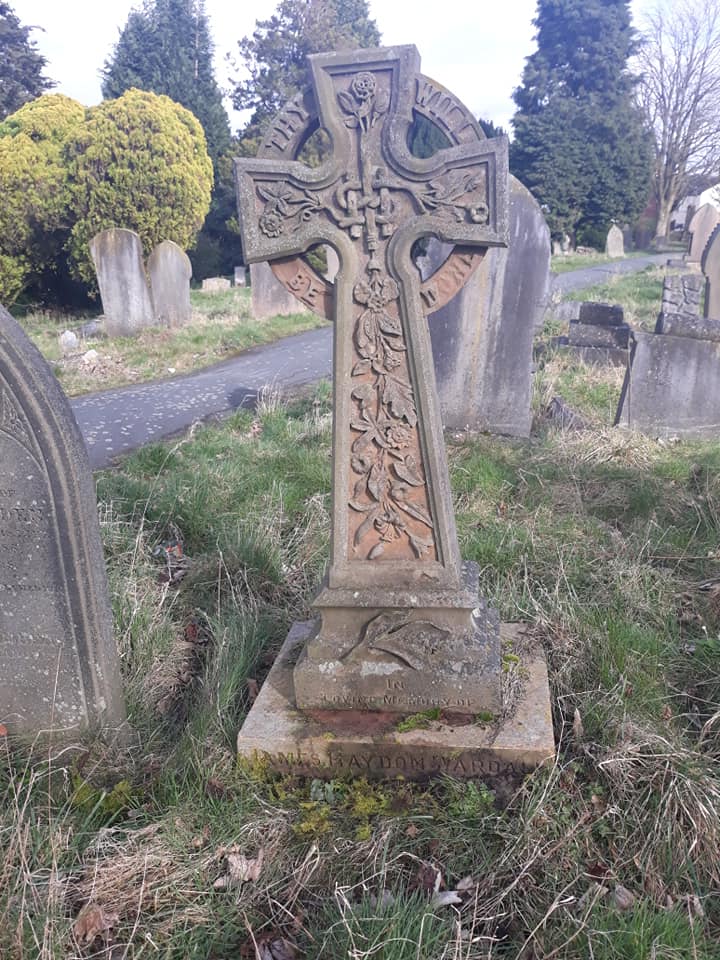
James Haydon Wardall

Wardall James H. 32 years Albion Hotel, Plymouth burial 24th April 1888 plot E7997.

Radnor Street Cemetery burial registers.

Wardall James Haydon of Parel Bombay India died 20 April 1888 at the “Albion” hotel Plymouth Administration (with Will) London 4 February to Margaret Wardall widow Effects £140 14s

Emma Lavinia Watson – formerly of Eynsham

Now my Radnor Street Cemetery colleague Noel and I thought it was quite a coincidence when we realised we both had connections with the village of Eynsham in Oxfordshire, but imagine my surprise when I discovered the story of Mrs Watson, born and married (twice) in Eynsham but buried in Radnor Street Cemetery.

Emma Lavinia Goodwin was born on July 30, 1844, the daughter of Charles Goodwin landlord at the Royal Albert and brewer at the Crown Brewery, Eynsham and his wife Harriett. Emma was the couple’s fifth child and at the time of the 1851 census the family lived in Newland Street, a long street lined with stone built properties large and small, that ran from Mill Street and out of Eynsham to Cassington.

Emma married Harry Gibbons (farmer and butcher) by licence on June 4, 1861, shortly before her 17th birthday. Marriage by licence usually indicates a desire to marry quickly and unobtrusively and it looks likely that young Emma was already pregnant. Harry was the son of James Gibbons, farmer, grocer and another brewer with premises in the High Street. Was this a union of two brewing dynasties?

At the time of the 1871 census Emma was living at Acre End Street, Eynsham where today stone cottages rub shoulders with brick built ones crowding close to the narrow road leading to St. Leonard’s Church. By 1871 Emma was just 27 years old with five children, Harriet 9, Maria 8 (staying with her aunt and uncle on census night) Frederick 6, Sarah 4 and 3 year old Jane. She was already widowed, her husband Harry having died in 1867 aged 30. But Emma didn’t rush into a second marriage, which is quite unusual for the time. A young woman with five children to support often remarried within 12 months but perhaps Emma’s extended family helped to support her financially.

Maria Gomm nee Gibbons (Emma’s daughter) and her husband Thomas

Emma eventually married in the December quarter of 1873. Her second husband was carpenter and joiner George Watson. They continued to lived in Acre End Street where the Watson children soon began arriving! At the time of the 1881 census living with Emma and George were Jane Gibbons 13, Emma’s youngest child from her first marriage, and Augustus Watson 7, Lavinia Watson 4 and three year old Mary Watson.

Then, towards the end of the 1880s the family moved to Swindon where George most likely took up a job in the GWR Works. When the census was taken in 1891 they were living at 50 Clifton Street with their five Watson children, two of whom, William and Charles, had been born in Swindon.

When George completed the census returns in 1911 he made a bit of a mess of the form with numerous crossings out and alterations. The family were now living at 29 Tennyson Street and he records that he and Emma have been married 38 years and had 7 children all living. He lists Jane R. Gibbons, his stepdaughter, as being present on census night but then crosses out her name and adds ‘Croydon, Surrey’ so presumably this is where she was living in 1911. Staying with the couple on census night were their married daughter Lavinia Deans and her five year old daughter Ruth.

William Watson, Emma’s son – founder of Watson’s Typewriters Ltd., Glasgow.

Emma made Swindon her home for about 30 years and the funeral report indicates she contributed to community life at St. Mark’s Church.

Emma died aged 70 at her home in Tennyson Street on June 26, 1915 and was buried in plot E8626F on July 2. She shares the plot with her youngest son Charles Watson who died the following year aged 27. George Watson, Emma’s second husband, died in 1916 and was burried on December 6 in the neighbouring plot E8626E.

Death of Mrs G. Watson

The remains of the late Mrs G. Watson, of 29 Tennyson street, whose death occurred on the 26th ult., were laid to rest in Swindon Cemetery on Friday, July 2. Deceased, who was 70 years of age, was a daughter of the late Mr C.A. Goodwin, a brewer, of Eynsham. During her residence in Swindon she took a great interest in the life of St. Mark’s Church, and she will be greatly missed by a large circle of friends. The first portion of the service was held in St. Mark’s Church, Canon A.G.G. Ross officiating. The rites at the cemetery were performed by the Rev E.A.W. Topley (All Saints’’) and the choir were augmented by that of All Saints’ Church, deceased’s eldest son bearing the cross. The inscription on the breast-plate was: “Emma Lavinia Watson, died June 26th, 1915, aged 70 years.” The chief mourners were Mr. G. Watson (husband), Messrs A., E., W. and C. Watson (sons), Mrs. T. Gomm, Miss J. Gibbons, Mrs W. Robinson and Mrs E. Davies (daughters) Mrs and Mrs L. Deanes (son in law and daughter), and Mr E. Watson (grandson). A large number of friends were also present. There were numerous floral tributes.

The Oxfordshire Weekly News, Wednesday, July 28, 1915.

The tall chimneys to the left (High Street 25 Jan 1886) belong to Gibbons brewery –

I recommend a visit Eynsham online.