Albert Sykes – the father and founder of music in Swindon

The re-imagined story …

Mr Sykes asked me to sing All Things Bright and Beautiful. He listened very carefully; his head tilted on one side. There was a brief pause after I stopped.

“Well Ada,” he said, “I’m sure we can find a place for you in the chorus.”

I was so excited I could have given him a big hug, but that would have been entirely inappropriate. You didn’t hug a gentleman like Mr. Sykes.

My ma said I was born to sing. She said that I sang even as a baby in my crib. “You never wailed or screamed like the other babies,” she said, “you sang.”

I’ve been singing ever since. I especially love to sing in church. My favourite hymn is Rock of Ages, I love the rise and swell of the music. And I sing at my work, but I try not to be too enthusiastic as Mrs Morse has delicate hearing and she usually asks me to close the green baize door while I’m in the kitchen.

But I had never sung in public before and I never dreamed I would one day stand on the stage at the Mechanics’ and sing before an audience. I could scarce believe Mr. Sykes might even consider me.

It was my best friend Polly who suggested I audition for the chorus in the Mechanics’ Institution pantomime that year – Babes in the Wood, or Harlequin and the Cruel Uncle.

Opening night was just days away and this was to be our dress rehearsal. “Let’s put you next to Letitia, just follow her lead,” Mr Sykes had said at our last rehearsal. Letitia Jones was one of the principal singers in the chorus. She had a beautiful voice, a bit on the quiet side, I always thought, but melodious none the less.

Polly was waiting in the wings when I arrived. She was in conversation with Letitia and had her back towards me, but I could hear them talking as I approached.

“I hope Ada Firebrace doesn’t stand next to me again. She quite puts me off,” said Letitia.

“I never expected Mr. Sykes would engage her,” I heard Polly say. “I hoped he might tell her … you know … tell her what an awful voice she has. Then perhaps she would stop singing morning, noon and night.”

I stood stock still. Letitia had seen me walk across the stage and was grimacing and nodding at Polly with the intention of warning her that I approached. It was too late.

I never spoke to Polly again and I didn’t take part in the Mechanics’ Institution pantomime that year either. But I did save up my pennies and took some singing lessons with Mrs Sykes.

Ma says my voice is more beautiful than ever now. I have no desire to sing before an audience anymore, but I will always have kind memories of Mr Sykes.

The facts …

The Late Mr Albert Sykes

In accordance with the recommendation in the report, Mr Spencer proposed that a large portrait be obtained of the late Mr Albert Sykes, and placed in the Reading Room. Mr Sykes, he remarked, was a man who in his day and generation did a great work for New Swindon, and many men had been indebted to him for his musical tuition. Mr. Sykes was a useful man on the Council of the Institute, a capital librarian during the time he held that position, and he was also the father and founder of music in Swindon.

Mr A.W. James seconded the proposition, which was carried unanimously.

Mr Morris said he was pleased to know that the Council were thus going to recognise Mr Sykes’ services, and he hoped the same course would be adopted with regard to the late Mr J.H. Preece and the late Mr F.G. O’Connor.

The Swindon Advertiser, Saturday, May 5, 1894.

The two Sykes brothers were born in Leeds – Albert in 1823 and Joah in 1824. On the 1841 census they are living in Hunslet where their father John worked as a surveyor of roads. Albert was working as a mechanics’ apprentice while Joah was a potter’s apprentice.

Albert began work as a fitter and turner in the GWR factory in September 1847 later working as a shop clerk.

The 1851 census shows Joah still living in Hunslet with his wife and baby daughter. He is working as a whitesmith (someone who works with tin). Joah joined his brother in New Swindon around 1853 where he worked as a blacksmith in the railway factory.  At the time of the 1861 census he is living with his wife and their five children at 1 East Place in a property they share with Peter Vizard, his wife and two daughters; Thomas Toombs, his wife and their three children and a lodger by the name of Jeremiah Walker!

By 1871 Joah and his family are living at 25 Reading Street, which remained his home until his death in 1910.

On first coming to New Swindon Albert lived in Westcott Place. Then he spent 20 years living in Fleet Street before moving to Victoria Road where he and his wife opened a music school.

Both Joah and Albert were talented musicians. Joah played the oboe and both brothers were involved with musical events at the Mechanics’ Institute where Albert conducted the Mechanics’ Institutes’ Choral and Orchestral Union.

The two Sykes brothers are typical of those early settlers who left their home, their family and friends to move to New Swindon and once here immersed themselves in the life of the community.

Albert died on February 27, 1894. His funeral took place on March 3, 1894 and he is buried in plot E8362 with his wife Mary Hannah, son Albert and nephew Herbert Francis Sykes – Joah’s son.

Joah was elected to the Council of the Mechanics’ Institution in 1870. He was a member of the Liberal Association with a reputation for being a radical and he was a member of the Methodist Chapel in Faringdon Road.

Joah died on February 17, 1910. He is buried in plot E8364 close to his brother Albert, with his wife Ellen and two of their daughters. Emily is described on the 1901 census returns as being an ‘imbecile from birth’.

The rebellious John Riley

The re-imagined story …

Some said John Riley was an intimidating character, but I never found him so. Yes, after a drink or two he could get a bit lairy, but I knew how to handle him. I suppose I had a bit of insight into what he had been through.

I don’t think anyone came back from the war the same person they had been before it. I’d argue with anyone who said they hadn’t known fear, hadn’t seen sights that made their stomach churn, done things that haunted them.

John Riley had known a fear and a horror the like of which few experienced and the only way to blot it out was to drink.

Aged just twenty, John had left the safety of a job as a storeman in the Works to join the army and have an adventure. Mostly all John saw were the bowels of the earth, like a rat in a sewer.

John liked to drink and he liked to gamble. His life was one big gamble. Would he be blown to pieces or buried alive? Would it happen today or tomorrow? The odds weren’t good.

DSC07150 - Copy

The facts …

John had little time for military protocol, he was outspoken and insubordinate and for this he was awarded Field Punishment No. 1. Sounds pretty innocuous, doesn’t it, but it was a torture metred out to rebels, those who wouldn’t abide by regulations. It was used to set an example to others who baulked at military discipline.

In September 1917 John went missing. He was absent while on active service for 34 hours and 55 minutes, and was charged with breaking out of camp at 9.30 pm on September 14 and breaking back in at 8.55 am on September 16. His punishment was to forfeit three days pay and 14 days Field Punishment No. 1.

So, what was Field Punishment No 1? The soldier found guilty was placed in fetters and handcuffs (sometimes spread eagled in a form called ‘crucifixion’) and tied to a fixed object such as a gun wheel or fence post, for one hour in the morning and one hour in the afternoon. Although this punishment was supposed to take place behind the front line in a field punishment camp, it was sometimes applied within range of enemy fire. When a unit was on the move, the unit itself would administer the punishment.

It wasn’t the first time John had been so punished. In September 1915 he had been ‘awarded’ as if it was an honour, 96 hours Field Punishment No 2 for “when on active service missing 8 am parade.” Field Punishment No 2 was a lesser punishment and involved the prisoner being placed in fetters and handcuffs, but not attached to a fixed object. Both sentences included hard labour.

In the summer of 1918, he was sentenced to 7 days Field Punishment No 1 for ‘misconduct’ on 24 August and on 31 August he received a further 7 days Field Punishment No 1 for leaving the lines without leave and missing a Medical Board as a consequence.

And a final insult, 12 days after the guns were silenced, John was demoted to Private by his Commanding Officer for “Neglect of duty.”

John’s audacious and fearless attitude, the qualities that made him a good tunneller, were the very characteristics that frustrated his Commanding Officers.

No one was more surprised than John when he survived the war and returned to the same job in the Works that he had left behind in 1914.

Did he enjoy the security, the safety, the daily routine? Surely, he didn’t miss the claustrophobia of the tunnels.

When John enlisted it was for three years or the duration of the war. It turned out to be a life sentence.

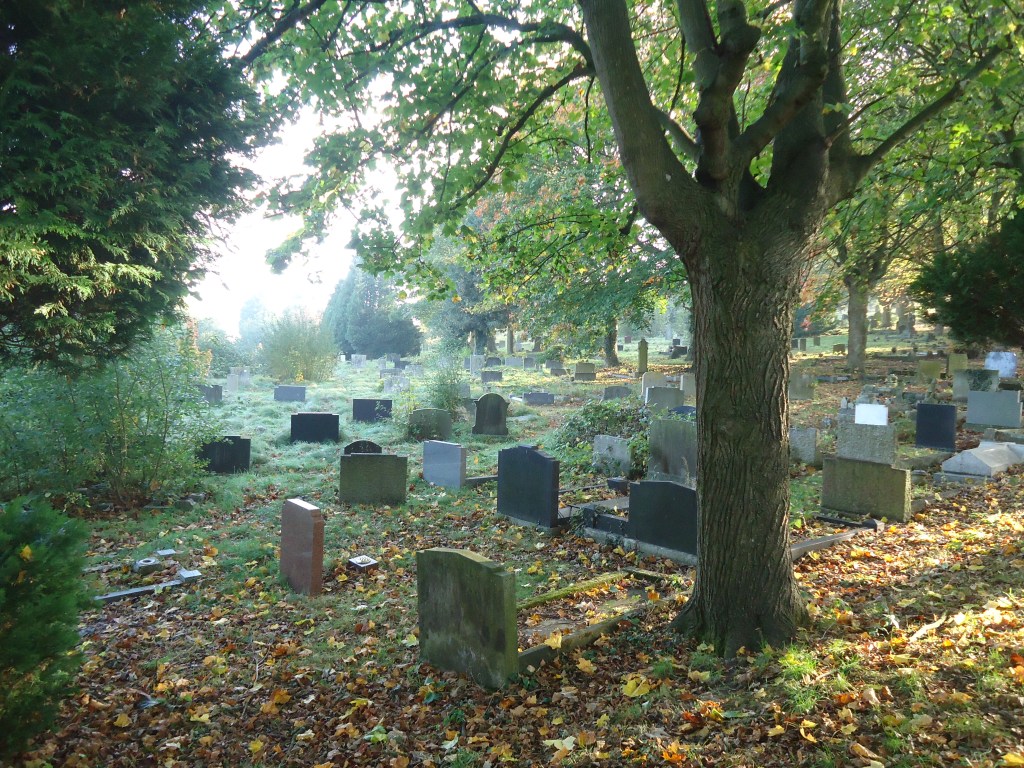
This image has an empty alt attribute; its file name is cemetery-view-3.jpg

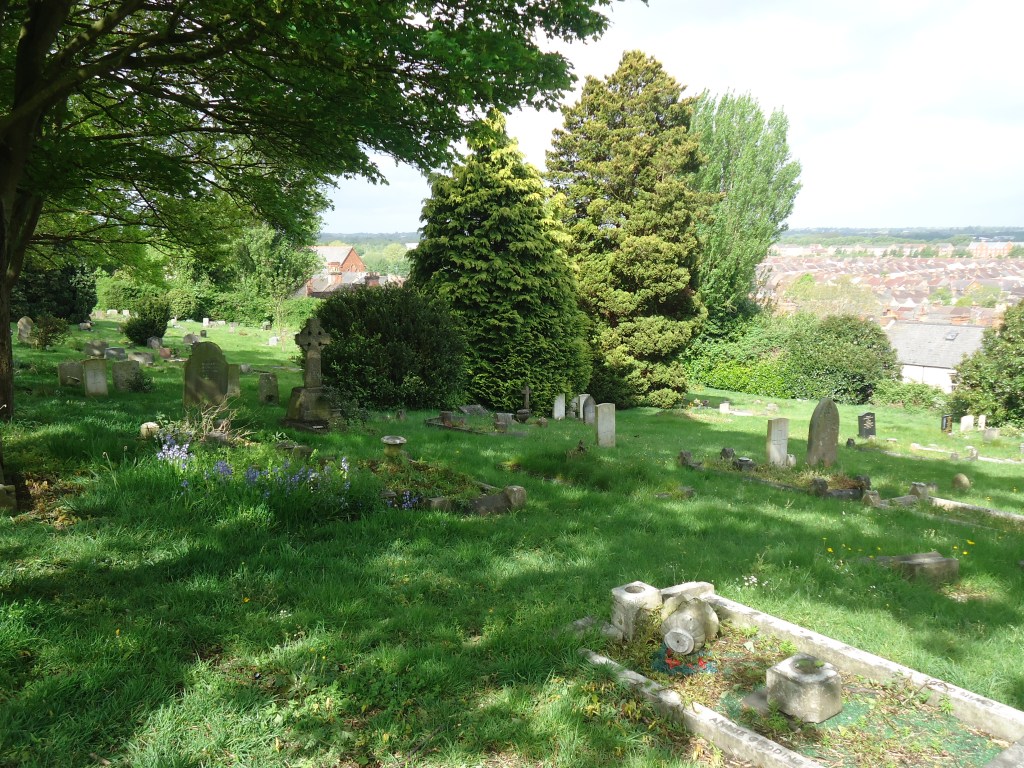
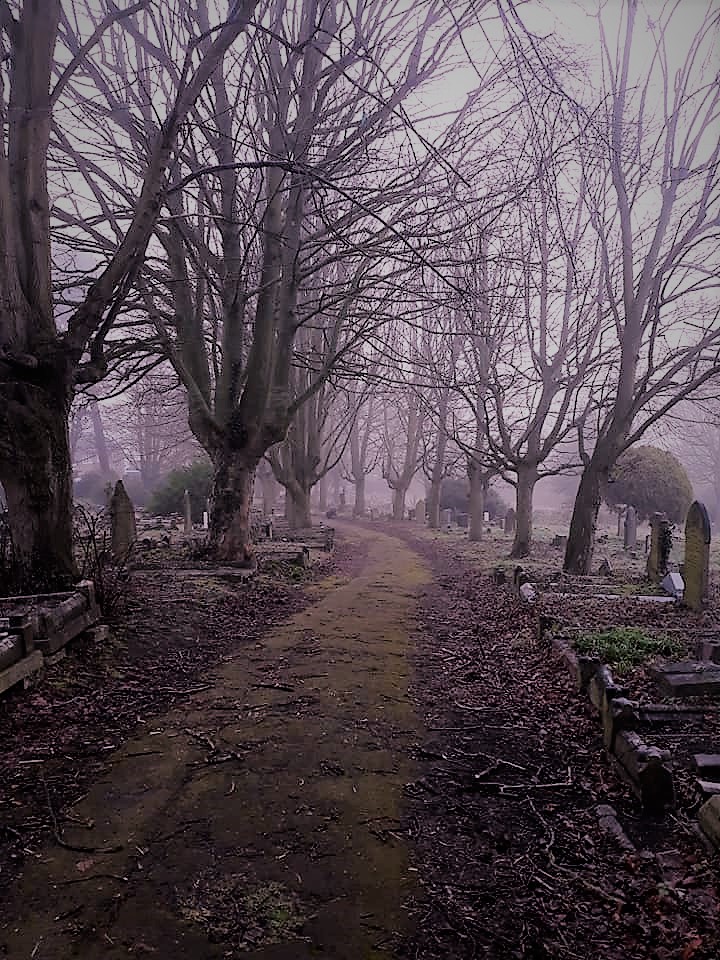
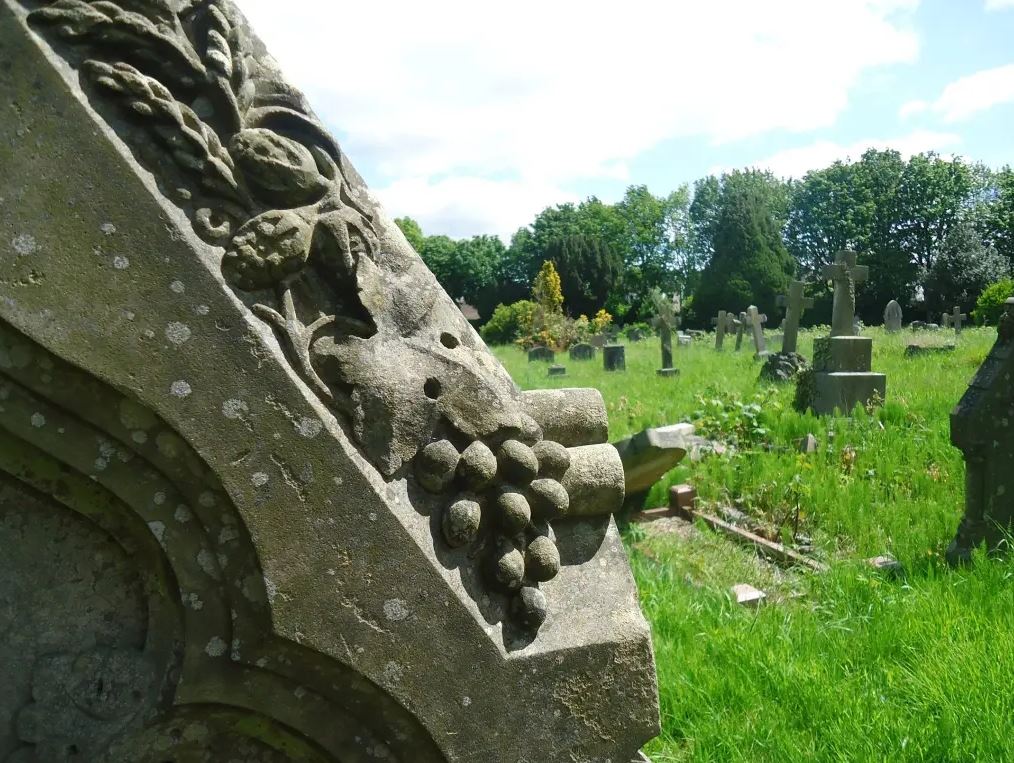
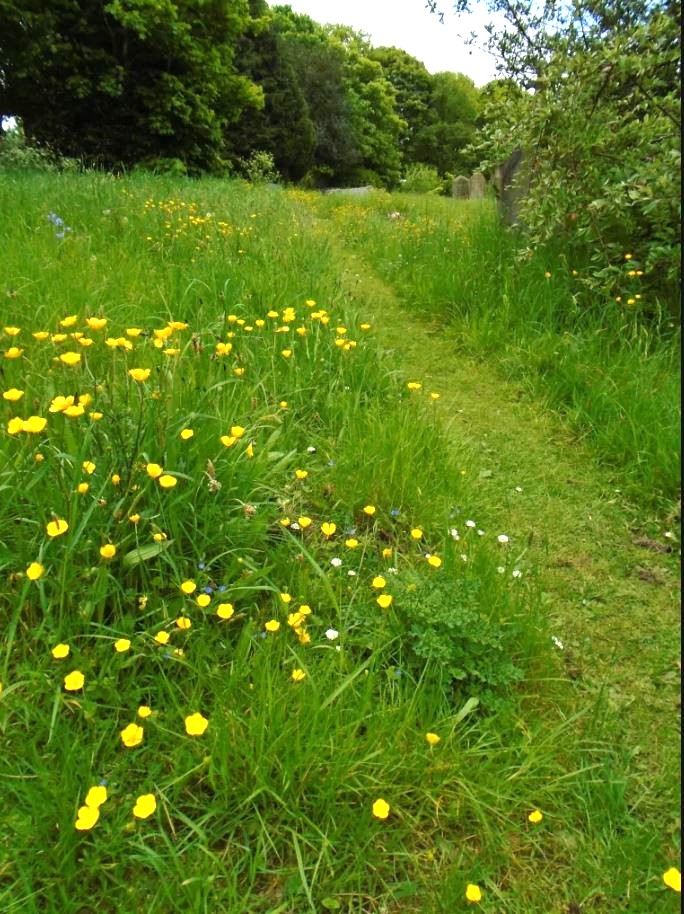
View across Section C where Edwin John Riley is buried.

(Edwin) John Riley was born c1895 in Rodborough, Gloucestershire, the only one of John and Sarah Jane’s three children to survive to adulthood. By 1901 the family had moved to 11 Folkestone Road, where John’s father worked as a builders’ plumber.

As a sixteen-year-old John worked as a fishmonger but by 1913 he had secured a job as Storeman in the Works

John enlisted in the 1st Battn Grenadier Guards at Caterham on December 19, 1914, aged 20 years and 34 days. His military records reveal that following eight months service at home John joined the Expeditionary Force in France from August 11, 1915 until January 10, 1918. By May 1916 John was attached to the 177th Tunnelling Coy RE (Permanent) Authy. For more information about the work of the tunnelling companies and the 177th see https://en.wikipedia.org/wiki/177th_Tunnelling_Company.

He married Daisy Sweeper in 1919. John was discharged on demobilization on March 31, 1920 and their daughter Stella was born in 1922. A second daughter Jose was born in 1927.

In 1939 John was working as a Stores’ Issuer in the Railway Works and living in Harcourt Road, Gorse Hill with Daisy and their two daughters Stella and Jose.

Edwin John Riley died in October 1945 and was buried in plot C1678 on October 16.

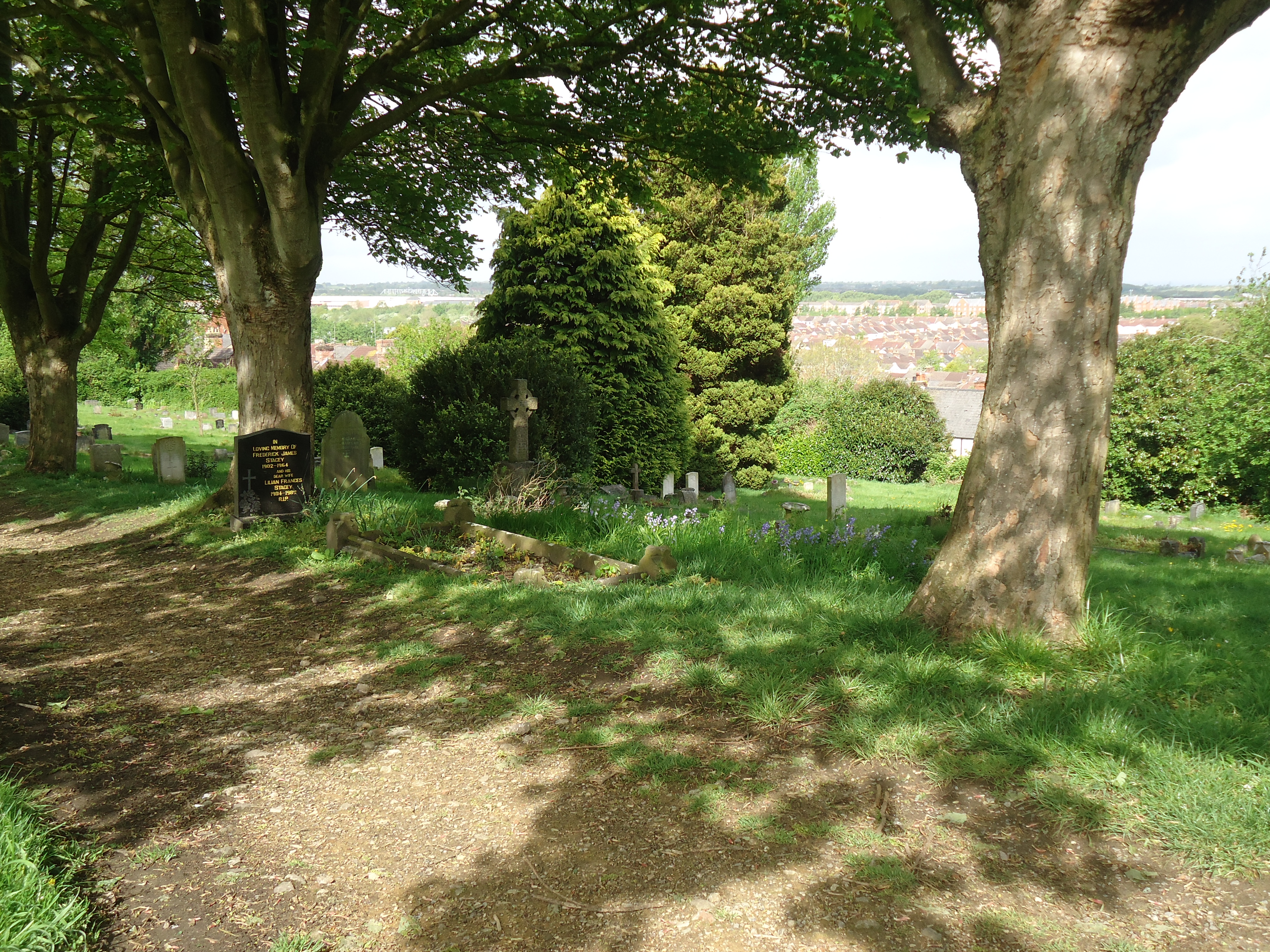
cemetery view

Joseph Robert Pinchon 14, fatally injured

When James Pinchon completed the 1911 census form he was required to state next to his wife’s name the number of years they had been married, how many live births she had had, how many children were living and how many had died. At the time of the 1911 census James and Ann lived at 1 Cyrus Cottages, Rodbourne Cheney. James was 69 years old, a retired Herald Painter (i.e. a coach painter). Ann was 70 years old, an old age pensioner. James and Ann had been married for 46 years. They had had 8 children of whom 2 were still living and 6 had died. One of those children was Joseph Robert who aged 14 had sustained fatal injuries in an accident in the Works.

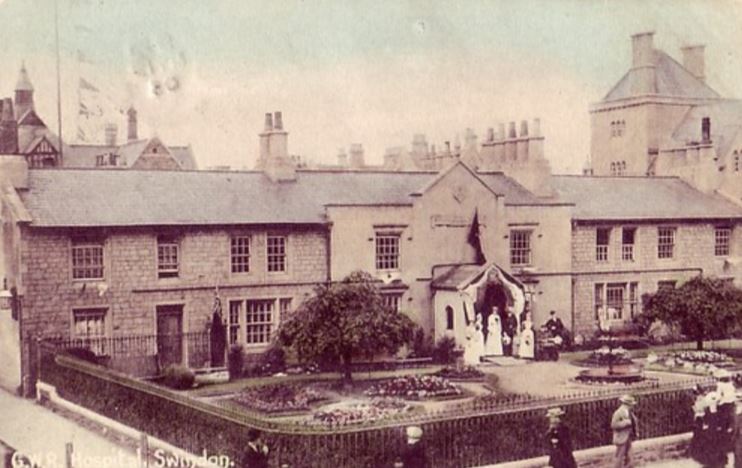
Much has been written about the GWR Medical Fund, a health care system established in 1847 and credited with informing the foundation of the NHS a hundred years later. The Accident Hospital was opened in 1872 in a building which had previously been the drill hall and armoury for the XI Wiltshire Volunteer Rifle Corps. The new hospital had four beds, an operating room, a bathroom, a surgery, a mortuary and accommodation for a nurse in an adjoining cottage.

Following the accident, Joseph Pinchon’s workmates carried the boy to the nearby Accident Hospital where he died ten hours later. Joseph Robert Pinchon of 16 Reading Street was buried in grave plot E8072 on September 25, 1888.

Medical Fund Accident Hospital – image published courtesy of Local Studies, Swindon Central Library.

Fatal Accident in the GWR Works – On Thursday morning in last week a sad accident happened to a youth named Joseph Pinchon, residing in Reading Street, New Swindon. He was working in the brass finishing shop in the GWR Works, and had occasion to go to the carriage department. In attempting to pass between two tracks of a train which was engaged in shunting operations, the buffers caught him in the chest and back and severely crushed him. He was immediately picked up and conveyed on a stretcher to the GWR Medical Fund Society’s Hospital, where he lingered till midnight and then expired.

On Saturday morning Mr Coroner Browne held an enquiry into the cause of the death of deceased, at the Cricketer’s Arms, New Swindon. Mr J. Bradbury was chosen foreman of the jury. Mr W. Mole represented the GWR Company.

James Pinchon, father of deceased, said his son was 14 years of age, and had only been employed in the Works two or three months. Dr. Cleveland (Messrs Swinhoe, Howse and Bromley), stated that death was due to internal injuries accompanying collapse.

Walter Martin, shunter in the Works, stated he was engaged in shunting operations when the accident happened. When the coaches were about two yards apart he saw deceased attempt to pass between them. It was impossible to stop the coaches when he saw deceased. – The jury returned a verdict of “Accidental Death.”

Swindon Advertiser, Saturday. September 29, 1888.

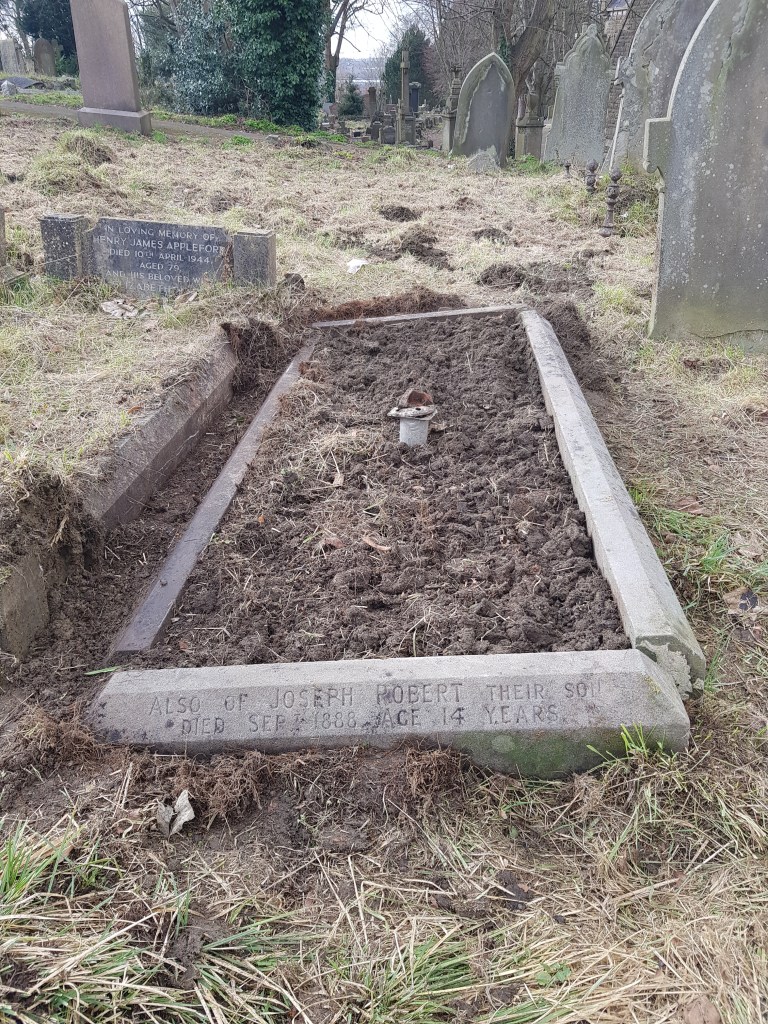
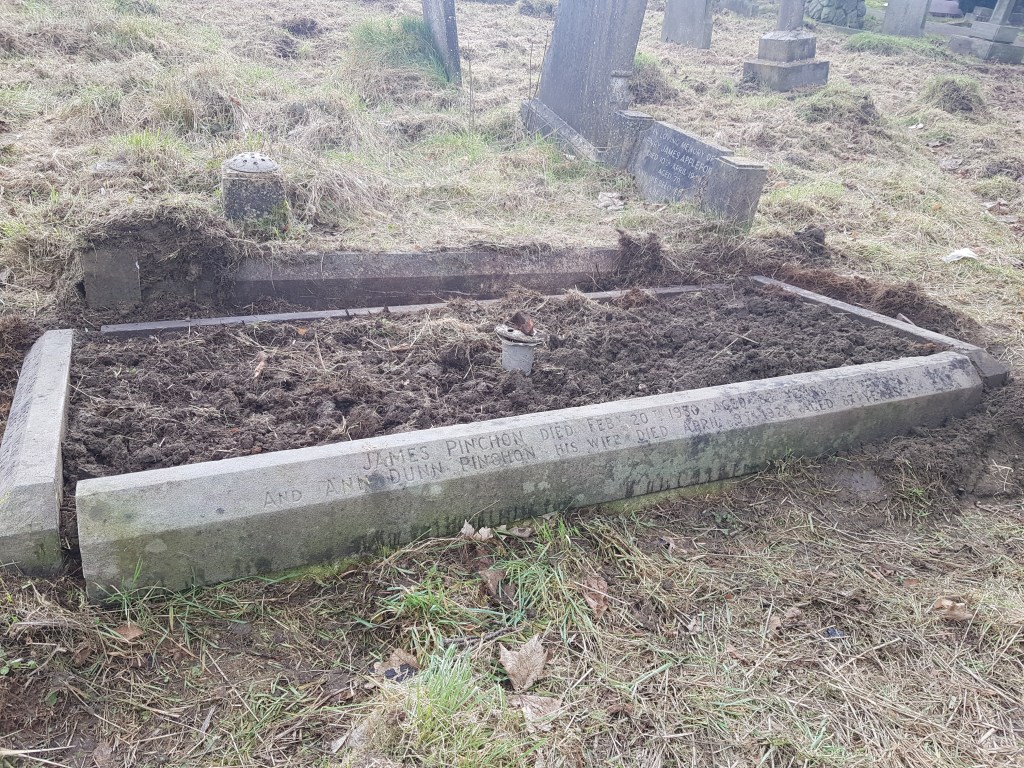
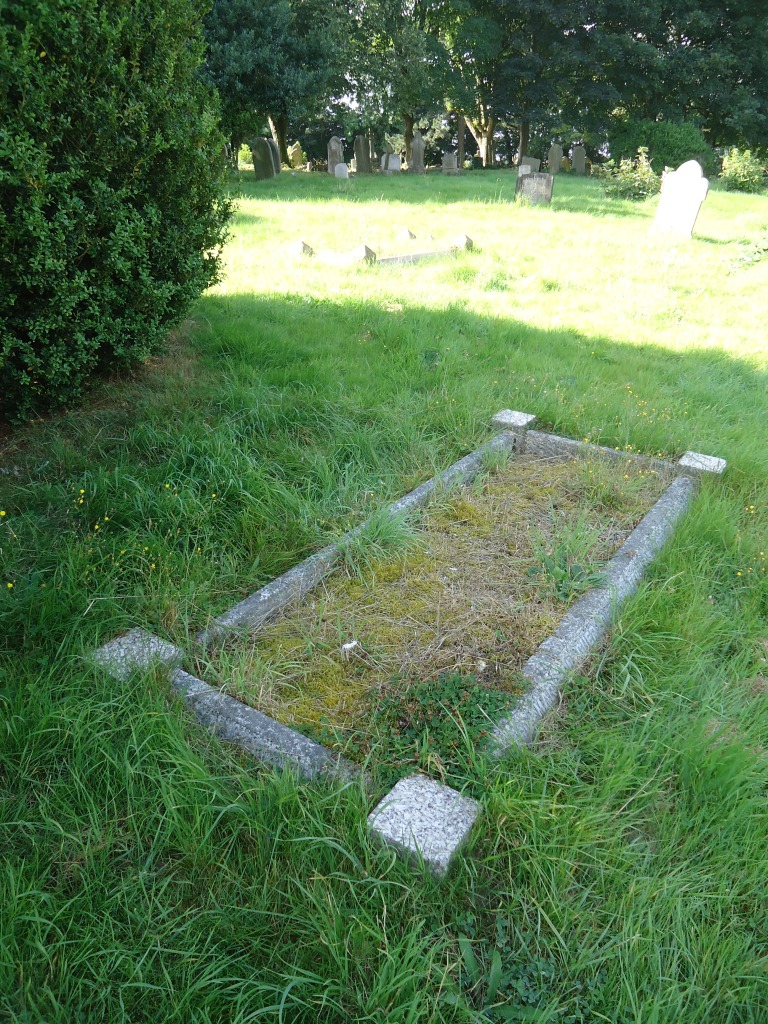
Our volunteers have revealed the Pinchon family grave. Young Joseph Robert was the first to be buried in this plot and it is likely there was no permanent memorial at the time of his death. The kerbstone would appear to have been erected after the death of his parents with an inscription which included his details. Ann died at her home in Rodbourne Cheney in 1928 aged 87 years. James died in 1930 aged 88 years. They were both buried with their young son who had died some 40 years earlier.

Florence Villa

Florence Villa

The re-imagined story…

My granddaughter is calling her new baby daughter Florence. I love it that all the old names are coming back into fashion.

Did you know that Florence Nightingale was named after the Italian city? I always wanted to travel to Florence; to walk the medieval roads and cross the Ponte Vecchio; to offer up a prayer inside the Cathedral of Santa Maria del Fiore; to stand before Botticelli’s Birth of Venus in the Uffizi Gallery. Oh my! Such a romantic city. I was lucky to have a week in Weston every summer as my parents reminded me when my imagination got the better of me.

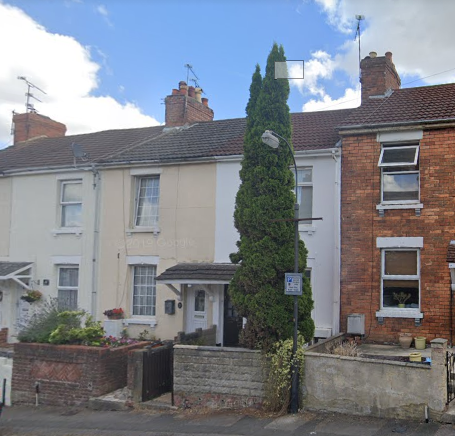
There wasn’t a lot of romance to be found growing up in post war Swindon. The closest I ever got to Florence was a house up the road from ours called Florence Villa. This was not an example of Renaissance architecture but a modest little red brick terrace property like all the others in Swindon Road. I used to wonder if the house was named in honour of a pilgrimage to that beautiful city, or maybe one that never came to fruition, like mine.

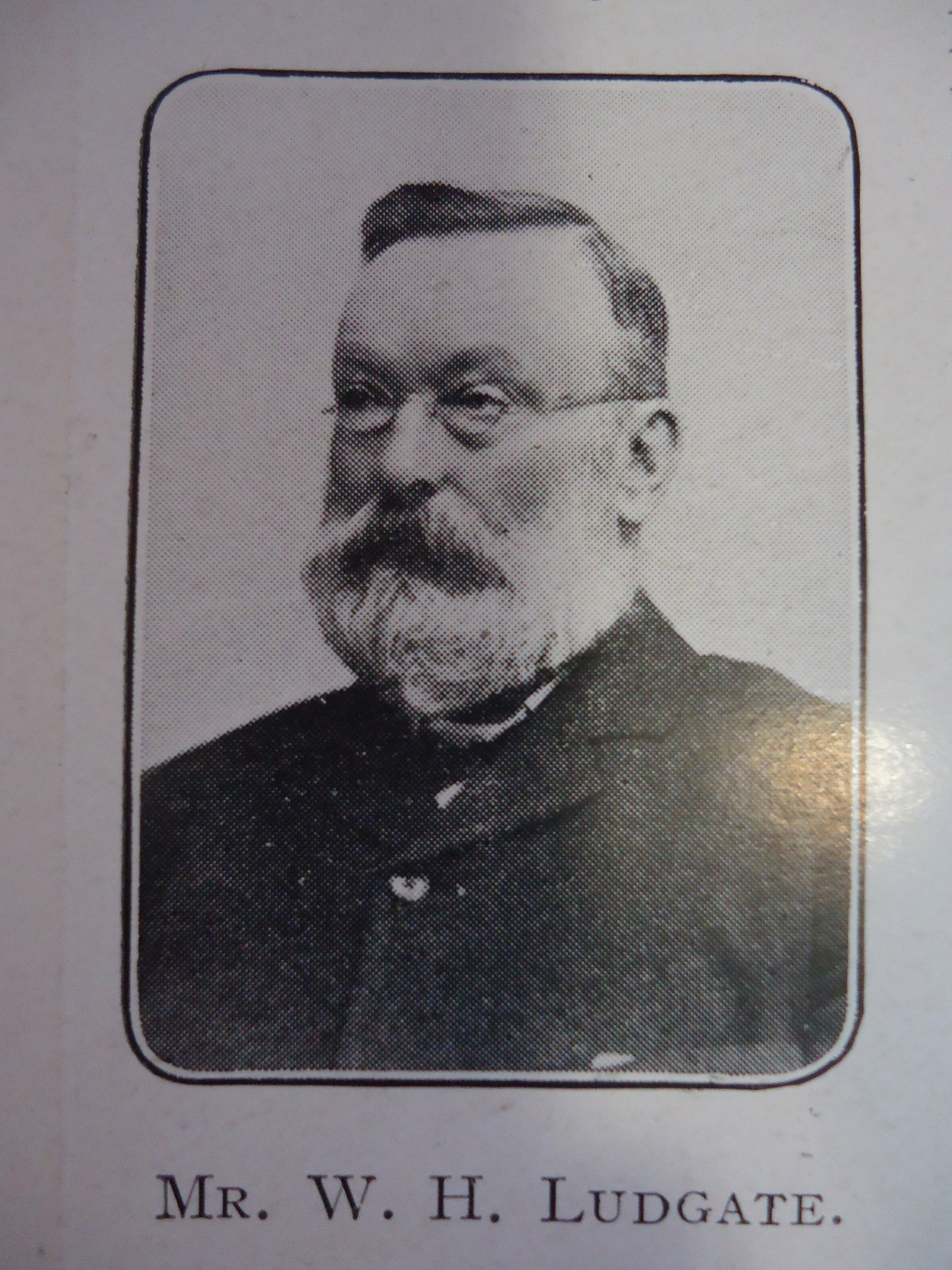
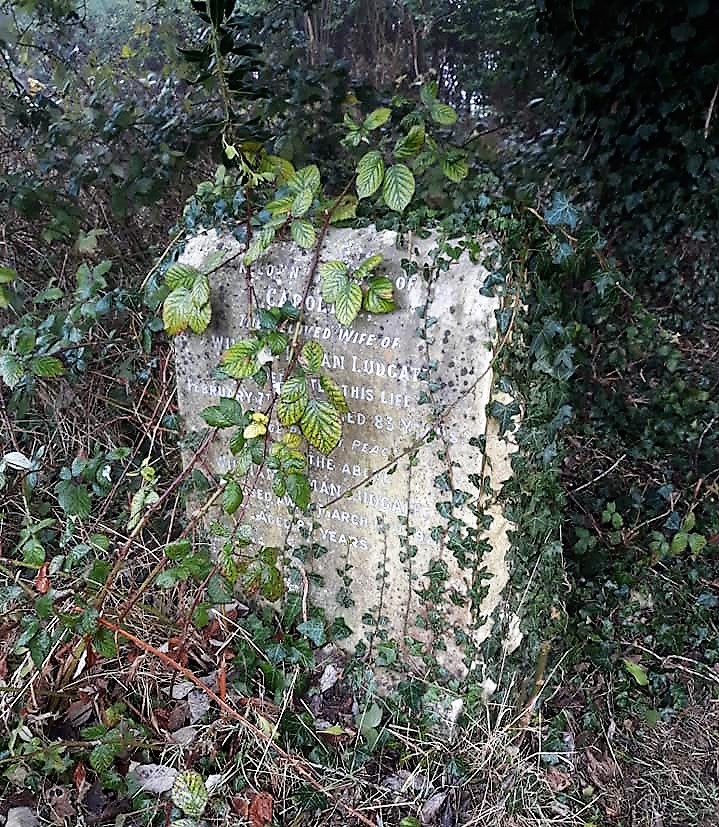
I later discovered it was the home of a senior official in the GWR Works, Mr William H. Ludgate, who had named his home in honour of his daughter Florence. Florence Ludgate lived in Florence Villa with her parents until her father died in 1921. By the time I grew interested in the house she was long gone but no one seemed to remember what had become of her.

I’ll suggest my granddaughter names her home after her new baby. Perhaps in years to come someone will speculate on the naming of a 21st century urban property. I wonder what our little Florence will achieve in her lifetime? What places will she visit? Perhaps she’ll fulfil my dream and visit her namesake city. More than anything I hope her story will live on, and that she will not be forgotten like Florence Ludgate.

DSC07555

The facts …

William Homan Ludgate was born in Fermoy, Ireland in 1833, the son of Robert Hooper Ludgate. He married Caroline Hill, the daughter of inn keeper George Hill, at St John the Baptist Church, Gloucester on December 2, 1857.

By the time of the 1861 census William and Caroline were living at 7, Bellwood Place, Swindon where Caroline’s sister Jane was staying with them.

The couple had two surviving children, William George born in 1864 and Florence born in 1873. According to the 1911 census Caroline states that a third child had been born and died by that date.

By 1891 the family were living at Florence Villa, Swindon Road, their home for more than thirty years.

Caroline died in 1918 and William in 1921. They are buried together in plot D401.

Swindon – The close of 1907 saw the retirement, after more than fifty-four years’ service, of one of the oldest Carriage and Wagon Department servants, in the person of Mr W.H. Ludgate , Chief Travelling Inspector. He started under the late Mr John Gibson, Paddington, at a time when there were no carriage or wagon shops at Swindon, the whole of the stock being purchased from private firms. Mr Ludgate was shortly after transferred to Gloucester, to inspect the stock purchased by the company, which came from the North loaded in wagons and had to be put on broad gauge frames at Gloucester.

Probably during the past forty years there has been no better-known man in wagon-building and private freighters’ circles than Mr Ludgate. Possessed of ability considerably above the average and of that invaluable personal asset, an equable temperament, he was eminently fitted for dealing with the many difficult questions arising in regard to the construction and maintenance of privateowners’ wagons, and it is owing in no small degree to his diplomatic methods that the various regulations of the Board of Trade and Railway Clearing House in regard to private owned stock have been successfully interpreted on the Great Western Railway.

Opportunity was taken of Mr Ludgate’s retirement to present him with a drawing room clock and cheque. In making the presentation Mr Churchward said it afforded him great satisfaction to be present at such a gathering to wish an old comrade goody-bye. He congratulated Mr Ludgate on his splendid record and announced that there were upwards of 600 subscribers to the testimonial.

Mr Ludgate has the best wishes of our readers for a happy retirement.

Great Western Railway Magazine 1908.

Ludgate, Caroline of Florence Villa Swindon Road Swindon Wiltshire (wife of William Homan Ludgate) died 7 February 1918 Probate London 20 March to Florence Ludgate Spinster Effects £2014 15s 2d.

Ludgate, William Homan of Florence Villa Swindon Road Swindon Wiltshire died 13 March 1921 Probate London 30 April to William George Ludgate engineer captain R.N. (retired) and Florence Ludgate Spinster Effects £8149 17s 10d.

Mr Ludgate had more than one string to his bow –

Gas Company Founder – The funeral of the late Mr William Henry [Homan] Ludgate of Florence Villa, Swindon Road, Swindon, one of the founders and for 43 years chairman of the Swindon United Gas Company, who died on Sunday, 13 March, at the ripe age of 87 years, took place on Friday in last week. The cortege left deceased’s late residence and proceeded to St Paul’s church where the first portion of the service was conducted by the Rev C.W. Jacob (Vicar) and Rev C. Averary Jones (Curate). The Vicar also officiated at the graveside in the cemetery, where deceased’s remains were laid to rest beside those of his late wife, who died three years ago. The chief mourners were Capt. W.G. Ludgate of Southsea (only son) Miss Florence Ludgate (only daughter) and Misses B. & E. Arkell, of Cheltenham (cousins). The Gas Company was represented by Mr A.G. White, Mr W. Harvie, Mr F.W. Adams, and Mrs J.S. Protheroe (directors). Mr E.G. Vince (Secretary) and Mr H.C. Shepherd. Mr Ernest Bishop represented the New Swindon Building Society, of which deceased was for many years Chairman, and there were also present Mr H.K. Noble, Mr Birks, Mr Jennings, and other old friends. There were numerous lovely wreaths and other floral tributes.

Faringdon Advertiser and Vale of the White Horse Gazette Saturday 26 March 1921.

Caroline and William H. Ludgate

Jesse Eagles – boilersmith

Jesse Eagles woke early and asked his wife if it was time to get up. On being told not yet, he turned over and went back to sleep – “a sleep from which he never awoke” as the Swindon Advertiser reported on July 17, 1909.

When the time comes this is how I would like to go. Peacefully, in my sleep with no prior warning, no lengthy, debilitating illness. But not yet, of course.

Sudden Death in Swindon

Mr J. Eagles of Clifton Street

Inquest and Verdict

The death occurred yesterday with painful suddenness, of Mr. Jesse Eagles, of 118 Clifton Street, Swindon. Deceased, who was a well known resident of the town, was a boilersmith by trade, and had been employed in the GWR Works for the past forty years. He was at work as usual on Wednesday until 5.30 p.m., and returned home and had his tea. In the evening he went out in his garden till nine o’clock, and later he retired to rest at the usual time. He awoke yesterday at four o’clock, and was then quite well, apparently. He remarked to his wife, “It is not time to get up yet, is it?” She replied in the affirmative, and deceased then went to sleep again – a sleep from which he never awoke. When his wife called him at five o’clock, there was no response, and she was alarmed. Medical aid was summoned, and Dr. Mason, from the GWR Surgery, attended, but he could only pronounce life extinct, death being attributed to heart failure.

Deceased, who was 60 years of age, leaves a widow and grown up family, for whom the deepest sympathy will be felt.

By the Foreman:- Deceased had no supper on Wednesday night. He was lying on his right side when witness found him.

By the Doctor:- He had not complained of shortness of breath when going up hill.

Dr. Woodgate Mason said he was called to the deceased about 5.15 that morning, and on arrival found him dead. In his opinion death was due to heart failure. He made an examination of the body, and found no marks of violence.

Extracts from the Swindon Advertiser, Friday, July 16, 1909

Jesse Eagles aged 60 years of 118 Clifton Street was buried on July 17, 1909 in grave plot E7453. His wife remained living at 118 Clifton Street where she died in 1921 and was buried with her husband.

The Boucher family paperwork

43731787_2357590734282064_2810830051103211520_n

The last serious act of vandalism to take place in Radnor Street Cemetery happened across one weekend several years ago.

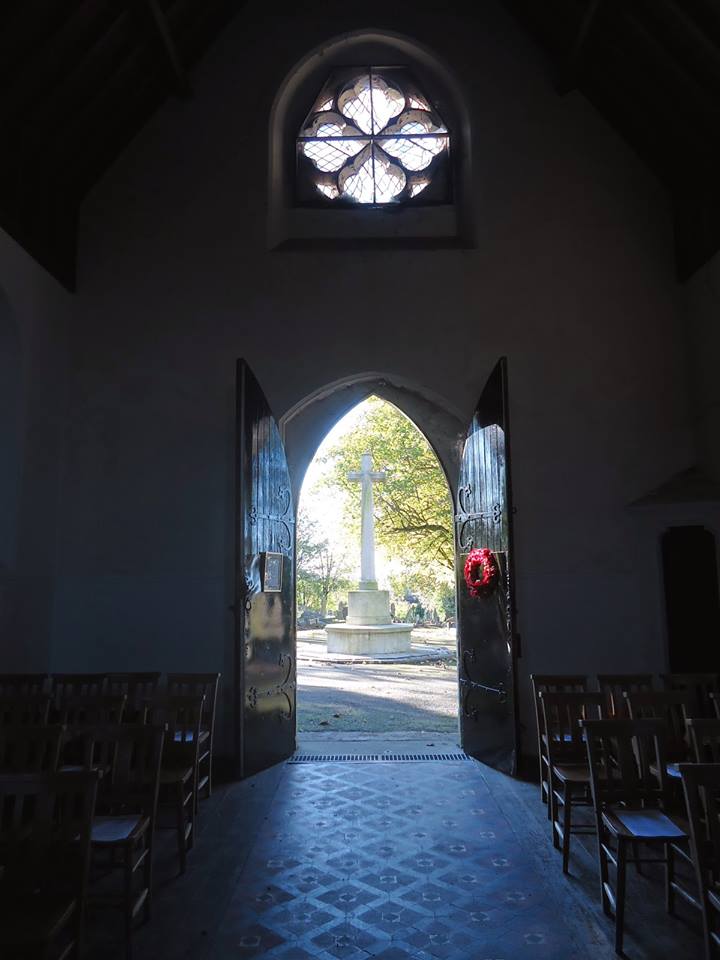
A break-in at the chapel saw windows smashed, including the rose window above the door. The intruders lit a fire in the vestry, the small room off the chapel, using a box of documents stored there.

The documents were ‘Form of application for permission to erect or restore a memorial’ and included the name and address of the owner of the grave and how much the memorial cost, invaluable information lost in the fire. One rare, surviving document includes the details of the Boucher family grave, naming the stonemason, the dimensions of the memorial and the inscription.

Boucher family

‘In loving memory of George Boucher died 8th July 1915 aged 61 years also Mary Boucher died 25th February 1943 aged 88 also Alice and Ethel their beloved daughters.

The owner of the grave was Annie Elizabeth Boucher who lived at 30 Swindon Road. The grave plot is C484 and the memorial cost in total £3 10s. Alice died in 1897 aged 16. Ethel died in 1956 aged 70.

George and Mary Anne were originally from Herefordshire where they married in 1877. They both came from farming families and were neighbours living in Cublington.

By 1881 they had moved to Swindon and lived in 19 Thomas Street, Rodbourne. George worked as a Machine Man in E & M Shop in the Works.

Ten years later and George was working as a machine manager in the Iron Works. The couple had seven children and were still living in Rodbourne at 54 Linslade Street.

By 1901 the family were living at 111 Linslade Street and the elder children had left home. Emily, aged 22 was working as a parlour maid while Ethel, 15 was a machinist in the shirt factory round the corner from Linslade Street.

At the time of the 1911 census the couple had just two children living at home in Linslade Street. William had followed his father into the Works as an engine fitter while Ethel remained employed at the Cellular Clothing Company in Rodbourne.

George died on July 8, 1915 and Mary Anne in 1943. Ethel was still living at 111 Linslade Street when she died in 1956, more than 50 years after the family originally moved there.

A 1917 Trade Directory lists Annie as a shopkeeper living at 30 Swindon Road, which was her last home in the 1960s. She died at the Cheriton Nursing Home on December 31, 1962. She is not buried in this family plot and does not appear to be buried elsewhere in Radnor Street Cemetery. She never married and left effects valued at more than £5,000 to the administration of two solicitors.

Frank Nutbeem – St. John Brigade Superintendent

Frank Nutbeem was born in Wroughton in 1895 the youngest son of Robert William and Mary Nutbeem. By the time of the 1911 census Frank and his two brothers were living with their widowed mother at 24 Shelley Street. All three young men were employed in the Works, Frederick 20 as a Coach Finisher; Claude 17 as a Brass Finisher and Frank 16 as a Screwing Machine boy.

Frank had begun work as a 15 year old machine boy on August 8, 1910 at a daily rate of one shilling and two pennies. He would remain working in the Machine Shop (No 15) his entire working life, except for his service in the RAMC during the First World War.

Mr G. Culling, chairman of the GWR Swindon Division of the St. John Ambulance Association stated that the tragedy of this accident was one with which, ‘had it been required of him, he could have so efficiently dealt.’

Fatal Accident in Swindon GWR Works

Death of Mr F. Nutbeem: Ambulance Stalwart

A verdict of “Accidental death” was returned by Mr. Harold Dale, the Wilts Coroner, at the inquest at Gorse Hill Police Station, Swindon, on Tuesday, on Mr Frank Nutbeem (45), of 61 Grosvenor-road, Swindon, who was killed instantly when he was drawn into a machine while at work in the Swindon GWR works on Saturday morning.

Evidence of identification was given by his brother, Claude Nutbeem, who said his brother had been in good mental and physical health before the accident.

Fractured Skull

Dr. Frumin, GWR Medical Fund, said that he was called to No 15 Shop in the GWR works about 11.10 a.m. when he found Nutbeem lying entangled in a machine. His head and face was crushed and his body was acutely bent. He was dead.

His injuries were a severely crushed dome, and fractured skull in front and behind.

Samuel John Owen, Highworth-road, Stratton St. Margaret, a machine foreman in No. 15 Shop, said that Nutbeem, who was a chargeman machinist, had been working a Holroyd four spindle axle-box boring machine for the past 18 months. He had complete charge of the machine.

Owen said that about 10.55 on Saturday morning he was told that Nutbeem was caught in his machine, so he telephoned from his office for ambulance men. A doctor was called, and soon arrived.

At the scene of the accident he saw Nutbeem had been carried into his machine.

He was on his back, and his head was underneath the “bar.” He appeared then to be dead.

Nutbeem was wearing a warehouse jacket of a grey coarse canvas material. These coats were long, and were worn by all the machinists, though it was not compulsory. The costs were bought from a private concern by the men themselves.

Nutbeem’s coat was found round the “bar,” which had a protruding cutter.

Heard a Shout

Stephen John Hunt, a machinist, of 15, Alfred-street, Swindon, said that he worked by Nutbeem.

On Saturday morning he heard a shout, looked up, and saw Nutbeem was in the machine. He rushed round, and stopped the machine, when he found that Mr. Nutbeem had become entangled.

Regret and sympathy was extended to the relations by Mr. Ray Hobbs, representing the NUR (Swindon branch). Mr Hobbs paid high tribute to Mr. Nutbeem for his work in connection with the GWR No. 3 Division of the St. John Ambulance Brigade.

Mr Dale said that it was an unfortunate case in which a very good worker who was thoroughly used to his machine, had been accidentally caught in it.

Mr. Nutbeem, who was married with a family, was a prominent St. John Ambulance Brigade worker. During the last war he was a sergeant in the RAMC and was attached to the Swindon Unit of the Field Ambulance.

An Appreciation

Mr G. Culling, chairman of the GWR Swindon Division of the St. John Ambulance Association writes:

By the death of Mr Frank Nutbeem, the GWR Swindon Division of the St. John Ambulance Association has suffered a great loss.

Qualifying for his first ambulance certificate in 1912, he served during the last war with the Swindon unit of the Field Ambulance of the RAMC, attaining the rank of sergeant. Upon the formation of the Old Comrades Association he became a popular member and retained his membership until his death.

Upon returning to civil life he became closely associated with those who at the time were organising the local division of the St. John Ambulance Brigade and was quickly promoted to the ranks of Sergeant, Ambulance Officer and Brigade Superintendent – a position he held until his retirement from that body a few years ago.

Frank held a remarkable record in competitions and for some years captained teams which were successful both in local contests and those organised by the GWR Company, and his Swindon team has on two occasions been one of the representative teams of the Company in the inter-railway annual competitions in London. He was leader in 1928 of the local Great Western team, who succeeded at Paddington for the first time in winning the Directors’ Shield, and they won the same trophy again in 1936.

During the years 1932-1936 he served on the Swindon Divisional Ambulance Committee, and shewed great ability in organising classes and instructing pupils in first aid, and was instructor to the Great Western Ladies’ Class when this was formed. These abilities were recognised by the local authorities, who since 1938 had utilised him as instructor at classes organised under the ARP scheme. He was also a keen worker in similar services organised by the GWR Company.

“Nutty,” as he was familiarly known to a wide circle of friends, has passed over – the victim of an incident of rare tragic intensity – in circumstances with which, had it been required of him, he could have so efficiently dealt. The esteem and regard in which he was held was shewn on Sunday morning, when over 150 ambulance men at the Bridge-street Institute joined with Dr. Hick and the Ambulance Committee in paying a silent tribute to his memory and as an expression of their deep sympathy for Mrs. Nutbeem and her two daughters in their loss.

He held gold awards for prolonged efficiency in first aid to the injured. Of him it can truly be said that his life was dedicated to the service of others, thus upholding the motto of the Order of St. John: “For the benefit of humanity.”

North Wilts Herald, Friday, 25 October, 1940.

Frank Nutbeem 45 years old, of 61 Grosvenor Road, died at the Great Western Works. The funeral took place on October 24, 1940 when he was buried in grave plot C1682.

You may be interested in reading about another St John Ambulance stalwart, Jack Dixon. It is more than likely that Jack and Frank Nutbeem served alongside each other, taking part in the various competitions at which both were so successful.

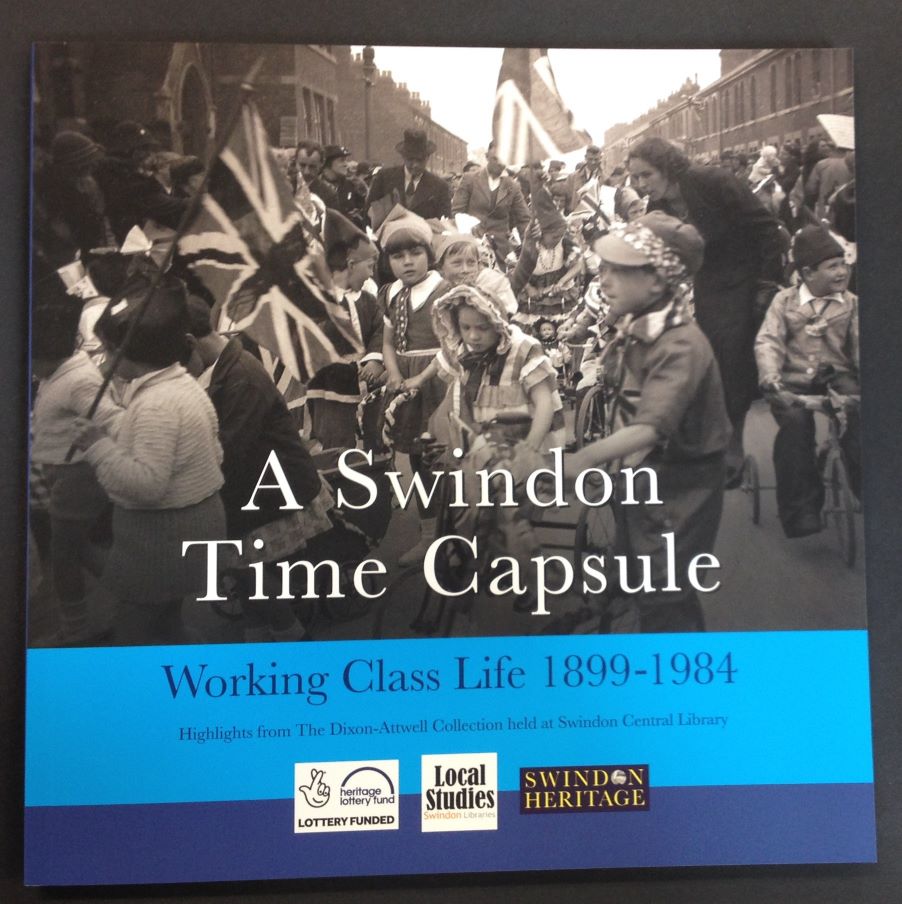
You can read about the life and times of Jack Dixon and the Dixon/Atwell family in the award winning book A Swindon Time Capsule – Working Class Life 1899-1984 by Graham Carter available from the Library Shop.

William Hall – killed at work aged 13 years and eight months

At 13 years and 8 months of age William was working as a ‘slipper.’ A ‘slipper’ was a young lad who assisted with the movement of wagons by horses. He would place the chocks to ensure that the wagon did not move when parked. They were called slippers because the chock looked like a slipper.* As one of the jurymen remarked during the inquest – ‘he thought it a great shame that the Co. should employ lads at such work. It was very dangerous for the lads so employed.’

William Hall had a short life. You could easily miss him on the 1881 census returns where he is recorded as James William Hall aged 4 years old. He was then living in Llanelly, Carmarthenshire with his parents John and Ellen, and two brothers. William was born in Swindon in 1877 but by 1881 the family had lived in Wales for a few years. His younger brother Thomas was born in 1879 in Llantrisant while Frederick was born in Llanelly in 1883. By 1890 the family were back in Swindon living at 166 Rodbourne Road, handy for the Works where John worked as a Stationery Engine man and where William would soon join him.

The Fatal Accident at the GWR Station

On Saturday, Mr W.E.N. Browne, coroner, held an inquest at the Cricketers’ Arms, New Swindon, on the body of the lad William Hall who received fatal injuries at the GWR Station, New Swindon, on the previous Thursday. Mr T. Wheeler was chosen foreman of the jury, who then proceeded to view the body, which was lying at the GWR Medical Fund Society Hospital. Inspector Wheeler was present to watch the proceedings on behalf of the GWR Co. The following evidence was taken:-

John Hall sworn, said: I am father of deceased, whose age was 13 years and 8 months. He had been only two days in the employ of the GWR Co., but he was at the same work for three days a fortnight ago, but left and did nothing till he was taken on again during the past week.

Henry Roach, shunter, in the Loco. Dept., said he was standing near the E Box in the afternoon. He heard someone call out, and on looking round he saw the second wheel of the van go over the deceased. Witness went to the lad’s assistance and picked him up. He asked deceased how he got under the van, and he replied, “My foot caught in the points, and it threw me down.” Deceased was quite sensible when picked up. The driver was at the horse’s head.

By a juryman: – It was a general practice for boys to be employed in “slipping coaches.”

(A juryman here interposed with the remark that he thought it a great shame that the Co. should employ lads at such work. It was very dangerous for the lads so employed).

Albert James Ford, said he was a driver in the employ of the Great Western Railway Company. Deceased was working with him as a “slipper.” On the day of the accident he was at work with the deceased, as usual. The first he heard of the accident was when the boy, being caught under the wheel, cried out. He went to the lad, and found the wheel had passed over him, and his shoe was left in the points. It was a horse box that was being drawn, but the boy was not riding on it at all. Witness had that same morning cautioned the deceased against walking on the rails, and he was not doing so when the accident happened. If the lad’s foot had not caught in the points the accident would not have occurred.

Mr Cailey, assistant to Messrs Swinhoe, Bromley, & Howse, said deceased was admitted to the hospital about 2.30 p.m. on Thursday. He was suffering from severe injury to the thigh and one arm. Deceased had his boots on when brought to the hospital. He lingered till six o’clock, when he died from exhaustion.

The Coroner having briefly summed up, the jury returned a verdict of “Accidental death.”

The Swindon Advertiser, Saturday, Feb. 15, 1890.

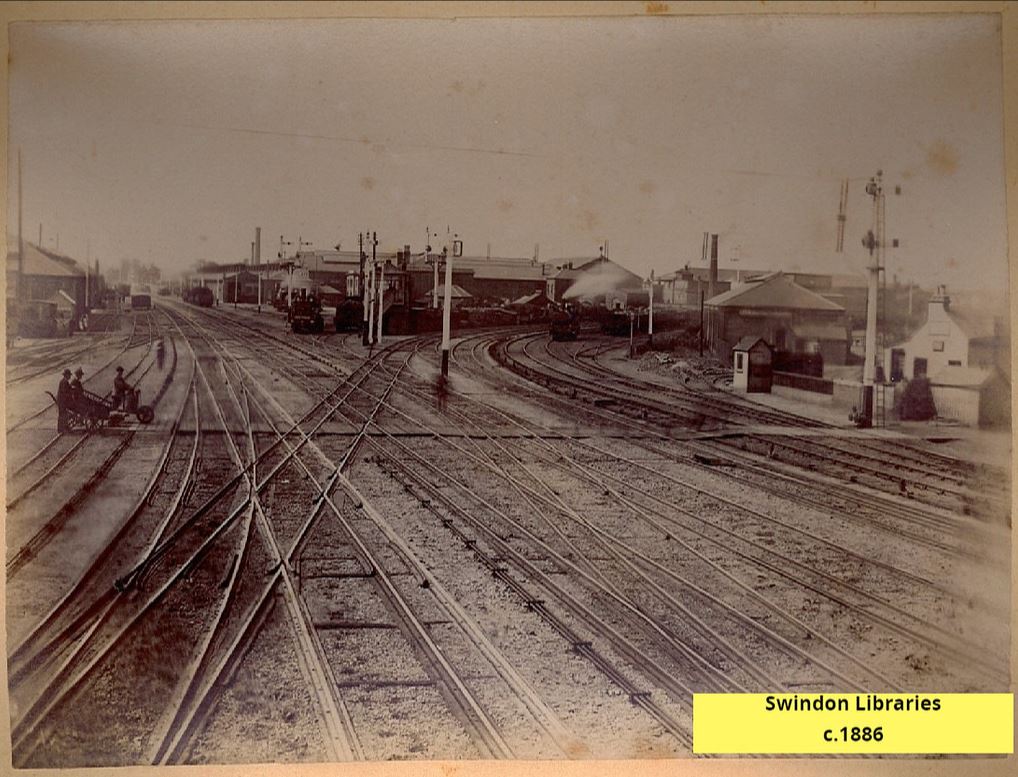
c1886 View of Swindon GWR Works from railway line published courtesy of Local Studies, Swindon Central Library.

Today there is no one left to remember the young boy who was doing the work of a man. No one to remember that William Hall was 13 years and eight months old when he was killed at work.

William was buried on February 18, 1890 in grave plot B1778 – a public grave that he shares with two others.

*Many thanks to David Robert for correcting a previous error.

Season of mists Pt IV

The sun is shining brightly this morning, but will the weather hold? I’ll make an early start, just in case, but you can relax at the kitchen table and take your breakfast at leisure. Join me on a virtual walk around the cemetery.

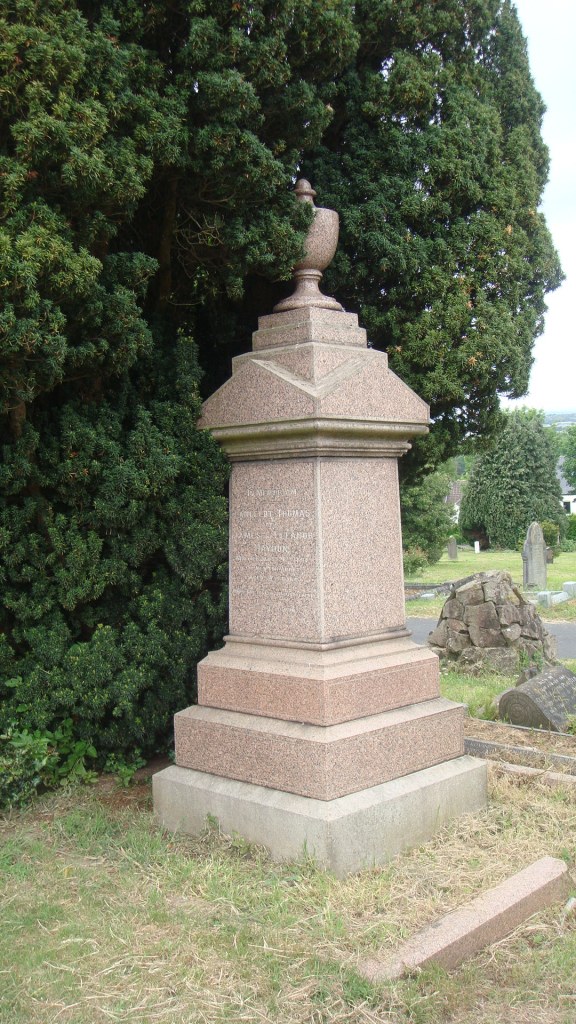
It’s easy to almost miss this magnificent pink granite monument to another railway father and son, encompassed by this large yew tree.  Like the Carlton obelisk opposite that we visited on our summer walk, this memorial was also paid for by employees at the GWR Works. 

James Haydon was born in Bristol in 1826.  The Railway Employment Records available on the Ancestry website, indicate that James entered the railway employment in March 1851 when he was about 25 years old.

By 1861 he was working as an engine fitter in the Swindon Works.  He lived with his wife Ellen, their young son Lancelot and his wife’s nephew Henry Wardle at 9 London Road.  Sharing number 9 were Thomas Watson and his wife Ann along with Ellen’s parents, Lancelot Young (who at 64 was still working as a boilersmith) Eleanor Young and several other Wardle children. Things must have been very cosy at number 9.

By 1871 James Haydon was Deputy Manager at the Works and was living in a house in what was then still known as Sheppard Fields.  This later became Sheppard Street, named after the former owner of this area, John Harding Sheppard.

James died on July 5, 1888.  He had been Assistant Manager in the Loco Works for 22 years. The inscription reads ‘this monument has been erected as a token of affection and esteem by his fellow officers and employes.’

Also remembered on this memorial is James’s son, Lancelot who died in 1894 aged just 38. Lancelot followed his father into the works and his career can be charted through the same railway records. He began work as a pattern maker apprentice in 1871.  In 1877 after he had finished his apprenticeship, he transferred to the Drawing Office. In 1881, by then a mechanical draughtsman, Lancelot left the GWR for an appointment on the Swindon, Marlborough and Andover Railway, but by 1888 he was back at the GWR firstly as Assistant Draughtsman and later as Chief Draughtsman.

At the time of the 1891 census he was living at his old family home, 21 Sheppard Street, with his wife Isabella and their young daughter. The following year Lancelot was on the move again, this time to Newton Abbott as Assistant District Superintendent Loco Carriage Dept.  He died less than two years later.

Tomorrow we meet another man who has left his mark on Swindon but now I will take a brisk walk down the hill as I’m sure I just felt some spots of rain.

Season of mists Pt II

And still more, later flowers for the bees,
Until they think warm days will never cease,
For Summer has o’er-brimm’d their clammy cells.

To Autumn by John Keats

Hope you can join me from the warmth of your sitting room where the logs crackle in the hearth and the wind moans down the chimney. You might have expected the cemetery to be inaccessible after the deluge yesterday, but I shall pull on my wellington boots and my raincoat and venture forth.

This is the final resting place of members of the Wall family, husband and wife William and Mary Ann, and their son Arthur Henry.

Arthur was born in 1899, one of William and Mary Ann’s six children of whom sadly only three sons survived childhood.  He grew up in Rodbourne living at addresses in Redcliffe Street, Drew Street, Linslade Street, Montague Street and Jennings Street.  William worked as a Boiler Maker in the railway factory and when young Arthur left school he followed him into the GWR Works and the same trade.

Following the outbreak of war in 1914 Arthur was keen to join up and enlisted in the 2nd Wiltshire Battalion on January 12, 1915.  He gave his age as 19.  He was in fact not yet 16, but recruiting officers were apt to turn a blind eye to a fresh faced, eager young volunteer.  He was posted to France on June 1 where his age was quickly detected and on July 7, 1915 he was sent back to England as being ‘under age and physically unfit for service at the front.’  He spent the following year in service on the home front before returning to France in June 1916, this time in the 1st Hertfordshires.

His service records reveal that on May 12, 1918 he was gassed. His medical records state that his capacity was lessened by 40% and he was left with defective vision and suffering from headaches.  He was discharged on November 23, 1918 as being no longer physically fit for war service.  He received a pension of 11s and returned to Swindon where he married Mabel Pinnegar in 1919.  

Whether Arthur was able to return to work as a boiler maker remains unknown.  In 1920 he wrote to the Infantry Record Office asking if he was entitled to anything under Army Order 325/19 concerning the Territorial extra allowances.  He received this reply:

‘I regret to inform you that you are not entitled to any extra pay or allowances under Army Order 325 of 1919 as you were discharged on 23rd November, 1918. The increase of pay authorised under the Army Order in question was only granted from 1st July, 1919 to soldiers who were actually serving on the date of the order, viz 13th September 1919.

Arthur died on May 22, 1922 aged just 23 years old. Have you noticed the date of death of Arthur and his father William? You can read more about the sad event here.

But for now I think I shall quicken my step and head off home as the rain clouds are gathering again. See you tomorrow to continue our virtual tour of Radnor Street Cemetery.