I leaned back on the bench and closed my eyes, my face turned towards the sun. Bird song filled the air on this glorious summer’s day. But how could there ever be a glorious summer’s day again? All I could think about were the days so many had been robbed of, and yet here was I in my 60th year, an old woman, enjoying the bird song and the sunshine.
I often come to sit in the cemetery. There is usually someone here, tending a grave. We exchange a few words, pleasantries. Sometimes we even talk about our boys.
The guns have been silent for many months, the servicemen returned home. Even those who were prisoners of war are back, aimlessly walking the streets of Swindon. They stop and speak. Everyone knew my boy.
I wish I could have brought his body home and buried him here in the cemetery. I’ve seen photographs of the battlefield cemeteries, row upon row of crosses. My boy has no known grave.
A parent shouldn’t out live their child. Will this be a country full of old people now? Parents mourning sons.
I open my eyes, ahead of me there is an old man, walking slowly up the hill. I think I recognise him. Another old man. This world is full of old people, all the young ones are dead.
He stops and lays the flowers he holds on a grave. I watch as he appears to stumble. I stand up and begin to walk towards the Dixon Street gate. I’ve had enough now, watching other old people. I shouldn’t be here, none of us old people should be here.
The facts …
Elderly Man Expires in the Cemetery
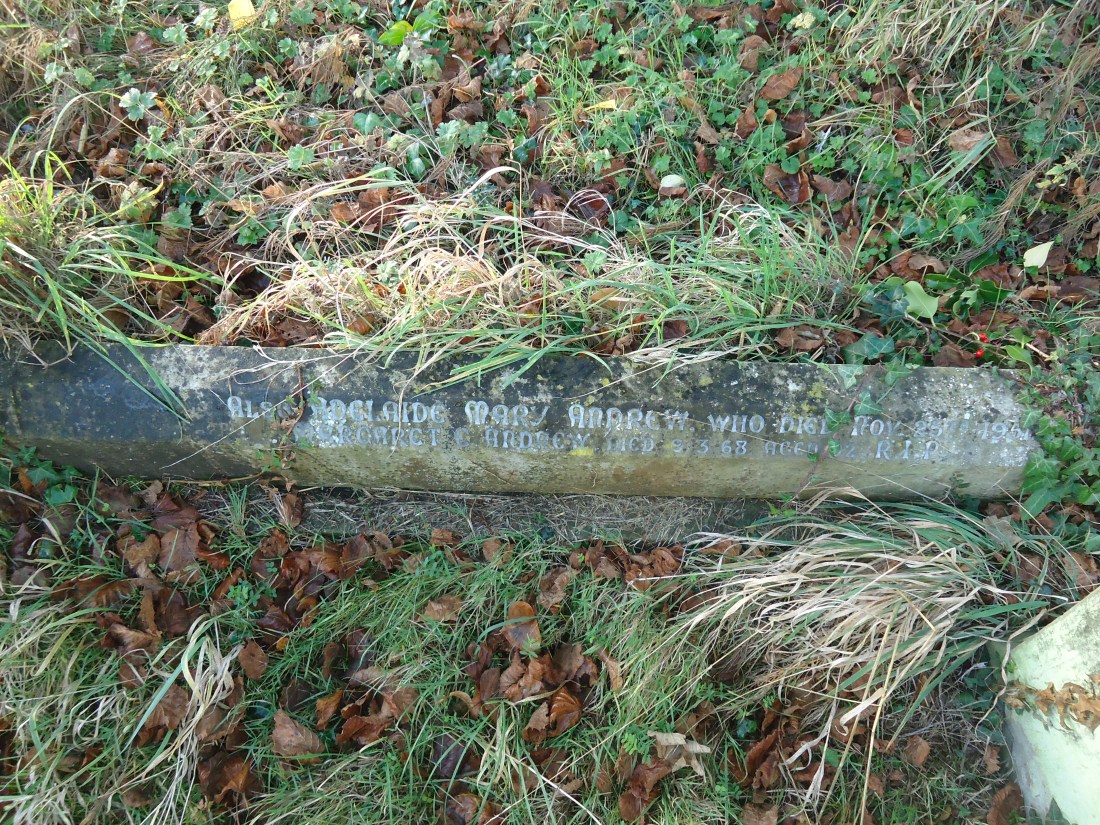
The death of a well known Swindonian, Mr Donald Macdonald Andrew, a retired GWR foreman, occurred under tragic circumstances in Swindon Cemetery on Saturday last. It appears that Mr Andrew, who was 72 years of age, and resided at 142 William Street, went on Saturday morning to the Cemetery, with the intention of placing some flowers on his wife’s grave. When walking along the pathway towards the grave he was seen by Mrs Amy Haynes, wife of Ald. A.W. Haynes, ex Mayor of the Borough, to fall. She ran to his assistance, and also a gravedigger, named Sidney Iles, who was working nearby. But deceased expired in a few minutes.
The Faringdon Advertiser Saturday June 21 1919.
The Andrew family lived at 142 William Street for more than sixty years. Donald Macdonald Andrew, an engine fitter in the Works, and his wife Emily Jane had six children, a seventh had died before the 1911 census – Samuel Henry, George Edward, Ralph Macdonald, Florence K and twins Adelaide Mary and Margaret Elizabeth.
Donald’s funeral took place on June 17, 1919. He is buried in a double grave plot E8347/8 with his wife, son Ralph and daughters Adelaide and Margaret.
The Radnor Street cemetery volunteers are a versatile group. Not only do they care for the CWGC graves and identify others with a military connection, but they mow and hoe, weed and clean and also locate lost graves. Bex recently helped Liz, a visitor to Swindon, to find her great grandparents grave and in doing so revealed yet another fascinating Swindon family history.
Liz helpfully had the cemetery paperwork concerning two family graves – plots D937 and D938. These proved to be the graves of two brothers, William John and James Henry Foyle with their respective wives, Margaret Ann and Mary Jane. The brothers were two of four sons born to Isaac and Rebecca Foyle. All four sons were born and raised in Swindon and all four followed their father Isaac, a labourer in the GWR iron works, into the railway factory; William as a boiler smith, James a brass finisher, George a railway clerk and Alfred an electrical fitter. William would eventually move to Wolverhampton, but following his death he was buried next to his brother James.
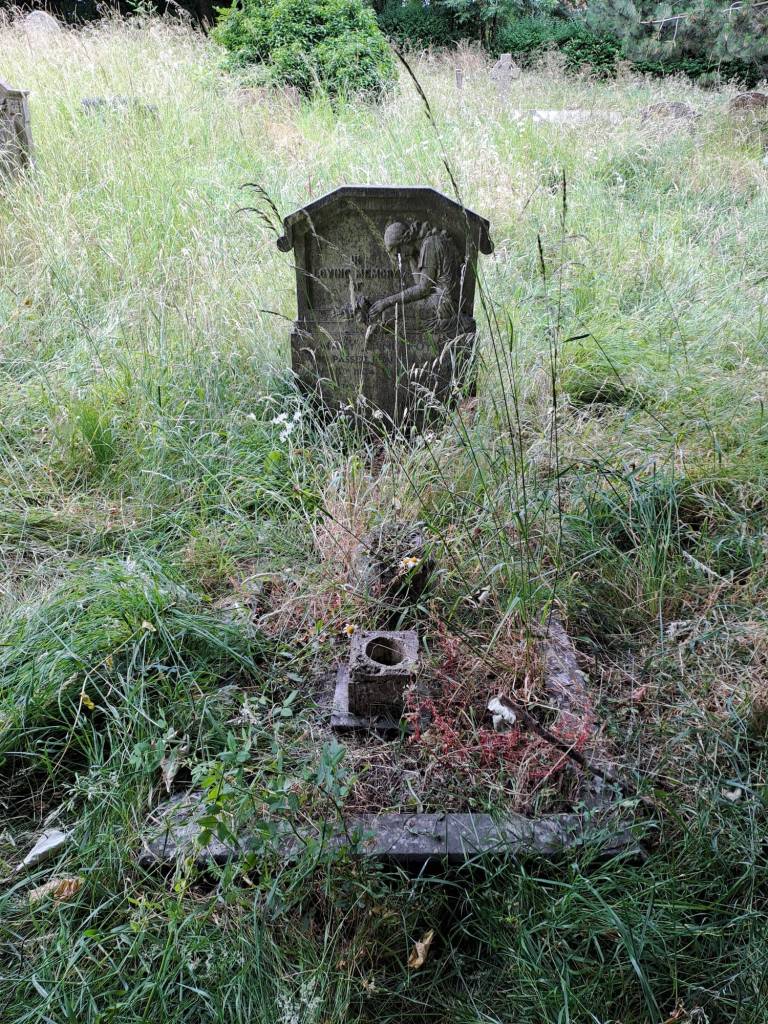
James’s grave with its elegant headstone was easy to locate. See below two before and after photographs taken by Bex.
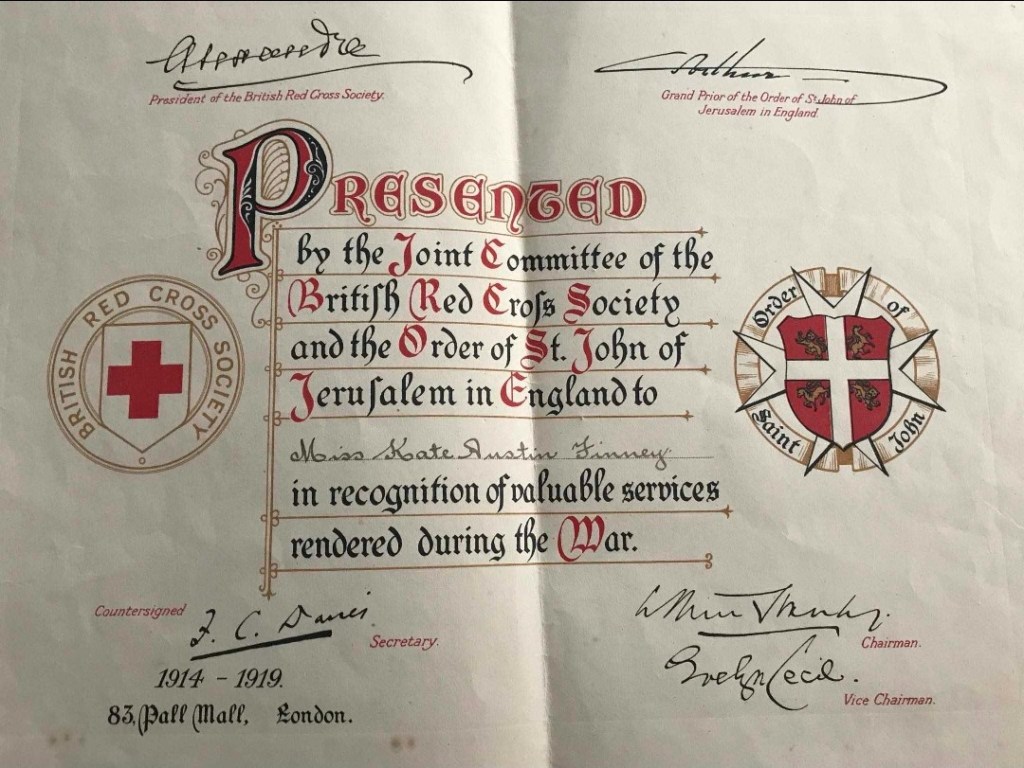
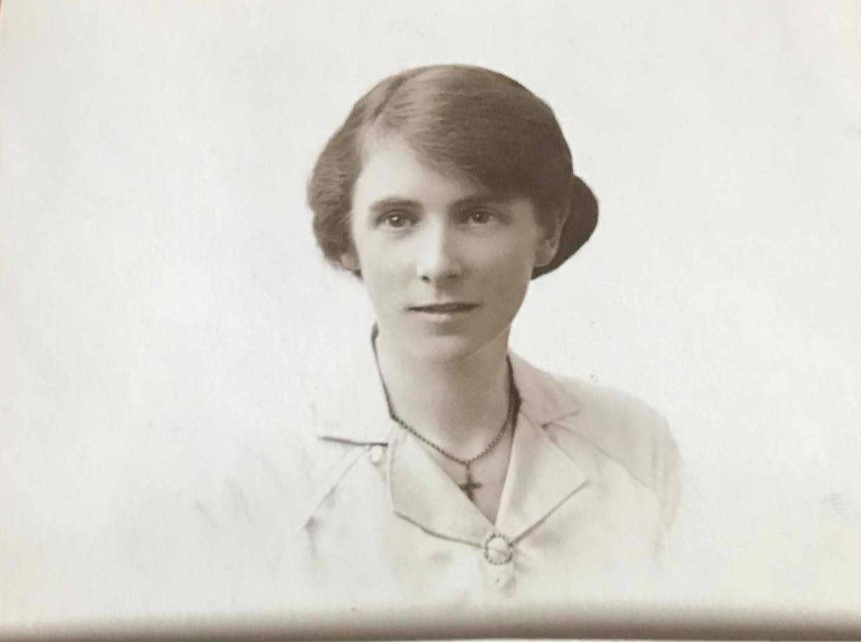
Liz was also keen to find other family graves, including those of Esther and Kate Finney. Research revealed that the two sisters were the daughters of William and Emma Finney.
Esther and Kate both served as Red Cross nurses during WWI. Esther was a volunteer at the Red Cross Hospital In Taunton in 1917 while Kate stayed closer to home and served as a Ward Helper at the Red Cross Hospital in Stratton in 1918.
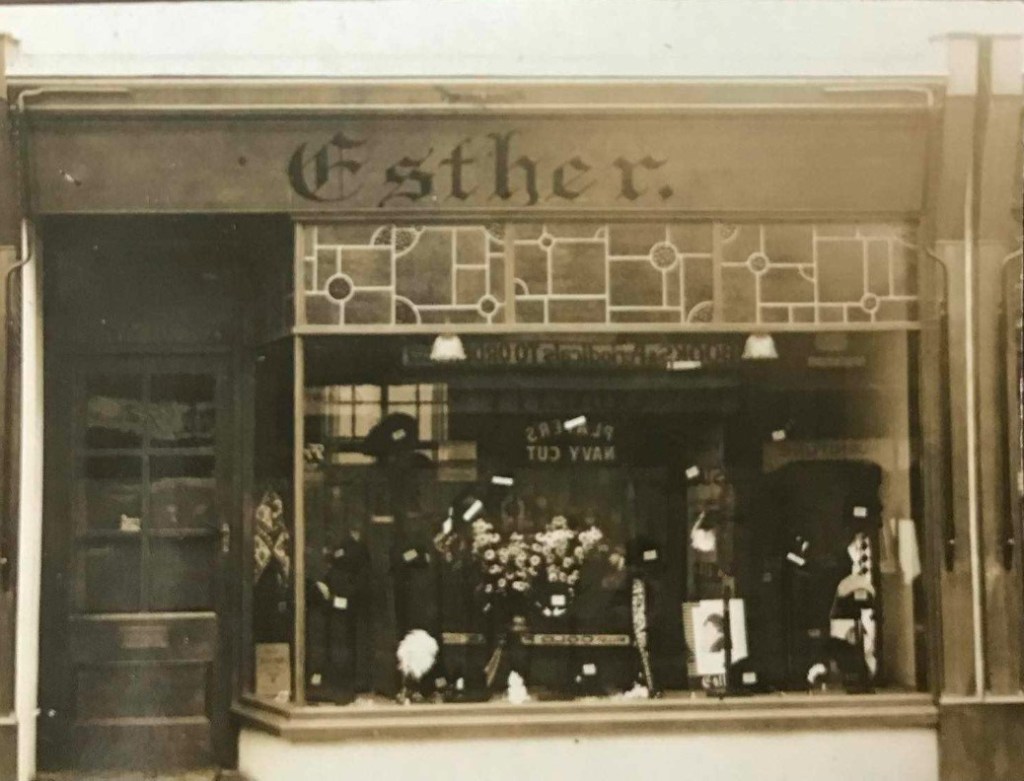
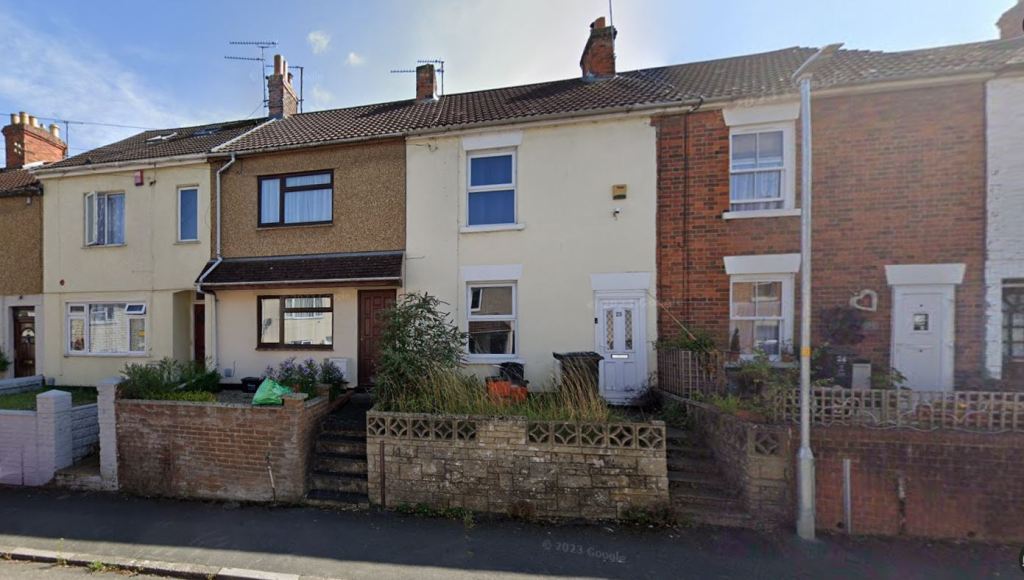
In 1939 Esther, Kate and their brother William lived with their widowed mother at 11 Clifton Street. Esther is described as a Shopkeeper (Gown and Millinery) and Liz was able to provide a photograph of the shopfront.
Esther died in 1959 and Kate in 1970 and they are buried together in grave plot E8298 with their brother William who died in 1957.
The connection between the Foyle and Finney family is that Esther and Kate’s brother John Marshall Finney, married James and Mary Jane Foyle’s daughter Elsie Gladys Foyle.
Hopefully Liz will keep in touch with Bex and even more family stories will emerge.
I could see Mr Higgs next door, standing at the bottom of his garden, looking out over the old canal. He was there most mornings, just standing and staring.
I picked up my basket of laundry and opened the back door. I could spare a few minutes chatting to him while I hung out the washing.
“Morning Mr Higgs,” I called. “Bit breezy! This washing should dry quickly enough.”
He was dressed in shirt sleeves even though it was a chilly January morning. I suppose he was used to being out in all weathers. He once told me that the old locos were open to the elements; no cab over the engineman then. Life for the drivers was hard in those early days.
It was all he talked about – the old days. The journeys he had done with the Royal family, how much the job had changed over the years.
He was hungry for news from the Works, but he had few visitors. Everyone was too busy, but I tried to find a few minutes in the day to talk to him, although I couldn’t bring him the conversation he wanted.
“Fifty-two years and two months, I worked for the Company,” he proudly told me, “and an unblemished career. I’m still fit and able to work but these new rules meant I had to retire.”
I’d read the newspaper reports published when he retired at Christmas. My husband Jack told me how Mr Higgs had fought the retirement ruling, but there was nothing the Company could do.
“I think he’d have taken any job going, but it just couldn’t be.”
I wasn’t so sure about that. Mr Higgs believed he was still fit enough to drive locos and that’s what he wanted to do. I don’t think a caretaker’s job would have suited him.
He turned his back on me as I started to peg out my washing. He didn’t seem to want to chat today.
“Everything alright Mr Higgs?”
He looked across towards the railway line.
“The wind must have changed direction,” he said. “I can’t hear the trains today.” He turned around and walked slowly back up the garden path.
“I think we might have some rain. Your washing won’t dry after all.”
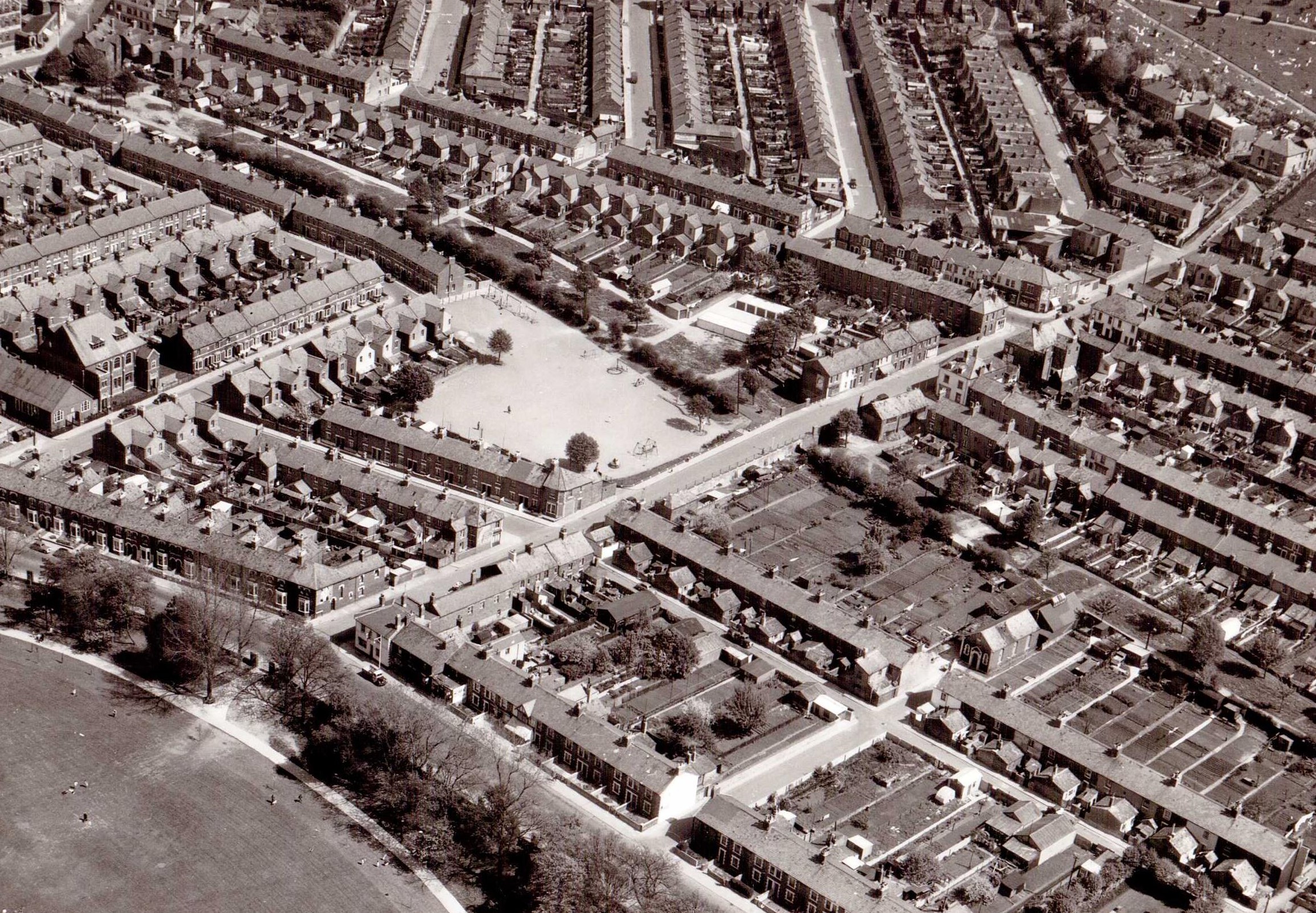
1950s photograph of Faringdon Road and the route of the old Wilts and Berks Canal
The facts …
Luke Higgs was born on December 3, 1834 and consistently gave his place of birth as London, Tower on census returns.
He married Margaret Beaupre in Bourne, Lincolnshire in October 1859. At the time of the 1861 census the couple were living at 20 Bath Street (now known as Bathampton Street) in the railway village, however their first child, a daughter Annie Agnes, was baptised at Holy Trinity Church, Paddington when they were living at 16 Waverley Road. The couple went on to have four more children and by 1871 the family was living at 19 Brunel Street. They soon moved to 8 College Street, their home for more than 40 years.
Luke entered the employment of the Great Western Railway in October 1852 just a few weeks before his 18th birthday. He worked first as an engine cleaner and lighter up before become a fireman in 1855. By 1861 he was working as an engineman and in a career that spanned more than 50 years.
Luke Higgs died at his home, 8 College Street, on March 12, 1913 aged 78. He left effects valued at £707 11s 3d (later resworn £642 11s 3d) to his wife. Margaret outlived him by a further twelve years. She died at 8 College Street on October 29, 1925 aged 90. They are buried together in plot D950 where they were later joined by their daughter Margaret Easley who died in 1953 and their grandson Elliott Tuckwell who died in 1967.
Retirement of a Railway Veteran
Over 50 Years’ Service
Mr Luke Higgs, of Swindon, who has just retired from his duties as driver on the Great Western Railway through the operation of the age limit of 70 years, has probably achieved a record of service, having been no less than 52 years and 2 months in the employ of the Company. It is remarkable that notwithstanding his great age he enjoys the best of health and looks a robust, able bodied man. He passed the eye sight and health test of the GWR doctor on 13 occasions, and when he passed last time his sight was exceptionally good.
Mr Higgs was born in London on December 3, 1834, his father being a noncommission officer in the Scots Fusilier Guards. Early in life he joined the service of the GWR and has grown in age with the railway, seeing many different systems in vogue during the half century. Improvements in the working of locomotives have of course come under his notice more particularly than any other, and he speaks of the time when there was no protection on the engines beyond the fire box, and no leg plates or cab, no steam pressure gauges, and no dry sand boxes. Those were hard times for enginemen, and great judgement was required to work the trains in safety.
He was fireman on the engine which took the late Prince Consort from Windsor to open Saltash Bridge in June 1857, and also filled a similar capacity on the train which conveyed the present King to Oxford, to open his college education, on Monday, Oct. 17, 1859. Not only that, but he has been fireman several times on the Royal train between Paddington and Windsor.
It is interesting to note that he was made a permanent engine driver the same day as the late Prince Consort died – December 14, 1861 – and ever since he has held a good reputation, so that when he retired there was not a black mark against his name. We are given to understand that he has the cleanest record on the Great Western line. In his career he has never lost an increase in wages or a premium, and has received from the Company £325 for good conduct whilst in their employ.
His varied experiences are of more than ordinary interest, and he modestly tells of incidents which would have turned but disastrously had it not been for his prompt actions. His advice in working trains has been frequently sought after by younger men, and many a good driver have been turned out of his engine. He was most economical in his work and studied the Company’s materials as though they were his own.
He is held in the highest esteem by all the officials with whom he came in contact, and all regret his retirement. The doctor who signed the last certificate said that Mr Higgs was well able to work for another five years, but of course the age limit had to be observed.
North Wilts Herald January 28th 1905
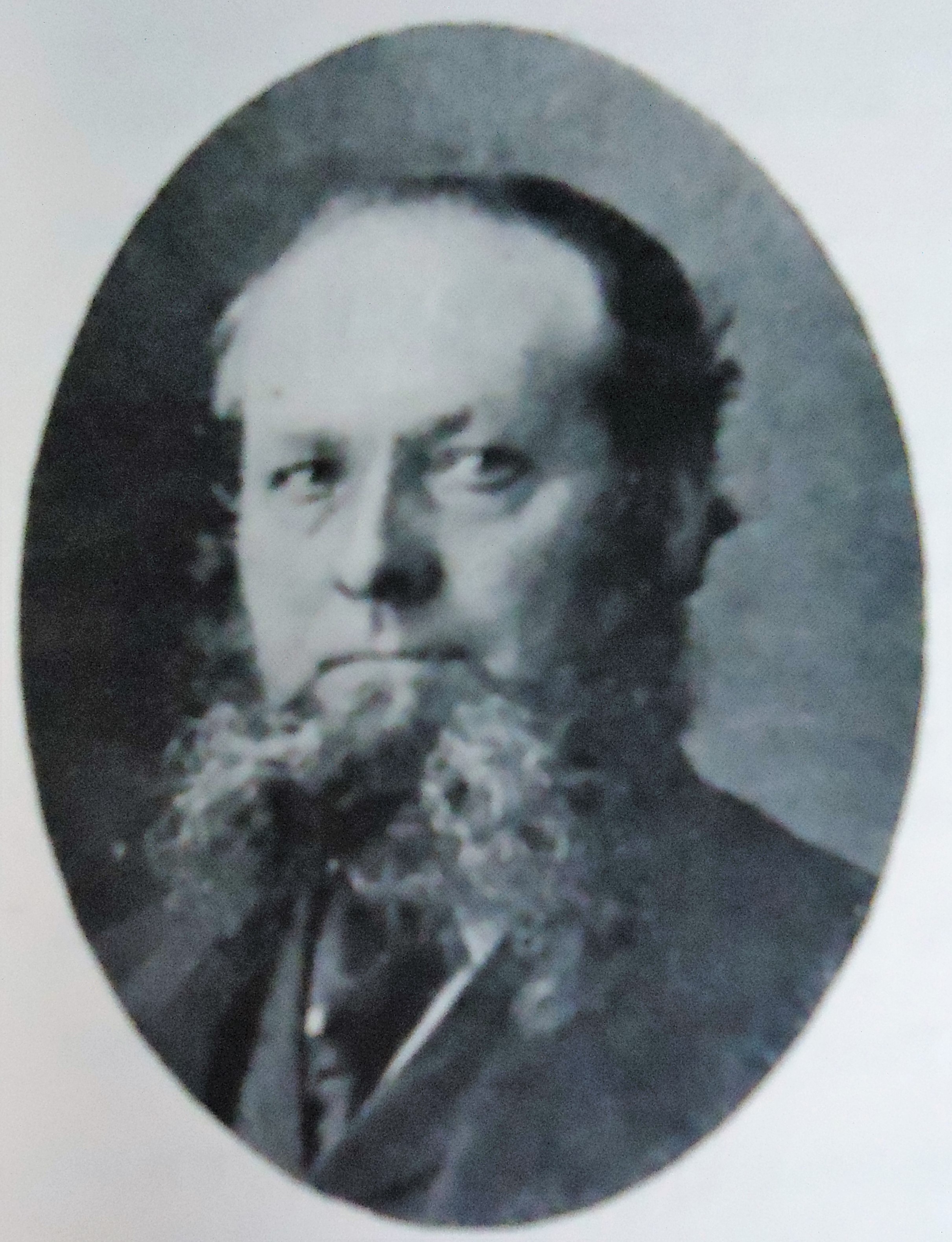
Luke and Margaret Higgs with one of their daughters. Published courtesy of philstree18 from a public family tree on Ancestry.
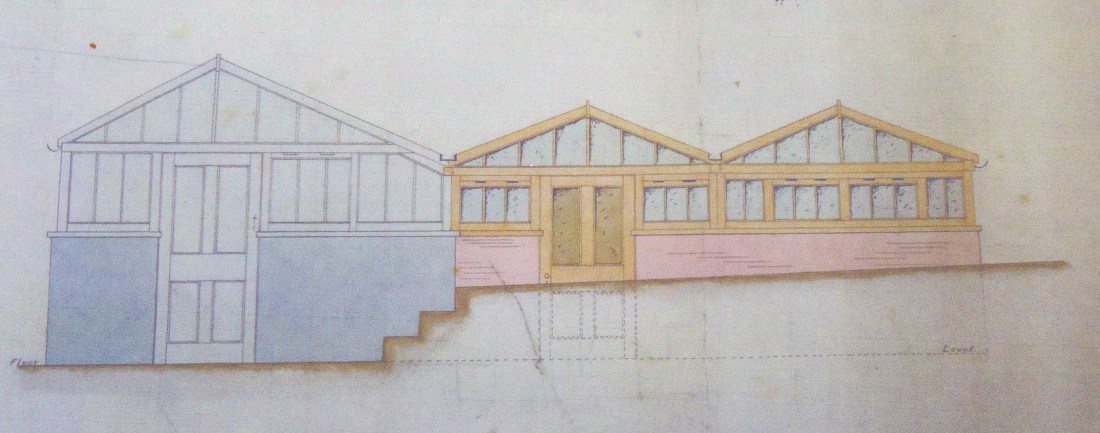
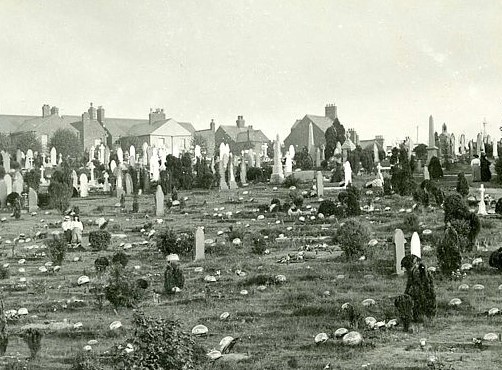
Back in the day there were flowers everywhere, right across the cemetery, displayed beneath glass domes; cultivated in the greenhouses. In 1907 the groundsmen were so busy that planning permission was sought for additional glasshouses to be built behind the caretakers lodge (see above illustration).
For those families who could not afford a headstone the flowers were a monument among the graves so densely arranged with barely a foot’s breadth between each plot.
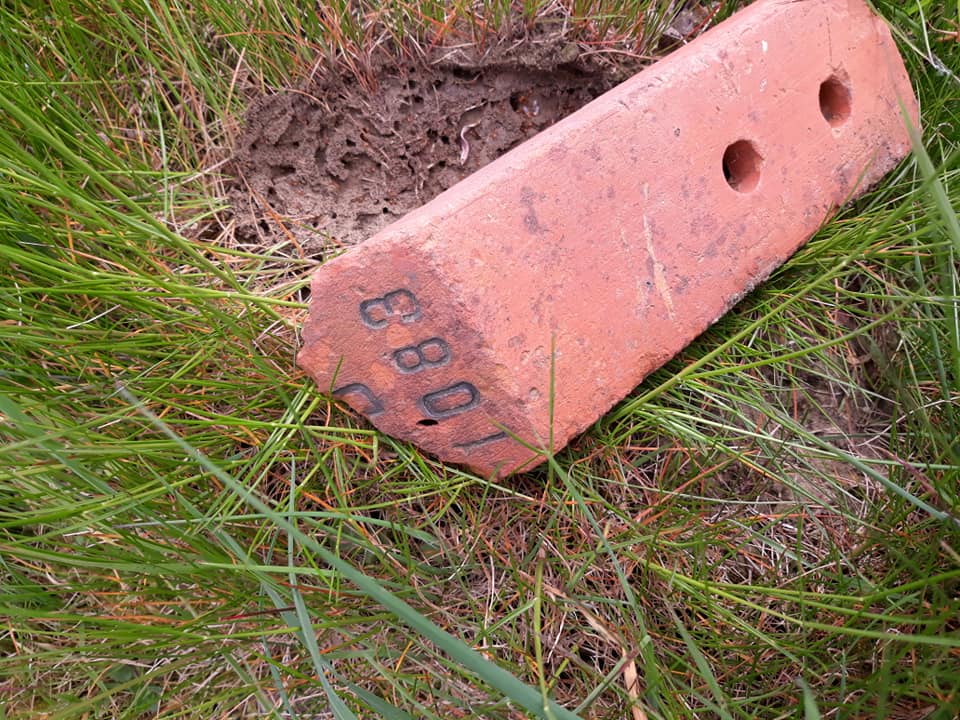
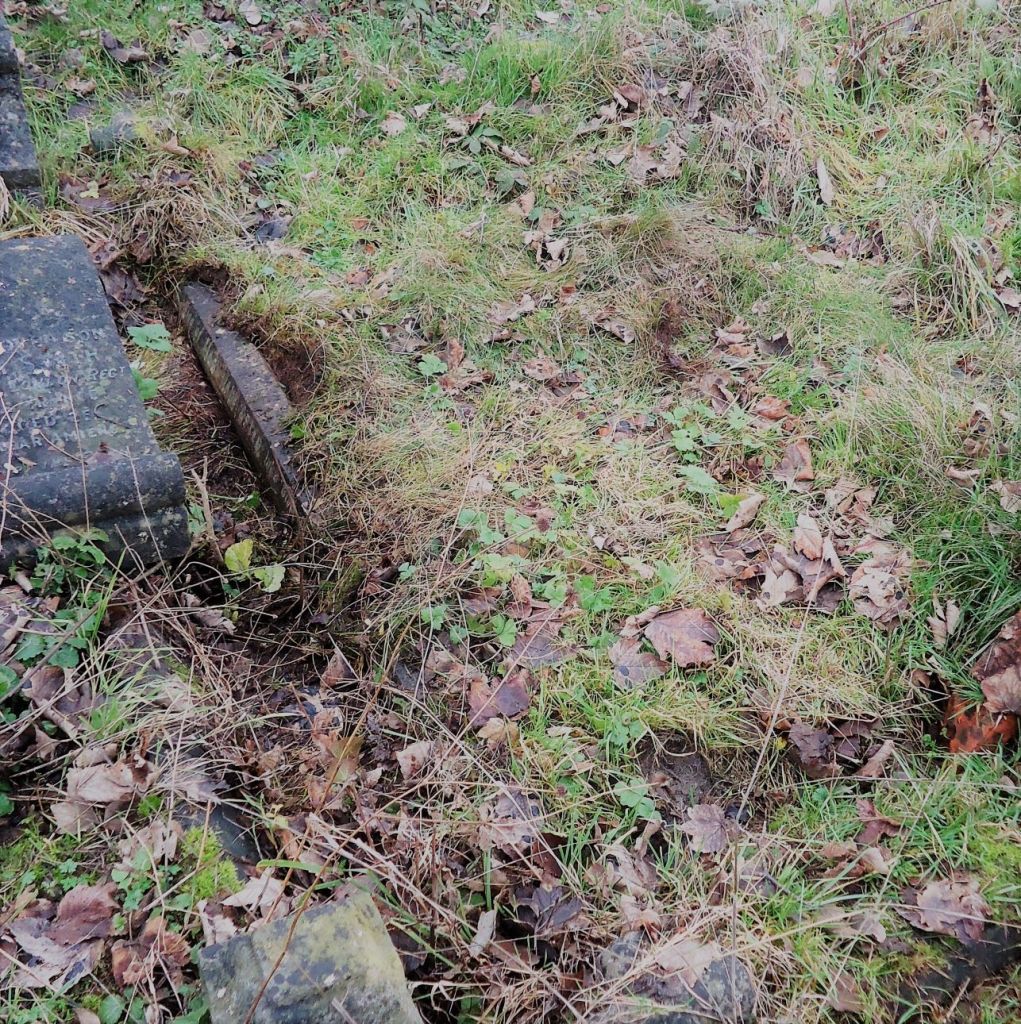
Every grave was identified by a terracotta marker, sadly an unsatisfactory method. The system had worked well when a caretaker and gravediggers were employed in the busy cemetery but today they lie broken and scattered about. Some graves sport several of the brick like markers, others have none, and when searching for a grave they should be used with caution and only as a rough guide.
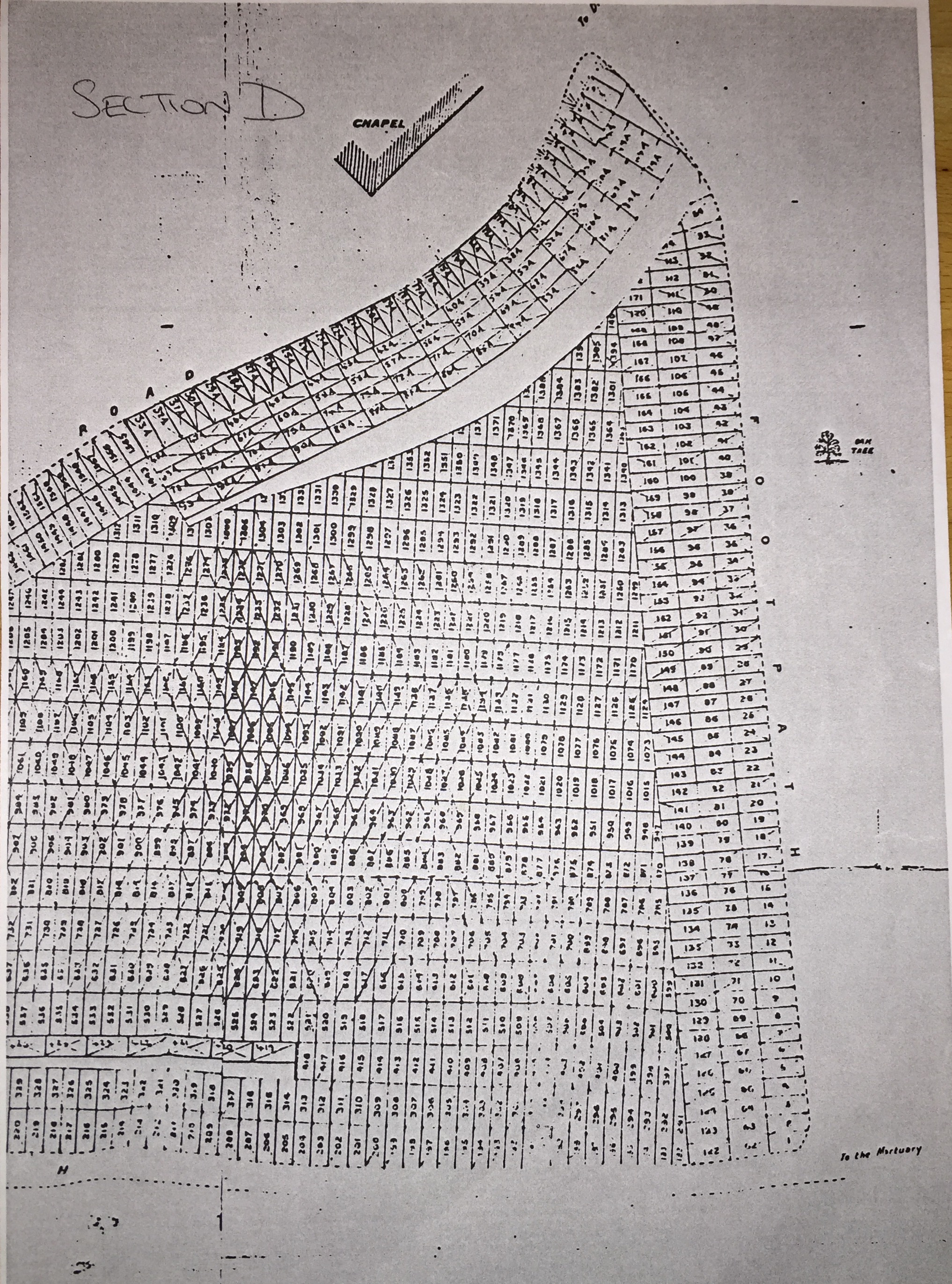
So what about the marker pictured here, found on a mound of earth. Is there a fallen headstone buried somewhere beneath? There are no clues, but it is possible to trace who was buried in plot D1083…
The facts …
The Radnor Street Cemetery burial registers reveal that there is only one person buriedin plot D1083. His name was William John Molden, a boilermaker at the Works, who died on March 3, 1919 at his home, 145 Clifton Street. He was 44 years old and his funeral took place on March 8. Administration of William’s estate was awarded to his widow, Emily and his effects were valued at £179 5s.
Without applying for William’s death certificate we cannot ascertain his cause of death. Unfortunately we do not have a budget to pay for all the death certificates we need when researching the cemetery.
William was born on February 23, 1875 in Purton, the son of Eli and Hannah Molden. He began a six year boilermaking apprenticeship in the Works on February 23, 1890 aged 15. The 1891 census lists William as a 16 year old GWR Boiler Maker Apprentice living with his parents and older brother Sidney at Battle Well, Purton.
William married Emily Painter in 1898 and at the time of the 1901 census they were living at 65 Redcliffe Street, Rodbourne with their four month old daughter Dorothy.
The family appears on the 1911 census living at 122 Clifton Street where William lists his occupation as Boilermaker Rivetter. The couple have three children, Dorothy Maud aged 10, Muriel Louise Hetty, 8 and Harold Sydney John 2. Another son, Raymond Edward Joseph was born in 1917.
William was a relatively young man when he died. Perhaps he died as a result of the post-war ‘flu epidemic which raged through Swindon as it did everywhere else.
I really didn’t want to visit Miss Blount. I liked her well enough; she was a kind, patient teacher, but she was dying. We all knew it. She had been ill for a long time and this would probably be the last time anyone other than her family would be invited to visit.
As the senior pupil teacher I was selected to deliver the presents the children had produced. The infants had drawn pictures while the older children had written diary entries telling her what was happening at school. The girls in Standard IV had baked a Victoria Sandwich cake, named after the Queen who was known to have a sweet tooth. My contribution was a bunch of dahlias grown in my dad’s greenhouse.
The Blount family lived at 14 Park Lane. I expected the house to be shrouded and shuttered, the family sombre and in premature mourning, but it wasn’t like that at all. Miss Blount was sitting in the sheltered back garden where her mother served the tea. The flowers were placed in a cut glass vase and set upon the garden table while both ladies exclaimed over the lightness of the sponge cake. The younger children’s pictures caused much delight and the diary entries were pored over with great interest.
Our little tea party was so relaxed and jolly that I began to think perhaps the reports of Miss Blount’s ill health had been exaggerated. Then suddenly she was overcome by a paroxysm of coughing, and her mother rushed to her side. When eventually the attack subsided I noticed the handkerchief she held to her mouth was spotted with blood. She looked exhausted and Mrs Blount thanked me for calling, which I took to be my cue to leave.
Miss Blount was very pretty and so young, just 27, but of course as a 14 year old school girl I didn’t truly appreciate the sorrow.
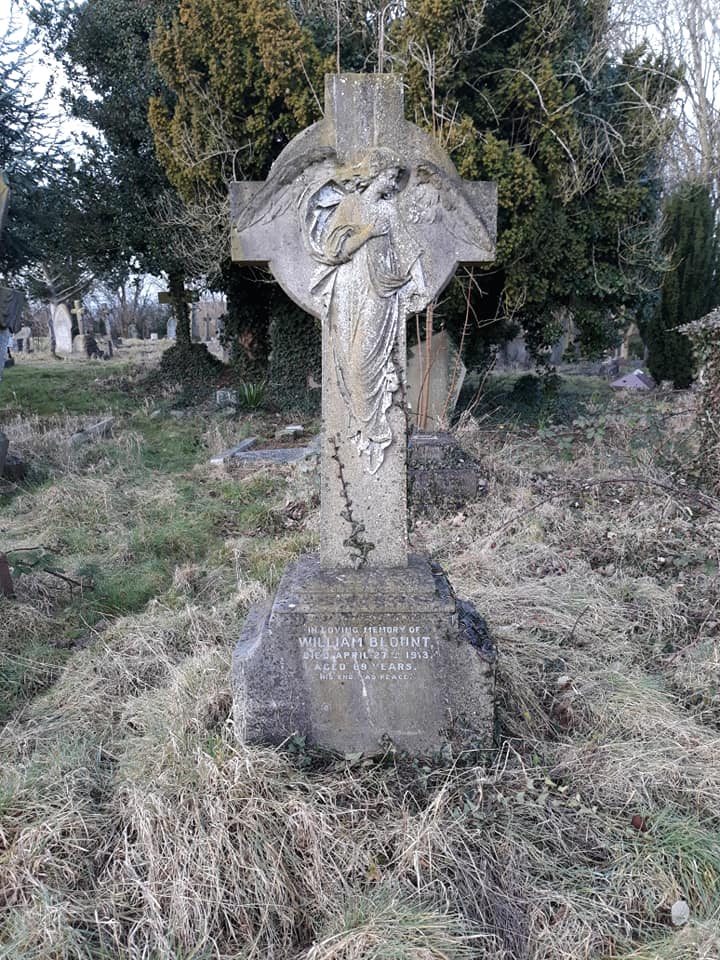
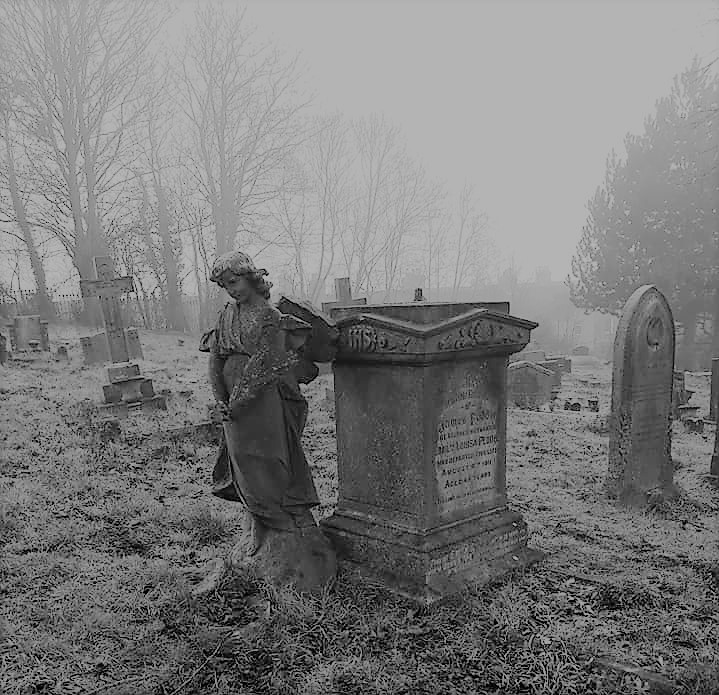
There’s a beautiful monument on her grave, a floating angel, delivering her soul to heaven. When I visit my parents’ grave I take some flowers for Miss Blount. She told me she thought the dahlias were a cheerful flower, that day of the tea party.
The facts …
Eleanor Marian Blount was born in Hereford, the eldest of William and Ann Blount’s eight children, but she was not the first to die.
William married Ann Lane on August 6, 1866 at St Peter’s, Hereford. They moved to Swindon in about 1868 where William started work as a Moulder in the railway factory. Their first home was in Havelock Street in 1869 before they moved to 43 Cheltenham Street. Their third child, Mary Emma Blount was born in Cheltenham Street but died at 8 months old. She was buried on August 22, 1871 in the churchyard at St Mark’s. In 1881 the family were living at 22 Cheltenham Street and by 1891 they were living at 14 Park Lane.
Three of their children went on to become teachers, Eleanor, Lily and Edgar. William John Lane Blount turned up in the US sometime around 1888-91. George followed his father in the Works as a Brass Finisher, but later he also emigrated to the US. Alexander (Henry) Blount worked as a mechanical engineer in the railway factory. Youngest son Frederick Walter, also worked in the railway factory as a fitter.
William died on April 27, 1913 aged 69. Ann survived him by more than twenty years. She died in 1934 aged 87. They were buried with their daughter Eleanor in a large double plot E8158/8159.
Life’s circumstances can create some unusual friendships. In the case of Mrs Peddle and me it was the death of our husbands.
We didn’t have a lot in common. Mrs Peddle had money and I didn’t. I had a houseful of children and she had none.
I don’t think she much enjoyed living in Swindon. She told me she was born in a village called Keinton Mandeville in Somerset and she was a country girl at heart. Her back garden was full of old fashioned country flowers like night scented stock and grandmother’s bonnet. My garden was always full of washing.
I’d never known anywhere other than Swindon. I’d been born in the railway village and lived there until I got married. My dad was a railwayman and so was his dad and just about all the boys I grew up with ended up working in the railway factory. My husband Fred was a steam hammerman.
I don’t know why Mr and Mrs Peddle moved to Swindon in the first place. Mr Peddle had worked as a house painter and decorator. Perhaps he looked at all those red brick terrace houses and thought there would be plenty of work for him, but of course everyone took care of their own properties in those days. Few of us had the money for an interior decorator. So like every other man in town, Mr Peddle found himself sucked into the railway works.
Mrs Peddle would come across to my house most afternoons. She seemed to enjoy the noise and chaos the children created and I was grateful for someone to hold the baby while I caught up with some household jobs.
Then afterwards we’d have a cup of tea and we’d talk. We’d talk about really personal stuff, things I’d never spoken to anyone else about. She told me why she’d never had any children and I told her why I had so many.
Before the year was out I married William, one of Fred’s friends, and moved into his house in Clifton Street. He had lost his wife around the same time Fred died. I needed a breadwinner and he needed a mother for his children. More kids! And we soon had one of our own together.
After that I only saw Mrs Peddle occasionally. The intimacy of those few months in 1911 was gone. I’m not sure that either of us wanted to be reminded about some of those confidences we shared.
It’s a funny old world. Death drew us together but life pulled us apart.
The facts …
Emily Jane Louisa was baptised on August 27, 1865 at the parish church in Keinton Mandeville, Somerset, the daughter of John Cox, a labourer and his wife Matilda. Emily worked as a dressmaker until her marriage to James Peddle in the September quarter of 1887.
At the time of the 1891 census James was recorded as living at No. 12 York Place, Swindon, where he worked as a painter and glazier. On census night 1891 Emily was staying with her widowed mother back home in Keinton. By 1901 James and Emily were living at 76 Radnor Street, their home for more than ten years. On the 1911 census James is described as a house painter employed by the railway company. James and Emily hadbeen married for 23 years and had no children.
James died on August 4, 1911 and was buried in plot D1473 on August 9.
In 1916 Emily married widower John Parker, a carpenter who worked in the railway factory. His wife Eliza had died in December 1914. John and Emily lived at 33 Wellington Street.
It was a brief marriage as Emily died on November 15, 1919. She was buried on November 21 with her first husband James Peddle in plot D1473.
John Parker outlived Emily by more than 30 years. He died on November 17, 1952 and was buried with his first wife Eliza in plot D1302, not too far from James and Emily.
John and Eliza Parker share their grave with their grandson Alan Parker who died in 1931 aged 8 years old.
Image published courtesy of Robin Earle taken in the 1980s.
One winter several years ago before public spending cuts became so constrained, Swindon Borough Council cleared a large area of the cemetery swamped by brambles, revealing many hidden graves. One of the rediscovered plots was that of the Barnes family.
This double plot E8410/E8411 is surrounded by an elegant, black marble kerbstone memorial. Although still partially concealed, two names can be detected. From these slim pickings it was possible to trace much of the history of this family, using a combination of sources beginning with the Radnor Street Cemetery burial registers.
On October 15, 1878 John Barnes and Elizabeth Jane (also known as Jane Elizabeth) Farmer married at St Mark’s, the church in the railway village. John worked as a plumber, most probably with his father Richard who was also described as a plumber on the marriage certificate. Elizabeth Jane was the daughter of Thomas Farmer, a mason.
At the time of the 1881 census John, Jane and their daughters Edith Ellen aged 1 and three-month-old Florence Beatrice, lived at 9 William Street. By 1891 they were still living in William Street where their family had increased by four sons – Harold E 6 years old, Ernest A 5, Herbert H J 3, and one-year old Frederick W.
By 1901 they were living at 5 Tennyson Street, their family complete with the birth of Edgar A in 1897. Their elder sons Harold aged 16 and Ernest 15 were both working in the building trade, Harold as an apprentice house carpenter and Ernest as an apprentice house painter. At a time when the railway works dominated the town, this large Swindon family worked independently and within the building trade. Maybe the family would look back on these times as the good years.
On September 4, 1907 18-year-old Frederick set sail for Australia. Perhaps the building trade had taken a temporary down turn, although that seems unlikely in fast growing Swindon. Was his departure a shock for his parents, or perhaps he had always been a daring, adventurous type?
But worse was to come. The first real tragedy struck on November 26, 1907 when 21-year-old Harold Ernest died, the first of the family to be buried in the large, double plot in Radnor Street Cemetery and whose name is visible on the re-discovered grave. It was Harold’s death that gave me an entry into this family’s history.
The 1911 census confirms some details. Jane states that she and John have been married for 34 years and that they had eight children, 7 of whom were living and one who had died. The couple’s four sons were listed at home in Tennyson Street, including Frederick returned from Australia.
On Boxing Day 1911 eldest son Herbert Horace John married Kate Gray Hill at St Mark’s, the church where his parents had married.
The following year Frederick and his younger brother Lionel set sail on the Orvieto bound for Sydney, Australia. John and Jane would never see Frederick again. He died in Drummoyne, New South Wales in 1913. His name is remembered on the family memorial.
Lionel remained in Australia where he married Lucy Amelia Hunt, a girl from Wootton Bassett, in 1913. They came back to England at some point, but returned to Australia in 1951 where Lionel died in Drummoyne, New South Wales in 1963 aged 71.
On September 23, 1914 Herbert’s wife Kate gave birth to a baby girl called Freda but sadly they both died the following day. Kate and her baby daughter were the first of the family to be buried in the adjoining plot E8411.
With the declaration of war, the parents must have feared for their sons, especially when their widowed son Herbert enlisted with the Royal Marines Divisional Engineers. He later transferred to the Royal Air Force.
Herbert returned safely from the war to marry Mabel Homer in 1919. He died in 1959 and was buried with his first wife and their baby daughter in plot E8411. They share the grave with Herbert’s sister Edith Ellen Lucas who died in 1962 and her husband Ernest Lucas.
Another son served in and survived the First World War. Edgar Arthur Thomas Barnes, a motor engineer, joined the army at the beginning of the war and served in the Royal Army Service Corps. He was awarded the Military Medal for repairing a motor under fire and bringing three wounded soldiers safely to hospital. Edgar died in Lincoln in 1961.
Jane died in 1922 and John in 1924. They were buried in plot E8410 with their son Herbert and daughter-in-law Mabel Barnes.
Eight family members and a day-old baby were buried in that newly discovered double grave plot. Thanks to the hard work of the Swindon Borough Council team it has been possible to trace the events of the Barnes family history.
This is the story of Thomas and Rhoda Timms. It’s the story of an ordinary family, like so many of the others we discover here in Radnor Street Cemetery.
Thomas was born in 1868 in Steventon, Berkshire. His father Joseph was an agricultural labourer and his mother was called Esther. Rhoda was born in 1873 in Yatesbury, Wiltshire. Her father Joseph Shergold was also an agricultural labourer. Her mother was called Sarah.
By 1897 Thomas had moved to Swindon and was living at 14 Westcott Place. Rhoda was living at 2 Brunswick Terrace. Thomas worked as a labourer in the Railway Works and Rhoda as a domestic servant when the couple married at St. Mark’s Church on October 23, 1897. Their first child, a son whom they named Harold Joseph, was born in about 1898. By 1900 the family were living at 24 Stafford Street where three daughters were born, Kathleen Rose in 1900, Winifred Evelyn in 1901 and Gladys Esther in 1909. All three girls were baptised at St. Paul’s Church. In 1913 another son, Albert Thomas, was born.
By then Thomas was working as a bricklayer in the GWR Waggon Works. The couple lived at 24 Stafford Street until Thomas died in 1952 and Rhoda in 1965. They are buried here in grave plot D390 with their daughter Winifred Evelyn Timms who died at St Margaret’s Hospital in 1994. She was 92 years old and although she died in hospital, her home address was given as 24 Stafford Street.
I’ve chosen to write about this family because they are typical of the average working class Swindon family and because the memory of Winifred lives on for one of our cemetery followers. Paul grew up in Stafford Street and remembers Winifred as a little old lady who always had a smile and a wave for her neighbours.
It was my privilege to try and find out a little bit about the lady he knew as Winnie and to be able to tell him where she is buried.
The following account of Frank Apted’s life was published in the Great Western Railway Magazine at the time of his retirement in 1908. It records only the details of his career, which is probably all you should expect to find in a work place publication, but Frank’s life was so much more than this.
Born in Peckham in about 1842, Frank was the son of schoolmaster Henry Apted and his wife Ruth, a schoolmistress. By 1861 Frank had begun his career with the Great Western Railway and was lodging with Thomas Jones and his family at 16 Faringdon Street. Frank would go on to marry Thomas Jones’s daughter Sarah but sadly this was to be a brief marriage as Sarah died in 1867 aged 25. She was buried in the churchyard at St. Mark’s.
Frank married for a second time in 1869. His second wife was Mary Jane Stone and this marriage would prove a long one but not without great sadness as well. At the time of the 1911 census Frank and Mary were living at 23 Park Lane. They had been married for 41 years during which time they had had 7 children. Sadly, only three survived to adulthood – daughters Alice, Louisa and Edith.
Later that same year their daughter Louisa died aged 30 in the Devizes Asylum. She was buried on August 24, 1911 in Radnor Street Cemetery, grave plot D125. Frank died on October 7, 1920 aged 78 and was buried with his daughter.
Mary Jane continued to live at 23 Park Lane where she died in 1930 aged 82. She was buried with Frank and their daughter on May 14.
When lives are reduced to facts and figures it can detract from the experience of these ordinary people. Perhaps Frank’s demanding and successful career with the GWR focused him, giving him strength amidst so much loss and sorrow. Perhaps he had a strong, religious faith which sustained him. Maybe I will find a reference to this in my future research. And what about Mary Jane …
Mr Frank Apted entered the service in 1856 as an apprentice to engine fitting, etc. He was subsequently transferred to the Running Department at Gloucester, returning to Swindon as an inspector in the works. Subsequently, Mr. Apted was placed in charge of the Works Drawing and Cost Office and in 1880 was given charge of the plant for testing chains, etc.
In his younger days Mr. Apted, realising the valueof technical knowledge, studied assiduously, and obtainedcertificates qualifying him as a science teacher, which vocation he followed with conspicuous success for a number of years at the evening classes connected with the Mechanics’ Institute. In the pursuit of his various callings, Mr. Apted exhibited marked ability, and was one of the most capable of the technical staff at Swindon.
Great Western Railway Magazine 1908
Frank was buried in grave plot D125. Today his grave and modest kerbstone memorial is very overgrown and almost lost.
Today I am publishing the first of a two part family story. George Henry Stevens devoted his life to public service – as did his eldest daughter Edith Harriett Stevens. George was described as ‘a foremost figure in trade union and Labour movements’ while Edith was a lifelong member of the Communist Party.
George was born in Mumbles, Swansea, the eldest child of Samuel and Eliza Ann Stevens. By 1851 the Stevens family had moved to Clifton where Samuel worked as a gardener.
In 1881 22 year old George was lodging at 27 Sheppard Street, Swindon with William and Mary West and working as an Engine Turner in the GWR Works.
He married Harriette Nash on March 24, 1883 and the couple went on to have six children.
Death of Mr G.H. Stevens
A Former Mayor of Swindon
Funeral Tributes
A former Mayor of Swindon, Councillor George Henry Stevens, J.P., of 62 County road, died on Saturday morning after a long illness.
His passing, at the age of 74 years, is a great loss to the town, for Mr Stevens’ record of public service was a notable one and he was a man who was swayed by the broadest sympathies and interest in all phases of the town’s administrative life.
Councillor Stevens’ devotion to his work is emphasised by the fact that he was a member of the Town Council for 18 years without a break and was honoured with the Mayoralty in the year 1928-29. His career was crowded with activity for the benefit of his fellow men.
46 Years’ Service
Born at Mumbles, Swansea, Mr Stevens came to Swindon in 1881 when 23 years of age, having served his time as a fitter and turner at Bristol. For 35 years he was a chargeman in W Shop at the GWR Works and retired in January 1928, after 46 years’ in the service of the company. For eight years he was a member of the council of the Mechanics’ Institute and for a quarter of a century was secretary of Swindon No. 3 branch of the AEU.
His first entry into the public life of the town was in 1914, when he was elected a member of the Town Council for King’s Ward. Later he represented the ratepayers of North Ward and continued to do so up to the time of his death. For seven years he held the position of chairman of the Electricity Committee and at the time of his death was a member of that committee as well as of the Works and Streets Committee, the Lighting Sub-Committee, the Staff and Stores Sub-Committee, the Finance and Law Committee, the Wages, Salaries, Superannuation and Loans Committee and the Rating and Valuation Committee.
Employed by Admiralty
During the war he served under the Ministry of Munitions for twelve months and afterwards was in the employ of the Admiralty as Labour Regulation officer for the North-Western area, stationed at Liverpool. He also served on the National Advisory Services Committee in Swindon, and was one of the first members elected on the National Health Insurance Committee for Wilts, serving in that capacity for 12 years.
Another important service he rendered was in connection with the Labour Exchanges for the South-West of England, and on that body he was the only Wiltshire representative during a period of three years.
Mr Stevens had been a member of the Ancient Order of Foresters for more than 60 years, and was one of the founders of the Swindon Brotherhood.
Trade Union Interests
He had been associated with the local Trades and Labour Council since its inception following upon a visit to Swindon of Mr. John Burns in 1885, and generally had been a foremost figure in trade union and Labour movements.
Extracts from North Wilts Herald Friday June 17, 1932.
George was buried in grave plot D1125 where he joined his wife Harriett who died in 1928 and two of their children – Stanley George who died aged 28 years in 1914 and Edna Gertrude who died in 1921 aged 25.









 Radnor Street Cemetery