Wentworth Joseph Evans – impressive funeral of late GWR foreman

The magnificently named Wentworth Joseph Evans was born on October 17, 1857 and spent his early childhood in Melcombe Regis, Dorset. By 1871 the family were living at 18 Gloucester Street, Swindon when Wentworth joined the GWR aged 14. He finished his apprenticeship in 1877 and went on to become an Assistant Foreman in 1897 and then a Foreman in 1905 working in A Shop, B & C Sheds and the Tender Shop before his death in 1912.

Wentworth married Eliza Ann Bugler in Weymouth, Dorset on December 29, 1880 and the newly weds began married life at 20 Carr Street. The couple went on to have three children and lived for many years at 10 Queens Terrace, Station Road.

The 1911 census provides lots of information about the family. Wentworth and Eliza had his widowed father and her widowed mother living with them in 1911. Wentworth’s father, Jabez [James] Evans is described as 79 years old, a retired Engine Erector (no pension). Eliza’s mother, Ann Bugler, is described as 82 years old, a widow and Old Age Pensioner 5/- per week. Wentworth and Eliza’s youngest son Alfred Arthur aged 25 works as a Pianoforte Tuner and is described as ‘totally blind from birth.’

When I checked the burial registers I discovered that Wentworth had died just 9 days after his father. Jabez [James] was buried with his second wife Catherine Evans in grave plot D1588.

A lengthy funeral report was published in the Swindon Advertiser.

The Late Mr W.J. Evans

Impressive Funeral of Late GWR Foreman

Seven Hundred Follows

The funeral of the late Mr Wentworth J. Evans, at the Swindon Cemetery, on Saturday, was the occasion of a most impressive tribute to the memory of the late foreman of the Erecting Shop of the GWR Works. Not only were Mr H.C. King and other officials of the Works present, but the Foremen’s Association, the Medical Fund, and the Council of the Mechanics’ Institute were also represented, while it is estimated that the number of men who showed their respect for their late foreman at the graveside must have numbered also seven hundred. It was the largest number of followers ever known in the Swindon Cemetery.

The cortege formed at Mr Evans’ late residence, 10, Queen’s Terrace, Station Road, and headed by a hand-bier bearing the beautiful floral tributes, and followed by an immense column of mourning men, proceeded to St. Mark’s Church. Here, the building was quite filled when the Vicar (The Rev. A.G.G. Ross) read the first portion of the sad rites for the dead. Re-forming, the procession made its way to the Cemetery, and here the Vicar of St. Mark’s again conducted the service. The remains were enclosed in a polished elm coffin with brass fittings, and the breastplate was inscribed:- “Wentworth Joseph Evans, died April 15, 1912, aged 54 years.

Extracts from The Evening Swindon Advertiser, Monday, April 22, 1912.

Wentworth Joseph Evans was buried on April 20, 1912 in grave plot D1480 where his wife Eliza Ann joined him following her death in 1913.

James Fox – accidental death

Fox family

James and Annie Fox

James Fox was born on February 28, 1851. He grew up at Salthrop Cottages, Wroughton where his father Richard Fox worked as a shepherd. By 1871 he had moved into Swindon and was lodging with his brother and sister-in-law at Eastcott Hill. James married Annie Herridge on December 24, 1874.

The UK Railway Employment Records 1833-1956 state that James entered the service of the Great Western Railway in April 1876. Two accidents occurred during his working career. The first was on January 28, 1894 which caused damage to wagons. The second on December 10, 1901 caused the derailing of an engine at Swindon. There could be various reasons for these accidents; the railway industry was a dangerous working environment yet employees safety was still an issue of personal responsibility. But far worse was to follow …

Frederick George Higgins, engine driver in the employe of the GWR Co., said he was shunting on September 6th in the Swindon transfer yard. He and deceased were going ahead with one empty truck and a guard’s van. The van was at the back. They were not going more than three miles an hour. Deceased was attempting to get on the back van, and slipped. Deceased wanted to ride to go to the other end of the yard. He was not engaged upon the shunting operation. He (witness) saw the deceased slip. Deceased did not get a firm footing. He hung on with his hands, and his feet evidently caught in the crossings. The truck wheel went over the deceased’s foot, crushing it. The deceased was taken at once to the Hospital.

Dr Astley Cooper Swinhoe said he attended the deceased on Sept. 6th. He found the deceased was suffering from a compound fracture of the lower part of the left leg. The leg was amputated at once. Two days afterwards gangrene set in, and the man died from exhaustion consequent upon the gangrene.

The jury returned a verdict of “Accidental death.”

20220409_132809

Funeral of Mr Fox – Impressive Scene at Swindon Cemetery

The funeral of the late Mr James Fox, a GWR shunter, who died in the Medical Fund Hospital, last Thursday, took place in Swindon cemetery, last Sunday afternoon, in the presence of an immense concourse of people.

The funeral procession left deceased’s late residence, 163 Beatrice Street (whither the body had been removed from the Hospital), at three o’clock, arriving at the Cemetery almost half an hour later.

The coffin, which was covered with beautiful wreaths, was conveyed in a hearse, and the chief mourners, relatives of deceased, following in three mourning coaches.

Then there followed on foot about 100 uniform men from the GWR Station fellow workmen in various department with deceased, and these were headed by Inspectors Simpkins, Spurlock, Winter and Taylor. About 30 other members of the Amalgamated Society of Railway Servants (of which deceased was a member) followed, being headed by Mr G.E. Leonard (Chairman of the Swindon Branch) and Councillors J.H. Thomas and J.H. Mayell. Many members of the GWR Provident Society were also present, headed by Mr. W.H. Perry Court Pride of Wiltshire, A.O.F., of which Mr Fox had been a member for many years, were represented by Bros. T. Robinson (Secretary), N. Young, F. Williams, J. Lawrence, W. Timbrell and W. Comley.

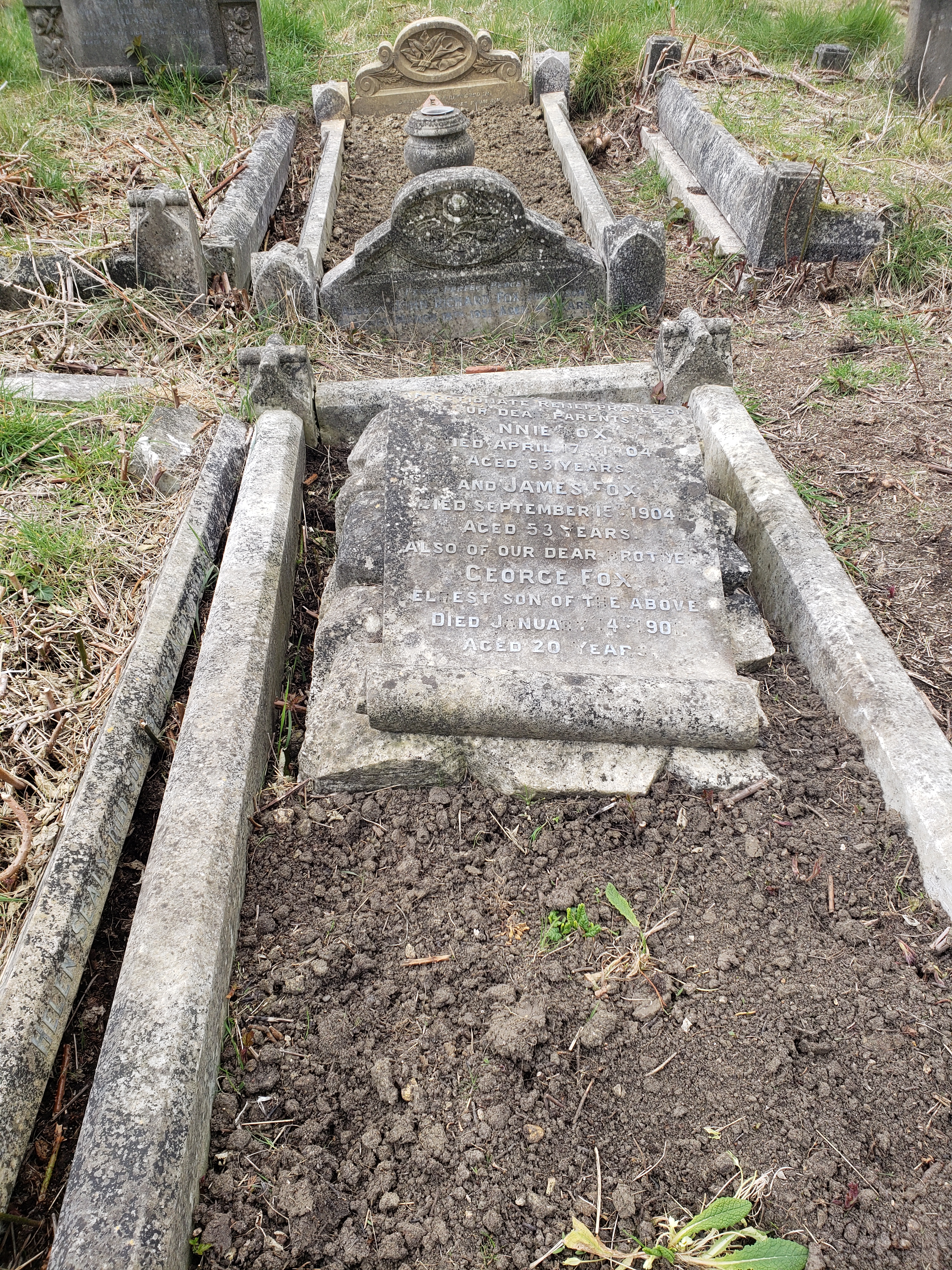
It was a lovely fine afternoon, and by the time the procession reached the Cemetery, a crowd numbering some thousands had assembled. The greatest order was maintained throughout, and the service was impressively read at the graveside by the Rev. W.J. Scruby, Primitive Methodist Sup. Minister. Deceased was buried in the same grave as his wife, who died last April, and a son, who died some four years ago.

The coffin was of polished elm, with brass furniture, and bore the following inscription: James Fox, died September 13th, 1904, aged 53 years.

Extracts taken from Inquest and Verdict/Funeral of Mr Fox Swindon Advertiser Friday September 23, 1904.

James Fox 53 years 63 Beatrice Street burial September 18, 1904 grave plot E7385

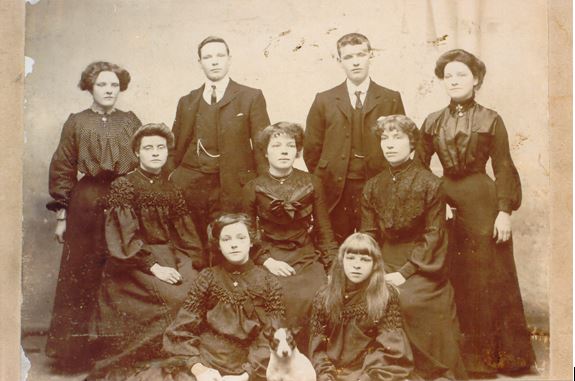
Photograph of the Fox siblings believed to have been taken on the day of James Fox’s funeral – Back left to right – Florence, Henry James, Tom, Elizabeth. Middle row left to right Annie Amelia, Emily, Alice. Front row left to right Winifred Ellen, Rose.

Railway Work, Life and Death project

There are copies of the Medical Fund Society Yearly Reports in Local Studies, Swindon Central Library and I recently published a blogpost about the Accident Hospital.

During 1885 there were 30 patients treated in the Medical Fund Hospital who had sustained injuries during an ordinary working day. Men like Henry Kent 44, a goods guard from Salisbury, who suffered fractured ribs and shoulder and died after 2 days in hospital. Thomas Tuck 38, a labourer from Wootton Bassett, who suffered a scalp wound but was discharged after 10 days in hospital. There are more details available about William Ball 56, a driver from Swindon, who fell off an engine while in motion and fractured two ribs and injured his head. He spent 29 days in hospital and was ‘discharged convalescent.’

Yesterday evening the Friends of Swindon Railway Museum’s monthly lecture, entitled ‘Into the Jaws of Death – working and dying on Britain’s railways 1900-1939,’ was delivered by Mike Esbester from the University of Portsmouth. The subject was the danger railwaymen faced on a daily basis whether working on the trackside or in railway factories such as Swindon Works.

In 1913 30,000 railway workers across the UK were killed or injured and yet responsibility was largely put on the men themselves – that they were careless!

In Mike’s presentation he talked about not just unsafe working practices and conditions but the pressure on workers to complete tasks at sometimes unrealistic speed; when wages were docked if targets were missed. Despite a railway inspectorate that highlighted dangers and trade unions that demanded change, railway companies were reluctant to act, and as Mike emphasised the onus was firmly placed upon the railwaymen themselves. Their personal safety was their responsibility.

In 2016 a joint initiative by the University of Portsmouth and the National Railway Museum saw the beginning of the ‘Railway Work, Life & Death’ project to try to make railway worker accident records more accessible and to see what could be learnt from them. These records are of interest not only to museums and archives professionals but to railway enthusiasts, family historians and the current railway industry. To date volunteers have transcribed around 50,000 surviving records, which are available to view on the project’s website.

Mike’s lecture was both compelling and revelatory. To discover more visit www.railwayaccidents.port.ac.uk.

And if you would like to join the Friends of Swindon Railway Museum visit their website. http://www.fosrm.org.uk/

Images of the Medical Fund Hospital published courtesy of https://swindonstory.uk/stories/gwr-hospital/

Charles Adolphus Sylvester Toogood

With such a distinctive name as Charles Adolphus Sylvester Toogood it should be easy to trace this gentleman, and up to a point it is. His employment records provide a birth date, December 13, 1869 and his entry into the GWR company as September 20, 1886. And from 1891 to his death in 1946 we can trace him through the census records. But there is a gap – something catastrophic appears to have happened to the family between the 1871 and 1881 census’s. It seems likely that Charles Toogood’s mother died before 1881; neither she nor his father Alfred can be reliably traced on the 1881 census. However, a ten year old boy by the name of Adolphus Toogood can be found in the Lyncombe & Widcombe Workhouse. Could this be Charles?

Charles married Florence Ann Greenaway at St. Mark’s Church on January 31, 1895 and the couple had five daughters, the youngest Pearl died before her first birthday.

The following account was published in the Great Western Railway Magazine when Charles retired in 1930.

Mr C.A.S. Toogood, of the Chief Mechanical Engineer’s Department, Swindon, retired from the Company’s service on December 13, after nearly 44 years’ service, practically the whole of which was spent in the Locomotive, Carriage and Wagon divisional superintendent’s office, at Swindon. With the abolition of the Swindon division in May 1922, Mr. Toogood, with others of the staff, was transferred to Bristol, but he returned to Swindon in December 1928 and has been attached to the accounts section since that time. Mr Toogood received a handsome timepiece and notes as a parting gift from his past and present colleagues.

Great Western Railway Magazine March 1930.

Charles Adolphus Sylvester Toogood died in 1946 and was buried on November 27 in grave plot C983 where he joined his wife Florence who died in 1937.

Accident Hospital

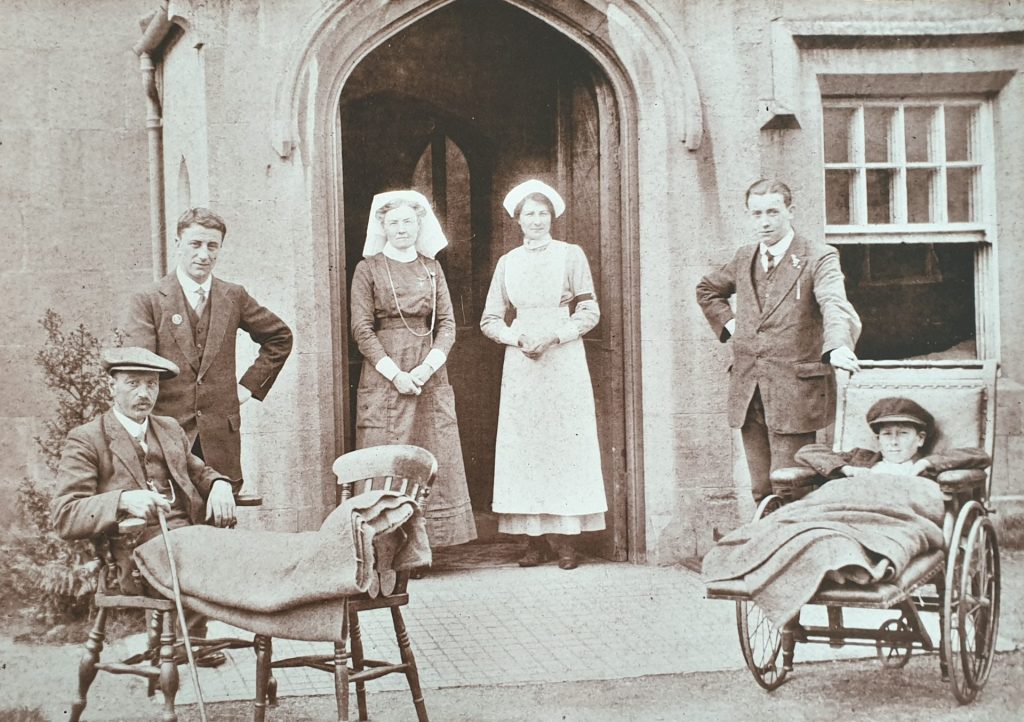
The Accident Hospital was opened in December 1871 and as the name suggests, that was its sole purpose in those early years. This postcard image published on the Local Studies flickr page has the annotation – ‘For use in case of accidents which are of daily occurance in the GWR Factory.’

On January 12, 1886 doctors Swinhoe, Howse and Bromley made their Accident Hospital Doctors’ Report to the Medical Fund Committee as follows:

Gentlemen,

The New Year of 1885, found us with three Patients in our Accident Hospital. Since then, twenty-seven new cases have been admitted, making a total of thirty for the twelve months. Of these, twenty have been discharged convalescent, six have died, and one is still under treatment and doing well.

We enclose tabulated list for your better information.

We are, Gentlemen,

Your obedient Servants,

Swinhoe, Howse, & Bromley.

Among the injuries treated during 1885 were leg fractures, a crushed foot and fractured ribs.

Of the six deaths that occurred in the hospital four of the deceased were buried in Radnor Street Cemetery.

Fireman Charles W. Nicholls aged 23 of 13 Medgbury Road died from having his ‘chest crushed in’. Charles Nicholls was buried on September 6, 1885 in grave plot A309.

George Turnbull aged 33, Charge Man in B2 Shop died from a compound fracture of the skull having spent 3 days in hospital. George Turnbull was buried on April 2, 1885 in grave plot A727.

Thomas Edwards who worked in the Saw Mill was admitted with a rupture and spent 40 days in hospital where he died of consumption. He was 33 years old. Thomas Edwards was buried on March 28, 1885 in grave plot A204.

William Collett of 40 Princes Street was admitted to the hospital suffering from extensive burns. He died 2 days later. He was 49 years old. William Collet was buried on March 26, 1885 in grave plot A628.

John Oliver Warren – accounts clerk

We’ve already met the Warren family on this blog. John was the younger brother of Lilium Lancifolium Warren, infact, she was named as a witness at his wedding in 1915 and when he died in 1930 she was awarded probate of his will.

John was born on September 27, 1886, the son of Alfred Warren, a goods guard, and his wife Marcellina.

His employment records with the GWR reveal he began work on May 5, 1902 and as his obituary states ‘he had been in the Company’s service for 28 years, the whole of which time he had spent in the accounts section.’

He married Frances Alice Iles at St. Paul’s Church, Swindon on April 12, 1915 and served in WWI. Unfortunately his military records are incomplete and all that survive indicate that he served as an Acting Sergeant in the Royal Army Medical Corps and that he was discharged on July 11, 1919.

His many friends will learn with regret of the death of Mr. J.O. Warren, of the Chief Mechanical Engineer’s Department, accounts section, Swindon, who died on January 20, after a short illness. Mr. Warren was 43 years of age and had been in the Company’s service for 28 years, the whole of which time he had spent in the accounts section. He leaves a widow and one little girl, and his loss is greatly deplored by his colleagues, many of whom attended the funeral on January 24.

Great Western Railway Magazine March 1930.

John Oliver Warren died on January 20, 1930 and was buried in grave plot E7367 where he joined his baby daughter Marjorie Olive who died in 1916 and his wife Frances Alice who died in 1926.

Richard Renwick Pattison – another story from St. Mark’s churchyard

It is seldom possible to read the words of our working-class ancestors, after all, what time was there to write diaries or even letters, but there is one source where occasionally we can hear their voice and that is in contemporary local newspapers.

In 1874 Richard Renwick Pattison retired from the Great Western Railway Company after a career spanning more than thirty years and the men with whom he had worked all that time had a whip round.

Richard Renwick Pattison was born in Houghton le Spring, Durham in 1819, the son of Christopher and Jane (Renwick) Pattison. He married Sarah Bellwood in Heighington, Durham on December 31, 1839 and by 1843 they had moved to Swindon, the new railway town in Wiltshire.

The GWR records state that Richard R. Pattison, engineer and fitter, was the third foreman of the Erecting Shops appointed in 1843 alongside Thomas Atkinson and Walter Mather. He is recorded as being a member of the team who erected the first engine built at the works, the “Premier,” completed in under two weeks in 1846 and later renamed the Great Western.

When Richard retired in 1874 the Swindon Advertiser covered his testimonial in some length:-

‘On Saturday week, the workmen employed in the B Shed, over which Mr. Pattison had been foreman, presented him with a silver inkstand and a very handsome writing desk, nearly all the men and lads in the department having contributed to the testimonial fund.

The subscribers and friends having been assembled in the B Shed, at the close of the day’s work, the desk and inkstand were duly presented to Mr Pattison by Mr Evans, accompanied by a few brief remarks expressive of the feelings which had dictated the offering, and hoping that the recipient of it might be spared to enjoy it, retaining always the good-will of those over whom for so many years he had acted as foreman.’

Richard then took to the floor and gave the following address:

‘I need not tell you how pleasing it is to my feelings to have this mark of respect shown to me on our separation, for it is really more than I could have expected, for I have done nothing more than to fulfil my duty as a foreman between master and man, and which duty I have endeavoured to fulfil impartially, and without favour. If I have in any way failed in this it has been an error in judgement. But, really, a foreman’s position is the most difficult to properly fulfil that I know of, for what with engines, masters, men, and those confounded boys – a toad under a harrow has a more comfortable life.

However, I may truly tell you all one thing, and that is, that I have never made one favourite in the shop, and those amongst you who have been promoted or raised one step higher up the ladder, have been promoted entirely through your own merit; at least so far as my judgement and conscience enabled me to judge fairly between you. And I am proud to say that there is not a shop in the kingdom that can surpass us for steady good workmen.

Another thing I should like to refer to, and it is this; we have had less change of men than in any other shop, and I sincerely hope this state of things will continue. And I have every reason to believe it will, for I have no doubt my successor will do all he can to pursue the same path; and I hope this splendid testimonial will be an inducement to him so to act, that should the day come when he shall be enabled to retired from his work, he also may receive a similar reward or mark of respect.

Now, fellow workmen, let me once more seriously thank you for this splendid testimonial and mark of respect which I shall highly prize, and which I hope may be handed down by my children for generations to come. But before we part I should like to ask one favour of you all, and that is forgiveness for past hard words, which perhaps was my greatest sin. But then, when you had the word you had the worst. There was no after sting or malice, for that is a thing unknown to me; and I am pleased to be able to say that I take farewell of you all with the best and kindest feelings and wishes, and I assure you I feel the separation more than I can express.’

That same evening the members of the testimonial committee entertained Richard at the Queen’s Arms Hotel. Following a toast to his health Richard spoke a few words, reminiscing on his time in the Works, saying ‘there were one or two things he should like to refer to, because they formed the foundation of his success.’ He went on to say that he had always kept his time in the works and that he could honestly say that for the first two years of his being at New Swindon he never lost ten minutes, and when, after he had been there about three years he lost his first quarter, he thought it would have broken his heart. He and a companion were talking and did not hear the bell ring, and this put him behind, and he could assure them he had never forgotten the circumstance.

He continued – another thing was this: whenever he had a pound he put it by – he put it in a building society, and in fourteen years it became two. This was a point he had always carried out: whenever he could save a pound he saved it, and when he had once saved a pound he never afterwards spent it, but left I to make more.’

The Works foremen had huge power and influence and were not the best loved of colleagues, but it would seem that Richard Pattison might have been of a different mould, for he received not just one, but two testimonials.

‘On Saturday afternoon last, after the day’s work in the shop, the boiler makers employed in the same department, but under another foreman, presented Mr Pattison with another testimonial, consisting of a silver goblet, and a pair of gold eye glasses.’

Again, we have the opportunity to read the words of Richard:

‘Mr Amos, Mr Sharps, and fellow workmen: This mark of respect is truly more than I could expect of you, for it is no secret that we have been continually at war with each other – my shop against the boilersmiths’ shop. But then it was only a friendly war in our effort to get the company’s work forward. You all know that your esteemed foreman (Mr Sharps), always liked to steal a march over the fitters, and then he quietly enjoyed a laugh at us. But then, we not unfrequently had our laugh at the blessed boilermakers. However, it is very gratifying to find that in our struggle to get the company’s work done we have preserved good fellowship, which is due in a great measure to your good and valuable foreman, Mr Sharps, whom you ought all to esteem, for he is truly a good man.

Now, my friends, you will not expect a long speech from me, but I must again express my sincere thanks for this splendid testimonial and mark of respect, and I wish the goblet had been full of wine so that I might have drunk all your healths. However, I hope you will all have an opportunity of drinking out of it yet, for I hope to have many a quaff from it in memory of bye gone days in the B shop, and of my kind friends there. (Loud and long continued cheering).’

Sadly, after so many years hard work, Richard Pattison did not enjoy a long retirement. He died aged 60 at his home in Sheppard Street on December 4, 1879 and was buried in the churchyard at St Mark’s.

Meet the Margetts family

When the churchyard at St. Mark’s was forced to close to new burials in 1881 it came as a great sadness to the railway families of New Swindon. During Victorian times death was a large part of life; there were funeral rituals to observe and traditions to be kept and large, municipal cemeteries were not so common outside the big cities. But now Swindon was to have one and the first families to have moved here in the 1840s were to be separated in death.

During my recent walk around the churchyard I came across the grave of George and Susannah Margetts. George was born in Buckingham in 1783 just as the Industrial Revolution was picking up pace and more than 50 years before the birth of New Swindon.

In 1841 George was landlord at The Ship in Wantage, Berkshire where he lived with his second wife Susannah and five of his 10 children. But by the late 1840s he had arrived in Swindon where the family lived in Exeter Street. Aged 67 he was working as a carpenter, presumably in the Works as he lived in one of the company houses. Still living with his parents was youngest son Samuel, an apprentice boilermaker.

Another son, Jesse, had also arrived in Swindon where he married Martha Townsend at St. Margaret’s church in Stratton St. Margaret on Christmas Eve, 1849. In 1851 he was living in Taunton Street with Martha and their 10 month old daughter named Susannah after his mother. Jesse worked as a labourer, again presumably in the Works as he too lived in the railway village. Jesse and Martha went on to have a large family of at least 10, possibly 12, children.

The first person buried in the St Marks grave plot was not George, but that of his six year old granddaughter Ellen, one of Jesse and Martha’s children, who died in 1862. There was obviously money enough to buy this plot and in due course an elegant headstone – not every family could afford this as is evident by the paucity of memorials in the churchyard. George died in 1868 having attained the impressive age of 85. His wife Susannah died in 1871.

When Jesse’s wife Martha died in 1885 she was buried in the new Swindon Cemetery, which later became known as Radnor Street Cemetery. She was buried in grave plot E8294.

Jesse quickly married again and in 1891 is living at 72 Albion Street with his second wife Eliza and his youngest son John who is employed as a boilermaker in the Works.

Eliza Margetts, Jesse’s second wife, died in 1904 and was buried in grave plot E7886.

When Jesse died the following year he had the choice of two wives and two burial spaces. He chose to be buried with his second wife Eliza. The remaining space in this grave was later occupied by his sister Rosa who died in 1920.

Sadly, the inscription on Martha’s headstone had partially disintegrated but the burial registers reveal that she does not lie here alone. Her son, also named Jesse, died in 1916 and was buried here with his mother.

I’m sure further research will discover plenty more members of the Margetts family buried in Radnor Street Cemetery, and maybe some at St. Mark’s before the churchyard was closed in 1881.

War Graves Week – Sapper Percy Harold Comley

Mary Elizabeth Hutchings and Percy Harold Comley are pictured (middle row right) at a family wedding in 1914.

Saturday May 11 sees the launch of the annual CWGC War Graves Week 2024. Radnor Street Cemetery friend and colleague Mark Sutton spent a lifetime devoted to remembering those who served in WWI.

Our thoughts today go out to those parents who lost a son, and in many tragic cases, more than one. But, Albert and Mary Ann Comley were not to know their youngest son had been killed in action.

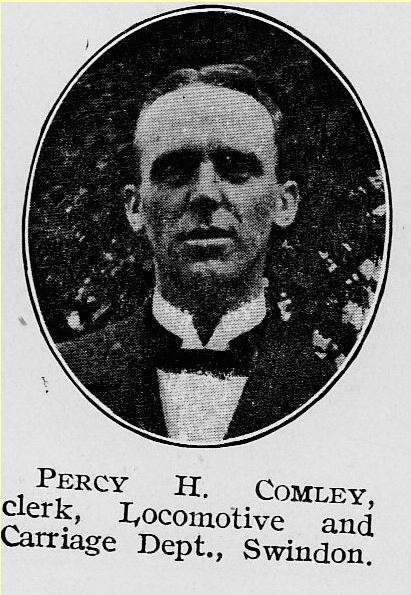
Percy Harold Comley was born on August 12, 1889 and began work as a 14 year old clerk in the GWR Works. He enlisted on November 24, 1915 and was put in the Army Reserve. He was mobilized on January 5, 1917, a Sapper in the Royal Engineers serving with the 2nd Light Railway Operating Coy.

He had married Mary Elizabeth Hutchings on October 26, 1916 at Christ Church. Less than a year later he was dead.

The charred remains of a telegram survive with his military records. It reads:

“Regret to inform you Officer Commanding 2 Canadian Casualty Clearing Station France reports 1st October 218815 PH Comley RE 1st October shell wound abdomen.”

Percy Harold Comley is buried in Lijssenthoek Military Cemetery Poperinge, Belgium. Mary Elizabeth never remarried. She died on February 4, 1947 at Weston-super-Mare.

Today our volunteers continue Mark’s work, caring for the Commonwealth War Graves headstones and recognising those remembered on private, family graves. To date they have noted 50 such fallen heroes. For more information about the War Graves Week visit the Commonwealth War Graves Commission website.

Mary Ann Comley died at her home 8 Ashford Road and was buried on May 21, 1915 in grave plot E8044. Her husband, Albert Comley, a watchman, died at Guys Hospital, London and was buried with her on August 15, 1916.

James Kibblewhite – athlete

Another day, another churchyard…

Legend has it that amateur Victorian athlete James ‘Kibby’ Kibblewhite would race alongside the train from his home in Purton to the GWR Works in Swindon, an amazing feat, but just one of many achieved by the middle distance runner.

James Kibblewhite was born at Purton in 1866, one of agricultural labourer James and Caroline Kibblewhite’s seven children.  He began work as a Post Office Messenger boy but like his father and brothers later found employment in the Swindon railway works.  Following a full working week as a machinist in R shop, Kibby ran record breaking races at events across the country in a career that spanned eleven seasons.

In 1889 he won the Three Mile Open Handicap Race at the Stamford Bridge Ground, Fulham finishing in 14 minutes 29 3/5 seconds, 9 2/5 seconds faster than the record set by Calne born Victorian super star runner W.G. George in 1884.

“The running of J. Kibblewhite furnishes one of the most remarkable performances of the season,” reported The Times. “Quite recently he ran a very fast mile on the Paddington track, and his record for three miles on Saturday, at the annual sports of the Spartan Harriers, is fresh proof of his abilities as a runner.”

The following year ‘Kibby’ led the Spartan Harriers to victory in the Four Mile Inter Club Race at the Kennington Oval.  “He took the lead very early in the race and won by 200 yards in the fast time of 20 min 20 3-5 sec,” The Times reported.

Competing in Birmingham that same summer he ran the One Mile Race in 4 minutes 23 1/5 seconds in the Amateur Championships, beating W.J. Fowler of the Finchley Harriers.  Back at the Kennington Oval in 1891 Kibby came in first, 80 yards ahead of Spartan Harrier team mate W.J. Manktelow.  “J. Kibblewhite covered the distance in the excellent time of 26 min 14 4/5 sec, a most creditable achievement, especially when the nature of the turf is considered.”

Modern membership restrictions did not apply in the 19th century allowing Kibblewhite to compete for several different clubs and in 1892 he broke the record for the Four Miles Race at Stamford Bridge running for the Essex Beagles.  Towards the finish of the race the crowd broke into the enclosure to greet the runners as Kibby finished in 19 minutes 50 3/5 seconds with a three yard lead.

In 1894 James married Mary Bristow and the couple had four children.  Their three sons all ran competitively.

By 1895 James Kibblewhite’s running career had ended.  He sold some of his prizes, valued at more than £1,000 and with the proceeds built a home he named Spartan Cottages after his old club.

Image published courtesy of Duncan and Mandy Ball.

James Kibblewhite died in 1941 and is buried in the churchyard at St. Mary’s, Purton.  Today Kibblewhite Close in Purton is named in his honour.

With grateful thanks to Bob Townsend.