First impressions

The re-imagined story …

There was a lot of talk in the workshop about the new cemetery. We had a vested interest as undertakers, and wondered at the choice of location.

“Makes you wonder why the Local Board settled on that piece of land.”

“Must have been something to be made out of it for one of them.”

“It belonged to Mr. Hinton.”

“Enough said.”

“Which gate will be the usual entrance?”

The new cemetery was situated in the middle of Kingshill with an approach by four entrances at Dixon Street, Clifton Street, Radnor Street and Kent Road.

“I’m assuming it will be the Radnor Street one. That’s going to be quite a climb with a handbier.”

“Kent Road might be a better option.”

“Which ever way you approach from New Town there’s going to be a hill to climb.”

“Has anyone been to have a look?”

“It’s one big building site up there at the moment. There’s work going on in all the surrounding streets. I pity anyone who has to bury a loved one during the next few weeks.”

Little did we know we would be burying our own governor, Mr Edward Hemmings, just five days later.
dsc07135

The facts …

Edward Hemmings, a carpenter, joiner and undertaker, was born in Charlton Kings, Cheltenham. He and his wife Eliza lived in London between 1851 and 1861 and moved to Fleet Street, Swindon in the mid-1860s.

By 1871 he had a business at 43 Fleet Street and ten years later they were living and working at 22A Fleet Street. This may have been the original property, renumbered as building work continued in that area.

Following her husband’s death Eliza placed an announcement in the Swindon Advertiser.

Mrs Hemmings, of 22, Fleet Street, New Swindon, begs to inform the inhabitants of Swindon and the neighbourhood that she intends carrying on the business of her late husband Edward Hemmings, Builder, Carpenter, and Undertaker, and trusts to meet with the same liberal support bestowed upon him during the past 15 years.

Six years later the following announcement appeared in the Swindon Advertiser.

22 Fleet St New Swindon

Fredk. Hemmings

Builder, carpenter, & Undertaker

Begs respectfully to inform the inhabitants of Swindon and neighbourhood that he intends carrying on the business of his later Brother Edward Hemmings, who preceded him as above so successfully for many years.

F.H. begs to remind them that the same earnest attention to business, and care in the execution of all orders entrusted to him, will be paid, and that there shall be nothing wanting on his part to give the same satisfaction as heretofore.

Funerals Economically Conducted.

Estimates given for all Work connected with the Building Trade.

The Swindon Advertiser, Saturday March 11, 1882.

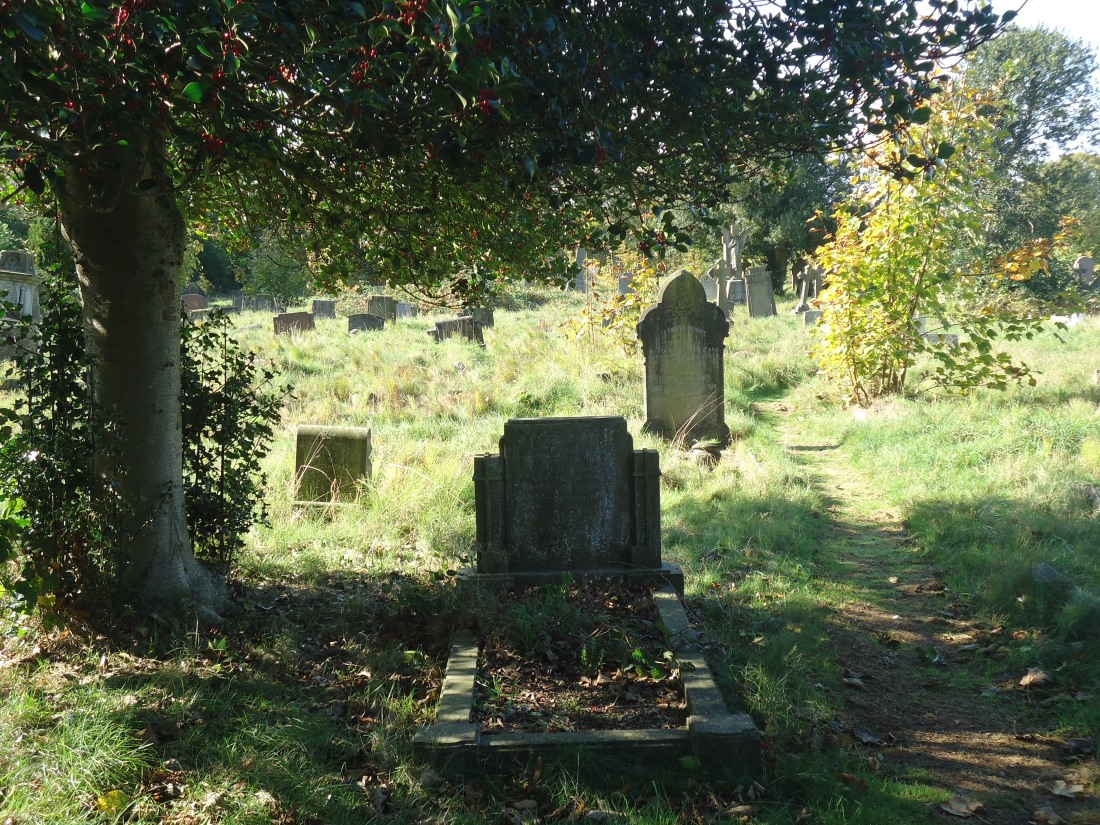
Edward was buried in plot A137 on August 11, 1881, the fifth burial to take place in the new cemetery. He was buried in a public or pauper’s grave where he lay alone for more than twenty years. In 1904 a child by the name of Frank Batt was buried with him.
dsc07126

The entrepreneurial James Hinton

The re-imagined story …

I will admit to having a grudging admiration for Mr. James Hinton, but I wouldn’t say I actually liked him. We’ve done business together on a couple of occasions and he’s very shrewd. He strikes a hard bargain and you have to respect him for that. And he works hard; the stamina of the man!

He’s been in the news most recently for offering up a piece of land on which to build the new cemetery. Some say he has gifted the land, but in fact he has sold it to the Burial Board. He’d probably like it to go down in history that he was a generous benefactor, but he’s sold it at a very competitive price. As the debacle of the cemetery question needs a quick resolution his fellow members on the Board were happy and grateful to accept the offer.

I’m quite surprised he didn’t win the contract to lay out the cemetery and construct the requisite buildings, but perhaps he didn’t put in a tender. Perhaps that would have been an audacious step too far. Next would have been a vote to name the new burial ground the James Hinton Municipal Cemetery.

But I will admit, I secretly quite admire the man.

Death of Ald. J. Hinton

A painful sensation has been caused throughout the town by the news of the death of Alderman James Hinton, of The Brow, Victoria Road, Swindon…

For some time past it had been known that Mr Hinton had not enjoyed what may be termed the best of health, and on several occasions recently he had to resort to medical care, but no one, even those nearest to him, ever thought for one moment that he would be stricken down with such painful suddenness…

The deceased Alderman was 65 years of age. He was essentially a native of Swindon having been born in Newport Street in 1842. He had been for very many years intimately connected with the moving forces of the Borough, and took a keen practical interest in its commercial developments. There is not a class in the town, no matter what their religious or political opinions may be, but what will deeply deplore the loss of a public man whose best energies were given to the service of the community in which he lived.

The deceased Alderman’s career was one characterised by much interest, inasmuch as by his own industry and business acumen he rose from a somewhat humble position to one of comparative affluence…

The deceased Alderman became well known too, for his judicious speculative undertakings. Important estates, capable of considerable developments, were laid out by him, notable amongst which was the Kingshill building estate laid out in 1879. He became a large owner of land, enterprise dominated his thought and action followed; money flowed in and accumulated, and by dint of patience and perseverance Mr Hinton emerged from the obscurity with which Newport Street and the butcher’s shop had somewhat enshrounded him into the full light of prosperous, active life…

As Mr Hinton became absorbed in the growing interests of the town, further important undertakings came in his way. In conjunction with Mr Haines, he had the contract for constructing the Swindon and Highworth railway, which upon its completion was acquired by the GWR Co. During his speculative undertakings Mr Hinton did not at once relinquish the auctioneering profession, in which he was eventually succeeded by his son, Mr Fred Hinton…

It is about 30 years ago that he was elected on the then New Swindon Local Board, taking the place of the late Mr J. Armstrong, who was for some time Loco. Superintendent at the GWR Works, Swindon…

The old Local Board existed up to the year 1894, when the District Councils’ Act came into operation, and Mr Hinton then succeeded Mr T. Brain as the Chairman of the Council. He represented the East Ward, and did not suffer defeat until 1896, on which occasion he was touring in Australia, and was as a matter of fact unaware that his name had again been submitted to the electors…

In 1900 the Charter of Incorporation was granted to Swindon, and that august body, the Town Council, was constituted. Mr Hinton once again entered the arena of active local life, still representing the East Ward. He was elected a member of the Wilts County Council on its formation in 1889, and was a member of that body up to the time of his death. It was only the other week that he was returned unopposed for the East Ward. He was for four years a member of the Board of Guardians in the time of the late Mr William Morris, who was then the proprietor of the Swindon Advertiser. He was Swindon’s fourth Mayor, and it was, of course, largely in consequence of his associations with the almost phenomenal development of the town that his acceptance of the Mayoralty was invested with exceptional interest…

Mr Hinton was a Freemason, and was a member of the Gooch Lodge. He was also a Forester, being initiated an honorary member of “Briton’s Pride” Court at the Eagle Hotel during his year of Mayoralty…

He was raised to the Alderman’s bench on the same occasion that he was elected to the Mayoral chair. He was a man who possessed a broad and liberal mind, and by his death the town has lost a good and trusted and esteemed servant…

Extracts taken from James Hinton’s obituary published in The Swindon Advertiser, Friday, March 15, 1907.

A return visit to Clifton Street

Victorian Swindon was the product of some daring speculative building.  Streets grew up in rows of terraces as local builders bought up small plots of land.  Sadly, today there are few remaining examples of the early names these builders gave their rows of terraces.

Built in 1883 by James Hinton, number 141 Clifton Street began life as 5 Graham Terrace.  The first owner was Alfred Reynolds, a coach builder obviously keen to invest in the Swindon property boom, who bought the property from James Hinton in 1884 and speedily sold it on.

On May 13, 1884 schoolmaster Samuel Snell paid £200 for No 5 Graham Terrace.  The deeds provide some fascinating details of the property and a glimpse of the Kingshill area in the middle of development.

The house at 5 Graham Terrace, Clifton Street is described as being ‘lately erected.’  The parcel of land on which the property was built had “a frontage to the said Street and being of the width throughout of fourteen feet eight inches.”  It was bounded “on the South Western end by a back road ten feet wide as the same is made or intended to be made parallel with Clifton Street.”

Samuel Snell didn’t live long in the house on Clifton Street before moving into the school building at The Willows, The Sands with his family, two assistant masters, three domestic servants and nine boarders.

John T. Mayell, a 24 year old boilermaker from Brierly Hill in Staffordshire was the next owner and moved into 141 Clifton Street with his wife and baby daughter.  In 1889 he took out a second mortgage on the property with Swindon solicitor Walter H. Kinneir, which he had repaid by 1901.  John lived in the house for more than ten years. 

By 1899 the street was built up along its entire length saving a few empty plots on the bend of the road opposite the Clifton Hotel.  The new road mentioned in the 1884 deeds is Exmouth Street.

In 1911 the property came on the market again.  Jabez Bull was the owner occupier and he sold the house to Charles Frederick Farr, an engine erector who lived just up the road at number 159.  Although now commonly known as Clifton Street, prospective buyers were reminded that the property had once been known as 5 Graham Terrace. 

James Hinton, New Swindon Local Board member, had land laid out between Dixon, Stafford and Clifton Streets by 1879.  In 1883 he built numbers 136-145 Clifton Street and the following year he built numbers 70-81 on the same street.

In 1880 James Hinton sold an 11½ acre plot in the middle of the Kingshill estate to Swindon’s two Local Boards for the building of the town’s much needed new cemetery.

He later served as Vice Chairman of New Swindon Local Board and became Mayor of Swindon in 1903-1904. Hinton Street in Gorse Hill was named after him. James Hinton died in 1907 and was buried in Radnor Street Cemetery.

Clayton Joyce – bungalow builder

Clayton Walter Joyce was born in Moredon in 1863 the second son of Charles Joyce, a mason and builder, and his wife Pamela. Clayton started work in the GWR Works and when he married Emily Jones in 1888 he stated that his occupation was that of mechanic. But inevitably he went into the building trading, working as a bricklayer from at least 1891.

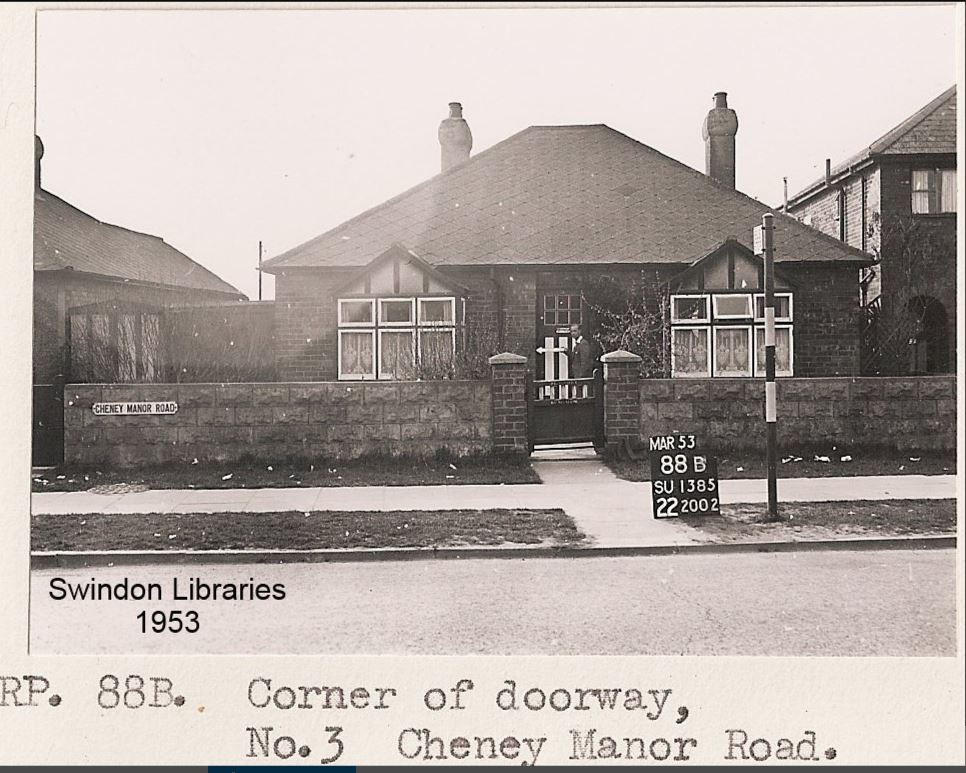
In 1925 Clayton began work on properties in Telford Road, Rodbourne Cheney. He built two bungalows both completed in 1926. That same year he built a bungalow for Mr Keene and began work on a house and shop completed in 1927. In 1927 he went on to build four bungalows, one for Miss Perry, one for Mr Walker and two for Mr G. Mabberley, the man who commissioned his first build in 1925. In 1928 he built a bungalow (nearest shop) and then in 1932 another bungalow in Telford Road for Mr A.J. Thorne in the recently renamed Cheney Manor Road.

This image is published courtesy of Local Studies, Swindon Central Library from the Ordnance Survey Revision Point series of photographs. Could this be one of Clayton Joyce’s bungalows?

By the 1920s Telford Road in Rodbourne Cheney had become a desirable residential area. Builders active in the area include Tydeman Bros who built a house for Mr Keefe in 1928. Our friend James Hinton (who owned the land on which the cemetery was laid out) was also busy in the area and had been for sometime, according to an entry in Architects and Building Craftsmen with Work in Wiltshire Pt 2., James Hinton – Swindon Telford Road, Harcourt Road, Cobden Road, Ferndale Road, new streets and back roads 1905.

Another view of Cheney Manor Road courtesy of Local Studies, Swindon Central Library. Could the bungalow on the right be a Clayton Joyce build?

In 1928 the Swindon Borough boundary was extended to incorporate Rodbourne Cheney and Telford Road was renamed Cheney Manor Road.

Clayton’s wife Emily died in 1925 and was buried on January 31 in grave plot D210. At the time of the 1939 census Clayton was living with his son and his family at 9 Suffolk Street. He died at Ogbourne Hospital in 1945 aged 82 and was buried with Emily on February 7.

Redcross Street Cemetery?

In the beginning the cemetery was simply called Swindon Cemetery, but it could so very easily have become known as Redcross Street Cemetery.

Today this is the only reference to Radnor Street’s previous name.

When building began in the street that would begin at the top of the precipitous Stanmore Street and continue to the junction with Shelley Street and Cambria Bridge Road it was known as Redcross Street.

Mr James Hinton, auctioneer, announced that on January 29, 1879 there would be a sale of ‘All those EIGHT NEWLY-ERECTED SIX ROOMED, COTTAGES with GARDENS thereto, Situate on the North side of Redcross-street, Kingshill, Swindon, being Nos. 177, 178, 179, 180, 181, 182, 183, And 184 on the Plan of the Lower Kingshill Estate, which Plan will be produced at the time of Sale.’

Just a week later more properties and additional building plots in Redcross Street came under the hammer. Lot 1. All those five newly-erected six-roomed COTTAGES, and five similar COTTAGES not quite completed, with gardens thereto, situate on the north side of Redcross-street, Kingshill, Swindon, being Nos. 185, 186, 187, 188, 189, 190, 191, 192, 193 and 194 on the plan of the Lower Kingshill Estate, which plan will be produced at the time of sale. Lot 2. All those ten PLOTS of valuable FREEHOLD BUILDING LAND, situate on the south side of Redcross street aforesaid, being Nos. 223, 224, 225, 226, 227, 228, 229, 230, 231, and 232 on the plan of the Lower Kingshill Estate. Each plot has a frontage of 15 feet to Redcross-street.

By 1881, when negotiations for the new cemetery were under way, the street was already being referred to as Radnor Street, however at the time of the census taken in April 1881 it was still called Redcross Street and was apparently renamed sometime later that year.

Jacob Pleydell-Bouverie, 4th Earl of Radnor served as Lord Lieutenant of Wiltshire from 1878 until his death in 1889. The Pleydell-Bouverie Wiltshire base was at Longford Castle, near Salisbury and closer to home, they owned the stately pile that was Coleshill House. Maybe Swindon thought it advantageous to name one of their many streets of red brick terrace houses after the local aristocracy.

Building continued in Radnor Street throughout the 1880s with properties built by S. Spackman, J. Longland and B. Jefferies.

George Kilminster – neighbourhood builder

William Street published courtesy of P.A. Williams and Local Studies, Swindon Central Library.

In 1950 Sir John Betjeman, Poet Laureate 1972-84, described Swindon as a town with very little architecture and a great deal of building – and you’ve got to take his point. There has never been a time when Swindon was not desperate for housing and the basic red brick, utilitarian terrace house is a feature of our town.

There were a lot of builders in 19th century Swindon, all buying up pieces of land for development. Some bought great swathes of land such as James Hinton who laid out Dixon, Stafford, and Clifton Streets in 1879 and the Gorse Hill housing estate in 1889. Others worked on a smaller, though no less productive scale, sometimes entering into short term partnerships, later creating what would become a family firm employing more than one generation.

George Kilminster was one such builder, working with a Mr Ball on several properties in Swindon Road before establishing his own family business. And between 1893 and 1921 George Kilminster worked close to home – very close.

George Kilminster was born into the building trade in 1857, the son of Cricklade slater and plasterer Robert Kilminster and his wife Maria. By 1871 fourteen year old George was working with his brothers Joseph 18 and Alfred 12 as slaters alongside their father.

George married Mary Ann Hart in Cricklade St Sampson in 1880 and by the time of the census the following year they were living in Upper Stratton. In 1891 the census records the family living in William Street, which became their permanent home and George’s workplace. Between 1893 and 1921 George built in William Street a toolhouse and store; 2 cottages; a schoolroom at the Wesleyan Chapel; seven houses and a villa.

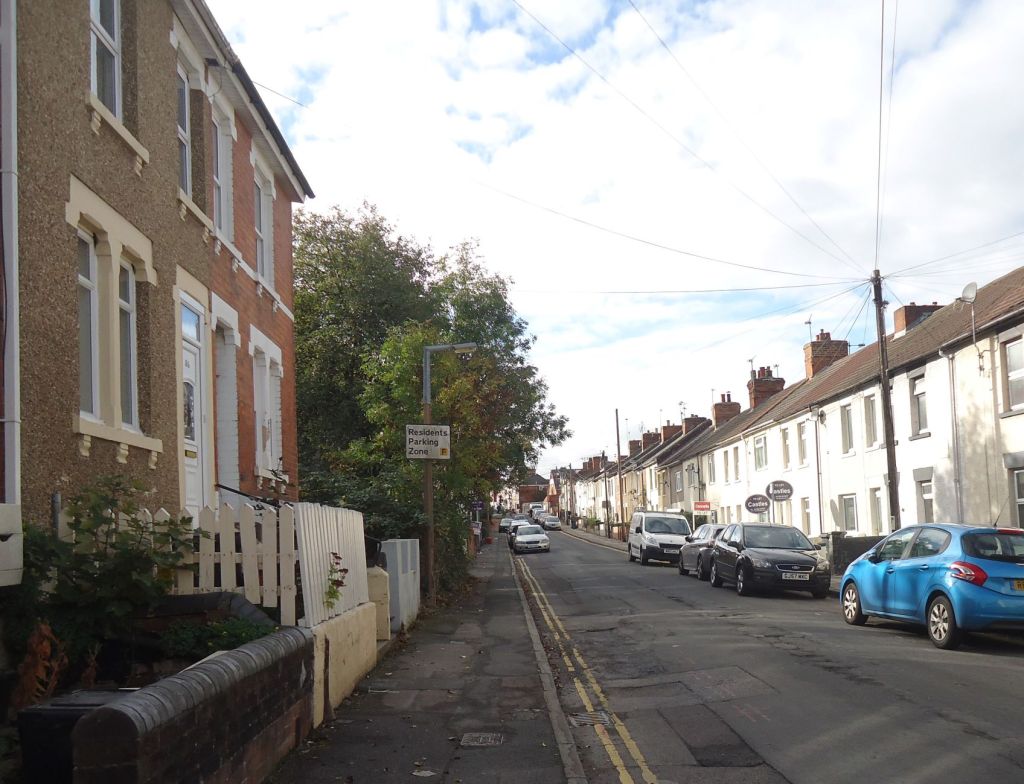
In Roadways – The History of Swindon’s Street Names, authors Peter Sheldon and Richard Tomkins list William Street as being named after builder William Crombey with work beginning in 1878. Street numbering begins and ends at Cambria Bridge Road with more than 160 properties extending to the Kingshill Road. Today there is some new building half way along and alterations to properties at either end of the street, most especially the demolition of the Wesleyan Methodist Chapel. But to stand in the street on a quiet day when there aren’t so many cars parked there, well it could look quite similar to the street George would have known.

George died in 1941, leaving his business in the hands of his sons Arthur and Harry. He was buried on February 15 in Radnor Street Cemetery in plot D1037 which he shares with his wife Mary Ann who died in 1946 and their daughter Iris who died in 1978.

Wesleyan Mission Hall

William Street, New Swindon

Such has been the growth of the cause of Wesleyan Methodism in West Swindon that it was found necessary to contemplate the erection of a hall in which to hold the services. A suitable piece of land having been procured at the west end of William Street situated immediately on the south side of the Wilts and Berks Canal and close to the Wootton Bassett road, the erection of a mission hall was very soon commenced. The erection of the building is being accomplished by Messrs J and C Williams, builders, of Swindon, to the specified plans of Mr Davis, architect. The dimensions of the hall will be 35 feet in length by 24 feet breadth, and 13 feet in height. In addition, there will be the necessary out-offices. The building will be of brick, with freestone dressings to windows and piers. Inside, the roof will be match boarded, with worked principals. So far has the erection of the building proceeded that the ceremony of laying the foundation stones was gone through on Wednesday last.

Extract from the Swindon Advertiser, Saturday, October 8, 1887.

William Street published courtesy of P.A. Williams and Local Studies, Swindon Central Library.