Charles and Annie Baghurst – Rodbourne grocers

Like so many other town centres, Swindon’s has lost its way. Built on a mid-Victorian industrial new town model, its retail heyday is long past and even the big High Street chain stores that arrived a century later have also gone.

In 2006 the Rodbourne Community History Group published Walk Down the Lane, a celebration of the enduring commercial viability of their neighbourhood where business has continued to survive and thrive for more than 140 years.

Take, for example, 178 Rodbourne Road on the corner of Jennings Street, opposite the Dolphin. In 2006, at the time Walk Down the Lane was published, it was a Tool Hire Centre. By 2009 MotoShop had recently closed and the shop was boarded up, available to rent, but this premise in such a prime location wouldn’t remain closed for long. In 2012 it was operating as The Furniture Box and four years later the Second Skin Tattoo parlour. Today it is the Beauty Base – Salon and Nail Academy.

Number 178 Rodbourne Road was built in 1884 for Mr T. Phipps and by 1891 the grocer’s shop and accommodation above was occupied by Charles Baghurst and his wife and their large family of eight children. On the census returns of that year Charles states his occupation as both carpenter and grocer. His wife Annie is also credited with the job of grocer as it was probably she who did the lion’s share of the work in the shop while Charles was employed full time in the Works. By 1901 the family had moved on and John and Elsie Wise had taken over.

Charles and Annie Baghurst moved first to 1 Milton Road and later to 220 Country Road where Annie died in 1908 aged 56 years. Just five months later her 19 year old son Harold Fawlk Baghurst died. Charles later moved to Euclid Street where he died in 1919 aged 65. Annie, Charles and Harold are buried together in Radnor Street cemetery in grave plot D1466.

178 Rodbourne Road – Beauty Base – Salon & Nail Academy

published courtesy of Rodbourne Community History Group

Charles Baghurst

Annie Baghurst

William Jasper Hall – DSM

The re-imagined story …

Mr King held a whole school assembly the day the news was published. William Hall had been awarded the DSM, the Distinguished Service Medal for Honours for Services in Action with Enemy Submarines.

William Hall hadn’t been a pupil at Jennings Street School. By the time the school opened he was working as an Engine Fitter ‘inside.’ It was this job that made him ideally suited for the role of Engine Room Artificer.

We all knew the Hall family. They lived at 77 Jennings Street. My auntie lived opposite them at number 4. Everyone knew everyone in Rodbourne in those days. We all shared in the glory of one of our own being so honoured.

Less than a year later we all mourned his death as well. He wasn’t killed in battle. To expect another act of heroism from one man would be too much. William Hall died of pneumonia and pleurisy – another form of drowning, only not at sea.

Perhaps Mr King held another assembly. I don’t know, I had left school by then and was waiting to start my own apprenticeship in the Works. I was too young to serve, much to the relief of my mother.

By 1918 everyone knew of someone who had died in the war. It was like that in Rodbourne. But not everyone knew someone who had won the DSM.

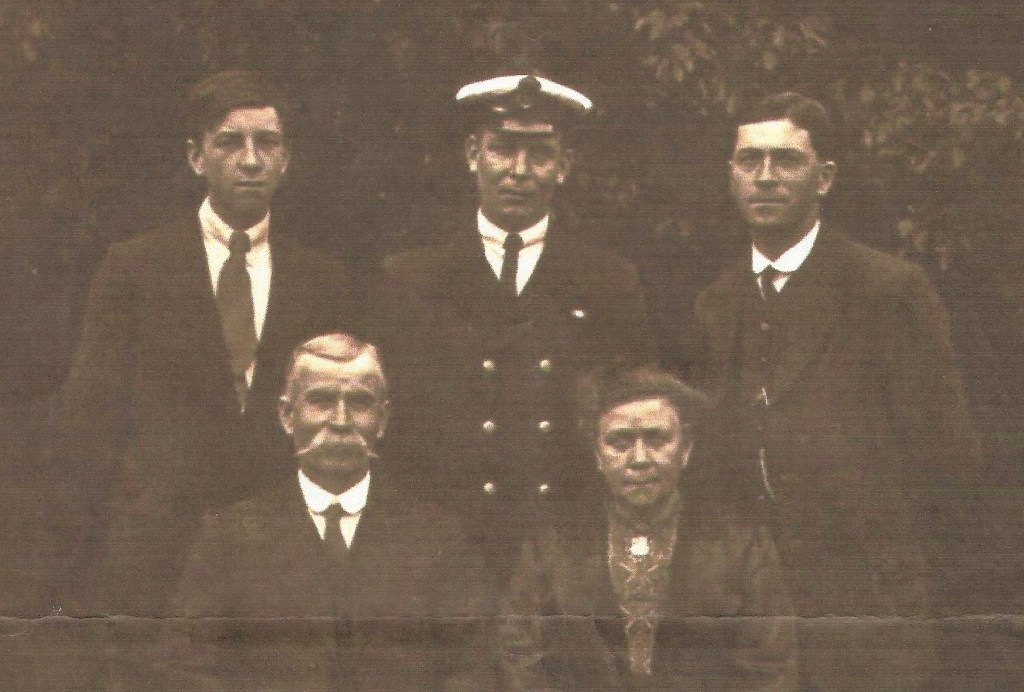
L to r Thomas Redvers Hall, William Jasper Hall and Frederick Charles Hall. Seated are their parents William Charles and Sarah (nee Kingdon) Hall.

The facts …

William Jasper Hall was born on November 6, 1888, the third child and second son of William Charles Hall and his wife Sarah. At the time of the 1891 census the family were living a 30 Jennings Street, Rodbourne on the very doorstep of the Great Western Railway Works. The family continued to live at various houses in Jennings Street.

William Jasper followed his father into the Works, entering the GWR Employment and a 7 year Fitters apprenticeship on his 14th birthday, November 6, 1902.

He enlisted in the Royal Navy on March 20, 1916 and completed his training period on the Victory II as an ERA (Engine Room Artificer) on April 28, 1916. His character and his ability were both described as Very Good.

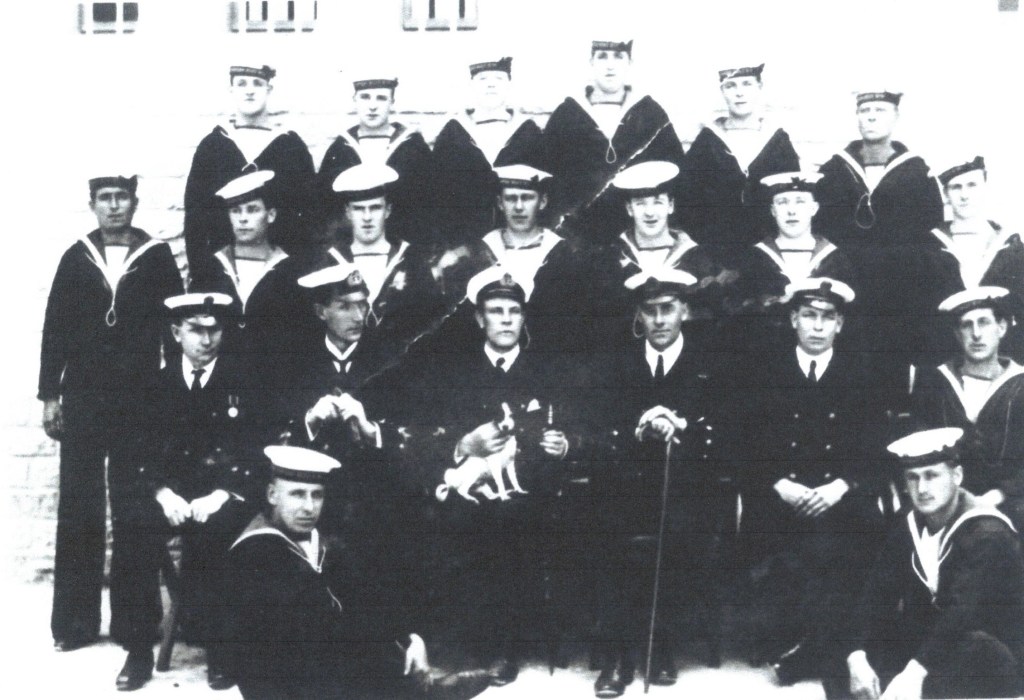
William Jasper Hall seated second on right

His naval records reveal that he served on HMS Cormorant, a receiving ship at Gibraltar where he joined the Freemasons at the Masonic United Grand Lodge in 1916.

In September 1917 William was awarded the DSM (Distinguished Service Medal) for Honours for Services in Action with Enemy Submarines.

By 1918 he was back on Victory II, a shorebased depot for Royal Navy Divisions at Crystal Palace and Sydenham. From here he was admitted to the Royal Haslar Hospital in Gosport where he died on September 14, his cause of death pneumonia & pleurisy.

Family recollections are that William caught the Spanish Influenza with a poignant postscript to the story. His mother Sarah visited the hospital where she was able to care for her son during his final days. Sadly, Sarah contracted the ‘flu and died two weeks after her son.

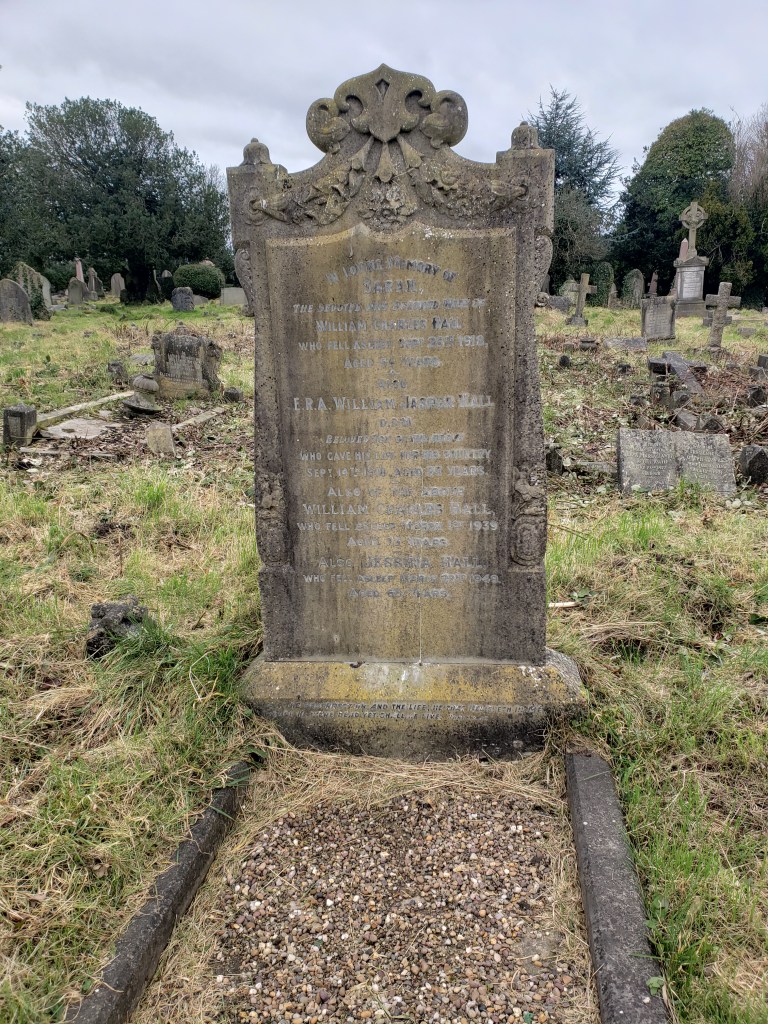
William was buried in plot E7464 on September 19. His mother Sarah was buried in the same plot on September 28. William Charles Hall died in 1939 and joined his son and wife. Jessina, William Jasper’s elder sister, died in 1949 and was buried in the plot with her brother and her parents.

Family photographs are published courtesy of the Hall family.

Originally published February 21, 2022.

Martha and George Coster – another ordinary couple

The strapline for this blog is ‘Remembering the ordinary people of Swindon.’ This grave story is about one such ordinary family. George worked as a platelayer with the Great Western Railway, a job described by Will Thorne, a platelayer during this period as The most neglected man in the service. The poorest of any railway employee with little or no opportunity for promotion or advancement.

In 1870 George married Martha Robinson at the parish church in Wroughton where they had both grown up. George and Martha would have 10 children but sadly four of them died young. In 1881 they were living at 13 Oxford Buildings, Rodbourne with three of their children, George’s mother and an unnamed lodger described on the census returns as having “left house.”

By 1891 they were living a 21 Jennings Street where they would remain for more than 20 years. It was where Martha died in 1918.

How many meals did the family sit down to eat in the kitchen? How many Mondays had Martha toiled over the boiler in the scullery, pegging out washing on a line that stretched the length of the garden. Did she dust and polish or was there little furniture to fuss over in the house at No 21 Jennings Street?

Was George a keen gardener, when all that washing wasn’t hanging in the way? Or was he too exhausted after a day’s work to do yet more digging and shifting earth? Was he a member of the Even Swindon Working Men’s Club and Institute, cutting along the backsies for a swift half? Or did he prefer to drink in the Dolphin? But then again, perhaps as a Methodist he didn’t partake of Mr Arkell’s finest.

And what about Hilda, the daughter who was buried with George and Martha. She never married and worked as a domestic servant, that much we know. She died on July 6, 1936 at 30 Twickenham Road, Isleworth, not at her home in Maze Road, Kew, nor at 49 Paxton Road, Chiswick, the address recorded in the burial registers.

So many unanswered questions about one ordinary Rodbourne family.

Martha Coster died at her home in Jennings Street in May 1918 aged 70 years old. She was buried in grave plot C1952 on May 9. Her husband George Coster died at 92 Beaufort Terrace, Rodbourne Road on January 31, 1922. He left effects valued at £266 18s 8d to his daughter Kate Fisher. He was buried on February 4 with Martha. Hilda Coster died on July 6, 1936 aged 53. She was buried with her parents on July 10.