Doreen Ind and the cemetery vandals

The re-imagined story …

I decided I’d join the guided walk around the cemetery on Sunday. I’d seen people on the walks before and to be honest I was surprised just how many turned out each time.

This image has an empty alt attribute; its file name is radnor-street-walk.jpg

I lived in Clifton Street and had grown up on the cemetery doorstep, so to speak. As a kid I’d learned to ride my bike there and made snowmen on the rare occasions we had a fall of snow. It was my route to school and a short cut to town and as a teenager I’d walk through it most days to meet my mate Josh. It was as familiar to me as my own back garden. The cemetery held little fear for me, now, after all these years.

It had closed in the 1970s, long before I was born. Years ago, the council used to keep it nice and tidy. The wardens held various events here and I remember coming to a nature day and helping to put up bat boxes. These days it is very overgrown and neglected.

People began arriving at the chapel just before 2pm and as usual there was quite a crowd.  The walk was led by a couple of older people. The woman gave us a short, potted history of the cemetery and the man told us a few do’s and don’ts. They were both quite funny actually, and made a good double act.

Then they led us around the cemetery, taking it in turns to talk about half a dozen graves and the people who were buried there. I was surprised at just how interesting it all was. I don’t know what I expected; something ghoulish and creepy, maybe a bit weird.

One of the old ladies started talking to me and took my arm as we were led away from the footpath and across the graves to where the two guides had stopped. I didn’t notice where we were heading.

“Do you think we could take the arm off?” asked Josh as he looked around for something to wield. “Wait up.”

He lived just a few doors from the cemetery gates and was gone just minutes, returning with a hammer.

“Go on. Have a go.”

I swung the heavy hammer but lost my grip and let it fall to the ground.

“Not like that, you idiot.” He began to swivel on the balls of his feet, like the athletes do when they throw the hammer. On the third revolution he let the hammer go. He was surprisingly accurate and the arm of the stone girl flew off.

“What the … Josh!”

We’d hung about in the cemetery loads of times, but we’d never done any damage before.

“Go on – have another go.”

“No.”

“Scared? Chicken?”

“It don’t seem right.”

“Well no one’s gonna complain. They’re all dead.”

I picked up the hammer. Perhaps if I just swung it around a bit maybe Josh would be satisfied. I raised it to elbow height and just as I swung it, a woman shouted out. I lost my balance and lurched at the memorial. The hammer flew out of my hands and knocked the head off the stone girl.

The woman continued to shout.  As we turned round I could see she was keying a number into her mobile phone.  No prizes for guessing who she was calling.

We legged it all the way down to the Radnor Street cemetery gate. I could hardly breath and my heart was beating furiously in my chest. We ran down the steep steps by the school and on to William Street, cutting through to Albion Street and the old canal walk, but Josh was laughing; laughing and laughing and laughing.

I’d have never done it – if I’d known the story of the girl and her dog – I’d never have done it.
This image has an empty alt attribute; its file name is doreen-ind.jpg

The facts …

Doreen was tragically killed when the wheel of a timber wagon trailer ran over her body after she fell from her bicycle. The fourteen-year-old sustained multiple injuries and died at the scene of the accident in Stone Lane, Lydiard Millicent on August 23, 1938.

Doreen was the younger of George and Catherine Ind’s two daughters and with her sister Iris was cycling to their Aunt’s house in Upper Stratton when the accident occurred.

Iris gave evidence at the inquest held the day after her sister’s death. She told how the two girls were cycling round a bend in the road on Stone Lane, keeping as near as possible to the near side. Doreen was in the front and Iris behind her.

Iris described how a lorry with a timber wagon trailer approached them on the road. The wheel of the trailer knocked her sister’s wheel causing her to wobble on her bicycle. She tried to pedal, but there was no room. Doreen fell into the road and the back, nearside wheel of the trailer went over her.

“Before the wheel went over her I called twice to the man to stop.”

The funeral took place at St Paul’s Church on August 27 followed by the burial at Radnor Street Cemetery.

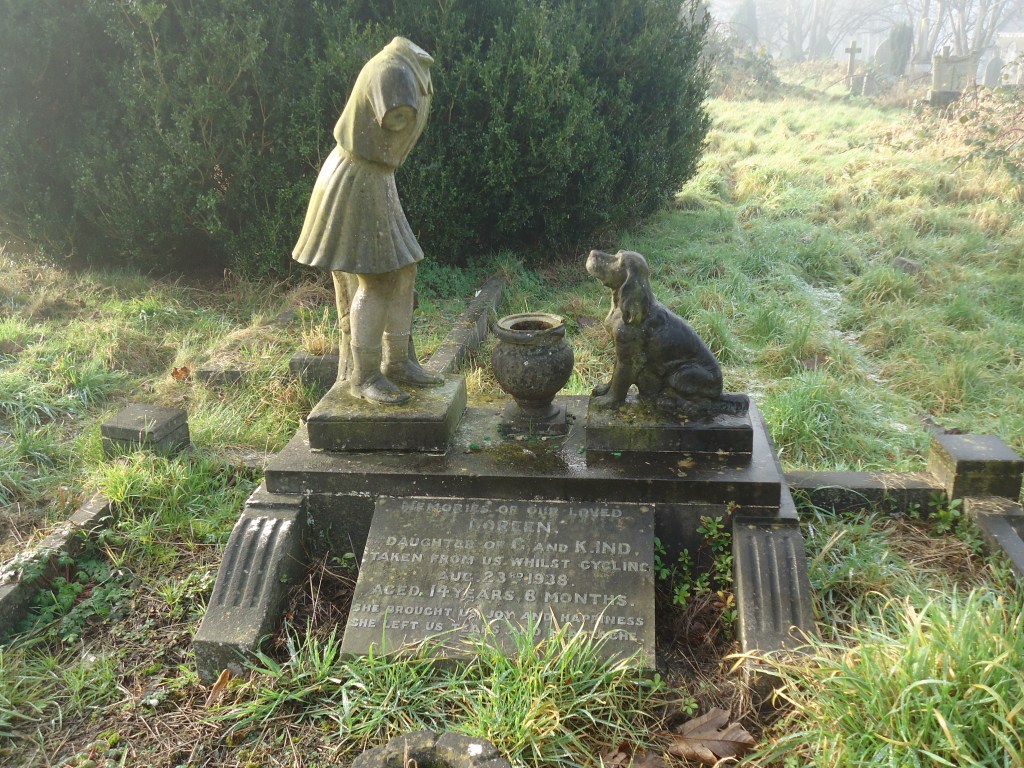
Doreen’s parents erected an unusual and poignant memorial to their daughter, depicting a girl holding out a ball to her pet dog. George died in 1947 and his wife Catherine in 1964 and they are buried with Doreen in a large double plot.

In 2009 a local resident walking through the cemetery disturbed a couple of boys attacking with a sledgehammer this unusual memorial of a girl holding out a ball to her dog. As you can see Doreen’s memorial is badly damaged, one of the last serious acts of vandalism to have occurred in the cemetery in recent years.

Doreen 4

Photograph of Doreen’s intact memorial was taken in 2000 and is published courtesy of D & M Ball.
The day Nellie Fitch came calling

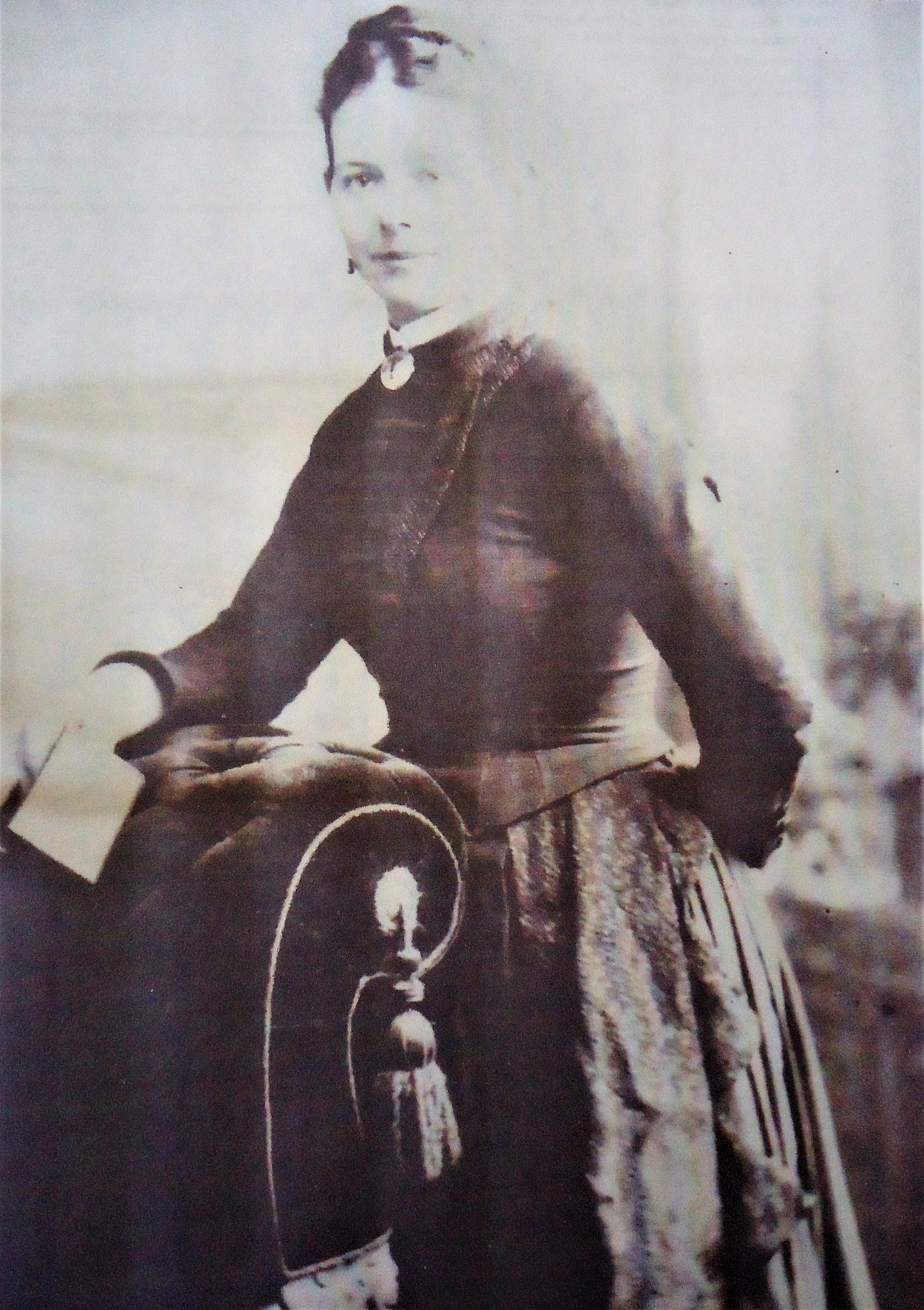
Jane Tuckey
Jane Helena Tuckey photograph courtesy of Peter Guggenheim

The re-imagined story …

Mother went to Mrs Dicks funeral. It was a very quiet affair, she said. Not many at the church and even fewer at the graveside.

“I don’t know why she wasn’t buried at St Mary’s, along with all her family,” said mother. “There’s a long avenue of Tuckey graves in the churchyard there. Great big gravestones enclosed by iron railings. Of course, there was money in the family then.”

A familiar guilty twinge stabbed me.

I used to visit Mrs Dicks most weeks. Mother would send me round with a meat pie or a suet pudding.

“She doesn’t eat very well.”

Mrs Dicks lived opposite us in Hawkins Street. Her husband had died several years before.

“He was a fitter in the Works. Nice man, people said, although a bit of a come down for her. Her first husband had been a wealthy farmer from Chippenham.”

Mrs Dicks’ terrace house was crammed full of great big pieces of dark furniture.

“No doubt from her father’s house in Shaw.”

Sometimes she would open the drawer in the big, old dresser and hand me a tortoiseshell casket and together we would look at her ‘treasures’ as she called them.

Then one day Nellie Fitch came with me.

I usually went to Mrs Dicks on my own but this day Nellie was sitting on our front wall.

“She can smell the pie.”

Nellie Fitch wore shoes with holes in them and her winter coat was too small for her. Nothing unusual about that. During the war most of the kids in Rodbourne wore hand me downs. But then she told me she often didn’t eat.

We didn’t have much, but I always knew I would have a cooked dinner. Nothing fancy mind, but mother was a good, plain cook and she knew how to make a little go a long way.

Nellie’s dad was away fighting the Hun, she told me.

“Nellie’s father disappeared years ago,” said mother. “And so has the layabout she thinks is her father.”

Mrs Dicks opened her front door to a small hallway, just like the one in our house and all the other houses in Hawkins Street.

She was pleased to see me, but less so to see Nellie. I don’t think it was her dirty clothes and shabby shoes that bothered Mrs Dicks. I imagine it was more the fact that now Nellie would know she accepted food from neighbours. Mrs Dicks tried to keep up appearances. She had come down in the world and keenly felt her loss of status. But to me she was just another little old lady who wore old fashioned dresses and spoke in a posh voice.

“Good morning girls. How lovely Violet. Please thank your mother,” she said as she took the warm basin into the kitchen. “Tell her I will settle up with her at the end of the week.”

She always said the same thing. No money ever changed hands, my mother wouldn’t have expected any and Mrs Dicks had none to give.

“Come into the kitchen girls. I was just making a cup of tea.”

If Nellie was hoping for a piece of cake or a biscuit she would be out of luck.

Nellie probably wondered why I spent time with the posh old lady in her dark and dreary house where there was nothing nice to eat.

Mrs Dicks would tell me about the house in Shaw where she had grown up with her eight sisters and her brother. How they played in the orchard at the back of the house and on Sundays they would walk all the way to the church in Lydiard Millicent. She would bring out her photograph album and tell me about the people; bewhiskered old men and wasp waisted ladies.

And sometimes she would bring out the tortoiseshell box and show me the beaded bag she took to dances when she was a young woman, and the diamond tiara that became a pair of dangly earrings at the click of a pin at the back. There was an amethyst ring that had belonged to her grandmother and brooches and pins.

Please don’t bring out the tortoiseshell box today, I silently pleaded. But the atmosphere was awkward with Nellie there. We were probably the only two quiet children in Rodbourne that morning.

I watched Nellie’s eyes grow as wide as saucers as she peeped inside Mrs Dicks’ tortoiseshell box, and she looked at me and smiled. Not a big, open smile, but something sly.

I never wanted to visit Mrs Dicks after that.

“I don’t have time to go calling in on Mrs Dicks,” my mother complained when she had to deliver the meat pie.

Nellie got a new winter coat that year, and a new step father.

“They’re not married,” said my mother. “She’s never marries any of them.” And then they moved away from Rodbourne.

The facts …

Jane Helena Tuckey was born on March 15th 1848 at Langley Burrell, the fourth daughter of Robert and Ann Tuckey.

The 1841 census returns for Yatesbury record wealthy bachelor farmer Robert Tuckey living with Ann Trotman, an unmarried servant and her four year old daughter.

Perhaps Tuckey family opposition to this mismatched alliance delayed a wedding. By the time the couple did get around to walking up the aisle at St. Saviours in Bath they had two daughters and Ann was pregnant again.

But by 1851 Robert had come into his inheritance and the growing family moved into Shaw House along what is now called Old Shaw Lane in West Swindon.

In 1872, shortly after the death of her father, Jane married farmer John Clarke, thirty years her senior, and moved to nearby Kington St. Michael where John farmed 381 acres. With 20 farm and house servants on the payroll, this was a big establishment.

Then in 1882 John Clarke was found dead in one of his fields having suffered a fatal heart attack and Jane’s life was to change dramatically.

In 1884 Jane married Francis Dicks. Her second husband, seven years her junior, was a fitter employed in the GWR works. The couple with Jane’s girls moved into 37 Hawkins Street, Rodbourne where a further two children were born.

In the small terraced house Jane’s lifestyle was far removed from the comfortable childhood she had enjoyed, playing in the orchard at Shaw House.

Widowed for the second time in 1903 she survived on an income derived from taking in a lodger.

Mrs Dicks died on November 26, 1918. She was buried in plot B1494, a pauper’s grave in Radnor Street Cemetery.

Tuckey house

Shaw House, Old Shaw Lane, Swindon

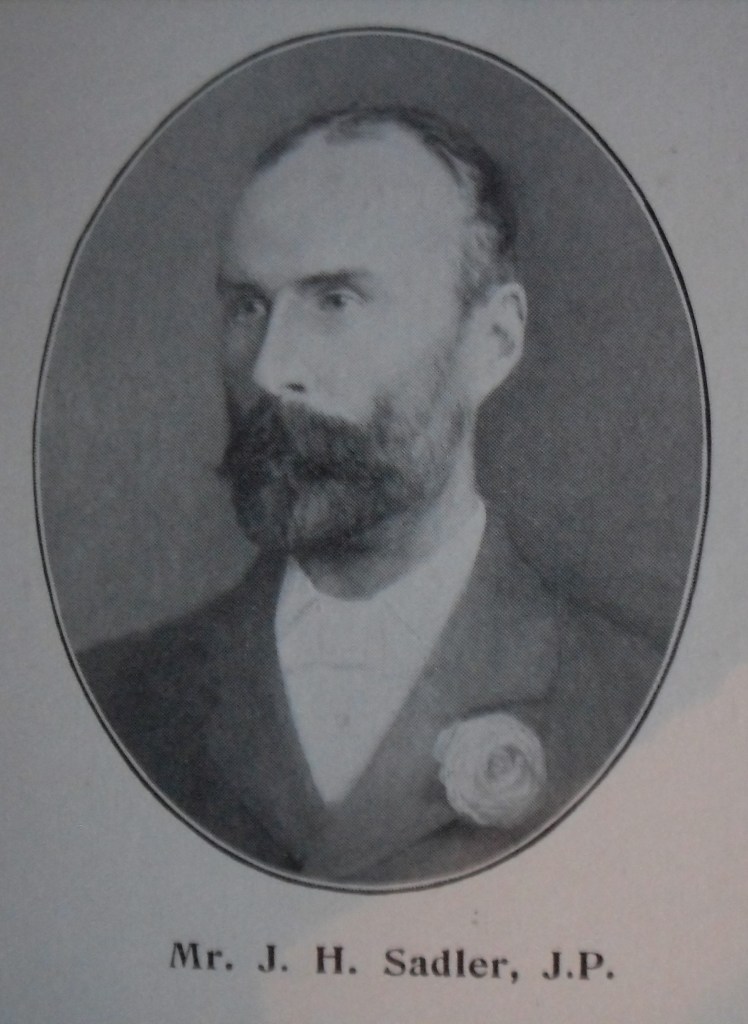
James Henry Sadler – much respected

Most of the time I am entrenched in Radnor Street Cemetery – but occasionally I venture out, sometimes to neighbouring churchyards and cemeteries. And sometimes my work with the Friends of Lydiard Park collides with Radnor Street Cemetery. I am presently transcribing the diaries of Hook farmer Elliot Woolford. On March 30, 1929 Elliot writes:

Saturday March 30, 1929

I went to James Henry Sadler Esq funeral at Lydiard Millicent this afternoon he was taken to Church on a farm wagon there was a lot followed he was much respected.

A short biography is published in the ‘Wilts Book’ discovered by Radnor Street Cemetery friend and colleague Mark Sutton.

Sadler. – James Henry Sadler, J.P., Lydiard House, near Swindon; son of the late Samuel Champernowne Sadler, J.P., F.R.C.S., of Purton Court, Wilts; born at Purton, August 17th, 1843; educated at Hoddesdon, Herts, and Royal Agricultural College, Cirencester. Landowner and agriculturist, farming some of his own property; Justice of the Peace for Wilts; member of the Wilts County Council since its formation, representing the Purton Division; Captain, Royal Wiltshire Yeomanry (retired); Chairman of the Cricklade and Wootton Bassett Board of Guardians, and Rural District Council; formerly, and for some years Chairman of the Purton and Lydiard Millicent Parish Councils, North Wilts Liberal Association, and Swindon Chamber of Agriculture. Recreations: hunting, and shooting. Married, in 1879, Ann Matilda, daughter of the late T.P.W. Butt, of Arle Court, Cheltenham.

Photograph published courtesy of Duncan and Mandy Ball.