Francis Edward Allen – Mayor of Swindon 1940-41

Francis Edward Allen was 77 years of age when he served as Mayor of Swindon during one of the difficult years of the Second World War, 1940-1941. Among his numerous duties during that year he launched Swindon Food Week, an initiative to help housewives make better use of rations; he lent his support to a national flag day on behalf of the air raid distress fund and he welcomed evacuees to the town.

Francis Allen was born in 1863 and baptised in the parish of Widcombe, Somerset, the son of stonemason Joseph Allen and his wife Mary Ann. By the 1880s he was living in Swindon where he married Emily Brooks on December 25, 1883 at the church of St. Paul’s. The couple went on to have 9 children and lived for all of their married life in the Rushey Platt/Wootton Bassett Road area.
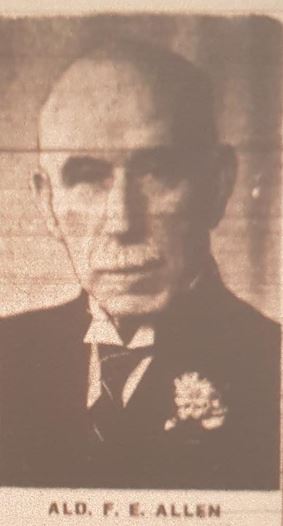
Ex Mayor of Swindon’s Sudden Death

Alderman Francis Edward Allen Mayor of Swindon in 1940-41, died suddenly at his home, 9, Wootton Bassett road early this morning. He was 80 years of age.

Mr. Allen was born at Bath and came to Swindon as a young man to taken up employment in the GWR Works. He rose to chargeman of the gas works and retired about 18 years ago, after 42 years service.

On his retirement Mr Allen took up public life and was returned to the Town Council as councillor for the East Ward. Later he was made an alderman and was elected Mayor in 1940-41.

Mr Allen was well-known for his work in connection with the North Wilts district of the Ancient Order of Foresters, of which he was senior trustee at the time of his death. As recently as Wednesday evening he attended a Foresters’ meeting in Swindon.

Mr Allen also made a name for himself by his interest in horticulture. In the days of the old Swindon Flower Show, then held in the Town Gardens, he was a most successful exhibitor and was also a very competent judge of flowers.

He had taken innumerable prizes in local club flower shows, and at one time was on the committee of the “Evening Advertiser” Flower Show.

He was a former treasurer of the Swindon Division Liberal Association.

Mr Allen leaves a widow, three sons (two living in Australia and one in Swindon) and six daughters. All the sons and daughters are living and married.

The Evening Advertiser, June 13, 1943.

Funeral of Ald. F.E. Allen, Former Mayor of Swindon

Ald. F.E. Allen

Alderman Francis Edward Allen, aged 80, Mayor of Swindon in 1940-41, of 9 Wootton Bassett road, who died last Saturday, was buried with civic and forestry honours yesterday.

The Mayor (Ald. A.J.B. Selwood), wearing his chain of office, attended the funeral service at Wesley Church, Faringdon road, and the Foresters’ burial service was read at the graveside in Radnor street cemetery by Bro. F.J. Franklin, District Trustee.

The service at Wesley Church was conducted by the Rev. A..E. Banks, who, in the course of a short address, referred to the integrity and steadfastness of purpose with which Ald. Allen had served the town, and said the qualities of character he had shown in his public work had won for him a warm place in the hearts of his fellow citizens.

Extracts from the Evening Advertiser, Thursday, June 17, 1943.
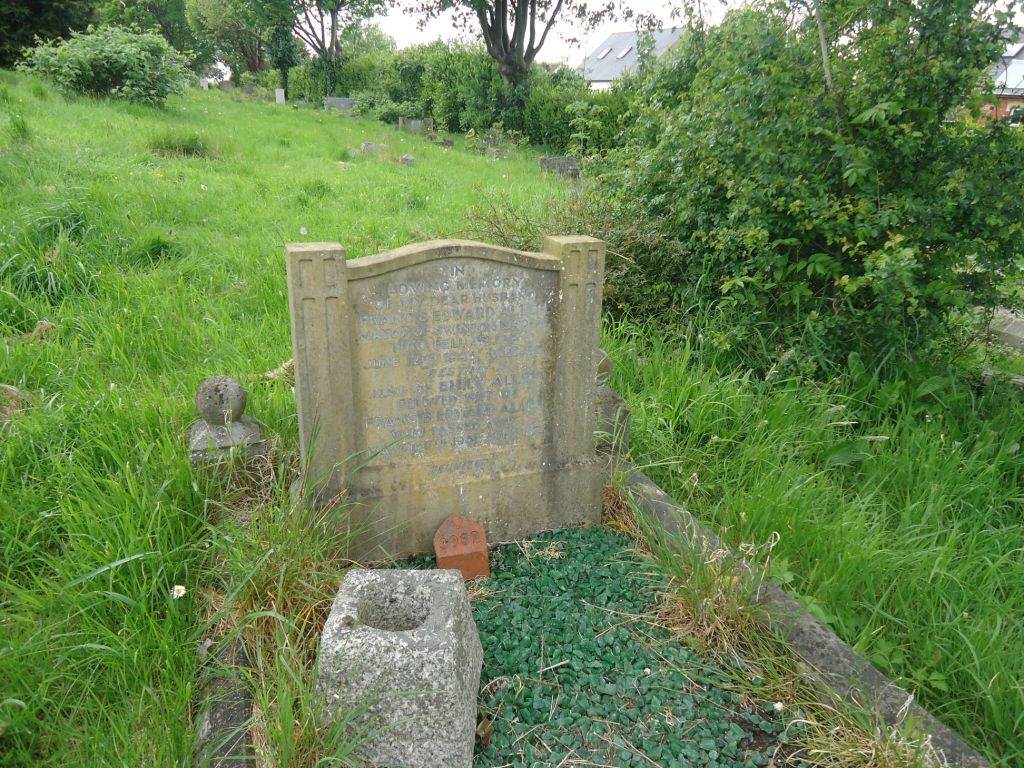
Francis Edward Allen died at his home 9, Wootton Bassett Road, aged 80. He was buried on June 16, 1943 in grave plot B3130, which he shares with his wife Emily who died in 1951. The couple are buried with Emily’s sister, Elizabeth Hannah Wilden who died in 1910.
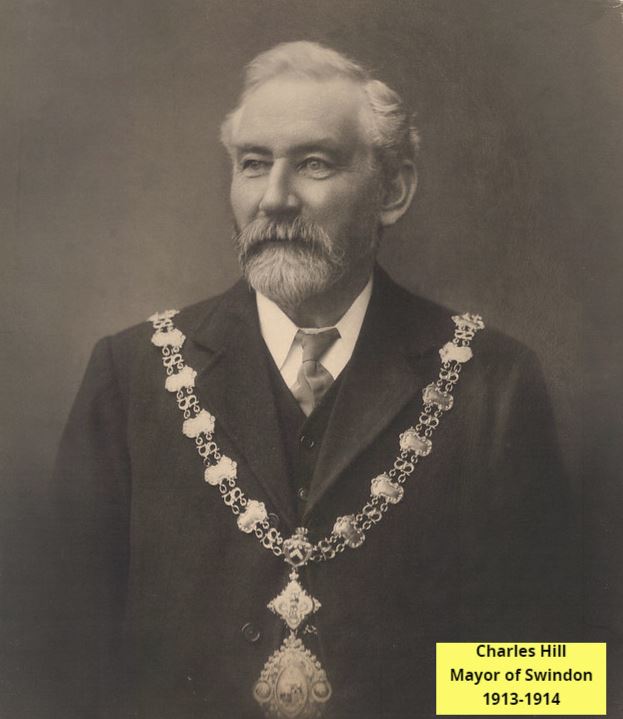
Charles Hill – Mayor of Swindon

I was recently asked by a blog reader why so many of Swindon’s ‘worthies’ were members of the non-conformist faith. Charles Hill is another such example.

Referring to the obituary published in the North Wilts Herald, Rev. A. Brown said it was a fine resume of the life of Mr Hill and could have gone on for another two or three columns had there been space.

Charles Hill was born in Newton Abbot in 1853. He married Elizabeth Ann Spackman in 1878 and the couple had three children, Mabel, Elsie and Percival. The story of his life follows here:

image published courtesy of Local Studies, Swindon Central Library.

Death of Mr C. Hill, J.P.

Former Mayor of Swindon and Chairman of the Education Committee for 12 Years.

The news of the death in the early hours of Saturday of Mr Charles Hill, of 32 Victoria road, Swindon, will come as a severe shock to thousands of people in Swindon and Wiltshire who knew him so well.

The news will be the more unexpected in view of the fact that right up till Friday he was apparently in his usual health and good spirits, and as recently as Thursday was seen walking in the streets of Swindon, and, indeed, recorded his vote in the municipal elections.

It was only last month that he retired from the many public offices he held in the town.

Foot Amputated.

Mr Hill underwent a severe illness about 18 months ago and had his foot amputated, but though this entailed a temporary retirement from public duties, he returned to them zealous as ever on his recovery.

Mr Hill’s life is the romance of the orphan of a farm, who, by dint of hard work combined with good spirits and geniality, rose to become the Mayor of the town of his adoption, and a magistrate of the county in which he came to live and work.

In April, 1853, he was born near Newton Abbot, and spent his early years working as an orphan boy on a Dartmoor farm. He came to Swindon in 1872, and obtained employment as a porter on the GWR station, later going into the factory.

Then when the old broad gauge track from Swindon to South Wales was converted in 1872, he was a member of what was known as a transport.

Then he went into the R Shop, where he worked for 12 years, first as a labourer, then as a machineman, and finally as chargeman. Leaving the Works, he became a part time agent for several insurance agencies, and in 1896 he was appointed local superintendent of the Sceptre Life Insurance Society.

Service on the Council

In 1894 Mr Hill was elected as a member of the New Swindon Urban District Council and on the incorporation of the borough in 1900 he was elected a councillor. With the exception of one year – 1896 – he completed, on his retirement for the council a week or two ago, 40 years’ continuous service.

There had been 13 Mayors of the borough before Mr Hill became Mayor, and he had served under every one of them. Then in 1913-14 he became Mayor himself, during the year the great war broke out.

For many years he had also served on the Wilts County Council, and until last March, when he retired, had held an aldermanic seat on the County authority for 21 years. His work also extended to the Wilts Standing Joint Committee, and though he had severed his connection with the County Council, he still held a seat on the County Small Holdings Committee.

Work for Education

But it was his work for education which had made him best known. He was appointed to the Education committee when it was established in 1903, and served continuously since that time until he retired about a fortnight ago, being vice-chairman from 1913 to 1919, and chairman since 1922.

In that position he won the affection and respect of his colleagues, and the hearts of children in the schools. He was a familiar visitor to all the schools, and at each of them he had some quaint little story, or a knotty problem with which to amuse the children.

At the time of his death he was the principal and director of C. Hill and Co., insurance agents.

In politics Mr Hill was a progressive Liberal. He was hon. secretary of the North Wilts Liberal and Radical Association, and took part in the winning contest of 1898, 1900 to 1906.

He had been one of the pillars of Methodism and for some 40 years was superintendent of the Sunday School connected with the Regent Street Primitive Methodist Church – now the Methodist Church. He was for some time secretary of the church trustees.

The Funeral

Many public bodies were represented at the funeral service at Regent Street Methodist Church, on Wednesday afternoon.

Mr Hill requested that there should be no flowers and no mourning, and amongst his papers there was found a message asking that those who thought of sending floral tributes should send instead a donation to the Mayor’s Unemployment Distress Fund.

Extracts from North Wilts Herald, Friday, 9 November, 1934.

Charles Hill died at his home, 32 Victoria Road, aged 81 years. He was buried on November 7, 1934 in grave plot E7419 which he shares with his wife Elizabeth Ann who died in 1921 and his daughter Mabel Emma who died in 1965.

Mayor Tom Butler – Cabinet maker

Tom Butler was born in Ramsey, Huntingdonshire in the summer of 1856. By 1881 he had moved to Swindon and was working at premises at 81 Regent Street for master cabinet maker William Pooles. He would later have his own business and an elegant house on Victoria Road named after his birthplace.

In 1883 he married Mary Ann Turner at the Wesleyan Methodist Chapel on Bath Road. The couple had seven children, of whom five survived childhood.

The couple were devout Methodists and both played prominant roles in the church and public life in Swindon generally. Tom was elected to the Town Council in 1903 and served as Mayor in 1910/11 an auspicious year in which the coronation of George V took place and Tom’s much loved wife died suddenly.

Mayor Tom Butler published courtesy of Local Studies, Swindon Central Library.

The Late Mr T. Butler

Funeral of One of Swindon’s Most Prominent Citizens

All Sections of Public Represented

The very high regard in which the late Mr Tom Butler, ex-Mayor of Swindon, was held by all sections of the public was eloquently reflected on Saturday in the scenes that attended his funeral. From an early hour in the afternoon many people gathered in the sunlit Cemetery to witness the last phase of the passing of a noteworthy man, and long before the service was due to start the Faringdon Street Wesley Chapel was filled.

The funeral service was impressively conducted by the Rev J. Rogers (superintendent minister), who paid glowing tribute to Mr Butler’s work in the town. Mr Butler came to Swindon, said Mr Rogers, in 1878. He became a teacher at Wesley Church the same year, and after a break of some years, resumed the work in 1887. Most of them were familiar with the main incidents of his public life; he built up a prosperous business and made a competence. No aspersion had been cast upon his character or methods; he was a man of honour and integrity. There were certain dates prominent in his career which the speaker wished to recall. In 1886 he was converted, and by definite and intelligent choice made Christ the Lord of his life. To the vows then made he remained faithful. His experience of religion was real and vivid, and he was always earnest, warm-hearted and generous. In 1887 he entered the school as a teacher, in 1888 he became treasurer to the Sunday School and in 1889 he was appointed superintendent, remaining in office until his health broke down. He relinquished the office in 1914. Mr Butler was a trustee of that church and was a liberal supporter of its funds. He helped very materially in the erection of the monumental Sunday School premises, while as Circuit Steward he discharged his duties with urbane and faithful efficiency. His life of usefulness and devotion had its source in mystic fellowship with God. He was loyal to the work in the days of his activity. They all knew what Mr Butler was to the community, but they did not know what he was to that church.

Referring to Mr Butler’s public life, Mr Rogers reminded them that he was elected to the Town Council in 1903 and held office as Mayor in 1910-1911. During that year he suffered a bereavement from which he never fully recovered.

“Servant of God! Well done,” concluded Mr. Rogers, and the fervent murmurs of the congregation was an endorsement of his eulogy.

North Wilts Herald, Friday, October 20, 1922. (extracts)

Tom Butler was buried in grave plot A1033 where he lies with his wife Mary Ann who died in 1911 and their two young children, Hilda Mary who died aged 6 years in 1898 and Denis Stanley a 3 month old baby who died in 1899.

You may also like to read:

Mayoress Mary Ann Butler and the Coronation