William Harvie and the amazing Multiple Cake Cutting Machine

The re-imagined story …

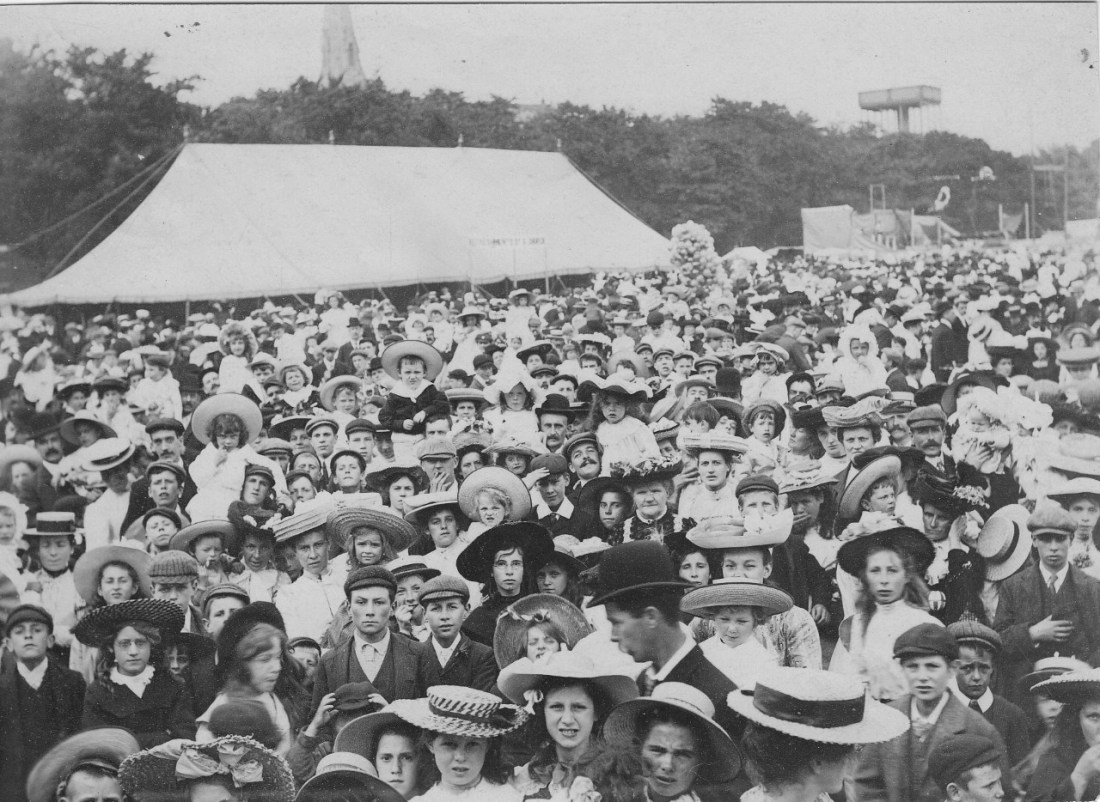
There are two highlights in the Swindon calendar for the children – Trip, when the Works shut down for the annual holiday and we go to the seaside, and the Children’s Fete, and I can never sleep the night before either of them.

Preparations for the Children’s Fete begins well in advance and I have first-hand knowledge of this as my father is on the Mechanics’ Institute Council and our whole family is involved.

The fete takes place in the GWR Park, the gates open at half past one. Tickets cost 3d for adults and 2d for children. The children receive two free rides on the steam roundabouts, a drink of either tea or oatmeal water and a piece of cake.

For weeks beforehand we save every penny, ha’penny and farthing we can; never have so many errands been run, so many jobs done about the home.

The familiar GWR Park becomes kaleidoscopic with rides and stalls and fairy lamps festooned around the Cricket Pavilion and the bandstand. Entertainments on the central stage take place throughout the afternoon; comedy acrobats and trapeze artistes and trick cyclists and one year there was even a troop of performing dogs. Mr Harvie is the chairman of the fete committee and director of amusements but this isn’t what he became best remembered for.

The event runs like a well-oiled machine, which is hardly surprising as it is organised by some of the most well qualified and experienced engineers in the railway works. And perhaps the greatest feat of organisation is the cake.

The quantity of cake required was enormous, amounting to no less than 2 tons 13 cwts. The job of baking it went to Mr E.P. Monk of Old Swindon who produces annually approximately 1,200 cakes weighing 5lbs each. Next comes the task of cutting the cakes into half pound slices, a job which had previously fallen to a handful of volunteers. It used to take 12 people approximately six hours to cut up and bag the cake. And then Mr Harvie invented the Multiple Cake Cutting Machine.

At this year’s event Mr Harvie’s new improved machine will be used for the first time. The machine, a dangerous looking contraption, is composed of crossed knives, balanced on spiral springs, which hover above each cake. The average speed of this new machine being no less than 6 cakes, or 60 half pounds per minute. The cakes are fed into the machine on 12 wooden trays by an endless band on rollers worked by the handle at the end of the machine, and here Mr Harvie has introduced another novelty in the shape of an electric bell, which is so adjusted that when the tray reaches the exact centre of the knife it strikes two levers and forms an electric communication with the bell, which commences ringing, and continues to do so until the cake is cut. The tray then passes on with the cake to make room for the next. When the tray on which the cake is cut reaches the end of the machine, it runs on an inclined board which carries it to the packers.

So exciting is the whole process that I think it should form part of the entertainments on the fete stage. Perhaps I’ll suggest that to Mr Harvie for next year.

My fete dress hangs on the back of the bedroom door. My hat, decorated with ribbons and flowers, sits on the dresser. I open the curtains a crack, it is not quite dark yet. Early tomorrow morning my father will join the others assembling the stage. I squeeze my eyes tightly shut. I must go to sleep, I must go to sleep.
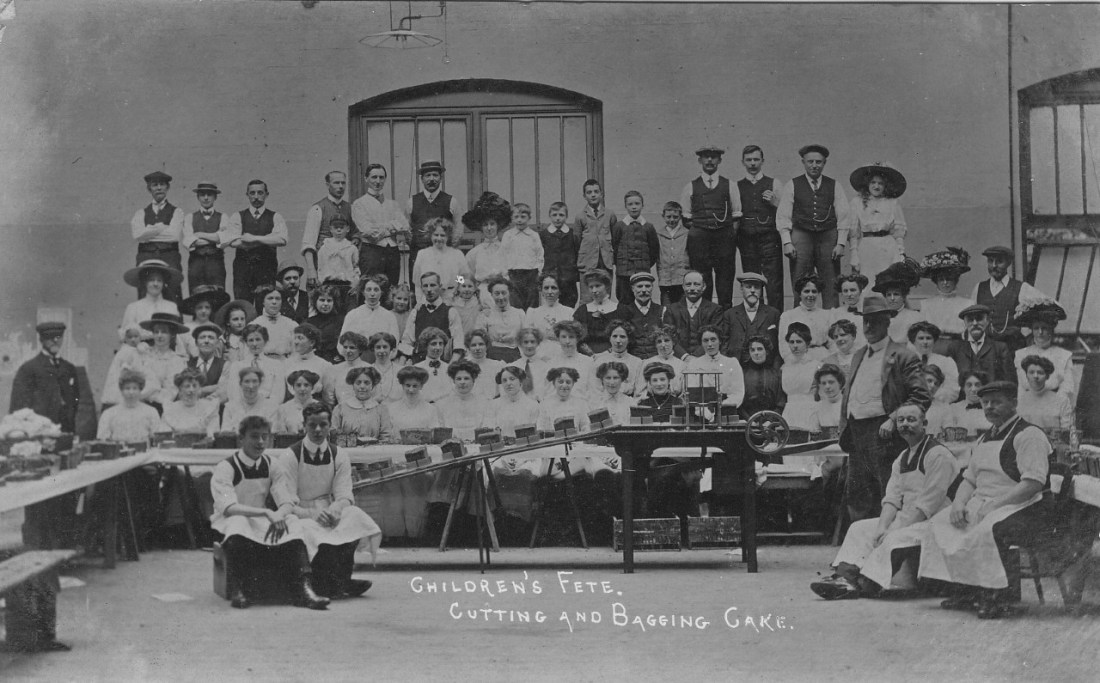
children's fete cake cutting

The facts …

William Harvie was born in Islington, London in c1849. He began his career as a coach trimmer in Birmingham where he met and married his first wife, Susan Newman, at St Peter and St Paul’s Church, Aston. Susan was a widow with a young son. By 1871 the couple were living at Rushey Platt with Susan’s son Edward and two children of their own, Henry and Louisa. They would have a third child George William. The family lived at 15 Faringdon Street for a number of years and by 1891 William had been promoted to foreman.

He served as foreman over the women in the polishing shop, and during the 1890s he was responsible for organising the entertainment for the ‘annual tea of the female staff employed in the Carriage Department.’ He even performed a couple of humorous songs, said to have contributed to the event.

By the time of Susan’s death in 1906 they were living at 6 Park Lane. Two years later William married again. His second wife was Alice Elizabeth Turner. She died in 1921 at their home 92 Bath Road but does not appear to be buried in Radnor Street Cemetery.

William died in 1930. Details of his estate were published in various newspapers, including the Daily Express.

‘A Black Country working lad who, in his spare time, played in a theatre orchestra, became a railway foreman, and dabbled in stocks and shares during fifty years’ service, has died worth nearly £44,000. The workers of this great railway centre used to dub William Harvie of Bath road, Swindon, “the wealthiest workman in England,” but even they were surprised when his estate was announced, and the sole topic of conversation in the town was the large sum he left. He was 84 when he died last October, a widower, and intestate.’

A notice in the Western Morning News reported that he was instrumental in building the first saloon railway coach for Queen Victoria but there is no mention of his famous invention, the Multiple Cake Cutting Machine.

William is buried in plot D14a with his first wife Susan. They were later joined by their elder son Henry.

Susan and William Harvie

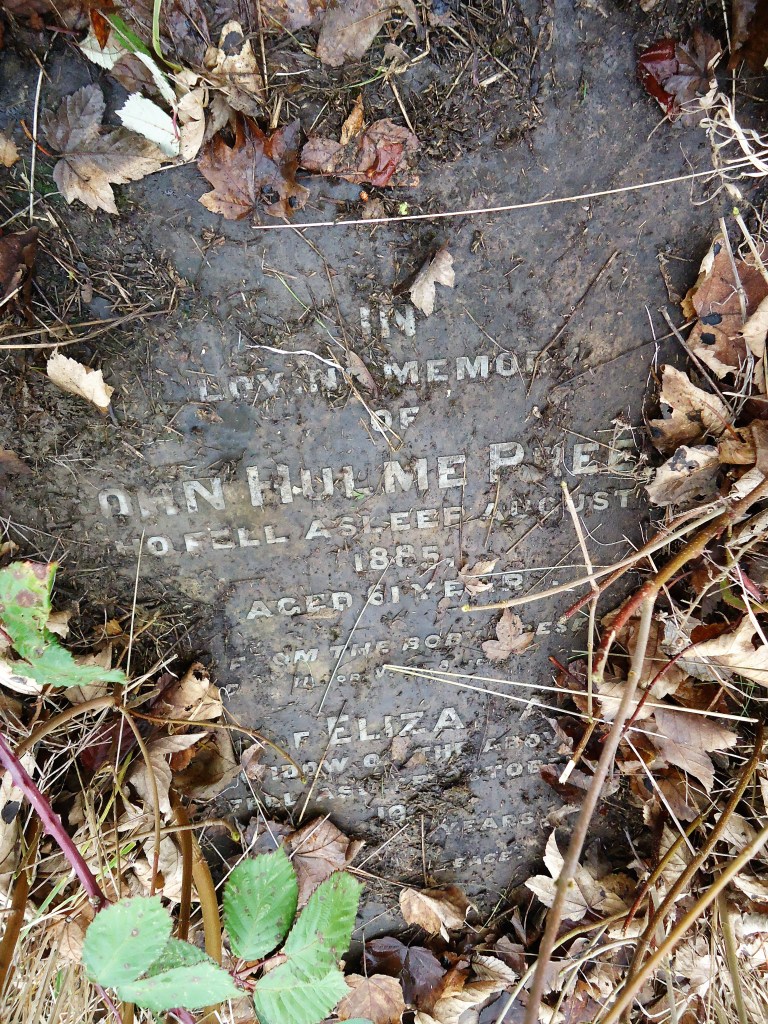
John Hulme Preece – a devoted Christian

John Hulme Preece was born on January 1, 1824 at Tenbury, Worcestershire, the son of a Baptist Minister. He married Eliza Sarah Whitmore in the December quarter of 1853 and by 1855 the couple were living in Swindon. The UK Railway Employment Records 1833-1956 state that John began work as a railway clerk in the Locomotive Department on February 2, 1855.

The couple joined the Independent Church, Victoria Street in 1861. This church was demolished in the 1960s for a road widening scheme.

John and Eliza lived first at Union Villa where Eliza ran a Seminary for Young Ladies. They later moved to 8 Gloucester Terrace which had a larger schoolroom and remained their home until John died in 1885 and Eliza in 1905.

In 1861 John was elected to the Council of the Mechanics’ Institution, the first clerk to be elected. Previously it was felt that only railwaymen would be able to appreciate the needs of those working on the shop floor. But John soon proved his worth and the following year was elected as Secretary of the Mechanics’ Institute, a role he fulfilled with energy and commitment until his death.

Trevor Cockbill makes many references to John in his definitive book about the Mechanics’ Institution – Finest Thing Out published in 1988. He describes him as being a quiet, gentle, studious man of a modest and retiring nature. A devoted Christian who was deeply interested in scholarship and education.

Swindon

The death is announced of Mr. John Hulme Preece, who has been for 26 years secretary of the New Swindon Mechanics’ Institute. Mr. Preece who was 61 years of age, was for about 30 years a clerk at the Great Western Railway Works.

Reading Mercury Saturday 29 August 1885.

The Funeral of the late Mr. John Hulme Preece, whose death on the previous Thursday evening we noticed in our last issue, took place on Monday afternoon, at the Cemetery, and afforded another instance, had it been necessary, of the very general respect in which the deceased was held. The coffin, which was conveyed to the cemetery without the customary pall on a portable bier, was completely covered with floral wreaths and offerings. In addition to the relations of the deceased, who had preceded the funeral cortege to the cemetery, there was a very large representation of the Council of the Mechanics’ Institute, and of the G.W.R. Clerks, to the number of over 150.

Extracts from he Swindon Advertiser, Saturday, August 22, 1885.

Zacharias Peskett – Medical Fund Society Treasurer

Saturday July 8 sees Swindon celebrate the 75th anniversary of the NHS with the Mechanics’ Institution Trust. Events in the Emlyn Square area include an exhibition in the Central Community Centre with a talk on the GWR Medical Fund by Adam Busby at 4 pm. Visit the Railway Village Museum open 11-3 and join a walking tour of the Railway Village focussing on ‘Health.’ The Bakers Café will be open for refreshments.

And read below about one of those pioneering members of the GWR Medical Fund Society.

Swindon

Obituary

The death occurred on Thursday morning at his residence, 6, Milton Road, Swindon, of Mr Zacharias Peskett, an old and highly respected resident of Swindon. For the long period of 44 years he had been in the service of the GWR Company, and for over 30 years he had uninterruptedly held office as treasurer of the GWR Medical Fund Society. He was generally esteemed as an upright and honourable man, and was a valued servant of the company. He was in his 70th year.

Western Daily Press, Bristol, Friday, May 29, 1914.

The Late Mr Z. Peskett,

Funeral

The esteem in which the late Mr Zacharias Peskett, of 6, Milton Road, Swindon, was held by his former colleagues in the GWR Works and by the officials of the GWR Medical Fund Society – an organisation with which his name had been prominently associated for more than 30 years – was exemplified on Tuesday afternoon, when the funeral took place at Swindon Cemetery amid every manifestation of sorrow and respect.

The cortege left Milton Road at 3.15 and proceeded to St. Mark’s Church, where a short but impressive service was conducted by the Rev. Lionel Calway.

The coffin, on which was a large cross of white flowers from the family and other beautiful floral tributes, was conveyed on a four-wheel bier, Messrs J. Lawrence, E. Griffiths, W. Sansum, T. Jackson. R.A. Zebedee and Humphries (representatives of the Medical Fund Society) acting as bearers.

Then followed a hand-bier on which were placed the wreaths, and in charge of Mr Peskett’s personal staff – Messrs. T.H. Westbury, C.E. Knapp, J. Clark and Angle. Behind the mourning coaches walked the Rev. H.J. Parker (pastor of South Street Baptist Chapel, where deceased formerly worshipped), representatives of the Medical Fund Society and the Sick Fund Society and many old friends and former colleagues of the late Mr. Peskett.

Long list of mourners …

From St. Mark’s Church the coffin was borne to the Cemetery, the route chosen being Cambria Bridge Road, Radnor Street and Clifton Street. The Blinds at many of the houses on the way to the Cemetery were drawn as a mark of respect to the deceased.

At the graveside the cortege was joined by a large number of sympathisers, and the service was impressively conducted by the Rev. L. Calway. The coffin was of polished elm, with heavy brass furnishings, and the breast plate was inscribed as follows:-

Zacharias Peskett,

Died May 28th, 1914.

Aged 69 years.

Many beautiful floral tributes were sent by relatives and friends…

The funeral arrangements were satisfactorily carried out by Messrs. H. Smith & Sons.

Extracts from the North Wilts Herald, Friday, June 5, 1914.

Zacharias Peskett was buried on June 2, 1914 in plot D1297, a grave he shares with his wife Annie who died in December 1924.

Alfred James Charsley – theatrical impresario

“For someone who clearly loved the limelight, Alfred James seems to have been quite camera shy,” said Rhoda Murray who kindly supplied this story of her ancestor. The grainy, black and white photograph (see below) is all that Rhoda has been able to find.

Alfred was a colourful character, changing his name to James Allington Charsley and somewhat creative when applying his age to official documents. Born in Leicester in 1867, the fourth of Joseph and Lucy Charsley’s five sons, Alfred took to the stage performing a song and step-dance routine in pantomime aged 11-13. however on leaving school he worked in the boot making industry as did the rest of his family.

In 1892 Alfred briefly joined the London Metropolitan Police Force, but by the time of the 1901 census he was living in Northampton, once again working in the shoe and boot making industry, while continuing to pursue his theatrical career. By the time of his marriage to Emily Beatrice Wheeler in 1910, Alfred described his occupation as ‘Theatrical Manager.’

Alfred and Emily arrived in Swindon in 1934 when he took on the lease of the Playhouse Theatre in the Mechanics’ Institution.

He died on October 17, 1940 at Roundway Hospital, Devizes. His cause of death was recorded as broncho-pneumonia.

Emily took over the lease of the Playhouse and continued to live at the home she had shared with Alfred at 94 Croft Road. In April 1950 she married Arthur William Thraves and moved to Stratton St Margaret. She died in January 1962 and was buried with Alfred in grave plot C1750.

The Mechanics’ Institution Theatre c1931

Death of Mr J.A. Charsley

Swindon Playhouse Lessee

One of the best known personalities in the provincial theatrical world, Mr J. Allington Charsley, lessee of the Playhouse, Swindon, died last night after a short illness. He was 69 years of age.

Mr Charsley was taken seriously ill less than a fortnight ago.

A native of Staffordshire, Mr Charsley had been associated with the theatre from his early days, filling with distinction the roles of actor, producer and lessee. He was particularly interested in opera, and for many years toured the biggest company that has ever been assembled to play in provincial towns and cities. Many men and women, who have since gained world wide fame, were first brought to public notice as members of Mr Charsley’s companies.

He had a remarkable memory for names and dates, and would often recall how some of the stars-to-be were discovered in the back row of his choruses.

Mr Charsley has made a host of friends during his six years at the Playhouse, and in face of great difficulties has succeeded in bringing to his theatre – the only one in Wiltshire presenting flesh and blood shows – many of the best known variety and revue stars of the present day.

A fine sportsman, he was particular interested in racing and football, and his generosity, when approached to assist any deserving cause, was widely appreciated.

He leaves a widow, who is carrying on the Playhouse.

A brother of Mr Charsley, Mr, Chris Charsley, who is now living in retirement at Weston-super-Mare, was formerly Chief Constable of Coventry.

North Wilts Herald, Friday, 18 October, 1940.

Many thanks to family historian Rhoda Murray for providing the story of Alfred James Charsley – theatrical impresario.