William Charles Cook – died at the GWR Medical Fund Hospital

The re-imagined story …

I’ve seen some accidents in the saw mill in my time, but I’ve never seen so much blood before.

No one could fathom out how the saw had fallen from the frame. At the inquest we were asked the very same question, which no one could satisfactorily answer. Putting the saws in the frame had been Charlie’s job.

Charlie had already replaced the first saw, which had fallen from the frame when a second one fell, the blade skimming across his wrist. He was a big old boy, but we managed to lift him out of the way of the machinery until we could get him to the Medical Fund Hospital.

It wasn’t until Charlie had been transported to the hospital that I remembered Harry, the young apprentice who had started work with us that same week. I eventually found him hiding in the cloakroom curled up in a ball on the floor. I thought we were going to have to call the doctor back out again, I’ve never seen anyone look so queer. I suppose it must have been the shock of seeing all that blood.

I told him Charlie was going to be alright, but he didn’t seem to understand me and in the end we had to find his father to come and take him home. He came back to work the following day, but he soon transferred to the Stores. People said he was never the same again.

Like I said, I’ve never seen so much blood before. We spent the rest of the day scrubbing the place down.

Death at the GWR Medical Hospital

Inquest and Verdict

On Tuesday last at the Lecture Hall of the Mechanics’ Institute, Swindon, Mr A.L. Forrester, Coroner for North Wilts held the inquest on the body of W. Cook, who died at the Medical Fund Hospital, under circumstances detailed in the evidence given below.

Mr Greenaway was chosen foreman of the jury.

Mrs Annie Cook, of 15 Carr street, Swindon said that she identified the body as that of her husband, William Cook, aged 64, a sawyer, employed in the GWR Works. He died on Saturday at the Medical Fund Hospital, and witness was there at the time of his death.

George Ockwell, of Purton, sawyer, in the GWR Works, said that on last Thursday week between 11 and 12, witness was in the saw pit putting the blocks in to cut the timber to a certain size. The saws were hung in the frame but not set, and as Cook put a block in the saw fell down. As Cook went to put the saw back in its place the other saw next to it fell down and cut his wrist. Witness who was in the pit saw the blood coming down. It was Cook’s duty to fix the saw.

The machinery was not in motion of course.

Oh no sir. You had nothing to do with these blocks below? Cook had to hand me the blocks to put in, and the first saw fell down as he was handing me the first block.

You had not put this block in position? No sir.

What do you think caused the saw to fall? I don’t know.

Did the saw fall right down into the pit? Oh yes, sir, close to me.

How deep is the pit? About 14 inches.

Witness explained that he sat on a board to adjust the saw, his legs only being in the pit. The back of the saw was towards witness, and the saw fell down between his legs. The saws were not circular, but were straight “up and down” saws.

Ernest Samuel Richards, shop foreman in the saw mills, said that the mill at which Cook was working was a vertical long frame. The saws were 5ft 10in long, and the average width would be about 5½ inches. The saw had a buckle on, with a hook, and it was attached to the tiller with the hook the reverse way. They were fastened in the frame by a steel cotter. The blocks were simply packing, and did not affect the hook at all. He had never heard of saws falling down during adjustment. If these saws are hooked up and keyed how could it drop down? They cannot drop down when they are adjusted unless they come off the hooks, and that could only happen by a blow or by their being lifted in some way or other.

Dr G.R. Swinhoe said that on May 6th the deceased was received at the GWR Hospital suffering from a cut to the left side of the wrist, severing the radial artery. The bleeding was stopped and the wound was dressed, and he asked the man to stay in the Hospital, but the deceased took his discharge and went home. He come up every day to have the wound dressed until the day before he was re-admitted (May 12th). He was admitted on the 13th suffering from blood poisoning to the left arm. Hypostatic pneumonia had set in and Cook died from hypostatic pneumonia on May 15th. Witness then explained how the temperature from the blood poisoning would affect the heart, and render the heart unable to pump the blood through the lungs. The primary cause of all the trouble was the suppuration set up in the cut wrist, and the other things followed in an elderly and very stout man with a weak heart.

The jury returned a verdict that Cook died from hypostatic pneumonia following a cut on the wrist, accidentally caused by a saw in the GWR Works.

Mr H.B. Dawe was present as being in charge of the GWR Timber Department. Mr W. Ireland, Factory Inspector was also in attendance.

Funeral of Deceased

Yesterday afternoon the remains of the late Mr William Cook were laid to rest in the Swindon Cemetery. The funeral cortege left Carr Street shortly after three o’clock, and proceeded to the Cemetery where the funeral service, both in the Chapel and at the graveside, was conducted by the Rev. J.T. Evans, in the presence of a large number of relatives and sympathising friends. The remains were enclosed in a polished elm coffin with brass furnishings, and bearing a breastplate with the inscription “William Cook died May 13th, 1909, aged 64 years.”

Swindon Advertiser Friday May 21st, 1909

Capture

William Charles Cook was born in Bath in 1845, the son of John Cook. He married Eva Annie Perrin on October 22, 1874 in Aylesbury, Buckinghamshire and by 1876 they were living in Swindon where their son Lewis Ernest Samuel Cook was born. At the time of the 1891 census William and Eva, were living at 15 Carr Street with 15-year-old Lewis and 2-year-old daughter Frances.

William was buried on May 20, 1909 in plot E7378 in Radnor Street Cemetery. He lies with his son Lewis who died in 1900 aged just 24 and his wife Eva Annie who died in 1913.

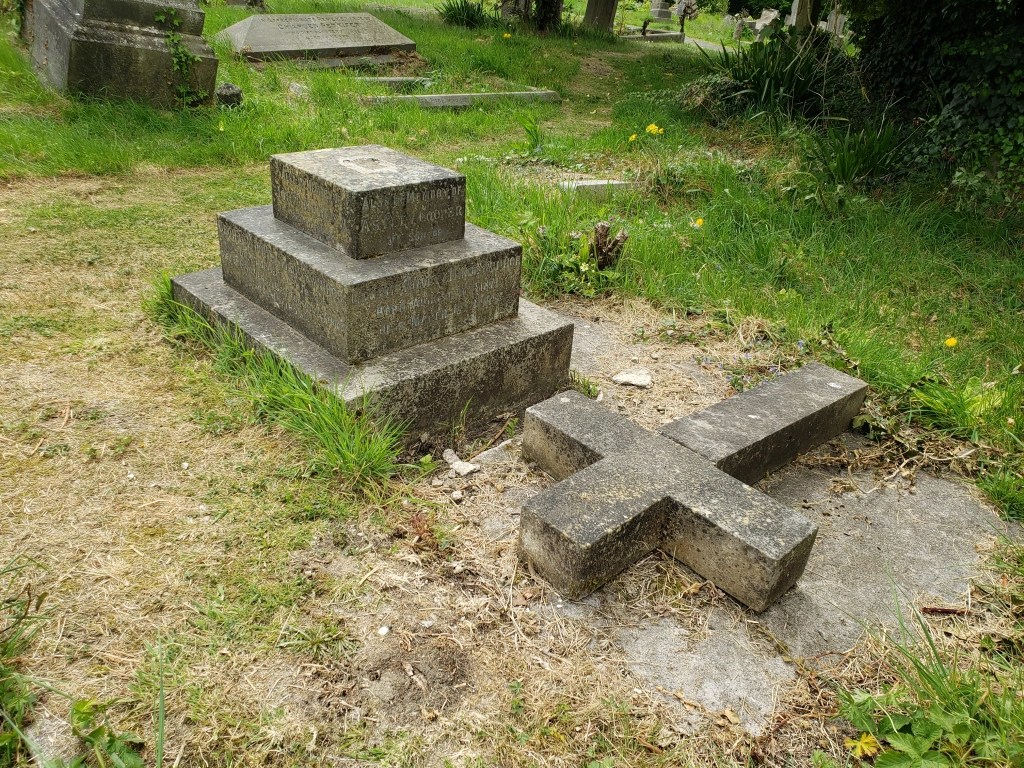
There may or may not be a headstone to William Charles Cook beneath all those brambles. We fully appreciate the financial constraints upon Swindon Borough Council – that the coffers are depleted and there is only enough money for essential services. But it is such a shame that an important heritage site such as Radnor Street Cemetery receives so little maintenance. Here lies, quite literally, the history of our town – remembering the ordinary people of Swindon.
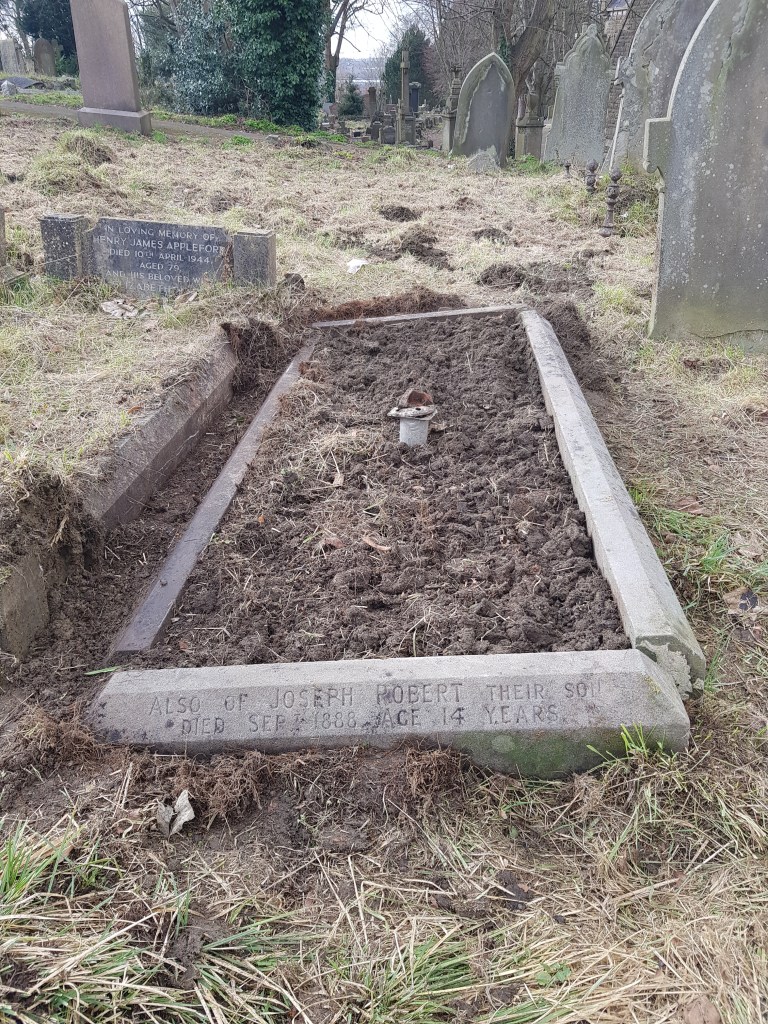
Joseph Robert Pinchon 14, fatally injured

When James Pinchon completed the 1911 census form he was required to state next to his wife’s name the number of years they had been married, how many live births she had had, how many children were living and how many had died. At the time of the 1911 census James and Ann lived at 1 Cyrus Cottages, Rodbourne Cheney. James was 69 years old, a retired Herald Painter (i.e. a coach painter). Ann was 70 years old, an old age pensioner. James and Ann had been married for 46 years. They had had 8 children of whom 2 were still living and 6 had died. One of those children was Joseph Robert who aged 14 had sustained fatal injuries in an accident in the Works.

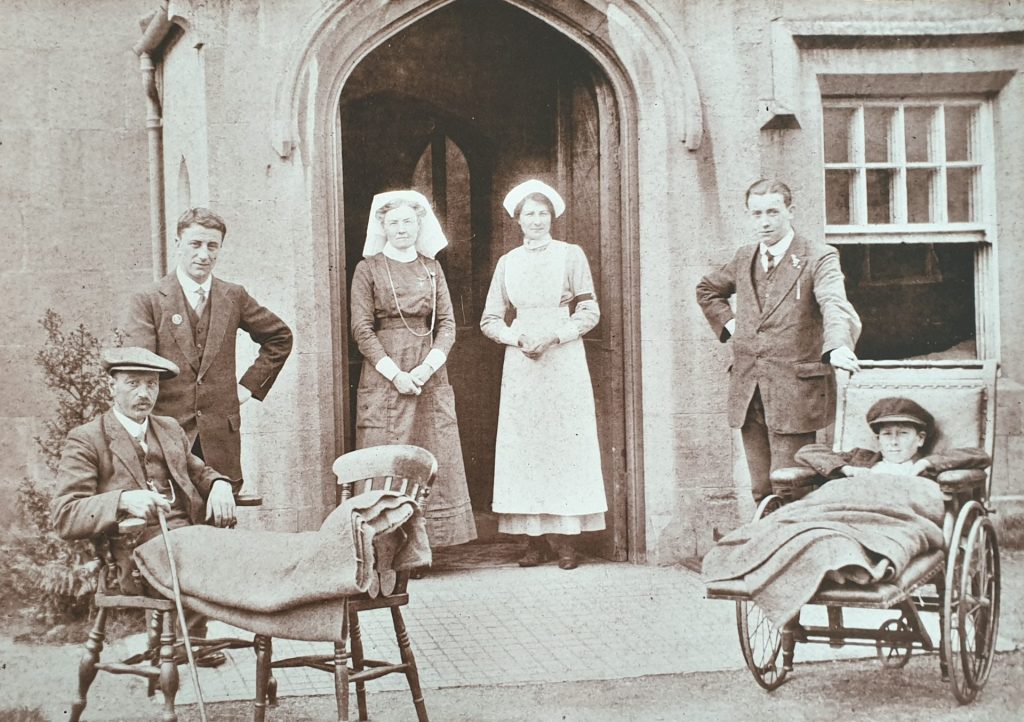
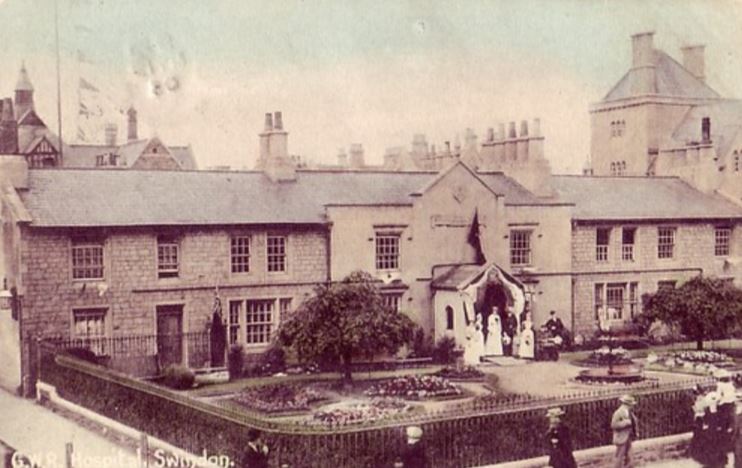
Much has been written about the GWR Medical Fund, a health care system established in 1847 and credited with informing the foundation of the NHS a hundred years later. The Accident Hospital was opened in 1872 in a building which had previously been the drill hall and armoury for the XI Wiltshire Volunteer Rifle Corps. The new hospital had four beds, an operating room, a bathroom, a surgery, a mortuary and accommodation for a nurse in an adjoining cottage.

Following the accident, Joseph Pinchon’s workmates carried the boy to the nearby Accident Hospital where he died ten hours later. Joseph Robert Pinchon of 16 Reading Street was buried in grave plot E8072 on September 25, 1888.

Medical Fund Accident Hospital – image published courtesy of Local Studies, Swindon Central Library.

Fatal Accident in the GWR Works – On Thursday morning in last week a sad accident happened to a youth named Joseph Pinchon, residing in Reading Street, New Swindon. He was working in the brass finishing shop in the GWR Works, and had occasion to go to the carriage department. In attempting to pass between two tracks of a train which was engaged in shunting operations, the buffers caught him in the chest and back and severely crushed him. He was immediately picked up and conveyed on a stretcher to the GWR Medical Fund Society’s Hospital, where he lingered till midnight and then expired.

On Saturday morning Mr Coroner Browne held an enquiry into the cause of the death of deceased, at the Cricketer’s Arms, New Swindon. Mr J. Bradbury was chosen foreman of the jury. Mr W. Mole represented the GWR Company.

James Pinchon, father of deceased, said his son was 14 years of age, and had only been employed in the Works two or three months. Dr. Cleveland (Messrs Swinhoe, Howse and Bromley), stated that death was due to internal injuries accompanying collapse.

Walter Martin, shunter in the Works, stated he was engaged in shunting operations when the accident happened. When the coaches were about two yards apart he saw deceased attempt to pass between them. It was impossible to stop the coaches when he saw deceased. – The jury returned a verdict of “Accidental Death.”

Swindon Advertiser, Saturday. September 29, 1888.

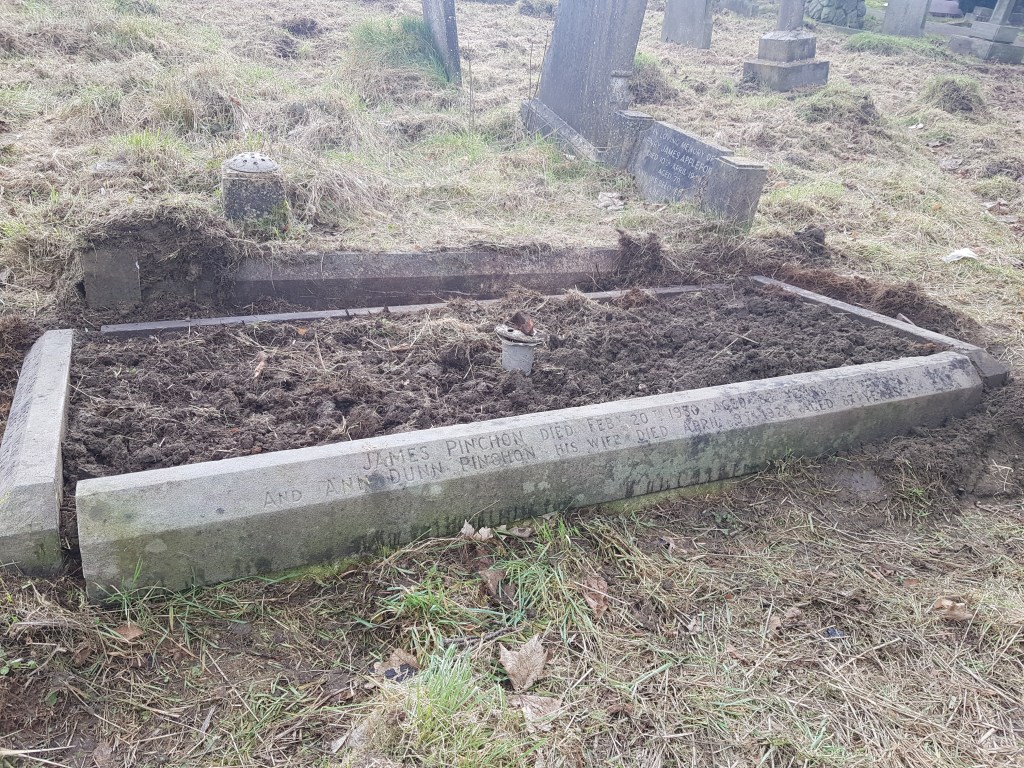
Our volunteers have revealed the Pinchon family grave. Young Joseph Robert was the first to be buried in this plot and it is likely there was no permanent memorial at the time of his death. The kerbstone would appear to have been erected after the death of his parents with an inscription which included his details. Ann died at her home in Rodbourne Cheney in 1928 aged 87 years. James died in 1930 aged 88 years. They were both buried with their young son who had died some 40 years earlier.

34 Faringdon Road

The re-imagined story …

I quite like what they’ve done to the place, especially the wallpaper in the front parlour. I could never have afforded that when we lived there.

The thing I notice most is how clean everywhere is. In my day it was a constant battle against the filth pumped out of the Works and the coal smuts from the trains. If the wind changed direction the washing would be covered in grime when I took it off the line.

I preferred our home in Box, but it was only a small village in those days. There were more opportunities for the boys in Swindon, so we moved here. It was a dirty, noisy place back in the 60s but the people were good and kind. When John died more than two hundred people lined the roads from Faringdon Street to St Mark’s.

I like to pop back to the house occasionally. It’s open to the public now, you know. Who would have thought it?

DSC01085

The facts …

Jane Bennet married John Hall at New Monkland, Lanarkshire in June 1840 when John was working as an engine driver with the Wishaw and Coltness Railway in Scotland.

At the time of the 1851 census the family were living in Box, Wiltshire but by the next census ten years later they were at 1 Faringdon Street.

John died on Tuesday, February 29, 1876 as the result of a grisly accident on the railways. At the inquest his son James gave the following evidence:

‘James Hall, son of deceased, said:- My father was 65 years  of age last August. On Tuesday morning, about 25 minutes after two, I was at the station with him as his stoker to pilot the up rails out. We were there in case of the other engine breaking down. There were four coaches in front of our engine, which we were going to push on to the rails. Whilst waiting, the gauge lamp went out, and my father went to the front of the engine to light it by the other lamp. As he was returning along the side of the engine the signalman signalled us to come on, and I blew the whistle and started just as my father had another step to take to get back, and, in fact, had his hand on the weather board. He was walking along the side of the engine. As he was about to step on the foot plate his foot slipped and he fell, his right leg going between the outside connecting rod and the wheel. I had only moved about a yard. The rod brought him up again against the splasher, causing his leg to be jammed and the flesh torn off. The first I knew of his position was my father calling out, ”Stop Jim,” and I stopped immediately. I got down and found he was fixed inside the rod, and he was terribly torn about. It took a considerable time to get him out. He was taken to the hospital at once.’

John died from the shock about four o’clock the same day.  As the report said: ‘The injuries were sufficient to kill anyone, the flesh being taken off to the bone.’

The funeral at St Mark’s took place on the following Sunday, a wet and windy dayattended by  ‘a large number of the inhabitants, many engine drivers and stokers from various parts of the Great Western Railway. We understand that free passes were issued to all such drivers and stokers as desired to attend the funeral, and in this way over ninety of deceased’s fellow workmen were enabled to attend his funeral to pay their last respects to his memory, according to the Swindon Advertiser.

DSC01082

Jane outlived her husband by ten years. She died on January 22, 1886 at the home in Faringdon Street where she had lived for more than twenty five years. She was buried in Radnor Street Cemetery in plot A1047, a public grave, with Jane Humphreys, the wife of Alfred Augustus Humphreys of 9 Bangor Terrace, Jennings Street, who had died the previous year.

Faringdon Street was later renumbered and renamed Faringdon Road. Today the Hall’s former home is 34 Faringdon Road, the Railway Village Museum.

Have you seen the doctor?

albert ramsden surgeon (2)

The re-imagined story …

Every Saturday Nan and me would come into town on the bus. We’d buy a bunch of flowers from a stall in the market and then walk up Deacon Street to the cemetery.

After we had spent a few moments looking at the wonky little headstone we would lay the flowers on the grave. Then I’d skip off down the steep path and out of the gate to Grandma’s house in Dixon Street, arriving at the front door ahead of Nan.

“Have you seen the doctor?” was the first thing she always said. Before “hello Marilyn, why aren’t you wearing a coat?” or “hello Marilyn I’ve got some chocolate cake in the pantry.”

Grandma was a wizen, little, ancient lady, who always dressed in black, I assumed in perpetual mourning for my dead Grandpa. Old ladies did that in my childhood. Of course, you don’t see that now. These days they get a tattoo and move on to a 50-year-old boyfriend. Grandma was my great-grandmother, someone to be revered and obeyed. That’s all changed as well.

When I was very young, I thought ‘the doctor’ was a relative of ours, but when I came to understand social politics I realised that’s wasn’t very likely; all the men in our family had been railwaymen.

Then one day Nan mentioned that the doctor was a surgeon, one of the GWR doctors employed at the Medical Fund Hospital. Perhaps he had performed some life saving operation on a family member. Perhaps that was why Grandma had been leaving flowers on the grave for more than 60 years.

Suddenly, as happens, life passed by. Grandma died and my much loved Nan took her place as the little old lady I took my children to visit on a Saturday afternoon. We didn’t call in at the cemetery first though as Nan lived just around the corner from us in Gorse Hill.

We talked about the past a lot, same as I find I do now, and then one day I asked her who the doctor was we used to visit in the cemetery.

She took her time replying and I wondered if she might have forgotten.

“When my mother, your Grandma, was young she worked for the railway doctors. The surgery was at Park House where Dr. Swinhoe lived, but the younger doctors lived in a house in London Street.” She paused for a moment and I sensed she was about to share a confidence that had not be spoken of for many years.

“Grandma used to do the washing for the young doctors, keep the house tidy and cook them a midday meal, returning in the afternoon to finish her duties. Remember mind, she was only 15 or 16. That was a lot of work for a young girl to be doing. That particular day, she left the meal for the doctors and went home for her own dinner.

“Just as she was about to leave her house a young boy knocked on the door with a note for her telling her not to return to work as one of the doctor’s had died suddenly. She would be expected at work the following morning. She never went back to her job or the house in London Street.”

It was a sad story. “Grandma must have been very fond of that doctor,” I said.

Nan sipped her tea and I could sense that wasn’t the end.

“It wasn’t that Marilyn. No one explained to her what had happened, or why he had died. She thought she had killed him.”

“Killed him?”

“She wasn’t a very good cook. Her family used to tease her and say one day she’d kill someone. That day she thought she had killed the doctor.”

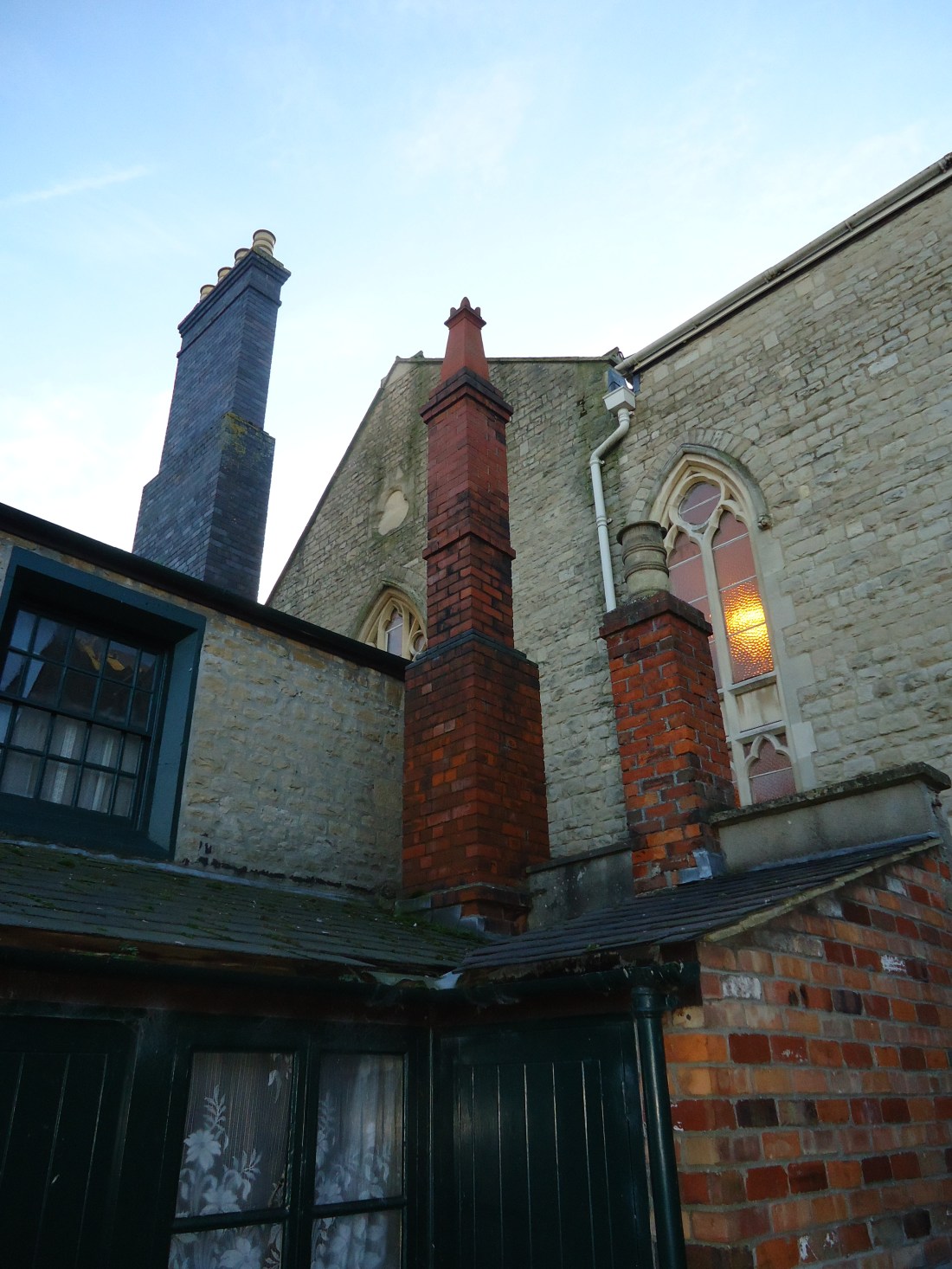
Views of London Street taken in 2019

The facts …

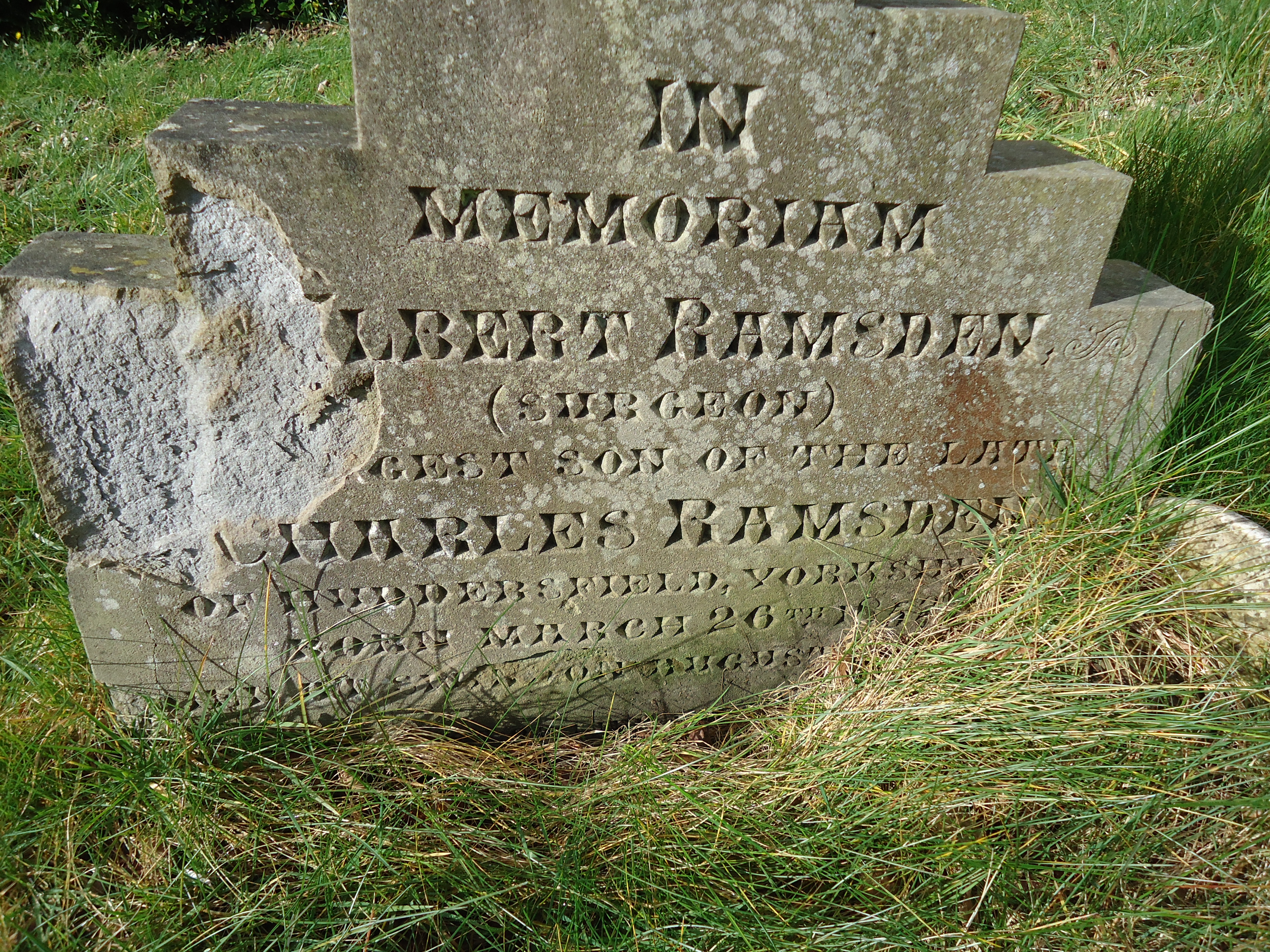
Albert Ramsden was born in 1852 the son of Charles Ramsden and his wife Ann. At the time of the 1851 census, the year before Albert’s birth, the family was living at an address in the Beast Market, Huddersfield where Charles worked as a dry-salter. A dry-salter was a dealer in dry chemicals and dyes and in the 1857 Post Office Directory Charles is listed as living at 9 Beast Market, a dry-salter and oil merchant. By 1861 he was employing five men and two boys and obviously earning enough to pay for his son’s education. That same year Albert was a boarder at a school in Ramsden Street, Huddersfield, run by John Tattersfield.

Albert moved to Swindon in 1881. At the time of the census earlier that year he had been lodging at 35 Bromfelde Road, Clapham where he was described as a medical student. He had previously worked for Dr John Sloane at his large practise in Leicester.

Sudden Death of a Medical Man – An inquest was held at Swindon on Wednesday, August 31st on the body of Albert Ramsden, aged 29, who died suddenly on the previous Monday afternoon, at his lodgings No 5 London-street, Swindon, where he resided with four or five other gentlemen of the medical staff. It appears that deceased, when at dinner, rose suddenly and went into the drawing room where he stayed two or three seconds, and then upstairs. On entering his room shortly afterwards his body was found lying across the bed with the head on the floor. The four medical gentlemen present did what they could for him, but to no effect. Deceased it seemed had fallen in a fit, death resulting from a flow of blood to the head. A verdict was returned in accordance with the evidence. The deceased had only resided at Swindon three weeks, having been an assistant to Dr Sloane, of Leicester, for several years. He was a member of the Royal College of Surgeons, and had passed his examination as L.R.C.P. only four weeks previously.

Leicester Chronicle and Leicestershire Mercury, Saturday September 10, 1881.

Albert had died during an epileptic seizure. He was buried in plot A137, the 14th burial to take place in the new cemetery at Radnor Street.

albert ramsden surgeon

Railway Work, Life and Death project

There are copies of the Medical Fund Society Yearly Reports in Local Studies, Swindon Central Library and I recently published a blogpost about the Accident Hospital.

During 1885 there were 30 patients treated in the Medical Fund Hospital who had sustained injuries during an ordinary working day. Men like Henry Kent 44, a goods guard from Salisbury, who suffered fractured ribs and shoulder and died after 2 days in hospital. Thomas Tuck 38, a labourer from Wootton Bassett, who suffered a scalp wound but was discharged after 10 days in hospital. There are more details available about William Ball 56, a driver from Swindon, who fell off an engine while in motion and fractured two ribs and injured his head. He spent 29 days in hospital and was ‘discharged convalescent.’

Yesterday evening the Friends of Swindon Railway Museum’s monthly lecture, entitled ‘Into the Jaws of Death – working and dying on Britain’s railways 1900-1939,’ was delivered by Mike Esbester from the University of Portsmouth. The subject was the danger railwaymen faced on a daily basis whether working on the trackside or in railway factories such as Swindon Works.

In 1913 30,000 railway workers across the UK were killed or injured and yet responsibility was largely put on the men themselves – that they were careless!

In Mike’s presentation he talked about not just unsafe working practices and conditions but the pressure on workers to complete tasks at sometimes unrealistic speed; when wages were docked if targets were missed. Despite a railway inspectorate that highlighted dangers and trade unions that demanded change, railway companies were reluctant to act, and as Mike emphasised the onus was firmly placed upon the railwaymen themselves. Their personal safety was their responsibility.

In 2016 a joint initiative by the University of Portsmouth and the National Railway Museum saw the beginning of the ‘Railway Work, Life & Death’ project to try to make railway worker accident records more accessible and to see what could be learnt from them. These records are of interest not only to museums and archives professionals but to railway enthusiasts, family historians and the current railway industry. To date volunteers have transcribed around 50,000 surviving records, which are available to view on the project’s website.

Mike’s lecture was both compelling and revelatory. To discover more visit www.railwayaccidents.port.ac.uk.

And if you would like to join the Friends of Swindon Railway Museum visit their website. http://www.fosrm.org.uk/

Images of the Medical Fund Hospital published courtesy of https://swindonstory.uk/stories/gwr-hospital/

Accident Hospital

The Accident Hospital was opened in December 1871 and as the name suggests, that was its sole purpose in those early years. This postcard image published on the Local Studies flickr page has the annotation – ‘For use in case of accidents which are of daily occurance in the GWR Factory.’

On January 12, 1886 doctors Swinhoe, Howse and Bromley made their Accident Hospital Doctors’ Report to the Medical Fund Committee as follows:

Gentlemen,

The New Year of 1885, found us with three Patients in our Accident Hospital. Since then, twenty-seven new cases have been admitted, making a total of thirty for the twelve months. Of these, twenty have been discharged convalescent, six have died, and one is still under treatment and doing well.

We enclose tabulated list for your better information.

We are, Gentlemen,

Your obedient Servants,

Swinhoe, Howse, & Bromley.

Among the injuries treated during 1885 were leg fractures, a crushed foot and fractured ribs.

Of the six deaths that occurred in the hospital four of the deceased were buried in Radnor Street Cemetery.

Fireman Charles W. Nicholls aged 23 of 13 Medgbury Road died from having his ‘chest crushed in’. Charles Nicholls was buried on September 6, 1885 in grave plot A309.

George Turnbull aged 33, Charge Man in B2 Shop died from a compound fracture of the skull having spent 3 days in hospital. George Turnbull was buried on April 2, 1885 in grave plot A727.

Thomas Edwards who worked in the Saw Mill was admitted with a rupture and spent 40 days in hospital where he died of consumption. He was 33 years old. Thomas Edwards was buried on March 28, 1885 in grave plot A204.

William Collett of 40 Princes Street was admitted to the hospital suffering from extensive burns. He died 2 days later. He was 49 years old. William Collet was buried on March 26, 1885 in grave plot A628.

Astley Cooper Swinhoe – a career full of promise

Astley Cooper Swinhoe was born on August 30, 1871 the 8th of George Money and Diana Swinhoe’s 12 children who survived to adulthood. He was baptised on November 17, 1871 by his grandfather, Rev Thomas William Wrench, Rector at St Michael’s, Cornhill in the City of London.

By 1901 Astley was working alongside his father and brother as a medical practitioner at Park House where he died on March 18, 1905.

Dr Astley Cooper Swinhoe

Death of Mr Astley Cooper Swinhoe

The Funeral

An Impressive Service

We deeply regret to announce the death of Mr. Astley Cooper Swinhoe, who passed away at Park House, Swindon, Saturday. The deceased gentleman, who was the third son of Dr. G.M. Swinhoe, contracted pneumonia, and this hastened his death in a painfully sudden manner.

He was well-known and highly esteemed by all classes in Swindon and the loss will be keenly felt. Deceased, who was only 33 years of age, was educated at Marlborough College, and had his medical training in London, where he was for some time in St Thomas’s Hospital. His career was full of promise.

Amid signs of mourning on every hand, the mortal remains of the late Dr Astley Cooper Swinhoe, who died last Saturday, after a short illness, at the early age of 33 years, were laid to rest in Swindon Cemetery on Wednesday morning.

It was a beautiful spring morning, and there was an immense concourse of persons assembled in the Cemetery, where the cortege arrived at a quarter past ten. The mourners left Park House at half-past nine, and proceeded to St Mark’s Church, where a large congregation had gathered. The service was simple and impressive, and was conducted by the Vicar, the Rev. A.G. Gordon Ross, and the Rector of Inkpen, the Rev. H. D. Butler, a former curate at St Mark’s, who also officiated at the graveside.

The body was enclosed in an elm shell, with unpolished oak coffin, with massive brass furniture. On the lid of the coffin was a large brass cross, at the foot of which was the following inscription:- “Astley Cooper Swinhoe, died March 18th, 1905, aged 33 years.”

The coffin was made by Mr Joseph Williams, and the funeral arrangements carried out by Messrs Chandler Bros., Swindon.

Extracts from The Swindon Advertiser, Friday, March 24, 1905.

Swinhoe Astley Cooper of Park-house New Swindon Wiltshire died 18 March 1905 Administration London 15 April to George Money Swinhoe surgeon Effects £1533 2s 2d

This image has an empty alt attribute; its file name is swinhoe-family-3.webp

Dr Astley Cooper Swinhoe was buried in grave plot E8228/29/30 which he shares with his parents and three brothers.

You may also like to read:

The Death of Mrs Swinhoe

George Money Swinhoe – Swindon doctor

Maurice Carew Swinhoe – banana planter and exporter

Dr George Rodway Swinhoe – GWR Company doctor


Alfred Bult Verrier – dental surgeon

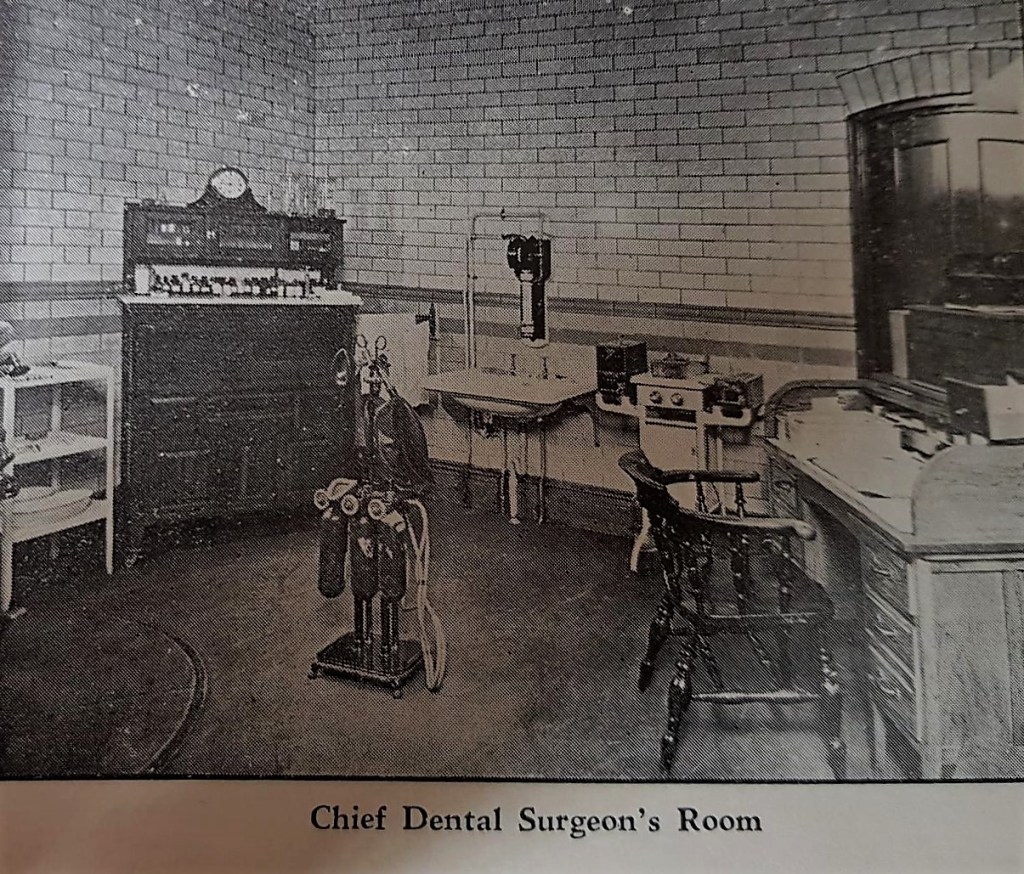
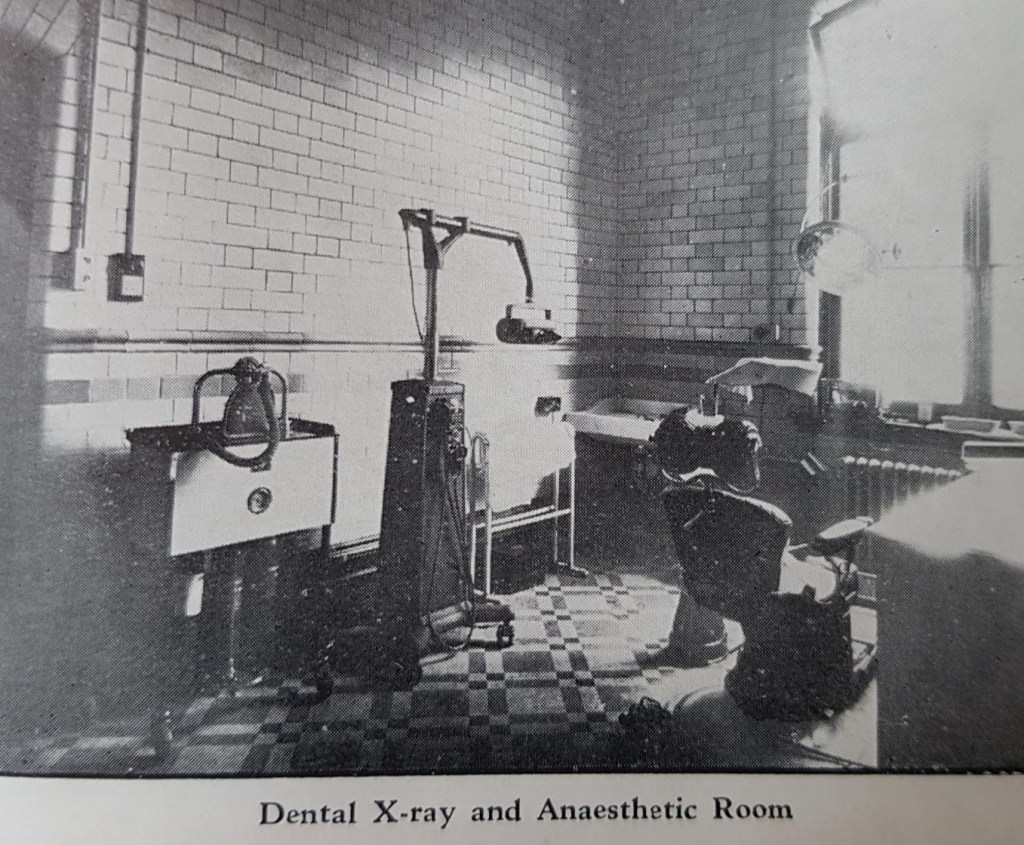
In 1887 the GWR Medical Fund Society appointed a dental surgeon to the newly established dental clinic. Apparently, by the end of that year he had pulled out more than 2,000 teeth.

What happened to those 2,000 teeth!

In 1872 Mr Verrier, a dentist with a practice in Bridport, advertised his new method of adapting artificial teeth. Mr Verrier soon made his way to Swindon where he was employed at the GWR Hospital.

Now I’m not implying that the over zealous tooth puller and Mr Verrier with his artifical gnashers are one and the same person, but did the aforementioned dentist have an ulterior motive for removing so many Swindon teeth? It does make you wonder.

Mr Verrier had a very interesting life and career. For one thing, in 1907 he patented an ‘Improved Protective Shield or Band for Pneumatic Tyres’, which is pretty far removed from dentistry.

Alfred Bult Verrier was born in about 1837 in Taunton, Somerset, the son of George Verrier, a Post Office clerk and his wife Selina. By 1851 he was living in Shoreditch Road, Taunton with his mother and aunt. But at the time of the 1861 census he was missing, most probably because he was living in St. Petersburg. He married Elizabeth Hirschfeld on June 2, 1859 at the British Chaplaincy, St Petersburg, Russia and the couple had two children. Following Elizabeth’s death (presumably) he married Sarah Margaret Blackburn on April 16, 1865 also at the British Chaplaincy, St. Petersburg, Russia.

The couple returned to Britain soon after their marriage and in 1865 Alfred Bult Verrier placed an advertisement in the Dorset County Express and Agricultural Gazette

Mr Alfred Bult Verrier, L.D.S.,

(Royal College of St. Petersburgh,)

Dentist

Informs the Clergy, Gentry, and Public, that he has taken up his residence at Bridport, and solicits the patronage of all who may require his aid.

Mr A.B.V. will be prepared to receive patients on Saturday, December 23rd, at Mr F. Bartlett’s, opposite the Post-office, Bridport.

Mr V. will visit Lyme Regis on Friday, January 5th, at Mrs Davey’s, Confectioner, Broad-street, and Beaminster on Thursday, January 11, at Mrs Meech’s Church-street, continuing his visits at each place fortnightly.

Dorset County Express and Agricultural Gazette – Tuesday 26 December 1865.

At the time of the 1871 census Alfred and Sarah were living at Chards Mead, Bradpole, Bridport with their five children, George Alfred 5, Alide 4, Lillah 3, Walter Ralph 2 and 3 month old Claude Blackburn. In 1881 they were living at Welcombe Regis, Weymouth, now with eight children.

By 1888 Alfred was living in Swindon, where he advertised in the Swindon Advertiser on June 2, 1888.

17, Bath Road, Swindon

Mr Verrier wishes to intimate to his Patients that he maybe consulted professionally on Fridays, at the above address.

And then I lose Alfred at the time of the 1891 census. It may be a transcription error that makes him difficult to find. Although I found Sarah, still married, but ‘living on her own means’ without her husband in Preston, Weymouth with four of her children Adele 23, Zillah 22, Margaret 17 and 10 year old Aldus. Had the marriage broken down?

Two of Alfred’s sons followed him into dentistry and their details, along with Alfred’s, are recorded in The Medical Directory, 1915.

Verrier, Alfred Bult, “Windermere House” Swindon, Wilts. – L.D.S. R.C.S.I. 1879: (Dub.) Dentist GWR Hosp. late Dentist Bridport Cott. Hos. Author, “On Ventilation;” “Continuous Gum Facings,” Dent Jl. 1873; “Mineral Inlay,” Ib. 1879. Inventor of the Continuous Gum Facing Process as applied to Vulcanite; Mineral Inlay & Tooth Crowns; Furnaces for Continuous Gum Work

Verrier, Claude Blackburn, “Windermere House,” Swindon Wilts –                L.D.S. R.C.S.Ed. 1905 (New Sch.Med. & Dent. Hosp. Ed.); Mem. Brit. Dent. Assn.

Verrier, Walter Ralph le, 32 Wood St., Swindon, Wilts. L.D.S. R.C.S. Ed. 1898; (Ed).

The Medical Directory, 1915.

Alfred died at his home 54, Westlecott Road aged 84 years in 1921. He was buried in Radnor Street Cemetery on April 6, 1921 where he lies alone in grave plot E7614.

So many facts about Alfred Bult Verrier’s life remain unknown, including whether he was the dentist who loved pulling teeth in the GWR dental clinic.

Images published in A Century of Medical Service – The Story of the Great Western Railway Medical Fund Society 1847 to 1947 by Bernard Darwin and published in 1947.

Dr George Rodway Swinhoe – GWR Company doctor

The GWR Company doctors came and left, but the Swinhoe family of physicians were a constant presence from 1859 until 1918.

George Rodway Swinhoe was born on December 15, 1867 at 4/5 London Street, a property in the railway village which served as both accommodation for the GWR company doctor and as a surgery. George was the sixth child and first son of George Money Swinhoe and his wife Diana.

A member of the Royal College of Surgeons (England) and a Licentiate of the Royal College of Physicians (London) Dr George Rodway Swinhoe was appointed to the medical staff at the GWR in 1893. His name appears in the Register of Staff alongside such railway luminaries as Charles Benjamin Collett, Chief Mechanical Engineer; Wm Arthur Stanier, Principal Assistant to the Chief Mechanical Engineer and Frederick George Wright, Chief Assistant Locomotive and Carriage Superintendent.

In 1894 he married Mary Canning Gertrude Glass and the couple had two daughters.

Dr Swinhoe died at him home on November 10, 1929. The following obituary was published in the North Wilts Herald.

Death of Dr. G. Rodway Swinhoe

Popular Swindon Medical Man

Useful Career

Dr George Rodway Swinhoe, of The Close, Church Place, Swindon, passed peacefully away at his residence at 6.40 on Sunday evening.

He had been in ill health for some time, but was only taken seriously ill a week ago. On the previous Monday he was engaged in his professional duties as consulting surgeon and examiner to the GWR Company at Swindon.

Dr Swinhoe was 61 years of age and had lived in Swindon practically all his life. “Roddy” Swinhoe, as he was popularly known to a host of friends, was a son of the late George Money Swinhoe, who came of a very old Northumbrian family.

Dr. G.M. Swinhoe was born in Calcutta, and he went through the Crimean War, but came out of the ordeal unscathed. He came to Swindon as chief medical superintendent on the GWR Medical Fund staff, on the special recommendation of the late Sir Daniel Gooch.

Appointed to the Staff.

At a later period the medical staff comprised Drs. Swinhoe, Howse and Bromley. The last named died in 1894, and Dr. G. Rodway Swinhoe was then appointed to the staff. Dr. Howse retired in 1899, and Dr Rodway Swinhoe became chief assistant to his father, whilst his brother, the late Dr. Astley Swinhoe, became third assistant.

The father and two sons carried on the three chief positions on the GWR Medical Fund staff til 1905, when Dr. Astley Swinhoe died.

In 1908 Dr George Money Swinhoe died, and Dr. G. Rodway Swinhoe was appointed to the office of Chief Medical Officer, a position which he held till the year 1917.

Dr “Roddy” Swinhoe, who was the eldest of a large family*, was a zealous and most able physician and surgeon. He was a member of the Royal College of Surgeons (England) and a Licentiate of the Royal College of Physicians (London). His post on the GWR Medical Fund staff and with the GWR was an onerous and responsible one.

Services During the War

During the war Dr “Roddy” rendered valuable medical services. He was previously in the old Swindon Volunteer Corps, afterwards taken over by the Wilts Territorials. Then he was promoted to the rank of Major in the RMTC.

In Charge of Labour Battalion

For a period of the war Dr. Swinhoe was in charge of a Labour Battalion in the Park and Drill Hall. Later he was in charge of a private military hospital at Bowood, Calne, which was placed at the disposal of the authorities by the late Lord Lansdowne.

Dr Rodway Swinhoe was also a keen worker in connection with the GWR St. John Ambulance Association, and was the experienced lecturer to the classes for a number of years. For his services he was, on his retirement, made an Honorary Associate of the Grand Priory of the Order of St John of Jerusalem.

Interest in Sport

Always a lover of clean, good sport, Dr. Roddy was closely identified with the Swindon Amateur Swimming Club, the Swindon Amateur Athletic Association, the Gymnastic Societies, and many other sports associations. In his younger days fishing and shooting were his hobbies, and he used often to tell some good stories at dinners of various societies to which he was always invited.

The Funeral

The funeral took place on Wednesday.

The first portion of the service was conducted in St. Mark’s Church by Canon A.G. Gordon Ross (vicar). Canon Ross also read the committal sentences at the graveside in Radnor street cemetery.

A long list of mourners included family members, and representatives from the GWR Company and the Medical Fund Society.

Many beautiful floral tributes were placed on the grave.

The funeral arrangements were carried out by Mr A.E. Smith, of Gordon Road.

North Wilts Herald Friday, November 15, 1929

*He was the 6th child but the eldest son

Dr George Rodway Swinhoe was buried in a large grave plot numbered E8228/29/30 which he shares with his parents and three brothers.

You may also like to read:-

George Money Swinhoe – Swindon doctor

Maurice Carew Swinhoe – banana planter and exporter

The death of Mrs Swinhoe

Private Albert William Hall – Royal Army Medical Corps

The report of the death of Albert William Hall published in the North Wilts Herald in 1920 is, in my opinion, a carefully worded account of an interview with his grieving family. Only they could have known the awful development of his ill health, the repeated operations, his re-admission to hospital again and again and the agonies of his final days.

Swindon Family’s Bereavement

The Late Mr A.W. Hall

The death occurred on July 13th, at 86 Ponting Street, Swindon, of Albert William Hall, the only son of Mr. and Mrs W.J. Hall, from disease contracted on active service.

Prior to the war deceased was employed at the Town Hall, under Mr. H.J. Hamp (the borough surveyor). Enlisting in the local Territorials in January, 1914, he was in training at the outbreak of war and was mobilised for service with the Wilts RAMC (T). Through a minor defect he was marked for home service, and subsequently transferred to the 2/1st Wilts RAMC (T) on the formation of that Unit.

As soon as possible he underwent an operation, thus fitting him for foreign service, and, joining the staff of the “Aquitania” in December, 1916, he proceeded abroad, and was attached to the Mediterranean Expeditionary Force. On the outward journey he contracted pneumonia, and on the ship’s return he was admitted to Netley Hospital, on December, 1916.

Following a successful operation in that hospital, he was in May transferred to the War Hospital at Bath. After a further five months in Hospital he was taken to Winsley Sanatorium for treatment lasting over four months. He arrived home in January, 1918, but progress was unsatisfactory, and two months later he was admitted to University College Hospital, London, where another operation was performed. In September he was transferred to a convalescent hospital at Cobham, Surrey, and remained there until January, 1919. He then returned home, but two months later was re-admitted to the University College Hospital, to undergo yet another operation.

After four months in this hospital he was, at his own wish, brought to the GWR Hospital, Swindon, where he remained an in-patient for three months. From October, 1919, until a few days before his death he attended the hospital daily for surgical treatment. Altogether his illness extended over 3½ years, during which time he was constantly brave and cheery, thus commanding the respect and admiration of doctors and nurses, and, indeed, of all with whom he came in contact. What he really suffered can never be known, because he always hated to complain, and it was only latterly when he began to experience great difficulty with his breathing, that he showed any signs of weakening under the strain. He was confined to his bed for a day or two only before his rather sudden death, and though suffering great pain during that time he retained consciousness to the last, and passed away very peacefully.

The greatest sympathy is felt by all for his parents and fiancée, who in the midst of their great sorrow can yet feel justly proud of a life which, though taken so early, has been one of such splendid example.

The funeral took place on Saturday, and the presence of so many old friends from church, school, office, etc., spoke eloquently of the sympathy manifested by all who knew him. Leaving his home in Ponting Street, the cortege proceeded to the Railway Mission, where the first part of the burial service was conducted by Mr. Ernest M. Lewis (former Sunday School teacher), the bearers being old Sunday School friends. During the service special tribute was made to the brave and patient manner in which deceased bore his long illness, and the hymn, “Loved with an everlasting love,” was sung. The interment was in the Radnor Street Cemetery, and at the graveside Mr. Lewis again officiated, a prayer being offered by Mr. Ludlow (Supt. Of the Railway Mission Sunday School). The coffin was of polished elm with brass fittings, and bore the following inscription:-

Albert William Hall,

Died

July 13th, 1920.

Aged 23 years.

Mr and Mrs W.J. Hall and family desire to tender their heart-felt thanks for the many beautiful tokens and the sympathy shown to them in their sad bereavement, also for the many kind enquiries made during their son’s long illness.

Extracts North Wilts Herald, July 23 1920

Albert William 23 years of 86 Ponting Street was buried on July 17, 1920 in grave plot D1088. He shares the plot with his father and mother – William John Hall who died in 1946 and Esther Tucker Hall who died in 1958.

This photograph was taken several years ago before the Radnor Street Cemetery volunteers began caring for the war graves. Today you will find access across the cemetery to the headstones via a mown path. The area around each headstone is kept clear and maintained by the Eyes On, Hands On team of volunteers working under the supervision of the Commonwealth War Graves Commission.