George Money Swinhoe – Swindon doctor

The re-imagined story …

I remember wondering why Dr Swinhoe had a sword on the top of his coffin. I kept pulling on my mother’s coat and asking – ma, ma until in exasperation she hissed at me ‘because he served in the Crimea War.’

Well, of course, I was none the wiser.

It was only years later that I learned about that bloody war where some 500,000 lost their lives due to the incompetence of commanding officers and the appalling conditions in the hospital in the converted barracks at Scutari. This was the war in which Florence Nightingale transformed nursing practices in the battlefield hospitals and back home here in England.

The Crimea War was the greatest military horror in a generation, that is until millions were sent to their death in the Great War.

Dr Swinhoe served as a medical officer in the Crimea War and I served as one in the Second World War. I didn’t get a sword though, shame about that!

Dr George Money Swinhoe

The facts …

Impressive Funeral Ceremony

Marked Expression of Public Esteem and Sympathy

The large crowds of people which followed the remains of the late Mr G.M. Swinhoe to their last resting place in the Swindon Cemetery on Saturday afternoon bore eloquent testimony to the very high and general esteem in which the deceased gentleman was held by all classes, for in these crowds were to be seen those of the very poorest circumstances mingling with those occupying important positions in connection with the public life of the town. It was a raw cold afternoon, and yet this did not deter these people from turning out in their hundreds to pay a last tribute of respect to the dead – to the memory of one who in his life time had been to so very many “a guide, philosopher, and friend.”

The solemn cortege was timed to leave the deceased gentleman’s late residence, Park House, Church Place, at two o’clock, but some time before this hour arrived, a very large number of people took up their position at a respectful distance from the house and patiently awaited the appearance of the coffin, which punctually at two o’clock, was borne out of the house. It was entirely covered with the Union Jack, and upon it, resting among a wealth of lovely flowers, was to be seen the trusty sword which the dead Crimean veteran carried with him during that eventful period in English history when he was attached to the medical staff. Within an area of but a few yards four Union Jacks could be observed flying at half mast – that at the GWR Medical Fund Hospital; that at the GWR Mechanics’ Institution; that at the Swimming Baths, and that in the Park over which Park House commands such an extensive view.

A minute or two after the hour had struck, the solemn procession moved slowly towards St Mark’s Church, where Mr Swinhoe was a regular worshipper, and where he for many years discharged the duties of Churchwarden. At the entrance to the Church the crowd was even greater than at Park House. Everyone wanted to gain admission to the sacred building, but accommodation was limited, and the police, of whom there were many on duty, firmly but gently had to stem the tide of those who sought to be present at the service. As it was, the Church was full almost to suffocation, but at no time was there any unseemly rushing, so well was the crowd controlled.

The service, conducted by the Rev. A.G.G. Ross MA Vicar of St Mark’s was of a most quiet and impressive character. As the coffin was borne into the Church, followed by the mourners, “Rock of ages” was sung as the processional hymn. Then the 90th Psalm, “Lord, Thou has been our dwelling place in all generations,” was chanted, the full Choir being present, after which Canon Ponsonby, formerly Vicar, read the Lesson from I. Cor., 15th chapter, from 20th verse. “But now is Christ risen from the dead.” The hymn, “Peace, perfect peace,” was then sung, after which, while the congregation stood, and as the funeral procession moved out of the Church, Mr E. Miles, the organist, played the “Dead March” in Saul.

All along the route to the Cemetery hundreds of people followed, and pedestrians going about their ordinary business stood and uncovered as the procession passed. At the Cemetery between three hundred and four hundred people had assembled. The grave, the same in which the remains of Mrs Swinhoe were interred some fourteen years ago, not far from the Cemetery Chapel, was within a roped enclosure outside which the people were kept back by the police, under the Deputy Chief Constable (Supt. Robinson) and Inspector Moore. The police, however, had not the slightest difficulty in controlling the crowd, no attempt being made to in any way break through the barrier.  As the funeral procession approached the grave the 130th Psalm, “Out of the depths have I cried unto Thee, O Lord,” was chanted. At the graveside the Rev. A.G.G. Ross performed the last portion of the solemn rite; then the hymn, “Now the labourer’s task is o’er,” was sung, and the impressive ceremony concluded.

The following members of the Committee of the GWR Medical fund Society acted as bearers: Messrs H. Morris (Chairman), William Humphries, W. Sansum, A Watson, B. Wheel, and Z. Peskett.

The grave is a brick one, and had been very beautifully lined with moss, snowdrops, violets primroses, crocuses, and auriculas. The remains were enclosed in an unpolished oak coffin, with a brass Latin cross down the full length of the lid, and at the foot was a brass plate bearing the following inscription: George Money Swinhoe, Died Feb 27th, 1908, Aged 77 years.

List of mourners and floral tributes …

Many of the officials connected with the Medical Fund Society carried wreaths.

In the procession of vehicles, it should be added, was to be noticed the deceased gentleman’s carriage in which he covered so many of his no doubt fatiguing rounds.

Extracts from the Swindon Advertiser, Friday March 6, 1908.
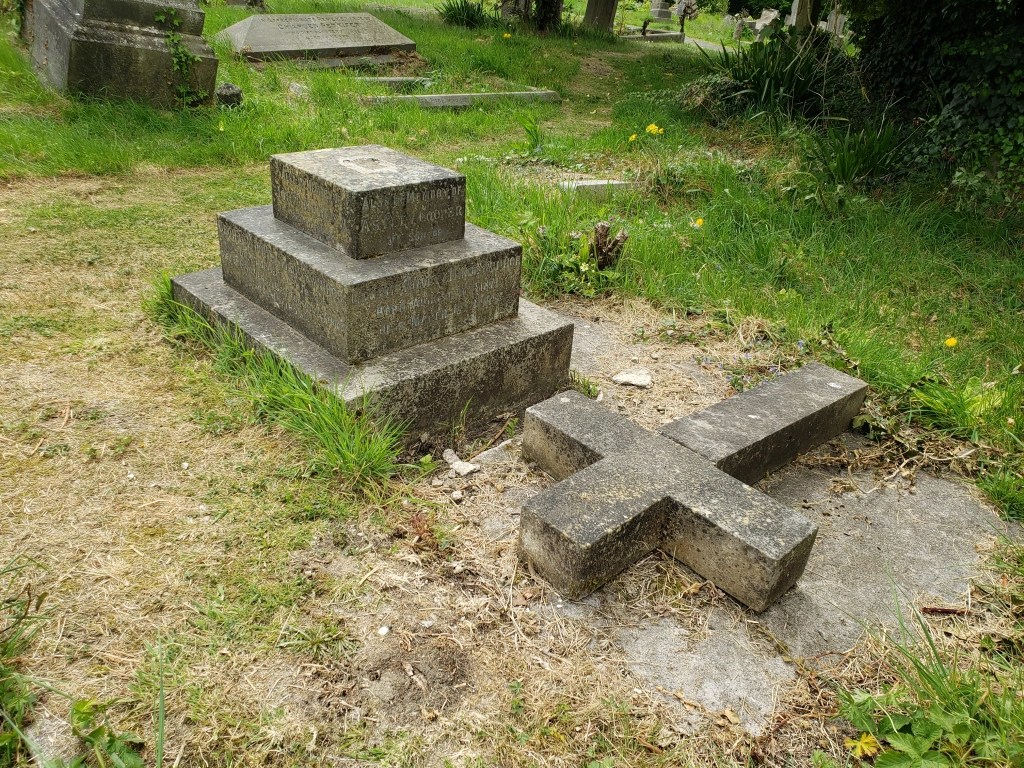
George Money Swinhoe 77 years of Park House was buried on February 29, 1908 in a large grave plot numbered E8228/29/30 which he shares with his wife and four sons.

You may also like to read:
Maurice Carew Swinhoe – banana planter and exporter

The Death of Mrs Swinhoe

The Cost of a Kiss?

The re imagined story …

Arranging this evening had been an organisational nightmare, I can tell you. I had to persuade Daisy to come out with me in the first place, then I had to wait until she had a Saturday evening off work. Probably the most difficult task was getting my father to allow me the use of the pony and trap. I couldn’t tell him I planned to take a young lady for an evening drive, he already thought I was irresponsible and not to be trusted. In the end I told him a lie. I said a friend had to make an emergency trip into the Medical Fund Hospital. I could hardly have guessed how prophetic this would be.

I managed to drive the pony and trap out of the yard without him glimpsing me. He would surely have seen through my deception had he caught me wearing a new collar and my Sunday best jacket.

I pulled up outside the manor house and waited for Daisy. I didn’t really know what we could do or where we could go, I hadn’t planned that far ahead. But it was a beautiful evening so I suggested we go for a walk through the copse to the stream.

I parked the pony and cart at the road’s edge along Church Hill. Mol was a placid old horse, I knew she would stay where she was left. I never thought of the bend in the road or that the light might soon be fading. I never imagined there would be any other traffic at that time of the evening, quite forgetting the shopper’s bus from Moredon to Swindon.

All I could think about was Daisy and how beautiful she looked that summer’s evening and whether she would let me kiss her as we walked down by the stream.

We had hardly walked into the copse before we heard the sound of galloping horses and raised voices and the Moredon bus travelling down the hill at a furious speed. Suddenly there were shouts and screams and a splintering crash.

Daisy had already begun to run back to the roadside. The pony and trap still stood where I had left them, but all around was a scene of mayhem. The bus had crashed into the bank, throwing several passengers out of the vehicle and onto the road. The driver must have climbed out, or perhaps was thrown out, as he stood between the two horses holding their bridles, attempting to calm them.

Everything was in chaos. A woman lay on the ground beneath the bus while others were trapped inside. I saw one poor man so covered in blood I could hardly see his features.

Daisy rushed forward to be of assistance while I stood rooted to the spot. “What will I tell my dad?” I pleaded. Could the trap I had left unattended just beyond the bend in the road be the cause of this disaster? I could tell by the expression on Daisy’s face that she thought so.

Valentine 2

The facts …

Road Car Accident at New Swindon

Several Persons Injured

One Man Dies

As already reported, an accident occurred on Saturday evening that to the 8.40 pm car from Moredon to Swindon, by which several persons received injuries, and unfortunately in one case a fatal result has followed. It appears that on Friday and Saturdays special cars are run to Moredon by the Swindon Road Car Company to enable persons to visit Swindon for shopping purposes, etc.

On Saturday last this car left Moredon as usual. On arriving at the Church Hill, Rodbourne, we are informed (and we give it with all reserve) that the driver did not put the brake full on, but allowed the horses to keep up the pace whilst descending the hill. The car was running on the right side of the road, and on turning the corner just below the churchyard a baker’s cart belonging to Mr H. Robins, baker, of Moredon, was seen. The driver immediately pulled to the left side, and ran into the bank, the swing turned the car over on its side. The occupants of the front seats were thrown out, and those inside were violently thrown about.

Assistance was soon to hand, and everything was done on the spot that was possible. Just after a waggonette belonging to Mr Hall, of New Swindon, and conveying a party of cricketers to Swindon, arrived. This party quitted the conveyance, and the injured were conveyed to the GWR Medical Fund Hospital therein. There were five adults and three children brought to the Hospital. After they had been attended to by Dr. G. Rodway Swinhoe, they were sent home with the exception of a man named Harry Marshall, a married man with a family, and residing at 17 Morse Street. He was suffering from a nasty scalp sound and an injury to his back. On enquiring this morning, we find he is progressing favourably.

Another man, named Herbert Newsome, a cripple, living with his parents in Spring Gardens, was found to be suffering from a cut on the forehead and chin. After receiving attention he was driven home. It appears however, that he suffers from bleeding, and on Tuesday it became so serious that he was removed to the Hospital about 2 am. Under the careful treatment of the staff the haemorrhage was stopped. He died, however, last evening and the cause of death will be the subject of an inquiry this afternoon. Deceased who was quite a young man had been a cripple for some seven years He was a member of the Wesleyan Chapel in Princes street and on the day of the accident was returning from the anniversary tea in connection with the Moredon Wesleyan Chapel in company with friends.

The Matron told us that the people presented an awful sight on their arrival at the Hospital on Saturday evening last ….

Extract from the Swindon Advertiser Friday June 9 1899

 At the inquest the bus driver told how he had worked around horses all his life and was an experienced coachman who had until recently lived in London. He said he had never had an accident before in his life.

A number of contributory factors to the accident were revealed – the bus was overloaded, braking equipment had failed and passengers said the driver was travelling too fast.

‘The Doctor’s Evidence

Dr G.R. Swinhoe said he was called to the cases at about 11 o’clock on Saturday night, and found two women and three men at the GWR Hospital, suffering from injuries received in the accident. They were all brought there in a carriage. Amongst them was the deceased, and when witness saw him he was told that he (deceased) was a “bleeder,” or a person who would bleed at the slightest scratch. Witness therefore attended him first. They did what they could for the man and put on such pressure as he could stand, and they apparently stopped all bleeding. He went home, but haemorrhage started again, and on Tuesday he was taken worse, and sent back to the Hospital. He (witness) would not have sent him out, but he had a little doubt as to whether he should or not, because he was not a factory hand. He eventually died from the effects of bleeding as a result of the accident. There were two cuts – one on the scalp and a very tiny one on the chin. It was this latter which caused the most trouble, for they could not get any pressure on it to stop the bleeding. Deceased must have lost a tremendous amount of blood before he came to the Hospital.

The Coroner said he thought they could all understand how the accident happened, and from the evidence no blame rested on the driver of the car.

The jury then returned a verdict of “Accidental death.”’

Extract from the Swindon Advertiser published Friday, June 16th 1899

Herbert Newsome was born in Twerton on Avon, the eldest son of Joshua and Lydia Newsome. At the time of the 1891 census the family were living at 6 Spring Gardens. Joshua was a general labourer in the GWR Works while Herbert worked as a Clothier’s Assistant. Herbert was buried in plot C934 on June 13, 1899.

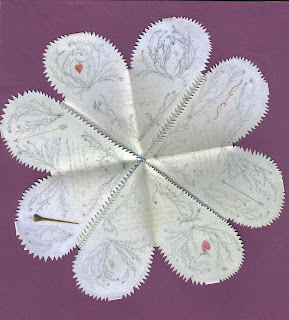
You might also like to read a story I wrote some years ago about a local Valentine card (see above) that appeared on the Antiques Roadshow in 2008.