Saturday July 8 sees Swindon celebrate the 75th anniversary of the NHS with the Mechanics’ Institution Trust. Events in the Emlyn Square area include an exhibition in the Central Community Centre with a talk on the GWR Medical Fund by Adam Busby at 4 pm. Visit the Railway Village Museum open 11-3 and join a walking tour of the Railway Village focussing on ‘Health.’ The Bakers Café will be open for refreshments.
And read below about one of those pioneering members of the GWR Medical Fund Society.
Swindon
Obituary
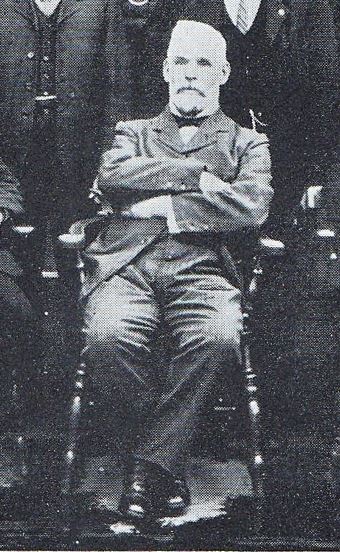
The death occurred on Thursday morning at his residence, 6, Milton Road, Swindon, of Mr Zacharias Peskett, an old and highly respected resident of Swindon. For the long period of 44 years he had been in the service of the GWR Company, and for over 30 years he had uninterruptedly held office as treasurer of the GWR Medical Fund Society. He was generally esteemed as an upright and honourable man, and was a valued servant of the company. He was in his 70th year.
Western Daily Press, Bristol, Friday, May 29, 1914.
The Late Mr Z. Peskett,
Funeral
The esteem in which the late Mr Zacharias Peskett, of 6, Milton Road, Swindon, was held by his former colleagues in the GWR Works and by the officials of the GWR Medical Fund Society – an organisation with which his name had been prominently associated for more than 30 years – was exemplified on Tuesday afternoon, when the funeral took place at Swindon Cemetery amid every manifestation of sorrow and respect.
The cortege left Milton Road at 3.15 and proceeded to St. Mark’s Church, where a short but impressive service was conducted by the Rev. Lionel Calway.
The coffin, on which was a large cross of white flowers from the family and other beautiful floral tributes, was conveyed on a four-wheel bier, Messrs J. Lawrence, E. Griffiths, W. Sansum, T. Jackson. R.A. Zebedee and Humphries (representatives of the Medical Fund Society) acting as bearers.
Then followed a hand-bier on which were placed the wreaths, and in charge of Mr Peskett’s personal staff – Messrs. T.H. Westbury, C.E. Knapp, J. Clark and Angle. Behind the mourning coaches walked the Rev. H.J. Parker (pastor of South Street Baptist Chapel, where deceased formerly worshipped), representatives of the Medical Fund Society and the Sick Fund Society and many old friends and former colleagues of the late Mr. Peskett.
Long list of mourners …
From St. Mark’s Church the coffin was borne to the Cemetery, the route chosen being Cambria Bridge Road, Radnor Street and Clifton Street. The Blinds at many of the houses on the way to the Cemetery were drawn as a mark of respect to the deceased.
At the graveside the cortege was joined by a large number of sympathisers, and the service was impressively conducted by the Rev. L. Calway. The coffin was of polished elm, with heavy brass furnishings, and the breast plate was inscribed as follows:-
Zacharias Peskett,
Died May 28th, 1914.
Aged 69 years.
Many beautiful floral tributes were sent by relatives and friends…
The funeral arrangements were satisfactorily carried out by Messrs. H. Smith & Sons.
Extracts from theNorth Wilts Herald, Friday, June 5, 1914.
Zacharias Peskett was buried on June 2, 1914 in plot D1297, a grave he shares with his wife Annie who died in December 1924.
Henry James Fortune was 82 years old when he died in 1943. He had lived an eventful life but was there anyone still around who remembered him as a young man? His wife Nellie had died 20 years previously.
So, let’s go back to the beginning.
Henry James Fortune was born on July 5, 1861, in Mells, Somerset, the son of John Fortune, a policeman, and his wife Mary.
As a young man, a little older than 15 when boys these days are still in school, Henry joined the navy. His service records describe him as 5ft 1½ ins, light brown hair, blue eyes, fair complexion. The first ship he served on was HMS Impregnable. On census night 1881 Henry, aged 19, was serving on the HMS Temeraire in the Grand Harbour, Malta. His last service date was April 22, 1886 and the last ship he served on was the HMS Hercules.
By 1886 Henry was settled in Swindon, employed as a Stores Clerk in the GWR Works. The following year he married Ellen Louisa House at Holy Trinity Church, Frome. At the time of the 1891 census he was living at 26 Taunton Street aged 29 years when he describes himself as a Fitters Labourer (another change of occupation?) – Ellen and their two children are visiting her parents in Frome.
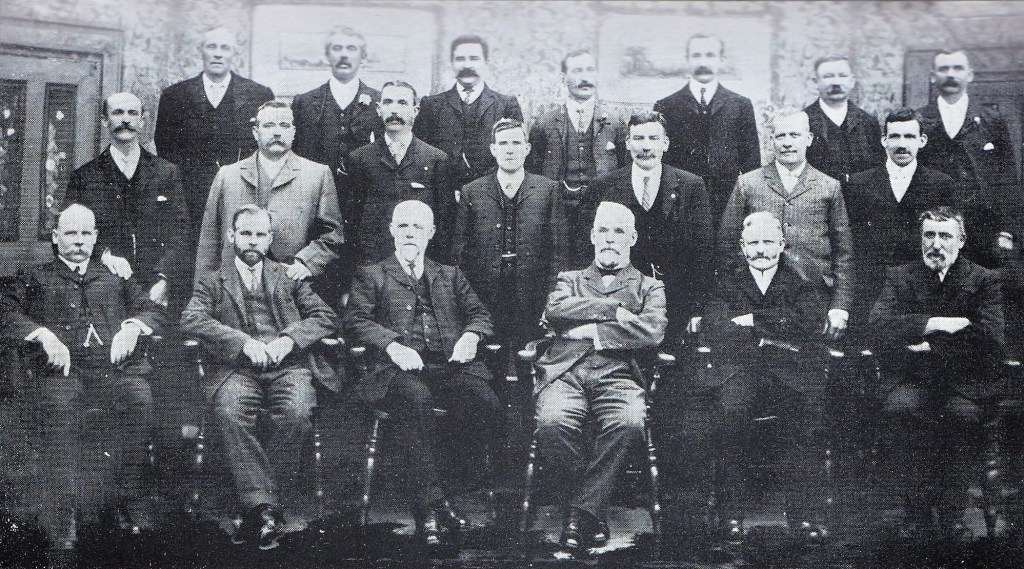
Henry was nominated for election to the Management Committee of the GWR Medical Fund Society in 1904 and in 1907 is pictured on a formal photograph seated next to Zacharias Peskett, the long serving treasurer.
On the 1911 census returns the Fortune family are living at 20 Oxford Street where 49 year old Henry works as a railway clerk. The couple have been married 23 years during which time they had 12 children of whom sadly 4 have already died.
In 1939 he was at 246 Ferndale Road, a widowed retired Railway Clerk living with Leonard and Edith Brain (daughter and son-in-law) and their family.
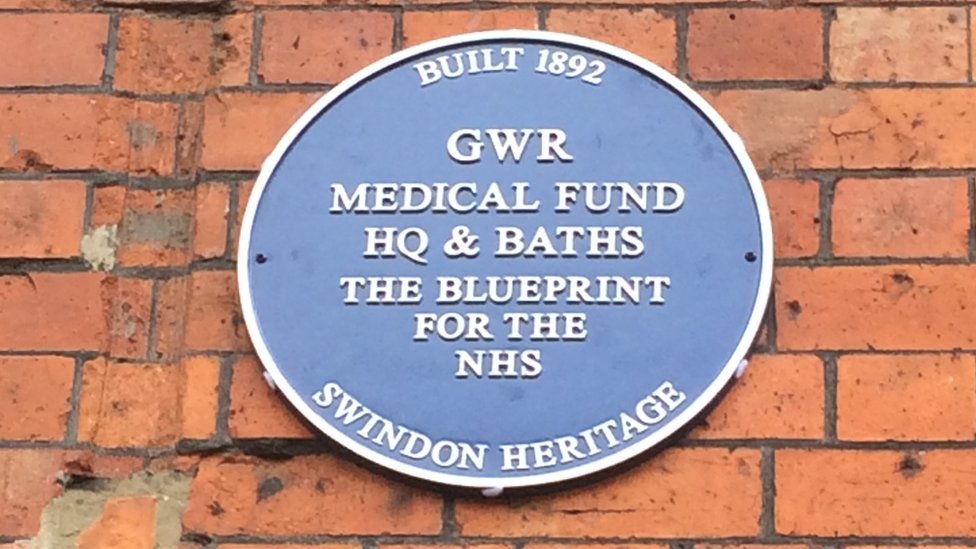
The GWR Medical Fund Society, like many other similar organisations across the country, provided a blueprint for the National Health Service established in 1948. Henry had been gone nearly five years by then. For those who remained on the Medical Fund Committee it must have been a time of mixed feelings. Free health care for all but with that came the eventual dismantling of the Medical Fund and 100 years of endeavour in Swindon.
Henry James Fortune died in St. Margaret’s Hospital aged 82 years. His funeral took place on December 30, 1943 when he was buried in grave plot C3868 with his wife Ellen who had died in 1923.
The Medical Fund Society Management Committee pictured in 1907
As we prepare to celebrate the 75th anniversary of the National Health Service, I am publishing on this Swindon based blog the story of the GWR Medical Fund Society and some of the people who made it a success.
Perhaps fittingly Henry Morris, Chairman of the GWR Medical Fund Society for 33 years, died in the GWR Medical Fund Hospital.
Henry was born in Wolverhampton but at the time of his marriage had already moved to Swindon where he worked as a brass finisher in the GWR Works. He married Sophia Annie Evans in St James’s Church, Wolverhampton on July 10, 1871. The couple lived at 23 Gloucester Street where they would remain throughout their long marriage.
Death of Mr H Morris
33 Years Chairman of the Medical Fund Society
By the passing of Mr Henry Morris, Swindon has lost an old resident who has contributed in no small measure to the well being of the town of his adoption. A man of absolute and unimpeachable integrity, and one who aimed at doing “good by Stealth,” he has left behind him a record of public and social service which stands forth as a shining example to those of the younger generation, and it is indulging in the merest of truisms to say that the community is all the poorer by his death.
The late Mr Morris came to Swindon from Wolverhampton in 1870, and remained in the service of the GWR Company until the Christmas of 1915. From that time onwards his health gradually failed, and about ten weeks ago it was found advisable to remove him to Guy’s Hospital for an operation. He went through the as satisfactorily as was to be expected, and returned to Swindon a fortnight since, but it soon became apparent that the end was not far distant, and he passed away, after enduring great suffering, in the GWR Medical Fund Hospital on Tuesday afternoon. Mr Morris was 72 years of age.
It is because of his remarkable work in connection with the GWR Medical Fund Society that Mr Morris will be best remembered. For no less a period than 36½ years he was a member of the committee, and his colleagues testified in no uncertain manner to their appreciation of his unfailing courtesy and geniality by electing him as their chairman for 33 years in succession. Mr Morris saw the society pass through many vicissitudes while he was in office, but, thanks very largely to his zealous work and sound leadership, it succeeded in weathering all the storms with which it was assailed. Swindon people hardly need to be reminded of the development of the society’s operations during the past quarter of a century and more, and in the construction and management of the up-to-date Turkish, swimming and washing baths the late Mr Morris was largely identified. He was also chairman of the hospital Sub-Committee for many years, and took a real an deep personal interest in the welfare of the members of the society whom misfortune had brought within the four walls of that invaluable institution.
In his capacity as chairman of the committee of the Medical Fund Society Mr Morris was a member of the Management Committees of the Swindon Victoria Hospital Winsley Sanatorium (until it was taken over by the Charity Commissioners) and the Royal West of England Sanatorium at Weston-super-Mare, and he also attended the general meetings of numerous hospitals and other charitable institutions, his advice and experience being of great value on such occasions. It may be re-called that on Mr Morris’s retirement from the GWR Company’s service the members of the society presented him with a purse of money and an illuminated address, and made him one of their vice-presidents.
Amongst other public offices held by the late Mr Morris was that of a justice of the peace for the borough of Swindon, that honour having been conferred upon him in February, 1914. He was also for a number of years a director of the Henry Street Co-operative Society.
The deceased gentleman with be affectionately remember by many of the past and present generations because of his labours in connection with the Faringdon Street Wesleyan Church. For a very long period he conducted with marked success, a large class in the Sunday School and his work did not begin and end there for he filled various offices in the church itself from time to time.
Extracts from the North Wilts Herald, Friday, October 19, 1917.
The Late Mr H. Morris
Funeral
To the accompaniment of a striking demonstration of affection and regard, the remains of the late Mr Henry Morris was consigned to their last resting place in Swindon Cemetery on Saturday afternoon. The first portion of the burial service was held at the Faringdon Street Wesley Chapel, with which the deceased gentleman was so long and so prominently associated. A large congregation assembled, and the proceedings were impressively conducted by the Rev. H.C. Basset, the recently appointed superintendent…
In the course of the service the Rev. H.C. Bassett gave a brief address:
“I think, perhaps, it is fitting,” he said, “that just a word should be spoken before we lay to their last rest-place the mortal remains of our brother, Morris. My personal knowledge of him was only limited, but to most of you he was a very intimate acquaintance. I visited him on different occasions during the illness which carried him away from us, and there was displayed one ach of those occasions a firm trust in the Saviour, and the realisation of the presence of the God Whom he had loved and served for many years. From all I have heard of him, his removal will be a heavy bereavement to this church. His service was always characterised by great devotion, fidelity and whole-heartedness and I believe he carried the same qualities into his work in other spheres. That he gained the respect of his fellows in endorsed by your presence. As a public servant he discharged his duties faithfully, with credit to himself and satisfaction to those who elected him to office. One person especially has spoken to me of him as one of Nature’s gentlemen – a beautiful tribute to his winsome personality. If you had asked him, he would have said, ‘By the grace of God, I am what I am’…
Mourners included –
Messrs J. Clark, W.J. Hathaway, C. Spencer and W.G. Slatter representatives of the GWR Sick Fund Society and amongst the officials and members of the Medical Fund Society were Messrs W. Spruce and S.E. Walter (past and present secretaries).
Extracts from the North Wilts Herald, Friday, October 26, 1917.
Henry Morris was buried on October 20, 1917 in grave plot E8657. His wife Sophia Annie died in January 1942 and is buried with him.
The cemetery has many moods and I love them all. At the moment it is wearing it’s summer personality with swathes of ox eye daisies swaying in the breeze. However, it does make locating graves a tad difficult. Armed with my notebook and cemetery maps I was pleased to discover the grave of William and Harriet Spruce was closer to the path than I had calculated.
William Spruce was born on February 6, 1858 in Chippenham, the eldest son of William and Mary Spruce. By 1871 the widowed William Snr had moved to a cottage in North Street where he lived with his two boys and worked as a blacksmith’s striker, most probably in the GWR Works. Thirteen year old William followed his father into the Works later that same year.
William married Harriett Badminton in 1880 and by 1891 the family were living at 32 Hythe Road – William, Harriett, their four children and Harriett’s widowed father Isaac.
William’s employment records state that he worked in G Shop as a shop clerk and that he retired on November 25, 1922. There is also a note that he was Medical Fund Society Secretary.
As today, in 1916, public figures were subject to scrutiny. At the 69th annual meeting of the GWR Medical Fund Society the Chairman delivered what he called “the most unfavourable report in the history of the society.”
The account in the North Wilts Herald continued:
“The past year had been one of increased difficulties, and the committee thanked the members for their kind assistance in surmounting them. The continuance of the war had made many demands upon the finances of the society. The increased cost of medical assistance, and the high and increasing cost of drugs, necessitated a further consideration of the financial position of the society.”
And then in the middle of this sombre and difficult meeting, a motion was proposed by one of the members.
Allegation Against the Secretary
After the accounts had been passed, Mr Stevens moved that a committee of members – numbering perhaps seven – should be formed to make an enquiry regarding the “offensive and abusive behaviour” of the Secretary to the members and their families when business took them to his office. Mr Stevens proceeded to give an account of what he alleged transpired at the office when his daughter called. The Secretary asked inquisitive questions, and, before a number of people said: “I am surprised at your father, secretary of a trade union, out robbing the society in the way he is doing. We have been robbed of scores of pounds, and your father, a trade union secretary, doing it!”
Mr Stevens here called the Secretary a “contemptible cur,” and drew upon himself loud cries of “Withdraw” from all sides. He thereupon withdrew the term.
The Secretary said he had no bias against Mr Stevens, and could vindicate his position.
It appeared that the hitch had arisen because Mr Stevens had not removed his daughter’s name from the register after he had left the town.
A long explanation was given by the Chairman and Mr Spruce, who denied the allegations of Mr. Stevens.
After a long, and at times very lively, discussion, it was decided to appoint a committee of seven members to enquire into this and any similar cases.
Extract from North Wilts Herald, Friday, January 28, 1916.
A contentious meeting was later held in the large hall of the Mechanics’ Institute in May 1916 to discuss the question of Mr Stevens’ debt and subsequent expulsion from the Medical Fund Society. The meeting eventually concluded with the reinstatement of Mr Stevens’ membership and the payment of the money owed as he and Mr Spruce met on the platform and shook hands. William Spruce resigned from his role as Secretary in 1917.
Of course, the demanding role of secretary of the Medical Fund Society was not his ‘day’ job.
Retirement of Mr. W. Spruce
Presentation from Fellow Workers
As a mark of the esteem in which he is held, Mr William Spruce has been the recipient of a mahogany clock (suitably inscribed) and an umbrella for Mrs Spruce from the foremen, clerical staff and workmen of G Shop of the GWR Works. Mr Spruce was secretary of the GWR Medical Fund Society from 1901 until 1917, and has for the past five years been the chief clerk in G Shop. He would have retired under the age limit in February, but ill health has necessitated his earlier departure.
Mr T. Walker, of the clerical staff, presided at the presentation gathering, and Mr J. Tanner expressed his deep regret, on behalf of his fellow workers, at the necessity for Mr Spruce’s retirement, and hoped that he would be soon restored to health.
Mr T.W. Robson (senior foreman) made the presentation, and said there were times when pressure of work was distracting, yet he had never known Mr Spruce grumble or complain. He had indeed rendered faithful service.
Mr Spruce thanked all his friends for the great kindness shown to him upon the event of his retirement. He thanked them especially for including Mrs Spruce in their remembrance. “Good wives,” said Mr Spruce, “are a treasure, and Mrs Spruce has been a good wife to me.”
Mr G. Marshman (assistant foreman) and Mr A. Handel (late of G Shop clerical staff), both spoke in eulogistic terms of Mr Spruce, and the company sang “For he’s a jolly good fellow.”
Previous to the shop meeting, Mr T.W. Robson, on behalf of G shop foremen, presented Mr Spruce with a silver mounted umbrella, Messrs. Robson, Marshman, Earp and Wilkins taking part in the ceremony.
Mr Spruce commenced his service with the Great Western Railway in the Rolling Mills as an office boy in 1874. Six years later he was transferred to V Shop, and in 1881 entered V Shop office as a clerk*. In 1890 Mr Spruce was transferred to J Shop office, where he became chief clerk. In 1898 Mr Spruce was elected a member of the New Swindon Urban District Council. This position he retained until Swindon became a borough, but, as at that time he had become an aspirant for the secretaryship of the GWR Medical Fund, he did not seek re-election. In 1901 Mr Spruce was appointed to this position, and held his secretaryship with great distinction for sixteen years. About 40 years ago he joined the Ancient Order of Foresters, and became an active member. For the past 30 years Mr Spruce has been associated with the Victoria Road Congregational Church and for four years of that period he carried out the duties of secretary of the Sunday School.
North Wilts Herald, Friday, December 1, 1922.
*Information varies in the UK Railway Employment Records 1833-1956.
William Spruce is pictured seated second on the right in this photograph of the Management Committee of the Medical Fund Society in 1907.
Death of Mr W. Spruce
Formerly Secretary of Medical Fund
The death took place on Wednesday afternoon at his residence, 97, Hythe Road, Swindon, of Mr William Spruce, who was well known and highly respected in the town.
The deceased, who leaves a widow and family was associated with many branches of work in the town, and he will be remembered for the service he gave to the GWR Medical Fund Society. For about 18 years he was secretary of that society, and his forethought and businesslike methods stood the Society in good stead during the momentous period of its history. He previously served as auditor, being appointed secretary in 1899, and was succeeded in February, 1917, by the present secretary, Mr S.E. Walters.
Practically the whole of his life has been spent in the service of the Great Western Company. At an early age he was employed as a shop clerk, and on resigning from the secretaryship of the Medical Fund Society he took up similar duties, retiring in 1922 on account of failing health. While in the Company’s service he earned the respect of all for his honesty and integrity of character.
Mr Spruce was a member of the New Swindon Urban District Council just prior to the incorporation. He was very enthusiastic in the work of the friendly societies, his especial interest being centre in the Ancient Order of Foresters. He was a keen Congregationalist, and was a prominent worker at the Victoria Road Church.
The funeral will take place to-morrow.
North Wilts Herald, Friday, June 26, 1925.
William Spruce died in June 1925 at his home, 97 Hythe Road. He was 66 years of age. His funeral took place on June 27 when he was buried in grave plot E7015 where his mother-in-law Harriett Badminton had been interred in 1882. William’s wife Harriett died in April 1931 and was buried in the same plot with her mother and her husband.
Yes, the grave looks a little disheveled, but assuming no one has tended it in more than 90 years it has to be expected.




 Radnor Street Cemetery