The Ellis family memorial

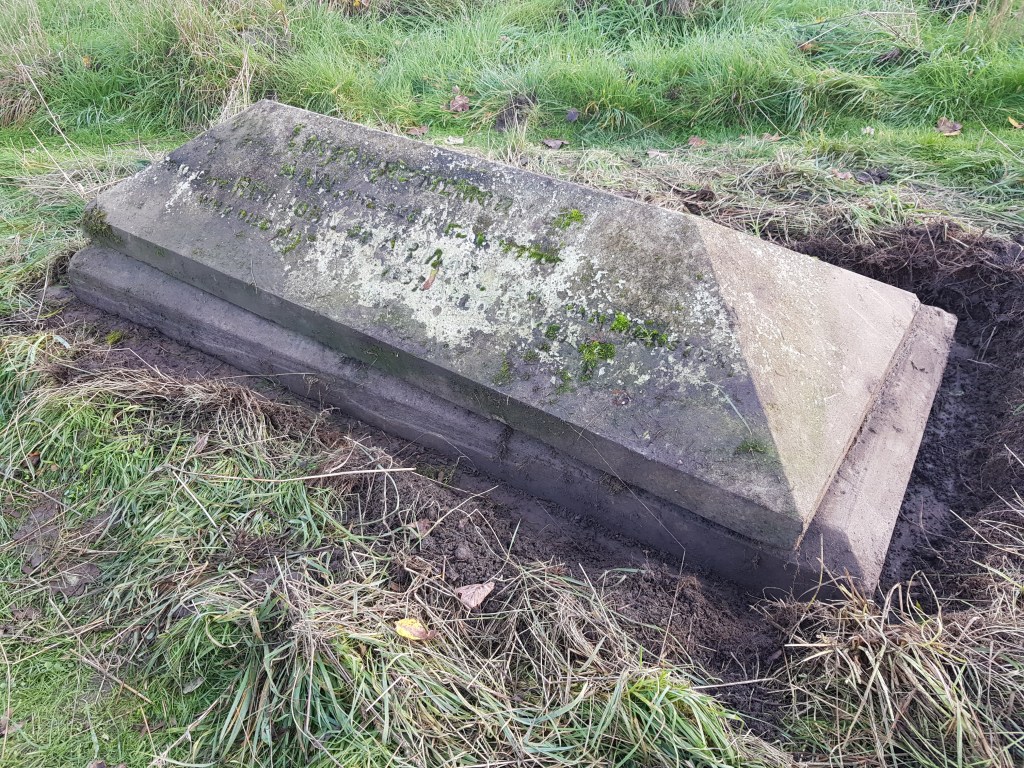
Sadly, this is all that remains of a once magnificent memorial to the Ellis family in Radnor Street Cemetery.  Thieves armed with cutting equipment removed the ornate metalwork and with it all reference to the family buried there.

William Ellis was one of the first members of the New Swindon Local Board, a director of the Swindon Building Society, Chairman of the New Swindon Gas Company and a director of the Swindon Water Company. A devout Methodist, he was described as being ‘a most acceptable lay preacher widely known in Wiltshire and South Wales.’

Expansion at the GWR Works in 1861 saw the building of new Rolling Mills. Once established the rail mill produced an estimated 19,300 tons of rails a year with the workforce consisting mainly of Welsh iron workers.  

Thomas Ellis was the first manager at the Rolling Mills and was responsible for building the cottages along Cambria Place to house the Welsh workers. 

William came to Swindon with his two young children and took over as manager in 1863.  The family’s first home was at 4 Church Place, before moving to the Woodlands, a GWR manager’s house.

When William died on May 25 1896 the Advertiser published a lengthy obituary in which he was described as having the ‘esteem of the large number of men who were under his control.’

“The first portion of the funeral service was conducted at 8 am on the lawn in front of the Woodlands by Revs A.A. Southerns and G. Osborne.  Portions of Scripture were read, and hymns No. 680 and 940 from the Wesley hymn book were sung at the close of the beautiful and impressive early morning service,” the Advertiser reported.  “The cortege then proceeded to a saloon, which was placed near the house, and the family left by the 9-5 train for Abergavenny where a hearse and carriages were in waiting to convey the remains and family to Lanelly church, where a large number of friends from neighbouring places had assembled.”

William’s son Ernest followed his father into the Rolling Mills where he worked as Assistant Manager.  He and his wife Catherine lived at the old Ellis family home at 4 Church Place. Two of their children who died in infancy were buried in the Radnor Street plot, Olga Louise in 1897 aged 2 years and 2 months and Louis Robert in 1890 aged just six months.

Ernest died in 1915.  The Advertiser published an account of the Memorial Service held in the Wesley Chapel, Faringdon Street during which Ernest was described as a man who ‘hoped for the best, and believed of the best in people,’ ironic considering the vandalism of his family’s memorial.

Ernest’s wife Catherine who died in 1931 aged 78 and his sister Louisa who died in 1944 aged 89 were both buried in the family plot.  The names of William and his wife Emily were included on the family memorial.

Fortunately there are photographs of the distinctive monument preserved on Duncan and Mandy Ball’s website.  Without this record the memory of one family who made such a large contribution to 19th century Swindon would be lost.

Rev John Sharman’s family

A Wesleyan ministry was not for the faint hearted and if it was a hard life for the Minister, imagine what it was like for his wife.

John Sharman was born on May 22, 1814 the son of Michael Sharman and his wife Hepzibah, in the parish of Walsoken, Norfolk. He began his ministry in 1835 and five years later married Ann Allen. Ann was born in 1840, the daughter of Thomas and Susannah Allen, themselves Methodists.

By researching the birth of John and Ann’s eleven children it is possible to map the many places where John ministered.

Their first child John Parker Sharman was born in Whitchurch, Hampshire on April 25, 1841. Annie Rebecca (1842) and Thomas Michael (1844) were both born in Ashford, Kent.  Selina Jane was born here in Swindon on January 31, 1846. She was baptised at the ‘Wesleyan-Methodist Chapel Swindon & at places in its Vicinity’ on May 16 with her brother John Parker Sharman. James Allen was born in 1847 in New Buckenham, Norfolk and baptised on March 19, 1848 at Attleborough, Norfolk. Frederick William was born in 1850 in Bury St. Edmunds, Suffolk. At the time of the 1851 census the family were living in the small hamlet of Botesdale on ‘the turnpike road leading from Scole to Bury Saint Edmunds.’ Elizabeth Hephzibah (1852) and Catherine Laura (1853) were both born in Botesdale. Frederica Allen was born in 1855 in Harwich, Essex as was her brother Frederick James born the following year. Mary Susannah was the last of John and Ann’s children. She was born in St. Just, Cornwall and baptised on July 12, 1859 at East Looe, just three months before John died.

At least seven different homes in 19 years of marriage (and child bearing for Ann) travelling England and Wales.

John died on October 11, 1859 at Holsworthy, Devon, aged 45.

By the time of the 1861 census Ann was living at Grove Street, Wantage with seven of her children and her widowed mother Susannah Allen. In 1871 she was living in Harwell Street, Harwell, Berkshire with her five daughters and by 1881 she was living at 65 Clifton Street, Swindon.

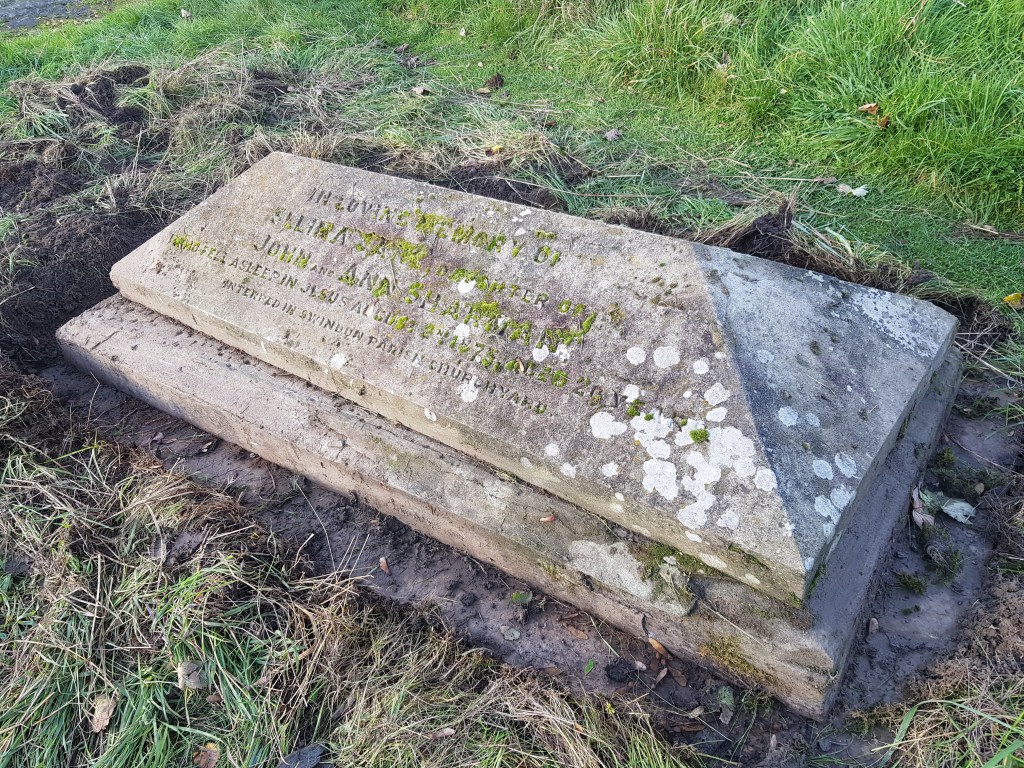
Ann Sharman died in March 1887 at 3 Graham Terrace, Clifton Street, aged 68. She was buried in grave plot E8500 where two of her daughters would later join her; Annie Rebecca Cole who died in February 1913 and Mary Susannah Richards who died in March 1924. Selina Jane Sharman is also mentioned on the memorial. The only child to be born and to die in Swindon was buried in the churchyard at Christ Church. She died aged 29 in 1875, before Radnor Street Cemetery was built.

Ann and John’s son, Frederick James Sharman, who died in 1916, is buried with his wife and daughter in grave plot E8515 just a short distance from his mother’s grave.

A few examples of the busy life of Rev. John Sharman.

“On Thursday morning at five o’clock, the Rev. John Sharman of Abingdon, preached to a large congregation.”  Newbury, Berkshire May 1839.

Rev. John Sharman of Tredegar preached at Nantyglo in October, 1846.

November 1846 – Tredegar. “In the morning of Sunday November 15, Rev. John Sharman, resident minister, preached in the morning.”

Wesleyan Missions – On Sunday, Feb 6th, two sermons were preached in the Trewelland Chapel, St. Just Circuit, on behalf of the above missions; viz., in the morning by the Rev. John Sharman, and in the evening by the Rev. N. Alston. On the following Wednesday, the annual public meeting was held, when the claims of missions were ably advocated by the Revds. John Hobson of Redruth, Sharman and Alston, of St. Just; William Trezise, Esq. in the chair. Collections were made, amounting to the same as last year.

Royal Cornwall Gazette, Friday Feb 18, 1859.

St. Just Institution

On Monday last, the Rev. John Sharman, Wesleyan Minister, of St. Just, lectured on “Druidism.” The Rev lecturer handled his subject in his usual masterly style, and delivered a highly interesting and instructive lecture, which was approved of by the audience in a cordial vote of thanks, on the motion of Mr John Boyns, seconded by Mr William Holman, and presented to the reverend lecturer by the Chairman, Mr A. Chenhalls.

Royal Cornwall Gazette Friday March 18, 1859.

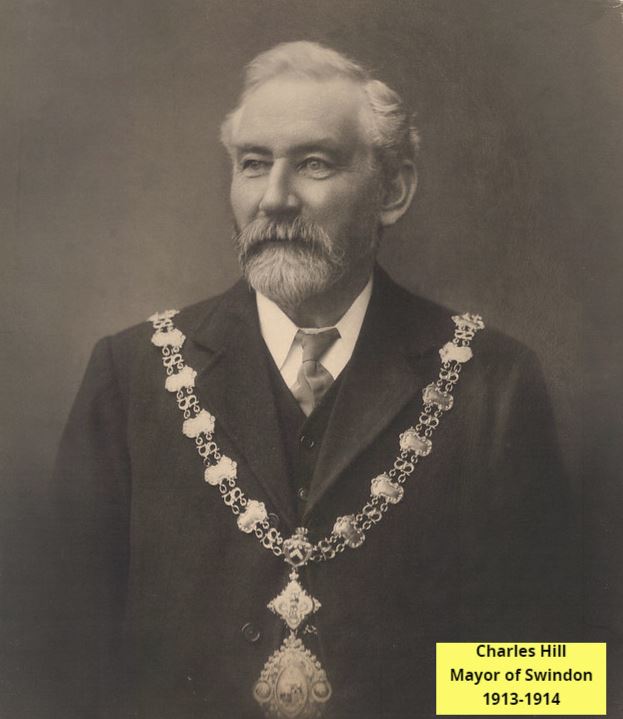
Charles Hill – Mayor of Swindon

I was recently asked by a blog reader why so many of Swindon’s ‘worthies’ were members of the non-conformist faith. Charles Hill is another such example.

Referring to the obituary published in the North Wilts Herald, Rev. A. Brown said it was a fine resume of the life of Mr Hill and could have gone on for another two or three columns had there been space.

Charles Hill was born in Newton Abbot in 1853. He married Elizabeth Ann Spackman in 1878 and the couple had three children, Mabel, Elsie and Percival. The story of his life follows here:

image published courtesy of Local Studies, Swindon Central Library.

Death of Mr C. Hill, J.P.

Former Mayor of Swindon and Chairman of the Education Committee for 12 Years.

The news of the death in the early hours of Saturday of Mr Charles Hill, of 32 Victoria road, Swindon, will come as a severe shock to thousands of people in Swindon and Wiltshire who knew him so well.

The news will be the more unexpected in view of the fact that right up till Friday he was apparently in his usual health and good spirits, and as recently as Thursday was seen walking in the streets of Swindon, and, indeed, recorded his vote in the municipal elections.

It was only last month that he retired from the many public offices he held in the town.

Foot Amputated.

Mr Hill underwent a severe illness about 18 months ago and had his foot amputated, but though this entailed a temporary retirement from public duties, he returned to them zealous as ever on his recovery.

Mr Hill’s life is the romance of the orphan of a farm, who, by dint of hard work combined with good spirits and geniality, rose to become the Mayor of the town of his adoption, and a magistrate of the county in which he came to live and work.

In April, 1853, he was born near Newton Abbot, and spent his early years working as an orphan boy on a Dartmoor farm. He came to Swindon in 1872, and obtained employment as a porter on the GWR station, later going into the factory.

Then when the old broad gauge track from Swindon to South Wales was converted in 1872, he was a member of what was known as a transport.

Then he went into the R Shop, where he worked for 12 years, first as a labourer, then as a machineman, and finally as chargeman. Leaving the Works, he became a part time agent for several insurance agencies, and in 1896 he was appointed local superintendent of the Sceptre Life Insurance Society.

Service on the Council

In 1894 Mr Hill was elected as a member of the New Swindon Urban District Council and on the incorporation of the borough in 1900 he was elected a councillor. With the exception of one year – 1896 – he completed, on his retirement for the council a week or two ago, 40 years’ continuous service.

There had been 13 Mayors of the borough before Mr Hill became Mayor, and he had served under every one of them. Then in 1913-14 he became Mayor himself, during the year the great war broke out.

For many years he had also served on the Wilts County Council, and until last March, when he retired, had held an aldermanic seat on the County authority for 21 years. His work also extended to the Wilts Standing Joint Committee, and though he had severed his connection with the County Council, he still held a seat on the County Small Holdings Committee.

Work for Education

But it was his work for education which had made him best known. He was appointed to the Education committee when it was established in 1903, and served continuously since that time until he retired about a fortnight ago, being vice-chairman from 1913 to 1919, and chairman since 1922.

In that position he won the affection and respect of his colleagues, and the hearts of children in the schools. He was a familiar visitor to all the schools, and at each of them he had some quaint little story, or a knotty problem with which to amuse the children.

At the time of his death he was the principal and director of C. Hill and Co., insurance agents.

In politics Mr Hill was a progressive Liberal. He was hon. secretary of the North Wilts Liberal and Radical Association, and took part in the winning contest of 1898, 1900 to 1906.

He had been one of the pillars of Methodism and for some 40 years was superintendent of the Sunday School connected with the Regent Street Primitive Methodist Church – now the Methodist Church. He was for some time secretary of the church trustees.

The Funeral

Many public bodies were represented at the funeral service at Regent Street Methodist Church, on Wednesday afternoon.

Mr Hill requested that there should be no flowers and no mourning, and amongst his papers there was found a message asking that those who thought of sending floral tributes should send instead a donation to the Mayor’s Unemployment Distress Fund.

Extracts from North Wilts Herald, Friday, 9 November, 1934.

Charles Hill died at his home, 32 Victoria Road, aged 81 years. He was buried on November 7, 1934 in grave plot E7419 which he shares with his wife Elizabeth Ann who died in 1921 and his daughter Mabel Emma who died in 1965.

Mayor Tom Butler – Cabinet maker

Tom Butler was born in Ramsey, Huntingdonshire in the summer of 1856. By 1881 he had moved to Swindon and was working at premises at 81 Regent Street for master cabinet maker William Pooles. He would later have his own business and an elegant house on Victoria Road named after his birthplace.

In 1883 he married Mary Ann Turner at the Wesleyan Methodist Chapel on Bath Road. The couple had seven children, of whom five survived childhood.

The couple were devout Methodists and both played prominant roles in the church and public life in Swindon generally. Tom was elected to the Town Council in 1903 and served as Mayor in 1910/11 an auspicious year in which the coronation of George V took place and Tom’s much loved wife died suddenly.

Mayor Tom Butler published courtesy of Local Studies, Swindon Central Library.

The Late Mr T. Butler

Funeral of One of Swindon’s Most Prominent Citizens

All Sections of Public Represented

The very high regard in which the late Mr Tom Butler, ex-Mayor of Swindon, was held by all sections of the public was eloquently reflected on Saturday in the scenes that attended his funeral. From an early hour in the afternoon many people gathered in the sunlit Cemetery to witness the last phase of the passing of a noteworthy man, and long before the service was due to start the Faringdon Street Wesley Chapel was filled.

The funeral service was impressively conducted by the Rev J. Rogers (superintendent minister), who paid glowing tribute to Mr Butler’s work in the town. Mr Butler came to Swindon, said Mr Rogers, in 1878. He became a teacher at Wesley Church the same year, and after a break of some years, resumed the work in 1887. Most of them were familiar with the main incidents of his public life; he built up a prosperous business and made a competence. No aspersion had been cast upon his character or methods; he was a man of honour and integrity. There were certain dates prominent in his career which the speaker wished to recall. In 1886 he was converted, and by definite and intelligent choice made Christ the Lord of his life. To the vows then made he remained faithful. His experience of religion was real and vivid, and he was always earnest, warm-hearted and generous. In 1887 he entered the school as a teacher, in 1888 he became treasurer to the Sunday School and in 1889 he was appointed superintendent, remaining in office until his health broke down. He relinquished the office in 1914. Mr Butler was a trustee of that church and was a liberal supporter of its funds. He helped very materially in the erection of the monumental Sunday School premises, while as Circuit Steward he discharged his duties with urbane and faithful efficiency. His life of usefulness and devotion had its source in mystic fellowship with God. He was loyal to the work in the days of his activity. They all knew what Mr Butler was to the community, but they did not know what he was to that church.

Referring to Mr Butler’s public life, Mr Rogers reminded them that he was elected to the Town Council in 1903 and held office as Mayor in 1910-1911. During that year he suffered a bereavement from which he never fully recovered.

“Servant of God! Well done,” concluded Mr. Rogers, and the fervent murmurs of the congregation was an endorsement of his eulogy.

North Wilts Herald, Friday, October 20, 1922. (extracts)

Tom Butler was buried in grave plot A1033 where he lies with his wife Mary Ann who died in 1911 and their two young children, Hilda Mary who died aged 6 years in 1898 and Denis Stanley a 3 month old baby who died in 1899.

You may also like to read:

Mayoress Mary Ann Butler and the Coronation