On Thursday November 1, 1888 a young woman was taken ill on a train travelling from Plymouth to London. She was removed from the train at Swindon and taken to the Queen’s Hotel at the station where she died the following Sunday at midnight.
A lengthy report was published in the Edinburgh Evening News and although very detailed there is no information concerning Miss Wasser other than some spurious conclusions. Some questions that in my opinion were not asked and should have been are: – What was the Hon Athol Liddell’s involvement in this case? How well did he know Miss Wasser? Having made her acquaintance in France some months previously, why couldn’t he provide more information about her circumstances? And why had he met her in Plymouth prior to her departure on the London train?
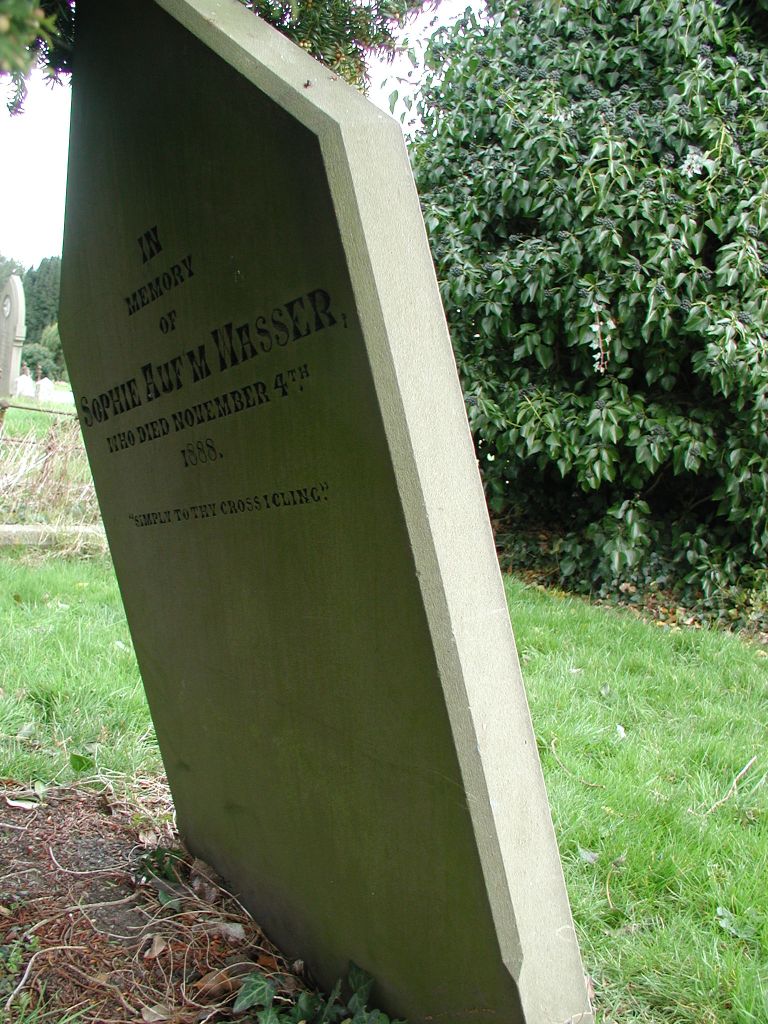
The story of Miss Wasser has recently been brought to my attention by local historian James Turner. James came across the grave of Miss Wasser and was greatly moved by the sad circumstances of her death. We both felt this was a story that needed to be told.
The Mysterious Death of a Lady at Swindon station
The Plymouth correspondent to the Bristol Times and Mirror telegraphing to that paper says, – A brief and mysteriously incomplete paragraph in a London evening paper on Friday was the first and hitherto the only information that has reached the public concerning the death of a young lady under circumstances of great mystery. The death occurred a week ago. There has been a coroner’s inquest, which did little to elucidate the real cause of death. The facts are as follows:-
Miss Dufin Wasser travelled from Plymouth on Thursday, November 1, by train due at Swindon at five minutes after four. At Swindon junction she was found to be so seriously ill that her removal from the train was imperative. By advice, Miss Wasser was taken into the hotel at the station and put to bed. All that the most watchful care and the best professional skill could suggest was done for her, but she died at Sunday mid-night. At the inquest, subsequently held, a verdict in accordance with the medical testimony was returned, the “medical testimony” being to the effect that death was due to apoplexy, arising from excessive vomiting. It was stated in evidence that amongst the effects of Miss Wasser was a bottle containing medicine, one of the ingredients of which was tincture of iron. This was contained in a bottle, on the label of which was written in French, “two or three teaspoonfuls in the day time.” The mixture could not therefore have been of a very powerful character, and it is unlikely that violent vomiting was due to it. Dr Spackman says it is possible that some other drug might have been taken, but this theory was not verified or dissipated by a post mortem examination. Not a word was said as to what did or might have caused that vomiting. In the body of the dress of the deceased was found an unsigned letter, from which it was gathered that she was enceinte. This letter was in a gentleman’s handwriting, evidently a person of good education and epistolary facility. The writing is singularly large and of the “up and down” type. The place from which the letter was written was torn off, according to the expressed desire of the writer, who advised Miss Wasser, if she was in the condition she feared, to go to some secluded place. She was promised plenty of money, and was urgently entreated not to allow the name of the writer to transpire. In addition to the letter and medicine found was a good deal of money, about £50. Most of this was in French currency, the number of English coins being comparatively few. The deceased’s luggage comprised several articles, apparently presents, their quality and character marking them as not such as a person in the apparent position of the deceased would buy.
In the same third-class compartment in which Miss Wasser travelled from Bristol there were also another lady and gentleman, and Police Inspector Cruse, of Swindon. The lady appeared only faint at Bristol, but afterwards suffered great agony. She received with gratitude the attentions of the lady and gentleman, but hardly spoke one word. When she arrived at Swindon she appeared to be suffering from paralysis.
Inspector Cruse, before he knew the details of the case as disclosed at the inquest, formed an opinion as to the cause of the agony his fellow-passenger was suffering, and on reaching home informed his wife that something remarkable would happen before the train reached London. There was amongst her papers one which showed she had been staying at the Duke of Cornwall hotel, Plymouth under the name of Mrs Adler. A telegram elicited a reply from Mr Hellard, solicitor to the Hon. A Liddell, urging that everything possible should be done for her, and nothing that thoughtful consideration could do, or money could procure was wanting to bring about the ladies recovery.
Mr Liddell and Mr Hellard came to Swindon for the inquest. Mr Liddell stated that he made the acquaintance of Miss Wasser in France, in August last, and that he saw her at Plymouth on the day before she left for London to take up her residence for a time at the Swiss Home for Ladies, Mecklenburg Square, where she had previously stayed, and from which place she had obtained situations as governess. He also stated that she was of “Independent means.” It has since been ascertained that Miss Temple, sister of the Bishop of London, knew her in the capacity of governess with families she visited. The deceased was buried in Swindon cemetery on Wednesday. A headstone is to be erected, bearing the simple inscription. “Sophie Dufin Wasser, died November 4th, 1888.” While at the Queen’s hotel she never once spoke except in monosyllables in reply to questions. One of these replies was a sad “No” to the question, “Have you any friends?”
Edinburgh Evening News Monday 12th November, 1888.
The entry in the burial register reads:
Wasser Sophie A.M. 25 years 7th November 1888 grave plot E8300.
 Radnor Street Cemetery