Graveplot B1328

This is the story of Harry Woolford, born in Swindon the son of Robert and Matilda Woolford. When I first saw the name I wondered if he might be a member of the Lydiard Tregoze/Purton family in whom I have an interest.


In 1901 Harry aged 26 lived at 13 Jennings Street with his mother, her second husband Thomas Bailey, his three Woolford brothers and a 9 year old half brother, Alfred Bailey.


On that day in January 1903 Harry left his home in Rodbourne to begin work in the railway factory as usual. But that day he met with a fatal accident.

Fatal Accident in Swindon

Man killed in the GWR Works

This morning a sad accident occurred in the GWR Works, by which a young man named Harry Woolford, residing in Jennings Street, Rodbourne Road, Swindon, lost his life.

The deceased, who is a single man, was employed as a labourer in the Mason’s Yard, under Mr Dougall Clark. Whilst attending some machinery, we believe, oiling it, his right arm became caught, and had it not been for the ready assistance of some of his mates who were standing near, he would probably have been drawn in and crushed badly. As it was, his arm was sadly injured, and the loss of blood was so great that he died almost immediately.

A message was sent to London Street, and Dr. G. Rodway Swinhoe and Dr. Pattison were soon on the spot, but their medical knowledge was of no avail. His body was removed to the GWR Medical Fund Mortuary shortly after to await an inquest, which will probably [be] held tomorrow.

Swindon Advertiser, Tuesday, January 6, 1903.

Harry was buried in graveplot B1328, a public grave, once called a pauper’s grave, reserved for those families who could not afford to buy their own, private plot. He was buried with his father, Robert Woolford, who had died 15 years previously and Georgina Hatton, an 86 year old widow who died in 1913.


As was the custom in this cemetery, the grave lay unmarked and undisturbed for 50 years.


Then in 1963 there was a terrible accident in Park South where two little girls were struck by a school bus and killed.


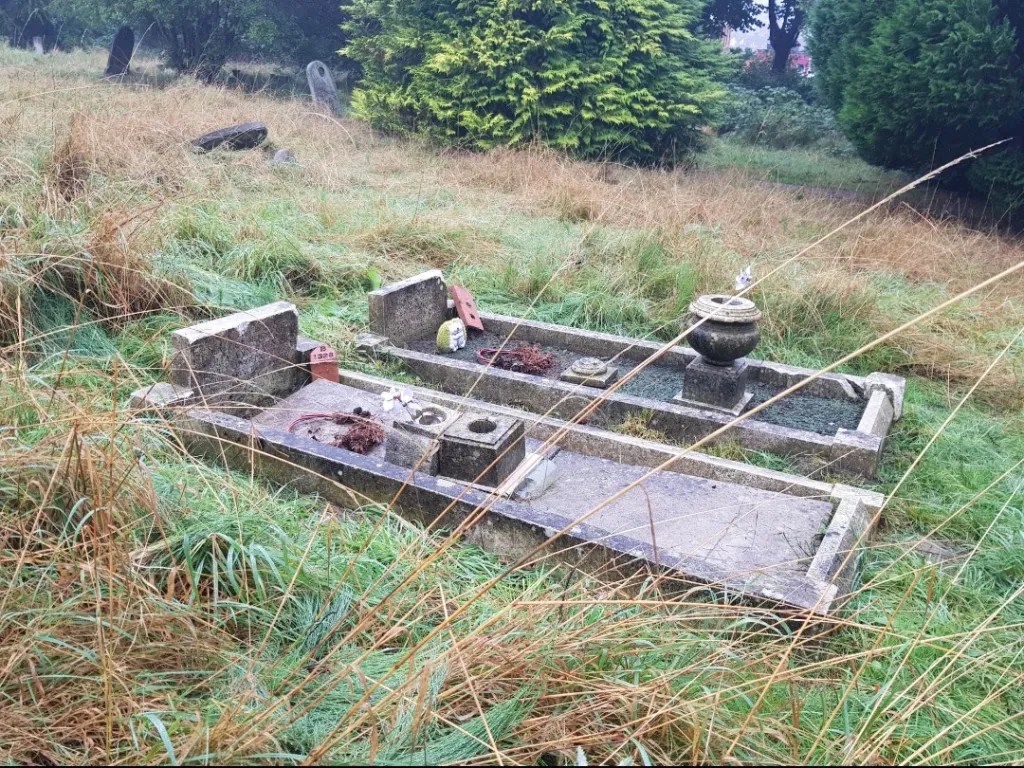
Friends and neighbours, the two families wanted their daughters to be buried side by side. Julia Ann Barnes parents bought plot B1329 and Dawn Maria Rose’s bought plot B1328.


No longer a neglected, pauper’s grave, the two families erected a fine, identical memorial on each of their daughters’s graves. The Radnor Street Cemetery volunteers keep these graves tidy and Cheryl, Gina and Angie Phillips lay flowers in the little girls’ memory.


This is the story of Harry Woolford who died in an industrial accident in the railway works and Julie Ann and Dawn, two little friends who died returning home from school.
The story of school friends Julia Ann and Dawn

Julia Ann Barnes and Dawn Rose were best friends and next door neighbours. That day in March 1963 the two girls were excited – they had a birthday party to go to. The school bus stopped at the junction of Wolsesly Avenue and Thornbridge Avenue where the girls jumped off and ran behind the bus to cross the road. They were struck by a school bus travelling in the opposite direction.

The news of their deaths reverberated through the Park South community and 60 years later is still remembered by one of the families who lived on that road.

In 1962 a series of articles in the Evening Advertiser featured families who had made their homes here in Swindon during the town’s expansion programme. George and Violet Phillips, who had moved from Bermondsey, South London, were interviewed. They spoke about how much they enjoyed living in Swindon, however, Violet said: “My only grievance is the schooling.”

Park South was built during the 1950s but by 1962 the area was still without a designated school and children were bussed to schools outside the area. The Phillips’ young daughter Cheryl aged 7 was one of those children ‘bussed’ to King William Street School in Old Town and George was concerned for her safety. As a member of the Park South Tenants Association George campaigned for building work to begin on a school in the area – and he took his concerns higher – first to the Mayor of Swindon and the Education Committee and then to Francis Noel-Baker, Swindon MP and eventually to the Minister of Education when members of the Park South Residents Association delivered a petition to the House of Commons.

It was anticipated that Park South Infants School would be ready for use by August 1963 and the Junior School a year later – but tragedy struck before then.

In June 1963, following the deaths of Julia Ann and Dawn, George made an official request that his daughter be transferred from King William Street School to Lawn Junior. He then withdrew his daughter from school in protest. George faced a hearing held by the Child Care Sub-Committee with the threat of a possible prison sentence if he did not return his daughter to school. But the campaign waged by George Phillips and the Park South Tenants Association did see changes implemented on the schools transport service. Children were accompanied and supervised on the buses; bus stops were relocated and a warning notice ‘Caution Children Alighting’ was displayed on the back of the vehicles.

Angie Phillips writes: “Ironically, even when the Park South Infant and Junior Schools were completed, our house, being in Thornbridge Avenue was not in the catchment area and all the children in our house subsequently attended Lawn Junior School … but not by bus!”

Julia Ann aged 6 and Dawn 5 and 1/2 were buried on March 20, 1963 in a joint funeral service; their graves side by side with identical memorials.

Unfortunately, the graves had become overgrown in recent years but in the autumn of 2023 cemetery volunteers Kevin and Jonathan cleared and tidied them up. It is the wish of the Phillips’ sisters Cheryl, Gina and Angie that the story of the two young friends is remembered and today they regularly attend the graves.