
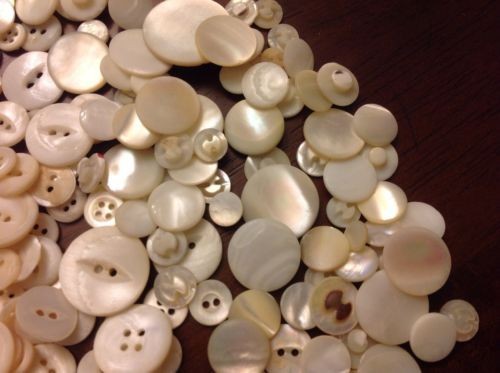
Pretty things; pretty things for pretty clothes to be worn by pretty women. Can they have any idea how these buttons are made or the conditions under which they are produced?
Macassar and manila shells were sourced from exotic places for the iridescent pearl buttons; hoofs and horns for the more mundane, everyday buttons were collected from the slaughter houses, stinking and crawling with maggots.
Small workshops huddled around filthy court yards where entire families labour in the dust and dirt and noise. The men sort through the shells, sawing and shaping the raw materials, deciding where to make the best cut. Women’s work; a light but practised touch was required to polish the buttons as the materials were fragile and easily broken. And the girls, sewing the buttons on cards, 14 to each card. They were expected to sew more than 3,500 buttons each day. The button manufacturer paid one penny sometimes a penny ha’penny a card and for her labours the girl might earn 7 shillings for a long, hard working week.
Pretty things; pretty things for pretty clothes to be worn by pretty women.
The facts …
Emma Bradley was born in 1855 and Sarah in 1860, the younger daughters of James Bradley, a miller (a milling machine operator) and his wife Maria.
In 1861 the family lived at Poole Street, (3 Court 3 House) Erdington, Aston Manor, Birmingham. Eldest daughter Mary Theresa 17 worked as a Glass Button Cutter while second daughter Ann Maria 11 worked as a Pearl Button Carder. James 9 and Emma 6 were at school and youngest child Sarah was just 9 months old.
At the time of the 1871 census Emma was working as a general servant at the home of Charles Watson, a pearl button manufacturer, but by 1881 she was back home in Poole Street with her widowed father James and her sister Sarah. Emma worked as a button polisher and Sarah as a press worker.
What brought the Bradley sisters from Birmingham to Swindon? Sarah Bradley married William Stanley, a blacksmith, in 1888. By 1891 they were living in two rooms in 14 Princes Street, Swindon and William was employed in the railway factory.
Emma appears in Swindon on the 1911 census as boarding at 30 Fleet Street where she works in a clothing factory, most probably Compton’s who had a factory in Sheppard Street.
The two sisters lived together again at the end of their lives. Emma died on March 3, 1924 at 52 Deacon Street. Sarah died on November 18, 1936 and her husband William on December 10, 1939 both at 52 Deacon Street. The two sisters and Sarah’s husband William are buried together in plot E8124.

 Radnor Street Cemetery