Photographs of the cemetery

Today there is a worldwide interest in cemeteries both as an historical resource and also as a place of beauty. From pristine perfection to benign neglect, cemeteries are of interest to many.

I follow a wide selection of ‘Friends’ groups including the Friends of Brompton, Kensal Green and Highgate cemeteries. And then, of course, there is Sheldon K. Goodman of Cemetery Club fame who receives rave review on Tripadvisor.

Between the Radnor Street Cemetery group of volunteers we have collected many hundreds of photographs but we seldom come across any taken at the beginning of the cemetery’s history. So it came as something of a surprise to find the following snippet of news published in the Swindon Advertiser in 1889.

Old Swindon Local Board

Cemetery Committee

A report was read from this committee, being of a formal nature. Amongst other business the committee recommended that a sum not exceeding £20 should be spent in purchasing and planting trees in the cemetery. A local photographer had applied to the committee, and was granted permission, to take photographs of and in the cemetery.- The report was adopted and this concluded the business.

The Swindon Advertiser, Saturday, November 23, 1889.

Who was that photographer and where are his photographs? Can anyone enlighten me?

These are the earliest known photographs of the cemetery – unless you know differently.
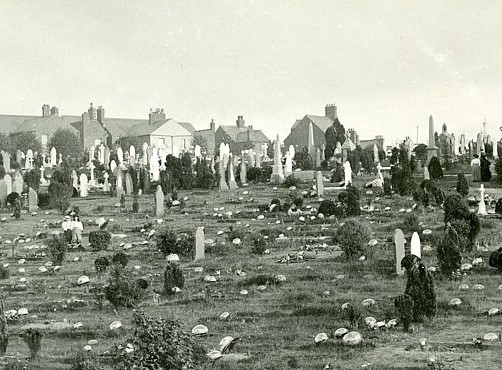
A photograph dated c1910 taken by William Hooper
A photograph taken following the funeral of Levi Lapper Morse in 1913.

Swindon Photographers

Swindonians were an adventurous lot, embracing new ideas and new inventions. In the early 19th century photography exploded in a blaze of magnesium and by the 1860s the popular carte de visite had become affordable to all but the very poorest in society.

In 1861 Richard Keylock Passmore, one of the first Swindon based photographers, was established at Victoria Street. By 1895 there were six local photographers listed in Kelly’s Directory with two in Regent Street and one in Regent Circus.

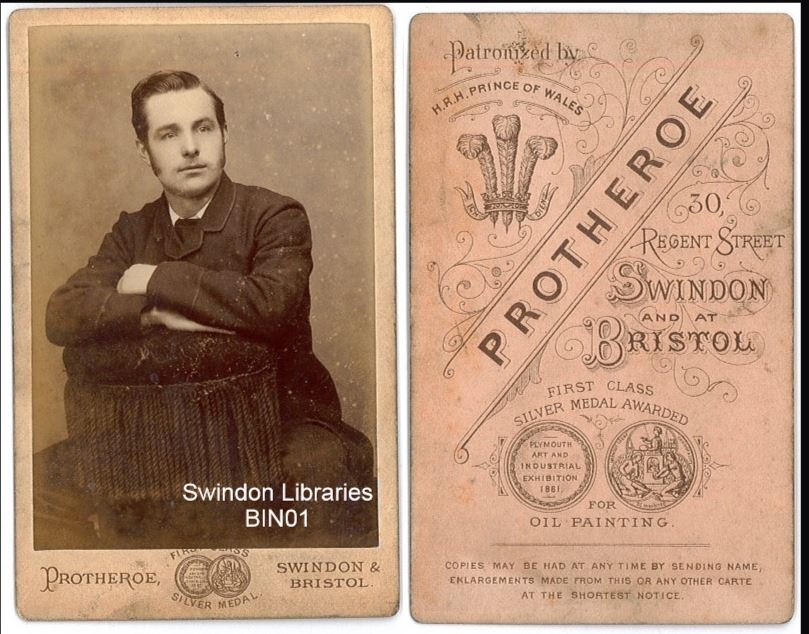
In 1889 James Smith Prothero had a studio at 30 Regent Street where he worked alongside his nephew Thomas Henry Simons who eventually took over the business. James Prothero died in Mumbles, Glamorganshire in 1929 and is buried in Radnor Street Cemetery. You can read more about him here.

Perhaps the most ‘famous’ of Swindon’s photographers is William Hooper who began his business following a disabling accident in the GWR Works which led to his dismissal on medical grounds. Hooper’s photographic career spanned more than 20 years and today his collection is managed by his descendent Paul A. Williams. William Hooper died in 1955 and is buried in Radnor Street Cemetery. You can read more about him here.

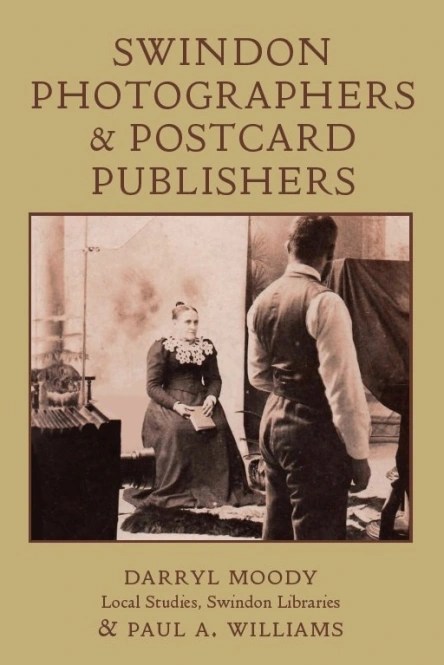
You might also like to read Swindon Photographers & Postcard Publishers by Darryl Moody and Paul A. Williams available from the Library Shop.

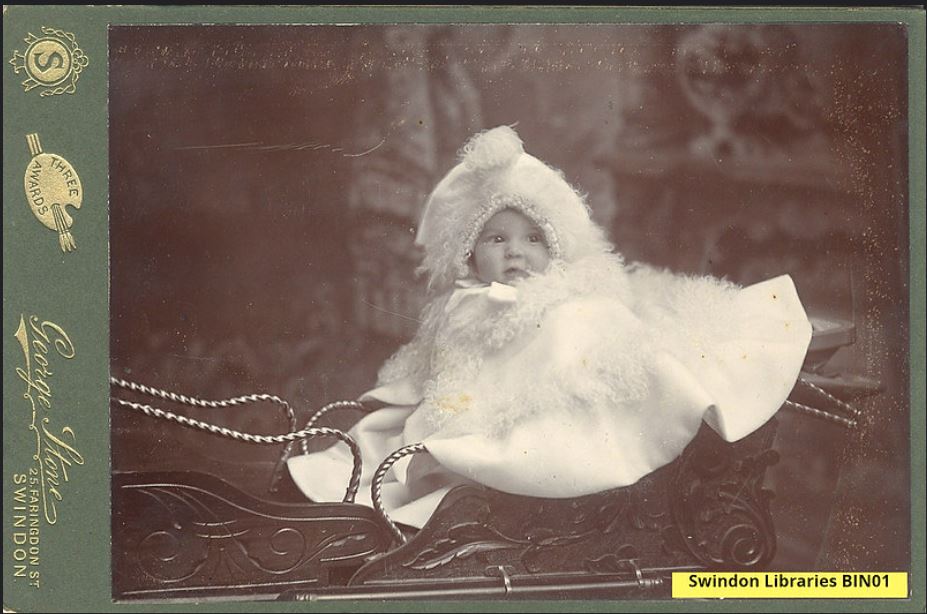
Carte de visite and cabinet card photographs survive in great numbers but sadly, unless in a family collection, most are identifiable. Local Studies at Swindon Central Library have reproduced some of their collection on their website. Here are just a few, people I am sure must now lie in Radnor Street Cemetery, if only I knew their names.

Eleanor Stroud

In a blogpost last year I mentioned that there were very few old photographs of the cemetery. There were only three pre-dating the 1920s and two of these were taken by William Hooper.  And then when I looked more closely into the work of this prolific Swindon photographer I found another taken at the funeral of his mother-in-law Eleanor Stroud.

Eleanor (sometimes known as Ellen) was born in Aldbourne in 1834, the daughter of agricultural labourer Thomas Brind and his wife Mary. She married James Stroud, also from Aldbourne, a railway guard, in 1864.

In 1871 Eleanor and James lived in Leominster with their two little daughters, Mary Jane 3 and Alice Kate 1. By 1881 the family had moved to 22 Merton Street, Swindon. On census night James and his daughters were at home. Eleanor, meanwhile, was employed as a monthly nurse at number 10 Merton Street where Annie Hacker had given birth three days previously.

In 1891 Mary Jane married William Hooper, a stationery engine driver with a passion for photography.

Two years later James Stroud was involved in a fatal shunting accident at Tetbury Road station when he was crushed between a waggon and the goods shed. He was brought to the GWR Medical Fund Hospital in Swindon but sadly died as a result of his injuries the following day on January 14, 1893.

After the death of her husband Eleanor lived with her elder daughter Mary Jane and her husband William Hooper. By 1911 William was working full time as a Portrait and Landscape Photographer. Eleanor is pictured here with William and Mary in their roof garden at Cromwell Street.

Eleanor Stroud died at her daughter’s home 6 Cromwell Street. She was buried on April 29, 1915 in grave plot A823 alongside her husband. William took this photograph at her funeral.

You may also like to read

William and Mary Hooper rock up at Stonehenge

Alice Kate Richards – smile please!