Winifred Edith Morse – founder of the Women’s Missionary Federation, Swindon branch

A comprehensive list of burial dos and don’t in Radnor Street Cemetery was published when the new burial ground opened in August 1881. The cost of a common grave was 5s (25p) but sadly, many working class families could not afford even this and there are numerous public graves in the cemetery where more than one unrelated persons are buried together. The cost rose considerably for a multi occupancy plot and a 9ft (2.7 metres) deep vault cost £4.4s (£4.20) while a brick or boarded grave for a single burial 9ft (2.7 metres) deep cost £1.1s (1.05). It is likely that the graves in the chapel area are vaults or brick lined, which would increase the cost.

The Morse family grave is surmounted by a magnificent black, granite monument and occupies two plots, 27A and 28A in Section D.
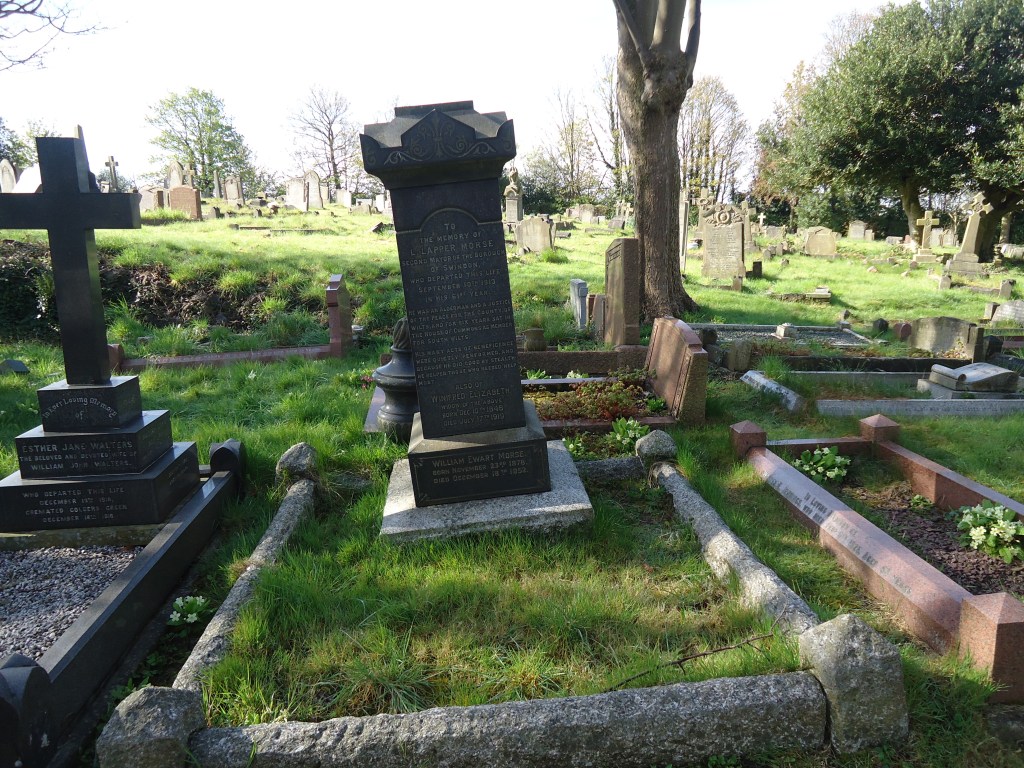
This is the last resting place of Levi Lapper Morse and as the inscription explains he was a Justice of the Peace and served as an Alderman and the second Mayor of Swindon. He was MP for South Wiltshire for six years. He was an active and energetic member of the Primitive Methodists, serving as Circuit Steward of the Swindon II circuit from its formation until his death. He was elected chair of the Brinkworth District Meeting and Vice President of Conference in 1896 and also served as District Missionary Treasurer for about nine years. He was a lay preacher, Sunday school teacher and an accomplished organist. Levi played a prominent role in both the political, commercial and religious life of Swindon and there is plenty of information available about him, but what about his wife?
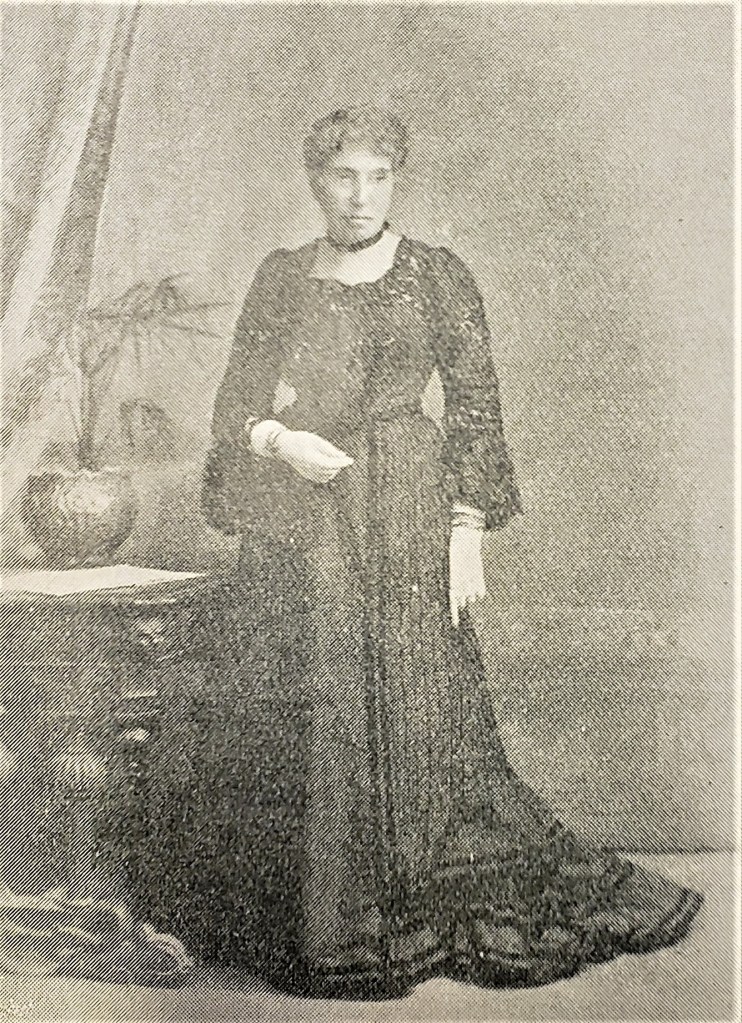
Winifred Elizabeth Humphries was born on December 10, 1848 the eldest child of Farmer Isaac Humphries and his wife Elizabeth. She grew up at Cockroost Farm, Broad Hinton where her father employed five men and two boys and a 17 year old governess to teach his growing family.

Charles Morse established a family retail business in Stratton St Margaret but his son Levi went on to accomplish far greater things. Levi opened one of Swindon’s first departmental stores, which until the 1960s stood on the present site of W H Smith’s in Regent Street, Swindon.

Levi and Winifred married in 1875 and set up home above the shop in Stratton Street, Stratton St. Margaret where he described himself as a grocer and draper, employing two men, two females and two boys. Winifred’s first child Ella Elizabeth was born in 1876 with seven more to follow. Levi states on the census returns of 1911 that he and Winifred had been married 35 years and that they have eight children, six of whom are still living while two have died.

Winifred supported her husband throughout his political career, but it was within the Primitive Methodist Church that she did most of her work. Winifred had been an active member of the Primitive Methodist Church since before her marriage and as a young girl played the organ at chapel services, often walking several miles from her home on a Sunday morning. The first Primitive Methodist Church in Regent Street was built in 1849. Further structural changes saw the church become the largest of the three Primitive Methodist Churches that formed the Swindon Circuit in 1877. It was also the focal point for the missionary activities of the Primitive Methodists in Swindon in the 1880s and where Winifred was the founder of the Women’s Missionary Federation Swindon branch in 1909.

The Morse family moved into The Croft in 1896, an elegant property that stood in four acres of land with paddocks, flower beds and ornamental trees, a tennis lawn and a fountain. William Ewart Morse, the couple’s son, remained in residence until his death in 1952 after which the house fell into disrepair and was eventually demolished. Hesketh Crescent built in 1957 now stands on the site.

Winifred died on 17 July 1919 following a long illness. Her funeral took place at the Regent Street Primitive Methodist Church with which she had so long been associated. The service was conducted by Rev F.W. Harper assisted by Rev J. Dobson, an old family friend. The Rev Dobson spoke in his address of Winifred’s good works and the loss which the church had sustained by her death.

You might also like to read

Mr Levi Lapper Morse – the end of an era

Regent Street Primitive Methodist Church

Amy Edna Riddick – life long member of the Primitive Methodist Church

Hannah West and her class tickets

As fans of Time Team and Digging for Britain will know, grave goods are essential for dating pre-historic burials. From jewellery found recently in a Bronze Age tomb in the sand dunes at Cape Trafalgar on the Cadiz coast to the unpublished book of poetry Dante G. Rossetti buried with his wife Lizzie in Highgate Cemetery (he later exhumed her body to retrieve the book), we have buried significant and sentimental items with our loved ones. And in 1905 Hannah West was buried in Radnor Street Cemetery with her collection of class tickets* collected over more than 70 years.

Hannah Ride was born on October 14, 1815 the daughter of John Ride and his wife Martha. As a young child Hannah left for a brief stay in America with her family where her mother died of a fever. John returned to England and dedicated his life to the work of God after meeting Hugh Bourne and William Clowes, co-founders of Primitive Methodism.

Hannah converted to Primitive Methodism at the age of 17 and pursued a lifetime of devoted service to the cause. In 1842 she married the Rev Samuel West and the couple had eight children. Hannah and Samuel’s last home together was in Kingswood, Bristol where Hannah remained following the death of her husband in 1867. In 1903, by then aged 88, Hannah moved to Swindon to live with her eldest daughter Mary Williamson, the wife of a draper with a shop at 24 Regent Street.

The obituary written by W. Scruby and published in the Primitive Methodist Magazine describes Hannah as follows:

‘When visited she was always bright and quietly confident of her acceptance with God. Her trust was beautiful in its simplicity. Although so far advanced in life her memory was most tenacious; she would recall events of the last eighty years with the greatest accuracy. To the last she retained an intelligent interest in all that was passing, and would converse on social, political, and religious events with great zest. Her Bible and Hymnal were her daily companions, and the daily paper was carefully read. She had her political preferences, and with the condition of the working classes previous to the abolition of the Corn Laws vividly before her mind, she concluded that Mr. Chamberlain was a very bad man. Until within a short time of her death she hoped to get to services again, and desired to attend another old fashioned Camp Meeting.’

Hannah West died at her daughter’s home in August 1905 and was buried with her class tickets in plot E7652 on August 15. Her youngest daughter Emma was buried with her on August 31, 1932.

*A class ticket was a certificate of membership of the Methodist Church, and was first issued by John Wesley in 1742. Hugh Bourne revived this tradition when he issued the first Primitive Methodist class ticket in May 1811.

Examples of class tickets are published courtesy of My Primitive Methodists.

Agnes Harding – Methodist and Mayoress

The following words were published in the North Wilts Herald in 1939 as part of a much longer article celebrating the Golden Wedding anniversary of former Mayor A.E. Harding and his wife Agnes. Of course the article concentrated on the work of the Mayor but his wife was more than an equal in this partnership.

Agnes Westmacott was born in Somerford Keynes into a staunchly Primitive Methodist family. Her father, Samuel Westmacott, was a baker and grocer who moved to Swindon by the time of the 1871 census. He became a member of the Regent Street Chapel with which Agnes would be involved throughout her life.

Agnes married Albert Edward Harding, a railway clerk in 1889 and the couple had three children, Stewart, Myrtle and Albert. The family’s long time home was ‘Apsley.’ Not Apsley House, former home of the Swindon Museum and Art Gallery, but a property called Apsley at 56 Victoria Road.

Albert entered politics in 1907 serving as a councillor representing the East Ward on the Swindon Town Council and in 1922 was appointed Mayor. However, family life continued to centre around Primitive Methodism and the Regent Street chapel where Agnes served as a Sunday School teacher for many years. She was also the first secretary of the Brinkworth and Swindon district branch of the Primitive Methodist Women’s Missionary Society.

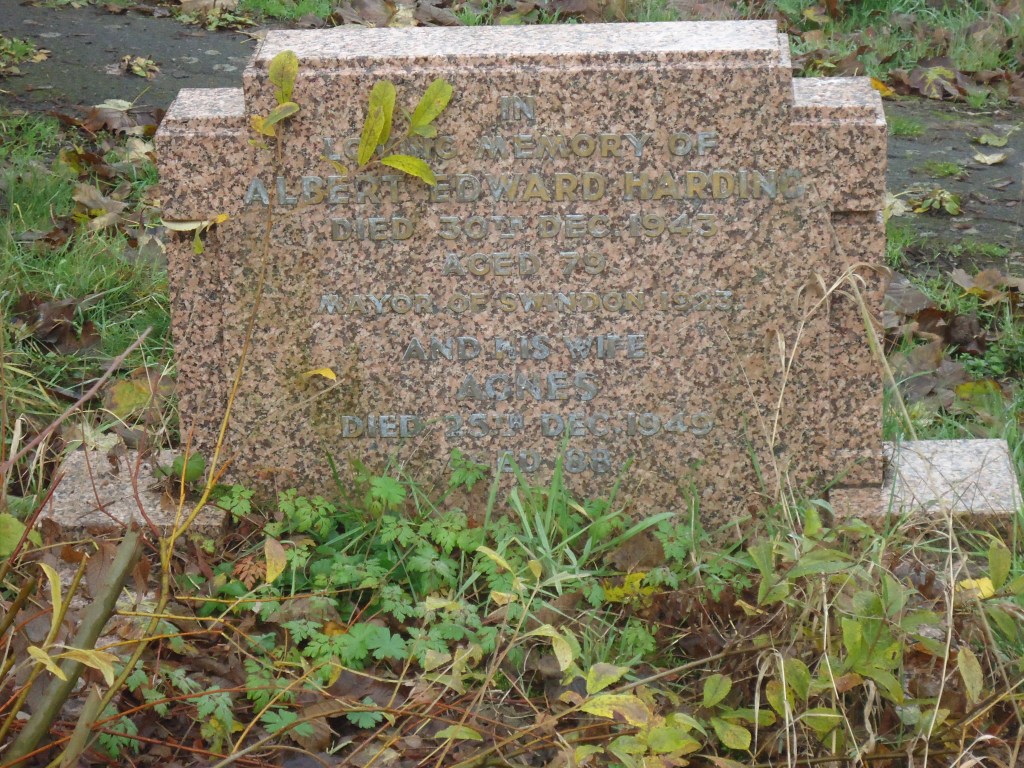
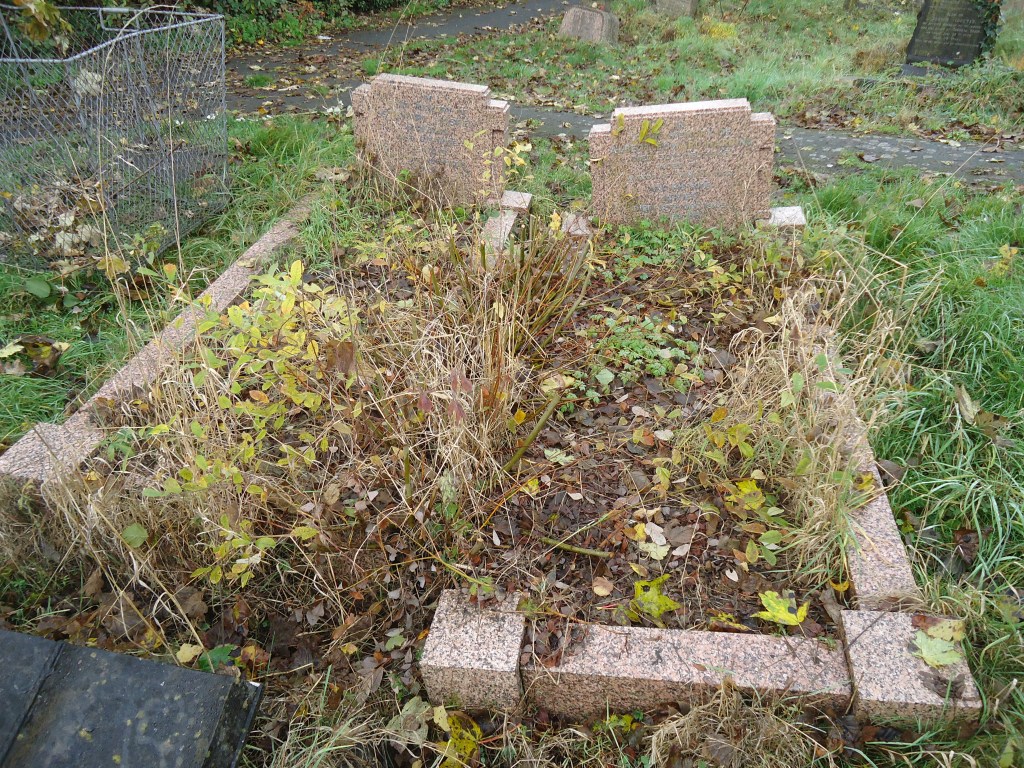
Agnes Harding died at her home and was buried with her husband, who had died six years previously, in Radnor Street Cemetery in grave plot E8568 on December 30, 1949. The couple were later joined by their youngest son Albert and his wife Kathleen. Buried in the neighbouring plot is their eldest son Stewart, who predeceased his parents, dying in 1931. He is buried in plot E8569 with his wife Gladys who died in 1968.

Married for Fifty Years

Golden Wedding of Mr and Mrs A.E. Harding of Swindon

Mrs Harding’s Record.

Mrs Harding was born at Somerford Keynes and came to Swindon with her parents in her youth. She was a scholar in the day school at the Regent street Primitive Methodist Church, and one of the first scholars to attend the College street school. For many years she was a teacher in the Primitive Methodist Sunday School, Regent street, with which church she has been associated all her life. She was elected to teach a class of unruly youths – and then for many years taught the infants class of some seventy children. During this period she was presented with the diploma for long service.

For many years she has been a class leader, with at one time 95 members on her book, but of late years has had to have more assistants.

Mrs Harding was one of the first pupils of the Art School which was held in the old Town Hall, The Square, whilst the College was being built.

When the Primitive Methodist Women’s Missionary Society was established she was one of the first to form a branch in Swindon, and was secretary of the Brinkworth and Swindon district branch. At the conference at Cardiff in 1924, Mrs Harding was elected national president of the society; she represented the District Sunday School at the triennial conference at Liverpool, was a delegate to the annual synod at Aylesbury and to the conference at Sheffield.

During her year of office as Mayoress, Mrs Harding was presented by the branch with a silver purse and an album of the members’ names. As Mayoress she helped to form the Nursing Association and has continued as a member.

A member of the Red Triangle Club at its formation, she still continues her association with the women’s section.

When the Linen Guild at the hospital was formed, Mrs Harding became a member, and still continues with the weekly meetings. She is president of the sewing circle of the Regent street Church and in connection with these organisations, she has made hundreds of articles and is still an active member of all these societies.

At her silver wedding she was presented with a silver salad bowl by the British Women’s Temperance Organisation.

Councillor and Mrs A.E. Harding were presented to Her Highness Princess Helena Victoria at the opening of the Red Triangle Club; in 1933 to their Majesties King George the Fifth and Queen Mary, when they visited Swindon, and to the Duke of Gloucester on his recent visit when opening the Civic Offices.

Extract North Wilts Herald, Friday, 17 March, 1939