Mary E. Slade MBE

I had long wanted to find the grave of Mary E. Slade who died in 1960. I eventually discovered she was buried in the churchyard at Christ Church, but where …

The Swindon Committee for the Provision of Comforts for the Wiltshire Regiment was formed in 1914.  More than thirty years later Mary Slade and Kate Handley would still be supporting the soldiers who had survived the horrors of the Great War and the families of those who hadn’t.

Mary Elizabeth Slade was born in Bradford upon Avon in 1872, the daughter of woollen weavers Frank and Susan Slade.  Mary and her brother George grew up in Trowbridge but by 1899 Mary had moved to Swindon and a teaching position at King William Street School.

At the outbreak of war Mary headed the team of mainly women volunteers who were based at the Town Hall.  Their work was much more than despatching a few cigarettes and a pair of socks to the Tommies on the Front Line and soon became a matter of life and death as the plight of the prisoners of war was revealed.

“When letters began to arrive from the men themselves begging for bread, it was soon realised that they were in dire need, and in imminent risk of dying from starvation, exposure and disease,” W. D. Bavin wrote in his seminal book Swindon’s War Record published in 1922.

The provisions the prisoners received daily was a slice of dry bread for breakfast and tea and a bowl of cabbage soup for dinner.

“Had it not been for the parcels received out there from Great Britain we should have starved,” said returning serviceman T. Saddler.

The team of volunteers co-ordinated supplies and materials with the support of local shopkeepers, schools and hard pressed Swindon families.

In the beginning the committee spent £2 a week on groceries to be sent to Gottingen and other camps where a large number of men from the Wiltshire Regiment had been interned following their capture in 1914. By October 1915 the committee was sending parcels to 660 men, including 332 at Gottingen and 152 at Munster.  And at the end of July 1916 they had despatched 1,365 parcels of groceries, 1,419 of bread comprising 4,741 loaves, 38 parcels of clothing and 15 of books.

As the men were moved from prison camps on labour details, the committee adopted a system of sending parcels individually addressed.  Each prisoner received a parcel once every seven weeks containing seven shillings worth of food.  More than 3,750 individual parcels were despatched in the five months to the end of November 1916.

But their work did not end with the armistice on November 11, 1918.  Sadly, the soldiers did not return to a land fit for heroes as promised, but to unemployment and poverty.  Mary Slade continued to fund raise for these Swindon families through to the end of the Second World War.

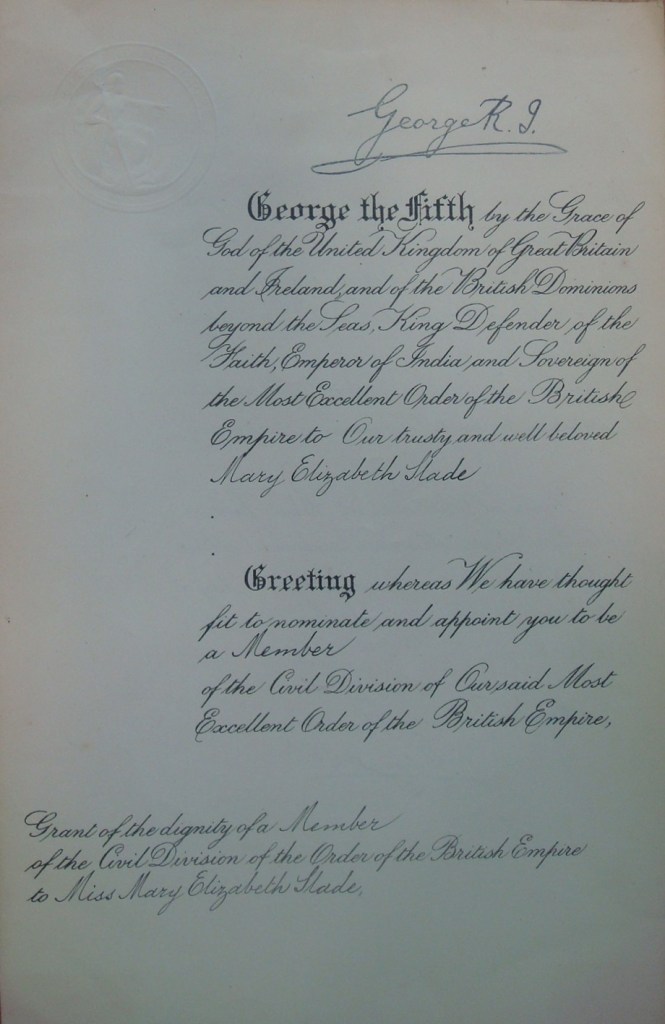
On July 25, 1919 Mary Slade and Kate Handley represented the Swindon Prisoners of War Committee at a Buckingham Palace Garden Party and in 1920 Mary was awarded the MBE.

Mary Slade died suddenly on January 31, 1960 at her home, 63 Avenue Road.  She was 87 years old.  The previous evening she had been a guest at the choir boy’s party at Christ Church.

Yesterday Noel and I visited the churchyard at Christ Church to pay our respects at the grave of our friend Mark Sutton. As we passed the Rose Garden on our way out I looked down and there was a plaque dedicated to Mary E. Slade. It was through Mark’s lifelong study of the Swindon men who served in the First World War that I first heard the story of Mary E. Slade.

Mary Elizabeth Slade
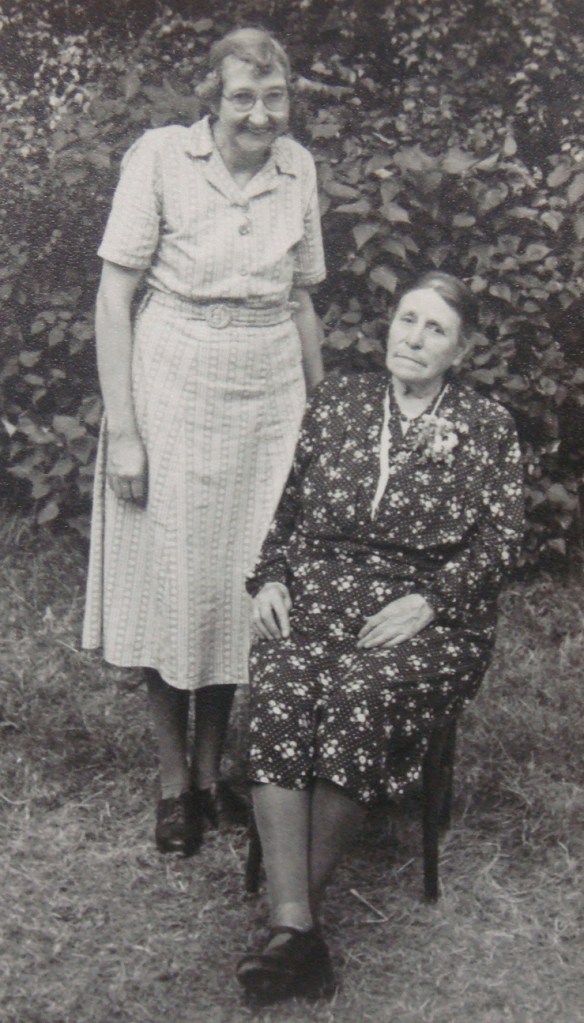
Mary Slade and Kate Handley

Elderly Man Expires in the Cemetery

The re-imagined story …

I leaned back on the bench and closed my eyes, my face turned towards the sun. Bird song filled the air on this glorious summer’s day. But how could there ever be a glorious summer’s day again? All I could think about were the days so many had been robbed of, and yet here was I in my 60th year, an old woman, enjoying the bird song and the sunshine.

I often come to sit in the cemetery. There is usually someone here, tending a grave. We exchange a few words, pleasantries. Sometimes we even talk about our boys.

The guns have been silent for many months, the servicemen returned home. Even those who were prisoners of war are back, aimlessly walking the streets of Swindon. They stop and speak. Everyone knew my boy.

I wish I could have brought his body home and buried him here in the cemetery. I’ve seen photographs of the battlefield cemeteries, row upon row of crosses. My boy has no known grave.

A parent shouldn’t out live their child. Will this be a country full of old people now? Parents mourning sons.

I open my eyes, ahead of me there is an old man, walking slowly up the hill. I think I recognise him. Another old man. This world is full of old people, all the young ones are dead.

He stops and lays the flowers he holds on a grave. I watch as he appears to stumble. I stand up and begin to walk towards the Dixon Street gate. I’ve had enough now, watching other old people. I shouldn’t be here, none of us old people should be here.

DSC07141

The facts …

Elderly Man Expires in the Cemetery

The death of a well known Swindonian, Mr Donald Macdonald Andrew, a retired GWR foreman, occurred under tragic circumstances in Swindon Cemetery on Saturday last. It appears that Mr Andrew, who was 72 years of age, and resided at 142 William Street, went on Saturday morning to the Cemetery, with the intention of placing some flowers on his wife’s grave. When walking along the pathway towards the grave he was seen by Mrs Amy Haynes, wife of Ald. A.W. Haynes, ex Mayor of the Borough, to fall. She ran to his assistance, and also a gravedigger, named Sidney Iles, who was working nearby. But deceased expired in a few minutes.

The Faringdon Advertiser Saturday June 21 1919.

The Andrew family lived at 142 William Street for more than sixty years. Donald Macdonald Andrew, an engine fitter in the Works, and his wife Emily Jane had six children, a seventh had died before the 1911 census – Samuel Henry, George Edward, Ralph Macdonald, Florence K and twins Adelaide Mary and Margaret Elizabeth.

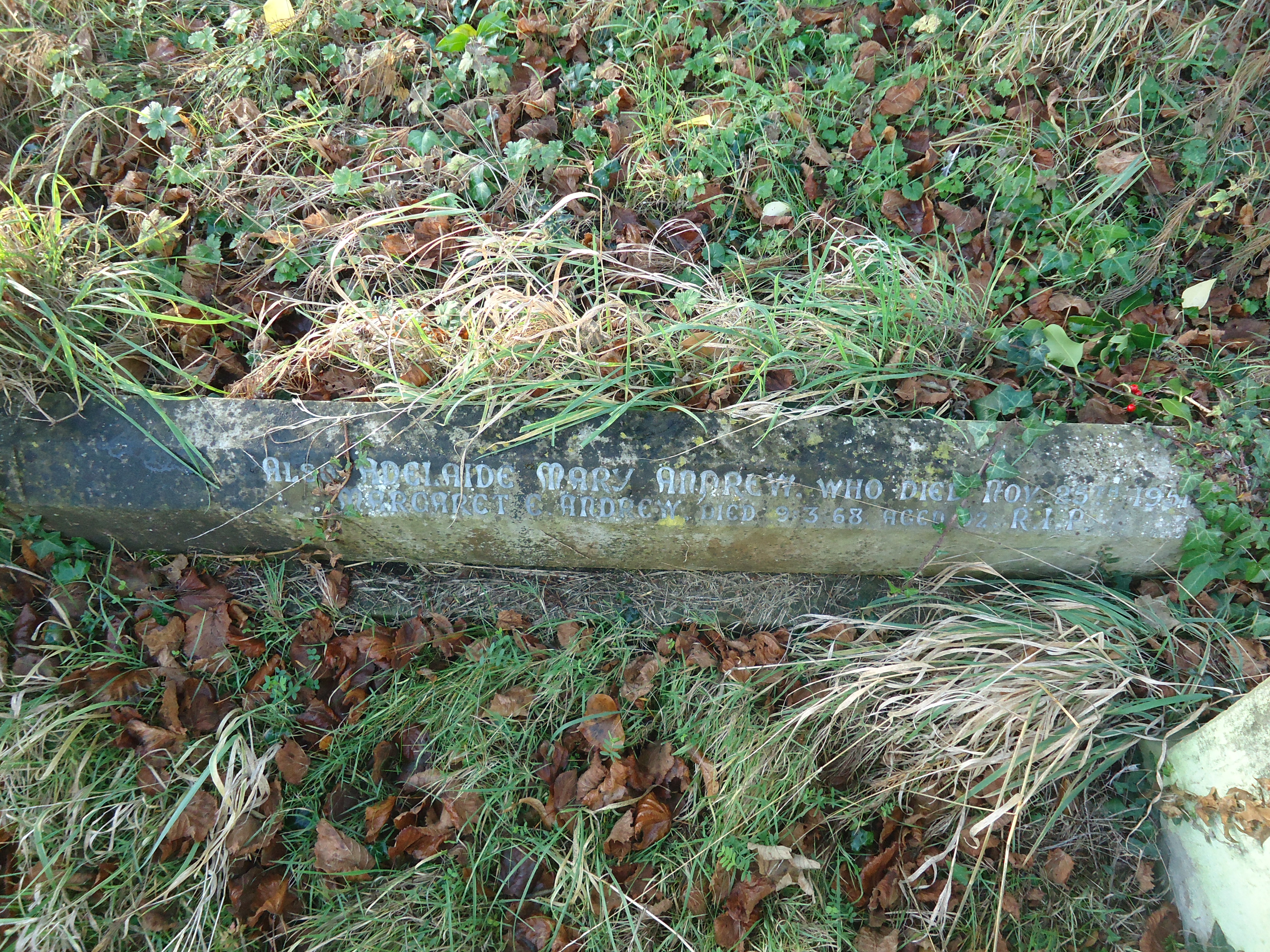
Donald’s funeral took place on June 17, 1919. He is buried in a double grave plot E8347/8 with his wife, son Ralph and daughters Adelaide and Margaret.

Adelaide Mary and Margaret Andrew

Elsie Wootten White – wartime volunteer

Elsie Wootten White was born on August 26, 1885 the daughter of Frank James White, a machineman in the GWR Works, and his wife Susan. She was baptised at St. Mark’s Church on October 19 when the family were living at 5 Bangor Terrace, Rodbourne Road.

Elsie began her long teaching career as a 15 year old pupil teacher and at the outbreak of the First World War she was working as an Assistant Mistress at one of the town’s board schools. By 1916 she was a member of Miss Slade and Miss Handley’s growing band of volunteers.

The Swindon Committee for the Provision of Comforts for the Wiltshire Regiment was formed in 1914. Miss Mary E. Slade, Infant Head Teacher at King William Street School, led a team of volunteers, most of whom were women. These volunteers were based at the Victoria Hall where they collected and packed boxes to send to soldiers serving in the Wiltshire Regiment. However, this work soon became a matter of life and death as the plight of the prisoners of war was revealed.

“When letters began to arrive from the men themselves begging for bread, it was soon realised that they were in dire need, and in imminent risk of dying from starvation, exposure and disease,” W. D. Bavin wrote in his seminal book Swindon’s War Record published in 1922.

All the prisoners received daily was a slice of dry bread for breakfast and tea and a bowl of cabbage soup for dinner.

“Had it not been for the parcels received out there from Great Britain we should have starved,” said returning serviceman T. Saddler.

In the beginning the committee spent £2 a week on groceries to be sent to Gottingen and other camps where a large number of Wiltshire men had been interned following their capture in 1914. By October 1915 the committee was sending parcels to 660 men, including 332 at Gottingen and 152 at Munster.  And at the end of July 1916 they had despatched 1,365 parcels of groceries, 1,419 of bread comprising 4,741 loaves, 38 parcels of clothing and 15 of books.

As the men were moved from prison camps on labour details, the committee adopted a system of sending parcels individually addressed.  Each prisoner received a parcel once every seven weeks containing seven shillings worth of food.  More than 3,750 individual parcels were despatched in the five months to the end of November 1916.

Elsie and her mother Susan lived for many years at 25 Euclid Street where Susan died in 1941. Elsie died at the Victoria Hospital in July 1954 and was buried with her mother in grave plot D44A.