Amy Edna Riddick – lifelong member of the Primitive Methodist Church

Amy Edna Riddick was a member of Primitive Methodism royalty. Born in 1852 in Stratton St Margaret, Amy was the second daughter of Charles Morse and his second wife Rebecca Lapper.

Charles Morse was a legendary figure and pioneer of Primitive Methodism in not only North Wiltshire but neighbouring Berkshire and Hampshire. He was born in Purton in 1811 and converted to Primitive Methodism as a young man. He was soon engaged in preaching at open air meetings where he was frequently arrested and escorted away in handcuffs. He became a Sunday School teacher and conducted a Bible class. He was also an organist and became both a superintendent and Circuit Steward. A local business man who ran a grocer’s and draper’s shop in the village, Charles devoted his life to the cause of Primitive Methodism, as did his family.

Amy too spent a lifetime worshipping and working for the Primitive Methodist Church, associated with the first Regent Street Church in Swindon built in 1848 (rebuilt a further two times) and then as a married woman where she worshipped at the Prospect Place Church.

As a young woman still living at home in Stratton St Margaret Amy worked as an assistant in her father’s shop, alongside her brother Levi Lapper Morse. In 1875 she married Henry Raggett, tailor and grocer and Primitive Methodist. The newly married couple lived above the family business at 29 Eastcott Hill, as Amy’s own parents had done in Stratton St. Margaret. By 1891 they were living at 35 Rolleston Street with their four children, Milinda, Beatrice, Henry and Wilfred. Living next door at No. 36 was Primitive Methodist Minister Thomas Whitehead and his family.

Sadly, the beginning of the 20th century saw three deaths in Amy’s immediate family. In 1903 her son Henry Charles Edgar died at the age of 21. The following year her husband Henry died and then in 1905 her eldest child, Milinda died aged 28.

Amy, however, continued to work at a myriad of activities within the church and was appointed the first Treasurer of the Women’s Missionary Federation formed at a meeting convened by her sister-in-law, Winifred wife of Levi Lapper Morse, on October 22, 1910. The census taken the following year records her living alone at 77 Goddard Avenue, a 58 year old widow living on ‘Private Means’.

In the March quarter 1912 Amy married again. Her second husband, Silas Riddick, was also a stalwart Primitive Methodist.

Amy died at her home on August 14, 1931. Her funeral took place at Radnor Street Cemetery on August 18 where she was buried in grave plot D158 with her first husband Henry Raggett and their two children, Henry and Milinda.

The Primitive Methodist records include numerous references to the Morse, Raggett and Riddick families. And Amy was a member of all three.

For more information about the history of Primitive Methodism visit the excellent website My Primitive Methodists.

Mrs S. Riddick

Death of a Well Known Swindon Methodist

Mrs Amy E. Riddick, of 77, Goddard Avenue, Swindon, passed away at the residence on Friday, after a long and trying illness, at the age of 79.

Mrs Riddick was the daughter of the late Mr Charles Morse, of Stratton, one of the pioneers of the Primitive Methodist Church in the district, and was the sister of the late Mr L.L. Morse, of The Croft, and of Mr E. Morse, of Blunsdon. She was twice married, her first husband being Mr. H. Raggett, who was well known in Primitive Methodist circles. He was an ardent worker in the Liberal cause, and at the time of his death was a member of the Swindon Town Council, the Wilts County Council and the Swindon and Highworth Board of Guardians. Her second husband was Mr S. Riddick, who had, previous to his second marriage, lived at Wootton Bassett. Mrs Riddick had four children by her first husband, two of whom had predeceased her. The remaining children are Mr W.L. Raggett of Bristol, and Mrs R.G. Cripps, of Swindon.

The funeral took place on Tuesday, and a service at the Prospect Place Primitive Methodist Church was conducted by the Revs. W.C. Russell and T. Sutcliffe. A large number of friends were present, Mr Arthur Button was at the organ. The Rev. W.C. Russell performed the last rites at the cemetery.

The chief mourners were Mr W.L. Raggett (son), Mrs R.G. Cripps (daughter), Mr R.G. Cripps (son-in-law), Mr Cyril Cripps (grandson), Mr W.E. Morse (nephew) Mrs W.A. Stanier and Mrs Le Sueur (nieces), Mr S. Payne (brother-in-law), Mr J. Riddick, Mr. W. Riddick, Mr F. Riddick, Mrs N. Riddick, Mrs T. Riddick, Mrs G.H. Matthews, Nurse L. Davis, and Mr W. Davis.

North Wilts Herald, Friday, August 21, 1931.
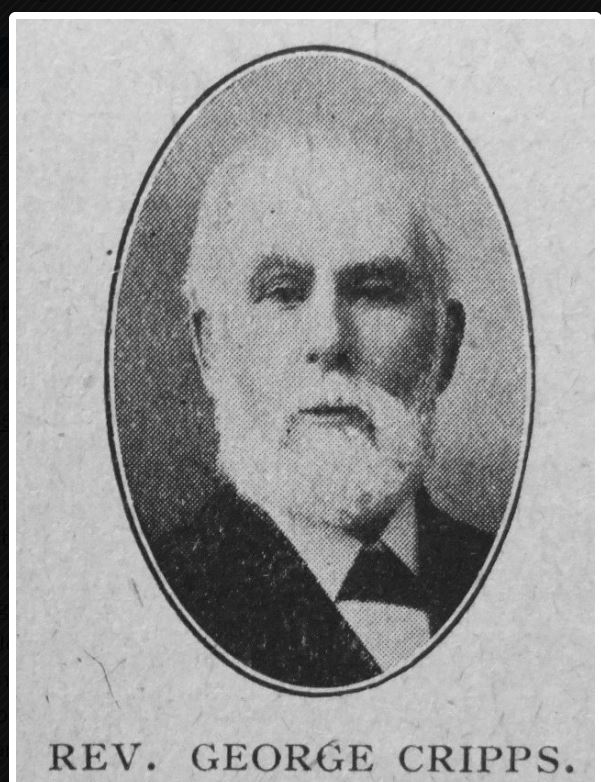
George Cripps – Primitive Methodist Minister

George Cripps was born on May 2, 1839 in Badbury and baptised on May 26 at Chiseldon Parish church.  He was the son of James and Sarah Cripps and when aged just 15 he dedicated himself to a life of Christian service. Within months of his conversion he was preaching on the local circuit and embarked upon a long career as a travelling preacher. He began his ministry in Witney in 1861 travelling the country and serving in various circuits including those at Andover, Thetford and Ipswich before returning to Swindon in 1897.

In 1866 he married Ursula Ellen Bayman and the couple had six children, two of whom had sadly died before 1911. Their son Raymond George Cripps married Beatrice Maud Raggett, a member of another prominent local Primitive Methodist family, and went on to become Mayor of Swindon in 1938-39.

George retired to Swindon where he worshipped at the Prospect Place Primitive Methodist Chapel. In 1901 he and Ursula were living at 134 Goddard Avenue. George died at his home on August 25, 1920 and was buried in grave plot D300 which he shares with Ursula who died in 1918.

A lengthy obituary written by Joseph Burton was published in the Primitive Methodist Magazine in 1920 – extracts can be read below:

After a period of further preparation, involving much thought and prayer, he commenced his life’s work as a minister of the glorious gospel of our Lord and Saviour Jesus Christ in 1861. The Witney Circuit pledged him, and he laboured with considerable success and acceptance on the Sturminster Newton, Faringdon, Andover, Newbury, Basingstoke, Thetford, King’s Lynn, Wangford, Ipswich, Tunbridge Wells and Guildford Circuits.

There were many preaching places on most of these circuits, covering a wide area, and sometimes necessitating a walk of fifteen or sixteen miles each way. Besides the ordinary week-night work, our brother frequently preached three and four times on the Sabbath. He built five chapels and reduced debts on others. It seemed to be his lot to have to grapple with such cases, but with indomitable perseverance and tact, he generally succeeded. At Ipswich, where I first formed his acquaintance, he waited upon a gentleman with the intention of getting financial help, but was unable to see him. He called again—twenty times—before he was granted an interview. The gentleman said: ‘‘I believe you have been before.” Our brother replied that he had called twenty times, and should call again unless he got what he desired. The gentleman bade him sit down, and retired to another room. Presently he brought a cheque for £20—a pound per visit—as a reward for his pertinacity, and, told him whenever he needed help, he could call again. 

The same zeal was in evidence for winning souls. Well do I remember as a probationer, the Saturday evening open-air services, with sometimes opposition, sometimes police interference; but if we were moved from one place it was to begin again elsewhere: the singing and exhortations went on, and, we had reason to believe, were made a blessing to souls.

He got the Free Church ministers to join him in a mission in connection with our Rope Walk Church, and as they proceeded down the Rope Walk, headed by a brass band, it was the signal for a tremendous opposition that required the whole of the town’s police, except two, to quell. But not before much damage was done. They smashed the windows of the chapel, brick-ends falling on to the platform, and those who had ventured inside the chapel had to be got out by the back door and through the caretaker’s house. Happily no one was seriously hurt. The windows were boarded up, and the mission proceeded for some weeks, leading ministers and friends of other Churches taking part. The riot was due to a misapprehension that the Salvation Army were beginning their mission in the town, but it turned out for great good, many souls professing conversion.

It was while on the Tunbridge Wells Circuit, under the strain of heavy chapel liabilities, and special services—including mid-day services to men during their dinner hour—that his health broke down. His condition was so serious that his medical adviser ordered a sea voyage to New Zealand on a sailing vessel. In a crisis of this kind, one sometimes discovers that: some of God’s servants have been watching the struggle. It was so in his case. One friend secured his passage, others sent useful presents for his comfort on his voyage, and almost weekly, during an absence of eleven months, never failed to minister to his wife and family. On his return it was found there was very little improvement in his health. The Conference of 1887 stationed him at Guildford, from whence he superannuated in 1892, having travelled thirty-one years. He settled down in Swindon. Though broken in health and a great sufferer, he served nine years on the Swindon Board of Guardians, and preached in nearly all the, Free Churches in the town. His wife, never strong in health, but a great helpmate on his circuits, ideal in the home, hospitable and very kind, predeceased him in 1918. Most of the time after her death he was obliged to remain indoors, and latterly was confined to his room suffering from a complication of diseases—uncomplaining, bright, cheerful and hopeful in spirit, and heartily responsive to prayer and spiritual conversation. 

Image published courtesy of My Primitive Methodists

You might also like to read:

Raymond George Cripps – first Mayor to be invested in new Civic Offices