John Hudson Read – Driver of the Royal Train

The re-imagined story …

Father spread the newspaper across the kitchen table. It took him some time to find the report he sought as Mr Morris had seen fit to hide it on the fifth page of his periodical. The attempt on the Queen’s life had happened two days previously and was old news by then.

Father cleared his throat before speaking. In his melodious Welsh voice he announced – ‘An attempt to shoot the Queen was made on Thursday evening at Windsor station.’

Father had a magnificent voice. I loved to hear him sing in the Baptist Chapel in Cambria Place where we attended every Sunday. Mind he had some keen competition, lot of good Welsh voices there were there.

Mother was less enthusiastic. ‘Likes to hear the sound of his own voice,” she said, which I thought was a compliment – until I grew older.

That evening he read to us the report of the attempt on the Queen’s life. In his rich tenor voice he presented the scene – the poorly clad, starving clerk and the brave Eton schoolboy who belted him round the head, the crowds, the police – it was like something out of a Penny Dreadful!

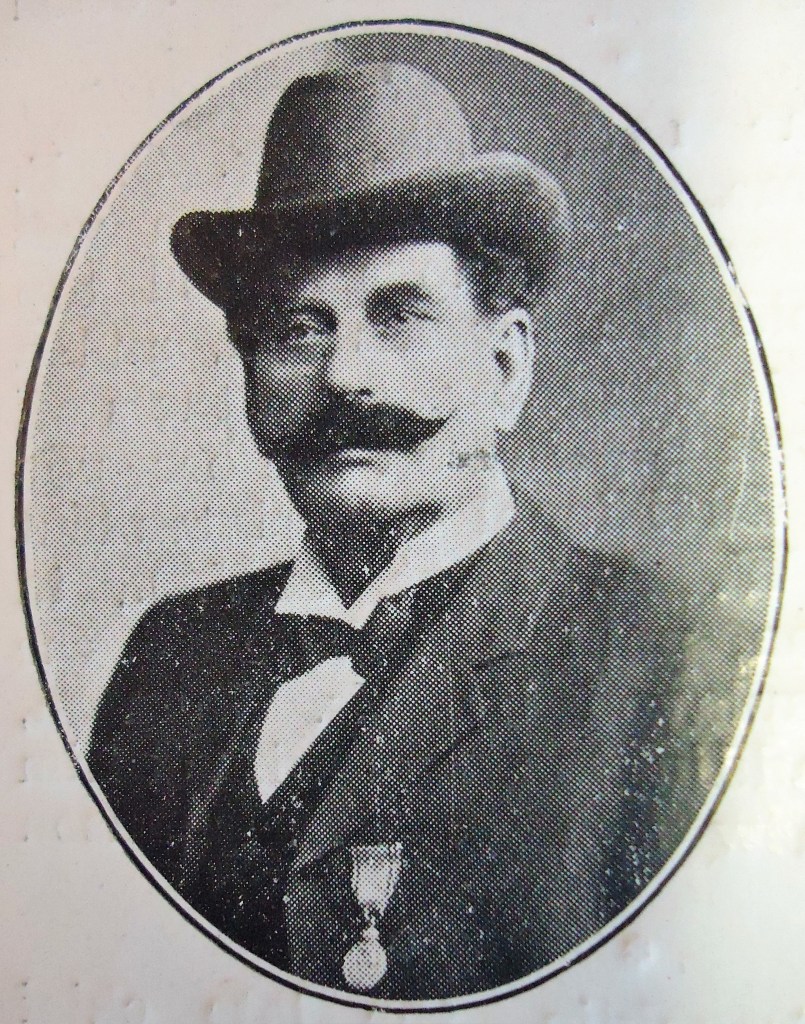
We later learnt that the Royal Train on which the royal party travelled that day was driven by a Mr. John Hudson Read. And then would you believe it, two years later he moved into the house next door to us. There’s famous he was. I used to tell the story to my children but they were less impressed. I suppose it was old news by then.

The facts …

Attempt to shoot the Queen

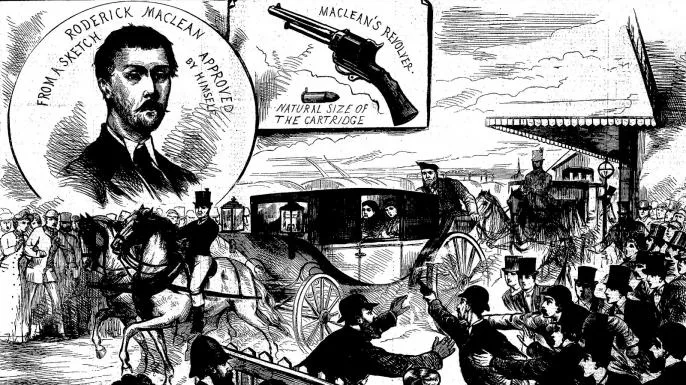
An attempt to shoot the Queen was made on Thursday evening at Windsor station. The name of the miscreant is said to be Robert Maclean, who was poorly clad, and who states that he is a clerk out of employment.

The particulars of the foolhardy act are as follow :- The Queen, who had been spending a couple of days at Buckingham Palace, left London in the afternoon for Windsor Castle. The Royal train arrived at Windsor about half past five o’clock, a large crowd having assembled to witness the arrival of the Sovereign. On alighting from the train her Majesty at once entered a carriage which was in waiting to convey her to the Castle, when just as she was about to drive oft a man who had been standing with others at the entrance to the station yard suddenly fired a revolver at the Royal carriage, but happily the shot did not take effect.

The fellow was about to fire a second time, when the pistol was wrenched from his grasp by a bystander, and he was at once seized by the police, who, however, had some difficulty in preventing him being lynched by the crowd. It is stated that at the moment the pistol was fired the crowd was cheering the Queen, who, it is thought, did not hear the report; but of course her Majesty was quickly apprised of the attempt which had been made upon her life, and, with her usual solicitude for others, she at once caused inquiries to be made as to whether any one had been struck by the pistol-charge.

Some doubt exists as to whether a bullet was really fired or not, as no trace of one has been found. The pistol, which was a six chambered one, was found to be loaded with two blank cartridges and two containing bullets. Several other cartridges were found on the person of the would be assassin. Maclean is thought to be of unsound mind.

This is the sixth outrage which has been perpetrated on the person of the Sovereign. The first occurred in June, 1840, when the Queen was fired at by Oxford. The next was in May, 1842, the would be assassin being John Francis. Two months later a man named Beau presented a pistol at her, but without firing it. In June, 1850, her Majesty was struck in the face by a fellow named Pate as she was walking out; and in 1872 a lad named Arthur O’Connor presented an unloaded pistol at her as she was entering Buckingham Palace.
The Prisoner Before the Magistrates,

Windsor, Friday afternoon.

The prisoner was driven to the Town-hall in an open fly at half-past one to-day, in charge of Supt. Hayes and a plain clothes official. He has a very wretched look, and is a man very much of the Lefroy type. He looks unclean and unshaven, and has a slight black moustache. He was immediately taken before the bench of magistrates, the Mayor of Windsor presiding Mr Stevens, solicitor to the Treasury prosecuted on behalf of the Public Prosecutor. Amongst the magistrates present were Alderman Chamberlain, and Mr G. Poole.

In reply to the Mayor, the prisoner said in a most off-handed manner and in a firm voice that his name was “Maclean-Roderic Maclean.” Supt. Hayes was then sworn. – Mr Stevenson said he was instructed to prosecute by the Secretary of State.- Supt. Hayes that her Majesty arrived at the station at 5-25 yesterday. She was accompanied by the Princess Beatrice, and Mr Brown was sitting behind the carriage. As the carriage started and had got half way to the gate he heard a report, and looked to the left, when he saw the prisoner. Prisoner here asked whether he was allowed to ask any questions. The Mayor said certainly he would, presently.

Examination continued: He looked to the left and saw the prisoner in the act of presenting a pistol at her Majesty. He did not hear more than one shot fired. The prisoner was about 150 yards from the carriage where the shot was fired when he first saw the prisoner. He was holding the pistol straight out in the direction of the carriage. He immediately sprung on him, and collared him by the collar and neck. He stopped to take the pistol from him when a young man named James Burnside subsequently got possession of the pistol, and handed it over to him. He produced the pistol, which had been in his possession ever since; he put it in his pocked immediately he put prisoner against the wall, assisted by Inspector Fraser and others. Prisoner said, “Don’t hurt me, I will go quietly.”

A little Eton boy came up and gave him a blow on his head, and he then took prisoner to the police station, and when there he asked him his name and address. He gave his name and address, and said he had been in Windsor about a week. On the way to the Police-station in the cab prisoner said, “I was starving, or I should not have done this.” At the station when charged he said, “Oh, the Queen!”

He examined the pistol. It was a German pin-fire revolver; it had two empty cartridge cases in it, that was to say exploded cartridges. Three were full whole cartridges, and two chambers empty. He drew the cartridges, and produced them. He searched the prisoner, and on him found 14 other cartridges of the same make. They were in a piece of rag. He found other articles of no value, including a pocket book, a knife, etc. Amongst other things a letter was found. It was taken from him by Inspector Fraser. The letter was then read, in which prisoner stated that he would not have dared the crime had the sum of 10s been given to him instead of 5s being offered the insultingly small sum of 6s. He was compelled to commit this crime against the bloated aristocrat, headed by that old lady “Mrs Vic.”

Witness further said that at 10.30 this morning prisoner said he wished to make a further statement, “I have a complete answer to the charge.” He then wrote a letter which was now put in and read, in which prisoner said he was not guilty of shooting at the Queen with intent to do grievous bodily harm, his object was only to cause the public alarm, with the result of having his grievances redressed. Such was the pecuniary strait in which he was.

All the circumstances tended to prove this statement. Had he cared to have injured the Queen he would have fired at her when she was getting out of the carriage. As it was he shot at the wheels but the pistol kicked and the bullet might have hit the carriage door. The only consolation he could offer the Queen was this statement, and he offered it if the charge of intent to do the Queen grievous bodily harm was withdrawn, and a charge of attempting to intimidate others substituted he would do all in his power to elucidate the mystery, and to bring the matter to a speed issue. At the end of the letter prisoner said that was the whole truth. The prisoner was remanded.

The Swindon Advertiser, Saturday March 4, 1882.

George Augustus Crocker – with Mother’s fond love

The re-imagined story …

‘Some say it was a futile war, a pointless war, an unjustifiable war. Tell that to Kate Crocker, that’s what I say.

When the old Queen married off her children into European Royal households she did it to create one big family. Well, we all know what families are like – there are favourite children and jealous cousins and an interferring aunt and uncle – but it’s something quite different when family members fall out on the world wide stage. Some people don’t know when they’re well off.

The First World War began when Gavrilo Princip assassinated Archduke Franz Ferdinand of Austria, but of course there was more to it then that. The causes of that Great War were many. Tell that to Kate Crocker.

By the time Kate took possession of her son’s war medals she was alone in this world, her immediate family gone, her husband and both her children dead. Europe was a different place as well. The old Queen’s plans for her family had come to nothing. Just like Kate’s.’

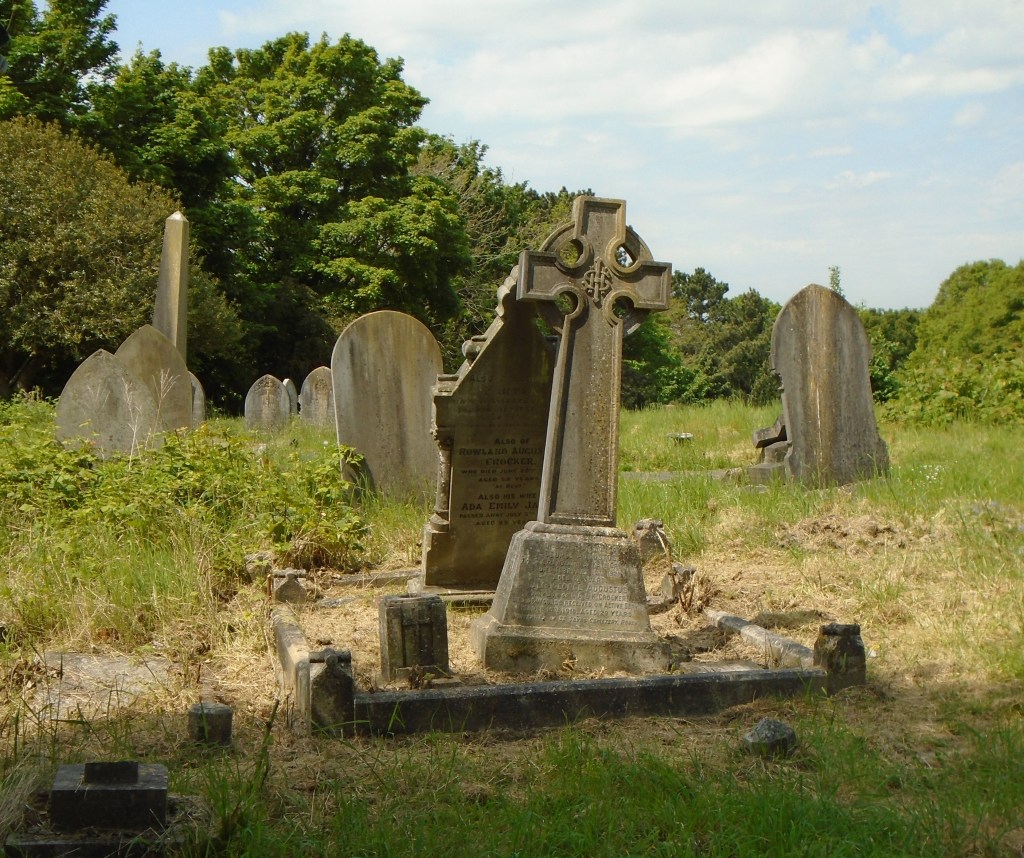
The inscription on the headstone reads:

Also George Augustus

only son of G.A. & K. Crocker

Died of wounds received on Active Service

March 15th 1918 Aged 29 years

Interred in St Seves Cemetery Rouen

The facts …

George Augustus Crocker and his sister Edith were baptised together at St. Mark’s on December 3, 1888. The family home at that time was at 28 Reading Street. In 1901 the family are recorded as living at 63 Exmouth Street.

George followed his father into the Works and a job as a railway clerk in the Operating, Traffic, Coaching Depts. He began his employment as a 16 year old on an annual salary of £25 on May 16, 1904.

George Augustus Crocker enlisted in the Royal Army Medical Corps at Swindon on May 10, 1915. He later transferred to 6th Cyclists Bttn Field Ambulance. He died on March 15, 1918 from wounds received in action (Gas) in No 9 General Hospital Rouen. He was 29 years of age. He had served a total of two years and 310 days – a year and 280 days at Home and 1 year and 30 days in France. He is buried in St. Sever Cemetery extension, France. The inscription on his headstone reads – They died that we might live with Mother’s fond love.

He left effects valued at £125 to his mother. Property returned to Kate included letters, photographs and a diary.

Kate Crocker died on June 8, 1938, She is buried in plot E8506 with her daughter Edith who died in 1908 aged 21 years and her husband George Augustus senior who died in 1921. Their son George Augustus is mentioned on their memorial. Ada Emily Jane Crocker, the widow of Rowland Augustus Crocker, George Augustus senior’s brother, was buried in the same plot in 1967.

In the neighbouring grave plot E8507 lies William Crocker, George Augustus senior’s brother, his wife Martha and the aforementioned brother, Rowland Augustus Crocker.

St Sever Cemetery and St. Sever Cemetery Extension are located within a large communal cemetery situated on the eastern edge of the southern Rouen suburbs of Le Grand Quevilly and Le Petit Quevilly. – see www.cwgc.org.

William Greenaway MVO

William Greenaway was one of the extraordinary, ordinary people Swindon has produced over the years.

William Greenaway was born in Purton on August 10, 1843. He entered the Great Western Railway employment as a labourer on January 7, 1860 aged 16 years old. His employment records reveal that he became a fireman on April 19, 1861, an Engineman on August 15, 1867 and an Inspector on July 8, 1889.

He married Emma Jane Ferris Shury at St Mary’s Church, Purton on July 26, 1862 and the couple had 9 children. The family lived at addresses in Purton, Swindon, Bradpole in Dorset and Bedminster, Bristol before returning to Swindon in 1891 when they lived at 37 Reading Street. By 1901 William and Emma were living at 6 Emlyn Square where Emma died in October of that year. She was buried in plot C1976 Radnor Street Cemetery on October 18. William Greenaway died at 6 Emlyn Square on February 20,  1908 aged 64 years. He was buried alongside Emma on February 23 in plot C1976.

A Swindon Railway Official Before the King

His Majesty Confers Upon Him the Royal Victoria Medal

His Majesty the King on Saturday morning conferred the Royal Victorian Medal upon Locomotive Inspector William Greenaway, of the Great Western Railway, Swindon, who was in charge of the engine working her late Majesty’s Jubilee train in 1897, and travelled with the Royal train on every subsequent occasion, including the removal of her late Majesty’s remains from London to Windsor.

The Earl Cawdor, chairman of the Great Western Railway Company, and Major W. Dean were present. The Hon. J.H. Ward, Equerry in Waiting, was also in attendance.

One of our representatives called upon Mr Greenaway this morning, and added his word of congratulation to the many others which have been extended to the recipient.

Although there is an entire absence of anything in the nature of obtrusiveness about Inspector Greenaway, he is pardonably proud of the high honour conferred upon him by the King of England. And, might we add, the pride is felt in an equal measure by all those who know him, for Swindon has reason to be gratified that one of our townsmen should be singled out for such distinction.

The ceremony at Buckingham Palace was of a very private character, and though short in duration his Majesty did not forget to refer to the great run West which he and the Queen took recently, and when Mr Greenaway stood by the driver on the footplate, safeguarding as far as it lay in his power the lives of the Royal travellers.

The Royal Victorian Medal is a small silver one, and bears the image of the late Queen, who on several occasions travelled under the guidance of Inspector Greenaway. The medal has been conferred upon the Inspector for the services he rendered at the Diamond Jubilee, and when, later, Queen Victoria’s dead body was carried to its last resting place.

Apropos this latter sad ceremony, the Directorate of the GWR presented a beautiful bronze medal to several of their officials who took part in the work of conveying the body from Paddington to Windsor, and Inspector Greenaway is the proud possessor of one of these.

Inspector Greenaway’s service dates from 1859, but it was not till the Diamond Jubilee that he was given the privilege of travelling with Royalty.

The Evening Swindon Advertiser, Monday, May 12, 1902.

Swindon – The somewhat sudden death of Inspector Greenaway on February 20th removed from the locomotive world a most interesting personage. From his earliest childhood engines possessed an extraordinary fascination for him, and from the moment when, at the age of ten years, he was allowed to have a ride on a locomotive, his choice of a career was determined. In 1860 he entered Swindon Works and only a year later was appointed fireman. In 1867 he was promoted to the position of engineman and frequently selected for special duties appertaining to the Running Department. In 1889 he was appointed locomotive inspector, and seven years later chief locomotive inspector. One of his duties was that of examining firemen before taking charge of an engine. He was the author of a comprehensive handbook on footplate work which had a very large circulation. In January, 1901, Inspector Greenaway was presented with a bronze medal and in 1902 was brought under Royal notice and personally presented by His Majesty the King with the silver medal of the Royal Victorian Order for the able manner in which he had taken charge of the Royal journeys. In December, 1905, he was commended and awarded a gratuity for prompt action resulting in the avoidance of a collision. He was associated with several records made upon the Great Western, notably that of July 15th, 1903, on the occasion of the visit of the Prince and Princess of Wales to the West of England, when a world’s record was created on the run from London to Plymouth. Inspector Greenaway’s knowledge of the duties of an engineman and the management of locomotives was of a very high order

And to the last the utmost confidence was reposed in him by his chiefs.

Great Western Railway Magazine March 1908

You may also like to read:

The Amazing Record Breaking Inspector William Greenaway