James Shopland – a local hero

The re-imagined story …

I’ve seen them all arrive at Swindon Junction, the King and Queen in 1924, the young Princess Elizabeth in 1950, politicians, film stars, you name them, I’ve seen them. But I’ve never seen a sight like the day they brought back the body of James Shopland.

I was just a youngster then and recently employed as a station lad. My duties mostly consisted of carrying things around, everything from luggage to parcels. I wasn’t allowed too close to the passengers as they alighted from the trains; I was considered too cheeking and disrespectful. I had a lot to learn and looking back I reckon my education began that day in July 1900.

Early that morning I was told to clear out a small, seldom used room along the platform. I was to get rid of any rubbish and sweep the floor. I was to place a small table there and a couple of chairs and to make sure everything was polished.

“Who are we expecting?” I asked Fred, the head porter, “the bloomin’ Queen herself.”

I soon learned not to give him any cheek. He boxed me round the ear and gave me a good telling off. I was lucky not to lose my newly acquired job that day and for a good few weeks after that I tried to keep out of his way.

The room was to be made ready to receive the floral tributes for a funeral due to arrive that afternoon. So many wreaths and crosses, I had never seen so many. That day on July 11, 1900 I witnessed the homecoming of an unsung hero, James Shopland who died as he tried to rescue three men in an accident at the Southampton Sewage Works at Chapel.

The funeral cortege left Mr Shopland’s home in Woolston, proceeding by way of the floating bridge to the Dock station. A special carriage was attached to the 2 pm train to Swindon where Mr Shopland was to be interred at the Swindon Cemetery on Kingshill.

The coffin was carried from the train, through the station and placed in a glass-panelled car. I watched the pallbearers return to collect the flowers and counted more than 60 wreaths and crosses. Some were placed in the car, others were carried by those that followed.

I watched the long line of carriages with many more people walking behind. The procession continued along Wellington Street where blinds and curtains were drawn at the windows and people stood with bowed heads to pay their respects.

The story of James Shopland’s death had already appeared in the Swindon Advertiser, but I was just a silly, cheeky young lad. I had paid no attention. That evening, when I told my Pa about the funeral, he told me how James Shopland had died.

primroses

The facts …

James Shopland, a civil engineer, was born in Purton in 1873, the son of James Rew Shopland, also an engineer.

By 1900 James had moved to the Southampton area and on July 6, 1900 he was at the Southampton Sewage Works, although it was pointed out at the inquest that he had nothing to do with the works, but was assisting in the rescue.

Three labourers working in the press house at the Sewage Works had attempted to free a blockage in a lime vat, firstly by ramming a rod down from the top, which was the usual way of clearing it. However, when this didn’t work, one of them went down into the ejector chamber and tried to free the pipe by undoing it. They tried to remove the cap but this wouldn’t move either, so they proceeded to remove a flange from the bottom and then the upright pipe. This immediately set off a fast flow of sludge and released a smell that rendered the men semi-conscious.

Passing workmen attempted to rescue the three men who were all lying unconscious in the sludge. As a call went out for volunteers, James Shopland arrived on the scene. A witness at the inquest described how as Mr Shopland descended the ladder he saw him put his hand to his head.

At one point someone tried to stop any more men going into the chamber, declaring that at this rate there would soon be fifty dead at the bottom.

James was brought to the surface where artificial respiration was attempted, but he was already dead. At the subsequent post mortem the cause of death was found to be due to congestion of the lungs brought about by carbolic acid gas poising.

The jury at the inquest recorded a verdict of accidental death and commended the noble endeavour made by James Shopland and four others who had attempted to rescue the men.

James was 26 years old and had been married for just a year. He is buried in plot D100 with his wife Helena (Nellie) Elizabeth Shopland. Helena moved to Bournemouth where she lived with her widowed mother-in-law, but she eventually came back to Swindon. At the time of the 1911 census she was living at 159 Goddard Avenue with her sister Violet Blanche Brown. She died just a few weeks later, on June 16, 1911. Her funeral took place on June 20 and she is buried with her husband.

James Shopland D

William Hall – killed at work aged 13 years and eight months

At 13 years and 8 months of age William was working as a ‘slipper.’ A ‘slipper’ was a young lad who assisted with the movement of wagons by horses. He would place the chocks to ensure that the wagon did not move when parked. They were called slippers because the chock looked like a slipper.* As one of the jurymen remarked during the inquest – ‘he thought it a great shame that the Co. should employ lads at such work. It was very dangerous for the lads so employed.’

William Hall had a short life. You could easily miss him on the 1881 census returns where he is recorded as James William Hall aged 4 years old. He was then living in Llanelly, Carmarthenshire with his parents John and Ellen, and two brothers. William was born in Swindon in 1877 but by 1881 the family had lived in Wales for a few years. His younger brother Thomas was born in 1879 in Llantrisant while Frederick was born in Llanelly in 1883. By 1890 the family were back in Swindon living at 166 Rodbourne Road, handy for the Works where John worked as a Stationery Engine man and where William would soon join him.

The Fatal Accident at the GWR Station

On Saturday, Mr W.E.N. Browne, coroner, held an inquest at the Cricketers’ Arms, New Swindon, on the body of the lad William Hall who received fatal injuries at the GWR Station, New Swindon, on the previous Thursday. Mr T. Wheeler was chosen foreman of the jury, who then proceeded to view the body, which was lying at the GWR Medical Fund Society Hospital. Inspector Wheeler was present to watch the proceedings on behalf of the GWR Co. The following evidence was taken:-

John Hall sworn, said: I am father of deceased, whose age was 13 years and 8 months. He had been only two days in the employ of the GWR Co., but he was at the same work for three days a fortnight ago, but left and did nothing till he was taken on again during the past week.

Henry Roach, shunter, in the Loco. Dept., said he was standing near the E Box in the afternoon. He heard someone call out, and on looking round he saw the second wheel of the van go over the deceased. Witness went to the lad’s assistance and picked him up. He asked deceased how he got under the van, and he replied, “My foot caught in the points, and it threw me down.” Deceased was quite sensible when picked up. The driver was at the horse’s head.

By a juryman: – It was a general practice for boys to be employed in “slipping coaches.”

(A juryman here interposed with the remark that he thought it a great shame that the Co. should employ lads at such work. It was very dangerous for the lads so employed).

Albert James Ford, said he was a driver in the employ of the Great Western Railway Company. Deceased was working with him as a “slipper.” On the day of the accident he was at work with the deceased, as usual. The first he heard of the accident was when the boy, being caught under the wheel, cried out. He went to the lad, and found the wheel had passed over him, and his shoe was left in the points. It was a horse box that was being drawn, but the boy was not riding on it at all. Witness had that same morning cautioned the deceased against walking on the rails, and he was not doing so when the accident happened. If the lad’s foot had not caught in the points the accident would not have occurred.

Mr Cailey, assistant to Messrs Swinhoe, Bromley, & Howse, said deceased was admitted to the hospital about 2.30 p.m. on Thursday. He was suffering from severe injury to the thigh and one arm. Deceased had his boots on when brought to the hospital. He lingered till six o’clock, when he died from exhaustion.

The Coroner having briefly summed up, the jury returned a verdict of “Accidental death.”

The Swindon Advertiser, Saturday, Feb. 15, 1890.

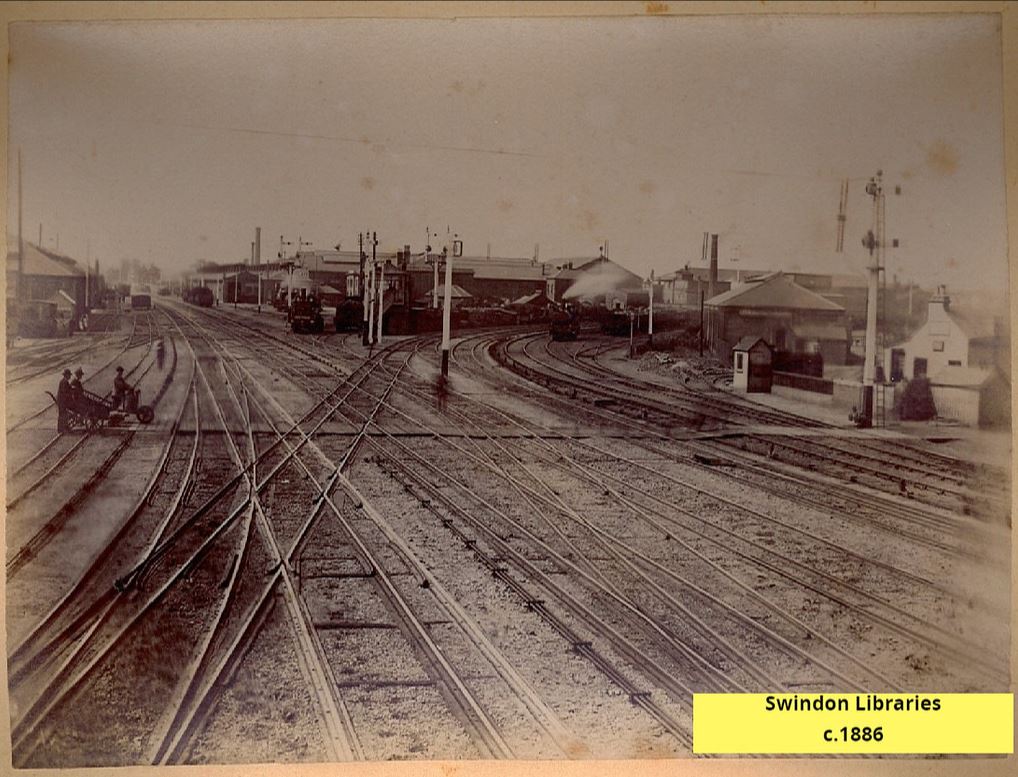
c1886 View of Swindon GWR Works from railway line published courtesy of Local Studies, Swindon Central Library.

Today there is no one left to remember the young boy who was doing the work of a man. No one to remember that William Hall was 13 years and eight months old when he was killed at work.

William was buried on February 18, 1890 in grave plot B1778 – a public grave that he shares with two others.

*Many thanks to David Robert for correcting a previous error.

Sarah Cox – guilty of wilful murder?

The story of Sarah Cox was revealed for all to read in the local press; to question her morality; to gossip and pass on the details of her crime. Yet who knew the facts; who knew what had happened to her? Her employer W.H. Stanier, Chief Clerk to William Dean, Chief Locomotive Engineer at Swindon Works, described her as ‘a God-fearing, steady girl.’ To his knowledge she never went out but once a week, besides going to a place of worship.

She kept the secret of her pregnancy and the identity of the child’s father, but in the end she confessed to her crime.

The inquest on Sarah’s baby was reported at great length. Then, perhaps surprisingly, the charge was commuted from ‘wilful murder’ to the lesser, second indictment of ‘concealing the birth of her child’.

But what happened to Sarah …

Rolleston Street pictured in 1957 shortly before demolition. Published courtesy of Local Studies, Swindon Central Library.

Inquest on an Infant at Swindon

Verdict of Wilful Murder

On Saturday Mr. Coroner Browne held an enquiry at the Clifton Hotel, New Swindon, into the circumstances attending the death of an infant which was found buried in a garden at the rear of No. 28, Rolleston Street, New Swindon. The case has excited considerable gossip in the town. It appears that a young girl named Sarah Cox, in service at Mr. W.H. Stanier’s, the Sands, Old Swindon, was confined on Wednesday night, April 24th, unknowing to any of the family, and that she took the child away in her box, and afterwards buried it in her brother’s garden in Rolleston-street. Mr George Wiltshire was chosen foreman of the jury, and the following evidence was taken:-

Richard Cox, brother of Sarah Cox, stated that he lived at 28 Rolleston-street. His sister came to his house on Thursday morning. He saw her at nine o’clock in the evening, after he came home from work. He went to bed that night about 11 o’clock, leaving her on the couch in the front room. She would not go to bed that night. She brought her box with her when she came to his house in the morning. He went to his work as usual the next day, and at twelve o’clock he was sent for by his wife, who told him of what had taken place, and that the body was in the back garden. He at once went into the garden, and saw where the earth had been removed, and then gave information to the relieving officer and Inspector Cruse. He saw Sarah Cox, his sister, about eight days previously, and noticed she was stouter than usual, but she had never made a decided statement that she was enceinte. His sister had been away from his house since October last, except coming occasionally since Christmas, on account of ill-health. His sister had had a child before, but it only lived a short time – some three months.

Mary Ann Heath, a laundress, living in the Quarries, Swindon, said she knew Sarah Cox as a servant at Mr. Stanier’s. She saw her there at a quarter to eight on Thursday morning. Witness had not then any suspicion as to the girl’s condition. She looked very ill; her face was as white as paper, and her lips were black. The girl never said anything as to her state of health. She left at half-past nine o’clock on Thursday morning in a cab, which Mr. Stanier had ordered;- By the Coroner; All the time witness was attending at Mr Stanier’s she never saw anything wrong with the girl, nor misjudged her in any way. The girl had told Mrs Stanier that she met with an accident a month ago. Mrs Stanier asked witness if she had any suspicion about the girl, and she replied, “Not in the least.” No complaint was made to her by the girl. Witness noticed a large bloodstain on the bed when she made it.

Inspector Cruse said that just before one o’clock on Friday morning he had his attention called to this matter by Richard Cox, and in consequence went to 28, Rolleston-street. He saw that the earth in the back garden had been disturbed. He removed it, and found about three inches below the ground the body of a newly-born male child wrapped in two newspapers, and with a piece of tape tied tightly round its neck. He saw Ellen Cox, the previous witness, who told him all that she had stated in her evidence. He had the body removed to the mortuary, and communicated with a doctor.

Mr E.C. Arnold, FRCS, MB, said he was called soon after one o’clock on Friday to the house, 28, Rolleston St. He went and saw Mr and Mrs Cox there. He went upstairs, and there saw Sarah Cox. He found she had every symptom of having been recently confined. She informed him that she had been delivered of a child on Wednesday night. He examined her in the presence of a witness. He saw the body of a child with a piece of tape tied round its neck. He afterwards made a post-mortem examination of the body and found that it had breathed. The girl said she had no recollection of anything except that she was confined on Wednesday night, and the next morning she found the child dead on the floor with the tape tied round its neck. He called in Dr. Streeten to assist him in the post-mortem examination, and they concurred in the opinion that it was fully developed, and perfectly healthy in every organ. There was a deep groove round the neck, and the signs were those of asphyxia. With the exception of the mark made by the tape, there were no signs of violence. The tape was tied with sufficient tightness to cause death. There was no proof, however, that the child had had a separate existence from its mother. The cord was divided near the placenta end, and had the appearance of having been cut, and not torn. The girl could have cut it herself.

Mr W.H. Stanier was the last witness called. He said that Sarah Cox had been servant at his house for the past six months. Within the last two months she had complained of stiffness in her hips. About four months ago she went to her brother’s in consequence of illness. During the past month she had frequently complained of her hip, and ascribed it to rheumatism. On several occasions she had gone to the GWR Surgery for advice and medicine.

On the night of Thursday, April 11, on her return from the surgery, she said that Dr. Bromley had advised her to take rest for a few weeks. Mrs Stanier asked her if she wished to go at once, or if she could remain until another servant was obtained. She replied that there was no difficulty in her staying a week or two longer.

The girl had a bedroom to herself all the time she was with the family. Mrs. Heath, the laundress, who had given evidence, had been in the habit of coming to assist in the house once or twice a week, and she would be the only woman likely to go into the girl’s room. On Thursday morning she got up and set the breakfast. Mrs. Stanier came to him shortly after eight o’clock, and remarked that the servant seemed very ill. The result of their conversation was that he ordered a cab to take her to her brothers. Mrs Stanier sent Mrs Heath to her bedroom, and she afterwards said there appeared to be nothing inconsistent with the girls’ statement.

Witness had previously consulted Dr. Bromley, and he said he did not notice that the girl was in the family way. Witness said he would like to add that he had always held the highest opinion of the girl’s character. He believed her to be a God-fearing, steady girl. To his knowledge she never went out but once a week, besides going to a place of worship. The excellent character she bore (disarmed) all suspicion.

This was the whole of the evidence and after some deliberation the jury returned a verdict of “Wilful Murder” against the mother, Sarah Cox.

The jury gave their fees to the Victoria Hospital.

Extracts from The Swindon Advertiser, Saturday, May 4, 1889.

The Alleged Wilful Murder

In the case of Sarah Cox, 27, servant, indicted for the wilful murder of her child at Swindon, the Grand Jury thew out the bill for wilful murder, returning a true bill on the second indictment of concealing the birth of her child at Lyneham. Prisoner pleaded guilt to the lesser count, and she was let out on her own recognisances and those of her brother to come up for judgment when called upon.

The Salisbury Times and South Wilts Gazette Saturday, July 6th, 1889.

The details of the baby are recorded in the Radnor Street Cemetery burial registers as – Cox 1 day old 28 Rolleston Street buried on April 29, 1889 in plot B1178, an unmarked, public grave.

Albert Cook – a little boy crushed to death

This is the unbearably tragic story of three year old Albert Cook who hitched a ride home from school on the axle of a brewer’s cart. It is the story of two young boys who witnessed the accident but were too frightened to alert the carter, and were later called to give their evidence at the inquest. A story of unbelievable horror, which anyone at the scene would surely never be able to forget.

A Little Boy Crushed to Death

On Tuesday evening a most sad and painful accident happened to a little fellow named Albert George Stephen Cook, living with his parents at 10, Swindon Road, New Swindon.

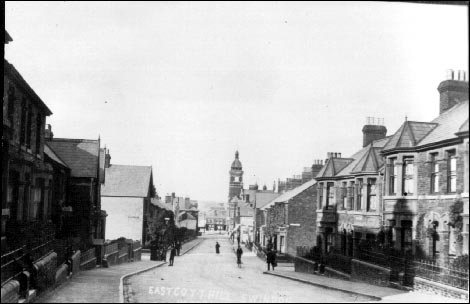
It seems that a light covered wagon belonging to Col. Luce, brewer, of Malmesbury, was proceeding down Eastcott Hill on Tuesday evening, when a Mrs. Tyler living at 114, heard a scream, and running to the door saw a child entangled in the wheel. She immediately apprized the driver of the fact, and he stopped his horse, and with the help of P.S. Peplar, who was soon on the spot, started to extricate the poor little child from its awful position.

The body was so tightly fixed between the wheel and the axle that a “jack” had to be obtained from Messrs. Affleck, Bros., Prospect Works, and the wheel taken off before the child could be removed. This taking about one hour. Dr. Fox assistant to Drs. Rattray and Lavery, was sent for, but life was extinct.

It is evident that the child was doing what hundreds of them do every day, viz., swinging or riding on the backs of wagons, one of the most dangerous practices for a child, and after this frightful accident, we should think mothers would warn their children against it.

The Coroner was communicated with, and an inquest was held on Wednesday evening, at the “Globe” Inn, Eastcott Hill, before Mr Amos Barns, deputy coroner, and a jury of whom Mr Charles Fox was chosen foreman.

William Cook, living at 10, Swindon Road, said he was father of the boy, whose age was three years and two months, and his name was Albert George Stephen Cook. Harold Matthews, a boy of six summers, said he with others, including the deceased, were returning from school. When they got to Eastcott Hill, they saw a wagon, and they ran behind to get a ride. Deceased sat on the axle, and he (witness) thought he was looking out between the bed of the cart and the wheel to see if the carter was coming after them, when he caught his head in the wheel and springs. Witness was frightened, and did not call to the driver, but went away.

Jesse Goldsmith, aged nine years, said he saw deceased sitting on what appeared to him to be the drag chain, and he went to rise himself up, and in doing so, fell into the spokes of the wheel, which drew deceased up to the top, and then deceased body stopped the wheel. The driver of the wagon stopped at the top of the hill and the children were round the wagon then, and the driver drove them away, but they waited until he got up into the wagon again, when they ran to the back of the wagon as before.

Emma Tyler said she lived at 114 Eastcott Hill, and on the day in question, about 4.15 p.m., she heard a scream and ran to her front door and there saw deceased in between the wheel and the wagon, his head being drawn nearly up top of the wheel, whilst his body was twisted under the bed of the wagon. She called to the driver, who stopped the horse immediately, and got down.

Charles Warner, of Malmesbury, said he was a drayman in the employ of Col. Luce, of the Malmesbury Brewery, and he was the driver of the wagon on which the little child met its death. He said when he got to the top of Eastcott Hill he stopped, and put the drag and safety chain on. The vehicle was empty, but he thought it would be easier for the horse. There were several children waiting to get a ride, he supposed, when he got back into the wagon. He ran after them and told them to run away. When he started he had no children on the back, and he was not aware any came there until the woman called out to him. He found the child in between the off hind wheel and the bed of the wagon, with its body twisted round through the springs. He helped take the wheel off and the pins out of the springs before they could get the child out. From the position it was in, it must have been sitting on the axles or day-chain, and fallen into the wheel.

Dr William Monds Fox said he examined deceased and found very few external marks of injury, but the neck was dislocated, which caused death.

The deputy coroner said the main point the jury had to decide, was whether or not the driver of the wagon had shown any negligence or was to blame in any way in the matter. The foreman said the jury returned a verdict of “Accidental death,” and wished to exonerate the driver Warner from all blame.

The Swindon Advertiser, Saturday, August 24, 1895.

Albert G. Cook 3 years old of 10 Swindon Road was buried on August 23, 1895 in grave B2339 an unmarked, public plot, with three babies – 14 days old Henry Trappel who was buried on August 19, 1895; Stanley William Herbert Hayes, 8 months old, who was buried on September 22, 1921 and Leonard George Scott, 11 months old, who was buried on September 24, 1921.

Season of mists – last day

Sadly, we have arrived at the last day of our virtual walk through Radnor Street Cemetery – it’s been fun, hasn’t it and the weather wasn’t too bad? It could have been worse. We conclude by stopping off at the grave of William Chambers.

Despite a shortage of readily available building land and a depression in the railway industry during the 1870s, Swindon enjoyed a building boom throughout much of the late Victorian period.  Many of our street names bear testimony to a number of local builders, George Street, Crombey Street, Colbourne Street, Ponting Street, Turner Street.

William Chambers lived and worked as builder and funeral director in the end house in Ashford Road, the one with the Calvary cross in the brickwork.  The silhouette of the shop sign can still be seen.  As we have already discovered William Chambers was building on the Kingshill estate in the 1890s.

William was born in Stroud in 1839 the son of Samuel, a handloom weaver, and his wife Maria.  In 1859 he married Sarah Tyler and the couple raised their family of eight children in nearby Bisley where William then worked as an agricultural labourer.

In 1871 he was working as a bricklayer and by 1884 the family had moved to Swindon where William established himself as a builder and contractor.  His four sons would eventually join him in the business, William and Alfred both bricklayers and Robert and Samuel who were joiners.
From 1884-1897 William was engaged in building projects in Stafford Street and Hythe, Kent and Maidstone Roads.  In the last decade of the nineteenth century William was also busy building in Ashford Road.

At the time of the 1891 census eldest married sons Alfred and William both had homes in Stafford Street.  Family folklore tells how so many relatives once lived in Stafford Street that it was known locally as Chambers Street.

William’s son Samuel took over the family business after his father’s death.  A 1906 trade directory entry describes the business at 1 Ashford Road as under new management – S. Chambers (late W. Chambers) builder & contractor, dealer in all kinds of building material, funerals completely furnished, repairs promptly attended to at moderate charges.

William died in 1901 and Sarah in 1926.  I think this stylish headstone befits a couple who spent their lives in the funeral business.

I’ve very much enjoyed your company this week. You may like to join us for ‘an in person’ cemetery walk this Sunday September 29. Meet at the chapel 1.45 pm for a 2 pm start.

Extracts taken from To Autumn by John Keats

Season of mists Pt IV

The sun is shining brightly this morning, but will the weather hold? I’ll make an early start, just in case, but you can relax at the kitchen table and take your breakfast at leisure. Join me on a virtual walk around the cemetery.

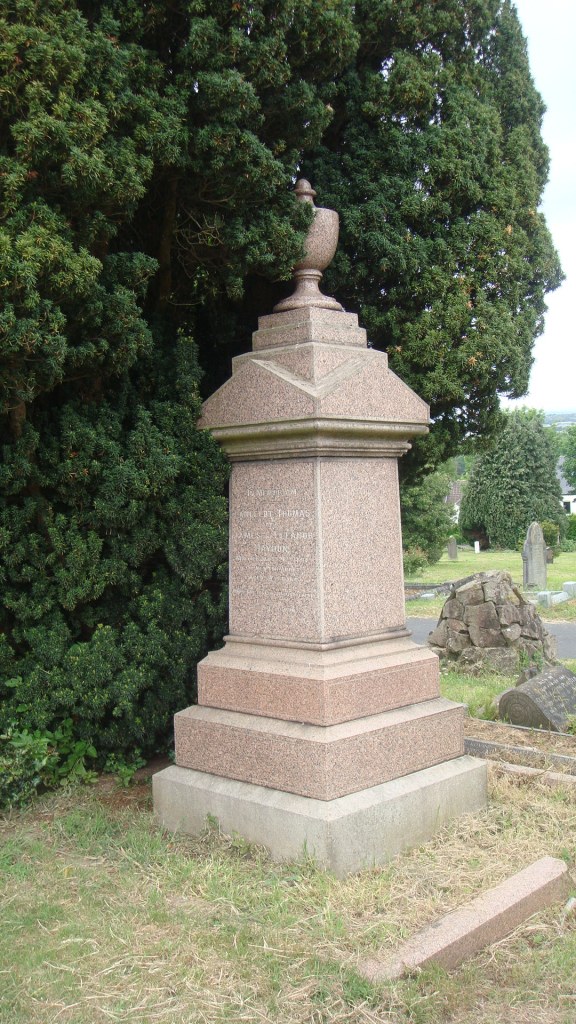
It’s easy to almost miss this magnificent pink granite monument to another railway father and son, encompassed by this large yew tree.  Like the Carlton obelisk opposite that we visited on our summer walk, this memorial was also paid for by employees at the GWR Works. 

James Haydon was born in Bristol in 1826.  The Railway Employment Records available on the Ancestry website, indicate that James entered the railway employment in March 1851 when he was about 25 years old.

By 1861 he was working as an engine fitter in the Swindon Works.  He lived with his wife Ellen, their young son Lancelot and his wife’s nephew Henry Wardle at 9 London Road.  Sharing number 9 were Thomas Watson and his wife Ann along with Ellen’s parents, Lancelot Young (who at 64 was still working as a boilersmith) Eleanor Young and several other Wardle children. Things must have been very cosy at number 9.

By 1871 James Haydon was Deputy Manager at the Works and was living in a house in what was then still known as Sheppard Fields.  This later became Sheppard Street, named after the former owner of this area, John Harding Sheppard.

James died on July 5, 1888.  He had been Assistant Manager in the Loco Works for 22 years. The inscription reads ‘this monument has been erected as a token of affection and esteem by his fellow officers and employes.’

Also remembered on this memorial is James’s son, Lancelot who died in 1894 aged just 38. Lancelot followed his father into the works and his career can be charted through the same railway records. He began work as a pattern maker apprentice in 1871.  In 1877 after he had finished his apprenticeship, he transferred to the Drawing Office. In 1881, by then a mechanical draughtsman, Lancelot left the GWR for an appointment on the Swindon, Marlborough and Andover Railway, but by 1888 he was back at the GWR firstly as Assistant Draughtsman and later as Chief Draughtsman.

At the time of the 1891 census he was living at his old family home, 21 Sheppard Street, with his wife Isabella and their young daughter. The following year Lancelot was on the move again, this time to Newton Abbott as Assistant District Superintendent Loco Carriage Dept.  He died less than two years later.

Tomorrow we meet another man who has left his mark on Swindon but now I will take a brisk walk down the hill as I’m sure I just felt some spots of rain.

Season of mists Pt III

Where are the songs of Spring? Ay, where are they?
Think not of them, thou hast thy music too –
While barred clouds bloom the soft-dying day,
And touch the stubble-plains with rosy hue;
Then in a wailful choir the small gnats mourn
Among the river sallows, borne aloft
Or sinking as the light wind lives or dies;

To Autumn by John Keats

Join me on another virtual cemetery walk from the comfort of your home.

There has been heavy rainfall over night and underfoot is very damp and slippy.  But I have come prepared as today I am taking you to a crowded corner of the cemetery where there are some magnificent monuments with some classic funeral iconography. 

The IHS on this cross is the Greek representation of Jesus Christ’s name.  The garland of flowers around the cross represents victory in death. This is the last resting place of Edward Henry Sammes.  It’s interesting that his family should make a point of adding ‘of Swindon’ to the inscription because Edward was not originally from Swindon but was born in Lambeth in January 1842, the son of William and Sarah Sammes.

The first reference to Edward in Swindon is in the 1871 census when he is 29 years old and living a 1 Belle Vue Road where he describes himself as a grocer.  That same year he married Sarah Anne Spackman from Wootton Bassett. The couple had two children William and Millicent who are both buried here as well.

At the time of the 1881 census Edward described himself as a retired grocer.  By 1889 he was a member of the Old Swindon Local Board, so well placed to know plans for development in the town.  The family were then living at Wycliffe House in Devizes Road.

In 1892 Edward submitted a planning application to build eight houses on the corner of Kent Road and Maidstone Road. The land had orginally come on the market in the 1870s but development was slow to take off. However, by the 1890s the area was pretty much one huge building site. 

A map of Edward’s project shows an empty site next door on the corner of Kent Road and Ashford Road with another empty site opposite.  The building specifications for Edward’s houses describe three bedrooms, a parlor, sitting room, kitchen, conservatory, scullery, WC, coals and pantry. At the other end of the road rival builder William Chambers had a yard opposite his own development at Ashford Terrace.  

Edward died in 1897 aged 55. He left £5,814 18s 6d to his widow Sarah and son William, worth today somewhere in the region of £2.7 million.

I’m not sure if his son William ever worked or whether he spent his whole life living off his inheritance.  In the 1911 census the family are living at 31 Devizes Road where William, then aged 35, and his sister Millicent 27 are both living on private means.

We have been fortunate with the weather today. And doesn’t the cemetery look beautiful in its Autumn finery. But then it always looks beautiful to me. I look forward to keeping your company tomorrow.

Call yourself a Swindonian?

Can you call yourself a Swindonian? Many an argument has ensued about how long you have to live in Swindon before you’re considered a local; 20 years, 30 years, 2 generations – or more?

Walter Rumble was born in Chieveley, Berkshire in 1864 and began his working life as a Carter Boy (a farm servant). In 1890 he married Annie Caines and by the time of the 1891 census the couple were living at 128 Stafford Street. Walter worked as a general labourer, most probably in the GWR Works where he remained for the rest of his working life.

Yesterday I met Walter’s great-grandson at the Swindon Society Open Day held at the Lawn Community Centre, Guildford Avenue. There were displays from the Society’s extensive photographic collection (including the many albums of Beaney photos) talks about Alfred Williams and Radnor Street Cemetery and more local historians on call than you could shake a stick at!

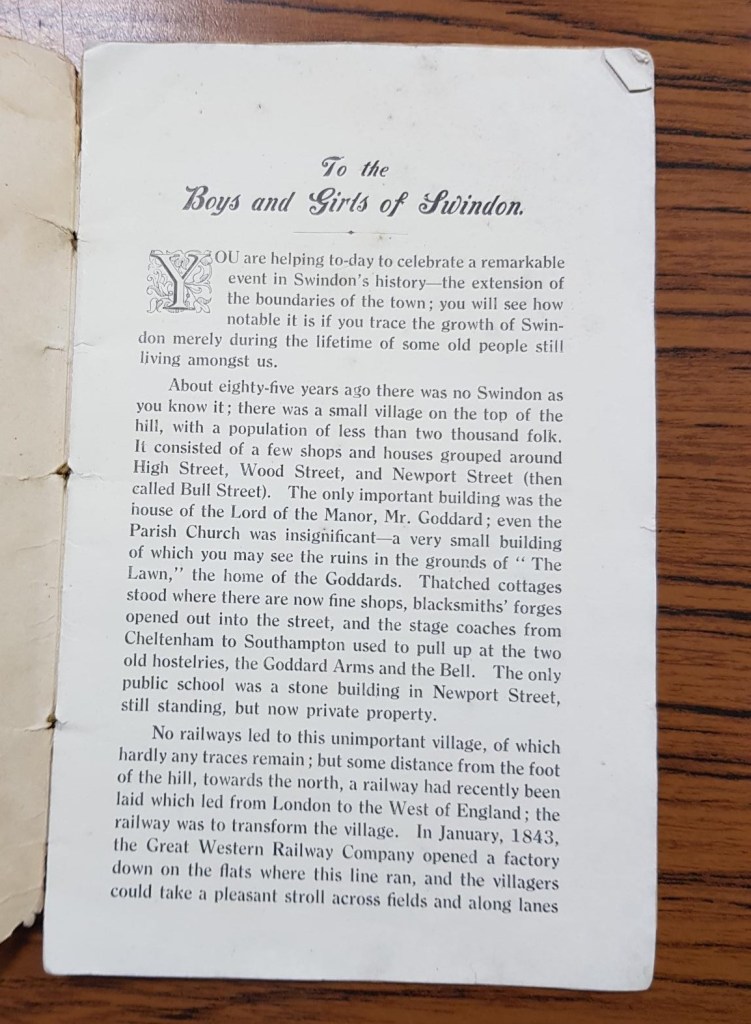
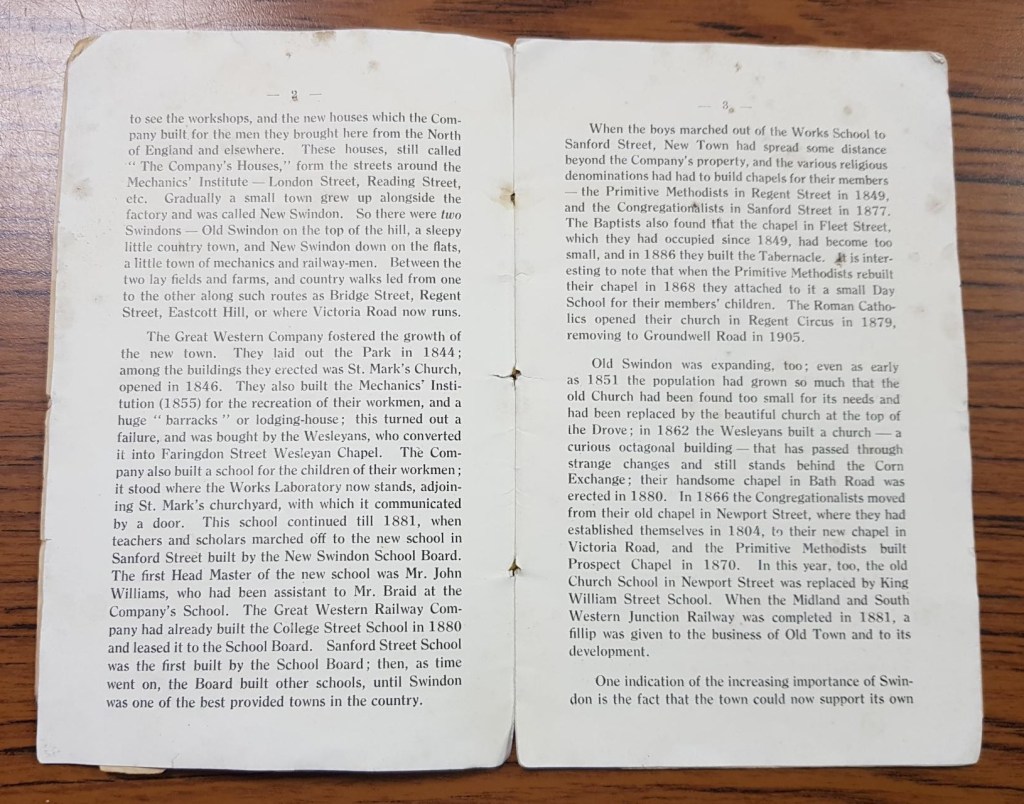
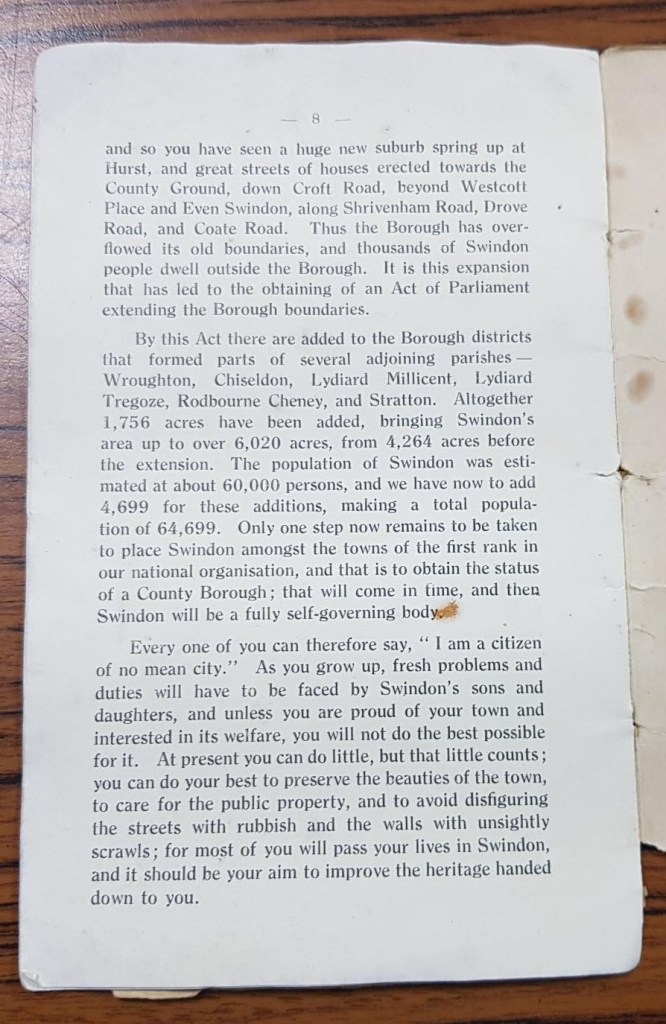
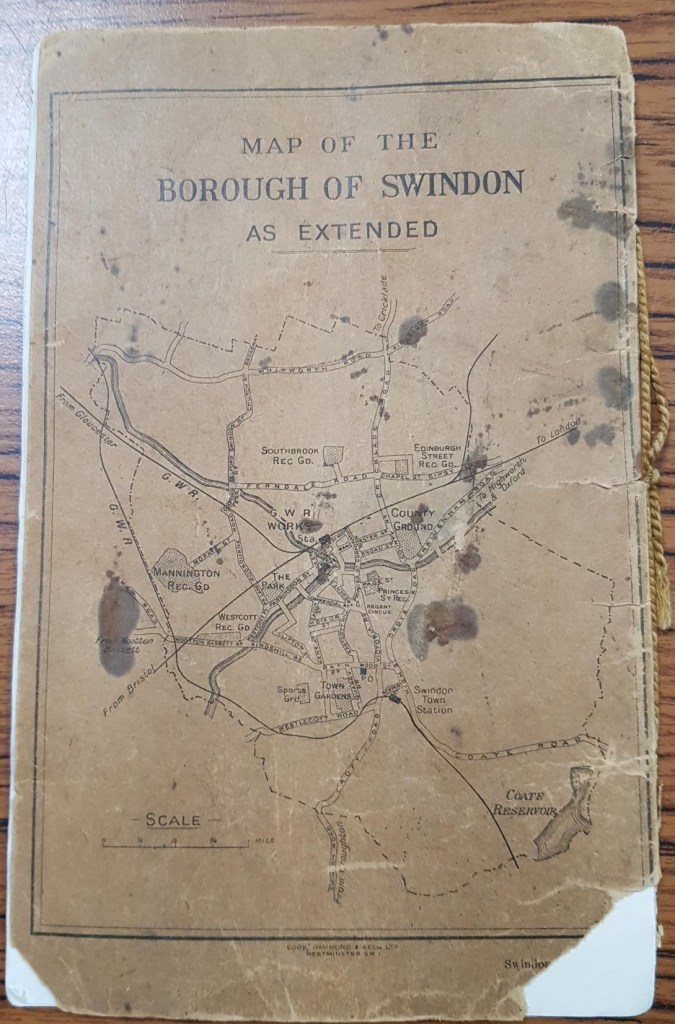
And then Mr Rumble showed me a booklet his father was presented with as a schoolboy in 1928 – Borough of Swindon – Extension of the Borough 1st October 1928.

Walter and Annie lived at various addresses in Stafford Street where Annie died at No. 105 in 1926. She was buried in Radnor Street Cemetery in grave plot D826.

Walter later lived with his son Frank and daughter-in-law Violet at 134 Ferndale Road where he died aged 80 and was buried with his wife in 1944.

I think members of the Rumble family can consider themselves Swindonians – but what about you?

Edward Thomas William Robins – Swindon Veterans of Industry

In December 1930 more than 200 men retired from the Great Western Railway Works, an event of such importance to warrant a detailed article in the first January edition of the North Wilts Herald published in 1931.

The names and addresses of those men forced to retire under the introduction of the 66 years age limit were recorded in appreciation of their long years employed in the Works.

Mr E.T.W. Robins – A large number of different interest have claimed the attention of Mr. Robins. He has had 52 years’ service as a fitter with the GWR Co., and has been a chargeman for 37 years, working as a fitter in the B Erecting Shop.

He is now 66 years old. A Londoner by birth, he has lived in Swindon since he was a child.

Mr Robins was one of the first secretaries of the Swindon Hospital Saturday Fund in 1894 and 1895, and has also been a member of the Hospital Management Committee.

He has done a great deal of church work at St. Mark’s, Swindon.

He is a member of the Foresters (Court Britain’s Pride). He was at one time secretary of the Swindon Chrysanthemum Society.

Swindon Veterans of Industry – North Wilts Herald, Friday, January 2, 1931.

Agnes and Edward Thomas William Robins are pictured to the right of the photograph

Edward Thomas William Robins was born in March 1864 and baptised at St. Stephen’s Paddington June 26, one of Thomas and Henrietta’s 11 children. The family appears on the 1871 census as living at 16 Reading Street.

Edward married his first wife Hannah Williams on February 10, 1889 at the Independent Church, Victoria Street. Following her death he married his second wife Agnes Thomas at St. Mark’s on April 17, 1897. The couple had two sons Thomas Arthur and Cecil.

Edward Thomas Wm Robins died aged 82 years and was buried on March 25, 1947 in grave plot B3102 where Agnes joined him when she died in 1948.

Herbert Pinnegar – killed at work aged 14

Emma Pinnegar’s five sons all followed their father into the railway works. Francis and Ernest became fitters, Nelson a blacksmith and Levi a coppersmith. Her youngest son Herbert had been employed just a few months when he was killed at work one Monday afternoon.

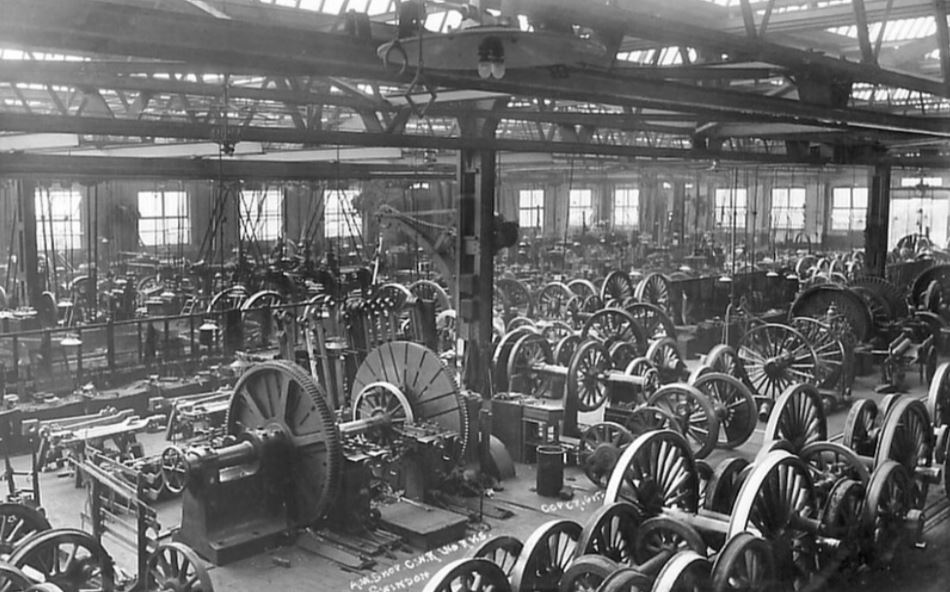
Herbert was working in D Shop “cutting of tyres for the wheels of railway carriages.” He was rather short sighted, according to the newspaper report, and working with heavy machinery. Do you suppose he was wearing glasses? I doubt it. Do you suppose anyone was supervising him? I doubt it.

In Swindon Works – The Legend, Dr. Rosa Matheson devotes a chapter to accidents. She writes: “The causes of accidents could be put down to a number of things – workers’ carelessness, difficult and horrendous conditions, over work, inexperience, lack of supervision, inattention, youth, old age, bad luck.”

It would seem young Herbert ticked a number of these boxes.

The railways brought employment and prosperity to Swindon; the railways brought life and they also brought death. Emma’s husband had been killed ten years previously walking home to Purton along the railway line. It appears he had been doing some shopping in Swindon that evening after work – it was the week before Christmas.

Fatality at Swindon

A terrible fatal accident occurred in the D Shop of the GWR Works on Monday afternoon. A lad named Pinnegar, aged about 14, was engaged upon a machine for the cutting of tyres for the wheels of railway carriages. Pinnegar, who was rather short sighted, was looking down to see if his work was placed in a right position, when going too near the large wheel, he was knocked down between the chisel and another part of the machine. The top of the poor boy’s head was cut completely off. Death, of course, was instantaneous. Deceased’s father, about six years ago, was killed on the railway while returning home from work.

The Bristol Mercury, Wednesday, September 16, 1891.

Herbert was buried in Radnor Street Cemetery in grave plot B1592, a public grave. He is buried with three other unrelated persons.

Fatal Railway Accidents Near Swindon – Between twelve and one o’clock on Saturday morning the stoker on a goods engine passing the Rifle Butts, between Swindon and Purton, saw what he thought to be the body of a man lying by the side of the rails. On search being made the body of a man named Frank Pinniger, a boilersmith in the Great Western Railway Works, but living at Purton, was found. He had been in Swindon shopping on the previous night, and left Rodbourn Lane about eleven o’clock to walk to his home down the line. The night was rough and windy, and it is supposed he was struck by the 11.20 mail train from Swindon. His body was removed to the mortuary at Swindon to await an inquest. Deceased was between 40 and 50 years of age, and leaves a wife and eight children.

The Stroud News and Gloucestershire Advertiser Friday, December 24, 1880.

Frank was buried on December 24, in St. Mark’s graveyard ‘by Coroner’s Order.’

A William Hooper image of A W Shop taken in 1907 and published courtesy of Local Studies, Swindon Central Library.