There is a world of difference between enjoying a drink and taking a bottle of whiskey to bed and I wonder what propelled Mary Bailey from the one to the other.
Drunkenness was the scourge of the 19th century working classes. Even in Swindon where the much lauded Great Western Railway Company provided wrap around care ‘from the cradle to the grave’ there was still want and destitution for those who fell through the cracks of society.
Temperance societies encouraged people to abstain from drink and to take the pledge of a lifetime of sobriety. By the end of the century Swindon numbered around 18 such organisations, including the GWR Temperance Union with around 3,000 members, however it is unlikely Mary joined their ranks.
A Fatal Taste for Alcohol
A sad case came from Coroner W.E.N. Browne, on Monday in an inquest concerning the death of Mary Baily, wife of a GWR fitter of 11 Hawkins Street, New Swindon.
The deceased who was 49 years of age, was stated by a neighbour to be of intemperate habits. Her husband on Friday night went to bed at 10 o’clock, and thinking his wife was asleep did not disturb her. He arose at five o’clock on Saturday morning and found his wife dead and quite cold. A whiskey bottle was found beneath the bed. Dr. Duffield stated that death was due to asphysxia, cause by the woman lying on her face in a helpless condition ensuing upon an over-dose of alcohol.
Gloucester Citizen Tuesday November 28, 1899.
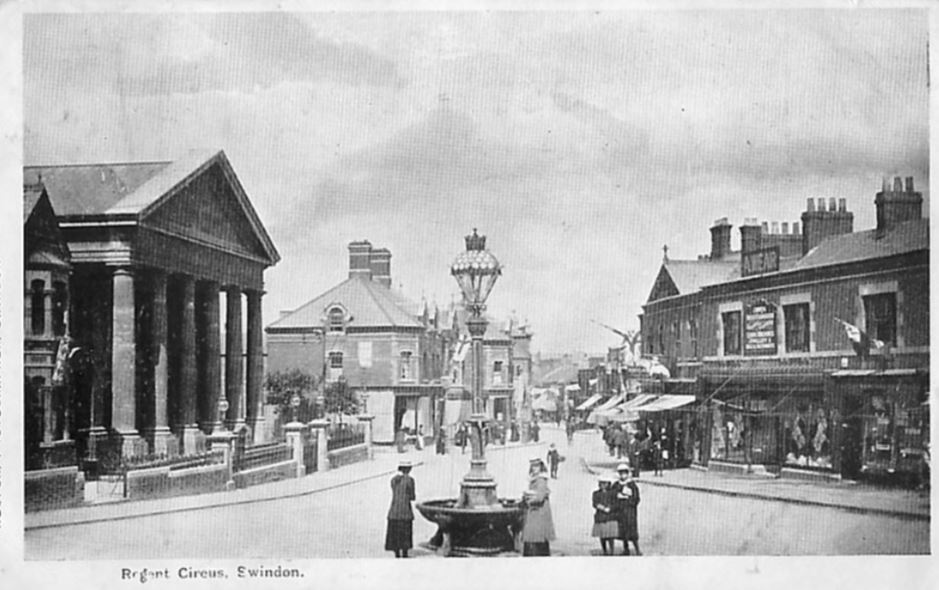
Drinking fountain erected by the Swindon United Temperance Board in Regent Circus 1893
Mary Christianna Dance was born in Stratton, Gloucestershire and baptised on February 4, 1849, the eldest of John and Jane Dance’s eight children. She married Thomas Bailey in 1871 and by 1881 they were living at 11 Henry Street (later renamed Hawkins Street) with their 8 year old son Thomas, and Mary’s brother Charles. Both men worked as carriage fitters in the Works.
So what happened to Mary between 1881 and 1899, or had her problem with alcohol begun long before? Did she try to control her drinking, or was she aided and abetted by her husband Thomas, whose comments at the inquest appear ingenuous when compared with the neighbours observations.
Mary was buried on November 28, 1899 in grave plot C109, a privately purchased grave, which might come as some surprise. In 1908 she was joined by Tryphena Bailey, Thomas’s second wife and then in 1937 by Thomas himself.
Many thanks to David Lewis and his book Between the Bridges – The Early Days of Rodbourne.
There are 33,000 burials in Radnor Street Cemetery but rather fewer memorials. The spread of headstones vary in the different sections with E and D sections the most densely populated and dotted across the cemetery are 104 distinctive Commonwealth War Graves headstones.
When the Burial Board published a list of fees concerning interment in the new cemetery in 1881 it included the following statement:
All inscriptions and plans of monuments, tablets, and stones, to be erected in the Cemetery or chapels to be submitted to the Board for its approval.
The majority of the headstones in Radnor Street Cemetery are simple and stylish, but have a closer look and you will find some fascinating detail.
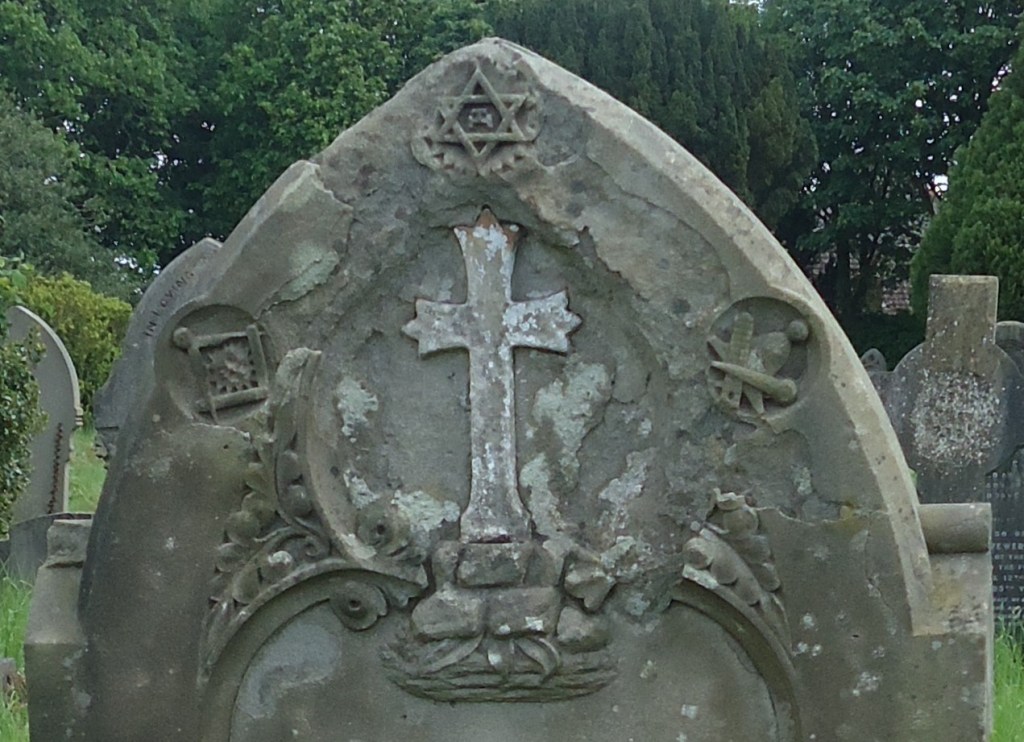
Victorian Swindon had strong links with Freemasonry and this headstone (see below) has examples of Freemasonry symbolism, including the Square and Compasses, which depict a builder’s square joined by a compass.
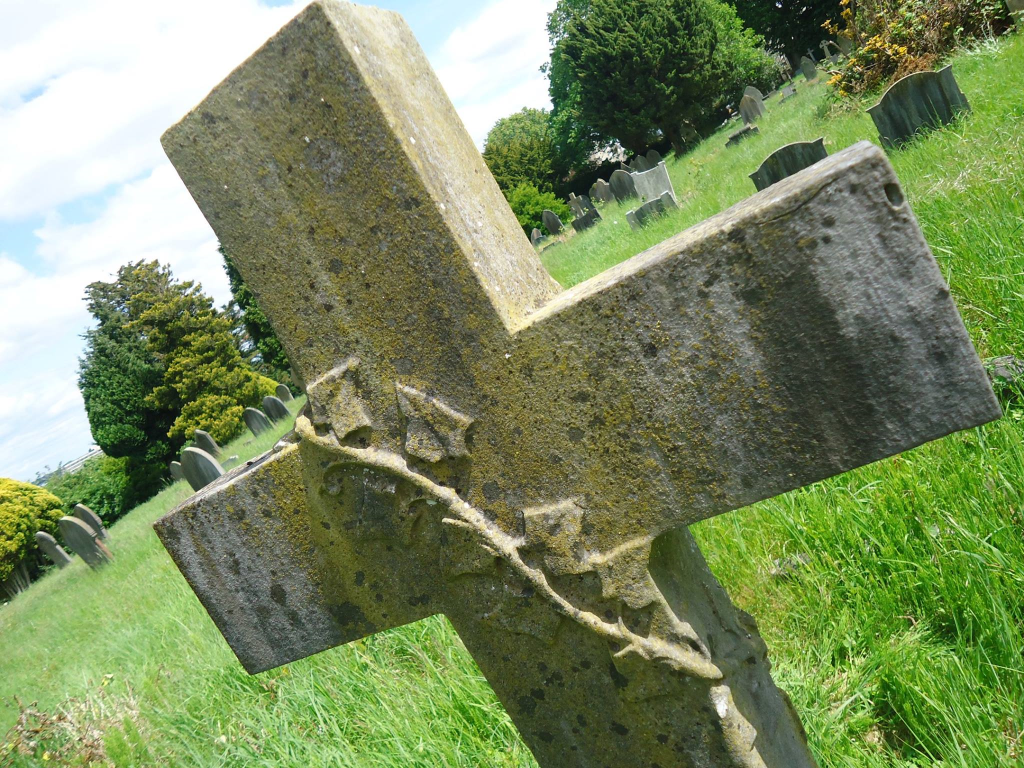
Ivy trailing across a headstone symbolises friendship and immortality.
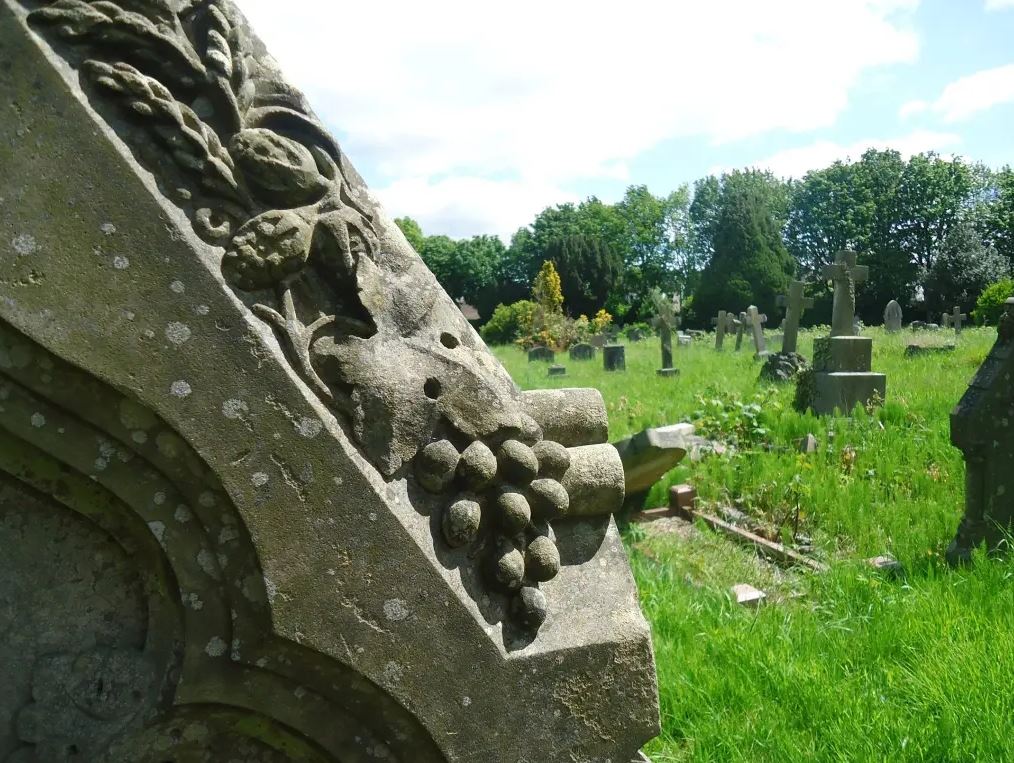
Fruits in many varieties are symbolic of the fruit of life, while grapes and leaves represent Christ and Christian faith.
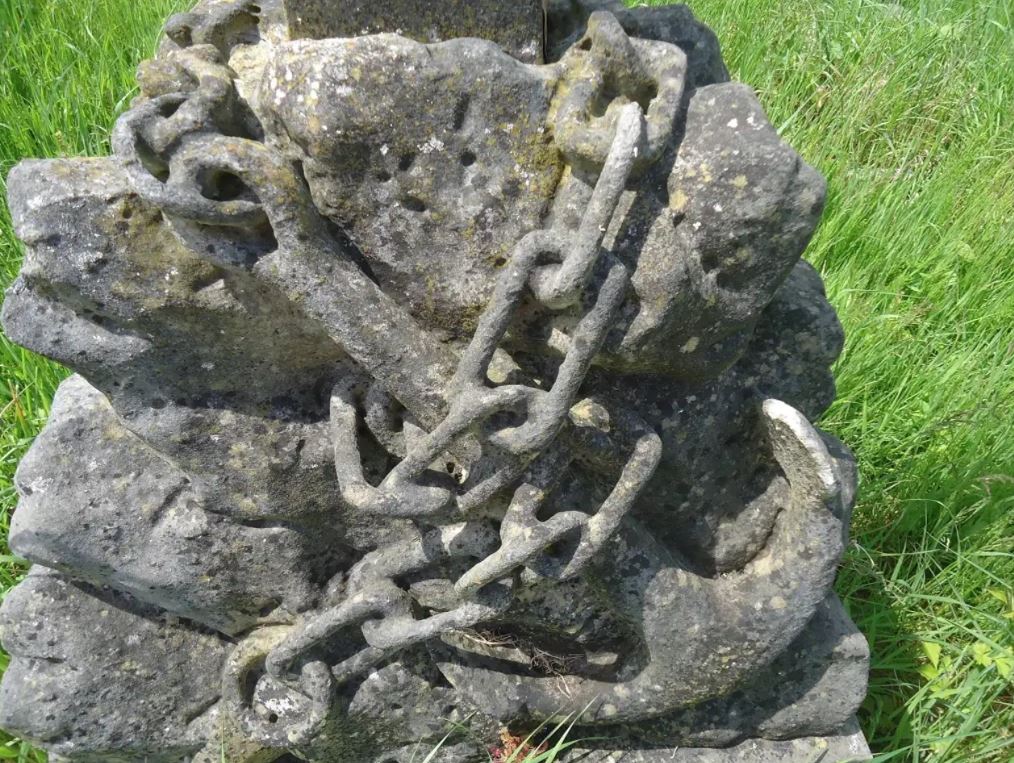
An anchor and/or chains have various meanings, apart from the obvious naval one, and include the severance of the body and soul. There is also a connection with the International Order of Odd Fellows, another popular organisation here in Swindon.
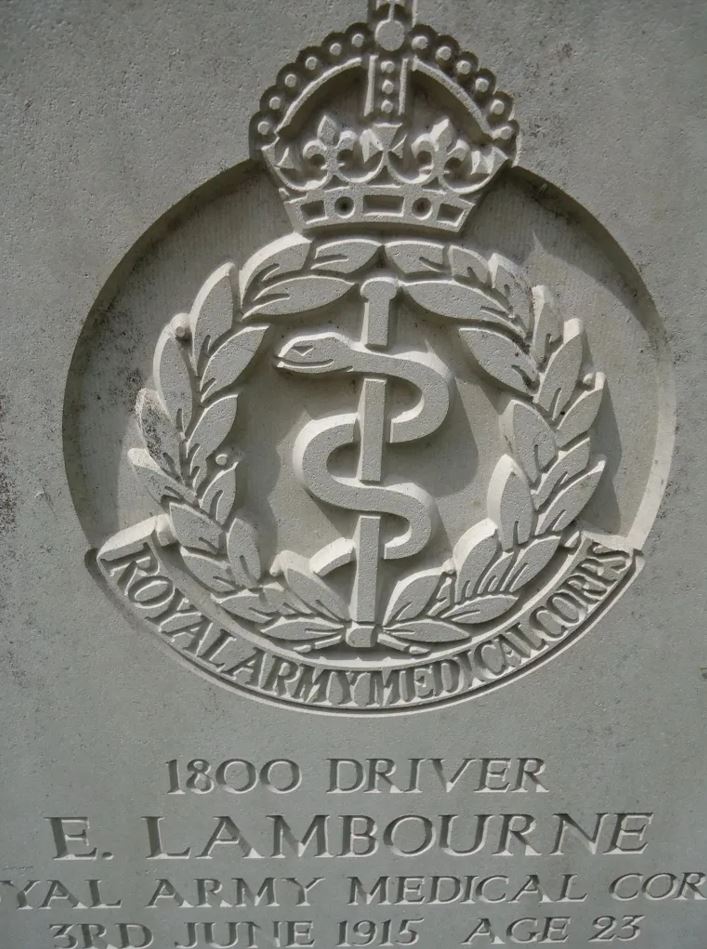
The Commonwealth War Graves headstones all carry the regimental insignia of the deceased service personnel. This is the badge of the Royal Army Medical Corps.
Flowers have various meanings for example the rose is symbolic of love and virtue. A rosebud can indicate the death of a young person. The problem is trying to identify what the variety of flower is on a weathered headstone.
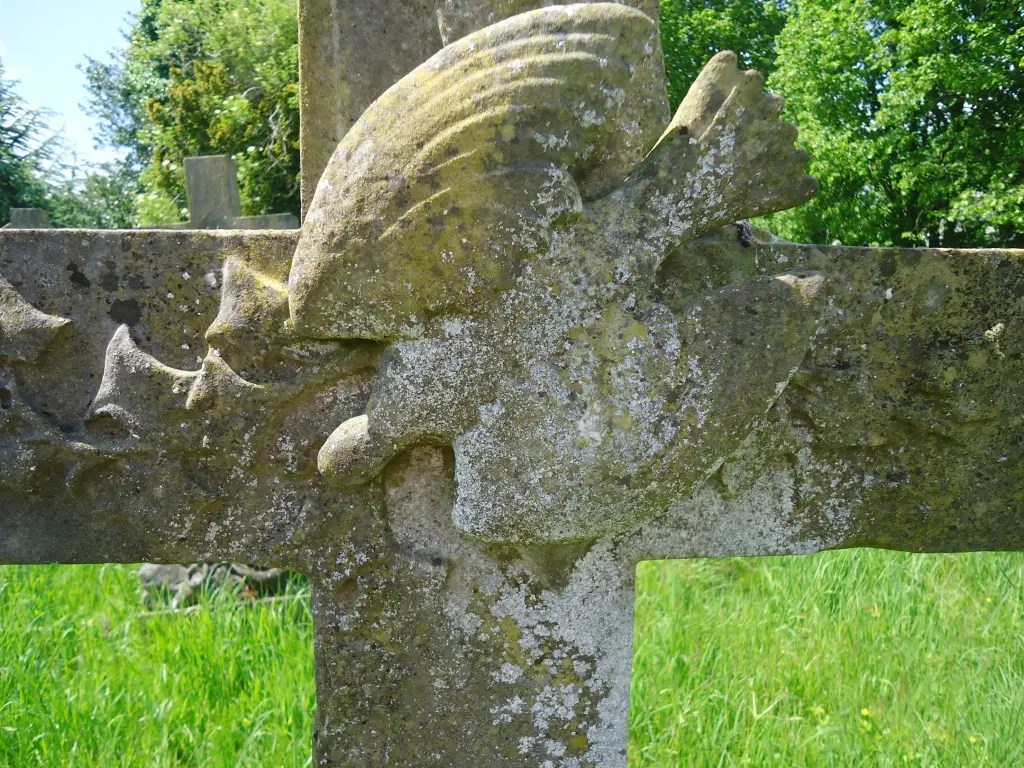
The bird/dove has various meanings including that of eternal peace.
And the letters IHS seen on many headstones in the cemetery, come from the Greek spelling of Jesus and symbolise the first three letters – Iota, Eta, Sigma.
What can a headstone tell you? A surprising amount actually, and that doesn’t just include the inscription.
In older churchyards you might find skulls and crossed bones and dancing skeletons on headstones but you are unlikely to come across these symbols in Radnor Street Cemetery. There are angel monuments and angels carved in relief, but most of the iconography is more subdued.
The cemetery was established in response to several urgent needs. The rapid growth of the town saw diminishing space for burials in the existing churchyards (see Proposed Cemetery for Swindon) and a large and a growing congregation of Dissenters or Non-Conformists. This accounts for the non-denominational nature of the cemetery chapel (most municipal cemeteries have an Anglican and a Dissenters’ Chapel) and why the burial ground itself is unconsecrated ground.
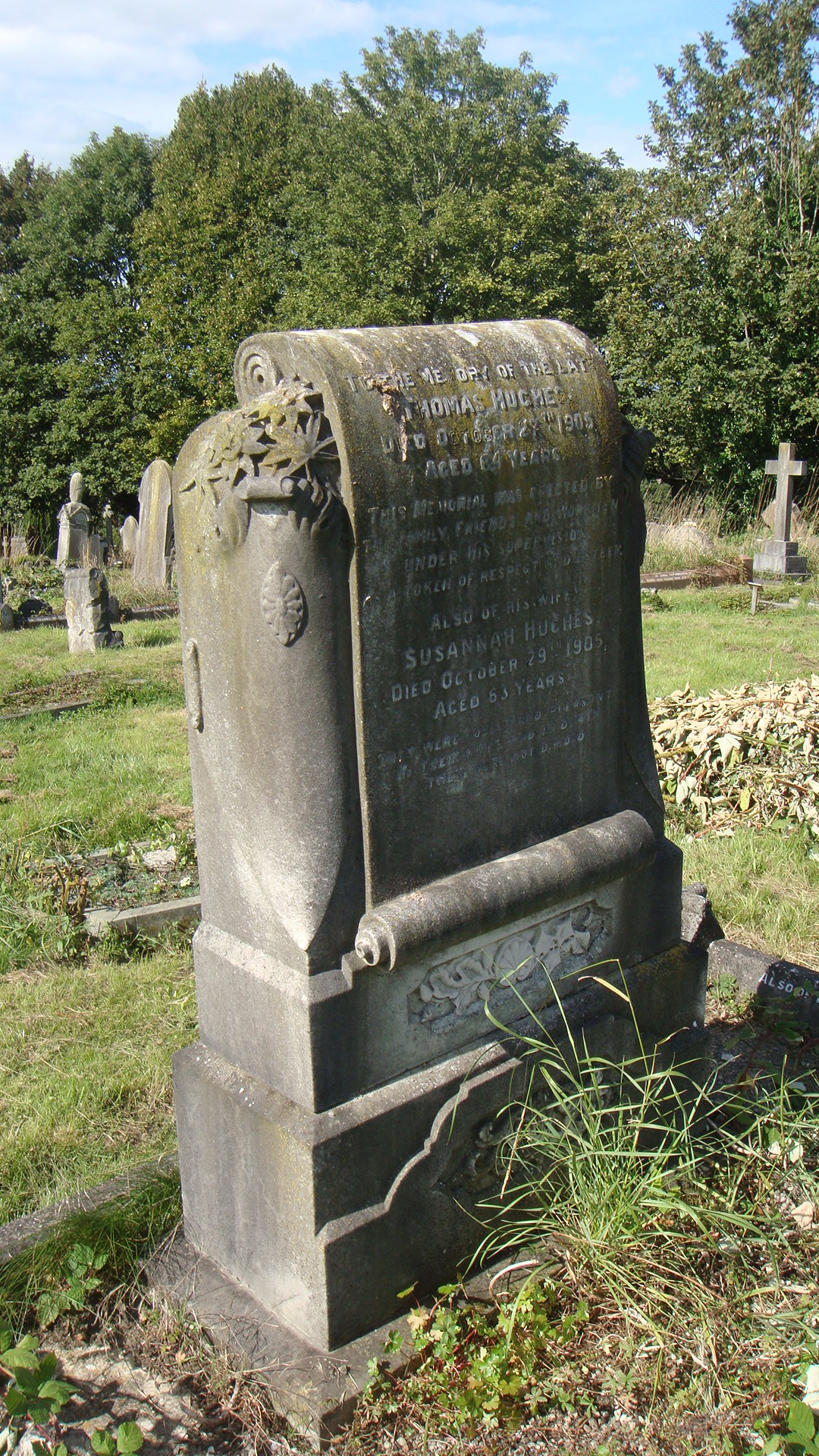
So, what does the inscription on Thomas and Susannah Hughes’s headstone tell us?
To the memory of the late Thomas Hughes/Died October 27th 1905/Aged 64 years/This memorial was erected by the family friends and workmen under his supervision/a token of respect and esteem/also of his wife/Susannah Hughes/died October 29th 1905/aged 63 years/They were (illegible) and pleasant/(illegible) their lives and death/they were not divided
The headstone is in the shape of a scroll, which itself has various interpretations. It can signify a love of learning or a religious conviction. A scroll partially unfurled can indicate a premature death, although not in this case as both Thomas and his wife Susannah were in their 60s.
Acanthus leaves are a classical symbol dating from antiquity and represent both immortality and life’s prickly path. Ivy leaves represent friendship and immortality and oak leaves hospitality and endurance. The medallion shaped flower is most probably a sunflower, representing affection and remembrance while the Easter lily signifies resurrection.
The facts …
We regret to announce the death, on October 27th, after a very short illness, of Mr Thomas Hughes, foreman of the Erecting Shops at Swindon.
Mr Hughes was born at Smethwick, Staffordshire in 1841, and in 1855 was apprenticed to Messrs. James Watt & Co., late Boulton & Watt, Engineers, Soho Foundry, Smethwick, near Birmingham, as general engineer, machinist, turner, fitter and erector. He left Soho Foundry in 1862, after the completion of his apprenticeship, and joined the service of the London and North Western Railway at Crewe, where he stayed for only a short time, returning to Soho Foundry and eventually entering the service of the Great Western Railway Company at Swindon in 1866, as an erector. He was appointed foreman in 1876, and his position was one of the most important at Swindon, as he had full control of the erection of new engines, also of the erecting work in connection with repairs.
He was a man of marked ability in his profession, and was held in high esteem by the officials, particularly by the Chief Superintendent, who, at the opening meeting of the Junior Engineering Society on October 31st, alluded to the said incident in the following terms: – “This Society is unfortunate in a lost which we have sustained within the past few days. I allude to the death of poor Foreman Hughes. He was a member of our Committee, and I am sure I express your views when I say he was one of your most respected members. I am proud to say that Tom Hughes was a friend of mine for a great number of years, and I can scarcely express to you the shock it gave me when I heard of his death.”
For a number of years Mr Hughes held the position of First Engineer in the Company’s Fire Brigade, and in this direction exhibited characteristic energy and interest. He was also a Member of the Council of the Mechanics’ Institution, to which he was devotedly attached. The case is a peculiarly sad one, as within a day or two of Mr Hughes’s death, his wife, who had been ailing for some time, passed away.
Great Western Railway Magazine December 1905.
Death of Mr Hughes
We regret to announce the death, which took place on Friday morning, at his residence, 8 Faringdon Street, Swindon, of Mr T. Hughes, a foreman in the GWR works. Deceased, who had only been ailing a short time, passed away somewhat suddenly. He had been a foreman in the GWR works – over the A Shop (New Work & Erectors), B Shop (Erectors), and P Shop, for 30 years, having been employed in the GWR Works 40 years. He was well known as a member of the Council of the Mechanics’ Institute, in which he took an active interest, especially in the Library and Reading Room, having been a member of the council for seven years. Deceased leaves a widow and grown up family, for whom the deepest sympathy will be felt, especially as Mrs Hughes is lying seriously ill. Mr Hughes was also a prominent member of the GWR Fire Brigade.
Death of Mrs Hughes
An extremely pathetic sequel to the death of Mr T. Hughes, a GWR foreman, which took place on Friday last, is the fact that his wife passed away yesterday morning. She had been ill for some time, and was lying prostrate when her husband died. The funeral takes place tomorrow, when the bodies of Mr & Mrs Hughes will be buried in the same grave in the Swindon cemetery.
Swindon Advertiser November, 1905
In 1871 Thomas and Susannah lived in a shared property at 24 Oxford Street. By the time of the 1881 census they had moved with their six children into one of the larger, foreman’s houses at 8 Faringdon Street where they remained for the rest of their married life.
They were buried on the same day, October 31, 1905 in plot D141. They share their grave with their eldest son Charles Thomas, who died in 1907 and their son in law, Ernest James John Tarrant, the husband of their daughter Alma Susan, who died in 1914.
This is the case of a man who placed a few stolen flowers on a grave where he would later lie himself.
Helen Hill died on January 31, 1885. She was 84 years of age and a widow. The Hill family were originally from Scotland where her husband Mathew worked as a Flax Mill Spinner in Leven, Fife. By 1861 Helen, and her son James, a turner in the Works, and her daughter Henrietta, were living in Faringdon Street.
This wasn’t exactly the crime of the century, more the act of a grieving son. Even Mr. H. Kinneir, Clerk to the Local Board, emphasised that this was a trivial case but the theft of flowers on existing graves was taking place all over the cemetery. Standards had to be unheld and such petty thieving would not be tolerated! (I detect here the opinion of cemetery caretaker Charles Brown.)
Charge of stealing flowers from a grave – James Hill, 51, fitter, of Faringdon street, New Swindon, was summoned at the instance of the Swindon Local Board and Burial Board, charged with stealing some flowers – daisies – from a certain grave in the Swindon Cemetery and placing them on that of his mother – Mr. H. Kinneir, Clerk to the Local Board, appeared to prosecute, and in opening the case stated that the action was taken at the instance of the New Swindon Local Board and the Cemetery Committee. The case, although not a serious one – possibly a trivial one to many – was one of importance to the Cemetery Authority, and people interested in the cemetery. It was well known that persons who had relatives lying buried therein took pains with the graves, and planted flowers thereon. The present action arose through defendant, who was a man well known and highly respected, going through the cemetery on a Sunday and plucking several flowers from a certain grave and placing them on his mother’s grave. It was to point out the seriousness of the case that the present action was taken. Mr Kinneir said the Board did not wish to press the case, but wished for a small fine to be imposed, to let the public know that they must not gather flowers from a churchyard or cemetery. This proceeding of gathering flowers was going on all over the cemetery, and the Board wished to put a stop to it. The maximum penalty for the offence was £5. Without hearing any witness the bench imposed a fine of 2s 6d, and ordered payment of court fees.
James died in 1897 and was buried with his mother in grave plot A631, a public grave. They share the grave with 23 years old Lily Palmer who died in 1928 and is unlikely to be any relation.
If you are in the habit of cutting through the cemetery to reach your destination you will appreciate what an inconvenience it is to find the gates locked.
This is just the situation in which William Richard Crook found himself on October 17, 1882. The 25 year old carpenter did what any able bodied young man would do and climbed over the fence.
However, he had been spotted by the fiercesome cemetery caretaker Charles Brown. Brown’s care of his kingdom and its deceased residents was exemplary. He had less patience with the general public!
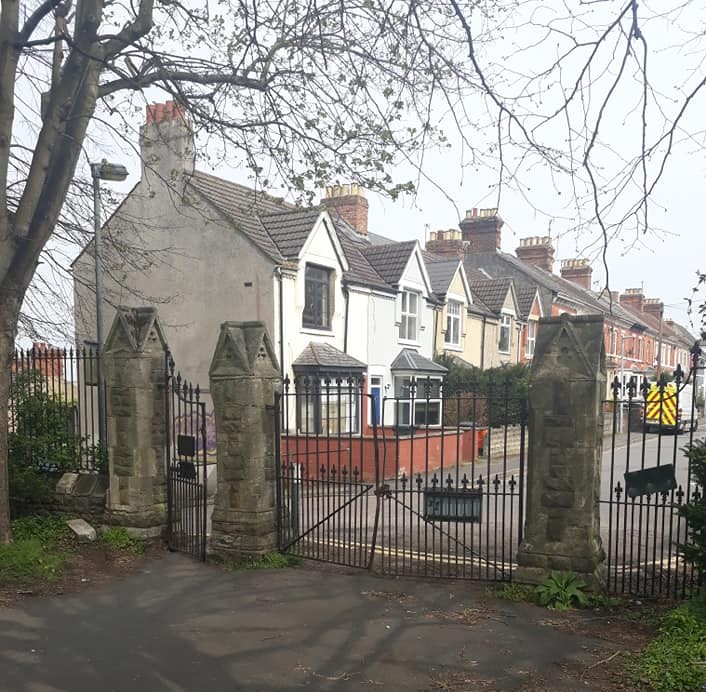
Radnor Street gate
Damaging the Cemetery Fence – William Crook, carpenter, Swindon-road, was charged by the Burial Board with damaging the fencing at the Swindon Cemetery, on the 17th inst. Charles Brown, caretaker, proved seeing defendant climb over the rails of the cemetery when he found the gate locked. – Defendant admitted the offence, and was ordered to pay 1s damage, 1s fine, and 7s costs, the Bench cautioning him not to offend again.
The Swindon Advertiser, Monday, October 30, 1882.
Dixon Street gate
William was born in Pewsey in about 1858, the younger son of George and Amaryllis Crook. By 1871 the family had moved to Swindon and were lodging at 4 Union Street.
William married Alice Pauline Carlton the same year in which he was charged with damaging the cemetery fence. The couple went on to have two children, Victor and Lilian, and by 1891 William was working as a publican at the Oddfellows Arms in Queen Street.
He died at the prematurely young age of 35 years old in 1893 and, of course, his last resting place was in the cemetery, the scene of his fence vaulting crime. I wonder if Charles Brown ever made the connection.
William lies in an unmarked, public grave B1702 which he shares with three others, including his son Victor who died in 1899 aged 15.
‘Mother always said there was nothing I could have done to help, but I never believed her. Today I can still hear the cries of the men, although mother said that wasn’t possible, they were too deep in the tunnel and I was too far away. But I wasn’t.
What she didn’t know was that I was there, by the mouth of the tunnel as the ballast train screeched through. I was the first person on the scene, a 10-year-old boy walking home from school across the railway line.
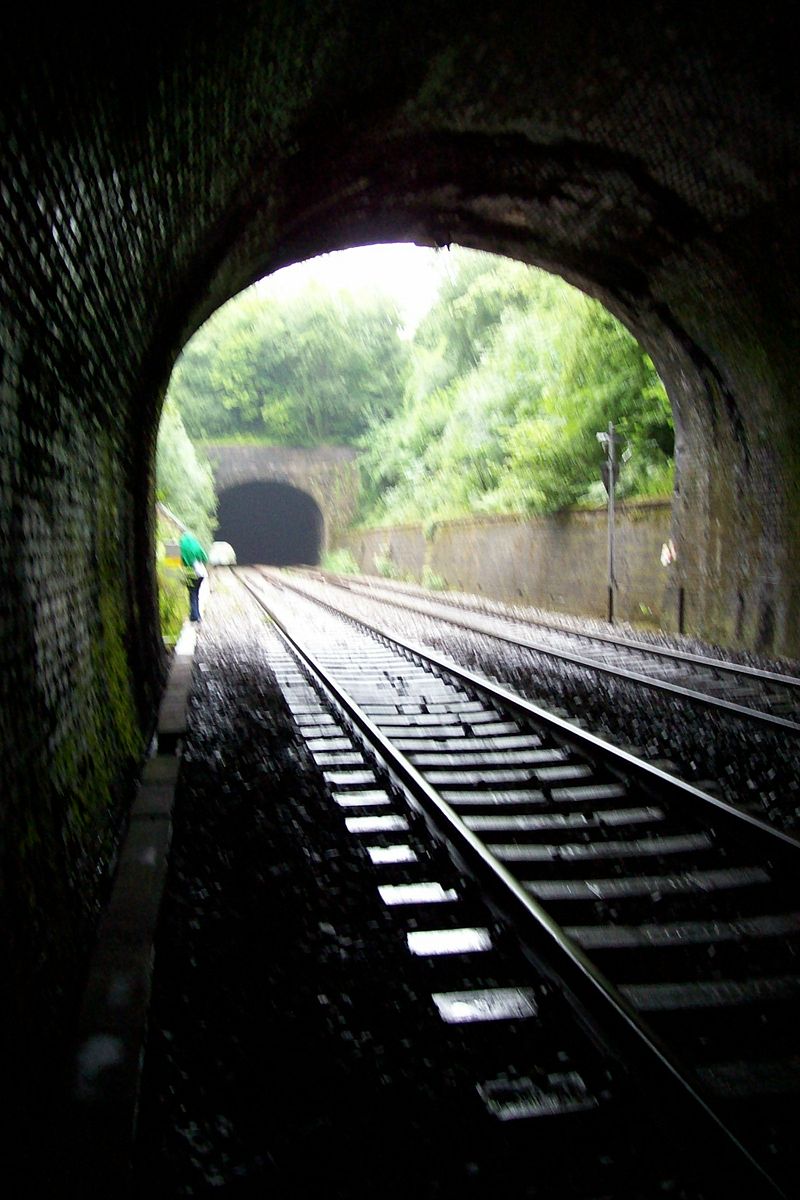
I knew the platelayers were at work in the Sapperton tunnel that day in April 1896. I had seen them arrive with their truck and their tools while I was about my early morning tasks on the farm. A section of the tunnel was under repair and I wished I could see inside.
The tunnel was a feat of engineering carved beneath the Cotswold escarpment and a source of wonderment to this 10-year-old boy. By the end of that day in April 1896 the Sapperton tunnel would be the stuff of nightmares, a scene that would haunt me for years.
For weeks afterwards it was all anyone talked about in the village. How the gang of five men had been warned of the approach of a down train and had stepped out of the way on to the other set of metals. They did not notice that an up ballast train had entered the tunnel. Two men were killed instantly, their bodies mutilated in a shocking manner.
And I saw it all. At first I thought all were dead, but then came the moaning and the cries as the two who were less severely injured began to move.
I crept closer. In the light of their lantern I could see a man still lying on the track, his arm wrenched from his body, blood seeping from his head.
Sapperton Railway Tunnel
Help was slow in coming. The three surviving men were eventually picked up by a passenger train passing through the tunnel half an hour after the accident. At Stroud they were taken from the railway station to the hospital, causing a painful sensation in the town.
The men who died were named as H. Ballard and E. Greenaway. Another, J. Hillsley sustained concussion of the brain, scalp wounds and bruised limbs while W. Pointer was sent home from hospital during the course of that evening. The man with the severed arm died on the way to hospital. His name was Frederick Gee.
Mother said there was nothing I could have done to help, but I never believed her.’
The facts …
Platelayer – a man employed in laying and maintaining the railway track. The poorest of any railway employee with little or no opportunity for promotion or advancement. ‘The most neglected man in the service.’ (Will Thorne, Victorian platelayer).
Ganger Frederick Gee 47 was married to Mary Ann nee Willis and left seven children, five under the age of 10 years including a baby son just a few months old, when he died working in the Sapperton tunnel in April 1896. Frederick was buried in Radnor Street Cemetery where in 1900 the couple’s sixteen-year-old daughter Rosa Ethel was buried alongside him and four years later their son Harry Howard, aged 21.
In just a few short years Mary Ann lost her husband and two of her children, but she was made of stern stuff.
On March 14, 1907 Mary Ann set sail from Liverpool on board the SS Cymric with her four youngest sons Sidney 17, Ernest 15, Frank 13 and eleven-year-old Wilfred, to begin a new life in the United States of America.
The family arrived in Boston, Massachusetts on March 25 and in the 1910 US census they can be found living in Forest Dale, Salt Lake City, Utah.
In 1917 Mary Ann, then aged 62, married William A. Tolman. William Augustus Tolman was 69, a widower and a member of a prominent pioneering family in the Church of Jesus Christ of Latter Day Saints (the Mormons). William’s father Cyrus had arrived in Salt Lake City, Utah in 1848 with Brigham Young’s second company.
Theirs was a brief marriage. William died from smallpox in 1920. He was buried in the family plot at Oakley Cemetery, Cassia County, Idaho with his first wife Marintha.
Mary Ann died in 1929 aged 71. She had survived the death of two husbands, two sons and a daughter.
We could all see that the tram was travelling too fast and people on the street began to move, clearing a path. When the accident happened, it was as if in slow motion; until the screech of metal on metal and the screams of the passengers plunged the scene into sharp and noisy relief.
As the tram swerved and toppled over some of those travelling on the open top were thrown to the ground. Surely, they could not hope to survive.
The visitors to the Bath and West Show who thronged down Victoria Road stood in shocked disbelief. For a split second there was a silence, a nothingness and then onlookers surged forward to help.
I was just returning to the studio from an assignment and had my camera with me. I briefly considered taking photographs of the scene, but just as quickly decided against it. I left my equipment in the foyer at the Empire Theatre and joined those helping to rescue the trapped and injured passengers.
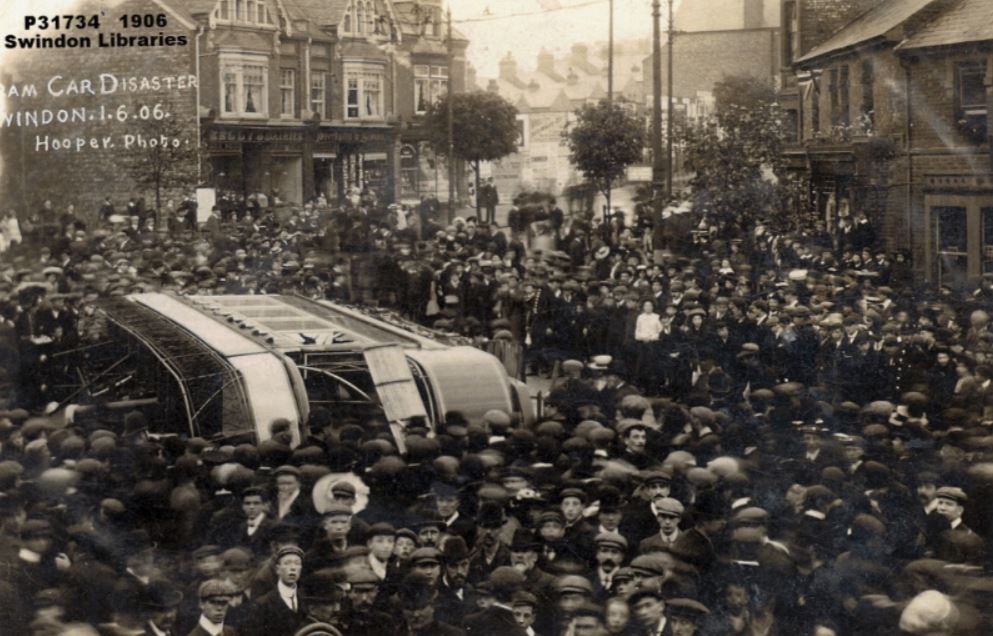
Local photographer William Hooper published a postcard photograph of the crash scene that same day. I knew then that I didn’t have what it took to be a commercial photographer and I resigned from my position before my employer had an opportunity to dismiss me.
I took up a clerical job in the Works soon after. When I retired forty years later my colleagues presented me with a camera!
The facts …
Runaway Tram Car
Dashes Down a Swindon Hill and Overturns
Four Passengers Killed and 30 injured
Somerset Farmer loses his life
Dorchester People Injured
A serious tram accident occurred at Swindon on Thursday evening. In consequence of the Bath and West of England Agricultural Show, the electric cars, which are Corporation property, were very heavily laden, and No 11 car, which is registered to carry 56 passengers, was descending Victoria road, a steep decline connecting the old and new parts of Swindon, with a load of between seventy and eighty people. Midway down the hill, the car got beyond control and at the foot of the hill ran on to the uprails at a crossing, and overturned.
The passengers on the top were precipitated into the road like stones out of a catapult, some being thrown a considerable distance. There were a great many people about at the time, and for some moments the greatest consternation prevailed. A few cool heads were soon on the spot to render assistance. The shrieks and groans of the injured filled the air, and one spectator says that blood ran into the gutter in streams. Scarcely a single passenger escaped without injury, although one or two who saw their danger had jumped off before it was too late.
Dr. Lavery, who lives close by, came on the scene, and was soon followed by Drs. Waiters. Dalea Gordon, Ducane, and the officials from the Great Western Surgery. Dazed and unconscious, the victims lay strewn about the roadway for many yards. The doctors and ambulance men rendered first aid to the more serious cases, and conveyances were summoned and the victims conveyed to the Victoria Hospital.
All the injured were transferred to the Victoria Hospital where they were given further treatment. Unhappily, the injuries in two cases proved fatal. Mr Edwin H. Croad, proprietor of the Railway Hotel, Swindon died on the way to the hospital while Mr Harry Dyke, brewer’s agent, of Swindon succumbed to his injuries shortly after admission. Two other victims died later. The roll of injured contains the names of about 30 persons, and others who were merely bruised or shaken went direct to their homes.
William Hooper photograph published courtesy of P.A. Williams and Local Studies, Swindon Central Library
The Dead
Harry Dyke, brewer’s agent, Goddard-avenue, Swindon.
E.H. Croad, Railway Inn, Newport Street, Swindon.
Rowland J. Dunford, Nables’ Farm, Draycot Cerne, Chippenham.
Charles Phippen, farmer, Weston Bampfylde, Sparkford Bath.
The two first names died soon after admission. In all cases death is supposed to be due to fracture of the skull.
How the Accident happened
General comment is that the car was carrying far too many passengers; indeed, eye witnesses and many of the passengers declare that it was grossly overcrowded. In descending Victoria road, the brakes either did not act, or were overpowered, and the momentum acquired in descending this steep thoroughfare hurried it along at a pace which convinced passing pedestrians, and even the passengers themselves, that an accident was inevitable. Whatever the feelings of the passengers were, no panic was displayed.
There was an absence of screaming, one and all awaiting with a grim quietness the denouement which all felt was bound to come. The car kept to the rails going down the hill. At the bottom is a sharp curve into Regent circus. On reaching the bend, it ran on to the up line, rocked heavily, and then fell over on its side with great force. It was exceedingly fortunate that there was no car on the up line or the loss of life must have been much great.
Lyons, the driver, stuck to his car to the last. He is said to have been an experienced motor man. He received some slight injuries to his side, but soon recovered. The conductor, who was on top of the car, was picked up in a dazed condition, but he pulled himself together in a few minutes. Lyons declares that he put on his brakes on reaching the hill, and applied them as hard as he could. He never let go of these until the car toppled over, and did all that he could to avert the disaster.
The trams belong to the Corporation of Swindon, and there is no doubt that the matter of compensation will have to be faced by the town authorities. The overcrowding allegations give a further serious aspect to the matters. Passengers are booked on a way bill, similar to the system followed in Bristol, the deviation being that the bill, instead of being placed in a prominent position within the car, is kept in portfolio form, and checked by the inspector whenever he mounts the platform. This way bill doubtless will be produced when required at the official enquiries which will be held, and, if accurately entered up, should show the exact number of persons who were riding. This can be further checked by the number of punched tickets issued.
This is not the first mishap which has occurred at the foot of Victoria road, although, fortunately, the previous accident was not attended with serious consequences. Warnings have more than once been uttered emphasising the necessity for special care being exercised in the descent of the hill, and at the annual dinner of the Chamber of Commerce, Mr A.E. Withey, a prominent local solicitor, expressed strong views on the question.
Taunton Courier and Western Advertiser 6th June 1906 (extracts)
Edwin Herbert Croad, the 60-year-old proprietor at the Railway Hotel, Newport Street, Swindon was buried in plot E8374 in Radnor Street Cemetery on June 6. William Hooper got a photo of the funeral as well.
Swindon Corporation was found liable for more than £7,000 compensation and costs and was forced to increase the rates for three years to pay the bill.
William Hooper photograph published courtesy of P.A. Williams and Local StudiesSwindon Central Library.
I have Swindon photographer William Hooper to thank for my appearance on Time Team.
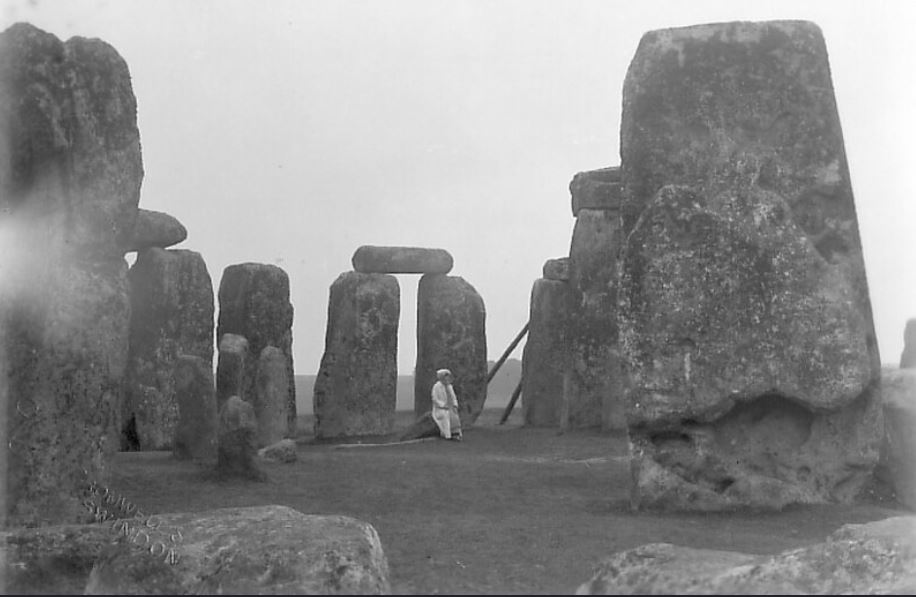
As a nerdy little kid, I was already interested in archaeology (in particular the Neolithic period) and the inspiration for my obsession was all down to a photograph that hung in my grandpa’s study.
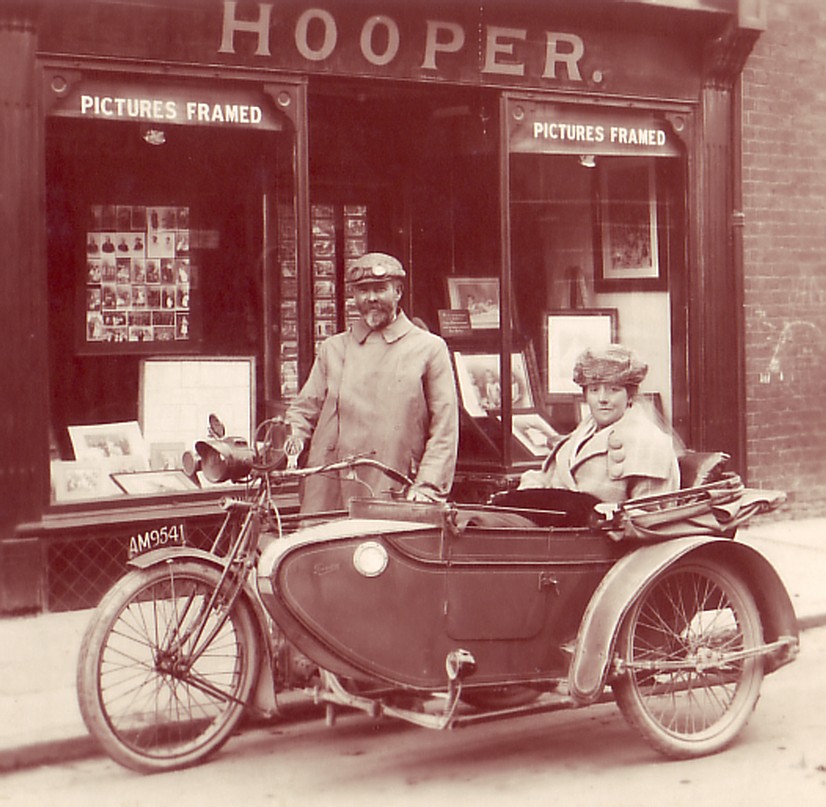
William Hooper has become famous for his Edwardian Swindon street scenes, but William and his wife Mary were not averse to getting on their bikes and venturing beyond Swindon. In the early days they travelled quite literally by push bike, graduating to a motor bike and sidecar as they travelled the Wiltshire countryside and beyond. Between 1905 and 1910 they took a series of stunning photographs of Avebury and Stonehenge.
The photograph in my grandpa’s study was of an ethereal woman dressed in white, sitting on a fallen boulder within the stone circle. These days you have to have permission and a very special reason for being allowed access to the stone circle but in 1910 the historic monument was still in private ownership, the property of Sir Edmund Antrobus 4th Baronet. Perhaps anyone could rock up and take a few photographs.
Image published courtesy of P.A. Williams and Local Studies, Swindon Central Library
Skip on twenty years or so and with my degree in archaeology under my belt, I volunteered for a brand-new television programme that was thought by many to be doomed before it even made it to the screen. Television producer Tim Taylor had the crazy idea of making a programme featuring scruffy, hippy looking student types digging trenches in muddy fields. The premise of the programme was that the team would turn up at a site of archaeological interest, dig for three days and then reveal the history of that site. For twenty years Time Team brought archaeology to the masses and achieved viewing figures in excess of 2 million per episode.
I was a regular participant on the show, taking part on a number of digs, working alongside my university professor Mick Aston and national treasure Phil Harding. There are photographs of us in trenches and in various pubs mulling over the findings of the day’s dig.
I’ve recently moved to a cottage in Avebury (the magnetism of those stones still draws me) and it has long been my intention to pay my respects at the grave of William Hooper, the man who sparked my interest and gave me a lifelong love of history.
I’ve been told his grave in Radnor Street Cemetery is difficult to find. Now, where is John Gater and his geophysical wizardry when you need him?
Image published courtesy of P.A. Williams and Local Studies, Central Library
The facts …
William Hooper was born in Windrush near Burford in 1865 and moved to Swindon and a job in the Works in 1882. In 1886 he was involved in a serious accident during which his leg was so badly crushed that he would eventually have it amputated at the knee.
William returned to his job in the railway factory where in 1891 he worked as a labourer and ten years later as a stationary engine driver. However, the work became too difficult for him and it was then that he decided to turn what had previously been a hobby into a business.
He opened his first photographic studio at 2 Market Street in around 1902, later moving to 6 Cromwell Street where he and his wife Mary remained until they retired in 1921.
Mary Stroud was born in Hereford where he father James worked as a Railway Guard. The family later moved to 22 Merton Street in Swindon. Mary and William married in 1890.
At the time of the 1911 census William, then aged 47, describes himself as a Photographer – Portrait and Landscape, his wife Mary as assisting in the business, but Mary did more than just ‘assist.’
In the extensive Hooper archive available online courtesy of P.A. Williams on the Swindon Local Studies flickr account, we glimpse Mary ‘assisting’ not only in the studio, but out on the road, travelling with her husband across Wiltshire on a variety of vehicles from a tandem to a motorbike and sidecar.
The couple never had any children of their own but were very close to Mary’s two nephews who also worked in the business with them from time to time.
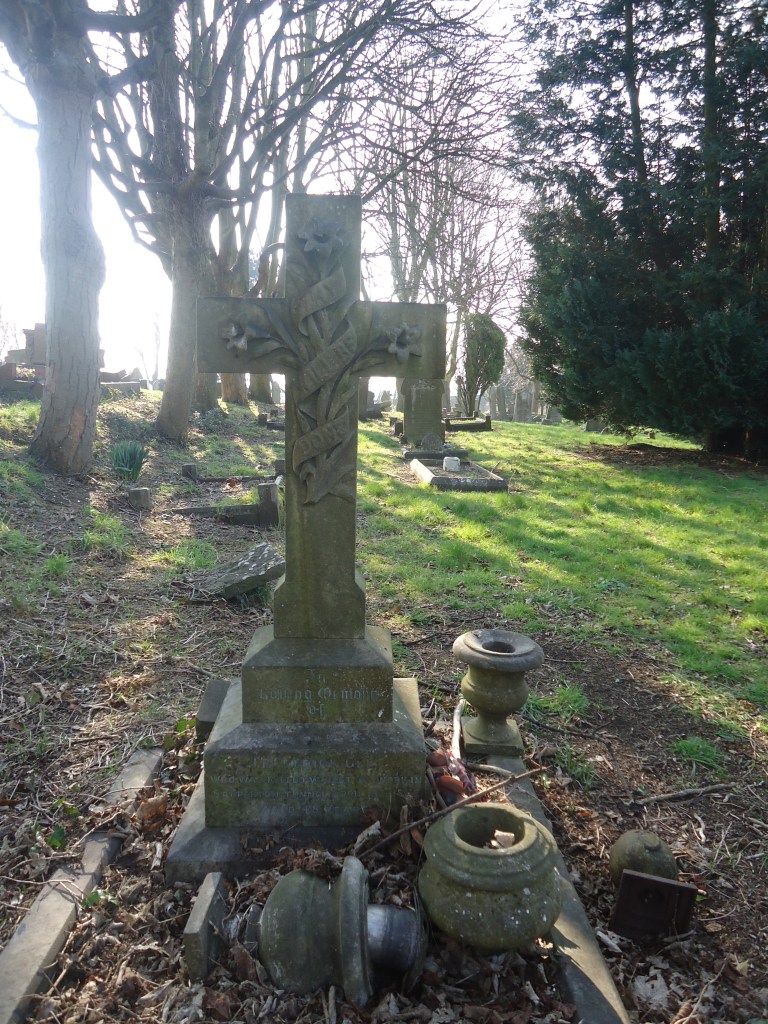
William died in 1955 followed by Mary a short while later. They are buried here with Mary’s parents James and Ellen Stroud.
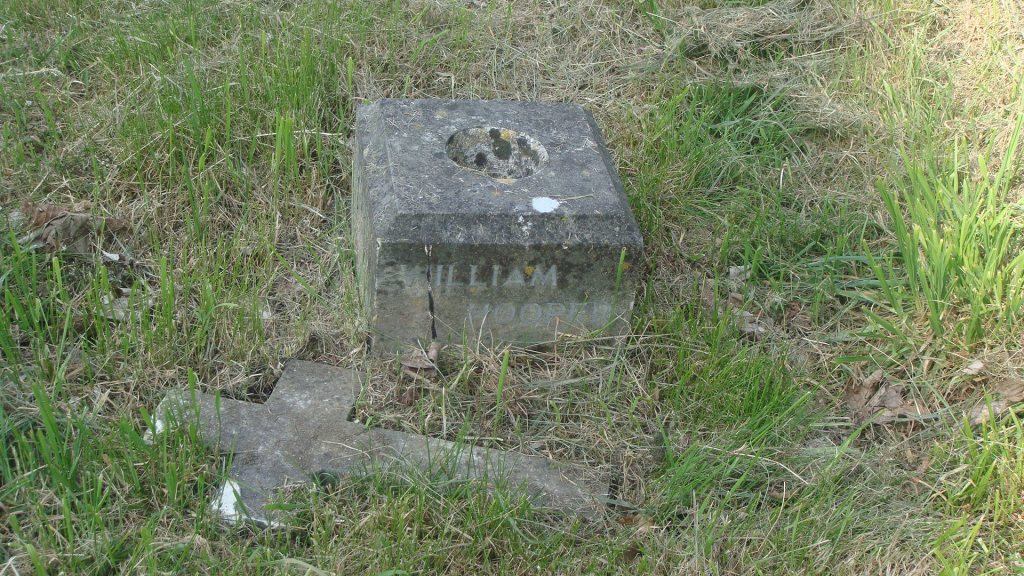
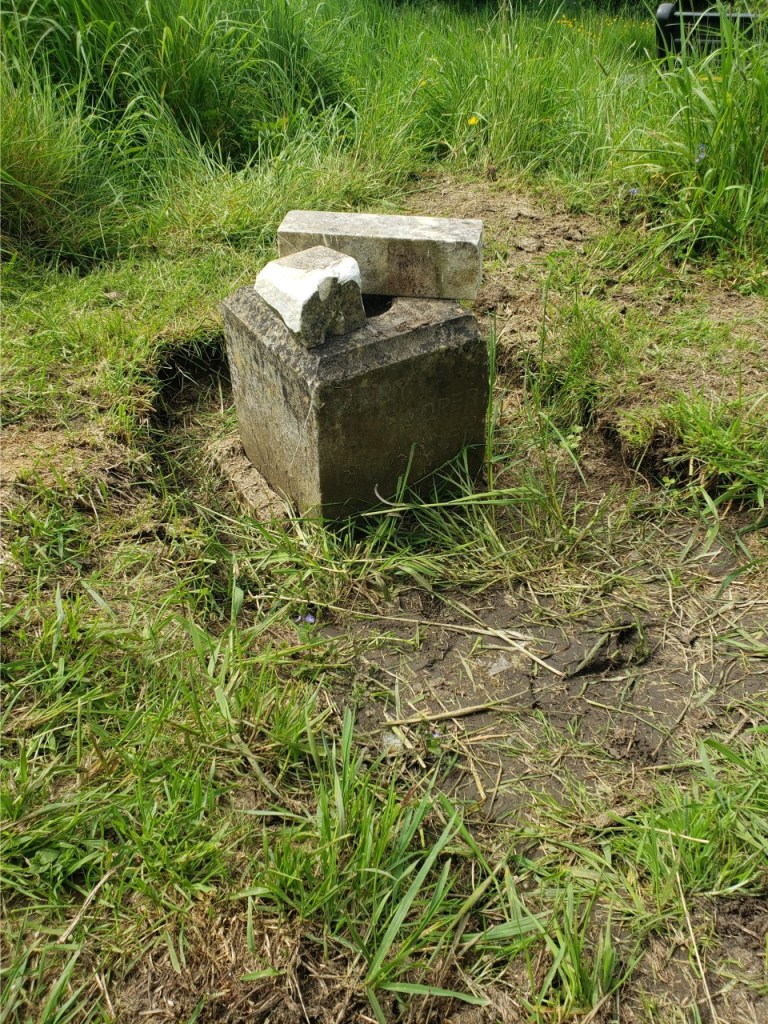
The modest memorial is a small cross on a plinth, sadly broken and difficult to find when the grass grows long. But the Hooper name lives on in the many photographs of Swindon William left us – with Mary’s assistance.
The Radnor Street Cemetery volunteers have revealed the battered William Hooper memorial and cleared the area around it. Unfortunately the cross is now badly broken.
For nearly a hundred years the cemetery was well maintained, the graves cared for by families, the gardens by groundsmen. And then the cemetery closed to new burials and families did not visit so often and nature began to reclaim the ancient Howse’s Coppice.
In 2005 the cemetery was designated a Local Nature Reserve. Areas of grass were left to grow long, providing habitat for insects. Hedgerows, corridors for wild life to move across the site, were maintained and bird and bat boxes were installed in the mature trees.
Following the financial crash of 2008 and subsequent local government spending cutbacks the cemetery was left to rest in peace. Today the plane trees are broad and lush, the grasses grow tall and some think it is a disgrace that the cemetery is so neglected, but there is a small group of volunteers who keep the history of the cemetery alive. Regular guided cemetery walks are attended by a growing number of people who come to listen to the story of Swindon’s history.
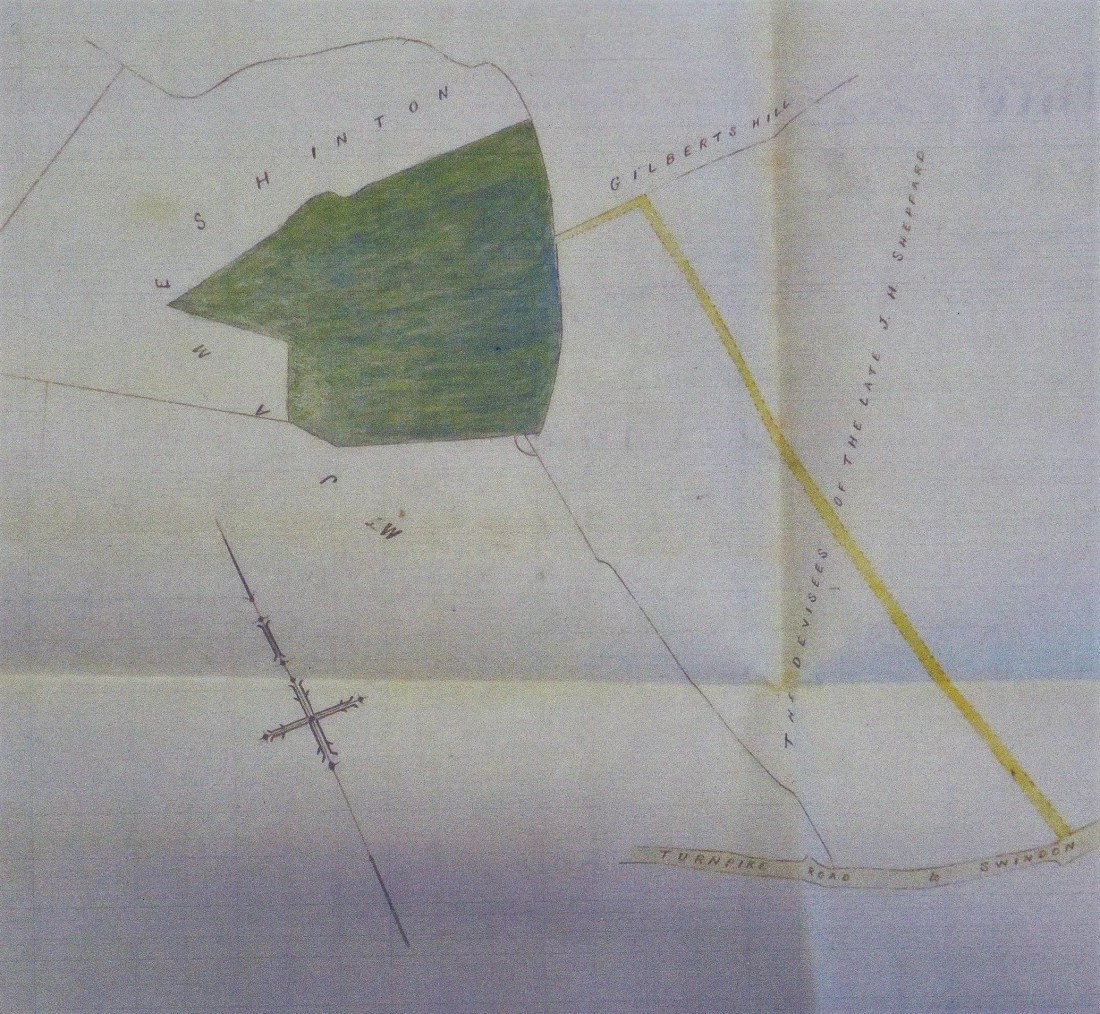
Documents held in the Wiltshire and Swindon History Centre, Chippenham trace the history of Howse’s Coppice back forty years before the cemetery was laid out. The land then belonged to James Bradford and appears on the Tithe Map details of 1840 where it is described as a coppice ground (an area of managed woodland) formerly called Wibley’s but later known as Howse’s Coppice.
James Bradford was a solicitor who lived and worked at a property in the High Street, Old Swindon, close to what was then the King of Prussia public house. His wife, Annica Werden Bradford, was a member of the Goddard family. James died in August 1861 and the following year Annica sold the coppice ground to John Harding Sheppard for £559 14s.
John Harding Sheppard was a farmer and brewer and owned large tracts of land across both New and Old Swindon, including the Kingshill area where Howse’s Coppice stood.
In 1871 the executors of Sheppard’s will, his sons John and William, sold Howse’s Coppice, by then described as a close of land, to James Edward Goddard Bradford, bringing it back into the possession of the Bradford family.
In 1878 James Hinton bought Howse’s Coppice, which formed part of the plot he would eventually sell to the Cemetery Committee two years later.
Howse’s Coppice was all that remained of ancient woodland that had once stood on Swindon’s doorstep before the arrival of industrialisation and the railways.
Sale of Property – Pursuant to advertisement in our paper, Mr. Dore submitted for sale the landed estate of the late John Harding Sheppard, Esq., This estate being situated on the Sands, and to the West between Old and New Swindon, has been considerably enhanced in value of late years, and a brisk competition for the various lots was anticipated. Some of the lots were not sold, consequent upon the reserved price not being reached. Though every lot obtained bidders. A piece of pasture land near Kingshill, and known as “Howse’s Coppice Ground,” 4a 3r 38s was knocked down to Mr J.E.G. Bradford for £490. Two pieces of land situate on the Sands, at Swindon – one having a frontage of 83 feet, and an average depth of 360 feet, and containing 2r 27p the other with a frontage of 80 feet, and containing 2r 18p, were sold to Mr Kinneir and Mr Lansdown, respectively for £220 and £235. The spacious premises occupied by Mr Matthews, draper, High-street, realised £1160, Mr Bradford being the purchaser. The house in the Square occupied by the late Mr J.H. Sheppard, was sold to Mr Kinneir for £1220, and, after a spirited competition, Mr Kinneir was declared the purchaser of the premises lately held By Mr Kimberley, for £400. The White Hart Inn, Newport-street, and six cottages adjoining, fell to Mr R. Bowly, at £1070; a dwelling house near to this lot, producing £13 a year, was purchased by Mr Jason Hutt, at £185. The Running Horse Inn, mill, land, and cottages, were purchased by Mr John Jacobs, for £680; two cottages near fetched £180 from the same purchaser. The house occupied by Mr. Oakford, in Wood street was bought by Mr Westmacott, for £420.
Wilts and Gloucestershire Standard, Saturday, October 8, 1870
It was a bitterly cold morning but we were the best dressed passengers on the platform at Swindon Junction that Boxing Day in 1906.
Uncle Alfred had polished his top hat to a shine and Bill looked prosperous, if a bit portly, with his fob watch chain stretched across his ample stomach.
I wasn’t sure how we would keep the children neat and tidy for the duration of the journey, but so far, they have been very well behaved.
We managed to find seats all together in one carriage, although it was a bit of a squeeze and Fred almost sat on Annie’s hat.
Aunt Charlotte would have loved all this.
My mother came prepared with a picnic hamper and enough food to sustain us on an expedition across the dark continent, never mind a trip to Cardiff.
No sooner had we passed through the station at Wootton Bassett Junction than my mother was handing round the scotch eggs.
We were met at Cardiff station by Florence’s uncle who took us to the church at Canton where the wedding ceremony took place and then it was back to the Davies’s home in Conbridge Road for the wedding breakfast.
The other day I was looking through some of my old bits and pieces with Maisie, my granddaughter. I’m moving in with her and her husband, I just can’t manage living alone anymore. I have to get rid of so much. It’s difficult.
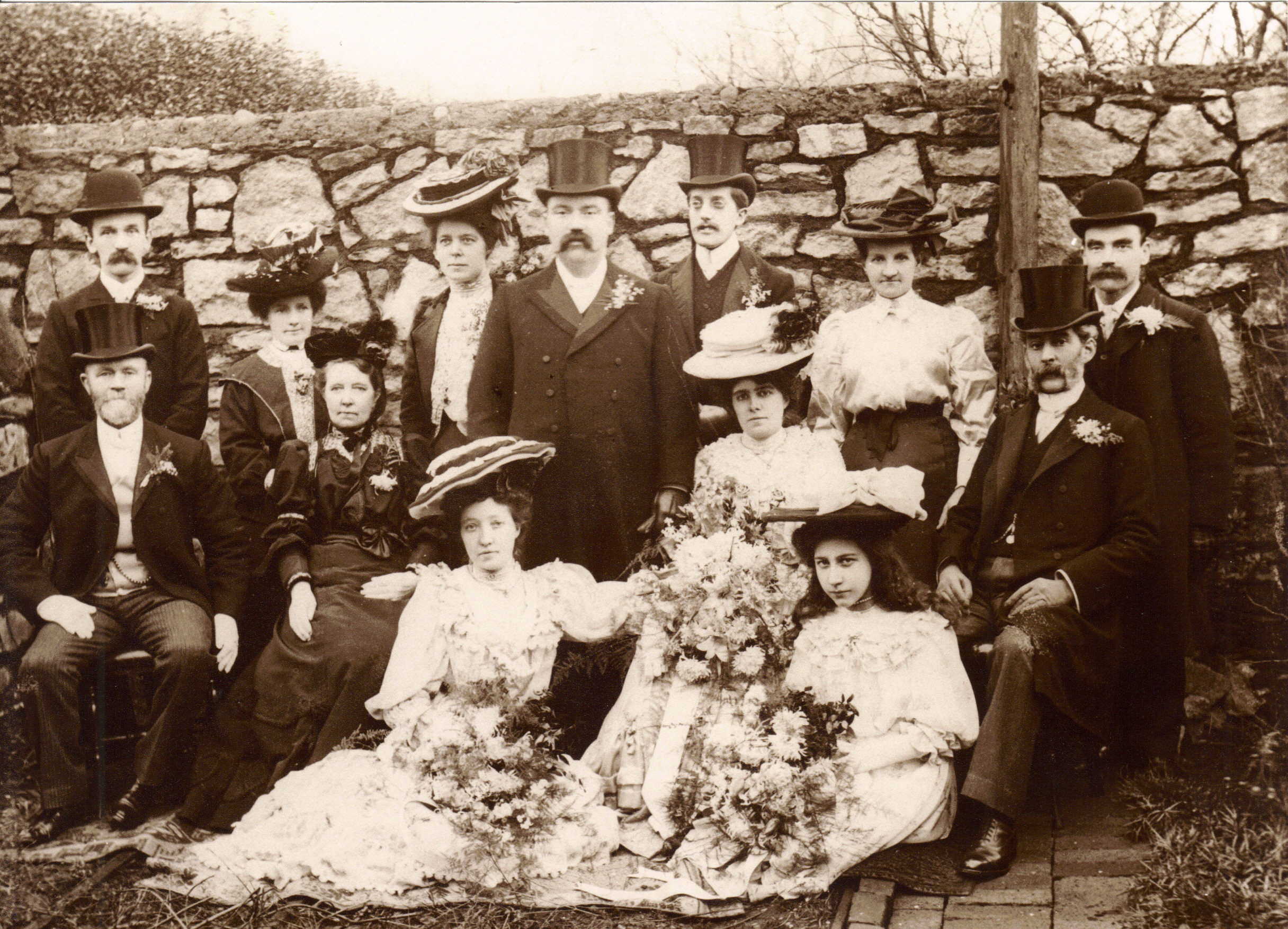
Maisie found Florence and Bill’s wedding photograph taken in the back garden in Canton on Boxing Day 1906.
“I love the ladies dresses,” said Maisie as she studied the sepia image. “Who are they all?”
I pointed out Uncle Alfred and Bill and Florence.
“I can’t remember who the others are, they are all members of the bride’s family.”
“They look a serious bunch,” she pulled a straight face. “Where are the Drinkwaters?”
“We were laughing and talking behind the photographer. I remember he asked us to be quiet as we were too much of a distraction.”
Aunt Charlotte would have loved that.
The facts …
Alfred Drinkwater was born in Barton St Michael, Gloucestershire in 1848. He married Charlotte Dent at St Mark’s Church, Gloucester on April 12, 1869. The couple had a large family of eight sons and four daughters.
Alfred worked as an engine cleaner, a fireman and a 1st Class Engineman (Engine Driver) The family moved from Gloucester to Reading, eventually arriving in Swindon in the mid-1890s. There is a family story that he once drove Queen Victoria’s train.
Charlotte died at the family home in Theobald Street and was buried in Radnor Street Cemetery in plot D1453 on June 29, 1904.
Alfred outlived her by almost 30 years. He died at 112, Millbrook Street, Gloucester on July 26, 1932, his body returned to Swindon and the plot he shares with his wife.
Alfred and Charlotte’s nine-year-old daughter Nellie died in 1895. She is buried in Radnor Street Cemetery in plot B2398.
The couple’s eldest son Alfred James Henry served a six-year apprenticeship in the railway factory where he worked as a fitter. He married Annie Cummins in 1892 at St Mark’s, Swindon. The couple never left Swindon and their last family home together was at 27 Whitehead Street. Alfred James Henry died in 1949 and his wife Annie died the following year, 1950. They are buried together with Alfred’s parents. The cremated remains of L.C. Drinkwater, probably Alfred and Annie’s daughter Lilian Charlotte, were interred in the family plot in 1989.
William Charles John Drinkwater and his wife Florence, the couple who married in Cardiff on Boxing Day 1906, were living at 40 Montagu Street, Rodbourne at the time of the 1911 census. They later moved to Wales. William died in the Pontypool and District Hospital on July 9, 1942 and Florence died at her home, 21 Saint Matthews Road, Pontypool on June 5, 1958.
Additional family history information obtained from Public Member’s Trees on http://www.ancestry.co.uk.














 Radnor Street Cemetery