Timothy Job Mills – a highly respected citizen

The family story is that Timothy Job Mills bought the Astill printing works that once stood at the corner of Victoria Street and Bath Road. His son Arthur Stanley Mills had married Amy, one of the Astill daughters and family historian Rhonda sent me the follow anecdote.

Image published courtesy of Local Studies, Swindon Central Library.

Arthur’s father Timothy Job Mills eventually purchased the Astill Printing Works and kept all the existing employees on.  He also bought tea in complete chests and the family used to spend ‘happy’ evenings bagging it up for sale to friends and neighbours.  It was his proud boast that he made one farthing profit on every bag… 

The enterprising Timothy Job Mills was born in Marston Maisey in 1845, the son of William and Helen Mills. By 1861 14 year old Timothy had moved to Swindon where he lodged with a family in Broome and worked as an agricultural labourer. In 1871, newly married to Ellen, he lived at Bradwick in Buckinghamshire where he worked as a painter’s labourer. By 1881 he was living in Upper Stratton and working as a commercial traveller. In 1891 he was living at 35 Bath Terrace, one of several terraces in the Farringdon Road area, where he continued to work as a commercial traveller. By 1901 he was living at 15 Devizes Road where he worked as a house furniture dealer, an enterprise his son Arthur Stanley Mills continued. In 1911 he was again working a a commercial traveller, this time dealing in cattle food. His acquisition of the Astill printing works followed but when his tea dealing enterprise took place remains unknown.

Timothy married twice – first to Ellen Reynolds by whom he had at least 7 children. Ellen died in 1893 and is buried in grave plot A965. Her details are recorded incorrectly in the Radnor Street Cemetery registers where it is stated she was 64 years old when she was actually 43.

Timothy married again in 1895. By then aged 50 his second wife was 23 year old Ada Kate Rosier. This marriage was a short one as Ada died the following year. She was buried with Timothy’s first wife in plot A965.

The Late Mr T.J. Mills

Funeral in Swindon

The funeral of the late Mr Timothy Job Mills, which took place on Friday, was marked by unusual demonstrations of sorrow and sympathy. The first part of the service was conducted at the Regent Street Primitive Methodist Church, where deceased had for so many years been a regular worshipper. He had filled many offices, including that of choirmaster, and he was also a circuit steward and a member of the Brinkworth District Committee, and had represented the church at District meetings and the district at annual conferences.

Appropriate music was rendered by the organist, and two of deceased’s favourite hymns were sung, “Give me the wings of faith” and “There is a land of pure delight.” The Revs. A.R. Wightman and C.H. Shawe officiated at the graveside in the Cemetery.

An Appreciation

In the course of the service at the church the Rev. F.W. Harper gave an address. He said Mr. Mills had lived a long life and had been a highly respected citizen of the town and a member of that church. He was a Free Churchman from principle and a regular worshipper at Regent Street church, and he had attended many important conferences as their esteemed representative. His very presence in the sanctuary, with his ever radiant smile and his jocose manner, brought to bear upon them the brightness of a spring-time morning. It was hard to think of Regent Street church without Mr. Mills. His cordiality was genuine, and he was ever out to do good for his fellow creatures. He always prayed simply, but persuasively and with great fervency, and he always joined heartily in the singing and loved the old Methodist hymns. Mr Mills’ child-like faith in the goodness of his Heavenly Father was one of the most beautiful traits in his character. He served his Lord and Master from a sense of duty as well as gladness. He was no weakling, and the church and denomination mourned the loss of a good man. Mr Mill had been an inspiration to preachers, to laymen as well as ministers.

Extracts from North Wilts Herald, Friday, March 2, 1923.

A Communion table & chairs were presented to the church by the family of T.J. Mills

Timothy Job Mills of 11 Devizes Road died on February 19, 1923. Probate was awarded to his two sons John Edwards and Arthur Stanley Mills when his effects were valued at £11,145 10s. He was buried on February 23 in grave plot A965 with his two wives, Ellen and Ada.
You may also like to read:-
The Astill Dynasty

The Astill Dynasty continued

Continuing the Astill family story

Continuing the Astill family story

In recent weeks I have been telling the story of the Astill family with the help of Rhonda and the recollections of the late Eric and at our recent cemetery walk I stopped at the Astill grave.

I have now discovered the grave of Amy Maud Astill born on June 27, 1871 one of Robert and Margaret’s elder daughters and one of the 8 children baptised at Christ Church on February 1880.

She married Arthur Stanley Mills on April 18, 1902, a house furnisher, at Christ Church and the couple went on to have four sons. By 1911 they were living at 15 Kent Road with their sons Edward 8, Wilfred 6, Arthur 4 and 8 month old Leslie.

Rhonda kindly provided the following family anecdote – Arthur was assistant to Mr Merricks of Gilbert’s Furniture shop in Newport Street, Swindon in 1900.  Became a partner in the business in 1923 and moved the shop to Bridge Street, Swindon and renamed it Mills and Merricks.  (Perhaps Arthur and James Merricks became partners in an independent venture.) After retiring to Sandbanks Road, Poole, made the business over to sons Edward and Arthur.  Arthur’s father Timothy Job Mills eventually purchased the Astill Printing Works and kept all the existing employees on.  He also bought tea in complete chests and the family used to spend ‘happy’ evenings bagging it up for sale to friends and neighbours.  It was his proud boast that he made one farthing profit on every bag.  Wilfred’s son Michael Mills, a pharmacist for many years at 123 Commercial Road, wrote to me 20+ years ago from his retirement in Poole, providing me with this information and sending me my copy of ‘Swindon In Old Photographs’.  

Rhonda has also supplied this photograph from the family archives labelled ‘Mills family’

Sadly, Amy died in 1919 and lies alone in grave plot E7466 where she was buried on March 6.

Arthur married Gertrude Hedges in 1920 and the couple had a son Leonard John and lived at 13 Croft Road. Arthur eventually moved to Poole where he died in 1975.

You may also like to read:

The Astill dynasty

The Astill dynasty continued

The Timms family

This is the story of Thomas and Rhoda Timms. It’s the story of an ordinary family, like so many of the others we discover here in Radnor Street Cemetery.

Thomas was born in 1868 in Steventon, Berkshire. His father Joseph was an agricultural labourer and his mother was called Esther. Rhoda was born in 1873 in Yatesbury, Wiltshire. Her father Joseph Shergold was also an agricultural labourer. Her mother was called Sarah.

By 1897 Thomas had moved to Swindon and was living at 14 Westcott Place. Rhoda was living at 2 Brunswick Terrace. Thomas worked as a labourer in the Railway Works and Rhoda as a domestic servant when the couple married at St. Mark’s Church on October 23, 1897. Their first child, a son whom they named Harold Joseph, was born in about 1898. By 1900 the family were living at 24 Stafford Street where three daughters were born, Kathleen Rose in 1900, Winifred Evelyn in 1901 and Gladys Esther in 1909. All three girls were baptised at St. Paul’s Church. In 1913 another son, Albert Thomas, was born.

By then Thomas was working as a bricklayer in the GWR Waggon Works. The couple lived at 24 Stafford Street until Thomas died in 1952 and Rhoda in 1965. They are buried here in grave plot D390 with their daughter Winifred Evelyn Timms who died at St Margaret’s Hospital in 1994. She was 92 years old and although she died in hospital, her home address was given as 24 Stafford Street.

I’ve chosen to write about this family because they are typical of the average working class Swindon family and because the memory of Winifred lives on for one of our cemetery followers. Paul grew up in Stafford Street and remembers Winifred as a little old lady who always had a smile and a wave for her neighbours.

It was my privilege to try and find out a little bit about the lady he knew as Winnie and to be able to tell him where she is buried.

Stafford Street and the Timms family home

Frank Apted

The following account of Frank Apted’s life was published in the Great Western Railway Magazine at the time of his retirement in 1908. It records only the details of his career, which is probably all you should expect to find in a work place publication, but Frank’s life was so much more than this.

Born in Peckham in about 1842, Frank was the son of schoolmaster Henry Apted and his wife Ruth, a schoolmistress. By 1861 Frank had begun his career with the Great Western Railway and was lodging with Thomas Jones and his family at 16 Faringdon Street. Frank would go on to marry Thomas Jones’s daughter Sarah but sadly this was to be a brief marriage as Sarah died in 1867 aged 25. She was buried in the churchyard at St. Mark’s.

Frank married for a second time in 1869. His second wife was Mary Jane Stone and this marriage would prove a long one but not without great sadness as well. At the time of the 1911 census Frank and Mary were living at 23 Park Lane. They had been married for 41 years during which time they had had 7 children. Sadly, only three survived to adulthood – daughters Alice, Louisa and Edith.

Later that same year their daughter Louisa died aged 30 in the Devizes Asylum. She was buried on August 24, 1911 in Radnor Street Cemetery, grave plot D125. Frank died on October 7, 1920 aged 78 and was buried with his daughter.

Mary Jane continued to live at 23 Park Lane where she died in 1930 aged 82. She was buried with Frank and their daughter on May 14.

When lives are reduced to facts and figures it can detract from the experience of these ordinary people. Perhaps Frank’s demanding and successful career with the GWR focused him, giving him strength amidst so much loss and sorrow. Perhaps he had a strong, religious faith which sustained him. Maybe I will find a reference to this in my future research. And what about Mary Jane …

Mr Frank Apted entered the service in 1856 as an apprentice to engine fitting, etc. He was subsequently transferred to the Running Department at Gloucester, returning to Swindon as an inspector in the works. Subsequently, Mr. Apted was placed in charge of the Works Drawing and Cost Office and in 1880 was given charge of the plant for testing chains, etc.

In his younger days Mr. Apted, realising the value of technical knowledge, studied assiduously, and obtained certificates qualifying him as a science teacher, which vocation he followed with conspicuous success for a number of years at the evening classes connected with the Mechanics’ Institute. In the pursuit of his various callings, Mr. Apted exhibited marked ability, and was one of the most capable of the technical staff at Swindon.

Great Western Railway Magazine 1908

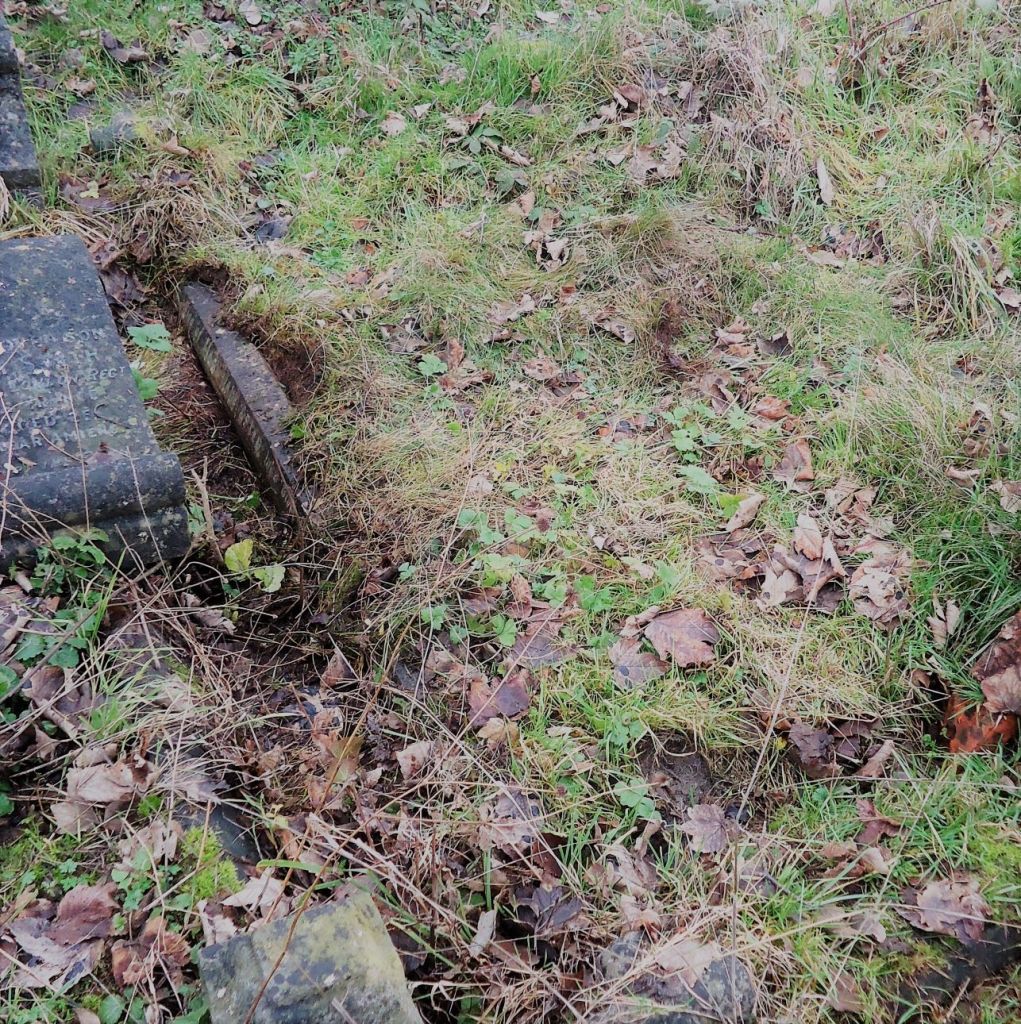
Frank was buried in grave plot D125. Today his grave and modest kerbstone memorial is very overgrown and almost lost.

James George Merricks

James George Merricks has already appeared on our radar, thanks to Rhonda and her Astill family history research.

She tells us that Amy Maud Astill’s husband Arthur Mills was assistant to Mr Merricks of Gilbert’s Furniture shop in Newport Street, Swindon in 1900, becoming a partner in the business in 1923 and moved the shop to Bridge Street, Swindon and renamed it Mills and Merricks – of course Gilberts is still trading in Newport Street to this day, perhaps Arthur and James became partners in an independent venture.

Now I need someone to fill in a few more gaps, such as how did James end up in South Africa in 1891 and what was Alice doing there?

In 1881 Alice was working as a governess for farmer Walter G. Cloke at Wiltshire Farm in Wokingham. Meanwhile James was working as a draper’s assistant in Bath. But by 1891 they were getting married in South Africa where three of their four sons were born, Eric George in 1892, Edward Alfred in 1893 and Lionel Marten in 1896. A fourth son, John Gordon was born in Swindon on June 14, 1900.

James George Merricks

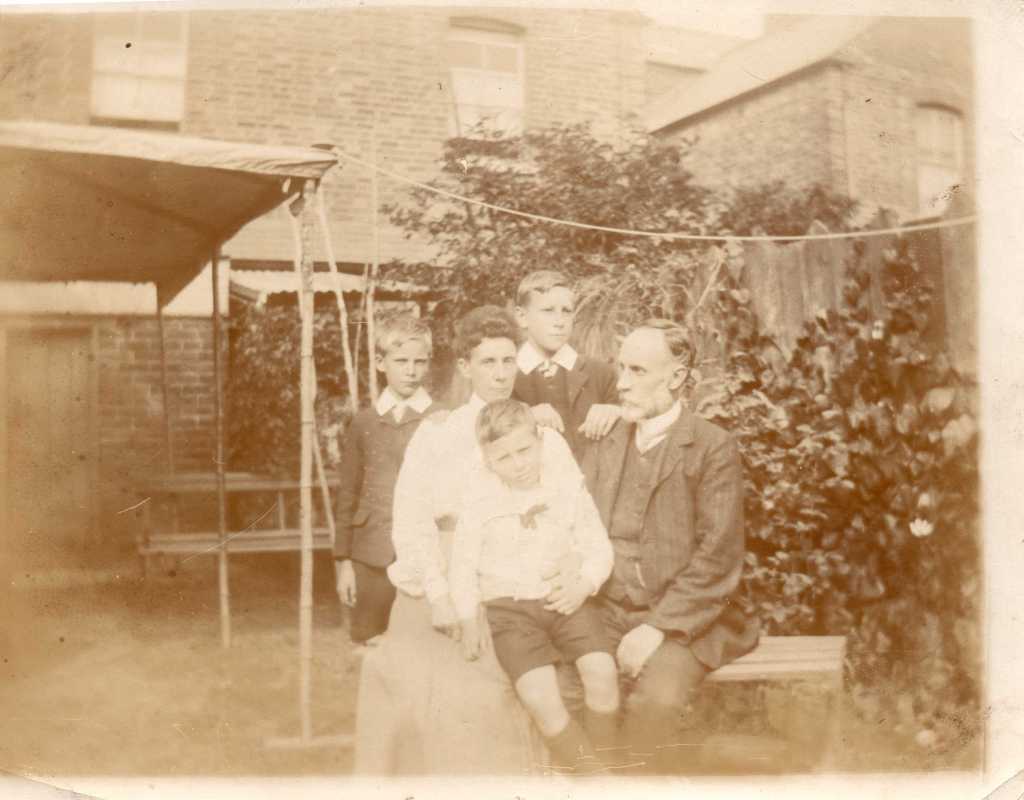
By the time of the 1901 census James and Alice were living at 42 St. Margarets Road, possibly where this photograph was taken in the back garden.

James George Merricks was a member of the Baptist Tabernacle, acting as Treasurer for 21 years. In 1934 shortly before his death, Mr J.G. Merricks presented a complete set of individual Communion bread plates to fit the cups previously given by his great friend and associate Mr. E.J. Lay. The two men are pictured together here.

There is still more to be learnt about this man. Especially how he came to spend such a lengthy spell in South Africa. Could this have been to do with the Baptist Tabernacle, I wonder?

James George Merricks died aged 75 years at his home 38 Devizes Road. He was buried on April 20, 1935 in grave plot E7574, joining his wife Alice who died in November 1923.

George Henry Stevens – Swindon Mayor 1928-29

Today I am publishing the first of a two part family story. George Henry Stevens devoted his life to public service – as did his eldest daughter Edith Harriett Stevens. George was described as ‘a foremost figure in trade union and Labour movements’ while Edith was a lifelong member of the Communist Party.

George was born in Mumbles, Swansea, the eldest child of Samuel and Eliza Ann Stevens. By 1851 the Stevens family had moved to Clifton where Samuel worked as a gardener.

In 1881 22 year old George was lodging at 27 Sheppard Street, Swindon with William and Mary West and working as an Engine Turner in the GWR Works.

He married Harriette Nash on March 24, 1883 and the couple went on to have six children.

Death of Mr G.H. Stevens

A Former Mayor of Swindon

Funeral Tributes

A former Mayor of Swindon, Councillor George Henry Stevens, J.P., of 62 County road, died on Saturday morning after a long illness.

His passing, at the age of 74 years, is a great loss to the town, for Mr Stevens’ record of public service was a notable one and he was a man who was swayed by the broadest sympathies and interest in all phases of the town’s administrative life.

Councillor Stevens’ devotion to his work is emphasised by the fact that he was a member of the Town Council for 18 years without a break and was honoured with the Mayoralty in the year 1928-29. His career was crowded with activity for the benefit of his fellow men.

46 Years’ Service

Born at Mumbles, Swansea, Mr Stevens came to Swindon in 1881 when 23 years of age, having served his time as a fitter and turner at Bristol. For 35 years he was a chargeman in W Shop at the GWR Works and retired in January 1928, after 46 years’ in the service of the company. For eight years he was a member of the council of the Mechanics’ Institute and for a quarter of a century was secretary of Swindon No. 3 branch of the AEU.

His first entry into the public life of the town was in 1914, when he was elected a member of the Town Council for King’s Ward. Later he represented the ratepayers of North Ward and continued to do so up to the time of his death. For seven years he held the position of chairman of the Electricity Committee and at the time of his death was a member of that committee as well as of the Works and Streets Committee, the Lighting Sub-Committee, the Staff and Stores Sub-Committee, the Finance and Law Committee, the Wages, Salaries, Superannuation and Loans Committee and the Rating and Valuation Committee.

Employed by Admiralty

During the war he served under the Ministry of Munitions for twelve months and afterwards was in the employ of the Admiralty as Labour Regulation officer for the North-Western area, stationed at Liverpool. He also served on the National Advisory Services Committee in Swindon, and was one of the first members elected on the National Health Insurance Committee for Wilts, serving in that capacity for 12 years.

Another important service he rendered was in connection with the Labour Exchanges for the South-West of England, and on that body he was the only Wiltshire representative during a period of three years.

Mr Stevens had been a member of the Ancient Order of Foresters for more than 60 years, and was one of the founders of the Swindon Brotherhood.

Trade Union Interests

He had been associated with the local Trades and Labour Council since its inception following upon a visit to Swindon of Mr. John Burns in 1885, and generally had been a foremost figure in trade union and Labour movements.

Extracts from North Wilts Herald Friday June 17, 1932.

George was buried in grave plot D1125 where he joined his wife Harriett who died in 1928 and two of their children – Stanley George who died aged 28 years in 1914 and Edna Gertrude who died in 1921 aged 25.

Read about Edith Stevens here tomorrow.

Wentworth Joseph Evans – impressive funeral of late GWR foreman

The magnificently named Wentworth Joseph Evans was born on October 17, 1857 and spent his early childhood in Melcombe Regis, Dorset. By 1871 the family were living at 18 Gloucester Street, Swindon when Wentworth joined the GWR aged 14. He finished his apprenticeship in 1877 and went on to become an Assistant Foreman in 1897 and then a Foreman in 1905 working in A Shop, B & C Sheds and the Tender Shop before his death in 1912.

Wentworth married Eliza Ann Bugler in Weymouth, Dorset on December 29, 1880 and the newly weds began married life at 20 Carr Street. The couple went on to have three children and lived for many years at 10 Queens Terrace, Station Road.

The 1911 census provides lots of information about the family. Wentworth and Eliza had his widowed father and her widowed mother living with them in 1911. Wentworth’s father, Jabez [James] Evans is described as 79 years old, a retired Engine Erector (no pension). Eliza’s mother, Ann Bugler, is described as 82 years old, a widow and Old Age Pensioner 5/- per week. Wentworth and Eliza’s youngest son Alfred Arthur aged 25 works as a Pianoforte Tuner and is described as ‘totally blind from birth.’

When I checked the burial registers I discovered that Wentworth had died just 9 days after his father. Jabez [James] was buried with his second wife Catherine Evans in grave plot D1588.

A lengthy funeral report was published in the Swindon Advertiser.

The Late Mr W.J. Evans

Impressive Funeral of Late GWR Foreman

Seven Hundred Follows

The funeral of the late Mr Wentworth J. Evans, at the Swindon Cemetery, on Saturday, was the occasion of a most impressive tribute to the memory of the late foreman of the Erecting Shop of the GWR Works. Not only were Mr H.C. King and other officials of the Works present, but the Foremen’s Association, the Medical Fund, and the Council of the Mechanics’ Institute were also represented, while it is estimated that the number of men who showed their respect for their late foreman at the graveside must have numbered also seven hundred. It was the largest number of followers ever known in the Swindon Cemetery.

The cortege formed at Mr Evans’ late residence, 10, Queen’s Terrace, Station Road, and headed by a hand-bier bearing the beautiful floral tributes, and followed by an immense column of mourning men, proceeded to St. Mark’s Church. Here, the building was quite filled when the Vicar (The Rev. A.G.G. Ross) read the first portion of the sad rites for the dead. Re-forming, the procession made its way to the Cemetery, and here the Vicar of St. Mark’s again conducted the service. The remains were enclosed in a polished elm coffin with brass fittings, and the breastplate was inscribed:- “Wentworth Joseph Evans, died April 15, 1912, aged 54 years.

Extracts from The Evening Swindon Advertiser, Monday, April 22, 1912.

Wentworth Joseph Evans was buried on April 20, 1912 in grave plot D1480 where his wife Eliza Ann joined him following her death in 1913.

Cemetery Walk

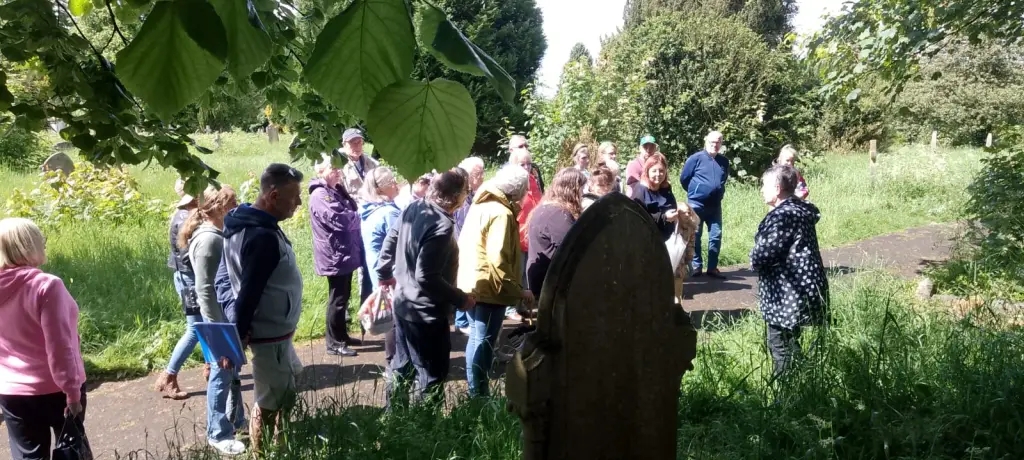
We had torrential rain, thunder and eventually beautiful sunshine on our guided cemetery walk yesterday, during which we welcomed regular and new cemetery followers.

Kevin updated us on the work of the CWGC Eyes On Hands On team and in honour of the forthcoming 80th anniversary he spoke about Private Kenneth William Scott-Browne, killed in an air accident during D Day training.

Here are some photos from the day.

A return visit to Clifton Street

Victorian Swindon was the product of some daring speculative building.  Streets grew up in rows of terraces as local builders bought up small plots of land.  Sadly, today there are few remaining examples of the early names these builders gave their rows of terraces.

Built in 1883 by James Hinton, number 141 Clifton Street began life as 5 Graham Terrace.  The first owner was Alfred Reynolds, a coach builder obviously keen to invest in the Swindon property boom, who bought the property from James Hinton in 1884 and speedily sold it on.

On May 13, 1884 schoolmaster Samuel Snell paid £200 for No 5 Graham Terrace.  The deeds provide some fascinating details of the property and a glimpse of the Kingshill area in the middle of development.

The house at 5 Graham Terrace, Clifton Street is described as being ‘lately erected.’  The parcel of land on which the property was built had “a frontage to the said Street and being of the width throughout of fourteen feet eight inches.”  It was bounded “on the South Western end by a back road ten feet wide as the same is made or intended to be made parallel with Clifton Street.”

Samuel Snell didn’t live long in the house on Clifton Street before moving into the school building at The Willows, The Sands with his family, two assistant masters, three domestic servants and nine boarders.

John T. Mayell, a 24 year old boilermaker from Brierly Hill in Staffordshire was the next owner and moved into 141 Clifton Street with his wife and baby daughter.  In 1889 he took out a second mortgage on the property with Swindon solicitor Walter H. Kinneir, which he had repaid by 1901.  John lived in the house for more than ten years. 

By 1899 the street was built up along its entire length saving a few empty plots on the bend of the road opposite the Clifton Hotel.  The new road mentioned in the 1884 deeds is Exmouth Street.

In 1911 the property came on the market again.  Jabez Bull was the owner occupier and he sold the house to Charles Frederick Farr, an engine erector who lived just up the road at number 159.  Although now commonly known as Clifton Street, prospective buyers were reminded that the property had once been known as 5 Graham Terrace. 

James Hinton, New Swindon Local Board member, had land laid out between Dixon, Stafford and Clifton Streets by 1879.  In 1883 he built numbers 136-145 Clifton Street and the following year he built numbers 70-81 on the same street.

In 1880 James Hinton sold an 11½ acre plot in the middle of the Kingshill estate to Swindon’s two Local Boards for the building of the town’s much needed new cemetery.

He later served as Vice Chairman of New Swindon Local Board and became Mayor of Swindon in 1903-1904. Hinton Street in Gorse Hill was named after him. James Hinton died in 1907 and was buried in Radnor Street Cemetery.

Thomas Mullett – a Gas Work labourer

The last time we find Thomas Mullet on official documents is in the 1901 census. A Gas Work labourer Thomas lived at 146 Morrison Street with his wife Jane and three of their children – George 23, a furnaceman, Rose 19, a dressmaker and Mary 18, a shirt machinist.

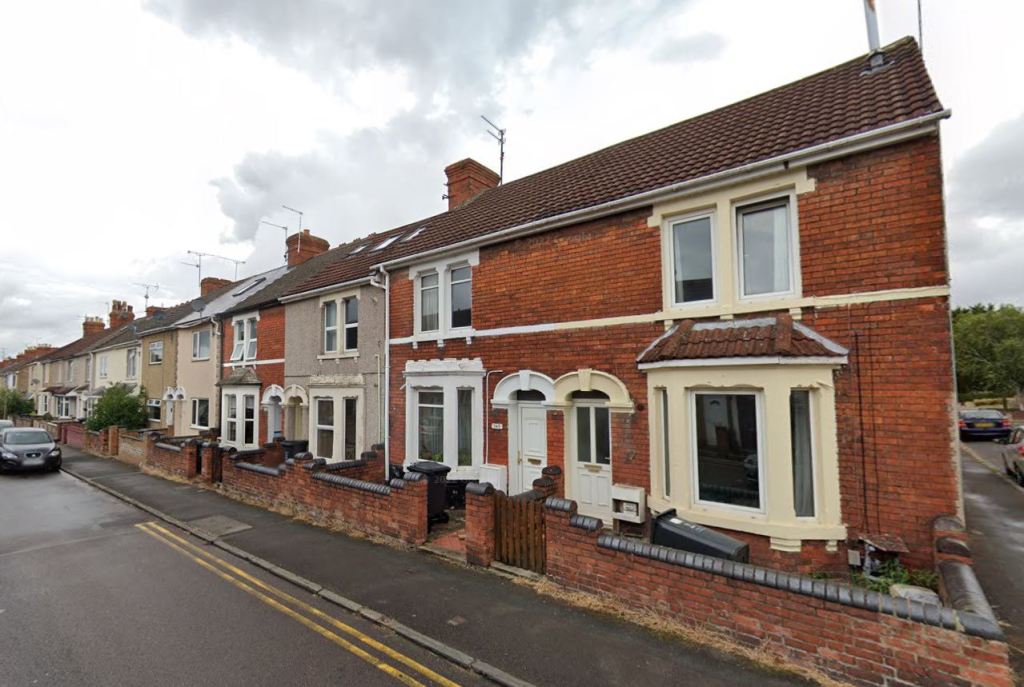
Morrison Street – the Mullett family lived in the end house

Swindon

Thomas Mullett of 146 Morrison Street has succumbed to the effects of injuries sustained in an accident in the GWR Works a fortnight ago.

Deceased mounted a wall for the purpose of lighting a lamp, and fell on a quantity of rough stones his head being cut open. He received attention at the GWR Hospital and subsequently went home. After a while however erysipelas and internal complications supervened and death took place on Wednesday.

Western Daily Press Friday October 5, 1906.

Thomas Mullett aged 56 was buried on October 6, 1906 in grave plot D137 where he lies alone.

After her husband’s death Jane took stock of where her own life was going. Just two years later she had made up her mind and set sail for the USA. In 1920 she was living with her daughter Rose and son-in-law William H. Hobbs in Onondaga County, New York State.

Jane died in 1939 and is buried in Sherrill, NY, a long way away from Morrison Street and Thomas in Radnor Street Cemetery.

Thanks to Between the Bridges – The Early Days of Rodbourne – by David Lewis