Walter George Watts was known to family and friends as George. The son of Charles and Elizabeth Watts he was born in Horton, Wiltshire and began his working life at 14 years old as a farm labourer in Haydon Wick. Perhaps he was still employed on the land in 1910 – there is little information to be discovered about Walter’s life – only the report on his death.
In 1932 the Prevention of Accidents booklet was published with ‘posed’ photographs of potentially dangerous situations for those working on the railways. But it seems likely George wasn’t a railway employee. The railways were (and continue to be) dangerous places, even if you didn’t work on them.
A recent view of Montagu Street, Rodbourne
Fatality on the GWR near Swindon
A fatal accident occurred on the Great Western Railway between Swindon and Purton, about midnight on Wednesday. Two men were walking along the railway towards Swindon, and after they had passed two trains, which were meeting each other, one of them missed his companion, Walter George Watts, of 119 Montague Street Swindon. He made a search for him and eventually found his dead body by the side of the line. He had been struck by one of the trains and was killed instantaneously. The body was removed on a light engine to Swindon to await an inquest. The unfortunate man was 24 years of age and met his death on his birthday.
Western Daily Press, Friday August 12, 1910.
Walter George Watts was buried on August 15, 1910 in a public, unmarked grave, plot B2401. He was buried with two others; Jacob Fry who died in 1895 and was probably unrelated and Walter’s father Charles Watts who died in 1913.
With thanks to David Lewis – Between the Bridges – The Early Days of Rodbourne.
If you are researching your railway ancestor you may also like to visit the Railway Work, Life & Death website.
The sad story of Elizabeth Jane Hardy who died at the Wilts County Mental Hospital in Devizes in 1934 and was buried there in error.
Exhumation of Swindon Woman
Re-Burial in Radnor Street Cemetery
The Late Mrs Hardy
Early on Friday morning, in the presence of about half-a-dozen people, the body of Mrs Elizabeth Jane Hardy, aged 82 of Swindon, was removed from the grave in the hillside cemetery at the Wilts County Mental Hospital at Devizes, where it has been for just over a month.
The exhumation, by request of the Home Secretary, Sir John Gilmour, who granted the order, was carried out “As quietly as possible,” and only three members of the public were present at the re-burial at the Radnor Street Cemetery, Swindon, an hour later.
Secret Proceedings
And so at last satisfaction has been secured in connection with the unfortunate mistake that led to Mrs Hardy being buried in the Mental Hospital grounds against the expressed wish and without the knowledge of her 82 year-old husband, Mr Samuel Hardy, of 4, Euclid Street, Swindon.
Not a single relative was afforded an opportunity of attending the first burial, or of sending a few flowers down to the hospital, and immediately he heard of what had taken place, Mr Hardy and other members of the family, who naturally, were greatly distressed, vowed that they would not rest until an exhumation order had been secured.
In order to avoid any kind of public demonstration, the proceedings on Friday morning were carried out with the utmost secrecy.
The exhumation order was issued on Monday through Mr A.E. Withy, who has been acting for Mr Hardy, and the Mental Hospital authorities were immediately notified. Last Thursday afternoon the arrangements for lifting the body were completed, and Mr F.N.W. Baker, son-in-law, accompanied by Mr D.S. Smith (son of Mr A.E. Smith, the undertaker) motored down to the hospital cemetery on Friday morning.
The grave had been opened by the time they arrived, and when the coffin was disinterred Mr Baker expressed a wish that the lid should be raised in order that he might identify the body. This was done.
Those present at the exhumation included Dr. J.W. Leech, acting medical superintendent of the hospital, Mr J. S. Deavin, Clerk, and the Rev. Dudley, hospital chaplain.
The Mourners
The elm coffin was then enclosed in a magnificent oaken shell, and brought in a hearse to Swindon.
Just after nine o’clock, following a short service conducted by the Rev. Bertram E. Woods, of the Methodist Central Mission, Swindon, the re-burial took place in the Radnor Street Cemetery, in the grave which was originally opened for the public funeral that had been arranged to take place on Tuesday, 3 April.
The mourners present were Mr Samuel Hardy, husband; Mrs F.N.W. Baker and Mr Baker, daughter and son-in-law; Miss Joan Baker, granddaughter; Mr and Mrs Walter Timbrell, niece and nephew; Mrs Butt, Mrs Tylee and Mrs Selby, nieces; Mr and Mrs F. Baker, and Mrs Trowbridge, friends.
Mr Hardy, in conversation with a North Wilts Herald reporter, said the members of the family were greatly relieved to know that their efforts had been successful, and they owed a great debt of gratitude to the many friends who had sympathised with them in this sad affair.
“We are particularly grateful to Sir Reginald Mitchell Banks,” added Mr Hardy. “When the appeal was made to him, he instantly responded, and despite the great call upon his time personally sought the Home Secretary in order to hasten forward the granting of a licence.”
North Wilts Herald, Friday, 11 May, 1934.
Elizabeth Jane Hardy was buried in grave plot D919 where her husband joined her when he died in 1937.
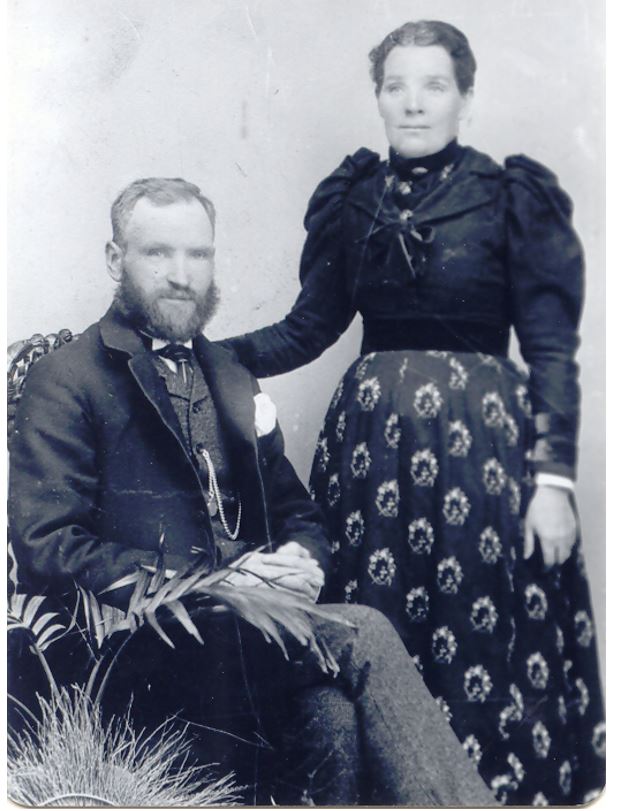
James Fox was born on February 28, 1851. He grew up at Salthrop Cottages, Wroughton where his father Richard Fox worked as a shepherd. By 1871 he had moved into Swindon and was lodging with his brother and sister-in-law at Eastcott Hill. James married Annie Herridge on December 24, 1874.
The UK Railway Employment Records 1833-1956 state that James entered the service of the Great Western Railway in April 1876. Two accidents occurred during his working career. The first was on January 28, 1894 which caused damage to wagons. The second on December 10, 1901 caused the derailing of an engine at Swindon. There could be various reasons for these accidents; the railway industry was a dangerous working environment yet employees safety was still an issue of personal responsibility. But far worse was to follow …
Frederick George Higgins, engine driver in the employe of the GWR Co., said he was shunting on September 6th in the Swindon transfer yard. He and deceased were going ahead with one empty truck and a guard’s van. The van was at the back. They were not going more than three miles an hour. Deceased was attempting to get on the back van, and slipped. Deceased wanted to ride to go to the other end of the yard. He was not engaged upon the shunting operation. He (witness) saw the deceased slip. Deceased did not get a firm footing. He hung on with his hands, and his feet evidently caught in the crossings. The truck wheel went over the deceased’s foot, crushing it. The deceased was taken at once to the Hospital.
Dr Astley Cooper Swinhoe said he attended the deceased on Sept. 6th. He found the deceased was suffering from a compound fracture of the lower part of the left leg. The leg was amputated at once. Two days afterwards gangrene set in, and the man died from exhaustion consequent upon the gangrene.
The jury returned a verdict of “Accidental death.”
Funeral of Mr Fox – Impressive Scene at Swindon Cemetery
The funeral of the late Mr James Fox, a GWR shunter, who died in the Medical Fund Hospital, last Thursday, took place in Swindon cemetery, last Sunday afternoon, in the presence of an immense concourse of people.
The funeral procession left deceased’s late residence, 163 Beatrice Street (whither the body had been removed from the Hospital), at three o’clock, arriving at the Cemetery almost half an hour later.
The coffin, which was covered with beautiful wreaths, was conveyed in a hearse, and the chief mourners, relatives of deceased, following in three mourning coaches.
Then there followed on foot about 100 uniform men from the GWR Station fellow workmen in various department with deceased, and these were headed by Inspectors Simpkins, Spurlock, Winter and Taylor. About 30 other members of the Amalgamated Society of Railway Servants (of which deceased was a member) followed, being headed by Mr G.E. Leonard (Chairman of the Swindon Branch) and Councillors J.H. Thomas and J.H. Mayell. Many members of the GWR Provident Society were also present, headed by Mr. W.H. Perry Court Pride of Wiltshire, A.O.F., of which Mr Fox had been a member for many years, were represented by Bros. T. Robinson (Secretary), N. Young, F. Williams, J. Lawrence, W. Timbrell and W. Comley.
It was a lovely fine afternoon, and by the time the procession reached the Cemetery, a crowd numbering some thousands had assembled. The greatest order was maintained throughout, and the service was impressively read at the graveside by the Rev. W.J. Scruby, Primitive Methodist Sup. Minister. Deceased was buried in the same grave as his wife, who died last April, and a son, who died some four years ago.
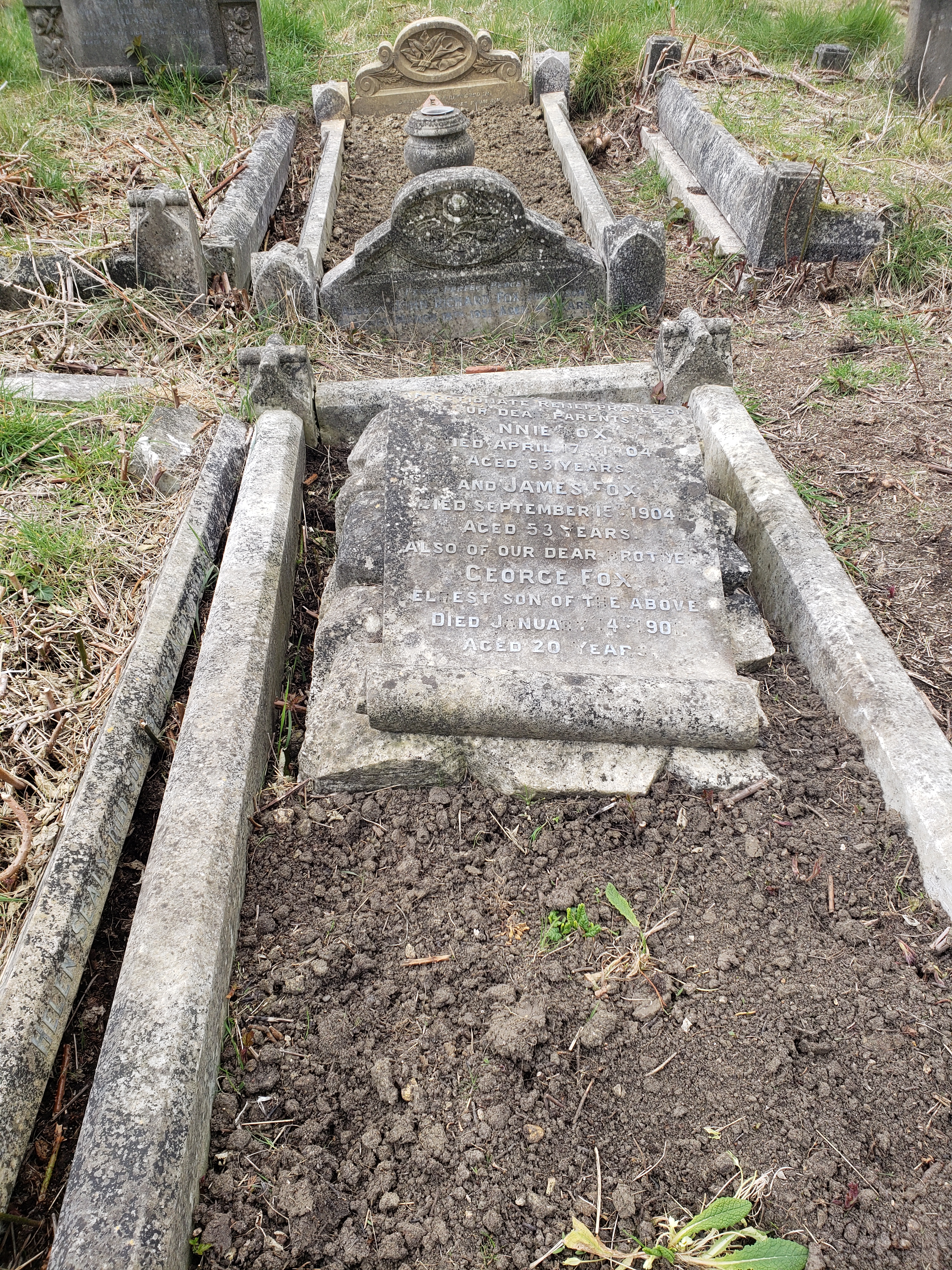
The coffin was of polished elm, with brass furniture, and bore the following inscription: James Fox, died September 13th, 1904, aged 53 years.
Extracts taken from Inquest and Verdict/Funeral of Mr Fox Swindon Advertiser Friday September 23, 1904.
James Fox 53 years 63 Beatrice Street burial September 18, 1904 grave plot E7385
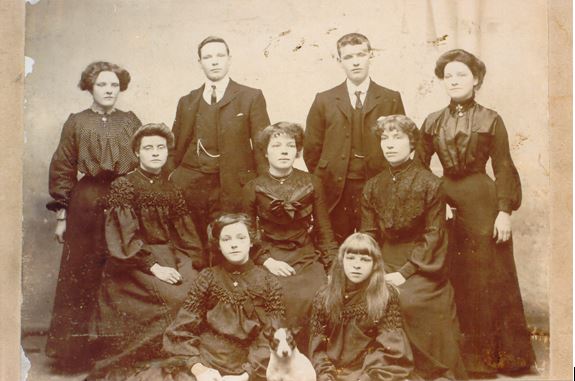
Photograph of the Fox siblings believed to have been taken on the day of James Fox’s funeral – Back left to right – Florence, Henry James, Tom, Elizabeth. Middle row left to right Annie Amelia, Emily, Alice. Front row left to right Winifred Ellen, Rose.
There are copies of the Medical Fund Society Yearly Reports in Local Studies, Swindon Central Library and I recently published a blogpost about the Accident Hospital.
During 1885 there were 30 patients treated in the Medical Fund Hospital who had sustained injuries during an ordinary working day. Men like Henry Kent 44, a goods guard from Salisbury, who suffered fractured ribs and shoulder and died after 2 days in hospital. Thomas Tuck 38, a labourer from Wootton Bassett, who suffered a scalp wound but was discharged after 10 days in hospital. There are more details available about William Ball 56, a driver from Swindon, who fell off an engine while in motion and fractured two ribs and injured his head. He spent 29 days in hospital and was ‘discharged convalescent.’
Yesterday evening the Friends of Swindon Railway Museum’s monthly lecture, entitled ‘Into the Jaws of Death – working and dying on Britain’s railways 1900-1939,’ was delivered by Mike Esbester from the University of Portsmouth. The subject was the danger railwaymen faced on a daily basis whether working on the trackside or in railway factories such as Swindon Works.
In 1913 30,000 railway workers across the UK were killed or injured and yet responsibility was largely put on the men themselves – that they were careless!
In Mike’s presentation he talked about not just unsafe working practices and conditions but the pressure on workers to complete tasks at sometimes unrealistic speed; when wages were docked if targets were missed. Despite a railway inspectorate that highlighted dangers and trade unions that demanded change, railway companies were reluctant to act, and as Mike emphasised the onus was firmly placed upon the railwaymen themselves. Their personal safety was their responsibility.
In 2016 a joint initiative by the University of Portsmouth and the National Railway Museum saw the beginning of the ‘Railway Work, Life & Death’ project to try to make railway worker accident records more accessible and to see what could be learnt from them. These records are of interest not only to museums and archives professionals but to railway enthusiasts, family historians and the current railway industry. To date volunteers have transcribed around 50,000 surviving records, which are available to view on the project’s website.
With such a distinctive name as Charles Adolphus Sylvester Toogood it should be easy to trace this gentleman, and up to a point it is. His employment records provide a birth date, December 13, 1869 and his entry into the GWR company as September 20, 1886. And from 1891 to his death in 1946 we can trace him through the census records. But there is a gap – something catastrophic appears to have happened to the family between the 1871 and 1881 census’s. It seems likely that Charles Toogood’s mother died before 1881; neither she nor his father Alfred can be reliably traced on the 1881 census. However, a ten year old boy by the name of Adolphus Toogood can be found in the Lyncombe & Widcombe Workhouse. Could this be Charles?
Charles married Florence Ann Greenaway at St. Mark’s Church on January 31, 1895 and the couple had five daughters, the youngest Pearl died before her first birthday.
The following account was published in the Great Western Railway Magazine when Charles retired in 1930.
Mr C.A.S. Toogood, of the Chief Mechanical Engineer’s Department, Swindon, retired from the Company’s service on December 13, after nearly 44 years’ service, practically the whole of which was spent in the Locomotive, Carriage and Wagon divisional superintendent’s office, at Swindon. With the abolition of the Swindon division in May 1922, Mr. Toogood, with others of the staff, was transferred to Bristol, but he returned to Swindon in December 1928 and has been attached to the accounts section since that time. Mr Toogood received a handsome timepiece and notes as a parting gift from his past and present colleagues.
Great Western Railway Magazine March 1930.
Charles Adolphus Sylvester Toogood died in 1946 and was buried on November 27 in grave plot C983 where he joined his wife Florence who died in 1937.
The Accident Hospital was opened in December 1871 and as the name suggests, that was its sole purpose in those early years. This postcard image published on the Local Studies flickr page has the annotation – ‘For use in case of accidents which are of daily occurance in the GWR Factory.’
On January 12, 1886 doctors Swinhoe, Howse and Bromley made their Accident Hospital Doctors’ Report to the Medical Fund Committee as follows:
Gentlemen,
The New Year of 1885, found us with three Patients in our Accident Hospital. Since then, twenty-seven new cases have been admitted, making a total of thirty for the twelve months. Of these, twenty have been discharged convalescent, six have died, and one is still under treatment and doing well.
We enclose tabulated list for your better information.
We are, Gentlemen,
Your obedient Servants,
Swinhoe, Howse, & Bromley.
Among the injuries treated during 1885 were leg fractures, a crushed foot and fractured ribs.
Of the six deaths that occurred in the hospital four of the deceased were buried in Radnor Street Cemetery.
Fireman Charles W. Nicholls aged 23 of 13 Medgbury Road died from having his ‘chest crushed in’. Charles Nicholls was buried on September 6, 1885 in grave plot A309.
George Turnbull aged 33, Charge Man in B2 Shop died from a compound fracture of the skull having spent 3 days in hospital. George Turnbull was buried on April 2, 1885 in grave plot A727.
Thomas Edwards who worked in the Saw Mill was admitted with a rupture and spent 40 days in hospital where he died of consumption. He was 33 years old. Thomas Edwards was buried on March 28, 1885 in grave plot A204.
William Collett of 40 Princes Street was admitted to the hospital suffering from extensive burns. He died 2 days later. He was 49 years old. William Collet was buried on March 26, 1885 in grave plot A628.
A blogpost published last year about the Astill printing establishment was recently seen by Rhonda in Australia. Rhonda is the great great granddaughter of Robert and Margaret Astill and has an ongoing family history research project that she has been kind enough to share with me, including some fab photos.
Here is Robert Astill, founder of the printing business.
And here is Margaret, his wife.
Robert Astill married Margaret Hall on October 27, 1866 at the Baptist Chapel, Fleet Street, New Swindon.
The Astill family numbered 13. Two daughters died in childhood, Frances in infancy in 1881 and Emma aged 3 in 1870.
The surviving children were all baptised at Christ Church – eight in one go – on February 8, 1880! Ella Alicia Ward Astill was baptised the following year on August 28, 1881 and Annie Kathleen Wootton Hall Astill and Lily Blanche Astill on April 4, 1900.
In 1891 all 11 surviving siblings were living at 2 Bath Road – 7 sisters and 4 brothers – their ages ranging from the eldest Margaret Florence Marionne who was 21 to the youngest Lily Blanche aged 6.
Ellen Victoria, known as Nellie, was the sixth child, born on March 12, 1874. Family memories of Ellen speak of a charming lady who didn’t have much of a life. In 1911 she appears on the census returns as living at Roves Farm, Sevenhampton where she is described as a servant. Farmer Herbert Haine and his wife Edith have two young children and it is likely Ellen’s work was of a domestic nature.
By 1923 Ellen had moved to 28 Avenue Road, Swindon where she worked as a dressmaker and lived with various siblings across the years. In 1939 she lived there with her brother Quigley and sister Ella. It was there that she died aged 72 in April 1946.
And here is Ellen Victoria seated between her sister Mary and her niece Violet. Ellen is the daughter buried with her parents in grave plot E8601.
Many thanks to Rhonda in Australia and the late Eric Barrett from Wroughton for information, photos and family memories.
We’ve already met the Warren family on this blog. John was the younger brother of Lilium Lancifolium Warren, infact, she was named as a witness at his wedding in 1915 and when he died in 1930 she was awarded probate of his will.
John was born on September 27, 1886, the son of Alfred Warren, a goods guard, and his wife Marcellina.
His employment records with the GWR reveal he began work on May 5, 1902 and as his obituary states ‘he had been in the Company’s service for 28 years, the whole of which time he had spent in the accounts section.’
He married Frances Alice Iles at St. Paul’s Church, Swindon on April 12, 1915 and served in WWI. Unfortunately his military records are incomplete and all that survive indicate that he served as an Acting Sergeant in the Royal Army Medical Corps and that he was discharged on July 11, 1919.
His many friends will learn with regret of the death of Mr. J.O. Warren, of the Chief Mechanical Engineer’s Department, accounts section, Swindon, who died on January 20, after a short illness. Mr. Warren was 43 years of age and had been in the Company’s service for 28 years, the whole of which time he had spent in the accounts section. He leaves a widow and one little girl, and his loss is greatly deplored by his colleagues, many of whom attended the funeral on January 24.
Great Western Railway Magazine March 1930.
John Oliver Warren died on January 20, 1930 and was buried in grave plot E7367 where he joined his baby daughter Marjorie Olive who died in 1916 and his wife Frances Alice who died in 1926.
The names of James Thomas Bown and his wife Mary Jane may not mean much to you. He was a clerk in the Works and she was a wife and mother. She was probably a lot of other things as well but wife and mother are the roles we know her by on official documents.
They married on August 20, 1881 at St. Mark’s Church and had four children of whom three survived to adulthood.
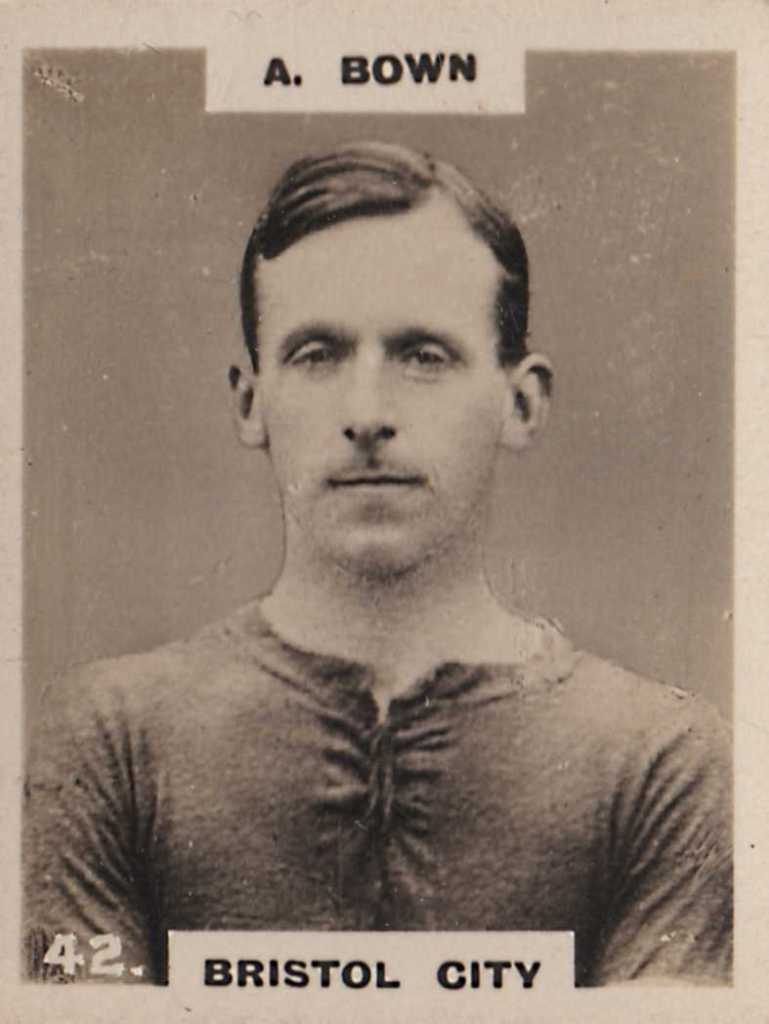
Now the Swindon Town football fans among you may have heard of their eldest son Archibald James William Bown. Born on July 22, 1882 Archibald entered the Works on January 11, 1897 as a draughtsman in the Carriage Department. It was something of an inauspicious start. Written in the margin of his employment records on February 24, 1897 was the comment ‘unsatisfactory character.’ He had been at work less than 2 weeks and was just 15 years old. He would show them!
Archie played his first game for Swindon Town on February 10, 1902 – an away game at West Ham. He didn’t score a goal – not that day. In a career that spanned 12 seasons Archie played a total of 291 games in which he scored 142 goals. He remains the Town’s fifth highest goal scorer in the club’s history.
In 1906 he married Beatrice Annie Scott and in 1911 the couple lived at 37 Roseberry Street with their two daughters Gladys and Trissie. Throughout his career with Swindon Town Archie continued to work as an Engine Fitter in the Works.
He also played for Swindon Casuals, Whiteheads, Southampton (as a guest) Bristol City and Weymouth where he ended his career and opened his own Sports Department. He died in 1958.
Archie’s parents continued to live in Swindon at various addresses including Commercial Road, County Road and Cumberland Road where Mary Jane died in December 1938. She was buried on December 26 in Radnor Street Cemetery, grave plot B2843. James married Alice Knee in 1944. He died three years later aged 87 years and was buried with his first wife on October 10, 1947.
It is also believed that Archie was related to athlete James Kibblewhite whose story featured on this blog recently. His grandfather was James Kibblewhite Bown born in 1836. More research is required to establish the connection kindly provided by Andrew Griffiths.
When the churchyard at St. Mark’s was forced to close to new burials in 1881 it came as a great sadness to the railway families of New Swindon. During Victorian times death was a large part of life; there were funeral rituals to observe and traditions to be kept and large, municipal cemeteries were not so common outside the big cities. But now Swindon was to have one and the first families to have moved here in the 1840s were to be separated in death.
During my recent walk around the churchyard I came across the grave of George and Susannah Margetts. George was born in Buckingham in 1783 just as the Industrial Revolution was picking up pace and more than 50 years before the birth of New Swindon.
In 1841 George was landlord at The Ship in Wantage, Berkshire where he lived with his second wife Susannah and five of his 10 children. But by the late 1840s he had arrived in Swindon where the family lived in Exeter Street. Aged 67 he was working as a carpenter, presumably in the Works as he lived in one of the company houses. Still living with his parents was youngest son Samuel, an apprentice boilermaker.
Another son, Jesse, had also arrived in Swindon where he married Martha Townsend at St. Margaret’s church in Stratton St. Margaret on Christmas Eve, 1849. In 1851 he was living in Taunton Street with Martha and their 10 month old daughter named Susannah after his mother. Jesse worked as a labourer, again presumably in the Works as he too lived in the railway village. Jesse and Martha went on to have a large family of at least 10, possibly 12, children.
The first person buried in the St Marks grave plot was not George, but that of his six year old granddaughter Ellen, one of Jesse and Martha’s children, who died in 1862. There was obviously money enough to buy this plot and in due course an elegant headstone – not every family could afford this as is evident by the paucity of memorials in the churchyard. George died in 1868 having attained the impressive age of 85. His wife Susannah died in 1871.
When Jesse’s wife Martha died in 1885 she was buried in the new Swindon Cemetery, which later became known as Radnor Street Cemetery. She was buried in grave plot E8294.
Jesse quickly married again and in 1891 is living at 72 Albion Street with his second wife Eliza and his youngest son John who is employed as a boilermaker in the Works.
Eliza Margetts, Jesse’s second wife, died in 1904 and was buried in grave plot E7886.
When Jesse died the following year he had the choice of two wives and two burial spaces. He chose to be buried with his second wife Eliza. The remaining space in this grave was later occupied by his sister Rosa who died in 1920.
Sadly, the inscription on Martha’s headstone had partially disintegrated but the burial registers reveal that she does not lie here alone. Her son, also named Jesse, died in 1916 and was buried here with his mother.
I’m sure further research will discover plenty more members of the Margetts family buried in Radnor Street Cemetery, and maybe some at St. Mark’s before the churchyard was closed in 1881.

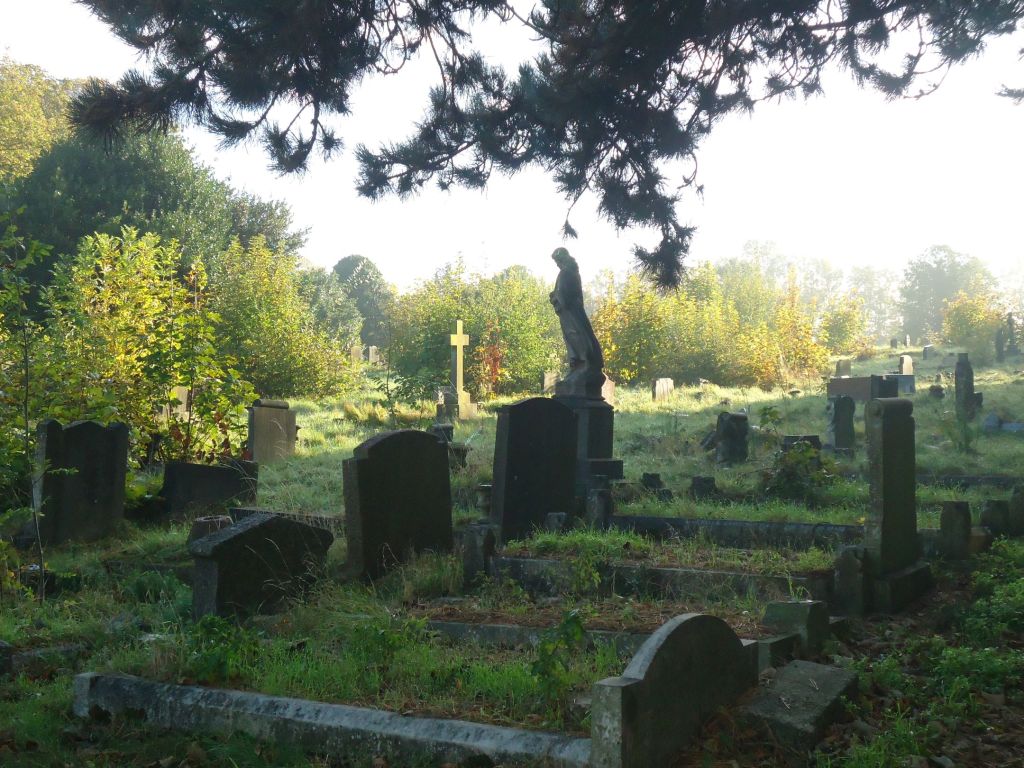








 Radnor Street Cemetery