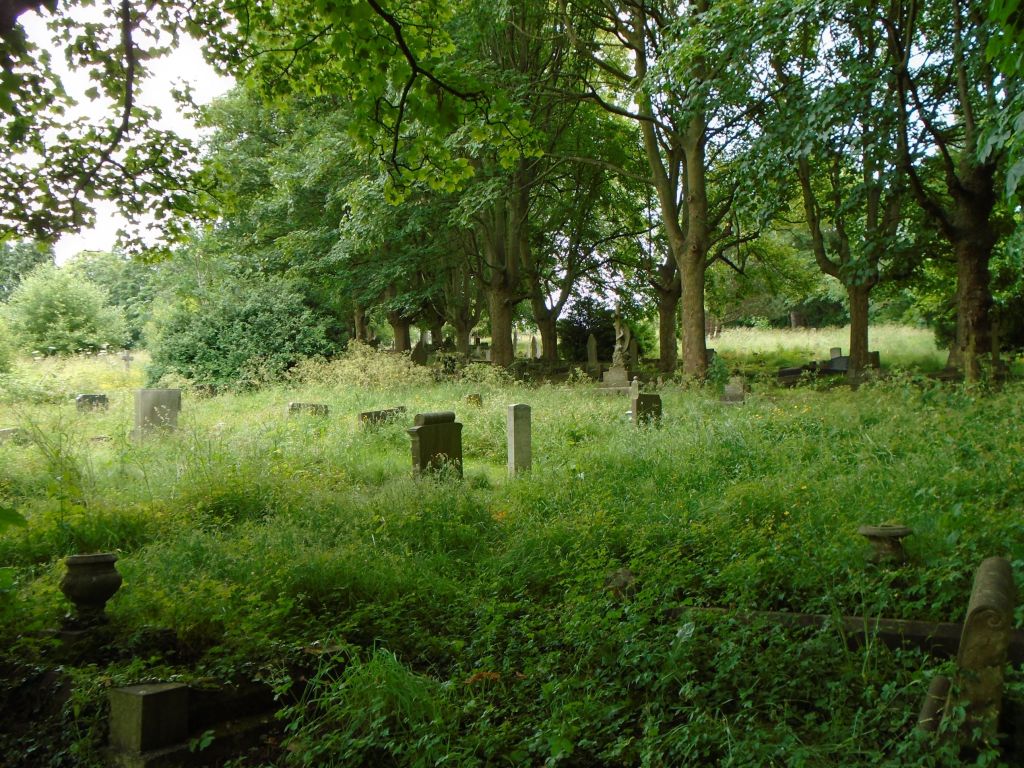
Welcome to Radnor Street Cemetery – a celebration of the working-class history of our town.
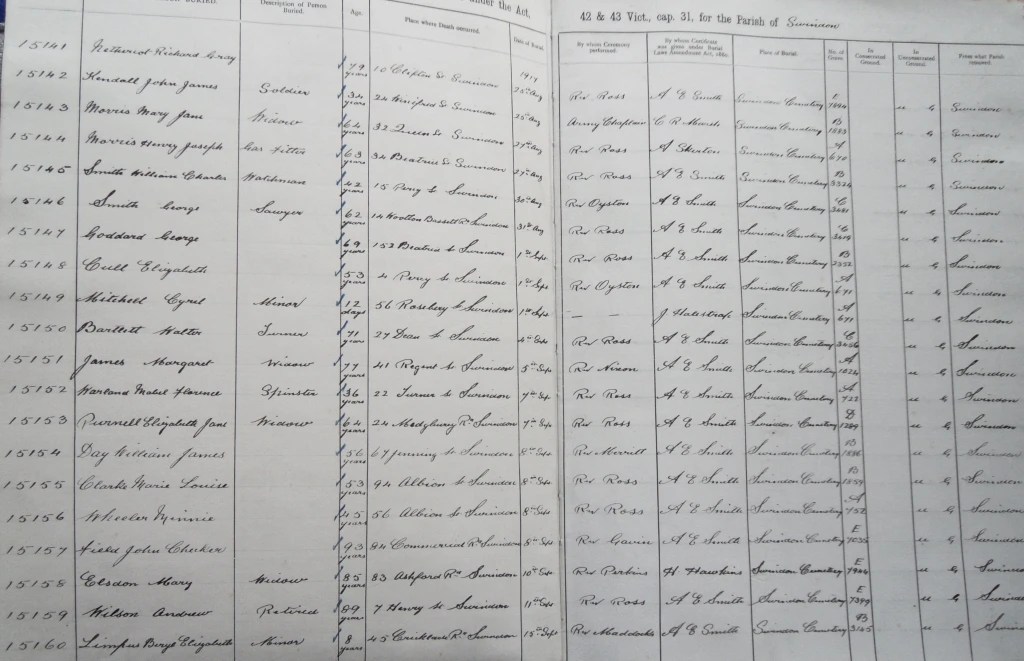
The Radnor Street Cemetery burial registers along with those relating to other Swindon cemeteries, are held at the Kingsdown Crematorium and are available for consultation by appointment. The Radnor Street Cemetery burial registers are in remarkably good condition, especially considering the different places they have been stored over the years. Rumour has it that they were once left in the cemetery chapel. Thankfully they didn’t suffer the same fate as the stonemason’s records, which were used to ignite a fire some years ago.
One set of registers are compiled chronologically, the other alphabetically and you need to have the full and correct name of the person for whom you are searching and the date of their death. There is also a set of grave plot registers with details of those buried in each grave.
The style of handwriting changes over the years and can take some getting used to, although it has to be said that the earlier volumes written in copperplate are often the easiest to read.
So, whose task was it to enter the details in these large tomes? The first caretaker appointed when the cemetery opened in 1881 was Charles Brown so perhaps it was his job to fill in the paperwork. Or could it have been the job of the Clerk to the Burial Board, Mr J.C. Townsend? Unlikely, as James Copleston Townsend was a solicitor and headed a busy legal practice based at 42 Cricklade Street.
The details in the registers reveal the various funeral directors at work in Swindon and the numerous ministers who attended at the committal. And fascinating facts about long forgotten terraces of houses, the name subsequently abandoned when construction on the street was completed. So many of these town centre streets now lie beneath modern developments – for example Canal Side, Brunel Street and Cromwell Street.
Younger residents might not know the significance of some of the Swindon street names. If you live in Tydeman Street, Gorse Hill you might be interested in this story about the Tydeman family.
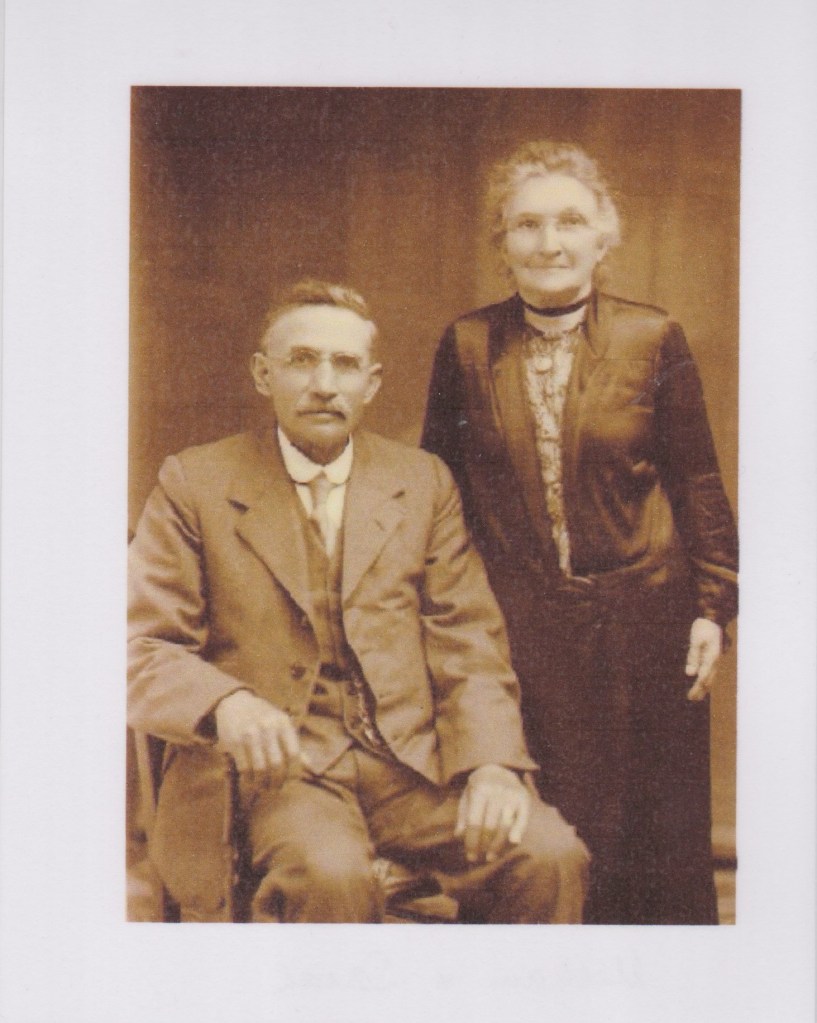
The son of a Police Sergeant, William Henry Tydeman married Sarah Anne Barnes in the parish church at Aldbourne on May 14, 1892. The couple moved to Swindon shortly afterwards and appear on the 1901 census living at 1 Edgware Road with their five young children, Elsie 7, Dorothy 6, Hilda 4, Henry 2 and 8 month old Lilian.
It was around this time that William went into partnership with his younger brother Walter and they began work on an ambitious building project in Rodbourne – nine houses in Linslade Street and eight in Jennings Street.
In 1904 the brothers advertised their business as ‘Contractors, Decorators and Undertakers at Sanford St. Swindon.’ In 1907 they built the Wesleyan Methodist Hall in Clarence Street, an iconic Swindon building, which was sadly destroyed by fire in 1977.
The business and the workforce grew following the First World War, eventually becoming Tydeman Bros. and Sons when the brothers two sons Henry and Nelson joined the firm. During the 1920s among their projects were 22 houses in Southampton Street, 19 houses in York Road and 16 houses in Iffley Road and more than 100 houses in the street that would bear their name, Tydeman Street.
In 1927 they were encouraging Swindonians to ‘Employ Your Own Townsmen – Tydeman Bros., Shopfitters, Builders & Undertakers Edgeware Rd. & Sanford St., Swindon. Inspect the Shopfront Alterations recently carried out by us at Messrs. Freeth & Son, Centre, Swindon, and the John Farmer Shoe Co., Regent Street, etc., Then send us your enquiries. Telephone 166.’
Sarah died in 1935 and was buried at Radnor Street Cemetery in grave plot D1310 with her daughter Hilda who had died in 1921, aged 25 years.
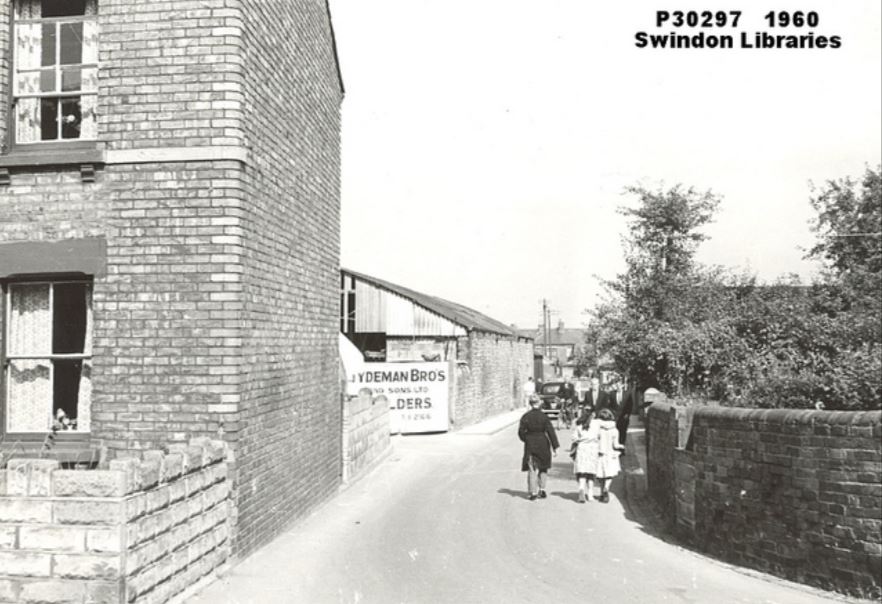
1960 image published courtesy of Local Studies, Swindon Central Library. Tydeman Bros off Cow Lane
Tributes to Mrs W.H. Tydeman
Funeral of Swindon Builder’s Wife
Mission Stalwart
The funeral of Mrs Tydeman, wife of Mr. W.H. Tydeman, of “Wanbourne,” 5 Downs View Road, Swindon, a member of the firm of Messrs. Tydeman Bros. and Sons Ltd., builders and contractors, took place last Thursday.
Mrs Tydeman had not been in good health for some months, but was taken seriously ill a week before her death on the previous Sunday. She was 73 years of age.
Although a native of Aldbourne, Mrs Tydeman had resided in Swindon for more than 40 years, during which time she made a host of friends, particularly in her connections with the Wesleyan Church.
Foundation Member
A foundation member of the Central Mission, which she had regularly attended since its inception, she gave endless time and energy to the furthering of the several activities with which she associated herself, and the many tributes received from the worshippers at the Mission bore evidence of her great work.
In his address during the service at the Central Mission Pastor J.W. Spargo, late of Swindon, and now residing at Reading, who assisted the Rev. R.A. Rogers in the service, spoke in feeling terms of Mrs Tydeman’s faith under adversity.
Mr F. Street was at the organ, and the hymns, “Jesu, the very thought of Thee” and “For all the Saints,” were sung. The lesson was taken from Psalm xxiii and a passage from Revelations.
The interment was at Radnor Street Cemetery, the committal sentences being pronounced by Pastor Spargo.
Mrs Tydeman is survived by a widower, one son, three daughters and one adopted son. Her mother also survives her at the age of 95 years.
Extracts from the funeral report published in the North Wilts Herald, Friday, 7 June, 1935.
A Prominent Methodist
Death of Mr W.H. Tydeman
A prominent Methodist, and a founder member of the well known Swindon firm of Messrs. Tydeman Bros and Sons, Ltd. Mr William Henry Tydeman, died at his home, 5 Downs View road, Swindon, on Saturday night two days before his 72nd birthday.
Mr Tydeman was a native of Donhead, South Wilts, his father being a sergeant in the Wilts Constabulary. He went to live at Upper Wanborough when he was about 13 years of age and was apprenticed to Mr Payne, builder of that village. On completion of his time he went to work in London. Later he spent a short period in the GWR Works and then, before branching out in business on his own account, was foreman for Mr George Whitehead, builder, of Swindon.
He and his brother, the late Mr Walter Edward Tydeman, founded the firm of Tydeman Bros. Some 40 years ago.
Built Central Mission
The firm of Tydeman Bros. built the Central Mission Hall, Clarence Street, Swindon, where Mr Tydeman was a prominent worshipper. He was a trustee of that church, and for a period of 25 years was superintendent of the Sunday school and church treasurer.
He was a keen sportsman and at one time belonged to the County Ground Bowling Club. He was also a life-long follower of Swindon Town Football Club.
Mr Tydeman, whose wife died five years ago, leaves three daughters – Mrs Ball, of 6 Cumberland Road, Mrs Austin, Bouverie Avenue, and Mrs Barrett, 48 Burford Avenue – one son, Mr W.H.T. Tydeman, who lives at 1, Edgware Road, Swindon, and an adopted son Mr Fred Vizor.
The funeral took place yesterday.
North Wilts Herald, Friday, 9 February, 1940
William Henry Tydeman was buried with his wife and daughter on February 8, 1940 in grave plot D1310.
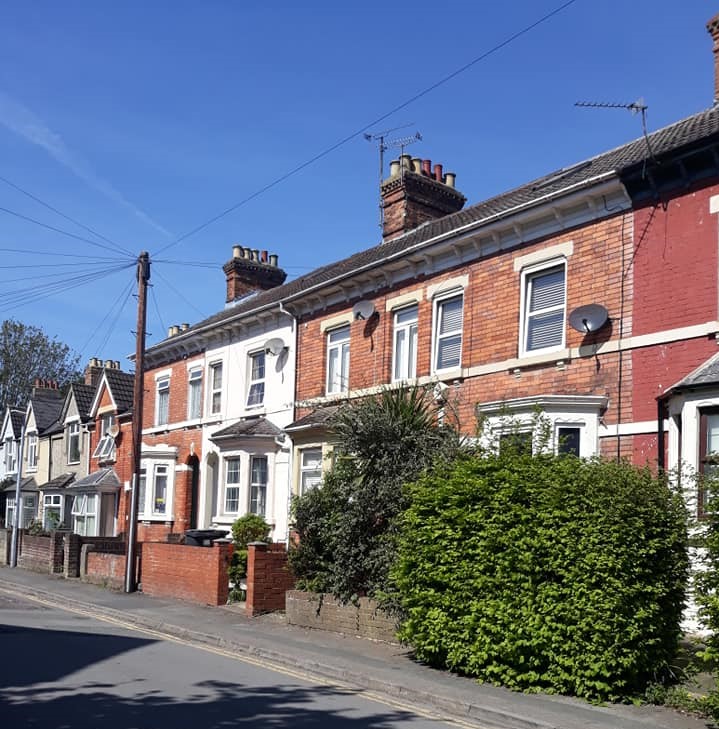
Examples of the work of different builders on Dixon Street today.
Two Welsh brothers arrived in Swindon during the 1880s and left their mark on the town.
Thomas and John George were born in the village of Boverton, Llantwit Major, Glamorganshire. Thomas was born in 1853 the elder son of Thomas and Margaret George; his younger brother John was born in 1866. Their father worked throughout his life as an agricultural labourer and in 1881 John was also working as a farm labourer. Thomas became a stonemason, a trade which would help the brothers establish themselves in Swindon’s late Victorian building boom.
Thomas arrived in Swindon in the 1880s where he quickly got to work, building a property in Rodbourne Road in 1887. By 1891 Thomas was living at 26 Dean Street with his wife Emma and their two young children Minnie 2, and 1 year old Thomas when his brother John joined him. This is the year in which Thomas and John would begin work on a street that would bear the brothers’ name – George Street.
The two brothers worked together throughout the 1890s building properties in Butterworth Street, Dean Street, Dixon and Deacon Streets. During the final year of the century they were engaged in projects in Wells Street, Gladstone Street, Ponting Street, Manchester Road and Groundwell Road.
At the time of the 1901 census the brothers were living at 69 and 71 Eastcott Hill. John was also married by then and had three sons Alfred 8, Bernard 7 and Albert 4 all born in Swindon. But ten years later and everything had changed. Then living at 169 Victoria Road John, aged 44 describes himself as a retired builder. Thomas would carry on the business alone building houses in Wells Street, Lincoln Street and Portsmouth Street in 1914/5.
By 1918 John and his family had moved to London. At the time of the compilation of the 1939 list John and Emma were living in Addison Gardens, Kensington with their son Alfred George, a wholesale wine merchant’s clerk.
Thomas remained in Swindon and a home at 1 Okus Road where he died in August 1915, aged 62. He is buried in plot E7669, a grave he shares with his wife Emma who died four years later.
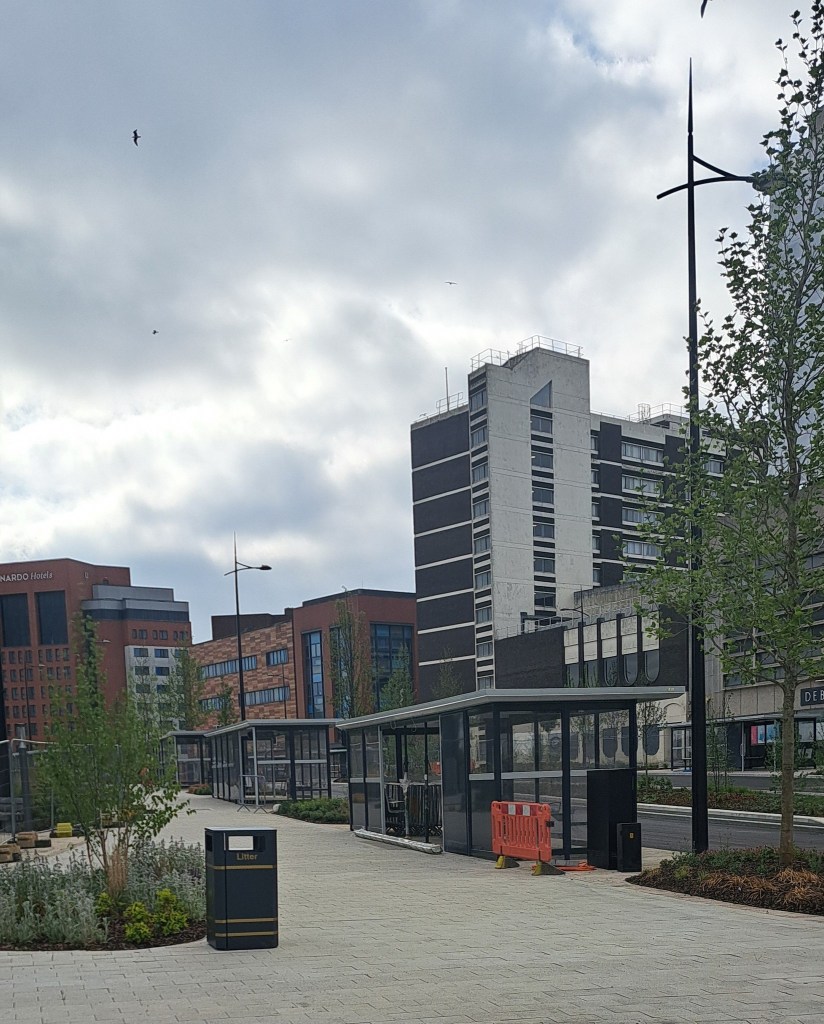
As Swindon’s long awaited bus boulevard nears completion, what lies in wait for the area that backs on to it?
In the 19th century this was recognised as a prime town centre location when the Oxford Building and Investment Co Ltd built 108 houses on the site. The Oxford Building Society was a relatively short-lived organisation registered in February 1866 and going into liquidation 17 years later.
When the company folded in 1883 it had an interest in 225 properties in Oxford and more than 100 Swindon.
The New Swindon properties were built on a parcel of land called Brierly Close, between the canal and Lower Eastcott Farm orchard, part of the extensive Rolleston Estate.
Named after Oxford City Centre locations, construction began on Merton Street in 1873 followed by Turl Street in 1874, Carfax Street in 1875 and Oriel Street in 1876 – an area that is unrecognisable now.
In 1881 the census enumerator who travelled from door to door collecting information seems to have struggled with the 34 households in Carfax Street. The census returns are covered in scrawled amendments and crossings out and could the details about No 21 actually be accurate? It would appear that 15 adults and four children occupied this small, terrace property, which can’t possibly be correct!
Head of the household was George Kinch aged 61. His occupation is given as Miller and he was born in Shrivenham in about 1820. At home with him in 21 Carfax Street on census night 1881 were his wife Sarah, his sister Charlotte, his stepdaughter Elizabeth, his 3 year old grandson William and his brother John. A pretty busy household – but then if the census is to be reckoned with there was also Albert Cove and his wife Lydia, John Williams and his wife Elizabeth, William Hibberd and William Watkins, his wife Ellen and their children William 4, Mary A. 3 and one year old Charles.
The terrace houses in Carfax Street were demolished in the 1970s and few photographs survive. It is, therefore, impossible to assess whether No 21 was actually a very large property or if 15 adults and four children actually squeezed into a more modest terrace house. Or perhaps the census enumerator recorded facts we cannot now unravel.
George’s wife Sarah died at No 21 shortly after the census was taken. She was buried in Radnor Street Cemetery on May 11, 1881 in a public grave plot A228. George died ten years later while still living at No. 21. He was buried with his wife on June 11, 1891. As in life so in death the couple shared their final resting place with a number of others. Hannah Scarrot who died in 1901, Frederick Boulton who died in 1918 and his wife Eliza Ann who died in 1944.
Sometimes the story behind a comprehensive headstone inscription can still take a bit of unravelling. Take the one on Arabella Dunbar’s grave.
In loving memory of
Arabella
Widow of the late
David Dunbar
Sculptor
(of London)
Who died December 27th 1885
At New Swindon
Aged 77 years
Thine eyes shall see the King in His beauty;
They shall behold the land that is very far off.
Isaiah 33
So, how did it happen that the widow of a celebrated Scottish born sculptor end up buried in Radnor Street Cemetery?
Arabella Riddiford was born in Uley, Gloucestershire, the daughter of Daniel and Susanna Riddiford and was baptised at the parish church on January 8, 1809. Little is know about her life before she married David Dunbar and even this evidence is confusing.
David Dunbar was born in 1793 in Scotland but when he married Arabella (his second wife) the details on their marriage entry are at variance with the other known facts. The couple were married at All Souls Church, St. Marylebone (where they are both described as living in the district) on July 15, 1844. David Dunbar describes himself as a widower and sculptor aged 28, the son of Stewart Dunbar a [stone] mason. Arabella Riddiford was also aged 28 a spinster the daughter of Daniel Riddiford Tea Grocer (deceased). Now by my reckoning David was at least 51 years old and Arabella 35.
At the time of the 1851 census the couple were living at David’s home, 9 Ranelagh Place and again the ages recorded are incompatible with other records.
The couple are difficult to locate on the 1861 census. They may have been living in Scotland at the time, where David died in Dumfries in 1866.
A lengthy obituary was published in national newspapers in both England and Scotland. (See examples below). His life’s work was obviously more important than his private life as there is no mention of a widow or any surviving children, however there appears to have been at least one son, David Dunbar Jnr who turns up in Swindon.
On June 25, 1849 David Dunbar a bachelor of full age (that is over 21) occupation Draper, address Ranelagh Place, father David Dunbar Sculptor, married Eleanor Cogdon at St. Peter’s Church, Eaton Square, Pimlico. The two witnesses to the marriage were John Cogdon (presumably Eleanor’s father) and Arabella Dunbar (presumably David’s mother).
Later that year there is a Notice of Indenture of Assignment published in The Wilts and Gloucestershire Standard, Tuesday, January 3, 1850 (see below) which names David Dunbar, Linen and Woollen Draper of Swindon and David Dunbar, Sculptor. All this adds weight to why Arabella ended up in Swindon where she died. Or does it?
The clue to this mystery is Charles Thomas, a 5 year old boy who is visiting Arabella at the time of the 1871 census when she lived in Stonehouse, Gloucestershire.
Charles Riddiford Thomas was the son of William Thomas, a beerhouse keeper, and his wife Arabella, who lived in Swindon. The couple had married at Christ Church on September 30, 1854 where we discover that Arabella’s maiden name was Riddiford and that she was the daughter of Charles Riddiford. Charles Riddiford was born in Uley, Gloucestershire the son of Daniel & Susanna Riddiford and was therefore Arabella Dunbar’s brother.
At last the connection is made between Arabella Dunbar, widow of a famous sculptor, and why she ended up buried in Radnor Street Cemetery. She was living in Swindon with her niece Arabella at the time of her death.
The entry in the burial registers record that Arabella was living at 6 High Street, New Swindon in 1885, (before it was renamed Emlyn Square). Her funeral took place on December 30, 1885 and she lies in plot A1039. The inscription on her headstone says it all, well nearly!
The facts …
The Late Mr David Dunbar, Sculptor
It is with deep regret we record the death of this genial and talented gentleman, which sad event took place here on Sabbath morning last, after a very short illness. We cannot allow so eminent a fellow-townsman to pass away without some tribute to his memory, and record of his active life.
While serving his apprenticeship as a stone-mason with his father, he shewed symptoms of that taste for sculpture which ultimately led to the adoption of that art as his profession. So great was his reputation as an ornamental carver among the building trade that he obtained an engagement in his seventeenth year to execute the capitals and other decorative parts of Lowther Castle, then in course of erection, at a wage of 7s per day. After following for a few years this, the lightest and most elegant part of the masons’ trade, he had his early aspirations of seeing Rome and studying in Italy realised through the kindness of some friends who had long watched with sympathetic interest the budding genius of the embryo sculptor.
During his sojourn in the “land of poetry and song,” he diligently pursued his studies in the fine arts, and on the eve of his return to England the Royal Academy of Cararra elected him a member of their body in recognition of his artistic genius – his “diploma study” being the “Sleeping Child,” a charming work, which long adorned the vestibule of St Michael’s, calling forth the admiration of countless visitors.
On his return to this country, he entered the studio of Sir Francis Chantry, where, during a number of years, his services were of great importance to that distinguished sculptor. Upon leaving London, he began business on his own account in Newcastle on Tyne, and during a lengthened residence there executed many works of great excellence. It was at this period he carried out a series of “Fine Art Exhibitions,” two of which were held at Dumfries, and contributed to the development of a taste for the plastic arts that was then arising among the people. Carlisle, too, was much indebted to Mr Dunbar for a healthy stimulus it received in favour of popular education; and so marked were his services in connection with the foundation of a Mechanics’ Institute in that city, that the principal inhabitants presented him with a substantial token of their gratitude and esteem.
During the last few years of his career he found employment for his chisel in various parts of the country, and it was while engaged upon some classic work in Edinburgh, that he took a journey to his native town for change of air and relaxation, of which he stood in much need: it was his last visit – he returned only to die – and his latest breath was drawn among the kindred he loved so well.
His best works are busts from the life; and some copies in marble, from the antique, one of which we lately saw in Carlisle (which was executed nearly half a century ago), and was to our enamoured sense truly a thing of beauty. He was honoured with sittings from Earl Grey, Lord Brougham, Lord Durham, and other eminent statesmen; and he executed a much admired bust of Grace Darling, which was several times reproduced in marble for the Bishop of Durham and other admirers of the heroine. The statue of Sir Pulteney Malcolm at Langholm, also by the deceased artist, is a fine memento of his genius and skill.
Mr Dunbar was full of emotional warmth, generous, and benevolent. He had a rich fund of anecdote and humour, and great stores of general information, from which he could draw at pleasure to delight the social circle. On all these accounts the announcement of his demise will be received with deep regret by numerous friends in Dumfries and other parts of the kingdom.
Dumfries and Galloway Standard and Advertiser, August 15, 1866.
Dunbar’s bust of Elizabeth Stephens, better known as Mrs Gaskell, author of Cranford, Mary Barton & North and South.
Notice is hereby given, that by Indenture of Assignment bearing date the 24th day of December, 1849 David Dunbar, of Swindon, in the Country of Wilts, ‘Linen and Woollen Draper, (trading under the firm of Dunbar and Company) assigned all his Estate and Effects unto William Ford, of No. 282, High Holborn, in the County of Middlesex, Line Draper, and David Dunbar of No 9, Ranelagh Place, Pimlico, in the County of Middlesex, Sculptor, upon trust for the benefit of all the creditors of the said David Dunbar, of Swindon aforesaid, who should Execute the said Deed, as therein mentioned. And that the said Deed of Assignment was duly executed by the said David Dunbar, of Swindon aforesaid, on the said 24th day of December, 1849 by the said William Ford, on the 27th day of December, 1849, and by the said David Dunbar, of No. 9, Ranelagh Place aforesaid, on the 1st day of January, 1850, in the presence of and attested by Richard Marriott Freeman, of No. 4, Great James Street, Bedford Row, in the County of Middlesex, Attorney at Law, at whose office the said Deed of Assignment now lies for execution by the Creditors. – Dated this 2nd day of January, 1850
R.M. Freeman, Solicitor to the Trustees,
4 Great James Street, Bedford Row.
The Wilts and Gloucestershire Standard, Tuesday, January 3, 1850.
The Katherine Losh mausoleum in the church at Wreay, Cumbria. Katherine was the sister of Sarah Losh, architect and designer.
David Dunbar, sculptor 1797-1866
When the opportunity arose in February, 1845, for carving the most prestigious statue in Victorian Cumberland, David Dunbar was staying at Woodside. He wrote to the committee offering to execute the statue of the Earl of Lonsdale in either bronze or marble. On discovering that his one-time pupil, Musgrave Lewthwaite Watson, was competing for the memorial, he wrote again offering ‘to resign any pretensions of mine in favour of that gentleman’. At Woodside he was probably engaged in sculpting the statue of Katharine Losh which was to be placed inside the mausoleum at Wreay. His hand would be guiding the chisel, but it would have been Sarah Losh’s imagination which was creating the image. He had once been an artist of rare ambition and considerable energy. David Dunbar had been born in Dumfries in 1793, the son of a stonemason. His father had taught him his craft, but he displayed an exceptional aptitude. At the age of seventeen he went to work on the building of Lowther Castle, one of the greatest building projects of the age. Paul Nixson, from Carlisle, employed him in carving the capitals which graced the inner court of this extravagant Gothic fantasy. Dunbar’s ambition took him to London where he married and became one of several assistants in the Pimlico workshop of Francis Chantrey, the most successful and accomplished sculptor of his day. There he acquired exceptional skills and began to exhibit at the Royal Academy. He left this promising situation to return to work for Paul Nixson in Carlisle in 1820. Nixson had a monumental workshop in Finkle Street, but offered little demanding work for the young sculptor beyond the carving of funeral monuments and marble fireplaces. However, Dunbar, Nixson and a young painter, Matthew Nutter, began The Carlisle Academy of the Arts. Their aspirations were embodied in the sculpture of the Genius of Carlisle which stood above the workshop entrance. Dunbar busied himself with carving the busts of local professionals and industrialists and occupied himself in educating the working men in the city and promoting a remarkable series of eight annual art exhibitions. In the small provincial city of Carlisle, Dunbar was showing works by the great masters from Titian to Rubens and Rembrandt and displaying plaster casts of sculptures from the antique and after Renaissance masters. He was also attracting exhibits from leading contemporaries throughout the country, including Edwin Landseer, John Varley, Frederick Watts, James Ward and members of the Norwich School, and from a school of proficient local artists. In 1826, he went on an extended tour of Italy, visiting the workshops of Thorwaldsen and Joseph Gott, among others, in Rome and being deeply impressed by the work of the late Canova in Possagno. On his return, he sought to extend his reputation. When he was refused entry to the Newcastle Exhibition because his statue of Musidora was considered indecent, he took the unprecedented step of staging a one-man exhibition in the city and then a second one in Durham. He found work among the liberal and radical community in the North-east. He sculpted the young Elizabeth Stephens, who in later years became the novelist Mrs Gaskell. He was also commissioned to make busts of Earl Grey and of James Losh, but the leading commissions did not come his way. His work lacked the individuality and imagination of Lewthwaite Watson. It was probably at this time, in 1832, that he carved busts of Sarah and Katharine Losh. Dunbar’s bust of James Losh was placed in the library of the Literary and Philosophical Society in Newcastle, but it was also used as a model for John Graham Lough, then working in Rome, to create a full-length statue of Losh in a Roman toga. It was Lough’s work which took pride of place on the staircase of the society. In 1839, he sought money and reputation by making the first bust of Grace Darling and selling plaster casts of the popular heroine of the Islands. His work and his income declined. In his last years he was a peripatetic stonemason and carver, repairing the stonework on colleges and churches. He died visiting his home town in 1866. His most popular and admired work was an image of his infant daughter, Elizabeth, which he made shortly after her death in 1822. There is a copy in Carlisle Cathedral, but he was prepared to sell the original even after he had donated it to his home church in Dumfries. His statue of Katharine Losh was recreated from the image of the bust he had already created from the life, from Sarah’s drawing and from Sarah’s memories and imagining. He rendered in marble that sense of gentleness, of sweet compliance, that sense of love between two sisters so embracing and so essential to each that they never thought of being apart. In carving the statue of Katharine, David Dunbar was touched by an art more profound than he had known before.
David Dunbar was born in 1793. He was the son of Thomas Dunbar, Stonemason and his wife Janet Johnstone. David Dunbar married first Ann Stokes and second Arabella Riddiford. He died at Academy Street Dumfries on the 12 of August 1866. His nephew George Dunbar registered his death
Grace Darling, the daughter of a lighthouse keeper who rescued the survivors of the shipwrecked Forfarshire in 1838 and gained national fame.
Do you believe that a house can retain memories? Have you ever visited a house and felt it had an atmosphere?
“Can’t you feel it?”
“All I can feel is damp. I bet this place hasn’t got a damp course.”
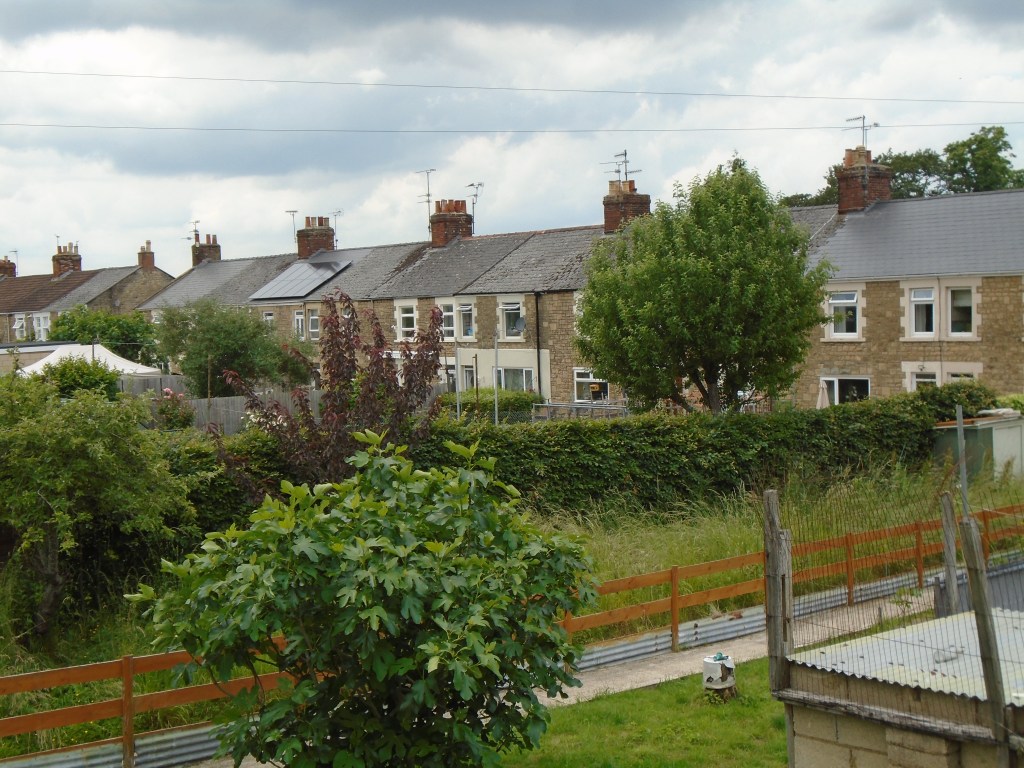
The row of stone-built cottages had once overlooked the canal before it was filled in, but it wasn’t damp that I was feeling.
“This could be a happy home,” I suddenly blurted out, but that wasn’t the plan. We were looking for a cheap property to renovate and sell on. “I could happily live here.”
“Really! Have you seen the bathroom?”
I wondered who had once lived here. Not recently, we knew who the vendors were, I mean in the past. Who had lived here when it was a brand-new property? How many children had squeezed into the bedroom upstairs, one of only two in the beginning? I bet there was a clothes line running the length of that long garden, full of washing every Monday; pinafore dresses and shirts, lots of shirts and overalls. I wondered how many meals had been eaten around the kitchen table? How many prayers had been said in this house?
I wasn’t quite sure what I was feeling – well, I did but if I blurted it out Darren would think I’d lost the plot. Ha, I know he sometimes has his doubts about me anyway.
This had been a busy house, but there was something else about the place, a sense of serenity. This was a house of God, a house where God had resided. I could just imagine telling Darren that.
“Let’s get back to the estate agent. See if there’s any movement on the price. Personally, I think they’re asking too much for it. And I bet it hasn’t got a damp course.”
The facts …
Death of Mrs Gibbs
Interesting Reminiscences
Rode on a Stage Coach and Electric Trams
There was laid to rest in Swindon Cemetery on Thursday in last week the mortal remains of Mrs Mary Gibbs, late of 120 Broad Street, and widow of the late Mr William Gibbs, who resided for many years at 46, Cambria Place, Swindon. The deceased lady, who had attained to the great age of 88 years, and retained all her faculties to the end, was an interesting personality. She was probably the oldest member of the Baptist community in Swindon, and was in the service of the Rev. Richard Breeze, before he came to Swindon and opened a Baptist Church here at the corner of Fleet Street and Bridge Street. Her late husband, who died 17 years ago, was one of the pioneers of the Ancient Order of Foresters in Swindon, and assisted at the opening of Court “Briton’s Pride,” A.O.F., and also the “Vale of White Horse” Court, Shrivenham. He was himself initiated a member of the Order at Abingdon, when he was residing at Sutton Courtenay, and remained a Forester until his death, having been a member for over fifty years.
The deceased lady was born at Lechlade, and her earliest recollections of Swindon was riding through this part of the country on a stage coach. What is now known as New Swindon then comprised only green fields. She lived to see the whole of the land built on, the electricity works opened in the neighbourhood where she resided, and more than once rode on the electric trams, notwithstanding her great age.
Her husband worked on the GWR during the construction of the line between Didcot and Swindon. He was connected with the Baptist Church, and took a leading part in the opening of the Rehoboth Baptist Chapel at the top of Rolleston Street, Swindon.
At the funeral of the deceased lady the burial service was conducted by Mr. S. Chappell, of the Rehoboth Baptist Church. The mourners included deceased’s five sons, Charles, William, Harry, George and John Gibbs, a grand-daughter, two grand-sons, and other relatives and friends.
There were many beautiful wreaths and other floral tributes placed on the grave.
The Swindon Advertiser, Friday, July 16, 1909.
Mary Gibbs 88 years 120 Broad Street burial 8th July 1909 plot number B2073
1871 census
Cambria Place
William Gibbs Head of household 47 Platelayer born Swindon
Mary Gibbs wife 49 born Berks Coleshill
Charles H. Gibbs son 21 Boiler Smith born Berks. Sutton
William J. Gibbs son 19 Boiler Smith born Stratton
Henry H. Gibbs son 17 Moulder born Stratton
Mary J. Gibbs daughter 15 Domestic Servant born Stratton
I started in the Works in the polishing department in 1937 and stayed for two years. I hated every day I was there.
French polishing sounds as if it might be a delicate, artistic occupation. I suppose there was an element of artistry about, it but it certainly wasn’t delicate. French polishing involved stripping back to the basic wood, making good any damage and then building up the polish again, brushing and sanding, brushing and sanding. A door could take you five days, on and off. We worked on anything made of wood, everything from panels and partitions to toilet seats.
12A Shop was in the Carriage Works along London Street and it was cold and filthy. We were quite separate from the men in the railway factory and had our own facilities. That’s a laugh, one toilet with two washbasins and some disinfectant soap useless at getting all the muck off our hands. Methylated spirits worked much better but it was hard on your hands and left them red and raw.
The mess room was under the workshop but no one wanted to spend their lunchtime there. When the weather was good me and Ivy used to walk to the GWR Park and eat our sandwiches on a bench. It got you out of the dirt and fumes for a bit.
In those days, just before the Second World War, jobs in the Works were few and far between for women. In fact, the polishing department was the first to employ women back in the 1870s. A big deal had been made about ‘the comfort of the women.’ Ha, well by 1937 that had all gone by the board.
My dad used to keep on about getting a trade and being set up for life, as if I were a man, but I couldn’t wait to get out of that place. All I wanted was a nice, clean little job before Ted and me got married. I looked forward to polishing my own furniture and it would be a sight easier than French polishing railway carriage doors, I can tell you.
The Carriage and Wagon Works, London Street published courtesy of Local Studies, Swindon Central Library.
The facts …
By the 1870s the railway factory had been in operation for some 30 years but the GWR were finding it difficult to recruit skilled men. The problem was a shortage of jobs in Swindon for young women, the railwaymen’s daughters. The men wouldn’t move their families to Swindon if there was no work for their daughters.
Joseph Armstrong, the Locomotive, Carriage and Wagon Superintendent, the top man, addressed the problem by extending the Carriage Works on London Street and creating a separate upholstery department for the employment of girls only. By the end of 1874 five women were employed in the new trimming department.
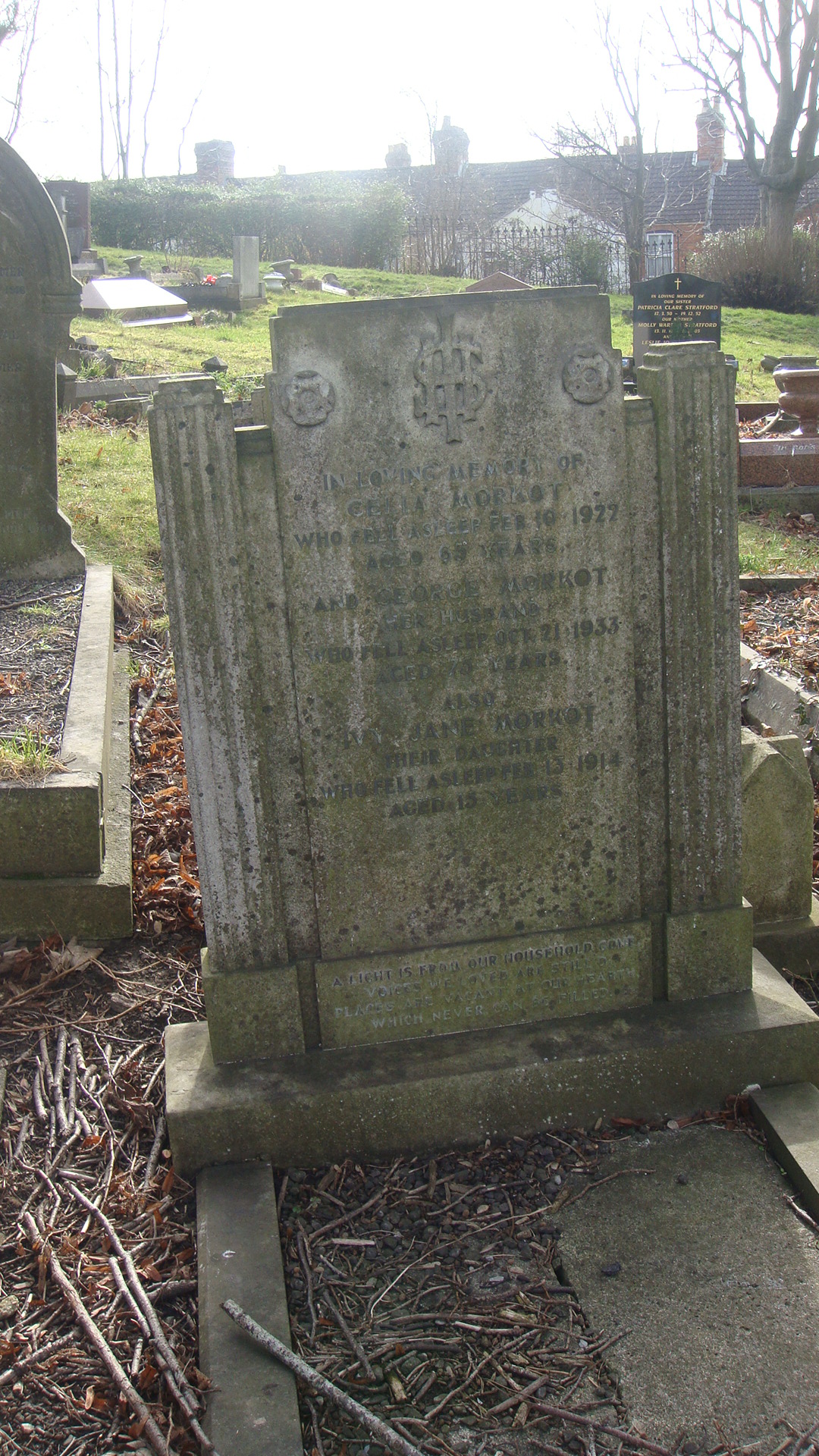
Celia Folland was born in Tredegar, Monmouthshire in 1857, the daughter of Richard Folland, a rail sawer, and his wife Margaret. By 1871 the family had moved to Swindon and were living at 1 Reading Street in the railway village.
Celia Folland was the first woman to be employed in a GWR workshop where she worked as a French polisher, checking in for the first time on July 18, 1874.
Celia married George Morkot at St Mark’s Church, Swindon on July 19, 1883 and by 1891 they were living at 31 Chester Street with their three children, Charles 6, Nellie 4 and George 2. Celia would go on to have another four children.
Celia died aged 65 years old in February 1922 at 31 Chester Street where the family had lived for more than 30 years. Her funeral took place at Radnor Street Cemetery on February 15 and she is buried in plot D1613.
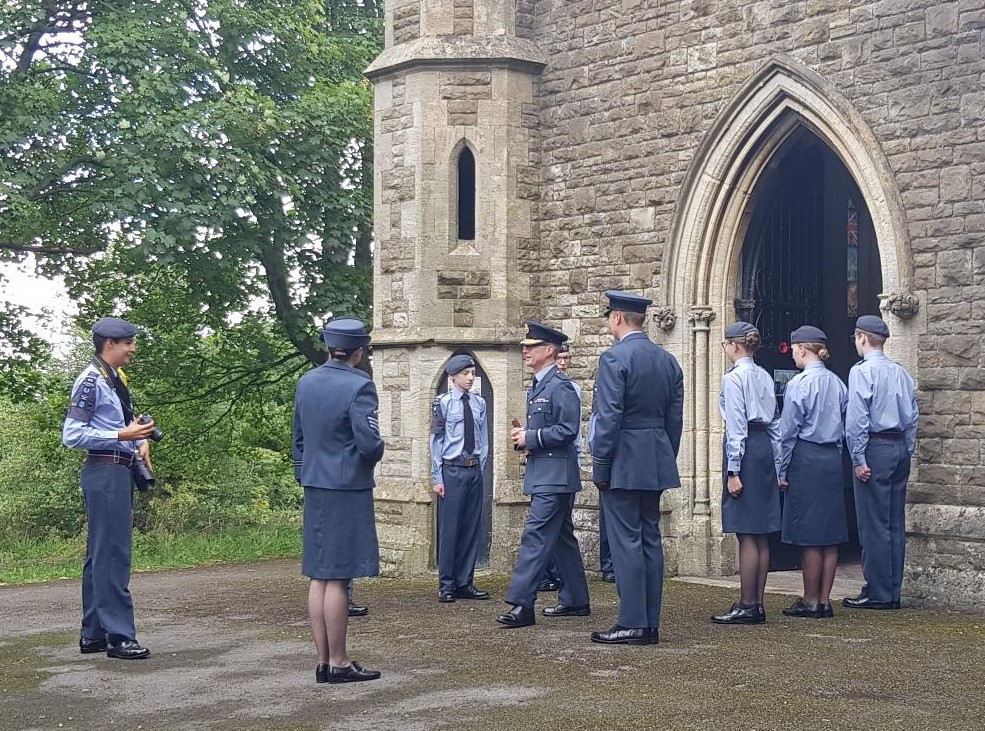
The rain clouds parted and the sun made a plucky appearance during our guided walk yesterday when we were delighted to welcome Air Commodore Tony Keeling OBE, Commandant Royal Air Force Air Cadets, to Radnor Street Cemetery.
Following the closure of the RAFA Club in Belle Vue Road the propeller mounted on the front of the building faced an uncertain future. Then a group of concerned Swindonians, among them Carole and David Bent, Neil Robinson, Toby Robson and Graham Carter, stepped in to rescue it.
At Sunday’s event Air Commodore Keeling cut the ribbon and led the assembled visitors into the chapel to view the propeller, now mounted above the door. Cemetery volunteer Kevin, a member of the Eyes On Hands On team, gave an informative talk about the history of the Airspeed Oxford to a packed chapel, as you can see from Andy’s photographs. Then, accompanied by fellow officers and air cadets, Air Commodore Keeling joined us on our walk.
Guest speaker, Paul Gentleman, gave an account of the career of Wing Commander John Starr who is remembered on his brother’s (Squadron Leader Harold Starr) grave. Paul and his wife Caroline along with Noel Beauchamp have been researching the life and times of the two Starr brothers for several years. Paul, Caroline and Noel, in association with Green Rook and Swindon Heritage, organised the Swindon Remembers event to commemorate the Battle of Britain 75th anniversary held in the cemetery in 2015.
Our visitors at Sunday’s event donated generously to the memorial plaque for Mark Sutton. This will be unveiled at the Remembrance Day Service, an event Mark established many years ago.
Here are some photos of the day captured by Andy and myself.
In July 1939, as war became imminent, the Lord Privy Seal’s Office issued a number of Public Information Leaflets. Leaflet No. 2 contained information on ‘Your Gas Mask – How to keep it and How to Use It’ as well as instructions concerning ‘Masking Your Windows’ with the following advice:
In war, one of our great protections against the dangers of air attack after nightfall would be the “black out.” On the outbreak of hostilities all external lights and street lighting would be totally extinguished so as to give hostile aircraft no indication as to their whereabouts. But this will not be fully effective unless you do your part, and see to it that no lighting in the house where you live is visible from the outside. The motto for safety will be “Keep it dark!”
The ‘black out’ was yet another feature of wartime that impacted on everyday life. In the winter of 1940 these difficult conditions and icy winter roads resulted in a road traffic accident and the death of Charles Smart.
Image published courtesy of Local Studies, Swindon Central Library.
Killed in Black-Out
Inquest on Swindon Man
Against the wishes of his niece who thought the roads too treacherous for him, Mr Charles Smart, aged 68, a retired GWR employee, of 44, Curtis Street, Swindon, went out on Tuesday of last week to the Central Club. On his way home he was in the act of crossing the road when he was knocked down by a Corporation ‘bus receiving injuries from which he died in the GWR Medical Fund Hospital on Saturday night.
A verdict of “Accidental death” was returned by the jury at Tuesday’s inquest, conducted by the Wilts Coroner (Mr Harold Dale), and the driver of the ‘bus William John Snell was exonerated.
Mr Smart’s niece, Mrs Dorothy Kate Critchley, with whom he lived, said her uncle enjoyed good health, hearing and eyesight.
Dr Alister McLean said the cause of death was shock following injury to the brain due to a blow on the head.
Reasonable Speed
Walter Fred J. Ockwell, 10, Milton Road, Swindon said that last Tuesday night about 10 o’clock, he was in Curtis Street and just before reaching Whitehead Street he saw a form in the middle of the road. The form was not moving. When about 30 feet away he shouted to the object. A ‘bus came along but the object did not appear to move until the ‘bus was almost on top of it. As the ‘bus swerved to the right the object moved to the left. The ‘bus was almost in the middle of the road, and was being driven at quite a reasonable speed.
When he reached the spot, the driver and passengers were getting out of the ‘bus. The object proved to be a man lying a little to the centre of the road. It appeared as if the ‘bus had pushed the man forward. Witness said that as the man stood in the road he faced the direction from which the bus came.
Private James Lewis Warburton said he saw Smart leave the pavement and walk towards the centre of the road, where he stood still. He thought Smart was going to stop the bus, and he did not see him slip.
Driver’s Swerve
The bus driver, William John Snell, described it as a very dark night, with bad road conditions. When he first saw the figure in the road it was very close to the bus and well into the road. He immediately applied his brakes and swerved to the offside, but, owing to the condition of the road, the bus slipped along a little further, and the nearside headlamp struck the man, who was wearing dark clothing.
Questioned by his solicitor (Mr S.G.G. Humphreys), Snell said that had Smart remained where he was when he first saw him, the swerve would have avoided him.
The Coroner suggested that it might be that Smart found the road so slippery that he was afraid to move.
Sympathy was extended to the relatives by the Coroner, and by Mr Humphreys on behalf of the Corporation and the driver of the bus.
North Wilts Herald, Friday, 9 February, 1940.
Image published courtesy of the Dixon Attwell Collection, Local Studies, Swindon Central Library
Charles Smart 69 years of 44 Curtis Street died at the GW Hospital and was buried in a public grave, plot C149 on February 8, 1940.
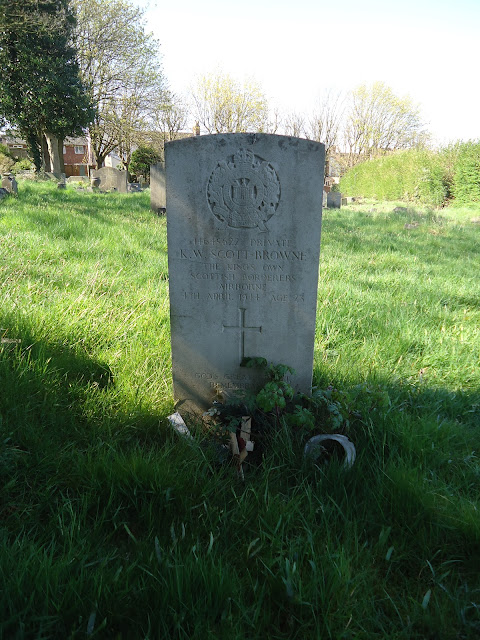
Kenneth Scott-Browne was a member of the King’s Own Scottish Borderers 7th Battalion. In November 1943 the 7th Battalion was converted into an Airborne Battalion and began training for the planned Normandy landings. During an exercise code named DREME a Stirling towing a Horsa glider carrying No 3 Platoon hit a tree and crashed. Scott-Browne was one of 34 military personnel killed that day in April 1944. His death was registered in Droxford, Hampshire and his body returned to his home at 85 Medgbury Road, Swindon for burial in Radnor Street Cemetery.
VE Day was a time for rejoicing but not for everyone. While the war in Europe had ended the one in Japan would continue for another three months. And what about the families who would never meet again their loved ones.
The Kenneth Scott-Browne’s wartime marriage to Elsie Herbert was a short one. The wedding took place in Swindon in the spring of 1941 and just four years later Elsie was a widow with a toddler, a son named Kenneth Frederick after his two grandfathers. By May 8, 1945 Elsie had remarried. She was still only 25 and had a three year old son to support when she married Leslie Jack Burnett. In 1954 she married for a third time.
Kenneth was buried on April 11, 1944 in Elsie’s Herbert family plot. Elsie outlived both her sons and died at the Kingsmead Nursing Home in Prospect Place, Swindon in May 2005, aged 84. She was buried in plot C4251 with her young, first husband Kenneth.













 Radnor Street Cemetery