A Tale of Two Towns

Until the Incorporation of the Borough in 1900, Swindon operated as two, quite separate entities. First there were the two Local Boards of Health (Old and New Swindon), then after the Local Government Act of 1894, the two Urban District Councils (Old and New Swindon). It was part of the reason the cemetery was so long in the consultation stage – neither of the local authorities wanted to pay for it!

One edition of the Swindon Advertiser, published on Saturday, November 23, 1895, included a Cemetery Committee report from the Old Swindon District Council while further down the page was a report from the Joint Cemetery Committee of the New Swindon Urban District Council.

How did local government ever get anything done?

Old Swindon Urban District Council

Cemetery Committee

This Committee in their report stated that during the last quarter 77 burials had taken place as against 72 in the corresponding period of last year. Dr Hoffmann, Her Majesty’s Inspector, had visited the cemetery and expressed his satisfaction at everything he had seen. The drainage at the Cemetery was now finished.

Swindon Advertiser, Saturday, November 23, 1895.

New Swindon Urban District Council

Joint Cemetery Committee

The report of this committee, among other items, contained the information that a sum of £79 15s 4d, was still unexpended of the £600 borrowed for draining the cemetery, the work having been completed. By this drainage scheme, the Surveyor reported that space had been made available for 6,996 more burials than was the case before, and that it was his (the Surveyor’s) intention of re-arranging the grave spaces, which would allow for about 800 more burials. Mr Longland, in moving the adoption of this report, expressed the indebtness of the Council to the surveyor and caretaker for the efficient manner in which the work was carried out at the cemetery.

Swindon Advertiser, Saturday, November 23, 1895.

published courtesy of Local Studies, Swindon Central Library.

Joseph Armstrong – Chief Superintendent of the Locomotive, Carriage and Wagon Departments

One of the most important people in Swindon’s history not buried in Radnor Street Cemetery is Joseph Armstrong.

Joseph Armstrong’s funeral was described as a spectacle seldom seen, with ‘the whole town and neighbourhood showing every possible honour to the memory of the deceased.’

Image published courtesy of Local Studies, Swindon Central Library.

The railway works closed for the day and an estimated 6,000 people lined the streets between Armstrong’s home at Newburn House, through Rodbourne and to the church of St. Mark’s.

During the first week of June 1877 Joseph Armstrong had left Swindon for a short holiday. He was suffering from heart disease and exhaustion exacerbated by his heavy workload. He died on June 5 at Matlock Bath.

Joseph Armstrong was born in 1816 in Bewcastle, Cumberland. Throughout his railway career he worked for the Liverpool and Manchester Railway, the Hull and Selby Railway, the London and Brighton Railway and the Shrewsbury and Chester Railway before arriving in Swindon in 1864. He was appointed the second only Chief Superintendent of the GWR Locomotive, Carriage and Wagon Works succeeding Daniel Gooch where he was responsible for the construction of all new engines, carriages and wagons and in charge of 12,900 employees.

A non-conformist, Joseph Armstrong was a staunch supporter of the need for a burial ground where non conformists could bury their loved ones according to their own beliefs and without the strictures of the established church. Sadly, at the time of his death just such a cemetery was still the subject of rancorous debate. It would be another four years before Radnor Street Cemetery was opened.

The strength of feeling at the time of Armstrong’s death is conveyed in the following extract from the editorial written by William Morris, published in the Swindon Advertiser.

Today an elaborate Grade II listed monument stands on the Armstrong family grave in St. Mark’s churchyard.

And this brings us to the lesson of Mr Armstrong’s death, and of the work and duty it has thrown upon us. We believe it was his desire to secure for others that liberty of religious thought which he enjoyed himself. And that this end might be secured he had taken an active interest in obtaining for the large and populous parish of Swindon that burial accommodation which the religious liberty of the subject demands should be provided for every parish, and the proposition to provide which for Swindon has been met and opposed by so many wretched subterfuges. We may treat with proper contempt the wretched work of bedaubing tombs and harrowing widowed hearts; but, as we have said we cannot afford to submit to such obstructions to our progress, to such evidences or the existence among us of a dogmatic priestly rule, altogether out of accord with the spirit of the age in which we live. This, then, is a work Mr Armstrong has left us to do – to provide a cemetery without priestly rule – a place of interment where we may bury our dead without the danger of having our feelings outraged by some impertinent and officious interloper who, by bell and book, would consign us to eternal punishment if we dared dispute his authority.

The Swindon Advertiser Saturday, June 16th, 1877

Extract from the editorial – written by William Morris

and a letter to which he refers in this lengthy editorial.

To the Editor of the Swindon Advertiser

Sir – Will you kindly allow me a space in your paper to lay before the people of Swindon the facts of a case upon which I think they should give judgment.

On Wednesday in Whitsun-week, (as you announced in your paper), a man named Benjamin Browning, of New Swindon, died suddenly, and his remains were interred at St. Mark’s on the following Sunday. His widow caused a tombstone to be erected to his memory, and underneath the usual inscription were placed the Latin initials R.I.P. Requiescat in pace or “May he rest in peace.” The Rev. George Campbell, vicar of St. Mark’s, seeming to consider these initials illegitimate, had them effaced with a covering of cement, and now in their stead there is a patch of a different shade to the stone.

I respectfully ask you, Sir, and the people of Swindon, if this is fair or Christian in a burial ground which, if it is not a public one, is the only one in the town for all denominations. And I ask also if the Rev. George Campbell has acted legally in defacing the property of another person?

There is something so simple, so sweet, and so impressive in the sentence for which those initials stand, that I think none could dislike it but those (if there be such a class of People) who do not wish the departed to rest in peace.

I am, Sir, yours respectfully,

James O’Connell,

23, Taunton-street, New Swindon, June 12th.

The busy Rye family

This attractive headstone drew my attention, partly because of the number of people recorded on it.

It is a scroll which in funeral symbolism can mean several things. It can indicate that the person buried had a religious conviction and a love of learning. When it is unfurling, like this, with the beginning and end rolled up it can mean a life half lived – the past is hidden and the future yet to be revealed. This is more often used on the grave of a young person, but no one buried here is particularly young.

Let me introduce you to Arthur Joseph Rye. The more I researched this family the more I pondered on the life led by Annie Rye, the last person recorded here who died in 1950.

This is the Rye family grave plot – Arthur Joseph Rye, his two wives and his eldest daughter Annie. The Rye family home had always been a bit crowded so their busy grave is no surprise.

We think 21st century family life is complicated …

Like so many Swindon residents, Arthur was an incomer. He was born in April 1856 in Irthlingborough in Northamptonshire but he didn’t come to Swindon because of the railways.

In 1871 Arthur was at a school in Spalding, Lincolnshire run by John C Jones, a Baptist Minister. Ten years later Arthur was in Swindon, newly married to Emily Beckingsale Greenaway and living at 1 Faringdon Road, employed as manager at the Castle Iron Works. In 1885 the Rye family moved to 55 Commercial Road.

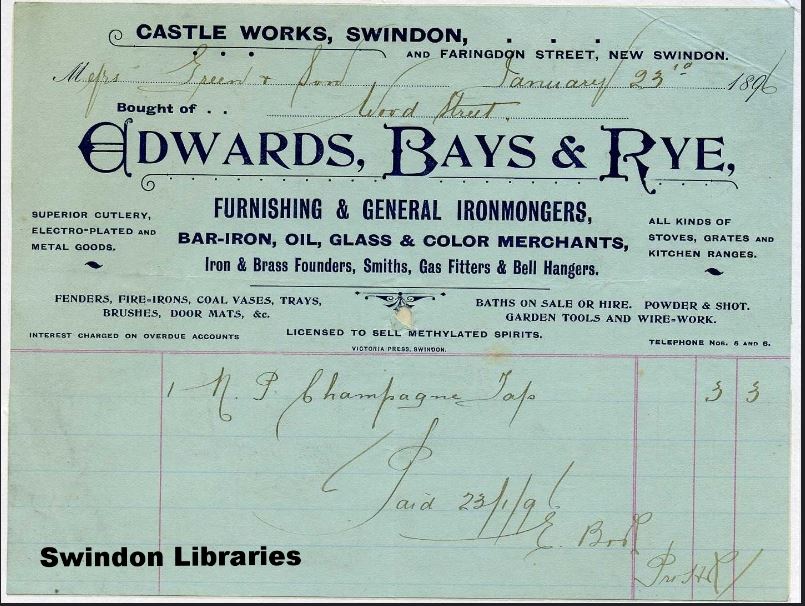
In 1892 Arthur was taken into the ironmongery partnership and the firm became Edwards, Bays and Rye, with the Castle Iron Works and shops in Wood Street and Faringdon Road.

In 1901 Arthur and Emily are living at 2 Devonshire Villas, The Sands with their four children, eldest daughter Annie who at 19 is working as a Telegraphist in the Post Office; Joseph 15; Margaret 7 and six year old Frank.

Emily died in the summer of that year but Arthur doesn’t hang around and in the summer of 1902 he married Adelaide Lucy Langfield and the Rye family part 2 begins.

In 1911 we find Arthur and Adelaide at 58 Upper Mall, Hammersmith with Adelaide’s brother Herbert, their mother, sister and two nieces. They are all listed as one large household – there’s no mention if they are just visiting. Arthur and Adelaide have just two of their five children with them, Olive 7 and Arthur E. 7 months (I think the baby’s name might be incorrectly transcribed as they already have a son called Arthur). But where are the rest of the Rye family.

Back home in Swindon 29 year old Annie is the head of a busy household at 100 Bath Road. She continues to work at the Post Office as a Sorting Clerk and Telegraphist. At home she is looking after her sister Margaret 17, who works as a milliner’s apprentice, her brother Frank 16 who is still at school along with her father’s three younger children by his second marriage Arthur 6, Herbert 5 and Kenneth 1. She has a live-in general servant called Clara Holland Mayling, but that’s still a pretty heaving workload.

Arthur Rye died here in Swindon in 1919 and Adelaide in 1922 but I can’t help wondering about Annie. Was she a career woman or did she miss the opportunity to marry and have her own family in order to help look after her father’s one?

Annie spent her last years at 89 Avenue Road. She died on October 24 and left effects valued at £3,347 7s 5d to the administration of her brother Joseph and her solicitor John Wignall Pooley.

The story of the Davis family and their memorial

For some considerable time the Davis family memorial stood in a dilapidated, collapsed condition. This was one of the first restoration projects our dedicated team of volunteers undertook.

William Davis was born in Faringdon in 1856, the son of Joseph and Jane Davis. He married Agnes Greenaway, the daughter of John, a farmer in Stratton St Margaret, and his wife Susan. For most of their married life William and Agnes appear to have had a member of the Greenaway family living with them.

William worked as a draper’s assistant and the couple began married life at 14 Edgeware Road. By 1891 they had moved to Rose Cottage next to the catalogue houses on Drove Road.

On one side of the monument you can see the name of Reginald Ernest Davis, the couple’s second son. Reginald had a complicated personal life and a tragic death.

He worked first as a teacher at a local board school here in Swindon. In 1908 he married Rose Louise Gorton in the parish church in Clapham, South London when he described himself as a dairy farmer. Rose’s father was a farmer at South Marston.

The following year Reginald, now described as a clerk, and Rose, emigrated to Canada and in 1916 they were living in Regina, Saskatchewan with their six year old daughter.

The next time I find the couple is at the time of their re-marriage on December 7, 1923, describing themselves as divorcees on the marriage certificate, so presumably they divorced sometime after 1916.

Sadly it was not to be a happy ever after story as less than a year later Reginald committed suicide at his home in Toronto, which is where he is buried.

Moving around the monument we see a reference to William and Agnes’ eldest son. William Harold Davis worked as an agent for a British Merchant in West Africa. In November 1917 he was returning home from a business trip on the SS Apapa when the ship was torpedoed by a Germany submarine off the coast of Anglesey. William was one of 77 people lost.

Henry Clifton Bassett – Superintendent of the Swindon Wesleyan Circuit

Non conformity had a small presence in Swindon until the arrival of a large industrial workforce who came from across the country to work in the Great Western Railway. In fact the large number of nonconformists who wished to bury their loved ones without the rites of the Church of England was a contributing factor to the building of Radnor Street Cemetery.

This is the grave of Wesleyan Minister, Henry Clifton Bassett. Born in St. Stephens, Launceston, Henry was the son of agricultural labourer John Bassett. John must have been ambitious for his son as the 1871 census reveals that 12 year old Henry was a boarder at a school in Launceston.

By 1881 Henry, then aged 22, was a Wesleyan Minister lodging in Paignton with William Anderson, a joiner and carpenter, and his family. In 1884 he was employed at Lerwick with John H. Hooper, working on the Shetland Isles circuit.

He married Mary Ann Read in 1887 and the couple had three children – a daughter Hilda Constance and two sons, Clifton Read and Henry Norman.

Death of the Rev. H.C. Bassett

Swindon Circuit Wesleyan Supt. Minister

We regret to record the death of the Rev. Henry Clifton Bassett Supt. of the Swindon Wesleyan Circuit, which took place at his residence, Eastcott House, Regent circus, Swindon, last Saturday afternoon, at the age of 60 years.

The rev. gentleman was born at St. Stephens, Launceston, Cornwall, and had been in the Wesleyan Ministry for 36 years, holding important appointments in a large number of Circuits, more recently as Superintendent. Among the town in which he laboured were Newton Abbot, Lostwithiel, Northampton, Barton-on-Humber, Accrington, Sheffield, Darleston, Willenhall, Whitby, Selby, and latterly at Swindon.

The term of a minister’s tenure in a Circuit is three years. It speaks much for the popularity of Mr Bassett that after serving his full term in most of the Centres in which he has ministered he has been invited to remain for a longer period, so acceptable has his preaching and his work generally been to the people.

He came to Swindon from Selby in September 1917, as Supt. of the Circuit. His principal reason for coming South was the health of his wife, who had been in indifferent health for some years, Mrs Bassett being unable to withstand the rigours of the northern climate.

Mr Bassett had always enjoyed good health. He was an extremely hard and conscientious worker, a circumstance which in point of fact brought about the illness which ended in his death. He overtaxed his strength in visiting and preaching during the prevailing epidemic of influenza with the result that after preaching on Sunday, December 8th at the Wesleyan Central Mission, he arrived home from the evening service utterly exhausted. Dr. Lavery was summoned, and Mr Bassett was ordered to bed, from which he was never able to rise. His case was diagnosed at first as influenza. His heart became affected and pneumonia supervened. On Christmas Eve Dr. J. Campbell Maclean was called in in consultation, and his report as to Mr Bassett’s condition was grave.

Death took place on Saturday afternoon, in the presence of his wife and daughter and a trained nurse who had been in attendance.

Deceased leaves a widow, two sons, and a daughter. One of the sons is engineer to the Sunderland Corporation and the other is serving as an apprentice in the Great Western Works at Swindon.

Sympathetic references were made in all the Wesleyan Churches in the Circuit on Sunday to the great loss the Church had sustained in the Connexion by the death of the Rev. Clifton Bassett.

The funeral took place on Wednesday. There was a service at Wesley Chapel at 2.30, conducted by the Rev. H.W. Perkins, assisted by the Ministers of the Circuit and neighbourhood, and an address was delivered by the Chairman of the District, the Rev. Grainer Hargreaves of Oxford.

The Faringdon Advertiser, Saturday, January 25, 1919.

Henry Clifton Bassett was buried on January 22, 1919 in grave plot D1304 where he was joined by his wife Mary Anne in 1923. The cremated remains of their daughter Hilda Constance was buried with them in 1975 and their son Henry Norman in 1986.

The Dickson dynasty

Andrew James Campbell Dickson left his home in Fife, Scotland for a new job and a new life in New Swindon. By 1861 he was living at 37 Taunton Street. He could hardly have imagined this move would establish a Swindon railway dynasty that would last for more than 100 years.

By 1871 Andrew was working as an Engine Driver. However, when he died in 1876 his occupation was given as Railway Clerk. In her book Railway Voices – Inside Swindon Works Dr. Rosa Matheson suggests “Whether Andrew had to give up as an ‘engine driver’ because of an accident is not actually known but it is a probable explanation. Records show that the GWR often found light work for long service, infirm or disabled firemen and engine drivers.” Andrew was buried in St. Mark’s churchyard.

Now we move on to trace the fortunes of his eldest son Matthew.

Born in Temple, Midlothian on February 11, 1857 Matthew was a wee boy when the family moved to Swindon. On official documents throughout his long life Matthew declares his birthplace as Scotland, but he could have had few memories of that place. However, there were many men of Scottish origin in the railway village in those early years; perhaps Scottish customs and traditions (and accents) were familiar to Matthew.

In 1872 fifteen year old Matthew began a 6 year apprenticeship in the Carriage Finishing Shop. His career would last an astonishing 52 years and in 1924 he was presented to King George V and Queen Mary when they made a visit of Swindon and the Works. A commemorative photograph was taken in which Matthew stands in the 3rd row 4th from the right.

Matthew married Kate Henley at the Wesleyan Chapel, The Planks on July 23, 1881. The couple lived at 76 Commercial Road where Matthew died in 1930 and Kate in 1939 and would remain the family home until 1968. Kate is captured there on the 1939 wartime census when she is described as ‘incapacitated.’ Living with her are her daughters Ellen 54, who is also described as incapacitated and Florence 49 who is unemployed. How on earth did these women survive?

Matthew died on February 9, 1930 and was buried in grave plot C89 with his mother-in-law Elizabeth Henley who died in 1898. He was joined by Kate in 1939 and their two daughters, Ellen Kate who died in 1968 and Florence May who died in 1973.

But the story does not end there …

Arthur Stote – headmaster at King William Street School

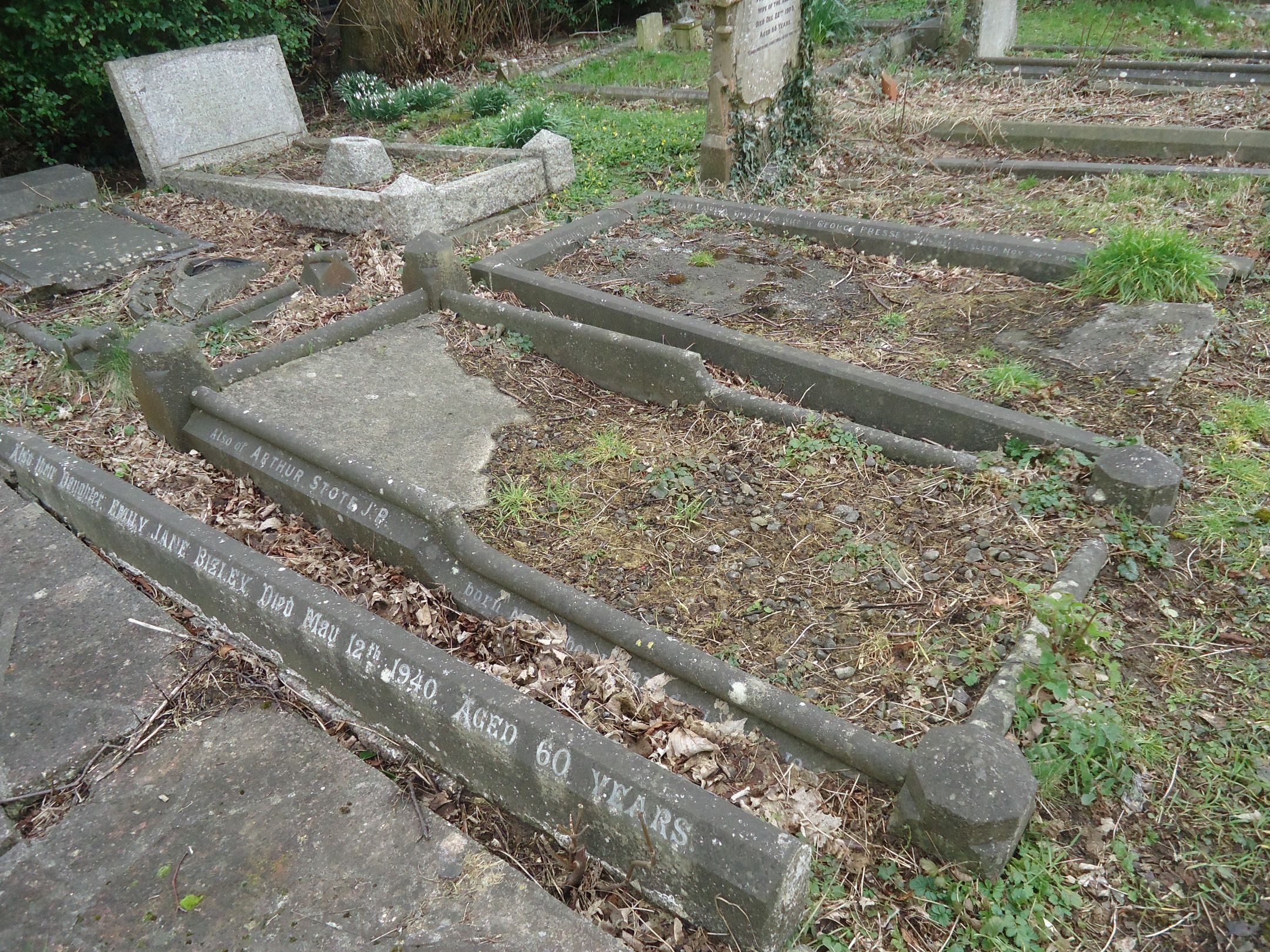
Arthur Stote was born in Lymington, Hampshire in 1835 and married Anne Jenvey in 1860. The newly married couple set up home in Yorkshire where Arthur held a teaching post. They moved to Swindon with their two elder sons, Walter and Cuthbert, when Arthur took up an appointment as headmaster at King William Street School on May 1, 1871. They went on to have another two sons, Arthur and Francis, born in Swindon.

Arthur retired on December 31, 1899 aged 65. For more information about the history of King William Street School follow the link

Swindon Magistrate’s Death

Mr Arthur Stote

There was removed by death on Sunday one of the oldest and best known inhabitants of Swindon in the person of Mr Arthur Stote, who passed away at his residence, 16, The Mall. Although he had reached the great age of 86 years, he retained all faculties to the end, and even last week he was out cycling – his favourite pastime, for he was always to be seen about the town on his tricycle. He was able to get out as recently as last Saturday. The end came quite peacefully on Sunday afternoon.

In 1906 Mr Stote was one of the first to receive His Majesty’s Commission of the Peace for the newly formed borough of Swindon, and he served actively on the Bench almost to the last, taking the greatest interest in the work of the children’s courts.

Mr Stote was a man of remarkable activity even in old age. When in his 79th year, in 1913, he completed a record of 40,000 miles of cycling made in less than eleven years, and this in addition to a considerable mileage of motoring. The funeral took place at Swindon Parish Church on Wednesday.

The Faringdon Advertiser, Saturday April 16, 1921.

Descendant of an Ancient Family

Mr Arthur Stote, who has died at Swindon in his 87th year, was a descendant of an ancient yeoman family. His ancestors held considerable properties from the Prior of Breamore before the Dissolution of the Monasteries, and after this a New Forest free tenancy remained in the family for nearly 300 years. Mr Stote went to Swindon in 1871, and for 29 years was headmaster of the Church of England Schools. He had served the town as an urban district councillor and guardian of the poor, was a prominent Conservative and churchman, and for ten years was hon. Secretary of the County Nursing Home at Swindon. He also occupied a position on the borough magistracy. In 1913, when he was in his 79th year, he completed a record of 40,000 miles of cycling in less than 11 years. Two of his four sons are clergymen.

Western Daily Press, Bristol. Wednesday April 13, 1921.

Arthur StoteArthur Stote was buried with his wife Anne in plot E8615 in Radnor Street Cemetery.

Ernest Henry Cousens – butcher

This stylish art deco headstone marks the grave of Ernest Henry Cousens. Ernest was born in Little Coxwell in 1885 the son of William Cousens, a carter, and his wife Annie. In 1891 they appear on the census living in the village of Lyford in Berkshire. Ernest has an 11 year old sister Edith Emma and a brother William aged 8.

In 1901 Ernest was lodging at 30 Hythe Road with Henry J. Keen, a butcher’s assistant. Sixteen year old Ernest was a butcher’s apprentice, so probably worked alongside Henry.

In 1908 he married Laura Young and the couple had four children; Irene born in 1912, Ernest born in 1916, Cecily 1918 and Eric 1922. At the time of the 1911 census he was living over his butchers shop at 15 Bridge Street with his wife Laura who is described as ‘assists in business’. The couple were aged 27 and 25 and had been married for three years. The first of their four children was born the following year. Living with them on census night was Ernest’s uncle James aged 59, a widower who worked as a general labourer.

Ernest Henry Cousens of 14 and 15 Bridge Street, Swindon died on March 28, 1939, aged 54. Probate was declared in London on June 15 and effects valued at £7,443 1s 8d were left to his widow Laura and his eldest son Ernest William Cousens, a chartered accountant. He is buried alone in grave plot C4708.

A little girl from Brixton

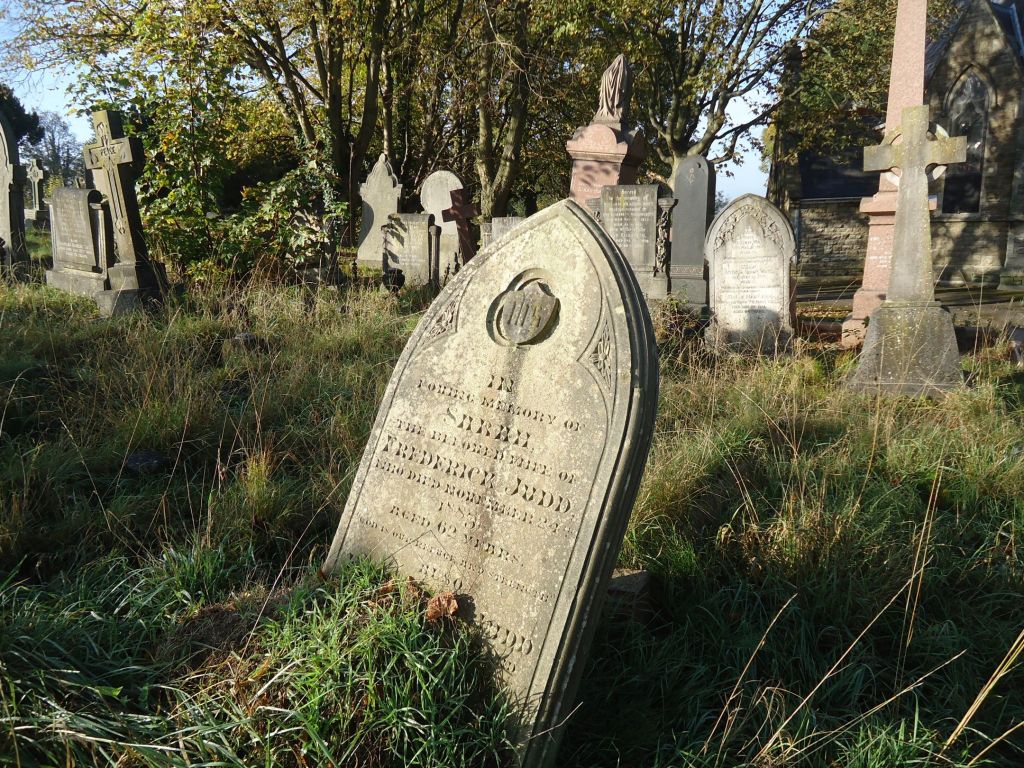
You can spend a whole lot of time on research when a particular fact piques your interest. This most recently happened to me when I was researching Sarah Judd who died at her home, 27 Havelock Street in 1883. For the past 140 years she has been resting in this sunny spot in Radnor Street Cemetery but before that she had lived in a great many other places.

Sarah was born in 1821 in Palling, Norfolk, the daughter of James and Rosetta Hicks. She married Frederick Judd in Chatham, Kent on January 17, 1850 and at the time of the 1851 census Sarah, Frederick and their baby son James were living with Sarah’s parents in Gillingham, Kent.

During the next 10 years the family moved about – a lot – their six children born at various addresses in Kent and Hampshire. By 1861 Frederick was employed as a Police Constable and they were living at No 19, Archbishop Place, a leafy suburb at the top of Brixton Hill, Lambeth. In 1862 their daughter Elizabeth was baptised at St Matthew’s Church, Brixton and in 1866 a second daughter Harriet was also baptised there.

The Tate Library, Brixton, Lambeth.

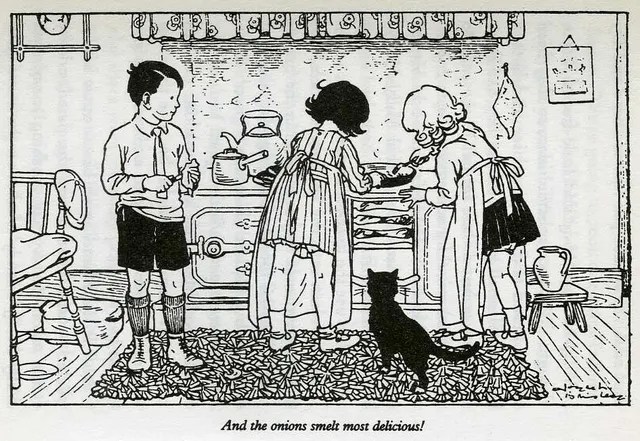
I grew up in Brixton in the 1950s and 60s and I know exactly where St Matthew’s Church is; it’s just a stones throw away from the Tate Public Library where I spent a lot of my childhood. Elizabeth was born some 30 years before the library was built in 1890 and 100 years before I used to borrow books there. One of my favourites was the stories about a little girl called Milly Molly Mandy who had the kind of life I wished I had. I used to carefully colour in the pictures before I returned the books.

Milly Molly Mandy and a picture in need of my careful colouring skills

The Judd family had arrived in Swindon by 1881. Frederick had long since left the police force and was working as a house painter. Still living with Frederick and Sarah were James 30 (born in Kent) Sarah 21 (born in Hampshire) and Elizabeth 18 and Harriet 15 (both born in Brixton).

Basking in the sunshine, the leaning headstone has a large ants nest obscuring the last inscription, probably the name of Sarah’s husband Frederick who died in 1907 at his home, 53 Crombey Street.

And buried in this plot in 1944 was their daughter Elizabeth, the little girl born in Brixton more than 161 years ago. I shall call round and say hello next time I’m passing.

Gunner Edwin Henry Hale – served in Mesopotamia

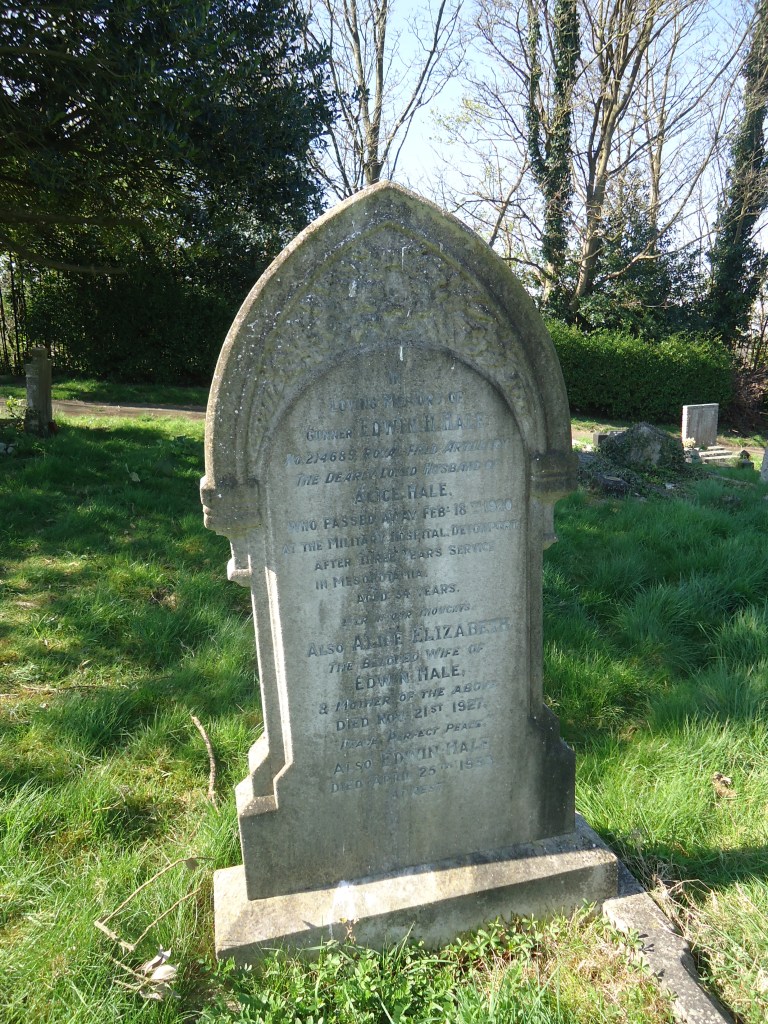
If you’re familiar with the CWGC commemorative headstones it might surprise you to know that this is one too. Families were given the choice of an official headstone or one of their own choosing and this is what the family of Edwin Henry Hale did.

Edwin Henry Hale was born on March 30, 1885, the only child of Edwin and Alice Elizabeth Hale. He was baptised at St. Paul’s Church on April 7, 1885 just around the corner from the family home at 2 Regents Place.

In May 1899 as a fourteen year old boy he entered the employment of the GWR as an office boy while he waited to begin an apprenticeship. Six months later in September 1899 he began a six and a half year apprenticeship in the Coach Trimming Shop.

In 1908 Edwin married Alice G. Gleed at St. Mark’s Church and by the time of the census in 1911 the couple were living at 53 Sydney St. Hornsey, London N.1. They had been married for three years but had no children.

Edwin’s military records did not survive the bombing during the Second World War, so the inscription on this headstone is crucial to our understanding of his military service during the First World War.

Gunner Edwin H. Hale gave three years service in Mesopotamia. Historically the area of Mesopotamia was situated between the Tigris and Euphrates rivers and today is home to Syria, Turkey and most of Iraq.

During the 1914-18 war the conditions on the battlefields were horrendous. Temperatures regularly reached 120 degrees Fahrenheit (49 degrees centigrade) in this arid desert area, which was prone to flooding. More than 12,600 soldiers died of sickness; 51,800 were wounded with 3,900 dying of their wounds; 11,000 were killed in action and 13,400 reported missing or taken prisoner.

And yet somehow Edwin survived this and was brought back to England. Sadly, he didn’t make it home to Swindon though, dying on February 18, 1920 at the Military Hospital in Devonport.

Alice Elizabeth Hale, Edwin’s mother died on November 21, 1927 and his father Edwin died on April 25, 1933. They were buried in the same plot with their only son.