Ivy Colborne and Colbourne Street

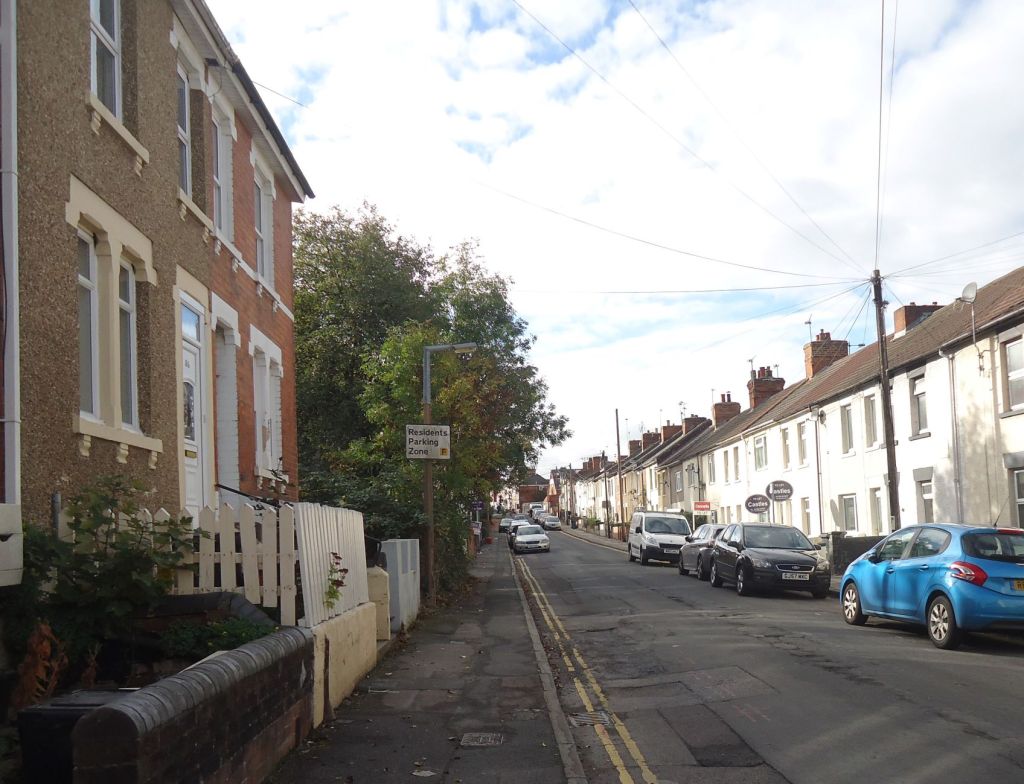
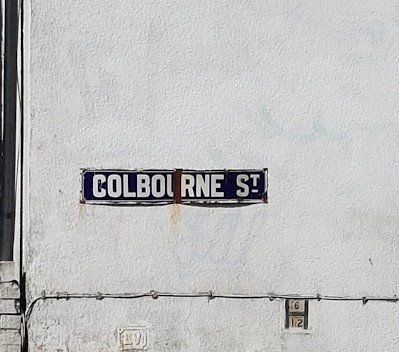
During the First World War Colbourne Street was the site of a munitions factory known locally as the Powder Works. The street is believed to be named after builder Arthur Joseph Colborne who had premises in nearby County Road, but why is Colbourne Street spelt this way? The spelling acquired an additional U when allocated to the new street in 1902. Did no one notice at the time (Swindon has form for this.) Or is the street named after someone (or some place) totally different? I suppose we’ll never know.
Arthur Joseph Colborne, was born in Midsomer Norton in 1870, the son of Thomas Colborne, a builder and timber merchant who by 1873 was established at the Cross Roads, Stratton St. Margaret. Between 1876-1940 the Colborne family built a staggering number of properties in Swindon, despite being on the verge of bankruptcy more than once.

But this is the story of a Colborne wife, and as usual, there is only a little information to be found about her.

Arthur Joseph’s eldest son Arthur Kenneth Colborne married Ivy Berry in 1925. The couple had two sons, Michael John born in 1927 and Richard Graham in 1931. Sadly, Ivy died on July 21 1938, aged just 36.

Death of Mrs A.K. Colborne

Wife of Swindon Business Man

By the death of Mrs Ivy Colborne, who was buried on Monday, the family has suffered its ninth bereavement in the last two years. For in this short period no fewer than nine members and relations of the families of Mr Colborne and his wife have died.

Mrs Ivy Colborne, who died last Thursday after a long illness, was the wife of Mr Arthur Kenneth Colborne, of 33 Croft-road, Swindon. She was 36 years of age.

Mr Colborne is a member of the Building and Public Works Construction Co. Ltd., Swindon. There are two sons one aged 11 and the other aged 6. Mr. Colborne’s brother, Alan, died about two years ago.

Mrs Colborne was a member of Swindon Baptist Tabernacle and used to be a keen worker for the YMCA Boys Club. Before her marriage she was a Miss Berry.

At the funeral service at the Baptist Tabernacle, on Monday, the Rev. C.H. Cleal and the Rev. P. Tomlinson officiated.

There was a large congregation of mourners. Mr A.E. Ford presided at the organ, and the hymns sung were “The morning flowers display their sweets” and “Jesus lives.” The organist also played “O rest in the Lord” and other appropriate music.

The interment took place in the Radnor street cemetery, the Revs C.H. Cleal and P. Tomlinson again officiating.

Extracts from the North Wilts Herald, Friday, 29 July, 1938

Ivy Colborne aged 36 years of 33 Croft Road was buried on July 25, 1938 in grave plot E8627. Arthur Kenneth Colborne remarried in August 1939. When he died in 1963 he was buried with Ivy.
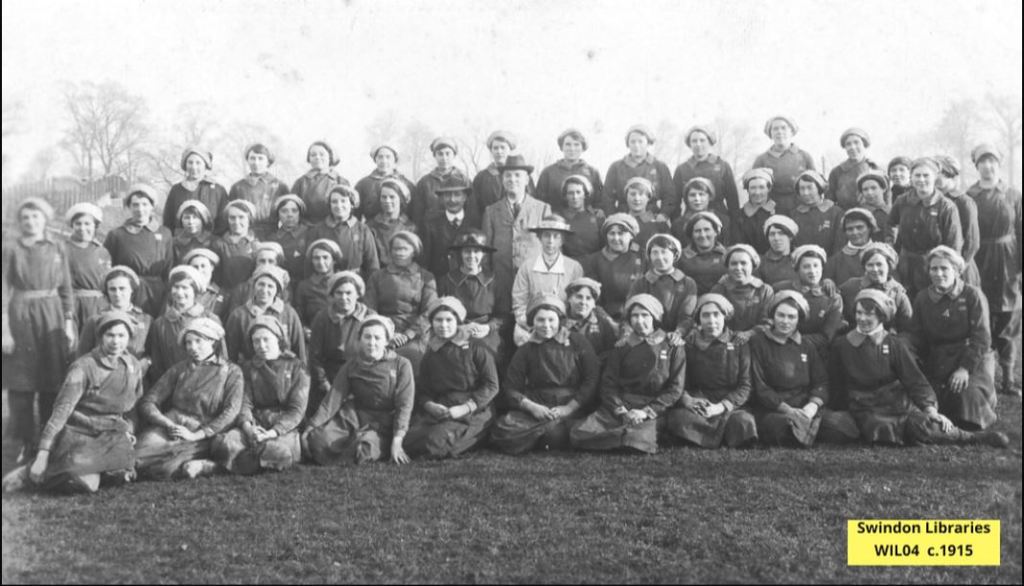
Munitions workers at the Powder Works, Colbourne Street pictured c1915. Tesco now stands on the site. Image published courtesy of Local Studies, Swindon Central Library.

John Kelynack – chief clerk of the GWR Chief Mechanical Engineer’s Department

When John Kelynack retired from the position of chief clerk of the GWR Chief Mechanical Engineer’s Department he received numerous presents; including a cheque from the GWR Enginemen’s and Firemen’s Mutual Assurance Sick & Superannuation Society and ‘a handsome barometer.’

Like so many of his generation John Kelynack appears to have had an inexhaustible enthusiasm for life, although perhaps his rather severe countenance in this press photograph might suggest otherwise.

His 47 year career with the GWR began when he was 16 years old and had taken him from working as a Time & Storekeeper at Penzance station to that of chief clerk in the GWR Chief Mechanical Engineer’s Department with responsibility for more than 1,600 employees.

Among his other responsibilities across the years was vice president, trustee and hon treasurer of the Mechanics Institution along with chairman of the GWR Medical Fund and president of the GWR Staff Gleemen. He taught Evening Classes at Swindon College and was churchwarden at St Augustine’s Church in Rodbourne. He also worked for a whole list of other organisations mentioned in the obituary below.

John Kelynack was born February 1, 1877 in Penzance the son of a cabinet maker John Kelynack and his wife Mary. In 1905 he married Margaret Ethel Maud Hiscock at The Wesley Methodist Chapel in Bath Road, Swindon. The couple did not have any children.

Mr J. Kelynack Dies at 69

Former Chief Clerk to Swindon C.M.E.

Mr John Kelynack, who retired from the position of Chief Clerk of the GWR Chief Mechanical Engineer’s Department at Swindon Works in February, 1941, died at 38, Goddard avenue, Swindon in the early hours of this morning. He was 69 years of age.

Mr Kelynack, who was a native of Cornwall, joined the GWR on 27, November, 1893 at Penzance. Four years later, (15 March, 1897) he was transferred to Swindon as a clerk in the Mileage and Accounts Section. In the evenings he took advantage of the night classes provided by the Education authority to gain a good grounding in accountancy under the late Mr Walter Johnson, chartered accountant.

Promotion Steps

Subsequently he went to the London School of Economics for further study in accountancy and office organisation and, after two years, returned as teacher to the Swindon night classes, where he was originally under Mr Johnson.

On 19 May, 1913, Mr Kelynack was appointed assistant to the clerk-in-charge, Locomotive Acccounts, and in March of the following year he became clerk-in-charge.

On the amalgamation of the Locomotive with the Carriage and Wagon Accounts in 1917, he was appointed clerk in charge of the whole accounting staffs.

Next step in his promotion was to the office of Assistant Chief Clerk on 21 February, 1918, and on the death of Mr A.J.L. White in October, 1929, he reached the top rung of the ladder as Chief Clerk.

Throughout his career he was closely identified with the introduction of new and improved methods of railway accountancy. He was the moving figure behind the great changes that took place in the counting and office methods of the GWR Medical Fund Society, and also rendered valuable assistance in the revision of the Society’s rules.

Church Work

For 30 years Mr Kelynack worked hard for St. Augustine’s Church, and was the first warden appointed by the Vicar.

Other offices held by him during his career included trustee, vice-president and hon. treasurer of the GWR Medical Fund Society; hon. treasurer of the GWR Enginemen and Firemen’s Mutual Assurance Society, trustee and hon. treasurer of the GWR Mechanics’ Institute, Swindon, trustee of the GWR Sick Fund; vice-president and hon. auditor of the GWR (Swindon) Athletic Association; member of the committee of the GWR (London) Lecture and Debating Society, president of the GWR (Swindon) Accounts Staff Gleemen and the GWR (Swindon) Retired Workmen’s Association.

He was also chairman of directors of the Swindon Permanent Building Society, and a member of the Remembrance Lodge of Freemasons.

Mrs. Kelynack died several years ago.

Swindon Advertiser Monday July 22, 1946.

John Kelynack died in July 1946 aged 69 years. His burial took place on July 26 in grave plot C10, joining his wife who had died 12 years previously.

John Hulme Preece – a devoted Christian

John Hulme Preece was born on January 1, 1824 at Tenbury, Worcestershire, the son of a Baptist Minister. He married Eliza Sarah Whitmore in the December quarter of 1853 and by 1855 the couple were living in Swindon. The UK Railway Employment Records 1833-1956 state that John began work as a railway clerk in the Locomotive Department on February 2, 1855.

The couple joined the Independent Church, Victoria Street in 1861. This church was demolished in the 1960s for a road widening scheme.

John and Eliza lived first at Union Villa where Eliza ran a Seminary for Young Ladies. They later moved to 8 Gloucester Terrace which had a larger schoolroom and remained their home until John died in 1885 and Eliza in 1905.

In 1861 John was elected to the Council of the Mechanics’ Institution, the first clerk to be elected. Previously it was felt that only railwaymen would be able to appreciate the needs of those working on the shop floor. But John soon proved his worth and the following year was elected as Secretary of the Mechanics’ Institute, a role he fulfilled with energy and commitment until his death.

Trevor Cockbill makes many references to John in his definitive book about the Mechanics’ Institution – Finest Thing Out published in 1988. He describes him as being a quiet, gentle, studious man of a modest and retiring nature. A devoted Christian who was deeply interested in scholarship and education.

Swindon

The death is announced of Mr. John Hulme Preece, who has been for 26 years secretary of the New Swindon Mechanics’ Institute. Mr. Preece who was 61 years of age, was for about 30 years a clerk at the Great Western Railway Works.

Reading Mercury Saturday 29 August 1885.

The Funeral of the late Mr. John Hulme Preece, whose death on the previous Thursday evening we noticed in our last issue, took place on Monday afternoon, at the Cemetery, and afforded another instance, had it been necessary, of the very general respect in which the deceased was held. The coffin, which was conveyed to the cemetery without the customary pall on a portable bier, was completely covered with floral wreaths and offerings. In addition to the relations of the deceased, who had preceded the funeral cortege to the cemetery, there was a very large representation of the Council of the Mechanics’ Institute, and of the G.W.R. Clerks, to the number of over 150.

Extracts from he Swindon Advertiser, Saturday, August 22, 1885.

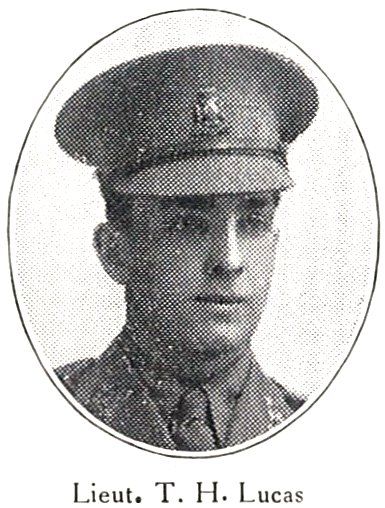
Thomas Henry Lucas – Lieutenant in the RAF

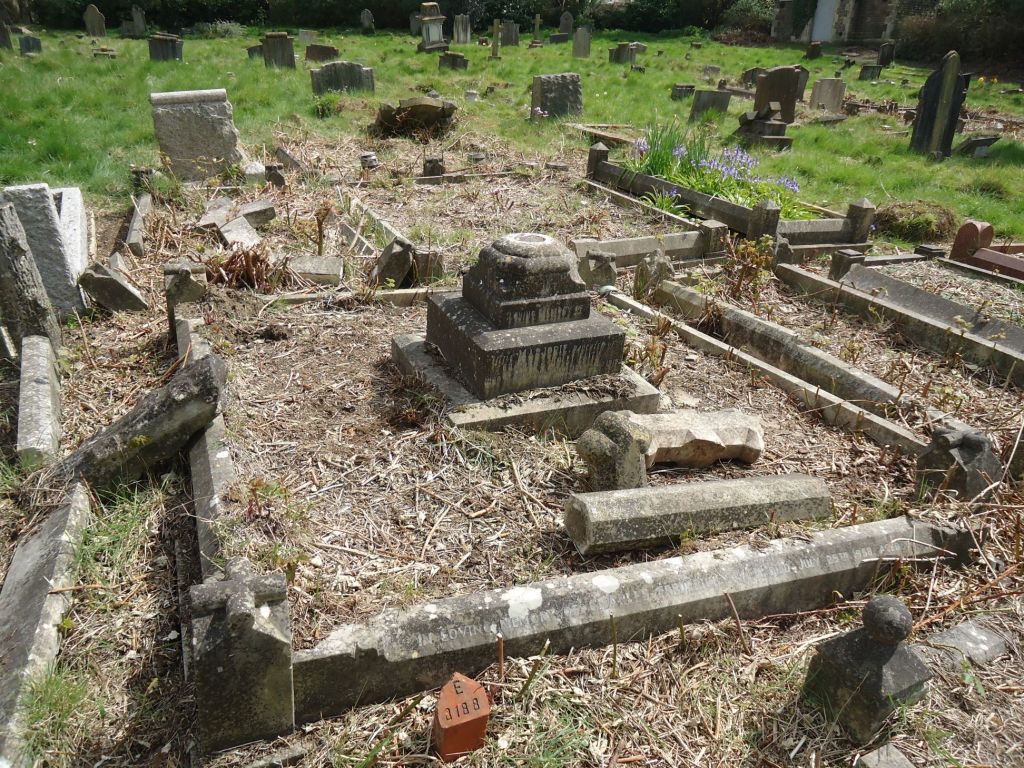
Graves appear and disappear with the passing seasons here in Radnor Street Cemetery. At the moment the grass is tall and the brambles rampant, but in the autumn the Borough Council will come and mow and perhaps this large family grave will reappear again.

Research has revealed several stories associated with this double grave, which extends across plots E8188 and E8189. The first story involves not a burial but a dedication on the kerbstone surround of the plot.

To the dear memory of Thomas Henry Lucas Lieutenant RAF Killed whilst flying in Egypt May 15, 1918 aged 27 years.

Thomas Henry was born in November, 1890 the son of William and Minnie Lucas, and baptised at St. John the Evangelist (a Chapel of Ease in the parish of St. Mark’s) on January 25, 1891. In May 1905 he began a 6½ year apprenticeship as a Coach Finisher in the Carriage & Wagon Works, later transferring to the Coach Body Making Shop.

Some of his military records survive and we know that he served with the Hampshire Regiment and also the Royal Air Force. He was killed in action on May 15, 1918 and is buried in the Cairo War Memorial Cemetery, Egypt. Were his grieving parents able to visit his grave? It is unlikely.

Thomas’s will was proved in 1919 when his address was given as 6 Lorne Terrace, Station Road. Administration went to his father William, a chargeman in the Works. His effects were valued at £360.

The first burial in this plot took place on January 3, 1920, that of five year old Marjorie Violet L. Faith, the daughter of Charles Frederick Faith and Violet Frances Euphemia Faith nee Lucas. (Charles was buried in this plot when he died in 1958).

Thomas’s parents William Henry and Minnie Sarah were buried here in 1942 and 1951 respectively, but there is one last story to tell.

The household at 6 Station Road was always a large and busy one. In 1901 William and Minnie Lucas lived there with their three children Violet 17, Minnie 14 and 10 year old Thomas. There were also two boarders living with them and on census night they had four visitors as well. And then there was their 18 year old domestic servant Mary Ann Gee. Mary Ann never married and remained with the family for many years. At the time of her death in 1948 she lived with William and Minnie at 67 County Road. She died that same year when she was also buried with them.

George Albert Hallard – Swindon Veteran of Industry

It was said that an apprenticeship served in the Great Western Railway Works was a passport to a job anywhere in the world. Some of the long past railway men might argue that it didn’t necessarily guarantee a job in the Swindon Works though! Skilled, newly qualified men went up a pay scale and the GWR only retained those where vacancies existed in specific shops.

In Doing Time Inside – Apprenticeship and Training in GWR’s Swindon Works Dr. Rosa Matheson reproduces the regulations under which apprentices were employed in the GWR Carriage Works in Swindon in both 1892 and 1908. Apprentices were not taken on under 15 nor over 16½ years of age (later revised to 15½ and 17 years). All candidates had to complete a one month trial without wages before being accepted.

In 1892 a working day began at 6 am and finished at 5.30 pm with a 45 minute breakfast break and an hour for lunch. The daily rate for an apprentice in his first year was 10d. He was expected to ‘commence work punctually at 8 am and to make, as a rule, full time (54) hours during the week.’

One such apprentice was George Albert Hallard who began his months trial on February 20, 1879 aged 15.

George Albert Hallard was born in Bristol in 1864, the eldest of 8 children. His father George was an Erector, Engineer, Fitter and by 1881 the family were living at 38 Westcott Place, next to the Falcon Inn.

George Albert Hallard married Marcella Ellen Kirkham in 1889. At the time of the 1891 census the couple were living at 13 Conduit Street, Plumstead, London but by 1901 they had returned to Swindon and a home in Birch Street.

George Albert Hallard was one of 228 men who retired under the 66 year retirement age limit in 1931.

Mr G.A. Hallard, of 70, Jennings Street, chargeman fitter and turner in “W” Shop, worked in the GWR works for 38 years and was chargeman for about 27. He was apprenticed in the works and then obtained a position in London. He then returned to Swindon. Mr. Hallard’s father, who is 91 years of age, also worked in the works for many years.

Swindon Veterans of Industry – North Wilts Herald, Friday, January 2, 1931.

George Albert Hallard died aged 77 years in Ogbourne Hospital. His home address was 70 Jennings Street. His funeral took place on December 12, 1941 when he was buried in grave plot C745 with his wife Marcella who died in 1903.

W Shop where George Albert Hallard worked for more than 27 years. Image published courtesy of Local Studies, Swindon Central Library.
The much travelled Criswick family

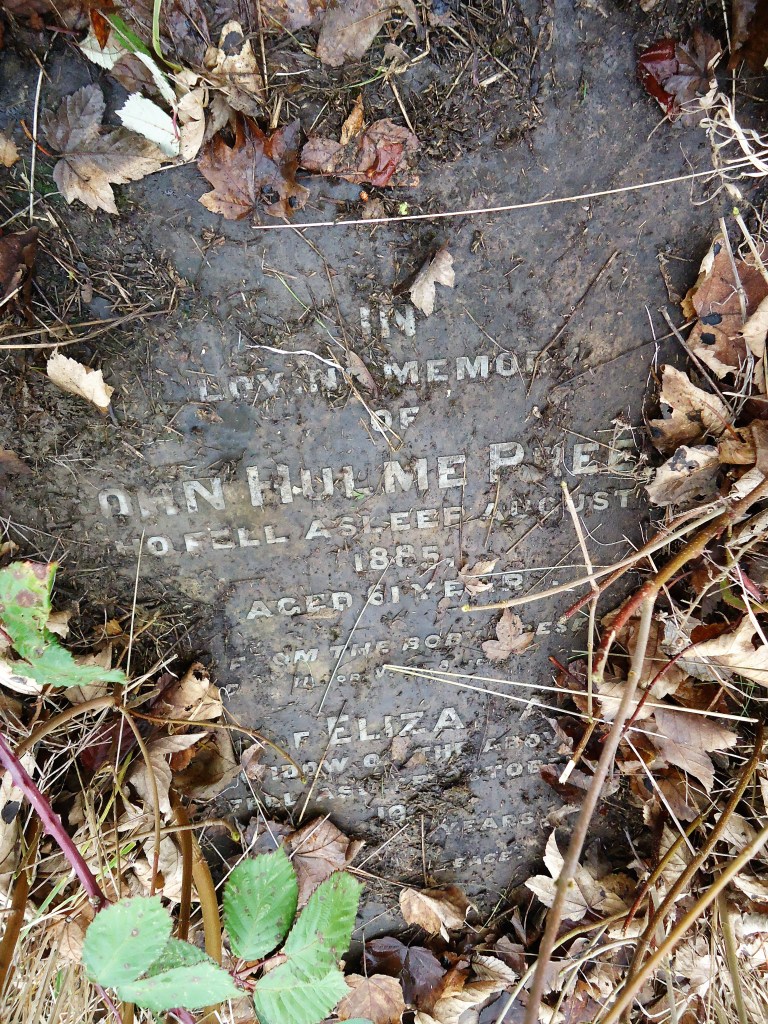
When Helen Criswick died in 1907 the first name placed on her headstone was that of her husband, although he was not buried with her.

Henry Charles Criswick died at Axim, West Africa on October 6, 1895. Henry, a civil engineer, had spent many years working in West Africa. Infact, he had only recently returned there just two months prior to his death.

Henry Charles Criswick was born in 1838 in Sherborne, Dorset, the son of James Criswick, a printer, and his wife Eleanor. By 1861 Henry and his brother George were lodging in a property in Greenwich where both brothers worked as assistants at the Royal Observatory. This is the last time Henry is captured on a UK census.

In 1868 Henry married Helen Elizabeth Ihler at Monrovia, West Coast of Africa and for most of their married life he worked in West Africa. The couple’s first child, Frances Helena, was baptised at St Alphege Church, Greenwich on March 21, 1871 but at the time of the census taken just a few days later she was living with her grandfather and aunt, without her parents. Perhaps they had returned to West Africa?

How Helen and her children came to be living at 41 Belle Vue Road, Swindon remains unknown. Was Henry working for the GWR at the time? He doesn’t appear with the family on the census returns. By 1891 Helen was living at 11 Claremont Crescent, Weston Super Mare. She must have seen her husband sometime during the intervening 10 years as by then she had two more children, Charles and Margaret. She declares that she was living on an allowance from absent husband – I’m assuming this means absent as in ‘working away’ and nothing more sinister.

On July 31, 1895 Henry sailed on the SS Nubia from Liverpool for Axim where two months later he died from tuberculosis.

So, how did Helen come to be buried here in Radnor Street Cemetery? Had her visit in 1881 endeared her to the town? In 1902 her daughter Helen married Frederick William Yoell, a watchmaker and jewellery dealer. By 1907 they were living in Swindon and premises at 25 Fleet Street, which is the address where Helen Elizabeth Criswick was living at the time of her death.

Helen Elizabeth Criswick was buried in grave plot B2692 on August 25, 1907 – without her husband.

Richard Dening and another Great Western family

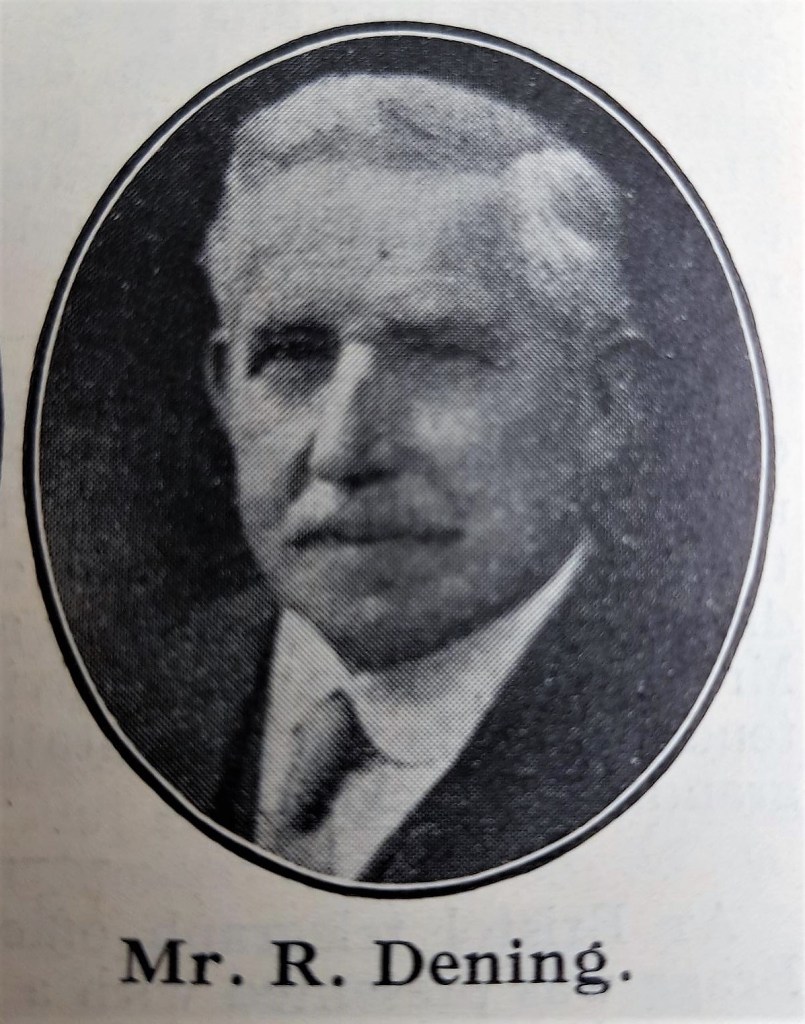
I frequently take Radnor Street Cemetery visitors to the grave of Freda and Irene Dening. These two sisters enjoyed a long career in the Great Western Railway at a time when it was unusual for women so to do. I must admit that I have made little attempt to find out much about their father, until I came across a note of his retirement in the Great Western Railway Magazine.

Richard Dening was born on April 20, 1866 in Winsham, Somerset, the son of Nimrod Dening, an agricultural labourer, and his wife Sarah Anne. He married Alice Louie Hunt in 1890 and the couple began their married life together at Clarence Street, Townstal, Devon.

Richard entered employment in the GWR on July 28, 1891 and is recorded as being Assistant Foreman in Fitting No 3 Shop. The family can be found on the 1901 census living at 61 Hythe Road with their three children Henry 9, Freda 3 and 7 month old Irene.

You can read about Richard’s career below:

Mr R. Dening, who for over four years was foreman of Nos. 3, 15, 15A, 18 and 19D shops, carriage and wagon works, Swindon, has retired from the Company’s service. He was held in high esteem, and widespread regret was felt on his retirement. At a smoking concert at the Great Western Hotel on April 18, a large company assembled to pay tribute to Mr Dening’s popularity. Mr. C.J. Coleman presided, and several interesting presentations were made. These consisted of an armchair and a grandfather clock, together with a handbag for Mrs Dening, from the men in Nos. 3, 15, 15A, 18 and 19D shops, and a set of four woods from the foremen and clerical staff. Tributes to the interest which Mr. Dening had taken in the shops were paid by Mr. S.J. Owen (who made the presentation), and Messrs H. Burchell, W. Clements, A. Fleming, F. Spackman, W. Watts, W. Blanchard, W. Newman, G. Dunn, A.E. Carter, C Thompson, T. Greenwood, and C. Garrett.

Mr Dening entered the Company’s service in July 1891, and commenced work in No. 15 shop. In 1906, he was appointed assistant foreman, and became head foreman in September, 1926. For 21 years he had been connected with the GWR Locomotive and Carriage Department Foremen’s Association, having occupied the positions of auditor, assistant secretary, secretary, vice-president, and finally president. For ten years he was also a member of the GWR Sick Fund Society committee, being chairman for eight years, and a member of the revision committee appointed to deal with the society’s financial position. In connection with his association with the Sick Fund Society, Mr. Dening helped in the formation of a benefit societies’ council, of which he became the first president. He is greatly interested in bowls, and is a vice-president of one of the clubs in Swindon.

Mr Dening’s son and two daughters attained outstanding educational distinction in each winning the Brunel medal at the London School of Economics, Mr H.R. Dening secured the medal in 1920, and Misses F.E. and I.A. Dening in 1921 and 1922, respectively.

Great Western Railway Magazine

Richard Dening died aged 85 years in the Cheriton Nursing Home. He was buried on February 13, 1953 in grave plot D187. His wife Alice Louie Dening died at her home, 60 Goddard Avenue, aged 90 years. She was buried on March 18, 1958 with her husband. Their daughters Freda and Irene were buried with them. Irene died in 1982 and Freda in 1994.

You might also like to read

Freda and Irene Dening – winners of the Brunel Medal

Redcross Street Cemetery?

In the beginning the cemetery was simply called Swindon Cemetery, but it could so very easily have become known as Redcross Street Cemetery.

Today this is the only reference to Radnor Street’s previous name.

When building began in the street that would begin at the top of the precipitous Stanmore Street and continue to the junction with Shelley Street and Cambria Bridge Road it was known as Redcross Street.

Mr James Hinton, auctioneer, announced that on January 29, 1879 there would be a sale of ‘All those EIGHT NEWLY-ERECTED SIX ROOMED, COTTAGES with GARDENS thereto, Situate on the North side of Redcross-street, Kingshill, Swindon, being Nos. 177, 178, 179, 180, 181, 182, 183, And 184 on the Plan of the Lower Kingshill Estate, which Plan will be produced at the time of Sale.’

Just a week later more properties and additional building plots in Redcross Street came under the hammer. Lot 1. All those five newly-erected six-roomed COTTAGES, and five similar COTTAGES not quite completed, with gardens thereto, situate on the north side of Redcross-street, Kingshill, Swindon, being Nos. 185, 186, 187, 188, 189, 190, 191, 192, 193 and 194 on the plan of the Lower Kingshill Estate, which plan will be produced at the time of sale. Lot 2. All those ten PLOTS of valuable FREEHOLD BUILDING LAND, situate on the south side of Redcross street aforesaid, being Nos. 223, 224, 225, 226, 227, 228, 229, 230, 231, and 232 on the plan of the Lower Kingshill Estate. Each plot has a frontage of 15 feet to Redcross-street.

By 1881, when negotiations for the new cemetery were under way, the street was already being referred to as Radnor Street, however at the time of the census taken in April 1881 it was still called Redcross Street and was apparently renamed sometime later that year.

Jacob Pleydell-Bouverie, 4th Earl of Radnor served as Lord Lieutenant of Wiltshire from 1878 until his death in 1889. The Pleydell-Bouverie Wiltshire base was at Longford Castle, near Salisbury and closer to home, they owned the stately pile that was Coleshill House. Maybe Swindon thought it advantageous to name one of their many streets of red brick terrace houses after the local aristocracy.

Building continued in Radnor Street throughout the 1880s with properties built by S. Spackman, J. Longland and B. Jefferies.

Alfred Bartlett – stonemason

If you look carefully as you walk around the cemetery you will see the name Bartlett on many of the headstones, usually inscribed discreetly on the kerbstone surround.

Alfred was born in Cricklade in 1865 the son of William Bartlett, a master stonemason, and his wife Mary Ann.  In 1881 16 year old Alfred was employed as a pupil teacher at the National School in Cricklade, perhaps with the intention of making teaching his career. But maybe the death of his father in January 1889 compelled him to take up his father’s occupation. In 1890 he married Leah Annie Brown when he states that his occupation is that of stone mason.

By the mid 1890s Alfred had established his business as a monumental mason in Bath Road where it remained for many years. Today the firm has premises on Victoria Road.

Alfred’s end was a sad one as his death in 1916 reveals he was a patient at the Wiltshire County Asylum in Devizes. It is recorded that between 1915-1920 there were high levels of TB and dysentery at the Asylum; perhaps one of these illnesses was the cause of his death.

Leah Annie never remarried and lived out her days at 22 Bath Road.  She died in 1934 and left effects worth £265 10s 4d to her executors, her sons William Alfred and Charles Bartlett, both monumental masons.

Alfred Bartlett died aged 51 years. He was buried here in plot C2021 on October 7, 1916. Leah Annie Bartlett died aged 66 years and was buried with her husband on March 28, 1934.

Alfred Guess Cook – Swindon Veterans of Industry

In 1900 the Great Western Railway employed more than 12,000 people in the Swindon Works. It has to be said that most Swindon families were a Great Western family.

This is the story of the Cook family.

John Cook was born in Wootton Bassett. He married Emily Smith at Christ Church, Swindon in 1852. At the time of the 1861 they were living in Oxford with their four children. In 1871 John returned to Swindon and brought his family (5 sons and a daughter) back to a home at 22 Westcott Place where two more children were born.

John worked as a boilermaker and by 1881 all five sons were employed in the Works. George 23 was an engine fitter, Henry 21 and Walter 19 were both boilermakers like their father, Alfred was an engine fitter and even 14 year old Frank had begun a boilermaker’s apprenticeship.

Alfred Guess Cook was born in 1863 and baptised at St. Thomas’s Church, Oxford where the family lived at 71 Bridge Street, Osney Town. At the time of the 1871 census the family were still living in Oxford, although it seems likely John had already returned to Swindon and a job in the Works.

By 1911 Alfred 48, lived at 25 Westcott Place with his two sisters Alice 42, and Emily 37, and his youngest brother James Irving Cook 33, a locomotive engine erector.

Six brothers all employed in the GWR – a fact observed in the newspaper report of 1931 when 228 men retired under the compulsory retirement age. It would be interesting to work out how many years combined the members of the Cook family gave to the GWR. They could hardly have anticipated there would come a time when the mighty Works would be no more.

Mr A.G. Cook, chargeman fitter, of 25, Westcott place, worked in the GWR works for 55 years, and held the position of chargeman for 42½ years. During the past 23 years he has inspected and put into traffic about 16,000 locomotives and rail cars.

Swindon Veterans of Industry – North Wilts Herald, Friday, January 2, 1931.

Mr A.G. Cook, who retired from the Company’s service on December 24, was a chargeman erector in the locomotive works for over 42 years. He had been in the Company’s employment a total of 55 years. Mr Cook comes of a Great Western family; six of his brothers are, or have been, chargemen under the Company.

Great Western Railway Magazine 1931

Alfred died at his home in March 1934, aged 71 years old. He was buried in grave plot D242 where he was later joined by his brother James, who died in 1944 and his sister Emily who died in 1947.