August 1882 and the new cemetery on Kingshill had been open a year. There were 14 burials during the month of August 1882, numbered 221 to 235 in the burial registers. In those early years most of the burials took place in Section A.
The oldest person buried in August 1882 was Richard Cowley aged 91. Richard Cowley was baptised on December 12, 1790 at St. Mary’s Church, Lydiard Tregoze, the son of John and Sarah. In 1810 he married Susannah Smith at the church where he had been baptised and they had five children (possibly more) Maria, Joseph, William, Sarah and John. In 1841 they were living in the Lodge Gate, Spittleborough Farm, Lydiard Tregoze, close to present day Junction 16 on the M4. They were living alone, both in their 50s, the children had all left home. In 1851 the couple were living near Marsh Farm, Lydiard Tregoze. No chance of retirement for Richard who still worked as an agricultural labourer. Susannah died in 1858.
The following year Richard married Elizabeth Green at All Saint’s Church, Lydiard Millicent. He was 68, she was twenty years younger. In 1861 Richard and Elizabeth lived at The Green, Lydiard Millicent. Richard, aged 70, was still working as an agricultural labourer, possibly for Anthony Kibblewhite at neighbouring Godwin Farm. By 1871 Richard was widowed for the second time; still living in Lydiard Millicent, still working.
Richard died in August 1882, aged 91. His last home was 63 Westcott Place where he lived with his youngest son John and daughter-in-law Caroline. He was buried on August 19, 1882 in grave plot A551, a public grave.
The youngest person to be buried in August 1882 was 2 month old Arthur William Thomas. He was baptised William Arthur Thomas at St. Mark’s Church on August 13. He was buried 15 days later in a babies grave plot A285 when he was recorded as Arthur William Thomas. Were his parents too distraught to notice his name was incorrectly recorded?
If William Arthur Thomas had lived as many years as Richard Cowley he would have seen man land on the moon!
In August 1882 Radnor Street Cemetery had been open a year; 14 burials took place that month, the oldest person was Richard Cowley, the youngest was William Arthur Thomas.
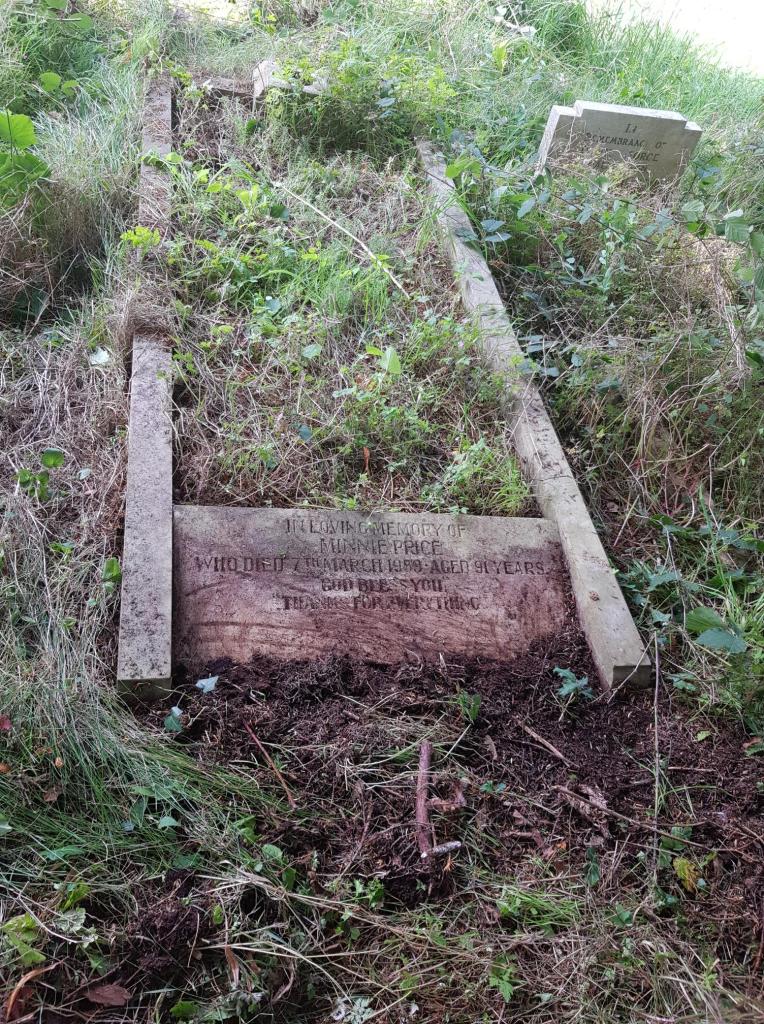
Minnie Price could so easily have slipped out of the pages of history. As a single woman she left no children to tell her story, but she did leave someone who remembered her with affection and made sure the world knew of their gratitude.
In loving memory of
Minnie Price
who died 7th March 1959 aged 91
God Bless You
Thanks for everything
Minnie was born on July 19, 1867 the daughter of John Price, a pudler in the GWR Rail Mills, and his wife Mary. By 1881 13 year old Minnie was out at work, employed by James Chisholm Wilson, a grocer with premises at 72 Regent Street. James’s wife Jane had recently given birth and young Minnie was employed as a nurse to care for both mother and child.
Minnie continued to live a life in service and in 1911 she was working as a housekeeper and recorded as a visitor at Richard Smith’s home in Didcot. Visiting with her was 10 year old Clifford Eugene Price. Clifford was born on November 19, 1900. He can be found on the 1901 census living in Barry – the 5 month old son of Arthur Price and his wife Jane. Arthur Price was Minnie’s elder brother.
The 1911 census finds Arthur back in Swindon and living with his father at 68 Curtis Street. Widower John Price is 82 years of age, a retired labourer who has several boarders living with him. Arthur is 49 years of age, also a widower and in 1911 has no job. He died in 1926 but cannot be found in the Radnor Street Cemetery burial registers.
In 1915 Clifford Eugene Price is also living in Swindon when he began work as a Machine Boy in the GWR Works Loco factory. By 1917 he was working as an engine cleaner and in 1918 he was a fireman, well on his way to becoming a loco driver. From July to September 1938 he was employed as ‘acting driver.’ At the time of the 1939 census he was living at 68 Curtis Street with Minnie and he states that he was working as a Loco Engine Driver. But by 1946 his mental health had taken a downward turn. His employment records reveal that at his regular annual medical examinations he suffered from ‘neurosis’, ‘nervousness’ and ‘nervous exhaustion’.
Clifford lived with Minnie for most of his life and I feel sure that he was the person who chose those words on her gravestone.
God Bless You
Thanks for everything
Minnie died at her home 48 Euclid Street and was buried in Radnor Street Cemetery on March 11, 1959. She shares this plot with her mother Mary, who died in 1900 and her father John, who died in 1920.
Clifford died at 48 Euclid Street on July 21, 1972. He is not buried in Radnor Street Cemetery.
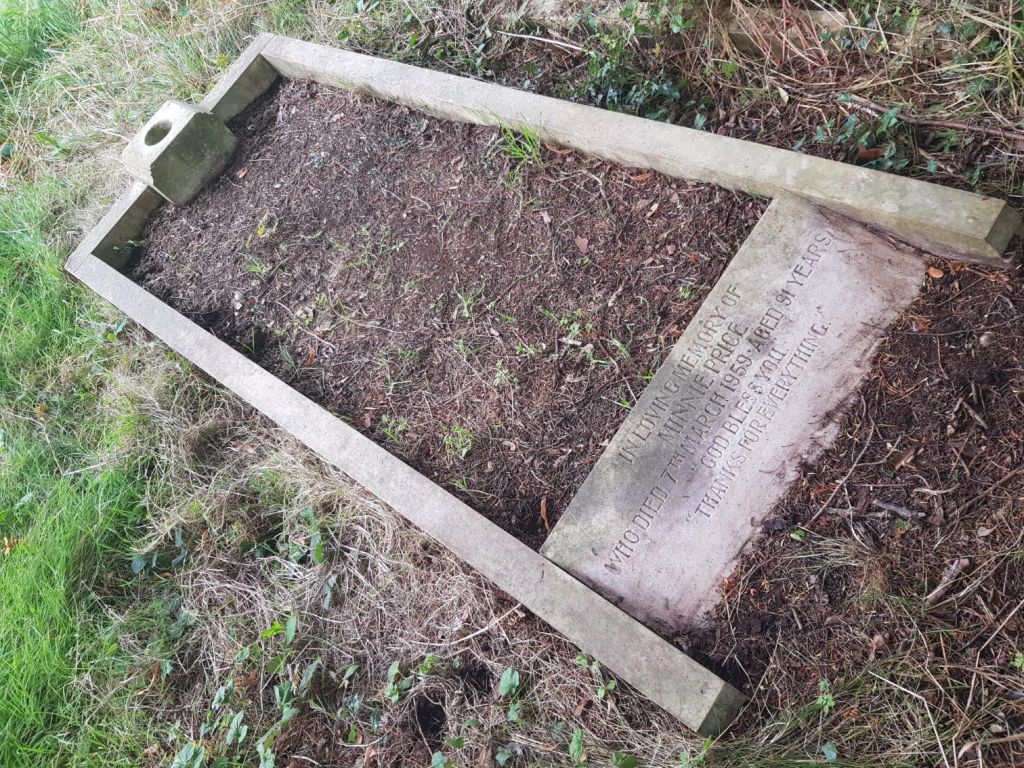
This gravestone, recently cleared by one of our cemetery volunteers, has saved the story of both Minnie Price and her nephew Clifford.
Our cemetery volunteer has returned and completed the clear up of Minnie Price’s grave.
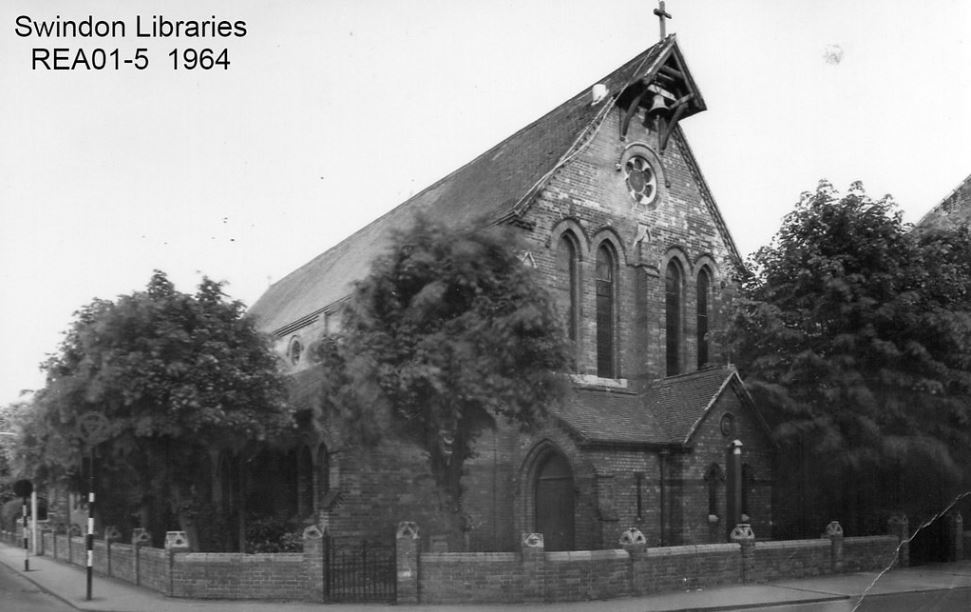
St Paul’s Church, Edgware Road, Swindon published courtesy of Local Studies, Swindon Central Library
You could be forgiven for never having heard of St Paul’s Church. It used to stand on the Woolworth’s site, although that won’t help you either as that store too has disappeared from Swindon’s town centre.*
The church of St Paul was designed by Edmund Ferrey and built in 1881 with a chancel added in 1883. St Paul’s served the myriad of town centre streets – Regent Place, Brunel Street, Gordon Gardens and others – all demolished during the 1960s re-development. An estimated population of 4,500 people were moved to housing estates on the outskirts of town and the prime retail site went on the market at £90,000. The church was demolished in 1965 when the valuable plot was acquired by F.W. Woolworth & Co. The St. Aldhelm’s Chapel stands on a small section of the former church plot.
The Rev Hanworth Hart Rackham arrived in Swindon following the death of Rev Douglas Ware in 1899. Born in Liverpool in 1860, Hanworth Hart Rackham was the son of Matthew Rackham, a Shipping Master Board of Trade, and his wife Katherine.
Swindon Clergyman’s Death
Rev. H.H. Rackham Passes Away in His Church
Death on Saturday evening carried away one of Swindon’s best-known clergymen, the Rev. Hanworth Hart Rackham, who had ministered as vicar of St. Paul’s parish for nearly 16 years. Happily there had been no long weary struggle for life, for the passing took place suddenly during vespers on Saturday evening in the church which he loved so well. It was a wonderfully peaceful end, and those who stood around the remains noted how the face was illumined with a happy smile.
Comparatively few of the congregation heard the sad news on Saturday night, and were greatly shocked with the intelligence which greeted them on reaching the church on Sunday morning.
Mr. Rackham, who was a native of Liverpool, was 55 years of age. He was educated at Worcester College, Oxford, where he took the BA degree in 1889 and the MA degree four years later. He was ordained deacon at Coventry, in the Worcester Diocese, in 1890, and priest in 1891. The first ten years of his ministerial life he spent as a curate at Kidderminster, where he had charge of a district church; but on the death of the Rev. D. Ware, he was presented by the Bishop of Bristol to the living of St. Paul, New Swindon, where he continued to labour until the moment of his death.
The late Vicar of St. Paul’s was a man of remarkable energy, which he displayed almost to the last, despite the fact that he suffered severely at times from disease of the heart. On taking charge of his parish he found its finances far from satisfactory, and he has left them thoroughly sound, besides building the Dowling Street Mission Hall and a new vestry to the church. This he accomplished owing to his splendid persuasive powers and his great faith in voluntary effort. He inaugurated in the parish a scheme of regular voluntary contributions, called the Sacred Treasury, to which members of the congregation undertook to subscribe week by week such sums as their means enable them to afford. The scheme soon became the backbone of the church’s finances in this thoroughly working-class parish. The outstanding feature of Mr Rackham’s work was not merely his energy, but his personal influence, which has been shown by the fact that his advice on spiritual matters has been sought by people living in all parts of England.
At St. Paul’s Church on Sunday morning, and again in the evening, when there was a large congregation, the Rev. H.J.W. Wrenford, in place of a sermon, made a short statement concerning the late Vicar’s passing. There was nothing in his condition to make one apprehensive that the end was coming. He was, as he had been on many previous occasions, obviously in pain and short of breath; but all through the day he was cheerful and bright, as he always was, surmounting all his pain and trouble. In the morning he was for a short time tending his roses in the garden, which showed that he was happy. Just before evensong, which he conducted in his usual bright and happy way, he came into the vestry, and we noticed that he paused for a moment, as he had often done before, to gain his breath. He went into the church to say evensong. He said the Confession and Lord’s Prayer. We noticed that he seemed in pain. We started the Psalms, and we had just finished the first of the Psalms for the evensong, which closed with the words “Put not your trust in man; put your trust in God, for vain is the help of man.” As soon as we had said these words he quietly collapsed on the floor. We did what we could to help him, but it was of no avail. It was God’s will; his time had come. I am sure of this – that he seemed to be conscious of no pain. It was certainly the most peaceful passing that one can imagine that one had ever seen. Immediately after he had passed from this world he lay with a smile on his face. I noticed that particularly, so I think we had great cause for thankfulness to God. We thank God that He gave him just the kind of death that he would have desired. Our Vicar, as you all know, would prefer to die in harness. I am sure there was no way in which he would sooner have passed from the world than in the presence of God in His Sanctuary.”
At the Cemetery
Thousand of people lined the streets as the coffin was taken up the steep declivity to the Cemetery, by way of Regent Circus, Eastcott Hill and Dixon Street. Such a funeral procession has probably never before been witnessed in Swindon. It stretched in a close line from St. Paul’s Church to the Town Hall.
The grave had been dug on the high ground near the Church of England chapel,** and in order to keep back the general public a large space was roped off and guarded by policemen.
Extracts from the North Wilts Herald, Friday, January 28, 1916.
Hanworth Hart Rackham 55 years old, priest of Edgware Road Vicarage was buried on January 27, 1916 in grave plot E7370 where he lies alone.
The Rev. Rackham’s grave has recently been rediscovered in Radnor Street Cemetery.
*The former Woolworth’s store is now occupied by OneBelow discount shop and Peacocks.
**The cemetery chapel was a non-denominational chapel.
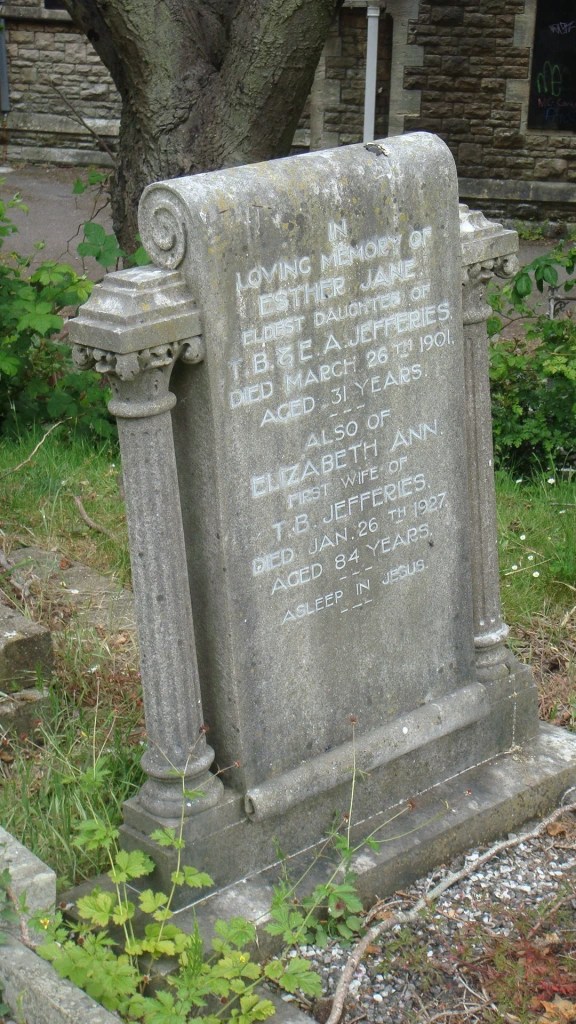
I chose to research this grave because I liked the typeface and all the funeral symbolism on the headstone.
A scroll can mean a number of things in headstone iconography including a love of learning and a religious belief, which is very appropriate for this family. It can also mean a life cut short with the past rolled up and the future yet to unfurl. This would make sense when you note that Esther J. Jefferies, the first person buried in this grave, was only 31 when she died. The pillars either side suggest an entrance and this symbolises an entry into heaven. At the top of the pillars are acanthus leaves, which have several interpretations symbolising the prickly journey of life to death and also enduring life. So, there’s a lot going on with this headstone.
Elizabeth Ann was born in Cricklade in 1843. She worked in service as a young woman before marrying Thomas Bennett Jefferies, a slater and plasterer. Their first home was in Wootton Bassett where Thomas was born. By 1891 they had moved to 18 Union Street, Swindon where the elder sons were now apprentice plasterers.
The 1911 census finds them at 165 Victoria Road and on this census we get some more details about the family. Thomas and Elizabeth had been married 42 years during which time they had 10 children, four of whom had already sadly died. And then I found a fantastic photo of the couple’s five sons, thought to have been taken at the wedding of their sister Ellen to Harry Frederick Keene in 1906. They are pictured in order of seniority left to right – Joseph, Thomas, John, Winfrith Frederick (usually referred to as Fred) and Charles Wesley.
Eldest son Joseph Page Jefferies emigrated to Australia with his family in around 1913. Following his wife’s death, he married for a second time in 1936 in Sydney, where he died in 1939. The couple’s third son, John Nelson became the assistant borough surveyor here in Swindon and in 1903 lived at 2 Hunt Street.
Death of Mrs T.B. Jefferies
With the death of Mrs Elizabeth Ann Jefferies, of 1 Durham Street, there has passed away one of the best known figures in Wesleyan Methodism in the town. Mrs Jefferies, who was 84 years of age, was a native of Cricklade, being the daughter of Mr and Mrs Joseph Page. She married Mr Thomas Bennett Jefferies at Purton Parish Church on September 26th, 1868, and the couple came to live in Swindon 46 years ago. Mr Jefferies is the oldest local preacher on the local Wesleyan plan, and although he has been preaching for over 60 years he continues to take appointments.
Mrs Jefferies was taken ill with influenza, and pneumonia supervened with fatal results. The funeral took place at the Central Mission Church on Monday, and was conducted by Pastor A.E. Stocking, assisted by the Rev. W. Kelson and the Rev. H.B. Turner. The committal rites at the Cemetery were performed by Pastor Stocking. Among the mourners were Mr T.B. Jefferies (widower), Messrs. Thomas Henry, John Nelson and Charles Wesley Jefferies (sons), Mrs Ellen Elizabeth Keene (daughter) Mrs Eliza Priscilla Jefferies (daughter-in-law), Mr Joseph Jefferies (son-in-law), Mrs Cottrill (half-sister), Mr Jesse Jefferies and Mr E. Jones (representing the local preachers of the Circuit).
North Wilts Herald, Friday, February 4, 1927.
Thomas Bennett and Elizabeth Ann Jefferies
Esther Jane Jefferies (Thomas and Elizabeth’s eldest daughter) was the first person to be buried in grave plot D109. She died in 1901 aged 31 years old. Elizabeth Ann Jefferies (Thomas’s first wife) was buried with her daughter on January 31, 1927. Next came Ellen Jefferies (Thomas’s second wife) who died in 1931 and finally Thomas Bennett Jefferies who was buried on April 18, 1932.
In recent years the Radnor Street Cemetery chapel has become a repository for rescued and recovered war memorials. Ten years ago Mark Sutton was instrumental in seeing the Sanford Street School War Memorial removed to Radnor Street Cemetery Chapel from the then empty school building where it was considered to be vulnerable. Then in 2015 a memorial to 19 Gorse Hill men who died during the First World War might also have been lost forever until rescued by Mark. In subsequent years more plaques and memorials have been deposited in the cemetery chapel.
During our next guided cemetery walk we will be unveiling another war time relic that was in danger of being lost to the history of Swindon.
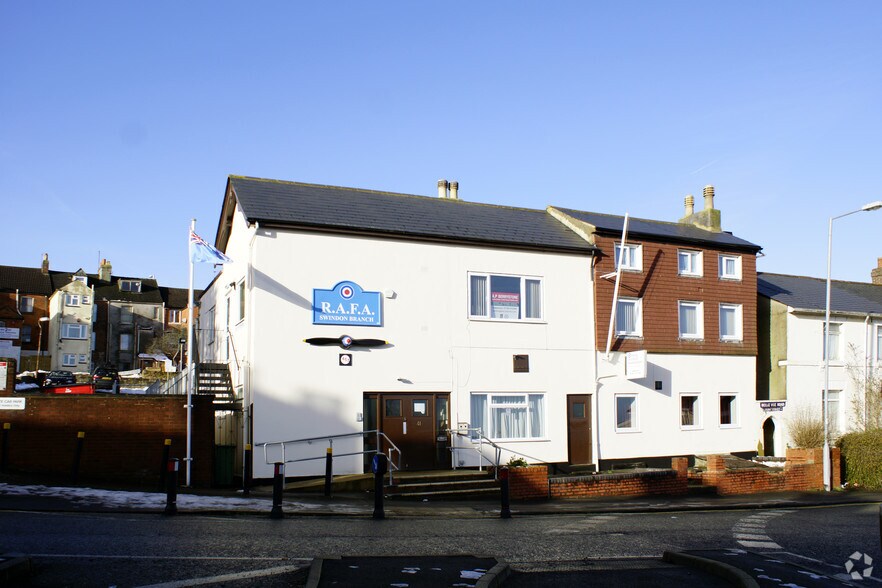
Following the closure of the RAFA Club in Belle Vue Road the propeller mounted on the front of the building faced an uncertain future. Then a group of concerned Swindonians, among them Carole Bent, Neil Robinson, Toby Robson and Graham Carter, stepped in.
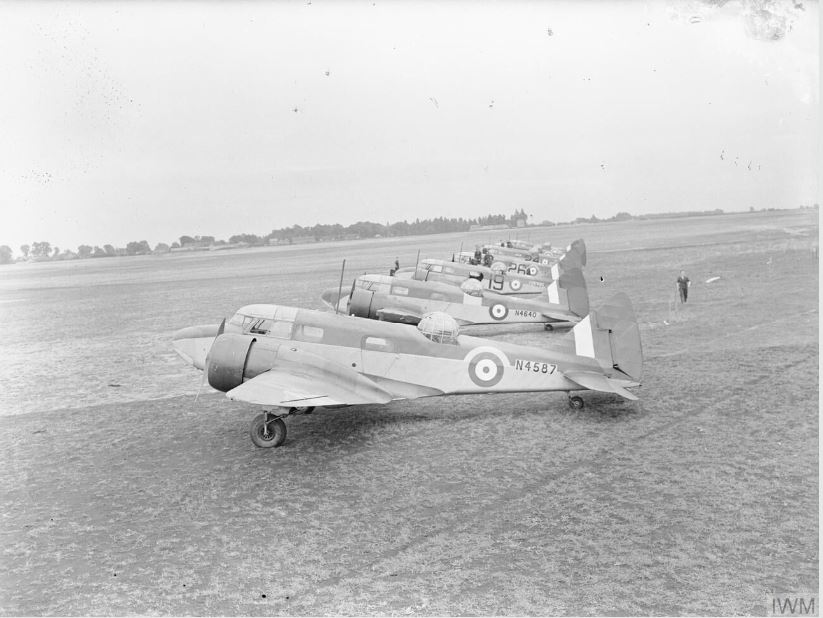
The propeller, which has been identified as belonging to an Airspeed Oxford – a trainer for RAF bomber aircrews, has now been installed in the cemetery chapel and will be unveiled by Air Commodore Tony Keeling OBE, Commandant Royal Air Force Air Cadets.
‘I’m delighted to see this propeller returned to display in Swindon. This is a visible celebration of the historic links between the town and the Royal Air Force. I am most grateful to the members of the local community who made this happen. Thank you.’
Following the unveiling our walk will follow a military theme during which we will visit the graves of several airmen who served during both World Wars and are buried in the cemetery.
Join us outside the cemetery chapel on Sunday August 13 for the unveiling at 2 p.m.
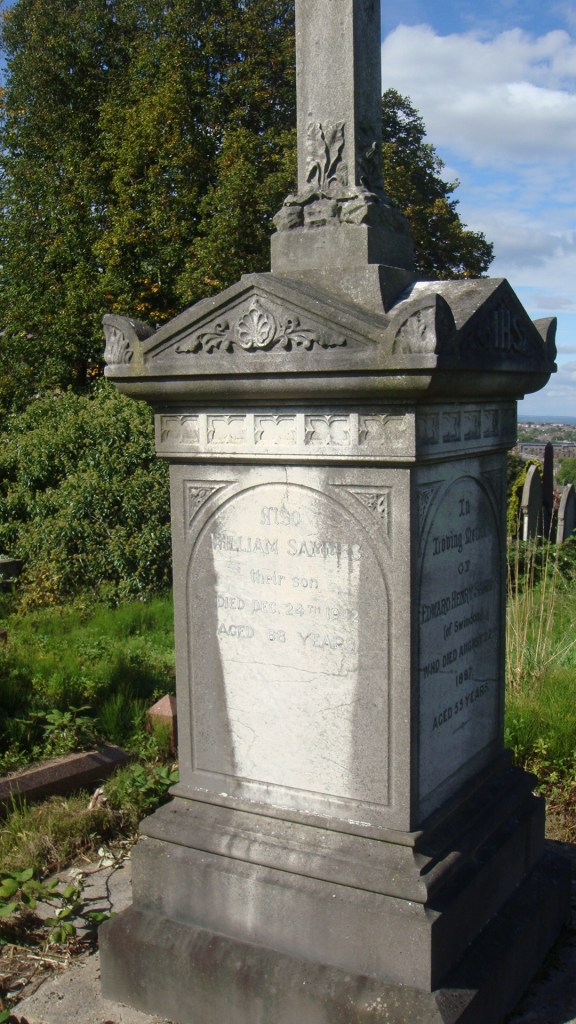
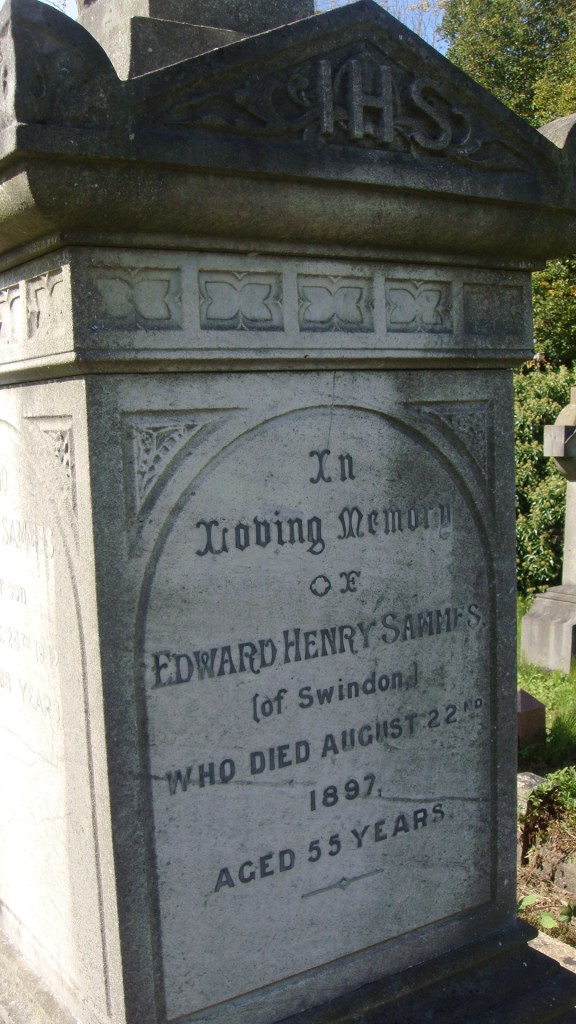
This is the last resting place of Edward Henry Sammes. It’s interesting that his family should make a point of adding ‘of Swindon’ to the inscription because Edward was not Swindon born.
Edward was born in Lambeth in January 1842, the son of William and Sarah Sammes.
The first reference to Edward being in Swindon is in the 1871 census when he is 29 years old and living a 1 Belle Vue Road where he describes himself as a grocer. That same year he married Sarah Anne Spackman from Wootton Bassett and the couple had two children William and Millicent, who are both buried here as well.
By 1889 he was a member of the Old Swindon Local Board, so well placed to know plans for development in the town. The family were by then living at Wycliffe House in Devizes Road.
In 1892 Edward submitted a planning application to build 8 houses on the corner of Kent Road and Maidstone Road. The building specifications for Edward’s houses describe three bedrooms, a parlour, sitting room, kitchen, conservatory, scullery, WC, coals and pantry.
This area of Kingshill was pretty much one big building site during the 1890s. The land had originally come on the market in the 1870s with the death of John Harding Sheppard but development was slow to take off. However, by the 1890s numerous speculative builders had snapped up the building plots and were busy at work. A map of Edward’s project shows an empty site next door on the corner of Kent Road and Ashford Road with another empty site opposite. At the other end of the road rival builder William Chambers had a yard opposite his own development at Ashford Terrace.
Edward died in 1897 aged 55. He left £5,814 18s 6d to his widow Sarah and son William, worth today somewhere in the region of £2.7 million.
I’m not sure if his son William ever worked or whether he lived off his inheritance. In 1911 William 35, was living at 31 Devizes Road, with his sister Millicent 27. Both of them were living on ‘private means’.
Local historian David Lewis has been able to add a some further information.
Edward Sammes lived at 31 Devizes Road “Wycliffe” in 1895 according to the Kellys directory as a private residence. Millicent was still there in 1951. Sometime in the 1960/70s, it became the Spiritualist Centre.
“Yes, used to live in King Street, before his wife died.”
“No, I don’t remember him.”
“Yes you do – we always thought she was a lot older than him. Turned out there was only two years in it. We talked about it.”
“Did we?”
“He married again just a few months after she died. Don’t you remember?”
“No, I can’t say I do.”
“He moved up to Gorse Hill. We all reckoned his new wife had a bob or two.”
“Oh yes, I remember now. She was older than him.”
“No, that was his dead wife. His last wife was much younger than him. Give me strength – I think you’re losing your marbles.”
“No, I do remember him now. Moses Willoughby. Used to live in King Street. Moved to Gorse Hill.”
“Yes, that’s him. Well he’s dead.”
Early 20th century photograph of Cricklade Road published courtesy of Mr. T. Midwinter and Local Studies, Swindon Central Library.
The facts …
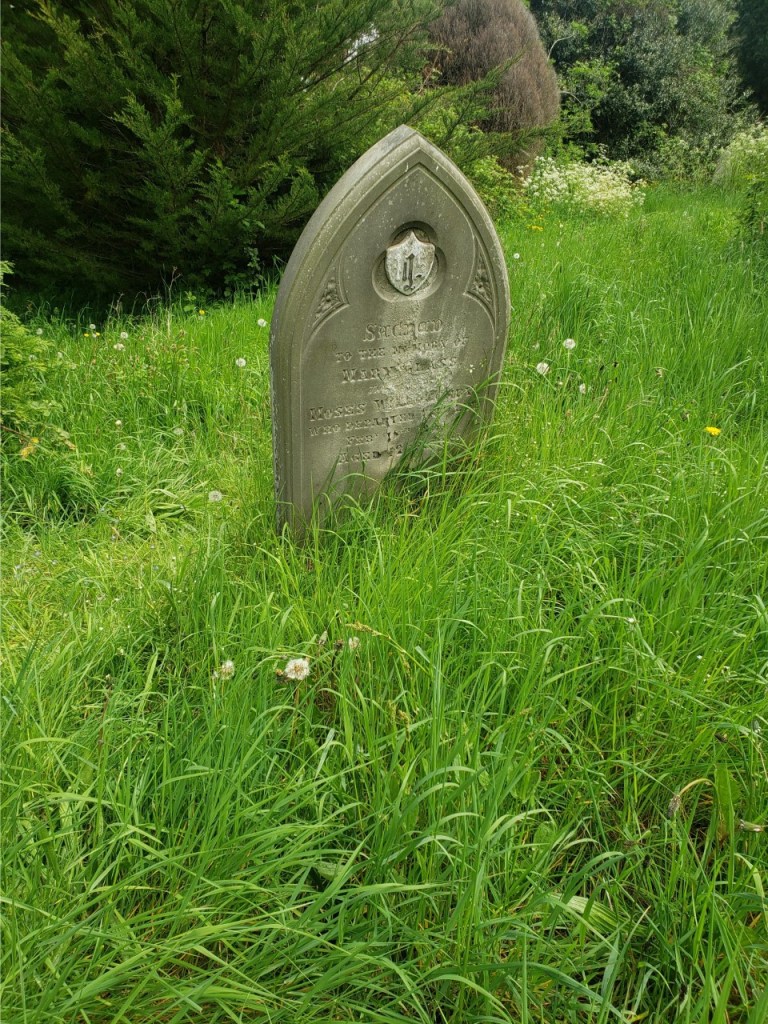
Thanks to the numerous genealogical resources available online it is now possible to piece together the history of those buried in Radnor Street Cemetery, even when the inscription on the headstone has deteriorated.
Moses Willoughby was born on October 22, 1818 and baptised in Highworth. He was the son of Charles and Ann Willoughby and grew up in Eastrop.
He married his first wife Ann Lay in Highworth on November 21, 1840. Their son John was baptised in Highworth on February 6, 1842.
Ann died in 1847. On the 1851 census Moses, 28 was working as an agricultural labourer and living at Bailey’s Piece, Highworth with his ten year old son John.
In 1855 he married for a second time. His bride was Mary Glass and the couple married in the parish church at Purton. They had a daughter Emily Kate baptised at Highworth on June 22, 1857. However, at the time of the census in 1861 there is no mention of Emily Kate, nor John, although he could well have left home/married by then.
By 1871 the couple had moved to Swindon and were living in Cetus Buildings on the canal side where Moses continued to work as a farm labourer. Moses declared that he was 46 and Mary 48.
At the time of the 1881 census Moses was employed as a factory labourer, almost certainly in the railway works. He states that he is 60 and Mary is 62.
Mary died at their home 3 King Street in February 1890, she was 72 years old. The funeral took place on February 19 when Mary was interred in plot A790.
On July 16, 1890Moses married for the third time. His wife was Mary Ann Haskins, a 49 year old spinster. At the time of the 1891 census the couple were living at 255 Cricklade Road, Gorse Hill. Moses was still working as a General Labourer in the GWR Works and they had two lodgers, both labourers in the Works.
Moses died on March 9, 1892. He left effects valued at £84 0s 7d to his widow Mary Ann Willoughby. He was buried three days later in Radnor Street Cemetery in plot A790, which he shares with his second wife.
Attempts to trace John Willoughby and his half sister Emily Kate have so far been unsuccessful.
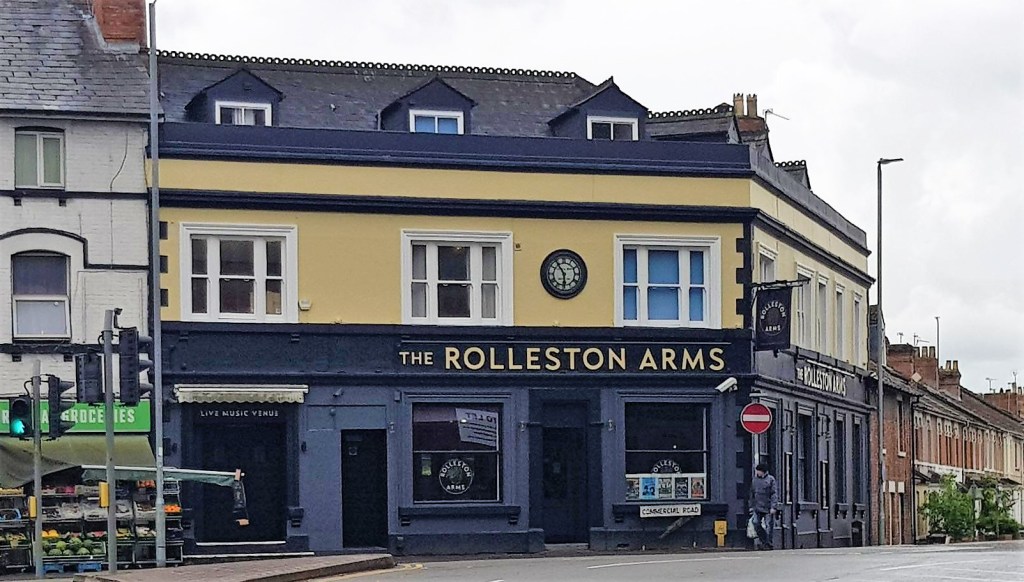
Today the Rolleston Arms is looking very smart with a new coat of paint and new signage. John Horsell, responsible for developing the new Rolleston Estate in 1890, was the first landlord. Charles Iles was landlord for more than 10 years until his death in 1938.
The Late Mr C.E. Iles
Funeral of a Swindon Licensee
The funeral of Mr Charles Edward Iles, licensee of the Rolleston Hotel, Swindon, who died after a long illness, on 21 March, took place last Thursday afternoon. The service at St Paul’s Church was conducted by the Vicar, the Rev. C.F. Harman, who also officiated at the interment in Radnor street cemetery.
Mr Iles, who leaves a widow, was a native of Swindon, and was 46 years of age. As a youth he was apprenticed as a boilermaker in the GWR Works, and served in the Royal Navy as an artificer from 1914 until 1920 when he was invalided out of the service.
He was licensee of the Foresters, Stroud, for three years, before taking over the Rolleston Hotel, where he has been for the last 12 years. Mr Iles was a member of the Western District United Service Lodge No. 2258 and Chapter Eliot.
The chief mourners were: Mrs Eva Iles (widow), Mr Charles E. Iles (father), Mrs Lawrence (aunt), Miss T. Gascoyne (friend), Mrs D. Kent (sister in law), Miss C. Warren (sister in law) Mrs Wenban (aunt), Mr A. Gerring (cousin), Mr H. Kent (brother in law), Mrs H. Kent and Mrs W. Harris (sisters in law), Mr Eli Mort, Mr J. Coster and Mr Harry Waters (uncles), Mr B. Menham, Mr W. Gascoyne, Mrs W. Gascoyne, Mr Johnson, Mr Cavel (representing Golden Carp Angling Association), Mr and Mrs C. Salmon, Mr Graham Davies, Mr Hayball, Mr J. Spackman and Mr N. Davies (representing Swindon Licensed Victuallers’ Association), Mr H.A. Reeves, Mr G. Beburn, Mr G. Wakefield, Mr F. Burchell, Mr Glass, Mr R. Matthews (representing Cirencester Brewery Co. Ltd.), Mr Halfpenny, Mr Charlie Baxter, Mr Watson and Mr Gilbey (representing A.S.E.).
Funeral arrangements were carried out by Messrs A.E. Smith and Son, 24, Gordon road, Swindon.
North Wilts Herald, Friday, 1 April, 1938.
Charles Edward Iles was buried in grave plot A352 on March 26, 1938. This was previously a public, children’s grave and two burials took place in the first year the cemetery was opened. Three year old Tom Wootton was buried here on October 20, 1881 and the following day Violet Lilian Murray aged 2 was buried in the same plot. The Iles family purchased the grave plot more than 50 years later when Charles died. His wife Eva remarried in 1941 and was buried with him when she died in 1979.
Every cemetery should have a cat – and we used to have one.
We never knew where he lived, only that it was somewhere local – maybe Kent Road or Clifton Street or perhaps Radnor Street itself. Most days he would be in the cemetery, prowling through the long grass on his deathly, daily business; stalking the wildlife. He barely acknowledged us and we never approached him – he wasn’t that kind of cat. He had a distinctive face and we had a nickname for him – too controversial to reveal here.
And then one day I saw his photograph on a local vet’s Facebook page, like a fugitive on a wanted poster – Found in Radnor Street Cemetery – some well meaning animal lover had captured him and deposited him at the vet’s.
We wondered if he would ever find his way back home, and more importantly, back to the cemetery.
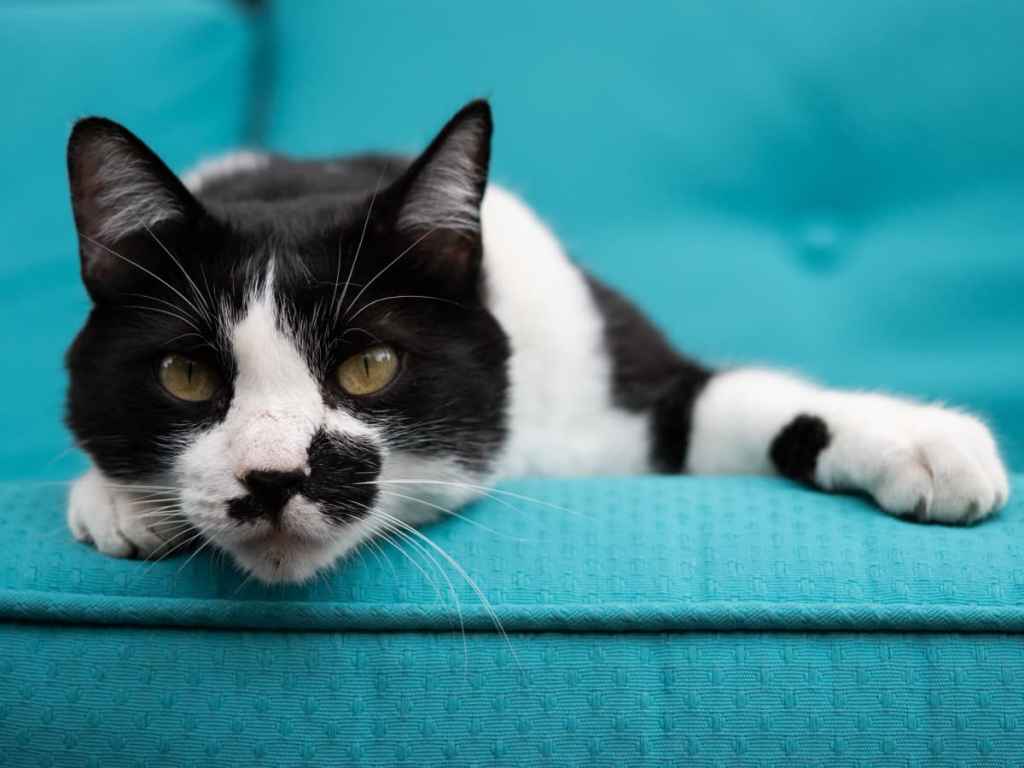
Every cemetery should have a cat. We had one once. He looked a bit like this – only more menacing.
And just when I thought I’d seen all the Alley family photos, along came two more.
George Richman Alley was born in Trowbridge in 1841, the son of Job Alley, a dyer. He moved to Southampton in around 1860 where he worked as a Coach Body Maker and in 1865 he married Emma Jane Ross, the daughter of a mariner. By 1881 they had moved to Swindon where George worked as a wheelwright body maker in the GWR Works. The couple lived first at 3 Carfax Street and then at 8 Merton Street where George died in 1925. Emma survived him by seven years.
George and Emma had one son, George pictured in the back row of this photograph, and seven daughters. Four of the daughters lived into their 90s and one reached her 100th birthday. Only one of the daughters left the Swindon area, of the other six, four went into business in the town.
Eldest daughter Emma trained in London as a ladies tailor before her marriage to Walter Lloyd Hull, a Bournemouth shopkeeper.
Following her husband’s death in 1947 Emma returned to live in Swindon. Then in her 80s she became a member of the Swindon Business and Professional Women’s Club and was active in many other organisations in the town, including the Richard Jefferies Society and the WEA.
In 1954 Emma gave a talk to the Women’s Club about her involvement with the suffrage campaign. when she had been an active member of the Women’s Freedom League and was arrested on several occasions and imprisoned. At these talks she was said to have worn a badge carrying an engraving of Holloway prison pinned to her dress. Other suffragette souvenirs she had were a cocoa mug and a salt pot smuggled out of Holloway and a Votes for Women banner.
Second daughter Maud, a dressmaker and upholsterer, married Henry John Lewis, a bootmaker and moved to Chippenham. Third daughter Mabel held the role of Postmistress at Westcott Place for more than 50 years and on the New Year’s Honours List of 1960 she was awarded the British Empire Medal in recognition of her service to the community.
Fourth daughter Amelia Ann, the only daughter to never marry had a milliners business at No. 90 Victoria Road which she ran with her sister Ethel (sixth daughter) until she married Wilfrid Hewer and together they ran the Oddfellows Arms in Cricklade Street. Fifth daughter Flora became a teacher. She married William Harold Hall and lived at 42 County Road.
Youngest daughter Eva pictured standing between her parents, married George Babington on March 1, 1911 at the Baptist Tabernacle. Eva and George ran a draper’s shop at 92 Victoria Road, next door to her sister Amelia’s millinery shop.
The following photograph was published following the death of George in 1925.
In reference to the death of Mr George Alley, of Swindon, the above photograph of members of the family is of interest from the fact that all were over 80 years of age. Left to right: Mr George Alley (85), Anna Alley (86), Louisa Alley (82), Martha Blatcher (84), and Fred Alley (80). Of the present living members the Misses Anna and Louisa Alley live at The Halve, Trowbridge, and Mr Fred Alley at 8 Merton Street, Swindon.
North Wilts Herald, Friday, December 4, 1925.
And so perhaps the reporter from the North Wilts Herald got a fact or two incorrect. With an exuberant and irrepressible family such as the Alley’s it’s easy to get confused.
The Late Mr G. Alley
A Well-Known Resident of Swindon
By the death of Mr George Richman Alley, of Merton Street, Swindon has lost one of its best-known residents. Deceased, who was 84, came to Swindon from Salisbury 51 years ago, when he entered the service of the Great Western in the Carriage Department. For nearly 25 years he was in charge of the road wagon department and he relinquished his position as foreman 18 years ago, when he entered upon a well-earned period of retirement. Had Mr Alley lived until Christmas he and his wife would have celebrated their diamond wedding, and a pathetic feature of his demise is that one of his daughters was at home at the time making preparations for the celebrations. Deceased leaves seven daughters, five of whom reside in Swindon, one in Bournemouth and one in Chippenham. His only son is a retired naval engineer, and lives in Suffolk. Deceased’s only brother, Mr Fred Alley, who is 80 years old, is the secretary of the GWR Retired Workmen’s Association. He celebrated his diamond wedding 12 months ago.
The funeral took place on Tuesday, a short service being previously held at the house. The coffin was followed to the graveside by deceased’s only son, his six sons-in-law, representatives of the Foreman’s Association and the Baptist Tabernacle.
North Wilts Herald, Friday, December 4, 1925.
George Richman Alley died aged 84 years at his home 8 Merton Street. His funeral took place in Radnor Street Cemetery on December 1, 1925. He was buried in grave plot D31A. Emma Jane Alley died aged 87 at 12 Park Lane and was buried with her husband on October 29, 1932.
My thanks, as always, to the lovely Alley ladies Di, Kay, Wendy and Christine for sharing their information and their photographs.










 Radnor Street Cemetery