Before he died on September 27, 1918 Charles Godfrey Montague Deacon had his family firmly on his mind.
Charley was born in 1886, one of William and Rose Deacon’s seven children. He grew up at 4 Western Street where William worked as a brickmaker. When Charley left school he became an assistant in an ironmongers.
Like so many others, Charley’s military records are lost, but we know that he served as a private in the 15th Battalion Lancashire Fusiliers and that he died of his wounds (Gas) in one of the Exeter War Hospitals. He was 33 years old.
The UK Army Register of Soldiers’ Effects 1901-1929 reveal an account of Charley’s money and where he wished it to go.
He left £35 3s 9d (about £35.15) and with no wife or children he divided his money between members of his family. To his widowed mother Rose he left £5 0s 7d (about £5.03). He left the same amount to each of his two surviving brothers, Irving Tom and Percival Oscar. To his sisters Daisy, Flossie and Hilda (the wife of Thomas Mott), he left £5 0s 6d each (about £5.02).
His last two bequests reveal another family tragedy. In the autumn of 1916 Charley’s brother Louis Stanley Deacon was ‘found drowned.’ He left a wife and several children. Charley left £3 7s (about £3.35) to ‘GW Bizley Guardian of children of Bro Louis’ and £1 13s 6d (about £1.67) to his nephew Sidney.
Charley gave his life for his country and the money he had saved to his family.
Charles Godfrey Montague Deacon was buried on October 2, 1918 in plot number B2819 which he shares with his brother Louis, his father William and his mother Rose.
Today I’m returning to the story of Georgina Verschoyle and although I am no nearer to understanding how or why she came to be living in Swindon, I do know more about her life here.
A view of St Mark’s Church taken from Radnor Street Cemetery
Following her death a lengthy obituary was published in the parish magazine of St. Mark’s Church.
Requiescat in Pace
Miss Verschoyle died on Dec. 20, and was laid to her rest in the Swindon cemetery on Sat., Dec. 23rd. Her health had been failing for several years, and though the end did not seem near to her friends, she was not strong enough to stand against a bad attack of Influenza, that scourge of our country at the present time.
Many who read these lines, perhaps far away now, will remember the time when she came to Swindon thirteen years ago. In those days Church life was just starting in S. Mark’s Parish. She threw herself with untiring energy into the work as a volunteer helper, and indeed continued as such to the end.
Before she had been in the parish many weeks she obtained the Vicar’s permission to commence a Bible Class for Men. The attempt was a decided success. A good number joined at once, and between 50 and 60 men have assembled, while on one of the last occasions when she presided over her Class at the new Parish Rooms, over seventy men were in attendance.
During the whole of the same period she has conducted a large Mothers’ Meeting, and for the last few years a Bible Class for Women at S. John’s. Unlike many of the kind, these classes have never diminished in the numbers of those attending them. People who have experience in such matters know well that classes such as these can only be kept together for so long a period by diligent and unceasing work and earnest prayer.
It is however in the District that we think that Miss Verschoyle’s work has chiefly been done. Well trained in Church work in earlier days at Clewer, Guildford, Market Drayton, S. Giles’, Reading, and S. Luke’s, Torquay, she had attained the habit of regular and systematic visiting. From early morning to late evening she was to be seen every day in all weathers going to all parts of the parish amongst the sick and the whole, bearing the message of comfort. Her daily visits to the dying were a striking feature of her work. Many a one in Paradise will, we believe, thank God for that regular earnest teaching which helped to bring the soul out of darkness into the light of Christ, while many a one living now, who may read these words will gratefully acknowledge that the turn in his life was due to her sympathy and help.
Miss Verschoyle knew the secret of success, viz., that no work for God can prosper unless His help is sought. She was regularly to be seen in her place at the daily Services of the Church, gathering strength into her own life, that she might be the better able to impart it to others. Indeed the Church was very dear to her; she enriched it with many costly gifts, and as each Festival came round, she spent time, money, and labour in decorating the Font with flowers.
We need scarcely say that she was beloved and respected by those amongst whom she worked. While we thank God for her work in the Parish, let us pray to Him to send to our Parish other such workers, and let us ask Him to give us grace to profit by her teaching and example, that when the great day comes, we may be found worthy to be on the King’s right hand among those to whom the word of comfort shall be spoken, “Come, ye blessed of my Father, inherit the kingdom prepared for you from the foundation of the world.
InsideSt Mark’s Church, Swindon
The Late Miss Verschoyle.
Dear Friends,
It has been suggested to me that some of those who have known Miss Verschoyle and her work in the parish may like to place some kind of memorial to her in S. Mark’s Church, where she was so constant a worshipper. I do not think it would be suitable to have an organised collection for such a purpose as this, but if any of those who read these words like to send a contribution, great or small, I will very gladly receive it. The nature of the memorial must be decided by the amount contributed. Yours truly, Maurice Ponsonby.
Throughout the year fund raising updates appeared in the parish magazine until in November the Rev. Ponsonby declared it was probably time to close the account and think about how the money should be spent.
I wonder if anyone can tell us what kind of memorial was chosen for Miss Verschoyle and whether it still survives in St. Mark’s today.
Fr Toby from St. Mark’s has sent the following words and kindly offered to provide a photograph.
The memorial is a window in the south aisle depicting Matt 15.28. The dedication on a plaque underneath reads: “This window is given by many friends in grateful memory of Georgina Verschoyle who fell asleep on Dec. 20th 1893 after 13 years of unceasing labour for God in this parish. Requiescat in pace.”
Clara Ellison had taught at Even Swindon School for 25 years when she resigned in 1908. Then aged 48 she might have expected to remain in post for a few more years. There is no mention that she was suffering from poor health so we have to ask did her husband’s bankruptcy case influence the members of the Swindon School Board?
Clara Illidge Shelton was born in 1860 in Birmingham, the daughter of William Shelton, a cab driver, and his wife Elizabeth. By the time of the 1881 census Clara was living in Eastbourne where she was employed as an assistant school mistress and lodged with William Cole and his family.
On December 1, 1883 Clara (by then living at 34 Wellington Street, Swindon) married John Ellison, a brass finisher in the Works, at St. Mark’s Church. Even Swindon Infant School was built in 1884, which is the earliest date at which Clara could have been teaching there. By 1891 the couple were living at 17 Linslade Street where John describes himself as a Brass Finisher and Clara as a School Board Teacher. They had two young sons, Gerald 6, and Wilfrid 4. Clara’s widowed mother Elizabeth lived with the family.
But was there a prejudicial attitude to Mrs Ellison prior to the events of 1908? In 1896 Mr Henry Day (Head Teacher at Even Swindon Mixed School) and Mrs Clara Ellison (Mistress at Even Swindon Infant School) both applied for an increase in their salaries. The School Management Committee initially recommended that they both receive a £10 annual increase whereupon Committee member Mr McRae immediately opposed both applications. In the case of Mr Day there was no seconder but Mr Keene also raised an objection in the case of Mrs Ellison. Some discussion followed when another member, Mr Sewell, entered a protest against Mrs Ellison holding the post, and ‘keeping a single girl out of work.’
But then came the matter of John Ellison’s bankruptcy in 1908 and a recommendation by the Teaching Staff Sub-Committee “that Mrs Ellison, head mistress of the Even Swindon Infant School be given three months’ notice to terminate her engagement.” Swindon Advertiser, Friday, May 22, 1908.
By August 1908 John’s bankruptcy examination was closed and Clara had resigned.
Even Swindon School published courtesy of Local Studies, Swindon Central Library
Presentation – On Wednesday afternoon, at the Even Swindon Infant School, Mrs Ellison, late headmistress, was the recipient of a very handsome pair of bronzes, given to her by the teachers (past and present) on the occasion of resigning her position as headmistress, which post she has held for 25 years. In making the presentation, Miss Witt said how very much they all felt the parting, but they hoped Mrs Ellison would be spared many years to enjoy the rest so thoroughly earned. – In reply, Mrs Ellison, thanking them, said how much she would value their beautiful present, and the very happy time spent amongst them would never be forgotten by her. She wished them every success, and trusted they would all work as happily together in the future as they had always done in the past.
Swindon Advertiser, Thursday, August 20, 1908.
Clara died the following year and was buried on October 1, 1909 in grave plot D128, a public grave, which she shares with her husband who died in 1924 and one other, probably unrelated, person.
The first woman to be employed in the Great Western Railway Swindon Works’ offices is believed to have been Elsie May Calladine. Elsie started work in the Mileage Office on January 1, 1912 aged 14. She is pictured far right at the end of the second row in this fantastic photograph taken in 1916 and reproduced in The Great Western at Swindon Works by Alan S. Peck. New mechanised account systems introduced in January 1913 and an expansion of office space saw increasing numbers of women clerks employed in the GWR Swindon Works’ offices, numbers which escalated during the years of the First World War.
I have been able to trace all of the young women pictured here in 1916 wearing their ‘uniform’ of smart long dark skirt and white high necked blouse with tie strings and bows.
In the second row, third from the right, is Freda Dening, one of two talented sisters about whom I have previously written. In the front row, seated third from the left, is Miss Gladys Florence Alice Noble, supervisor in the Freight Statistics, Addressograph offices and pictured in the centre of the back row is Mabel E. Carpenter, who married her second husband in 1973 when she was 74 years old and he was 89. Her husband was Frederick William Hawksworth, the last Chief Mechanical Engineer at the Swindon Works, who was previously thought to have never married. The couple lived at 30 Tithe Barn Crescent where Frederick died in 1976 and Mabel in 1982.
Pictured at the left end of the third row is Phyllis Mary Peters. Phyllis was born on November 14, 1899, the youngest of four children. Her father John was an engine fitter and the birth place of his children indicate his movement across the railway factories of the north east. Edgar was born in Newcastle and Lucy in Gateshead while Winifred and Phyllis were born after the family arrived in Swindon. Phyllis began work in the GWR Swindon Works’ offices on December 13, 1915, just after her 16th birthday.
At the time of the pre-war census in 1939 Phyllis was living with her widowed mother Lucy at 45 Goddard Avenue where she stated her occupation as that of Railway Clerk. As an unmarried woman Phyllis had been able to continue her career.
Phyllis died at St Margaret’s Hospital on April 14, 1957. She left effects valued at more than £10,000 (a legacy of her many years employed in the Works) to her two nephews, her sister Lucy’s sons.
Phyllis was buried in grave plot E7773, which she shares with her parents and her sister Lucy.
Caroline was born in Trevethin, Monmouthshire in 1859. Her family moved to Swindon in the 1860s following the opening of the Rolling Mills where her father Thomas worked as a Puddler. The family lived first at Bath Street (later renamed Bathampton Street). At the time of the 1881 census Thomas and his wife Sarah lived at 45 Westcott Place with their 9 children. Caroline aged 21 was the eldest and states her occupation as ‘Polisher GWR.’ The youngest child was 3 months old James.
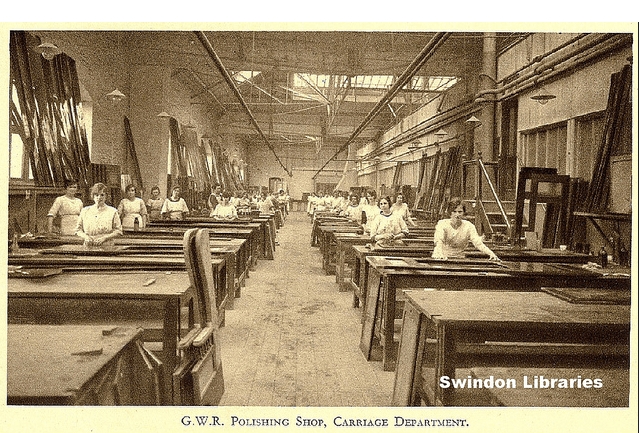
During 1874 and 1875 increasing numbers of women entered the GWR Works employed in the newly created upholstery department. Joseph Armstrong, Locomotive, Carriage and Wagon Superintendent 1864-77, had extended the Carriage Works on London Street and created a separate upholstery department for the employment of girls and unmarried women only. Caroline Shaw started work on November 3, 1875 as a French polisher. French polishing involved stripping back to the basic wood, making good any damage, brushing and sanding and building up the polish again. The women worked on anything made of wood from panels and partitions to toilet seats. Caroline was employed until July 1, 1887 – a week before her wedding on July 9.
Image published courtesy of Local Studies, Swindon Central Library.
Caroline married Henry Whale, a boilersmith, who also lived in Westcott Place, and the couple began their married life at 2 West End Terrace. Caroline never moved far away from Westcott Place, that long road that stretches from Faringdon Road to the bottom of Kingshill. The 1901 census records them living at 152 Westcott Place with their children Carry 12, Mabel 11, Harry 9, Milly 7 and five year old Polly. By 1911 they were at 165 Westcott Place, the home where Henry died in 1930 and Caroline in 1939.
Caroline and Henry are buried with Caroline’s parents Thomas and Sarah Shaw in plot C1107.
What were the events that led up to that fateful Tuesday morning in April 1938? Was Nellie frazzled with four young children under her feet as she tried to get on with her housework? Had she shooed Harold out of the house.
“For goodness sake Harry, get out from under my feet.”
Or had the boy taken advantage of the noise and busyness of the house to sneak out before his mother found him a job to do or an errand to run.
Perhaps Nellie didn’t even notice he had gone until there came a knock on the door.
Hawkins Street in Rodbourne
Swindon Boy Drowned
Fell Into Water Fishing for “Tiddlers”
Nine year old Harold Wall, of 13 Hawkins street, Swindon, went fishing for “tiddlers” in the Great Western Pump House Butts, alongside the Gloucester branch line at Rodbourne, Swindon, just after lunch on Tuesday*. He had not been there long when he fell in the water and was drowned. The water is well over six feet deep at the spot.
Shouts of other youngsters near by attracted the attention of some men working on allotments, and they rushed to the scene. At first they could not find the lad’s body, but eventually grappling irons were brought into use and his body was recovered.
A doctor and the police were quickly on the scene and Chief Officer T.W. Abrahams of the Swindon Fire Brigade, rushed to the field where Harold’s body lay with the oxygen resuscitation apparatus, but the doctor had already pronounced life extinct.
Mr Abrahams responded to a telephone call from Mr S.A. Shaw, of 28 Hawkins street Swindon.
Harold is the son of Mr and Mrs E.F. Wall and it is thought that he fell through the hedge which grows on the very edge of the water and was quickly submerged in deep water.
He was fishing quite near the pumping station at the far end of the Butts.
When the men from the allotments reached the spot where the boy had fallen through a narrow gap at the base of the thick hedge they could not force a way through, and valuable time was lost owing to the need for making a detour round the Pump House.
Mr Wall, the boy’s father, has been employed on the G.W.R. coal wharf.
At the inquest held at Gorse Hill Police Station last night, by the Wiltshire Coroner (Mr Harold Dale) the jury returned a verdict of “Accidental death.” They added that no blame attached to anyone.
North Wilts Herald, Friday, 22 April, 1938.
Harold Charles Wall was born in the December quarter of 1928, the eldest of Ernest Frederick and Nellie Wall’s large family. He was buried on April 22, 1938 in a public grave plot C632 with four others.
*Easter Sunday fell on April 17 in 1938. It is likely the children were on a school holiday the following week.
God’s Wonderful Railway – this colloquialism reveals the reverence in which the Great Western Railway was held. The railway company, established in 1835, was the epitome of excellence, innovation and achievement. The young engineer Isambard Kingdom Brunel (26 years) and his right hand man Daniel Gooch (20 years) sited the railway company’s principle Locomotive Station and Repairing Shops on a green field site at Swindon where ‘the Works’ would become the beating heart of the organisation.
But life was difficult for those early settlers who put their faith in the GWR, and the dangers came not only from working conditions within the railway factory. In 1841 building contractors J.D. & C. Rigby began work on 300 cottages in what today is known as the Railway Village. The company houses were overcrowded and conditions unhygienic with an insufficient water supply sourced from the Wilts & Berks Canal. A slaughterhouse and pig sties discharged into the streets while overflowing cesspits and ineffective drainage created frequent outbreaks of smallpox, typhus, typhoid and cholera.
As the ‘principal locomotive establishment’ opened in 1843 and families settled into their less than ideal homes, the railway men established the GWR Locomotive Department Sick Fund. In 1844 provision was extended and it became the GWR Locomotive and Carriage Department Sick Fund Society. Membership became a condition of employment, offering various levels of sickness benefit and provision for funerals. The management committee consisted of elected members and the Works Manager was President ex-officio with some financial assistance coming from the GWR directors.
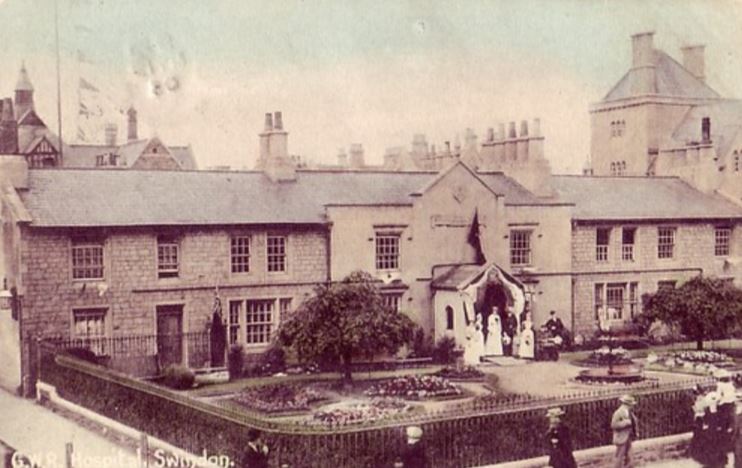
Swindonians are well acquainted with the legend that was the GWR Medical Fund, innovator of a wrap around system of health care for more than 100 years. Fortunately, some of the buildings central to that organisation still survive – the Milton Road Baths/Health Hydro and the Medical Fund Hospital now called the Central Community Centre, are evidence of the comprehensive health care system enjoyed by railway employees and their families. Subsumed into the post second world war National Health Service, the Medical Fund became redundant in 1948, but what about the ‘Sick Fund?’
Now, if like me, you had heard of the Sick Fund and believed it to have evolved into the Medical Fund, you would be wrong. The Sick Fund Society was always a separate entity and survived long after the establishment of the NHS. Local Studies in Swindon Central Library hold a collection of Sick Fund ephemera, including Rule Books dated 1953 and 1971, long after the end of the Medical Fund and the introduction of the NHS. Further research is required to establish when this organisation was eventually dissolved, but this evidence proves it was in existence long after the demise of the Medical Fund.
Those early settlers were not only railway pioneers but social activists and reformers, and many of them were later buried in Radnor Street Cemetery. You can read about some of them here on this growing archive.
The 42nd annual general meeting of the members of the GWR Locomotive and Carriage Department Sick Fund Society, was held on Monday last in the hall of the Mechanics’ Institute. There was a very small attendance.
Mr J. Williams presided, and was supported on the platform by Messrs. J. Horsington, James Beer, Robert Carver, Edward Leonard, Thomas Anderson, and Wm. Bell, committeemen: Mr S. Whiteman, treasurer; Mr George Stone, secretary, and Mr H. Gibbons, assistant secretary. The report presented was as follows:-
In submitting this, the forty first annual report of the society for your consideration we trust it will meet with your approval. Your committee are pleased to report that the society register is now completed (for which the best thanks of the society are due to the trustees) and it has been so arranged that every member’s ticket number shall be his registered number in the society, therefore to prevent any confusion in the future, as well as to facilitate the work of the secretaries, members are requested to see that their ticket number is properly entered on their medical certificate when declaring on sick benefit, also that it is properly dated, as several cases have recently come under the notice of the committee where members have worked the greater part, and in some instances the whole of the day, and sent their certificates in, dated for that day, which is decidedly contrary to rule. Your committee wish to inform the members that at a committee meeting held June 12th, 1884, the following resolution was passed, which we venture to think will be appreciated and approved of by the members: “That so much of the funds of the society as may not be wanted for immediate use, or to meet the usual accruing liabilities, may, with the consent of the Committee of Management, be lent to members upon mortgage of freehold house property, at 5 per cent per annum. All application for the above must be from members over 21 years of age, and over two years standing in the Society.” Since passing the above resolution we have advanced to members the sum of £310, £10 of which has been repaid. Our total investments now amount to £4,116; and the increase in our balance this year is £520 1s 10d.
Attached to the report was a financial statement, and a list of members who had received benefits during the year. The present number of members is 6,051, made up as follows:- Locomotive department 4,049, carriage department 1,747, outside members 206, superannuated 23, widows 30. The general fund account showed the balance brought forward from last year was £4,471 19s 3d; the contributions of members amounted to £4,582 18s 2d; fines, £27 17s 9d; dividends, £184 9s; income tax returned £27 17s 9d; contribution cards, 18s 4d; returned from Management Fund £72 2s 4d; total, £9,323 10s 10d. On the expenditure side it appeared that the superannuation allowance comes to £385 17s 4d, the sick benefits to £3,207 13s; funeral benefit £489; returned contributions £50 16s 6d, and 5 per cent of contributions to Management Fund £228 2s 11d, the balance at the end of the year being £4,992 1s 1d. The management fund showed an actual expenditure of £156 0s 7d, while the balance showed that the total value of the funds on December 31st last was £5,012 1s 1d, of which £4,116 was invested as follows:- GWR 5 per cent preference stock £800, New Swindon Gas Co. 5 per cent debentures £600, Swindon Cemetery 4 per cent £1,500, Metropolitan District Railway 4 per cent. £500, Kittering and Mapstone 4 per cent £416, on mortgage at 5 per cent £300, in addition to £658 2s in the County of Gloucester Bank, and £237 19s 1d in the hands of the treasurer.
The proceedings were opened by the Secretary reading the minutes of the past year’s meeting. These having been passed, and the report taken as read, the Chairman said he did not see that it required supplementary remarks, and he asked that it be adopted. This was unanimously done, and discussion thereon invited, the Chairman saying it was a great surprise to the committee themselves to see such a good balance after the extraordinary amount of sick pay they had been called upon for during the past year. There being no response, or no question to ask the Auditors as to the manner in which they found their accounts, the report was adopted.
The Chairman said the committee felt very strongly on the matter referred to in second paragraph of the report. It was found that the practices therein complained of were very prevalent. Members detected blamed the doctor, but the society had nothing to do with the doctor – only with the member, whom they could fine, and were determined to do so in future. If a member went in the first quarter in the morning and found he could not keep on, the society would be very willing to pay him, but if he stayed at home the first quarter and then went in they thought he should not be paid.
The election of officers was then proceeded with. Mr George Stone was unanimously re-elected secretary, on the proposition of Mr George Howse. Mr S. Whiteman was unanimously re-elected treasurer, on the proposition of Mr T. Money. Mr H. Hinton was re-elected steward. As committee men, Messrs J. Williams and Edward Leonard were unanimously re-elected for the Loco Department; Mr James Beer was proposed for re-election for the carriage Department, but Mr Hillier proposed in his stead Mr Edward Bullock. On a vote being taken there were ten hands held up for Mr. Bullock, and an overwhelming majority for Mr Beer, who was, therefore, declared elected. Mr T. Lucas was re-elected auditor. On the proposition of Mr George Howse, a vote of thanks was passed to the committee for past services, and the proceedings closed, not having occupied 20 minutes.
Frederick George Wright’s grave is surmounted by a magnificent monument. The obituary published in the North Wilts Herald was fulsome, his reputation lived on long after his death. Yet he lies alone in the grave plot in Radnor Street Cemetery, which seems a little sad.
I wanted to discover more about the women in his life, but apart from the basic officialdom there is little to learn.
His first wife Minnie Florence Matthews was born in 1862 at White Cross, Hereford, the daughter of accountant William Matthews and his wife Mary Anne. At the time of the 1881 census she was living with her widowed mother and her brother Thomas at 7 Edgar Street, Hereford where she states her occupation as ‘governess.’ Minnie married Frederick at St Mary’s Church, Cheltenham where she gives her address as 3 Promenade, Cheltenham. The couple had two daughters, Amy Florence Hughes Wright born in 1885 and Margaret Evelyn Houghton Wright in 1894. Minnie died on October 16, 1920.
In the December quarter of 1921 Frederick married Violet Dorothy Hamilton Cordon. Violet was born on July 7, 1891 in Hamilton, Lanarkshire the daughter of Walter Cordon, a Colliery Proprietor and Sanitary Pipe Manufacturer, and his wife Hannah. Violet trained as a nurse, gaining her certificate at Queen Mary’s Hospital for the East End in Stratford, London in 1918. In the year following Frederick’s death she was living at 12 Okus Road, Swindon. Violet died on October 19, 1976 at the Sceats Memorial Home in Gloucester.
Both Frederick’s two wives and his two unmarried daughters are buried elsewhere.
But now for Frederick’s story?
Loss to Public Life of Swindon
Death of Major F.G. Wright: former Mayor of the Town
The death at his home in Bath-road, Swindon, in the early hours of yesterday morning, of Major Frederick George Wright, J.P., at the age of 75, has taken from public life one who for more than half a century had actively associated himself with a wide variety of interest affecting the welfare of the borough and of the county.
He had been in failing health for several years, but maintained a courageous front, and almost up to the very last his indomitable spirit remained uppermost. His advanced age was against him, however, and about two o’clock yesterday morning he succumbed to a heart attack.
Since 1936 Major Wright had, under medical advice, gradually been relinquishing some of his public work, and his personal interest had already been missed in many quarters.
Service with the GWR
An engineer by profession, he applied his knowledge to great advantage in the public interest during the war.
Born in Birmingham, Major Wright was educated at Crypt Grammar School, Gloucester, and privately. Entering the service of the GWR Company as an apprentice in the locomotive shops at Gloucester in 1876 under his father, he was moved to Bristol in 1879.
Three years later he was transferred to the Drawing Office at Swindon, and became Chief Draughtsman in 1892.
Four years later he was appointed Assistant Manager of the Locomotive Works, and in 1901 became Principal Assistant to the Chief Mechanical Engineer, from which office he retired in July, 1932, after 19 years’ service.
Major Wright, who had lived in Swindon for 56 years, was a member of the New Swindon Urban Council, and was its last chairman.
Until quite recently he was an Alderman of the Town Council and was Swindon’s third Mayor. He became a magistrate in 1906.
A member of the old Volunteer Corps, he received his commission in the 2nd Battalion of the Wilts Regiment in July 1900. On the formation of the Territorial Force in 1908, he was instrumental in raising from the GWR Works the Fortress Company of the Royal Engineers. From 1912-17 he was Major commanding the Dorset and Wilts (Fortress) Royal Engineers, T.F., and was in the Territorial Force Reserve from 1917 to 1921, retiring in October, 1921, with the rank of Major.
Medical Fund Trustee
The oldest vice-president and trustee of the GWR Medical Fund Society, Major Wright had been a trustee of the Sick Fund Society for 55 years, while he also accomplished valuable work for the Mechanics Institution. In regard to the latter movement his deep practical interest found expression in connection with the library, and he effected many economies in the purchase of books.
Serving on the County Council before the war, he was re-elected after his retirement and became an Alderman in 1934, but retired three years later.
A Conservative and a Churchman he was for 13 years churchwarden at St. Paul’s, Swindon, and was a past president of the Swindon and North Wilts branch of the former English Church Union. He was one of the oldest members of the Swindon Rotary Club.
Major Wright was also chairman and managing director of the Swindon United Gas Company, chairman of the Swindon United Gas Company, chairman of the Swindon and District Gas Corporation Ltd., and chairman of the New Swindon Permanent Benefit Building Society. From its inception until 1937 he was a member of the Territorial Force Association, and was a member of the Swindon Area Guardians Committee.
Gas Company Chairman
In later years his chief interest was as chairman of the Swindon United Gas Company, of which he had been a director for 25 years, with a break during the war.
Outstanding, perhaps, in the constructive influence that he brought to bear in his public work, was his constant interest in the County Roads and Bridges Committee, of which he was vice-chairman. It may be claimed that as a result of his efforts nearly all the roads from Swindon to the County boundaries were reconstructed. He too, actively championed the move that resulted in Swindon obtaining greatly increased representation on the County Council.
He leaves a widow (his second wife) and two daughters by his first wife – Miss Margaret Wright of 12 Okus-road, Swindon, and Miss Amy Wright.
Members of Swindon Rotary Club stood in silent tribute to Major F.G. Wright at the beginning of their lunch yesterday.
Before the business of the Swindon Borough Police Court yesterday, the chairman, Mr. F. Eyres announced Major Wright’s death. The Bench wished to place on record its regret at his passing.
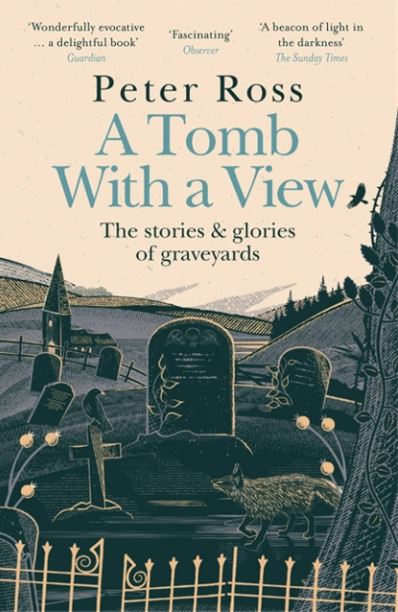
If you enjoy cemetery stories (and I’m guessing you do, otherwise you wouldn’t be reading this blog) you will enjoy A Tomb With a View by Peter Ross.
The author’s details at the front of the book briefly describe Peter Ross as an award winning journalist who lives in Glasgow with a view of the tombs. But if you’re not sure if this book is for you I recommend you read the Author’s Note. Peter Ross says everything I try to say, only better. He is a beautiful, descriptive, lyrical writer; the words and the emotions ease across the page.
He writes about those famous cemeteries I know of and have visited – Highgate and Brompton, two of London’s Magnificent Seven, and closer to home, Bristol’s Arnos Vale, and others that I now have on my to do list – Glasnevin in Dublin and Cathcart in Glasgow.
He has introduced me to familiar people I’d previously read about and those I hadn’t, such as Wayne Sanders, whose life was brilliant, until it wasn’t and who lies in a natural burial ground in Sharpham Meadow, Devon.
A Tomb With a View is available from all the usual places, but if you live locally please visit Bert’s Books, 54 Godwin Court, Swindon, SN1 4BB.
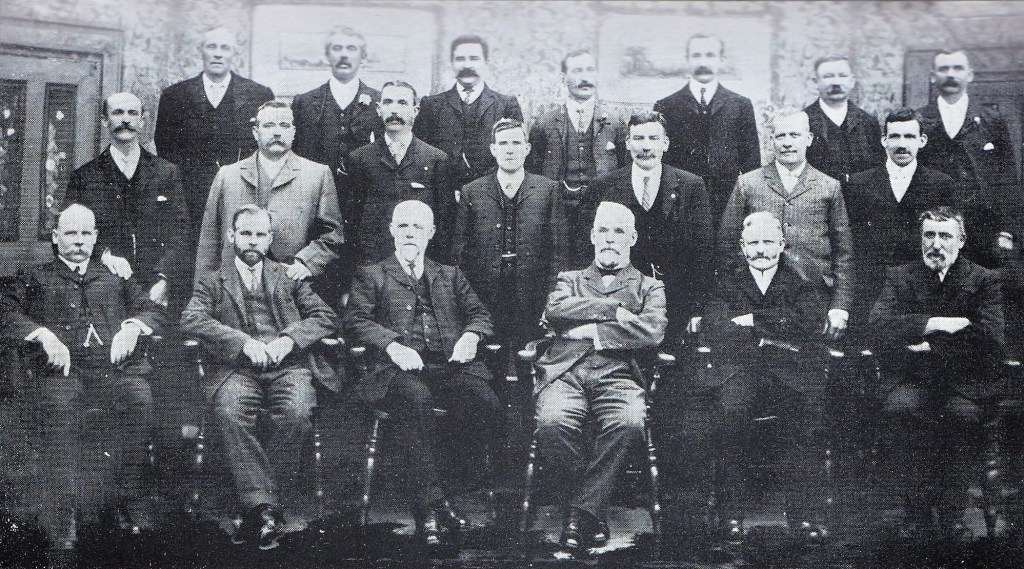
The Medical Fund Society Management Committee pictured in 1907
As we prepare to celebrate the 75th anniversary of the National Health Service, I am publishing on this Swindon based blog the story of the GWR Medical Fund Society and some of the people who made it a success.
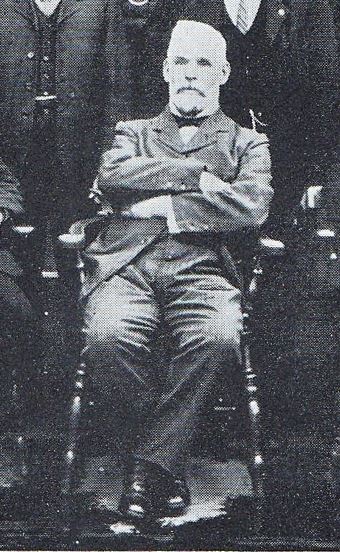
Perhaps fittingly Henry Morris, Chairman of the GWR Medical Fund Society for 33 years, died in the GWR Medical Fund Hospital.
Henry was born in Wolverhampton but at the time of his marriage had already moved to Swindon where he worked as a brass finisher in the GWR Works. He married Sophia Annie Evans in St James’s Church, Wolverhampton on July 10, 1871. The couple lived at 23 Gloucester Street where they would remain throughout their long marriage.
Death of Mr H Morris
33 Years Chairman of the Medical Fund Society
By the passing of Mr Henry Morris, Swindon has lost an old resident who has contributed in no small measure to the well being of the town of his adoption. A man of absolute and unimpeachable integrity, and one who aimed at doing “good by Stealth,” he has left behind him a record of public and social service which stands forth as a shining example to those of the younger generation, and it is indulging in the merest of truisms to say that the community is all the poorer by his death.
The late Mr Morris came to Swindon from Wolverhampton in 1870, and remained in the service of the GWR Company until the Christmas of 1915. From that time onwards his health gradually failed, and about ten weeks ago it was found advisable to remove him to Guy’s Hospital for an operation. He went through the as satisfactorily as was to be expected, and returned to Swindon a fortnight since, but it soon became apparent that the end was not far distant, and he passed away, after enduring great suffering, in the GWR Medical Fund Hospital on Tuesday afternoon. Mr Morris was 72 years of age.
It is because of his remarkable work in connection with the GWR Medical Fund Society that Mr Morris will be best remembered. For no less a period than 36½ years he was a member of the committee, and his colleagues testified in no uncertain manner to their appreciation of his unfailing courtesy and geniality by electing him as their chairman for 33 years in succession. Mr Morris saw the society pass through many vicissitudes while he was in office, but, thanks very largely to his zealous work and sound leadership, it succeeded in weathering all the storms with which it was assailed. Swindon people hardly need to be reminded of the development of the society’s operations during the past quarter of a century and more, and in the construction and management of the up-to-date Turkish, swimming and washing baths the late Mr Morris was largely identified. He was also chairman of the hospital Sub-Committee for many years, and took a real an deep personal interest in the welfare of the members of the society whom misfortune had brought within the four walls of that invaluable institution.
In his capacity as chairman of the committee of the Medical Fund Society Mr Morris was a member of the Management Committees of the Swindon Victoria Hospital Winsley Sanatorium (until it was taken over by the Charity Commissioners) and the Royal West of England Sanatorium at Weston-super-Mare, and he also attended the general meetings of numerous hospitals and other charitable institutions, his advice and experience being of great value on such occasions. It may be re-called that on Mr Morris’s retirement from the GWR Company’s service the members of the society presented him with a purse of money and an illuminated address, and made him one of their vice-presidents.
Amongst other public offices held by the late Mr Morris was that of a justice of the peace for the borough of Swindon, that honour having been conferred upon him in February, 1914. He was also for a number of years a director of the Henry Street Co-operative Society.
The deceased gentleman with be affectionately remember by many of the past and present generations because of his labours in connection with the Faringdon Street Wesleyan Church. For a very long period he conducted with marked success, a large class in the Sunday School and his work did not begin and end there for he filled various offices in the church itself from time to time.
Extracts from the North Wilts Herald, Friday, October 19, 1917.
The Late Mr H. Morris
Funeral
To the accompaniment of a striking demonstration of affection and regard, the remains of the late Mr Henry Morris was consigned to their last resting place in Swindon Cemetery on Saturday afternoon. The first portion of the burial service was held at the Faringdon Street Wesley Chapel, with which the deceased gentleman was so long and so prominently associated. A large congregation assembled, and the proceedings were impressively conducted by the Rev. H.C. Basset, the recently appointed superintendent…
In the course of the service the Rev. H.C. Bassett gave a brief address:
“I think, perhaps, it is fitting,” he said, “that just a word should be spoken before we lay to their last rest-place the mortal remains of our brother, Morris. My personal knowledge of him was only limited, but to most of you he was a very intimate acquaintance. I visited him on different occasions during the illness which carried him away from us, and there was displayed one ach of those occasions a firm trust in the Saviour, and the realisation of the presence of the God Whom he had loved and served for many years. From all I have heard of him, his removal will be a heavy bereavement to this church. His service was always characterised by great devotion, fidelity and whole-heartedness and I believe he carried the same qualities into his work in other spheres. That he gained the respect of his fellows in endorsed by your presence. As a public servant he discharged his duties faithfully, with credit to himself and satisfaction to those who elected him to office. One person especially has spoken to me of him as one of Nature’s gentlemen – a beautiful tribute to his winsome personality. If you had asked him, he would have said, ‘By the grace of God, I am what I am’…
Mourners included –
Messrs J. Clark, W.J. Hathaway, C. Spencer and W.G. Slatter representatives of the GWR Sick Fund Society and amongst the officials and members of the Medical Fund Society were Messrs W. Spruce and S.E. Walter (past and present secretaries).
Extracts from the North Wilts Herald, Friday, October 26, 1917.
Henry Morris was buried on October 20, 1917 in grave plot E8657. His wife Sophia Annie died in January 1942 and is buried with him.






 Radnor Street Cemetery