Drowning fatality at New Swindon

The re-imagined story …

At the inquest it was stated there were no adults in the vicinity of the pond where the three boys drowned, but I knew differently.

I heard them laughing and shouting as they edged across the frozen surface and then the screams as they foundered in the icy water.

I watched as the young Mapstone boy, still fully clothed and wearing his skates, jumped into the freezing water and momentarily disappeared. I watched him struggle up the bank, casting off his clothes and running this way and that, searching for something with which to pull the boys out.

The father of one of the lost boys asked the coroner about the adults who were observed at the scene of the tragedy, but young Mapstone said they arrived too late, the boys had already disappeared, but I knew differently. The police sergeant said no one was to blame. I knew I was to blame.

All the time I looked on, hiding in the hedgerow, praying that no one would see me, praying that no one would expect me to jump into that pond. Now, twenty years later I still pray that no one will discover my secret.

The young Mapstone boy was praised for his actions. I wonder if that was of any consolation to the eleven-year-old. I wonder if he still has nightmares. I know I do.

Today I enlisted with the Wiltshire Regiment. I’m hoping I’ll be sent out to France pretty soon. The casualty numbers are mounting and I hope I will soon be one of them. I don’t want to come home a hero. I don’t want to come home at all. I’m praying I’ll be killed pretty quickly. Then I’ll no longer see those boys drowning in that pond or young Edwin Mapstone frantically running along the bank, half dressed.

Drove Road 2

Drove Road c1910 published courtesy of P.A. Williams and Local Studies, Swindon Central Library.

The facts …

Drowning Fatality at New Swindon

Three Lives Lost

Inquest on the Bodies

On Saturday, about noon, a sad accident happened at New Swindon by which three lads lost their lives. It appears that the boys, being too venturesome, went sliding on a pond in a meadow known as Wharf Field, near the Drove road, New Swindon. Suddenly the ice gave way, and the three boys fell in. The water was about ten feet deep, and there being no one at hand to rescue them, all three were drowned. Some other boys who witnessed the sad occurrence ran off and gave information to the police, with the result that P.C. Keating and another constable hastened to the spot, but by the time they arrived the bodies were out of sight. They recovered the bodies, but life was extinct. Dr Lavery was also sent for, but he found all attempts at resuscitation useless, and the bodies were removed to the Queen’s Arms Hotel, and the Coroner communicated with. Two of the lads resided in Mill-street, their names being Charles Greaves, aged 8 years, and Thomas Tombs, aged 10 years. The third lad, who was about the same age, and whose name was Wm. Stagg, hails from Southampton, and was on a visit to some friends at 32 Princes Street. He was to have returned home the same Saturday evening.

The Inquest

On the bodies of the three unfortunate lads was held at the Queen’s Arms, on Monday afternoon by Mr Coroner Browne and a jury of whom Mr J. Jefford was foreman. – Chas. Fredk. Townsend aged 10 years, said he was sliding on the ice with the three deceased lads on Saturday about 12 o’clock. He slid across the pond first and the other three lads followed altogether. Greaves was first, and when they reached the middle of the pond the ice broke and all three fell in. He and the other lads watched them struggling in the water and whistled for assistance. – Edwin Mapstone, aged 11 years, said he was skating on a ditch about 100 yards from the pond and saw the lads sliding on the pond. On hearing the shouts of the other boys he went across to the pond and saw the three lads struggling in the water. He jumped in to try to rescue them, but could not swim under the weight of his clothes and skates on, and he went down once himself in trying to help the other boys. Two boys went for a prop, which witness put into the water, but the drowning lads had not strength enough to hold it. He saw the lads as he was passing the pond before they went on the ice and told them the ice was not safe. – In answer to Mr. Tombs, father of one of the deceased lads, witness said there were several grown up persons round the pond, but they did not arrive until the bodies had disappeared. – P.C. Scammel said he was informed of the accident whilst on duty in Regent-street, and he at once proceeded to the pond, but by the time he arrived the bodies had disappeared underneath the water. With the assistance of P.C. Keating he recovered the bodies but then all attempts at resuscitation were useless. – Edwin George Castle, of 40 Mill street, said he lived near the pond, the construction of which he knew perfectly well. It was nine feet deep in the centre and was cleaned out about two years ago. It was 25 ft. in width and was built in basin shape, with a division for the purpose of allowing cattle to drink. The ice covering the pond on the day in question was not safe. He was near the pond about 12.45 on Saturday last and saw the witness Mapstone running across the field, partially naked, crying for assistance. He obtained a pole and went to the pond, but when he arrived the lads had sunk. – E. Mapstone was re-called to answer a question as to whether there were any grown up persons near the pond at the time of the occurrence. He said the bodies had just disappeared when they arrived. – Sergt. Garrett said he had made full enquiries on this point, and did not think the grown-up persons needed any censure.- Mr Toombs: I do not wish to censure anyone. – Dr Lavery said he saw the bodies about ten minutes past two death was due to asphyxia from drowning. In answer to a question the doctor said if he had been present about five minutes after total submersion he might have succeeded in saving life. – This concluded the evidence, and the Coroner said there was only one verdict which the jury could return. No blame could be attached to anybody. The little boy Mapstone seemed to have done the best he could to try and save the lads and was deserving of the highest praise. – The jury then returned a verdict of “accidentally drowned,” and Mr Bradbury moved a vote of condolence with the bereaved families. The jury handed their fees to Mrs. Greaves, the widowed mother of the deceased lad Greaves.

Swindon Advertiser, Saturday February 2, 1895

The boys were buried in Radnor Street Cemetery on the same day, in graves just a few spaces apart.  Eight-year-old Thomas Greaves was buried in plot B2275, a privately purchased plot, which he shares with his father Francis who had died in 1894.

Ten-year-old Charles Tombs was buried in plot B2213 a public or pauper’s grave, which he shares with five others, including May Tombs, a 22 month old baby who died in 1893 and is most probably a relative.

There is no further information about William Stagg, the third boy who drowned.

Edwin Mapstone was born on May 29, 1883, the son of Welsh born Evan Mapstone, a striker in the Works, and his wife Margaret. The family lived at 41 Mill Street when Edwin was baptised at St John the Evangelist on December 29 of that year.

In 1897 the fourteen-year-old began a 6½ year apprenticeship in the Works as a blacksmith. In 1909 he married Emily Baker and by the time of the 1911 census he was living with his wife and baby son in Tredegar, Monmouthshire, where he worked as a labourer below ground in a colliery. The couple lived with Edwin’s elder brother John and his wife. He eventually returned to Swindon and a job as a painter in the Works.

Edwin died in January 1969 aged 85 years old and is buried in Radnor Street Cemetery in a privately purchased plot C1519, which he shares with three others, including his brother John who died in December 1964.

In 1891 Charles Tombs lived at 32 Mill Street, Thomas Greaves lived at number 25 and Edwin Mapstone at number 26. Drove Road
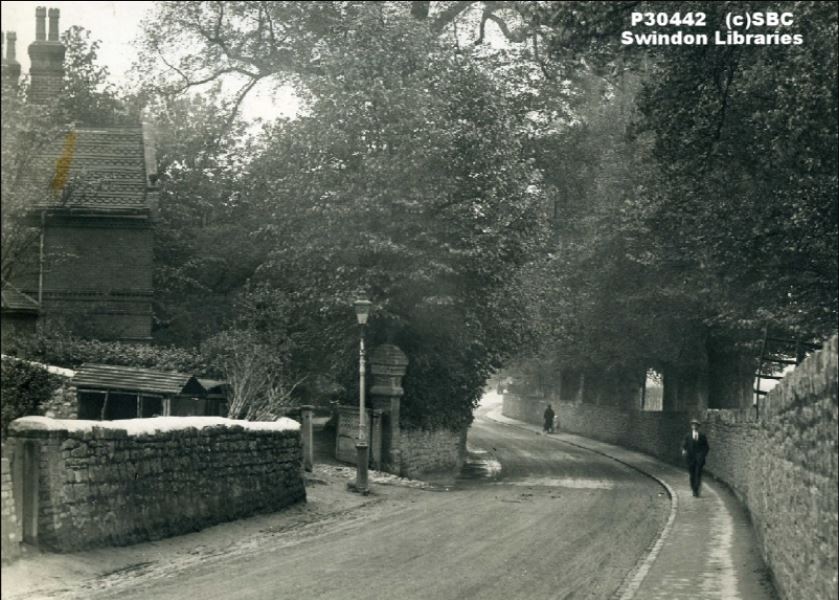
Drove Road c1920 published courtesy of Local Studies, Swindon Central Library

Thomas Messenger – Fatal Accident in the GWR Works

On Friday December 14, 1894 Thomas Messenger was involved in a fatal accident in the Timber Yard at the GWR Works. Back home in Linslade Street his wife Emma went into labour. Thomas died two days later. He was 31 years old and according to the report made to the Great Western Railway Board he had been employed in the Company for 5 years and 5 months, his daily rate of pay was 3s 2d.

Fatal Accident in the GWR Works – On Tuesday morning, Mr. Coroner Browne and a jury, of whom Mr W.J. Deavin was foreman, held an inquest at the Cricketers’ Arms, New Swindon, on the body of Thomas Messenger, aged 31 years, a labourer, employed in the Great Western Railway Works timber yard department. Mr T.O. Hogarth and Mr H. Hayward were present to watch the case on behalf of the GWR Company.

From the evidence adduced, it appeared that deceased was on Friday morning employed with other men in stacking timber. A “skid” – a piece of timber weighing some 7 cwt. – was used for sliding the timber on to a stock in order to save labour. Deceased placed the skid too far over the corner and it rebounded and stuck him in the head, causing a fracture of the skull.

A verdict of accidental death was returned. The jury gave their fees to, and also made a subscription on behalf of deceased’s widow, who is left with three children, and was confined on the morning of the accident. The sum handed to the widow was £1.

Wilts and Gloucestershire Standard, Saturday, December 22, 1894.

Thomas was buried on December 19 in a public grave plot B2264. His father, also named Thomas, was buried with him in 1902. They share the grave with a baby and an elderly widow, both unrelated.

Thomas and Emma had been married less than two years. Emma had already been widowed once before, left with two little daughters Martha and Amelia. Now she was on her own again with another child. The baby was baptised at the parish church in Latton on January 27, 1895. She was named Thomasina Polly Strong Messenger. Emma went on to marry for a third time in 1901. She died in 1943, aged 82.

Thomasina married, raised two children and died in High Wycombe in 1973, aged 79.

No 1 Shop, Timber Yard pictured in 1928. Image published courtesy of STEAM Museum.

Edith Gay Little and the wooden memorial

wooden grave

The re-imagined story …

He knew exactly what type of memorial he wanted for Edith, and he would make it himself.

He sketched it out on the table in the front room at 59 Station Road. A large cross, something that would stand proud and obvious.

In Memory of Edith Gay, the beloved wife of Edward Little. He practised the style of lettering he would use. He wanted something elegant. No, that was too ornate. He rejected his first attempt. The next was too difficult to read. Eventually he settled on a simple script, something Edith would have liked.

Would he leave a space for his own name to be added in the future? He decided not to. He couldn’t trust anyone else to choose the right script or to execute the work to a sufficiently high standard. This memorial was a symbol of his love. He didn’t want it spoilt by some ham fisted amateur.

He sat in the silent house; the late summer afternoon sunshine streamed through the window. He’d make a start now, he decided. He had a nice piece of seasoned timber in the shed.

Little

The facts …

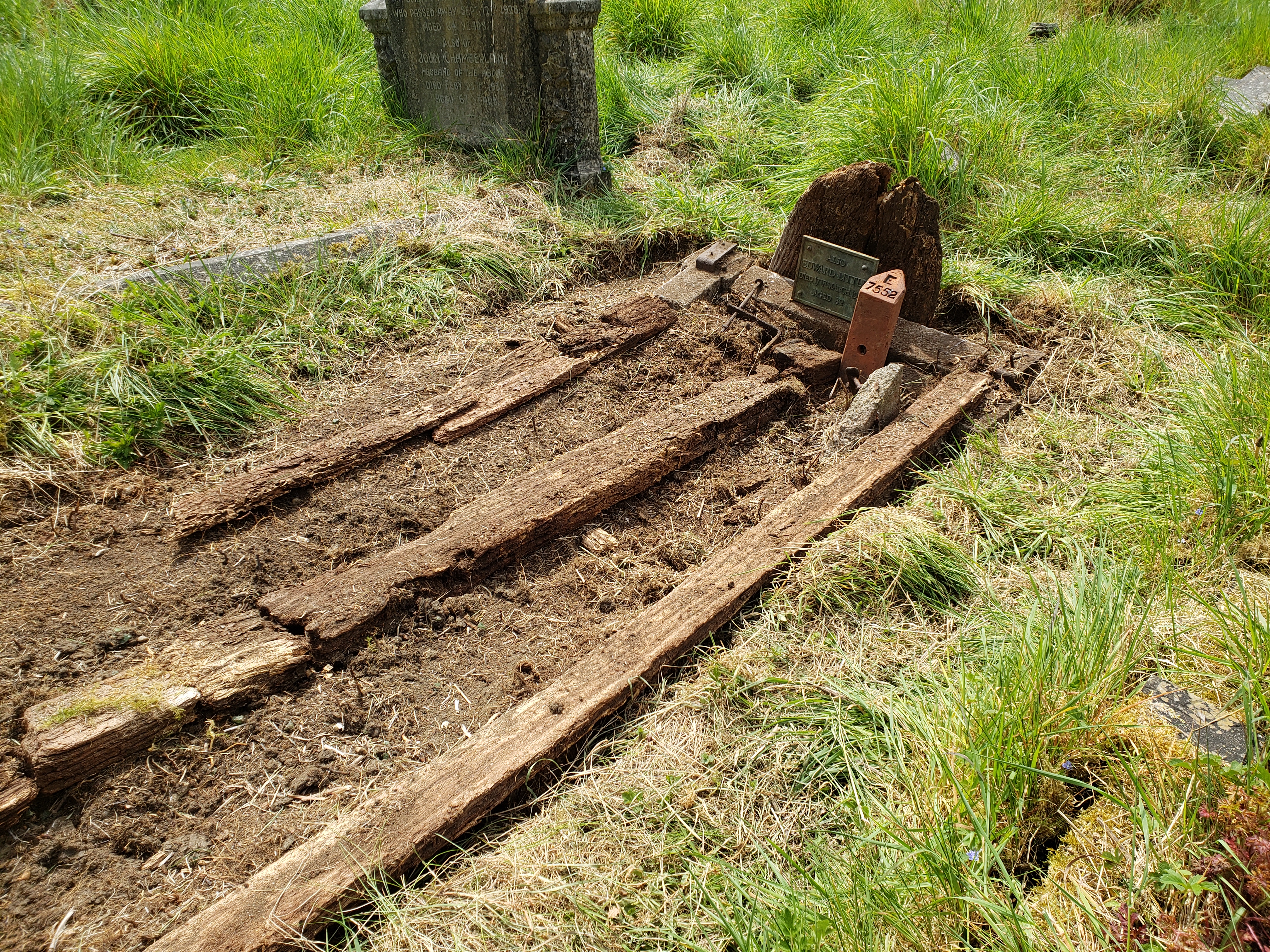
I first discovered this memorial more than ten years ago and each spring when the guided walks resume, I always have difficulty finding this grave again. And every year I wonder if it has managed to survive another winter, because this extremely unusual memorial is a wooden one.

It marks the grave of Edith Gay Little, a former nurse, who died on August 23, 1928 at the Great Western Railway Medical Fund Hospital.

Edith’s husband was Edward Little and I believe it was he who made this wooden memorial. Edward was employed as a bodymaker in the carriage and wagon works at the Midland & South Western Junction Railway at Cirencester. He was promoted to chargehand and eventually foreman and by 1923 was based in Swindon.

Edward was no stranger to Swindon as it was here that he married his first wife, Elizabeth Ann Bindon, at St Paul’s Church on August 21, 1897. Elizabeth died in 1909 aged 38 and was buried ‘under Coroner’s warrant’ in South Cerney where they were living at the time.

On September 22, 1911 Edward married for the second time. By now he was 41 and his bride Edith Gay Smith was 43. The couple married at Holy Trinity Church, Trowbridge.

Unfortunately, there are no known photographs of this memorial when it was new. How distinctive it must have looked, standing out against the surrounding white gravestones. I imagine Edward would have visited the grave regularly, polishing and treating the wood to preserve it.

It would appear that Edward had no children by either of his wives. He retired from the railway works in 1935 and continued to live at 59 Station Road, the home he had shared with Edith.

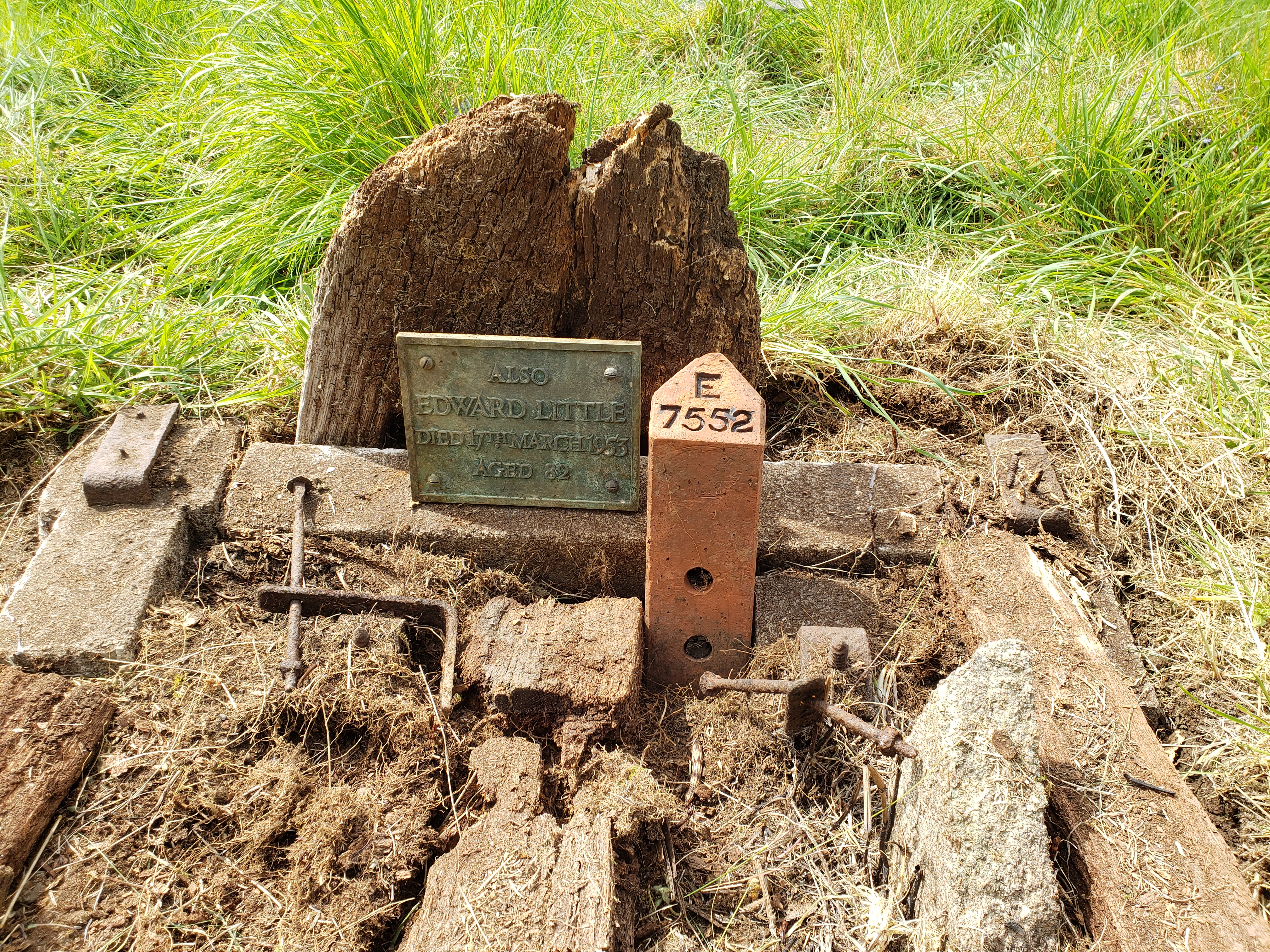
Sadly, he ended his days in Roundway, the psychiatric hospital in Devizes, where he died on March 17, 1953. Probate was proved at Oxford and his effects, valued at £2,369 16s 5d, were placed in the hands of Lloyds Bank.

He was buried with Edith. With no one left to come and polish the wooden memorial it now lies at the mercy of the elements.

This week Radnor Street Cemetery volunteers Kevin and Brian managed to locate and reveal the wooden grave. They even found a memorial plaque to Edward, the man who I believe was the maker of this unique and poignant memorial.

Little (2)

Edwin Gordon White – Military Cross

On our guided cemetery walks I frequently speak about the wartime work of Swindon’s women, in particular Elsie Wootten White, a Swindon school teacher who was a member of the Swindon Prisoners of War Committee during the First World War. However, this was only part of the White family’s war story.

Edwin Gordon White was born in Swindon in 1892 and baptised at St. Mark’s Church on March 12. He was the son of Frank James, a machineman in the Works, and Susan White and with his parents and sister Elsie lived at 29 Guppy Street, Rodbourne.

By the time of the 1911 census Susan was widowed and living with Elsie and Edwin at 61 Graham Street, the last home Edwin would know. Aged 19 Edwin worked as Laboratory Assistant and part time student in Swindon’s secondary school.

Unfortunately Edwin’s military records do not survive, but we do know that he was awarded the Military Cross, a medal granted in recognition of an act or acts of exemplary gallantry during active operations against the enemy on land.

The citation was published in the Wiltshire Times on Saturday October 5, 1918 – five months after his death.

Conspicuous Gallantry

Wiltshire Officers Decorated

The King has been pleased to approve the Military Cross to the undermentioned in recognition of their gallantry and devotion to duty in the field:-

T./Lt. (A./Capt.) Edwin Gordon White Wilts Regt.

For conspicuous gallantry and devotion to duty during a raid. Though badly wounded, he continued to direct operations as long as possible, thus greatly adding to the spirit and moral of his platoon. His personal reconnaissance work, carried out for five days before the raid with the greatest keenness and untiring energy, greatly added to the success of the operation.

The Wiltshire Times, Saturday, October 5, 1918.

Edwin died of wounds on May 7, 1918. He was 26 years old and is buried at Montecchio Precalcino Communal Cemetery Extension in Italy. The inscription on his headstone reads:

Only son of Mrs S. White

Ever in the thoughts of those who loved him RIP

He is also remembered on his mother and sister’s headstone in Radnor Street Cemetery.

Charles Haggard – Prisoner of War

Charles Haggard - Copy

The re-imagined story…

‘He woke up gently, sliding smoothly into a new day.  It wasn’t usually like this.  Sometimes he woke up with a jolt, ready to jump out of bed, as if he could.  Sometimes he suddenly found himself awake, his heart beating rapidly, his breath coming in gasps.  Sometimes he just lay there, eyes open, awake, absent.  But today felt different.  Today he turned over in bed and snuggled down beneath the blankets.

The bedroom was cold.  He’d known colder.  He’d known bone aching cold when every joint was immobilised, every muscle mortified.  But he liked this cold.  It reminded him of childhood.  Ice on the inside of the window; a house full of noise, children getting ready for school, his father already at work.

“Charlie are you up yet?” he was always the last one, reluctant to leave his bed.

Today his mother tapped softly on the bedroom door; checking if he was awake, checking if he was alive.  He understood her dilemma.  Should she wake him or should she let him sleep on?

“Morning Ma,” he called.

The door opened.

“Cuppa tea boy.”

Nearly 37 years old but he would always be her boy.  When he was a child he had to share her, but now she was his alone; making up for lost time.

His father hadn’t recognised him when he opened the door of 60 Stafford Street.  Four years as a prisoner of war had altered him immeasurably.  But as the cold January air swept around him and into the house she knew it was her boy returned.  She had never given up hope.

Today he felt a little better, a little stronger.  Today he would take a slow walk into town.  He would call in at the Town Hall and sign the register of returning soldiers.  He hoped Miss Handley might be there.  He would so like to see her, say thank you for the food parcels that had kept the prisoners of war alive’.

The facts …

Charles Haggard was born April 30, 1882 at the Old Red Lion Inn in Minety where his father Samuel was the innkeeper.  His parents were in their early 20s and already had four children, George, Alice, Kate and Thomas.

By 1901 the family had moved to 60 Stafford Street, Swindon and on the census returns for that year 18-year-old Charles described himself as a Steam Engine Tender Maker, Fitter & Turner – of course he still had two years left to serve of his apprenticeship.

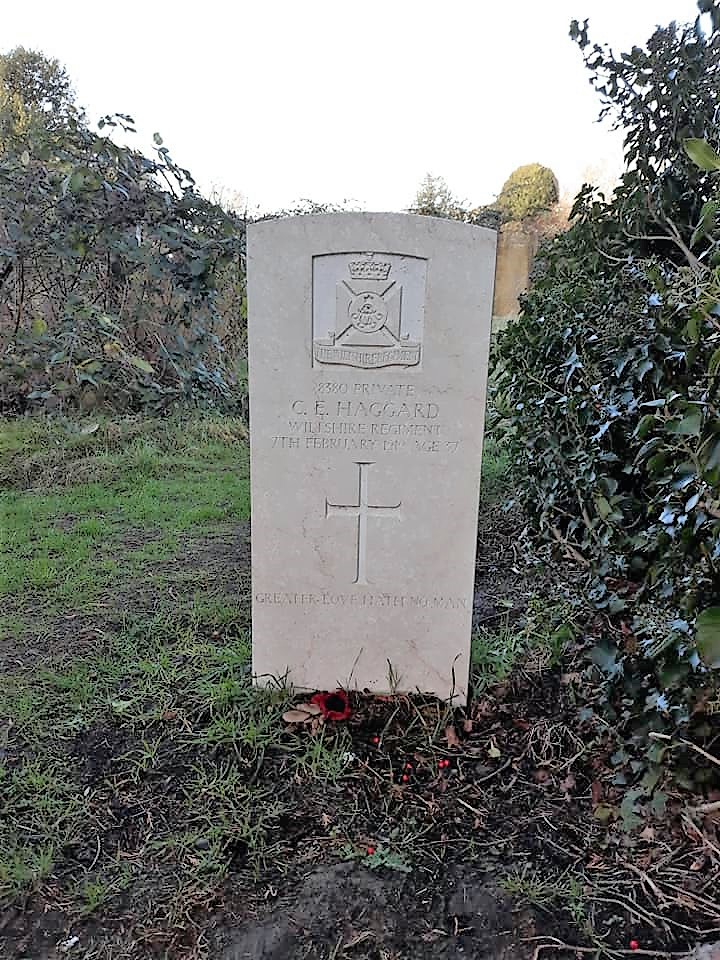
By 1911 he had left a life ‘inside’ (which is how everyone referred to working in the railway factory) and joined the army where he served as a Private in the 1st Wiltshire Regiment.  Charles was taken prisoner on October 24, 1914 at the Battle of Mons and was held prisoner at Krossen-on-Order for the duration of the war.

On February 7, 1919 Charles spent the day in Shrivenham visiting friends. He arrived back in Swindon sometime between 9 and 10 pm where he met his father in Manchester Road.

At the inquest Charles’s father said his son seemed very cheerful as they began the walk home to Stafford Street.

When they reached Deacon Street Charles called out “Wait a minute, dad,” and went to catch hold of the palisading, but fell backwards. His father knew he was dead.

Mr A.L.  Forrester, Coroner for North Wilts, held an inquest at St Saviour’s Schools, Ashford Road, Swindon where Dr Beatty testified that he had made a post mortem examination of the body and found athroma of the valves of the heart.  The cause of death was aortic disease of the heart, a condition worsened by starvation and exposure during his time as a prisoner of war.  Charles had been home less than three weeks.

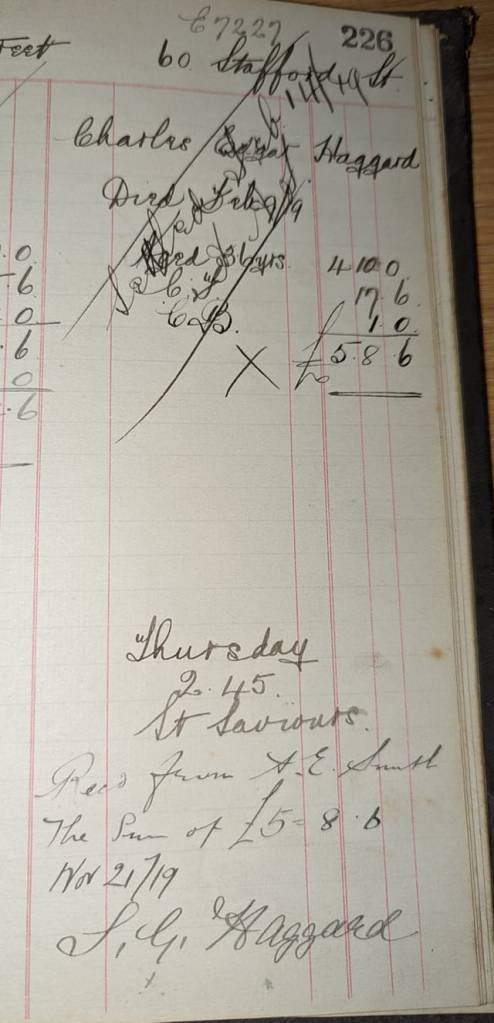
He is buried in plot E7227 with his brothers George and Thomas.

Image of funeral account provided by A.E. Smith & Son, Funeral Directors

Cyril Gordon Webb – Tell Them of Us

How terrifying must it have been to be the parents of five adult sons on the eve of war in 1914?

James George Webb and his wife Bertha lived a comfortable life at 117 Bath Road where in 1911 they stated on the census returns that they had been married for 25 years. They answered the questions– how many children born alive 5; children still living 5; children who have died nil. Not every family in this period was so fortunate.

Four of James and Bertha’s sons still lived at home with them in 1911. Their eldest son Vere was employed as a draughtsman in the Loco, Carr & Wagon Dept at the Wolverhampton railway works.

Then in 1914 second son Algernon Ewart Webb enlisted in the Army Service Corps, eight months before the outbreak of war. However, his military service was brief as he was found to be medically unfit when mobilization took place on August 6, 1914.

How relieved his parents must have been to welcome him home. Algernon and three of his brothers went on to live long lives. It would be their youngest son Cyril Gordon Webb who went away to war. 

A former student at the North Wilts Technical College in Victoria Road, Cyril is remembered on the college’s stained-glass window war memorial. The window, restored and renovated by stained glass window craftsman Richard Thorne, was moved to Swindon College at the North Star campus in 2010.

Pte C.G. Webb of the 52nd Battalion Bedfordshire Regiment died on June 7, 1918 at his home 37 Okus Road. His cause of death was Pulmonary Tuberculosis contracted during his military service.

Cyril’s father James died in October that same year, a few months after his son. Bertha died in 1934. They are both buried with their boy in Plot D402.

#TellThemofUs

#MarkSutton

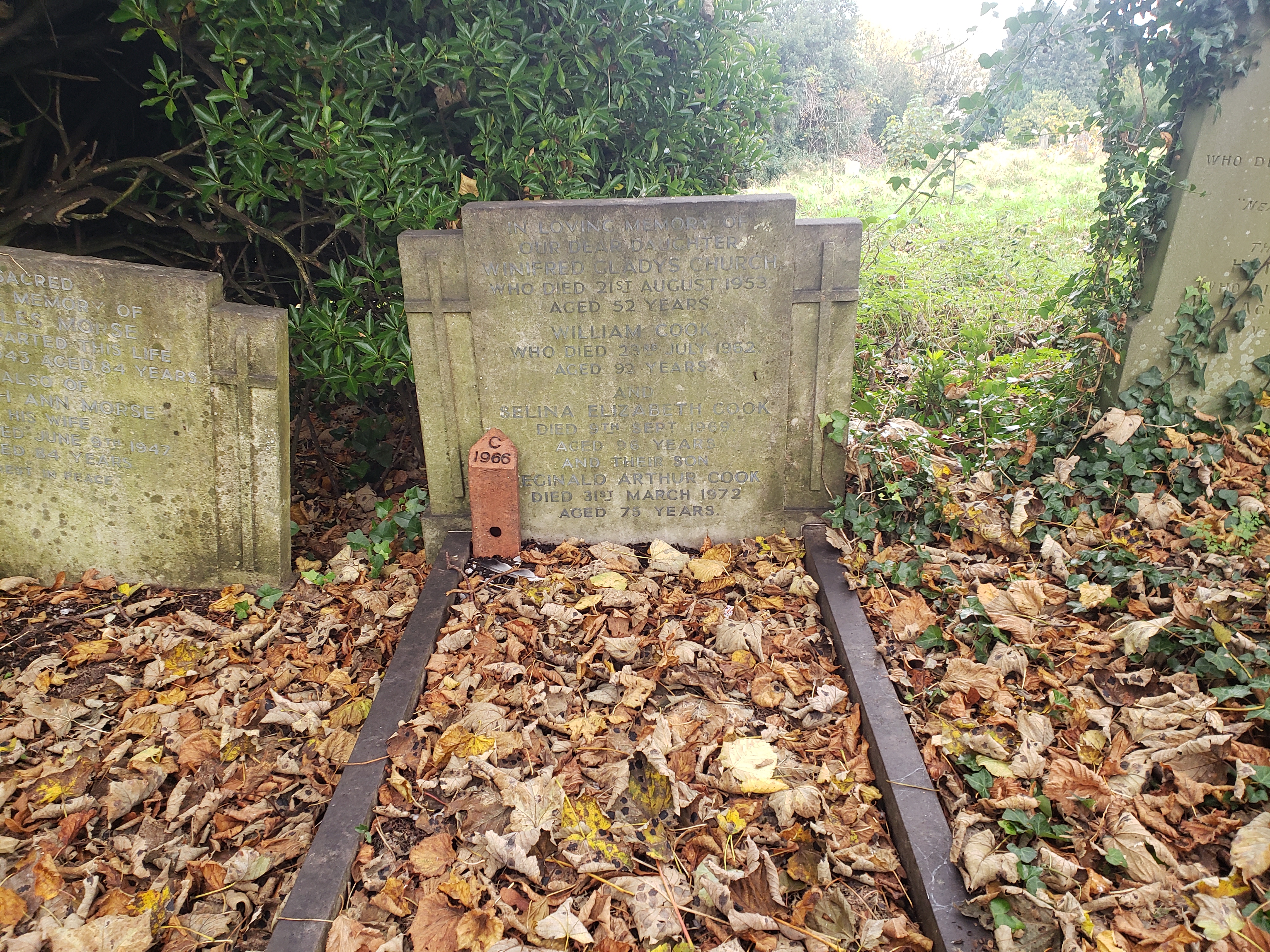
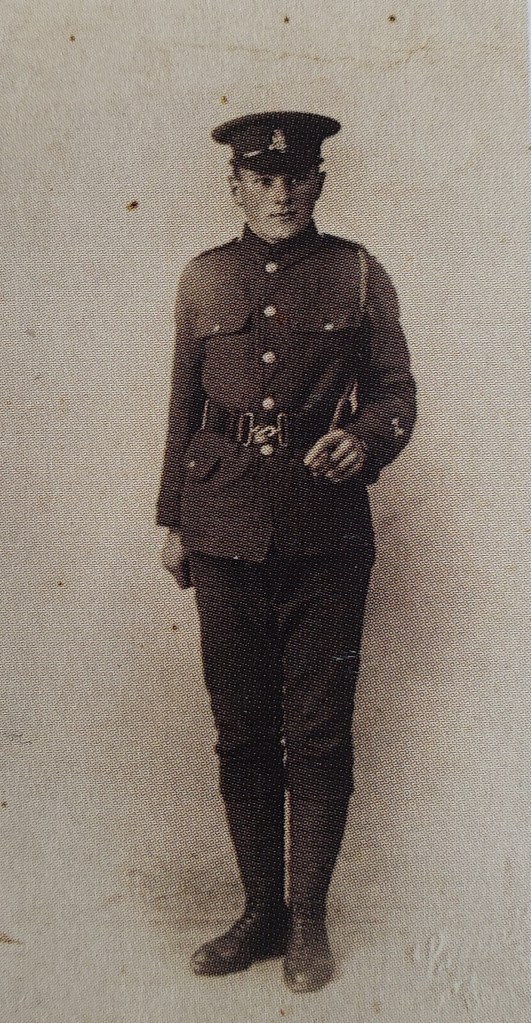
Tell Them of Us – Pte. R.A. Cook – promoted for gallantry

Continuing a series remembering Swindon’s sons who served in the First and Second World Wars.

Reginald Arthur Cook was born in Swindon on September 8, 1896 the son of William and Selina Cook. Reginald entered the employment of the GWR shortly after his 14th birthday and stayed with the company until his retirement. His only absence was during the First World War when he served on the Western Front and was promoted for an act of gallantry.

Swindon Soldier Promoted for Gallantry

Pte. R.A. Cook, the only son of Mr. W. Cook, Cemetery Superintendent, Radnor Street, Swindon, has been promoted to the rank of lance-corporal for gallant conduct.

Major-General H.D.E. Parsons, Director of Ordnance Services, British Armies in France, has written to Pte. Cook, dated October 19th, as follows: “Your name has been brought to my notice by your Commanding Officer for ‘gallant conduct in snatching an enemy stick-grenade, that had become ignited, from another man, and throwing it into a shell hole some ten yards away, thus saving the man’s life at grave risk of your own. The report reflects credit on yourself and the Army Ordnance Corps.”

Lce. Copl. Cook is 21 years of age, and is a native of Swindon. On leaving school he entered the GWR Works as a clerk. He joined the Army on October 6th, 1915, and proceeded to Woolwich for training, but after being there three weeks he was transferred to France, where he has been ever since. He is now home on leave, and will return to France on December 21st.

North Wilts Herald, Friday, December 14, 1917.

Reginald returned home to Swindon at the end of the war and lived with his parents at 63 Kent Road where he died on March 31, 1972. Reginald never married and was buried with his parents and his only sister Winifred Gladys, in the cemetery where his father once worked as Cemetery Superintendent.

Pte Percy Walter Dyer and his brother Pte Frank Edward Dyer – Tell Them of Us

With a fresh complexion, brown hair and brown eyes, Percy Walter Dyer weighed 129 lbs (9st 3lbs) and stood 5ft 5ins tall when he enlisted in the army. This poignant description of 19 year old Percy was written more than 110 years ago when his ambition was to serve with the Wiltshire Regiment.

Percy was born on April 13, 1888 in Lea, a small village 1½ miles east of Malmesbury. He was the son of John and Sarah Dyer and one of 11 children.

By 1901 the family were living at 141 Beatrice Street, Gorse Hill. Still living at home were Percy’s elder brothers Charles, Frank and Lewis who all worked as general labourers. His sisters Alice and Edith both worked as laundry assistants while Kate was employed in one of the towns several clothing factories. Younger siblings George, Ernest and Florence were still of school age but at 13 Percy stood on the threshold of adulthood.

When he filled in his attestation papers in Devizes on August 13, 1907 he was already serving in the Militia. What was his driving force – patriotism, or did he see a career in the army as an opportunity to travel, to escape.

As a serving soldier with seven years’ experience Percy was sent to France with the British Expeditionary Force (BEF) when war broke out in 1914.

During action at Armentieres on December 14, 1915 Percy received a gun shot wound to his right elbow. Although he survived, the injury caused permanent damage and limited the movement of his arm. In 1917 Percy was declared physically unfit for military service and was transferred to Avonmouth to work in an ammunitions factory.

A medical examination made in May 1918 declared that the injury to his arm rendered him 30% disabled and limited his prospects of employment on the open labour market. But this was not the extent of his poor physical condition. Percy was also declared 100% disabled by tuberculosis with ‘Sanatorium treatment’ recommended. But it was too late. Percy died on September 22, 1918. He was 30 years old and had spent eleven years in the army, three of those fighting in France and Flanders.

Sarah buried her son in Radnor Street Cemetery on September 25. Was there any consolation for her in having her boy back home? This was not the first of her sons to die as a result of the war but her elder son Frank had no known grave.

The military service records of Frank Edward Dyer do not survive, destroyed when an incendiary bomb hit the War Office Record Store in September 1940 during the Second World War. We do not know if Frank had been a volunteer when war broke out or whether he had been ‘called up’ following the introduction of conscription in 1916. Frank’s name is recorded on the Tyne Cot Memorial in Belgium, which bears the names of almost 35,000 officers and men whose graves are not known. The memorial was unveiled in 1927 – it is unlikely Sarah was ever able to visit it.

Percy was buried on September 25, 1918 in grave plot B2756. He was buried with his younger brother Ernest who died in 1911 and the boys’ father John who died just weeks after Percy joined the army. In 1933 Sarah Ann Dyer, the boys’ mother, joined them.

Cross of Sacrifice

The sheer number of bodies left lying on the battlefields of the Great War is today beyond belief and by 1915 the situation was already becoming reprehensible. Burials were frequently made without any planning or organisation with graves marked by a simple wooden cross, sometimes with the name scratched on in pencil.

Major General Fabian Ware, who commanded a mobile ambulance unit during the First World War, quickly recognised that this could not continue. Ware believed that the war dead should all be treated alike with no distinction between wealth and status. The headstones should all be uniform, displaying name, rank and regimental badge with an inscription chosen by the family.

It was Reginald Blomfield who designed the memorial, the Cross of Sacrifice, which is now familiar worldwide. The design was delegated to a team of architects and when disagreements occurred among the team Blomfield had the final say. Blomfield’s design became so popular it was adopted everywhere from battlefield cemeteries to churchyards where there were more than 40 war graves.

Messrs B. Turvey and Sons, of Bath, have been successful in securing contracts for headstones at the British Military Hospital, at Ovillers, France, and also at Swindon. They have also been commissioned to supply the War memorials at Swindon (Radnor Street Cemetery), and at Arnos Vale (RC) Cemetery Bristol. The former will take the form of a Cross of Sacrifice, with a bronze sword* on the face of it, and the latter will be a Screen Wall, with moulded panels bearing the names of the soldiers who were interred in the cemetery.

Bath Chronicle and Weekly Gazette Saturday 22 August 1925

*the sword is now a resin replacement

Join us tomorrow, Sunday November 10, 2024 for a Service of Remembrance. Meet at the Cross of Sacrifice for 2 pm.

Tell Them of Us – Jesse Bray

Military and local historian Mark Sutton spent a lifetime dedicated to the research of the Swindon men who served in the First World War. In 2006 he published Tell Them of Us – Remembering Swindon’s Sons of the Great War 1914-1918 – a go-to book for anyone researching their Swindon ancestors who served.

Among the many stories Mark tells in his book is that of Jesse Bray.

Born on November 13, 1897 in Aldbourne, Jesse was the son of Albert, a Windsor chair maker, and his wife Honor Bray. He was baptised on January 30, 1898 at the parish church of St. Michael’s and grew up in Castle Street and South Street, Aldbourne.

Taking up the story in Tell Them of Us, Mark writes how Jesse Bray enlisted at the age of just 17 and served with the 4th Battalion Wiltshire Regiment, attached to the Signal Service Royal Engineers. Jesse kept a diary recording his movements during the war, which Mark was allowed access to and which he reproduced in his book.

Jesse enlisted with the 4th Wilts on April 24, 1915. He returned to Aldbourne for a brief holiday before being sworn in at Princes Street, Swindon. On September 3 he joined the Signal Service and was moved to Winton, Bournemouth where he was billeted with “Mrs Best 33 Somerly.”

On March 14, 1916 Jesse embarked on HMS Saturnia at Devonport. “Set sail at noon. Destination unknown.” On April 3 he arrived at Alexandra Docks, Bombay. From 13-17 April he marched more than 60 miles from Jelicote to Chanbattia. On July 7 he visited Ranikhet, the Indian hill station, which made such an impression on another Wiltshire man, the Hammerman poet Alfred Williams.

Jesse spent 3 years serving in India recording his movements and memorable incidents in his diary. He recorded the marches, the outbreaks of fever and a minor wound. And then on November 11, 1918 Jesse Bray, signaller for 37th Brigade HQ, took the historic telegram that announced the armistice and an end to hostilities.

On August 29, 1919 Jess writes: “Transferred to departure camp.” On September 22 he enters “Warned for England.” The following day he left Deolali to begin his journey home. October 14 and he writes “Arrived Plymouth and entrained for Fovant.” Oct 16 – “Handed in rifle and left for Swindon.” On April 1, 1920 he is able to write “Final Discharge.”

Jesse returned to Swindon where he married Teodolinda Stefani in 1922. Despite the dangers and deprivations of his military service, Jesse lived to the grand age of 95. He died on March 24, 1992 at 26 Tiverton Road, Swindon and lies buried in St. Michael’s churchyard, Aldbourne.

Perhaps without Mark’s dedicated research we would never have known about Jesse Bray’s Great War Service.

Tell Them of Us – Remembering Swindon’s Sons of the Great War 1914-1918 by Mark Sutton.