William Y. Stock – friend and neighbour

Image of Milton Road published courtesy of P.A. Williams and Local Studies, Swindon Central Library.

The re-imagined story …

My wife says she sees less of me now I’ve retired than she did when I was working – not that I think she’s complaining, mind you.

I like to take a brisk walk around the park each morning and I get down to the allotments most days. There’s always some of my pals down there. We have a brew and a natter and put the world to rights. I’ve recently taken up swimming again after more than twenty years. I go to the Medical Fund Baths a couple of times a week and swim a leisurely length or two.

It’s important to look after yourself, no matter what age you are –  I learnt how precious and how fragile life is when my friend Bill passed away.

Bill and I grew up as neighbours in Farnsby Street. We went to the same school, joined the same clubs, played football in the winter and cricket in the summer. We started work together as clerks in Works. Then in March 1904 he left – too ill to continue work. Six months later he was gone, aged just 21 years old.

I’ve never taken my life for granted, the Great War taught me that, and losing Bill. I’ve had a good life, a smashing wife and four healthy children and a family that grows and grows, fifteen grandchildren and now the great grandchildren are coming along.  I count my blessings every day and I remember my pal Bill.

Image published courteys of Local Studies, Swindon Central Library.

The facts …

This impressive memorial surrounds two plots D152 and D153. Buried in plot D152 are Walter George Stock and his wife Mary Anne. In the second plot D153 lies their eldest son William Y. Stock.

Walter George Stock and Mary Ann Thomas were married on July 24, 1882 at St. Luke’s Church, Paddington. By the time of the birth of their first child they were living at 4 High Street, New Swindon (later renamed Emlyn Square). By 1891 the couple were living at 48 Farnsby Street and ten years later they were living at No 5 Milton Road with their three sons, a boarder by the name of Francis Shebbeare who was an Engineer’s Pupil, and Elizabeth Williams, a general servant.

The 1911 census provides more information about the Stock family’s circumstances.

5 Milton Road

Walter George Stock 54 Engineer in Testing House born London, Bayswater.

Mary Anne Stock 56 married 28 years 3 children 2 living 1 had previously died Tobacconist Shopkeeper born Coatbridge, Lanark.

Walter Harry Stock 26 Civil Engineer Rly construction born Swindon

Victor Arthur Stock 15 School born Swindon.

Eldest son William Youri was born on September 17, 1883. The UK, Railway Employment Records 1833-1956 state that he entered employment in the Stores Dept at Swindon Works on October 23, 1899. He is recorded as being ‘absent ill’ from March 1904 and died September 19, 1904. A further addition is made that he was previously employed from July 12, 1897.

Walter Harry Stock trained as a draughtsman in the Loco & Carr Drawing Office. He left the Swindon Works in 1909 and died in Belfast, Northern Ireland in April, 1944.

Youngest son Victor Arthur Stock followed his father into the Works. He later trained as an Analytical Chemist and worked for the Buenos Aires Western Railway. He died in La Pampa, Argentine on June 5, 1929.

Walter George Stock of 5 Milton Road died on January 15, 1922. He left effects valued at £610 to his wife Mary Ann. Mary Ann died on October 5, 1930. Her last home was 11 Stourcliffe Street, St Marylebone, Middx. Mary Ann left administration of her estate to Lloyds Bank Limited. Her funeral in Radnor Street Cemetery took place on October 8.

Stock brothersStock brothers (2)

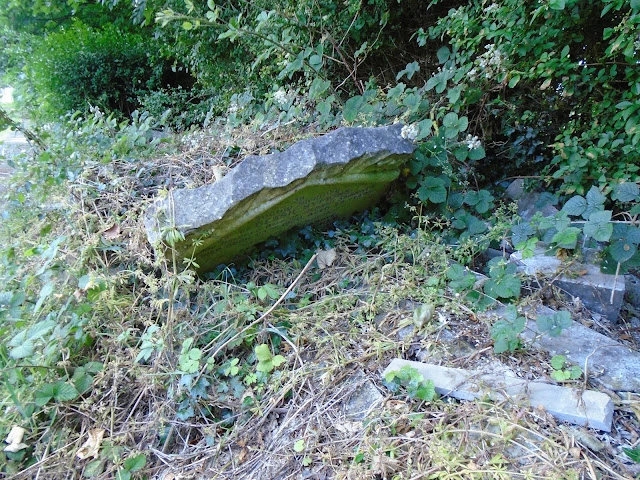
Bessie Symons Sparkes and the restored headstone

After more than fifteen years of research at the cemetery, I had never before seen this headstone, dumped in one of the cemetery’s peripheral verges.

In Loving Memory of Bessie Symons the beloved wife of Albert Sparkes died April 23rd 1920 aged 53 years. The rest of the inscription is difficult to read. The headstone was not far from its original site on plot E8516, removed for who knows what reason.

The Sparkes family were well known Swindon butchers at the turn of the 20th century. Frederick Sparkes had a shop at 47 Regent Street while his cousin Albert’s shop was at 60 Fleet Street.

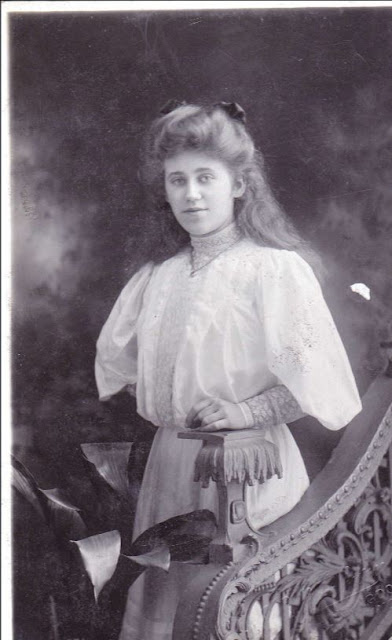
The census returns reveal a large household living over the Fleet Street shop in 1911. Albert and Bessie with their three daughters – Gladys Delia Alberta 19, a student teacher, Elsie Muriel Bessie 17, still at school part time while working as a book keeper for her father’s business and nine year old Dorothy Irene Audrey, still at school.

George Howard, a butcher’s apprentice, Ernest Salter, an assistant in the shop and May Beard, butcher’s book keeper, all lodged with the family along with Winifred Hunt, a domestic servant. The property  comprised nine rooms, not including the scullery, warehouse, shop and office, so quite a squeeze to accommodate eight adults and a child.

According to the headstone and burial registers Bessie died at her home at 15 Okus Road, Swindon on April 23, 1920 aged 53 and was buried four days later on April 27. However, confusingly the entry in England & Wales, National Probate Calendar (Index of Will and Administrations) 1858-1995 states that she died on 19 May 1919 and that administration was awarded to ‘Albert Sparkes butcher’ on 30 December 1926 when her effects were valued at £45 2s 6d.

Bessie was buried in plot E8516 with her husband Albert who died in 1937 and their daughter Gladys Delia Alberta who died in 1970. Is it possible the headstone was never replaced on the grave after the burial of Gladys?

And then I came across the Sparkes family tree published on the Ancestry website by philipacore and some fab photos.

Bessie and Audrey Sparkes
Gladys Delia Alberta Sparkes
Elsie Muriel Bessie Sparkes

The Radnor Street Cemetery volunteers have rescued Bessie’s headstone and it now sits on her grave.

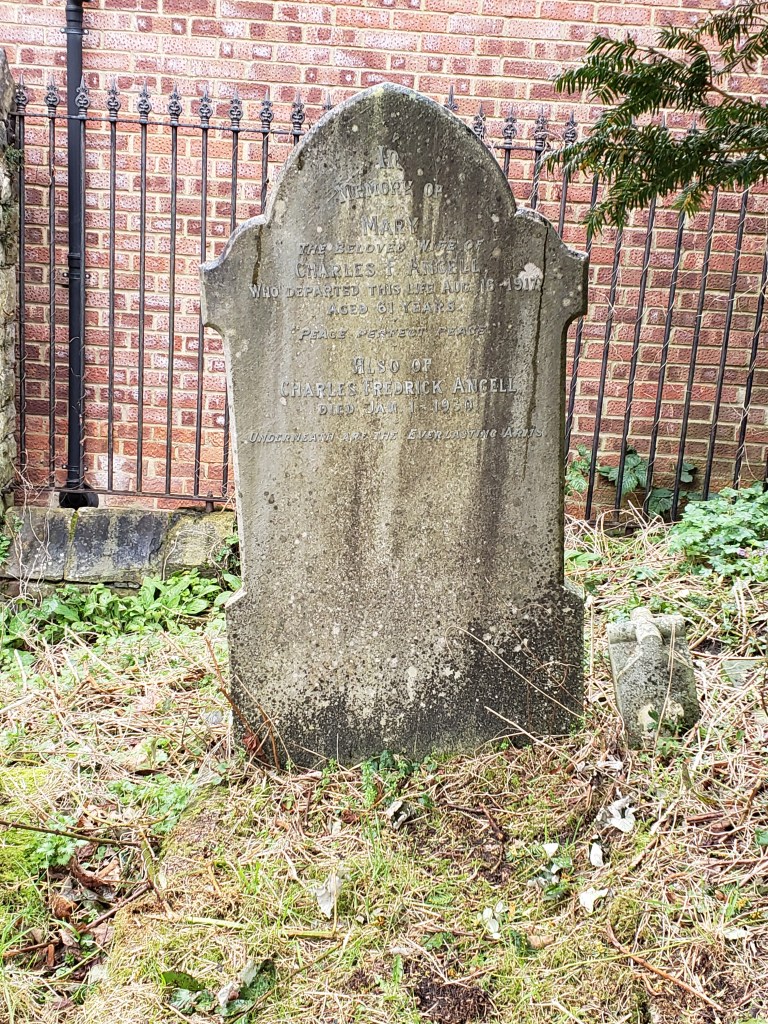
Charles Frederick Angell – marry in haste, repent at leisure

The re-imagined story …

Marry in haste, repent at leisure was one of my mum’s often repeated phrases. As an impressionable young girl with a tendency to fall in love, I was never sure if this maxim was a piece of warning advice for me or a comment on her own life. Turned out it was both!

But this story isn’t about me and my mum. It’s about Mr Charles Angell who worked in the stores with my dad. Mr Angell and his wife Mary lived just round the corner from us in Florence Street.

Dad knew him well – they had worked together for many years. ‘Unless he has come into a secret inheritance he can’t be worth a lot of money,’ my dad said.

You’ll understand what I’m getting at when I tell you the rest of the story.

Mary Angell died in August 1917. Mum didn’t even know she was ill. She would have helped out had she known. Dropped off a hot meal for the couple, done a bit of shopping for them, that kind of thing. Then just seven months after his wife died, Mr Angell upped and married again. People do funny things in grief, dad said but mum said he was old enough to know better.

His new wife was a Miss Neall. Dad said she was a nice looking woman, not young, but nice looking. That got a glare from mum.

“Well I hope he knows what he’s doing. Marry in haste, repent at leisure.”

The facts …

Charles Frederick Angell married Mary Tanner at St Mark’s Church on August 31, 1889. He worked as a labourer and she worked as a domestic servant. Two years later they were living at 21 Avenue Road, Old Town.

By 1901 they had left the leafy suburbs of Old Town for a more modest property in Beatrice Street, Gorse Hill where they lived with Mary’s widowed father Daniel and her sister Emma and nephew William.

At the time of the 1911 census they had moved just down the road to 28 Omdurman Street. They state on the census returns that they had been married for 21 years and had no children.

Mary died in August 1917 when the couple lived at 9 Florence Street. The funeral took place on August 20th when Mary was buried in grave plot A2534 in Radnor Street Cemetery.

Charles Frederick Neall was 61 years of age when he married Julia Elizabeth Neall 54, at St. John’s Church, Paddington on March 30, 1918 but less than a year later the marriage had obviously soured.

The following notice was published in the North Wilts Herald, Friday 10th January, 1919.

I, Charles Frederick Angell, late of 3 Florence Street, Swindon, will NOT BE RESPONSIBLE for any DEBTS incurred by my wife, JULIA ELIZABETH ANGELL, now residing at 7 Market Street, Swindon.

Julia eventually left Swindon and when she died in the September quarter of 1923 her death was registered in the Tonbridge area of Kent.

Within a year, Charles took the plunge again. He married Alice Pring Johnson on June 9, 1924 at St Mary’s church, Charlton Kings, Glos.

Charles died on January 1, 1930 at his home 28, Hunter’s Grove, Swindon. He was 72 years old. The death announcement published in the North Wilts Herald described him as ‘the loving husband of Alice Angell.’ His funeral took place on June 4, when he was buried with his first wife Mary.

Sidney James Maidment – Veteran Fireman

The re-imagined story …

Mr Day, my head teacher at Even Swindon School, spoke up for me. He said there was a lack of supervision in the family home, that my mother couldn’t cope after my father left her, that I was seldom in school and had fallen behind in my education.

I wanted to be a fireman when I left school. I didn’t know how you went about it though. Was it like the army, did you have to enlist somewhere? Or did you have to do an apprenticeship like in the Works? Did your dad have to put your name down somewhere – well that wasn’t going to happen. Sometimes I’d wait outside the fire station – you probably don’t remember the old station in Cromwell Street – just in case there was a call out.

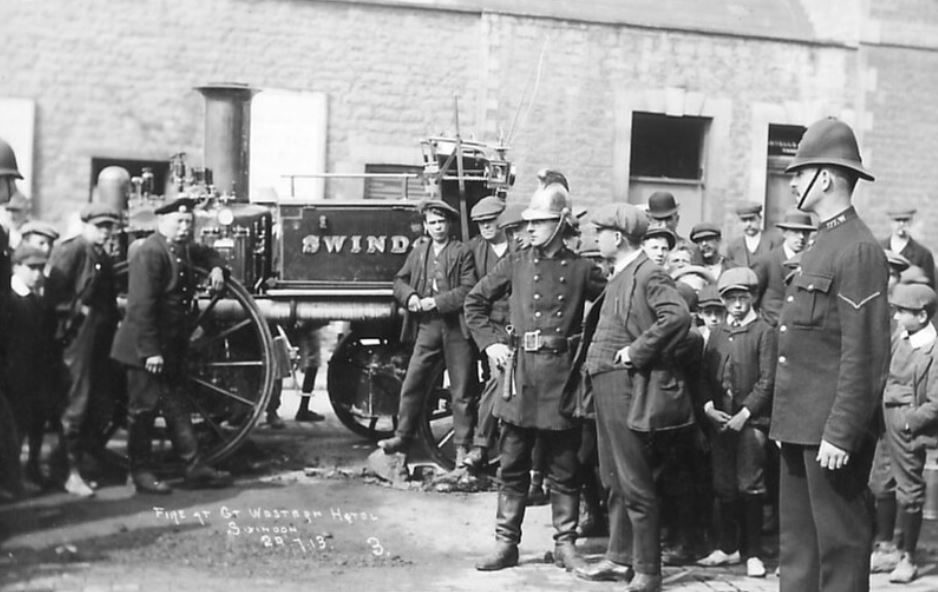
I remember Mr Maidment. He attended the fire at the Great Western Hotel garage. I’m one of the boys in the photograph. What a blaze that was. They thought it had been caused by the heat from the laundry next door.

The facts …

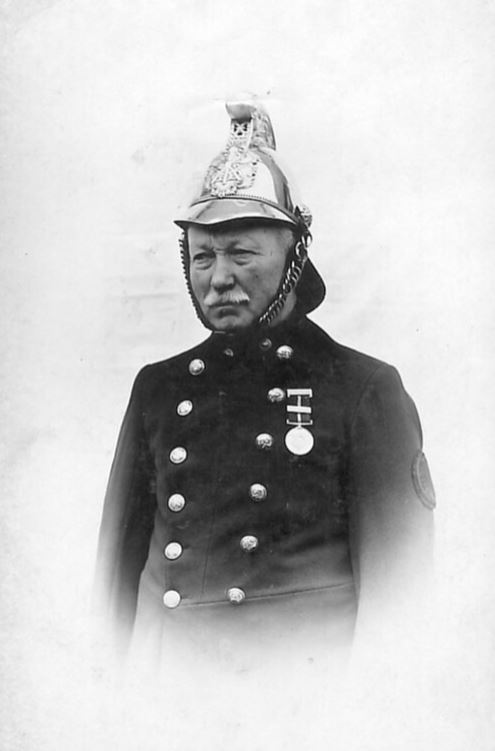
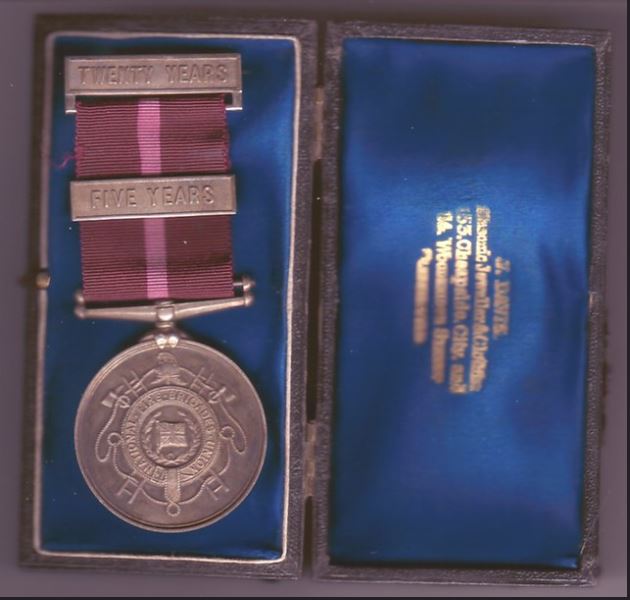
Sidney James Maidment is pictured proudly wearing his long service medal awarded for 25 years’ service in the Swindon Fire Brigade. Yet despite a funeral service attended by representatives from Swindon Corporation and the Fire Brigade, Sidney Maidment was buried in a public grave with three other unrelated people.

Theatre Tragedy

Swindon Attendant’s Sudden Death

Veteran Fireman

There was a tragic incident at the Empire Theatre, Swindon, on Monday evening. Mr Sidney James Maidment, of 2, Rolleston Street, had for the past 22 years acted as evening bar attendant, and he went to the Theatre as usual on Monday. He was seen to go into the circle bar, and was then apparently in his usual health. Some ten minutes or a quarter of an hour later, Mr. R. Manners, son of Mr. Alfred Manners, had occasion to go to the bar. Noticing that the electric light had not been switched on, Mr Manners opened the door and went in, and was startled to find Maidment lying motionless on the floor. Apparently deceased had fallen down on entering the bar, and he lay there lifeless. Death is attributed to heart failure.

A doctor was summoned, but life was extinct, and the body was removed on the borough ambulance to deceased’s home. He had been at home ill for several weeks, and only returned to his duties quite recently.

Deceased had been in the employ of the Swindon Corporation for many years as steam-roller driver, being the oldest driver. He was also for many years a member of the Swindon Fire Brigade, holding the position of engineer. He was a member of the Brigade before it was taken over by the Corporation, and in the old days he used to drive the horses when the engine was conveyed by that means to outbreaks of fire.

Deceased, who was 65 years of age, was a widower, his wife having died some years ago. He leaves a grown-up family of two sons and three daughters. There was no inquest, as deceased had been attended by Dr. Rattray.

The Funeral

The remains of the late Mr Maidment were laid to rest yesterday afternoon amid very impressive scenes. The Swindon fire engine was used as a hearse, and the brigade turned out in practically full force, under Capt. Baker. Many of the deceased’s colleagues, who served in the brigade with him were present to pay a last tribute. There were numerous wreaths, which were placed on the coffin and on the engine. Large crowds lined the route from Rolleston street to St. Paul’s Church.

The cortege was met at the church by the Vicar (the Rev. Alan Leslie), who conducted the service. Afterwards the procession was reformed and made its way to the Cemetery, where the curate of St. Paul’s (the Rev N.S. Willis) performed the last rites.

The mourners were: Mr Sidney W. Maidment and Stanley G. Maidment (sons), Misses Kate E. Maidment, Gladys Maidment, and Maud Maidment (daughters), Mr. H. Boreham, Mrs M.G. Maidment, Mrs. S.G. Maidment, Mrs Oakley, Mrs Titchener, Mr. W. Oakley, Mr and Mrs Anger, Mr Trevor Matthews, Councillor H.R. Hustings, and representatives of the Empire Theatre staff and of the High Street and Prospect Working Men’s clubs. Messrs J.J. Hamp and J. Boulton also attended at the graveside to pay a tribute of respect to an old employee of the Corporation. Past members of the Fire Brigade present included ex-Captains Reeves and Cox, and ex-Firemen Wiltshire, Ludlow, Eden, Woolford, and Hinton. The bearers were Firemen Frampton, W. Smith, and Ludlow, and Engineer Rogers.

North Wilts Herald, Friday, October 31, 1924.

Sidney James Maidment pictured left attending the fire at the Great Western Hotel in 1913. Image published courtesy of P.A. Williams Local Studies, Swindon Central Library.

Sidney James Maidment’s long service medal published courtesy of P.A. Williams, Local Studies, Swindon Central Library.

The aspirational Percival Seymour Scott

The re-imagined story …

When I was growing up in Swindon there was a ‘can do’ atmosphere in the town. If you wanted to make something of your life you could, yes even those from disadvantaged families.

From the very early days Swindon was an ambitious town with a self belief that permeated all aspects of life. It was taught in the schools and colleges; preached in the churches and chapels and honed and forged in the Works.

It was said an apprenticeship in the Works was the hallmark of excellence and recognised across the world.

Take George and Eliza Scott’s boy. He grew up in Ashford Road, one of the many roads of ubiquitous red brick terrace houses that crept up Kingshill, but what an exciting life he led. They must have been so proud of him. I’m sure they would say it was worth all the sacrifices they made.

The facts …

George Albert Scott and Eliza Seymour were married in the Providence Baptist Chapel on July 9, 1892. George was 26 and worked as an Engine Fitter and Turner in the GWR Works. He was born in Bristol in 1866 and first appears in Swindon on the 1881 census living with his mother Caroline and stepfather Charles Jefferies at 10 Queen Street. Aged 15 years old, George had already begun an apprenticeship as an engine fitter.

Eliza was born in Lechlade in 1871. In 1891, the year before her marriage, Eliza was living with her parents at 124 Stafford Street. Her father John was a grocer and Eliza worked as a dressmaker.

The newlyweds set up home in Ashford Road where the family would live for more than 70 years. They had three children, Percival born in 1896, Ivy in 1898 and Gwendoline in 1906. The 1911 census records the couple’s only son Percival 15, was a part time student whilst working as an Office Boy in the Works.

In 1915 Percival joined the Royal Navy for the duration of hostilities (the First World War). His naval records describe him as 6ft ½ ins tall with black hair, brown eyes and a dark complexion. At the beginning of 1918 he transferred to the newly created RAF. 

In 1920 Percival married Elsie Holbrow, the daughter of another railwayman Samuel Holbrow and his wife Minnie. The following year Percival’s name appears on the Ship’s Register of the SS Highland Glen bound for South America where Elsie would join him at their home in Buenos Aires, Argentina.

The couple apparently made return visits to Swindon and are recorded as passengers on the Asturias in 1926, their destination 47 Deacon Street (the home of Elsie’s parents), their permanent residence Argentina. They were too late to see Percival’s mother Eliza who died in 1922.

Elsie died in Buenos Aires just three years later on January 29, 1929 aged 32. Her details are recorded on her parents’ headstone.

George Scott married for a second time in 1924. He died in 1928 aged 62 years and was buried with his first wife Eliza in Radnor Street Cemetery plot E7492. His second wife Margaret died in 1973 and was buried in the same grave.

Percival remained in South America until at least the 1960s when he is recorded as living in Peru but he died closer to Swindon at his home The Hermitage, Combeland Road in Minehead on November 5, 1979.

Charles Edward Hall of 75 Morris Street, Rodbourne.

The re-imagined story …

When I was a child I used to think Mr Hall was just an old man who tottered about in front of his house in Morris Street before turning round and going back inside. I used to wonder what the point of this all was as he went nowhere and saw nothing new. Occasionally someone would pass by and stop to talk to him, but that was about it.

How pointless, I thought as I kicked my football on the way to the Rec. Or sped past on an errand up the Lane for my mother, keen to get it done and to be off with my mates. Always in a hurry, well kids are, aren’t they? Mr Hall was just another old man who tottered about in front of his house. As children we give little thought to the old people we see shuffling about the streets, or the life they might have lived.

Now I’m an old man who totters about in front of my house. Of course, Morris Street is a bit different these days, but someone usually stops and has a few words with me. Helps pass the day. I suppose that’s what it was all about for Mr Hall.

The facts …

Swindon J.P. Dead

Mr C.E. Hall’s Services to Methodism

Former Councillor

Mr Charles Edward Hall, J.P., of 75 Morris street, Swindon, died early on Friday morning, aged 75 years.

Heart trouble had confined him to his home for the past eight years, and except for an occasional walk outside his home, Mr Hall had never been out in the town during this time. He had been bedridden for the past few months.

Many years ago Mr Hall took an active interest in the affairs of Swindon, and among other things was a town councillor. He only served for three years, however, and did not seek re-election, as the council work interfered with his church activities.

He was an ardent Methodist, and took a prominent part in the affairs of the Regent street Clifton street and Butterworth street churches. He had been a steward on the Swindon circuit, while he was twice elected president of the Swindon and district Sunday School Union.

50 Years with the GWR

He was appointed a J.P. to the Borough bench in 1912.

A native of Hook, Mr Hall came to Swindon in his youth, and worked in the Great Western Railway factory as a boilermaker. At the time of his retirement 12 years ago, he was a foreman, and had completed 50 continuous years of service. He was an enthusiastic trade unionist, and became a member of the Boilermakers’ Iron and Steel Ship Building Society in 1880.

In his younger days Mr Hall took a keen interest in politics, and was a staunch worker for the Liberal cause.

He leaves a widow and one son.

The Funeral

The funeral took place at Radnor street Cemetery on Monday afternoon. The service at the house and the committal at the grave were conducted by the Rev. Allison Brown. There were no flowers by special request.

The chief mourners included Mrs C.E. Hall (widow), Captain and Mrs. A.E. Hall, Mrs Rees, Mrs Barrett, Mrs Richardson, Mrs Winter, Mr H.W. Watkins Mr W. Watkins, Mr A.W. Head, and Mr Turk.

The funeral arrangements were carried out by Messrs. A.E. Smith and Son, 24 Gordon road, Swindon.

Magisterial Tribute

When the Swindon Borough police court magistrates met on Monday afternoon the chairman (Mr. A.W. Haynes), addressing the court, said that within the last few days the magistrates had lost a colleague in the person of Mr C.E. Hall better known as “Charlie.” He had been ill for a very long period but previous to his illness he was a regular attendant at the court.

“I have known him personally for a long period and he was very active in former days in many ways of life. He was very conscientious in everything he did and very much respected by all who met him. The Justices and their Clerk deeply sympathise with the widow and family in their bereavement,” said Mr. Haynes.

North Wilts Herald, Friday, 8 March, 1935

Charles Edward Hall was buried in Radnor Street Cemetery on March 4, 1935 in plot D951 which he shares with his first wife Emma Jane.

Photographs published courtesy of Cathy Moseley and the Hall Family Tree, Ancestry.

Susannah Phillips – builder, contractor and marble mason

It wasn’t that unusual in Victorian Britain for a woman to head a family firm, which is exactly what Susannah Phillips did after the death of her husband John.

Susannah was born in Chatham, Kent on January 21, 1816, the daughter of George Reynolds and his wife Zipporah. Susannah married John Phillips, a carpenter, on December 25, 1845 at St Nicholas’ Church, Rochester. By the time of the 1851 census the couple were living in a house next door to the Victoria Inn on Victoria Street, Swindon with their two young daughters.

John’s building projects in Swindon date from about 1852 and the census of 1861 records him as employing 27 men, so a not inconsiderable size business.

As well as houses in the Quarries and King Street, John’s firm built some significant and now sadly lost buildings. In 1866 he built not only the Congregational Church on the corner of Bath Road and Victoria Street, demolished in the 1940s for road widening purposes, but also the now derelict Corn Exchange in The Square, Old Town. In 1873 John built the Belmont Brewery, thankfully still standing, just behind his former home.

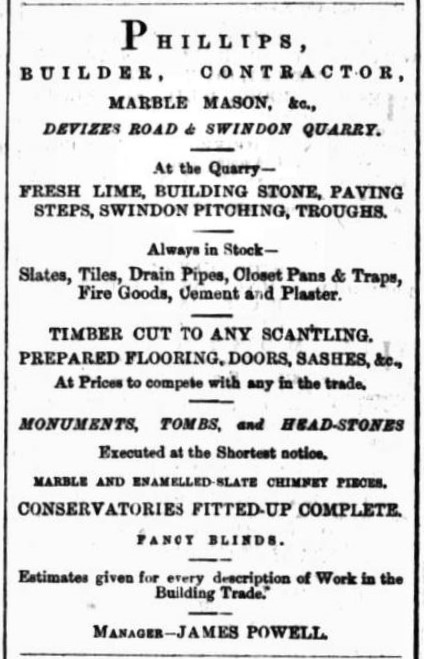
On June 18, 1874 John announced in the Swindon Advertiser that due to failing health he was retiring from business, leaving it in the capable hands of Mr Powell and Charles Phillips (his son). Just weeks later John died and was buried at Christ Church churchyard on July 28. Susannah carried a regular advertisement for her business in the Swindon Advertiser and then in the newspaper dated November 8, 1880 she announced her retirement.

Susannah Phillips,

Builder, Contractor, Marble Mason, etc.,

Devizes Road and Swindon Quarry,

In retiring from the old established Business for so many years carried on by herself and late husband, begs to return her sincere thanks to customers and friends for the kind patronage which has been bestowed upon her, and to inform them that in future the business will be carried on by her Son, in conjunction with Mr James Powell, who has for a long time successfully acted as her manager.

S.P. Trusts that her successors will meet with the same support which has hitherto been conferred upon her.

In 1881 Phillips and Powell along with George Wiltshire put in a successful tender to lay out the new Swindon Cemetery, better known today as Radnor Street Cemetery.

Swindon

The Cemetery works – In reply to advertisements six tenders were sent in for laying out, draining, fencing, and doing the necessary work for the Swindon Cemetery. The Cemetery Committee met on Thursday evening to open these. The tender of Messrs Phillips and Powell and Mr George Wiltshire, who sent in a joint tender was accepted. The tenders were as follow: John Richings (Faringdon) £5,647; John Webb (New Swindon) £5,510; Thomas Barrett (Swindon) £5,562; W. Maxwell (London) £5,450; A.J. Beaven (Bristol) £5,442; Phillips and Powell and George Wiltshire (Swindon) £5,393 10s.

Western Daily Press April 7, 1881.


Susannah died at her home, Clarendon House, Devizes Road on April 24, 1894. The announcement of her death appeared in the Swindon Advertiser on April 28, the day of her funeral. She had decided to be buried in the churchyard at Christ Church, with her husband, and not in the cemetery her family firm had built.


Clarendon House, the Phillips’ family home. The lane way alongside was named Phillips Lane in the 1970s.

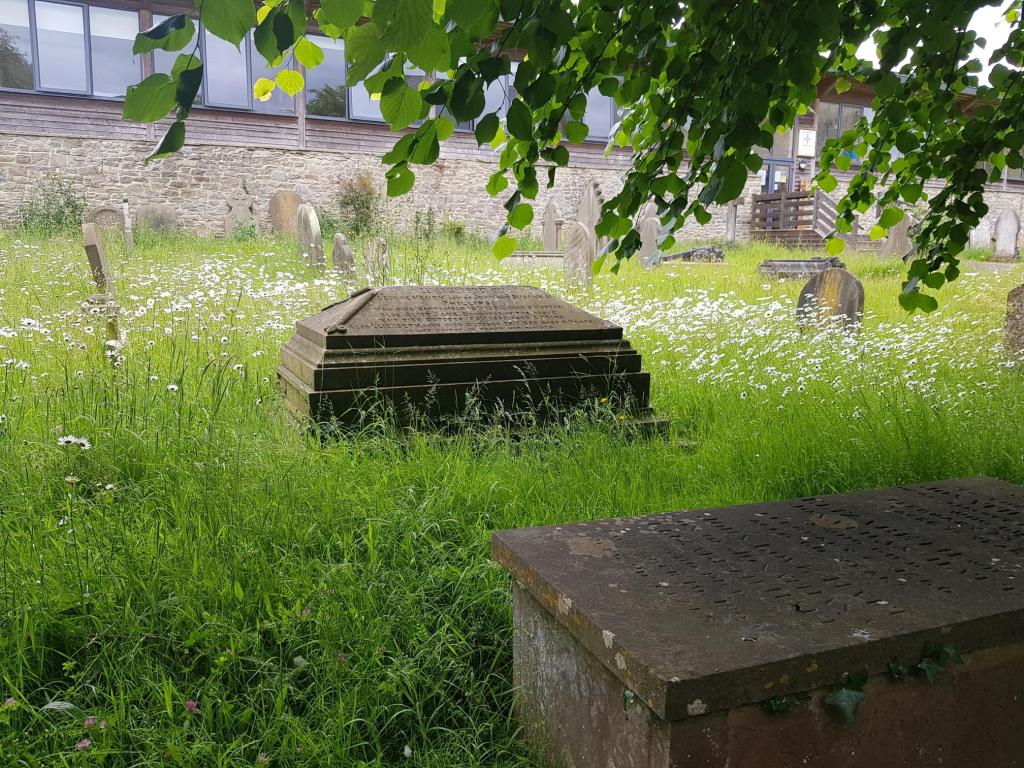
The Phillips family grave in Christ Church churchyard

John Horsell – builder and licenced victualler

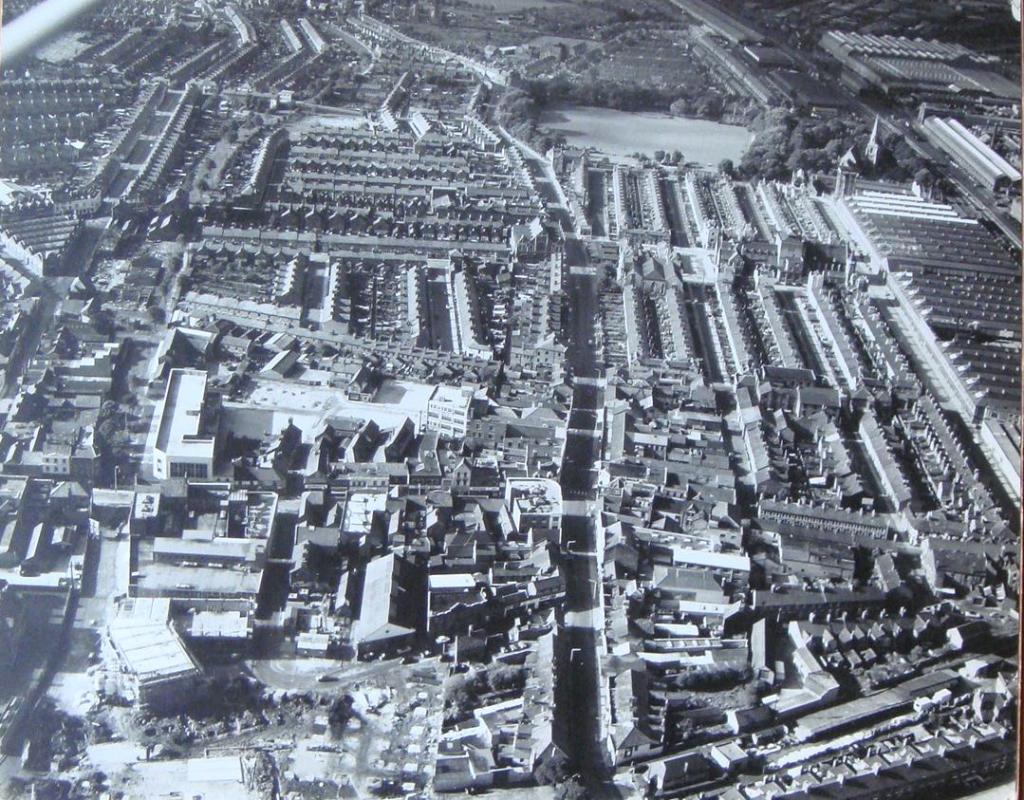
Aerial view of the town centre as demolition begins

The re-imagined story …

Can you remember the town centre as it used to be? I can. All those rows of old Victorian terrace houses, empty and boarded up. What a sight that was. What a disgrace.

Then at last our old fashioned railway town, for so many years stuck in the 19th century, was entering the 20th. There were even plans to demolish the railway village in the 1960s. Knock the lot down, I said.

We were so excited when we saw the new plans for the town centre. We were to have a ‘shopping mall.’ I’d never heard of such a thing – a shopping mall. Swindon was going to become like something out of the American films.

How excited we had been to see the new college rise out of the demolition waste from Horsell Street, all gone at last. And most of Rolleston Street and Byron Street as well.

I don’t get out much these days but this week my granddaughter took me into town to have my Covid booster jab. I thought we were to go to the old railway museum along Faringdon Road until she told me we were to go to STEAM – the museum they built in one of the original railway buildings.

I suggested we had tea in McIlroys afterwards but apparently it was closed more than twenty years ago and demolished soon after. That beautiful store, I couldn’t believe that. I asked her to drive down Regent Street so I could see the changes, but she said its pedestrian only these days.

The town centre has changed out of all recognition. All those terrace houses gone, Brunel Street, Davis Street and most of Havelock Street.

But the old railway village is still there. All tidied up and smart, apart from that dreadful old Mechancis’ Institute building, derelict for more than 35 years now. Knock it down I say.

Murray John Tower (2)

David Murray John Tower built in 1974-6 on the site of the old gas works.

The facts …

The Rolleston Estate, a large land holding that originally belonged to the Vilett family, was crucial to the development of New Swindon. In the 1880s the vast area of prime building land was held in chancery following the bankruptcy of its then owner Colonel William Vilett Rolleston, and was actively holding up the expansion of the town.

But by February 1885 it looked like things might be moving. At a meeting of the New Swindon Local Board it was announced that plans had been submitted by Messrs Maxwell and Tuke of Manchester, surveyors to the Bury Union Building and Investment company, for the development of laying out the Rolleston Estate for building purposes.

Construction began in 1890 when builders William Crombey, a former engine driver from Durham, and John Horsell, who lived in neighbouring Commercial Road, got the ball rolling.   They soon began work on streets that would eventually be named Curtis, Crombey and Deacon Streets.

John Horsell was born in 1848 the second son of Charles Horsell, a slater and plasterer and his wife Ann. He married Mary Jane Godwin at Christ Church on 10th February 1872. His address at the time of his marriage was 61 Newport Street and his occupation was that of Surveyor’s Clerk. The couple went on to have eight children.

His obituary published in the North Wilts Herald provides details of his career and his involvement in the development of the town centre at the end of the 19th century.

Rolleston estate

The Rolleston Estate – Horsell Street now lies beneath the Regent Circus development built in 2014.

Death of Mr John Horsell

The announcement will be received with sincere regret by his many friends of the death of Mr John Horsell, which took place at his residence in Rayfield Grove, Ferndale Road, Swindon, about 10 o’clock on Sunday morning. For the past 20 years the deceased had been a sufferer from gout, which became acute some six years since, and he had been practically an invalid during the last twelve months. His end, however, came somewhat unexpectedly.

The late Mr Horsell would have been 60 years of age had he lived until next May. He was born in what was then Old Swindon. Having left school he went into the office of Messrs Bradford & Foote, solicitors, and afterwards into that of Mr William Read, assistant overseer. After his marriage Mr Horsell became the landlord of the Cold Harbor Inn, Broad Blunsdon, where he remained about a couple of years. He then took the Ely Inn, Wroughton, and was there something like 18 months. Returning to Swindon, he received the appointment of assistant overseer, which he retained for 13 years. For some time after this he carried on the duties of tax collector duties which he had also discharged for some little time prior to his securing the assistant overseership. Then he went into the building business, and took a no mean part in the development of the town. He erected the Rolleston Arms Hotel in Commercial Road, and was proprietor there for eleven years. He has since carried on building operations in the Ferndale Road area, where he resided until his death.

In his time Mr Horsell had interested himself in many friendly and other kindred societies. He was a prominent Odd-Fellow and Forestry, and was a member of the former society for 36 years. He was also a Buffalo, and his enthusiasm for angling was remarkable. Altogether his career has been a varied and many respects a useful one.

A widow and seven children – fours sons and three daughters – are left to mourn a severe loss. Mr Horsell’s two youngest daughters left for Canada a few months ago, one to be married.

Funeral

Many manifestations of regret were in evidence at the funeral, which took place yesterday afternoon. The cortege left Rayfield Grove at 2 o’clock, and proceeded to St. Barnabas’ Church, where the first part of the service was conducted by the Rev. P. Maddocks (vicar). The same gentleman performed the last rites at the graveside in the Cemetery, where a respectful crowd of onlookers had assembled…

Deceased was for 20 years an enthusiastic member of the local Fire Brigade, and to show their last respects to a former comrade the following members attended in uniform and headed the cortege – Ex-Deputy Capt. T. Munday, Lieut. E.R. Bowering, Foreman Selby, Engineer Eden, and Fireman F. Reeve, C. Greenaway, R. Hinton, W. Ludlow and W.H. Gill. There also followed Mr W.H. Smith (secretary of the Swindon and District Licensed Victuallers’ Association of which the deceased was a former secretary). The coffin was of polished elm, with brass fittings, and the breast-plate was inscribed as follows:-

John Horsell,

Died January 13th, 1907

Aged 59 years

List of floral tributes …

The undertakers were Messrs. H. Smith & Son, of Gordon Road, Swindon.

The North Wilts Herald, Friday, January 18, 1907

John was buried in plot D30 in Radnor Street Cemetery on January 17, 1907. His grave is next to that of his son Albert John Horsell Licensed Victualler at the Rifleman’s Arms Hotel. His funeral took place on March 25, 1903. He was just 30 years old. He is buried in plot D29 with his infant son William who died aged 1 year old.DSC05332

Under construction – the Regent Circus development in Swindon opened in October 2014.

It’s a small (Ody) world!

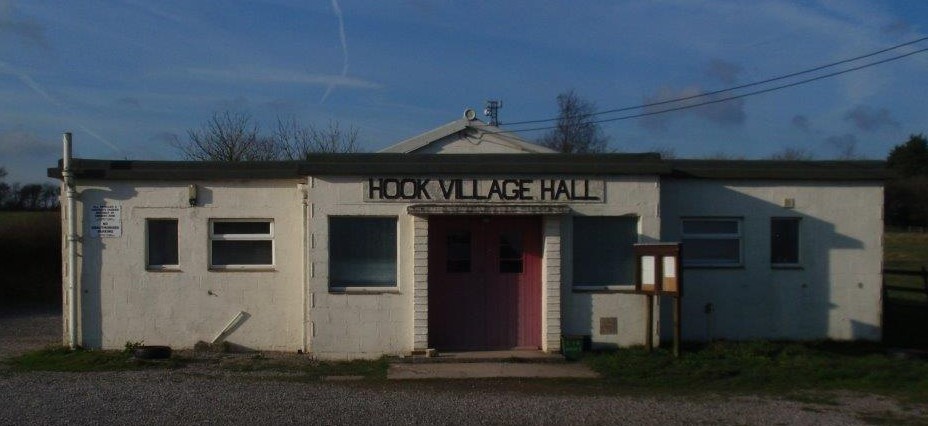
I recently took part in the hugely popular Cakes and Tales event at Hook Village Hall, Lydiard Tregoze. Held by the Friends of Lydiard Park this popular occasion has become an annual event as part of the Lydiard Tregoze Local History Project.

A general invitation was extended to all past and present residents of Hook village and the surrounding area to bring along their photos and share their memories. My involvement as a Friend of Lydiard Park is in transcribing the diaries of Hook farmer Elliot Woolford who kept a meticulous account of life on Hook Farm for more than 40 years.

I have a few ‘favourite’ families among the former residents of the Lydiards, most especially the Ody family. For me it began with discovering the grave of Noah and Sarah Ody in St. Mary’s churchyard.

Noah was baptised on November 14, 1790 at St Mary’s Church along with his sister Ann, the children of George and Mary Ody. He married Sarah Clark on November 25, 1811 at the parish church of Brinkworth.

Noah and Sarah raised a large family and along with their sons were tenants at Hayes Knoll and Bagbury Farms in Purton; Haxmoor in Purton Stoke; Braydon, Marsh, Flaxlands and Glebe Farms in Lydiard Tregoze and Lower Shaw Farm in the parish of Lydiard Millicent, at various times during the 19th century.

As Oaksey resident Harold Ody proudly told Elspeth Huxley when she was writing her book Gallipot Eyes – a Wiltshire Diary in 1975 – “There’ve been Odys farming in North Wilts for five hundred years,” – and I quite believe him.

At the recent Cakes and Tales event I was delighted to meet Liza and Marilyn who both trace their ancestry back to the three times married Richard Ody (1775-1840) one time gamekeeper to Lord Bolingbroke at Lydiard Park and the elder brother of my Noah (of course he’s not exactly ‘my’ Noah, but you know what I mean).

It was a busy afternoon with lots of people to talk to and not enough time to do it in – but I have Liza and Marilyn’s contact details and will be in touch.

Skip on another couple of weeks …

I received an enquiry on the Radnor Street Cemetery Facebook page concerning the death of Eliza Ody on April 9, 1921 who was buried in the cemetery.

Imagine my disappointment when I was unable to locate the burial! But wait – there had been an error. This was the lady’s maiden name and not the one she was buried with. It transpired that Eliza is buried in a public grave so sadly there will be no headstone to mark the spot, but I was determined to trace this member of the Ody family. And would you believe it – she was a descendant of the aforementioned Richard Ody and his 3rd wife Sarah Beasant.

Well I never, it’s certainly a small (Ody) world!