Reuben George and the Christmas card

The re-imagined story …

I thought the days of families going short of food and unable to heat their homes was a thing of the past. I’m glad dad isn’t alive to see how low his country has sunk. Was this the future he fought for in two world wars?

I’ve got a battered old biscuit tin full of election pamphlets and newspaper cuttings he kept along with meticulously copied letters he had written in the 1920s and 30s. There were replies he had received from local politicians and national ones as well and a whole batch written by Jimmy Thomas. Every railwayman in Swindon knew of Jimmy Thomas, a former engine driver who became the youngest ever president of the Amalgamated Society of Railway Servants and went on to become Labour MP for Derby.

There was even a Christmas card sent to dad in 1921 from Swindon Mayor Reuben George. I remember dad saying it was a travesty that Reuben George had never been elected an MP.

“Reuben George was a champion of the under dog,” dad used to say. I’m sure this isn’t the future he worked for.

The facts …

“It was the greatest public demonstration of spontaneous affection for a public figure that the town of Swindon had seen for very many years,” reported the Advertiser on the funeral of Alderman Reuben George, one of the forgotten political heroes of the town.

Born on September 11, 1864 the son of Stephen George, a bootmaker and his wife Elizabeth, Reuben grew up at Highfield Cottages in the hamlet of Barton St. Mary, Gloucester.

Reuben George moved to Swindon where he worked as an agent for the Wesleyan & General Insurance Company and by 1891 he lived with his wife Clara and their son, two year old Herbert Gladstone George, in two rooms in a shared house at 97 Princes Street. The rest of the house was occupied by Albert Bick, an iron turner at the GWR Works, his wife and her sister.

Socialist, pacifist, member of the Wiltshire Archaeological Society, an authority on Wiltshire local history, one of the founder members of the Worker’s Educational Association and supporter of the Richard Jefferies Society, George’s list of interests and achievements is a long one.

Elected to both Swindon Town and Wiltshire County Councils, he served on numerous committees, including the education committee of both authorities.  His lifelong interest in education stemmed from his own humble beginnings and early lack of opportunities.   

Reuben George stood as Labour Candidate for Chippenham in 1918, the first Labour Candidate to stand in that town, with the slogan – ‘You have King George, you have had Lloyd George, and all you want is Reuben George’. …

During his lengthy political career George served as Mayor of Swindon 1921-22. George inaugurated the original wooden diving stage at Coate Water opened in 1921 and celebrated the occasion by being the first to dive off.

Reuben George died in the Victoria Hospital on June 4, 1936.  Described as a champion of the under dog he was a socialist reformer inspired by William Morris, the 19th century artist, poet and political activist. George’s fame was not confined to Swindon.  

“The news of the passing of Ald. Reuben George was broadcast to the nation in the second news bulletin of the National programme on Friday night,” the report of his death continued in the Swindon Advertiser.

During a funeral service attended by not only local dignitaries but also the ordinary people to whom George had devoted his life, it was reported that ‘men and women sobbed audibly.’

A letter of condolence was sent by May Morris, daughter of the aforementioned William Morris and among the floral tributes were wreaths from the employees from local firms and Swindon schools. The pall bearers were six members of the Swindon WEA Executive Committee.

Among the family mourners were Reuben’s widow who attended her husband’s funeral against her doctor’s advice, his three surviving brothers John, Alfred and Walter and his two sons, Granville and Stanley (eldest son Herbert had died whilst on military service in India).

Bareheaded crowds lined the streets and blinds were drawn everywhere along the route as the funeral cortege made its way from Christ Church to the Radnor Street Cemetery.
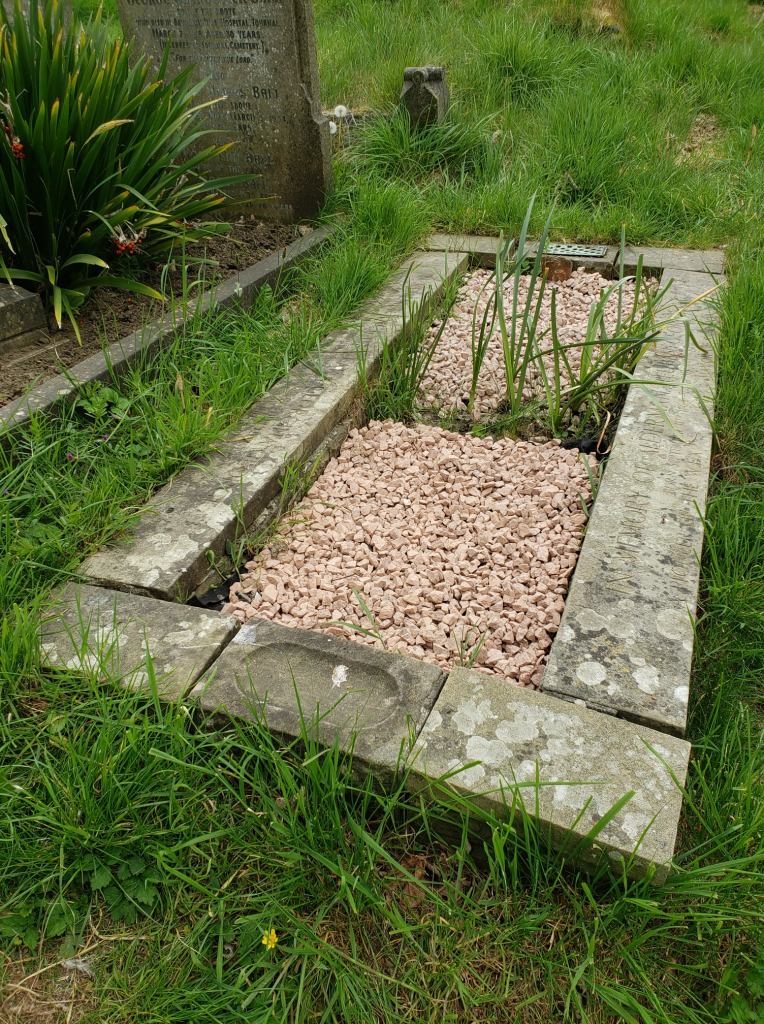
Today Reuben and Clara George’s modest grave has been adopted by Radnor Street Cemetery volunteer Jo, who has lined the grave with a membrane to reduce the weeds and added new chippings. Jo has also planted daffodil bulbs, which will bloom again for years to come.

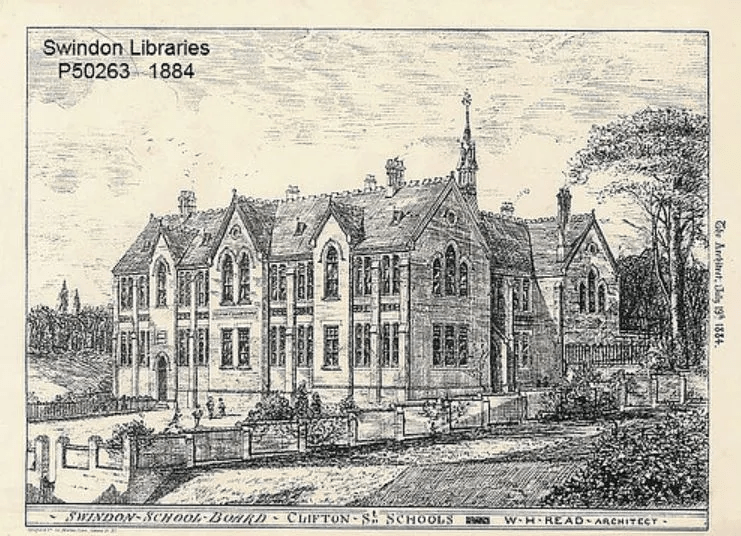
Miss S.A. Wright – Headmistress of Clifton Street Girls’ School

In the mid-Victorian period there were few career opportunities for an ambitious, working class girl. But perhaps attitudes were different in the Wright family home.

Susan Ann Wright was born on November 10, 1858 the second child and eldest daughter of Joseph Fletcher Wright and his wife Elizabeth. The family appear on the 1861 census living at 41, Exeter Street. Joseph was a Turner in the GWR Works, a skilled, well paid job. Perhaps he had a progressive attitude towards education and was pleased to see his daughter advance in her chosen career.

By 1891 Susan, 32 was living with her widowed father and her sister Emily, 30 and brother Alfred, 25 at 35 Wellington Street, which would be her home for the rest of her life.

Susan died on February 18, 1940 aged 81. She was buried in plot E8178 on February 23, a grave she shares with her brother Alfred who died in 1897 and his wife Esther Goodship (remarried surname) who died in 1932.

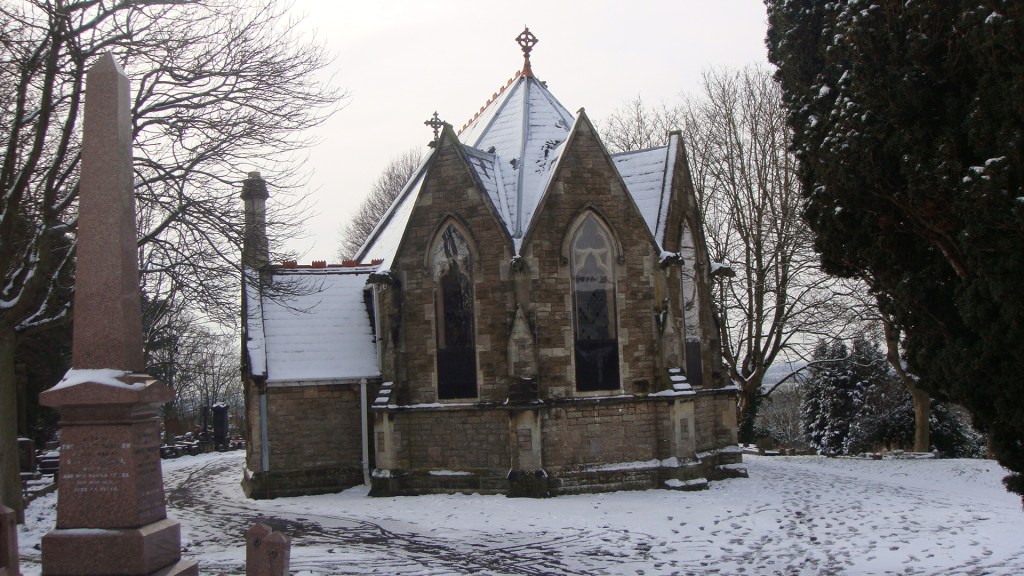
A snowy cemetery view

Swindon Funeral of Miss S.A. Wright

The funeral service took place on Friday at Wesley Church, Faringdon road, Swindon, of Miss Susan Ann Wright of Wellington street, Swindon, who for many years was a prominent figure in the educational and religious life of Swindon. Born in 1858, the eldest daughter of the late Joseph Fletcher Wright, she commenced her teaching career in the Wesleyan Day School at Eastbury. Later she took appointments in the Swindon schools, and for upwards of thirty years was headmistress of the Clifton Street Girls’ School. Her retirement in 1923 was made the occasion of a tribute of appreciation in which hundreds of pupils past and present took part.

For more than sixty years she was a valued and honoured member of Wesley Church, Faringdon Road, where she exercised an active ministry in many spheres, particularly among the young. Her intimate friends were few, but many will remember her generosity to the needy and her thoughtfulness for others.

Extract from North Wilts Herald, Friday, 1 March, 1940

Image published courtesy of Local Studies, Swindon Central Library

Clifton Street, of three departments, built at a cost of about £6,457, & opened in January, 1885; for 300 boys, 220 girls & 315 infants; average attendance, 282 boys, 211 girls & 302 infants; J. Dutton, headmaster; Miss S. Wright, headmistress; Mrs Le Manquais, infants’ headmistress.

Kelly’s Directory 1903.

Mary Ann Krempowiecki – remembered

The re-imagined story …

Today we buried Mary Ann Krempowiecki. I would not have known who she was had Mr. Bremner not been at the funeral.

I had worked for many years under Mr Bremner, one of the senior foremen in the Works, before I took the job of gravedigger. Maybe you think it a macabre occupation and an unusual one to choose, but I think it is an occupation that chooses the person – not everyone has the character to be a gravedigger. A man has to be physically strong, but more then that a man has to be respectful.

It was a bitterly cold day with a keening north easterly wind and dark clouds closing in, threatening snow. Not for the first time that day I reflected on the bleak situation of the cemetery high on Kingshill, quite forgetting its beauty during the other three seasons of the year.

There had been four burials in the cemetery that day. John Cottle, a machineman whose wife had chosen a grave plot in Section E close to the Kent Road gate. Amelia Schofield, a young mother who had died in the Royal United Hospital in Bath. And then there was an infant, there was always a child. This morning it had been a little girl barely eight weeks old.

There had been little enough labour to ward off the cold that late December day. I eagerly looked forward to the warm fire and cooked meal that awaited me at home. At least this last funeral of the day was close to the chapel affording some shelter for the mourners and the gravedigger.

And then I saw Mr Bremner and the young woman who stood at his arm and supported him. The funeral party was small, the elderly man and the young woman stood apart from the other mourners. It was obvious that Mary Ann Krempowiecki, daughter to one, mother to the other, was greatly mourned. I would not have known who she was had I not seen Mr Bremner at the graveside.

The facts …

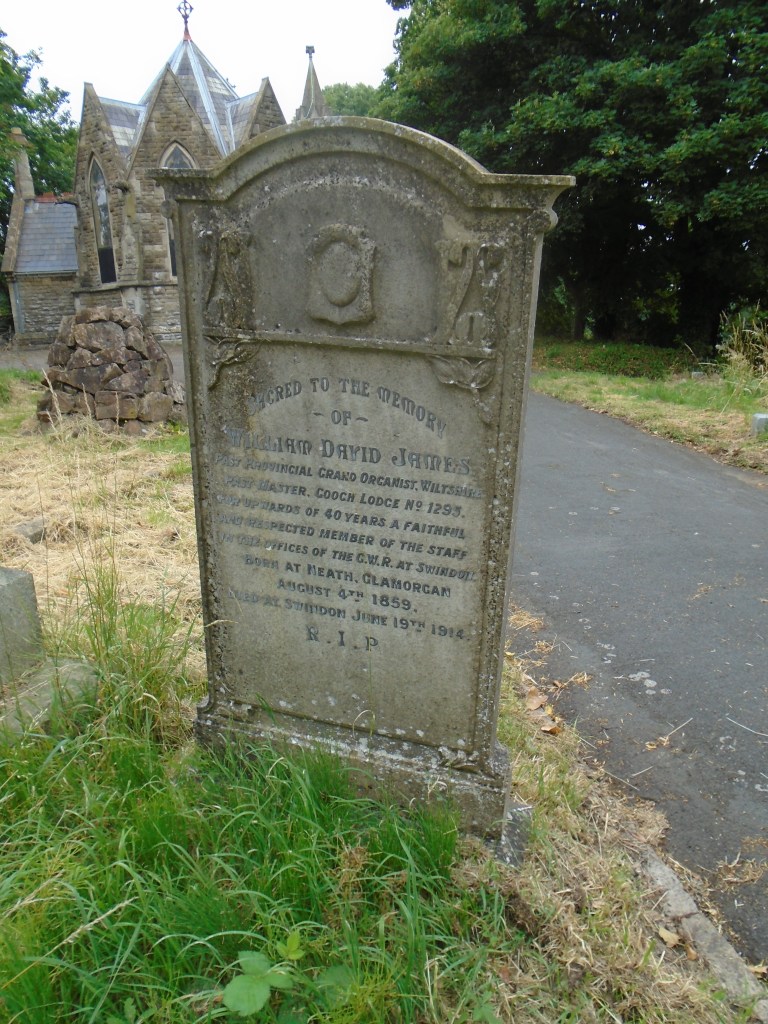
The lengthy inscription on this headstone is all about William David James, but there is a brief mention of his wife and mother-in-law on the surrounding kerbstone. So, what do we know about Mary Ann Krempowiecki and her daughter Anne Bremner James?

Mary Ann Bremner was born in 1841 in Hawkhill Dundee, the eldest daughter of railwayman Peter Bremner and his wife Ann. The family arrived in New Swindon in about 1848 and a home at 5 Taunton Street, one of the properties demolished in the 1970s.

Mary Ann Bremner was just 18 years old when she married James Thomas Atkinson, a fitter in the GWR Works. The wedding took place on September 4, 1858 at St. Mark’s Church. At the time of the 1861 census Mary Ann is living at her parents home in Taunton Street with her one year old son Henry. A daughter was born later that year and baptised Annie Bremner Atkinson at St Mark’s Church on October 20th.

By 1871 James Thomas Atkinson was dead. Eleven year old Henry and Annie aged 9 are living with their grandparents in Taunton Street. Their mother was living in London where on August 21, 1868 she had married Charles Stanislas Krempowiecki, the son of a Polish refugee. Mary Ann’s father-in-law Thaddeus Krempowiecki had stated that his occupation was Commission of Police in Poland, on his own marriage certificate, but was dead by the time of his son’s wedding.

Mary Ann Krempowiecki was back in Swindon and living with her parents at 5 Taunton Street when she died in December 1883. She was just 43 years old. Her funeral took place on December 29, 1883 when she was buried in plot A1091.

Annie Bremner Atkinson married William David James at St. Mark’s Church, Swindon on September 5, 1881. Ten years later, at the time of the 1891 census she is recorded as living at 27 Read Street with her husband and two sons William, 7 and Frank 1 years old. Another son Frederick was born in 1894 and a daughter Amy was born in 1896.

Annie died in St. Thomas’ Hospital London aged 37 in March 1899, following the birth of her son Wilfred. She was buried with her mother on March 13, 1899 in plot A1091.

William David James died on June 19, 1914 and was buried in plot A1091 with his wife and her mother. When his family erected the headstone they chose to mention their father in great detail, and rather less about their mother and grandmother.

Joshua Jackson – India Mutiny Veteran

The Ruins of the British Residency, Lucknow attribution Vyom.Y.

Joshua Jackson’s obituary published in the Wiltshire Times and Trowbridge Advertiser Saturday 29 April, 1911 might be brief, but it provides a lot of information about the extraordinary life he led as a young man (see below).

Joshua was born in at Manchester on January 7, 1836, the second of James Jackson, an inn keeper, and his wife Hannah’s 8 children.

At the age of 19 Joshua joined the army and within two years he was serving in India with the 60th Rifles during the Indian Mutiny. As with most wars, the causes were several but a flashpoint came when the Sepoy soldiers of the Bengal Army were issued with the new Enfield rifle. The Enfield used cartridges that had to be bitten open, which both the Muslim and Hindu soldiers believed had been greased with animal fats, contravening their religious observances. This however was just one cause in a complicated situation which signalled a significant turning point in the relationship between Britain and India. Joshua was also involved in the Siege of Lucknow*, defending the garrison and the British Residency in that city from the Indian soldiers.

The outcome of the Mutiny was an end to the East India Company’s right to rule India. Britain made India a part of the British empire and instated a British Governor General. Twenty years after the war Queen Victoria became Empress of India and the Viceroy of India ruled in that country on her behalf.

From India, Joshua went to serve in China during the Second Opium War where in 1859 he saw action at the Battle of the Taku Forts.

Battle of Taku Forts 1859

But by 1865 he was back in England where on May 4 he married Sarah Ann Potts at St John’s Church, Frome in Somerset.

The 1871 census records the couple living in Frome with three children, Henry 5, Percy 3 and one-year-old Henrietta. By 1881 they had arrived in Swindon. The census of that year lists them as living at 47 Haydon Street. Joshua worked as an Engine Fitter in the GWR Works while Sarah raised their large family already numbering 7 children.

In 1891 the family were living at 28 Guppy Street, Rodbourne. Three sons had followed Joshua into the Works as apprentice fitters and turners while another three sons had been born in the intervening ten years. Guppy Street remained the Jackson’s family home where Joshua died in 1911 and Sarah in 1928. The couple are buried together in plot C301 with their only surviving daughter Henrietta who died in 1920.

It appears that the Jackson family were buried in a reused grave. The first person buried in this plot was John Meek who at the time of his death in 1897 was an inmate of the Stratton Workhouse. The grave was no doubt a public plot but purchased by the Jackson family at the time of Joshua’s death.

Death of a Mutiny Veteran

Funeral at Swindon

There was buried in Swindon Cemetery last Monday afternoon the mortal remains of Mr Joshua Jackson, an Indian Mutiny veteran. He was born at Manchester in 1836, and at the age of 19 years he enlisted in the old 60th Rifles, and two years later was drafted to India, seeing much active service in the Mutiny, but fortunately he escaped without a scratch. He also fought later in the China War, and was present at the taking of the Taku Forts. When he returned to England he left the Army in 1867 and settled down at Frome. Then he removed to Swindon and worked at his trade for many years in the GWR Works. He joined the Freemasons while at Frome 45 years ago, and when he came to Swindon he joined the Gooch Lodge, 34 years ago, becoming Tyler, a post he held till the time of his death, at the age of 75 years.

Deceased leaves a widow and ten children – eight sons and two daughters.

Besides the family mourners, a large number of Freemasons attended.

Wiltshire Times and Trowbridge Advertiser Saturday 29 April 1911.

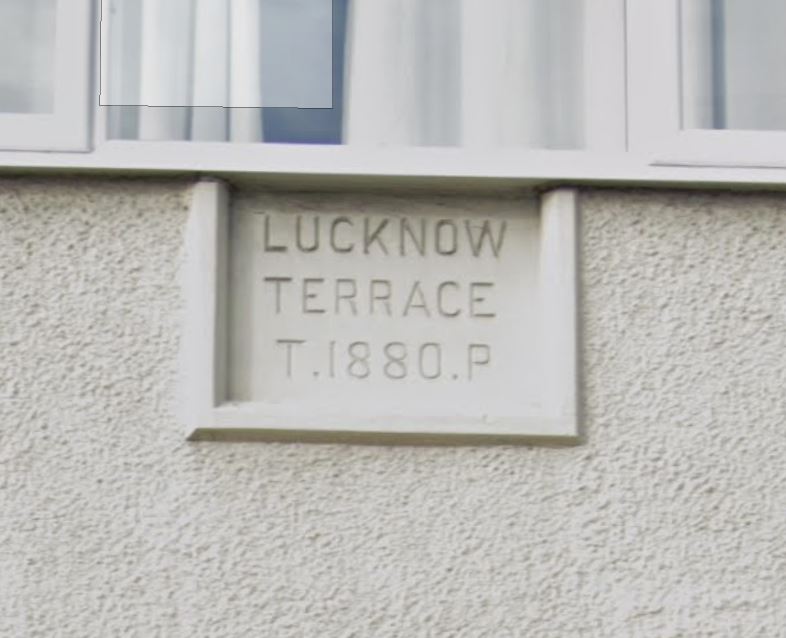
*As you walk along Rodbourne Road past Ron’s Stores, look up and above the terrace of houses you will notice in the brickwork an inscription that reads Lucknow Terrace.

James Fairbairn – pioneer railwayman

The re-imagined story …

We were promised a company house when we moved to New Swindon but when we arrived we discovered they were still being built!

So we ended up in one of twelve wooden cottages built in the back of beyond.

New Swindon was referred to as a pioneer town and out at Hay Lane we certainly felt we were living on the frontier. It would never have surprised me to see a herd of buffalo come bounding across the fields with Red Indians whooping and yelling behind them.

When the young Fairbairn couple moved into the empty cottage next to ours Margaret was heavily pregnant. It was her first child, but she was remarkably calm about giving birth in such primitive conditions.

Margaret’s pains came on in the middle of the night. We could hear her moans through the thin wooden partition that separated our homes. I left my own children in their beds and went next door to see what I could do to help. The poor girl laboured for many hours and I feared for her life and that of her baby. And at the end of her travails there was not just one, but two babies. They were small and I didn’t hold out much hope for either of them, but they thrived and survived.

And those draughty wooden cottages, well they were moved to Eastcott and survived as well. The GWR hated waste!

The facts …

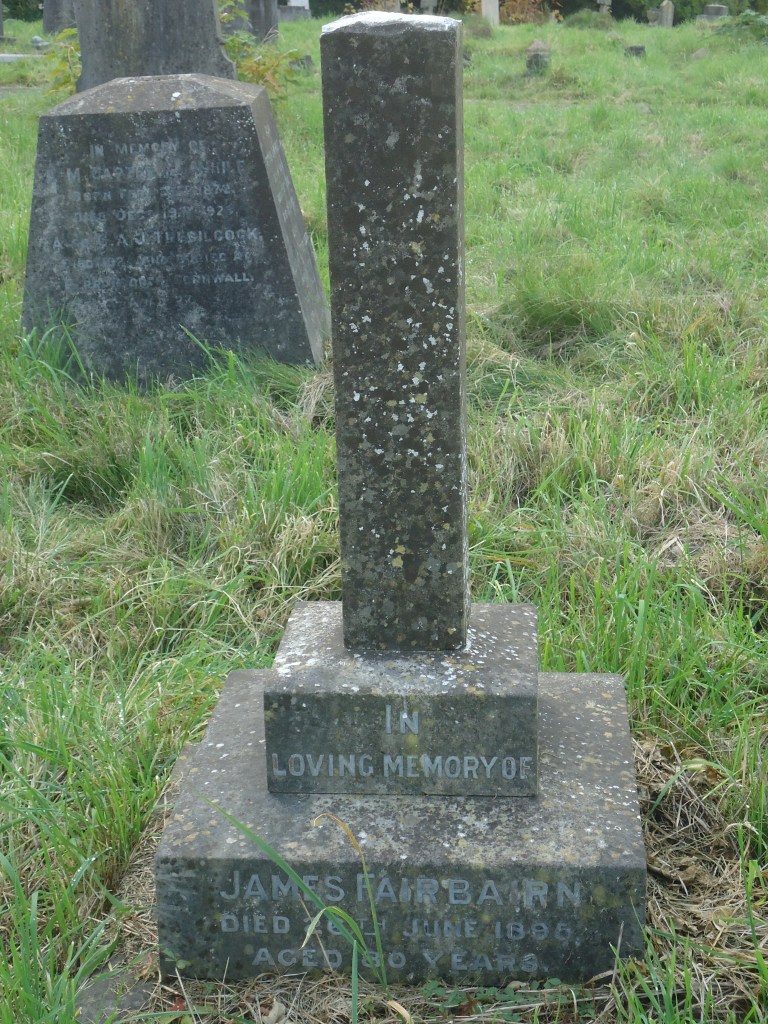
James Fairbairn was born in c1816 in Dundee in Scotland and was one of the early railway men to settle in Swindon. James moved first to Newcastle and then to London working for Daniel Gooch and Archibald Sturrock. He married Margaret Armstrong at St Mary, Newington on 2nd October 1841.

James Fairbairn worked as an Engine Erector and later became one of the most senior Foremen in the Works. He was one of the first subscribers to the Sick Fund in 1843 and an early member of the Mechanics’ Institution, elected to its ruling Council in 1855. He was also one of the first subscribers to the Medical Fund.

James and Margaret Fairbairn arrived in Swindon in 1842 at the very beginning of the railway transformation, before the company houses were completed. Like so many other newcomers, James and his pregnant wife Margaret were accommodated in temporary housing. In their case they were housed in buildings at the Hay Lane Station (Wootton Bassett Road).

Brunel had first considered siting the GWR workshops at Hay Lane and designed for employees a row of twelve, single storey wooden cottages erected by building contractor J.H. Gandall. However, Daniel Gooch considered that the Swindon location was more suitable and that is where the workshops were eventually built.

Conditions at the Hay Lane cottages were basic and it was there that Margaret Fairbairn gave birth to twins George and Elizabeth Ann in the Spring of 1842. The babies were baptised at Wroughton parish church on June 5, perhaps they were not expected to survive. George followed his father into the railway works as an engine fitter. He married Catherine Gosling and the couple had one daughter. George died at his home in Havelock Terrace in 1892 aged 49. He is buried in Radnor Street cemetery in plot B2070. His sister Elizabeth Ann married and moved away. Her husband, Charles While, a roll turner, moved to Swindon with the opening of the Rolling Mills in the 1860s. The couple lived at addresses in Workington and Sheffield before settling in Lancashire where Elizabeth died in 1912.

James and Margaret Fairbairn lived at various addresses in New Swindon, including 12 Reading Street, No 2 Fleetway Terrace, 25 Fleet Street and finally at 20 Harding Street where they both died in 1895. Margaret died in March aged 78 and James three months later in June aged 80.

You may also like to read

William and Isabel Hogarth and the old days

Thomas Oswald Hogarth – Howzat!

Thomas Oswald Hogarth – Howzat!

Taunton Street (3)The re-imagined story …

If you lived in Taunton Street you rubbed shoulders with royalty – railway royalty, that is. The first members of the Mechanics’ Institute Council Mr Grandison and Mr Fairbairn, lived in Taunton Street. Even old Mr Hurst, the first locomotive driver on the GWR, lived there although that was much later.

As a boy I was always in and out of the houses where so many of my friends lived. I used to play with James Bremner, his father was born in Scotland and was one of the first railwaymen to arrive in New Swindon.

But my best friend was Tom Hogarth and his twin brother George. Like my father theirs had moved down from the north-east in the early days of New Swindon.

Me and the Hogarth boys used to have a knock about in the park with an old cricket bat and ball. They were strict in those days, mind. The Works Manager Mr. Gooch published a notice warning parents to keep their children under control and to stop them damaging trees in the Cricket Ground. It was no idle threat either – if caught that boy would never be employed in the Works and his father could lose not only his job but his home as well.

DSC00136

Me and Tom never got up to any trouble though – or at least I don’t remember if we did. My mum would give me a clip round the ear for the slightest thing in those days. I was nimble on my feet, although that could make things worse and lead to a proper pasting when my father got home from work.

We were passionate about our cricket. I was a good little player as a boy, but not as good as Tom and George Hogarth. They went on to play for the GWR team and became famous when they played against the legendary W.G. Grace. Grace was having an unusually bad day and accused the GWR team of foul play and that they had fielded the same player twice. Tom and George had to be brought forward and stood side by side until the great man was convinced there was a pair of identical twins on the GWR team.

I liked James Bremner but Tom Hogarth was always my best friend. We had some fun together, though we never got into any trouble – well, not that I can remember.

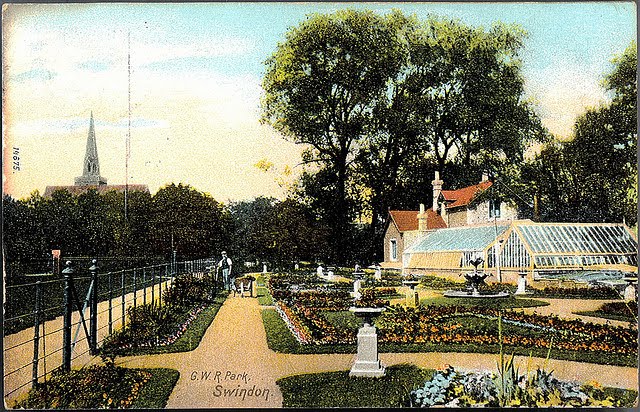
GWR Park

The facts …

Thomas Oswald Hogarth was one of twin sons born in a house in Taunton Street on September 10, 1850, the children of William and Isabel[la] Hogarth.

Thomas entered the GWR Works in February 1865 and during a long career served in many roles, firstly as a draughtsman. He then went on to become Timber Inspector in 1883, Assistant Manager of the Saw Mill in 1887, Assistant Manager in the Carriage and Wagon Works in 1895 and in 1901 the Manager. In 1902 he moved to the Saltney & Colcham Carriage Works, Cheshire where he worked until his retirement in 1911.

Thomas led a varied and active life in Swindon, serving on the newly incorporated Swindon Borough Council.

Borough of Swindon

Election of Councillors 1901

To the Burgesses of the North Ward

Ladies and Gentleman – I thank you most sincerely for the honour you have done me in again returning me unopposed as one of your representatives on the above Council and I hope that by carefully guarding your interest, to maintain the confidence reposed in me.

I am, Ladies and Gentlemen,

Yours obediently,

Thomas Oswald Hogarth “Woodlands” Swindon

Swindon Advertiser Friday November 8, 1901


Among his other interests he served as a director of The Swindon Steam Laundry Co Ltd in 1891.

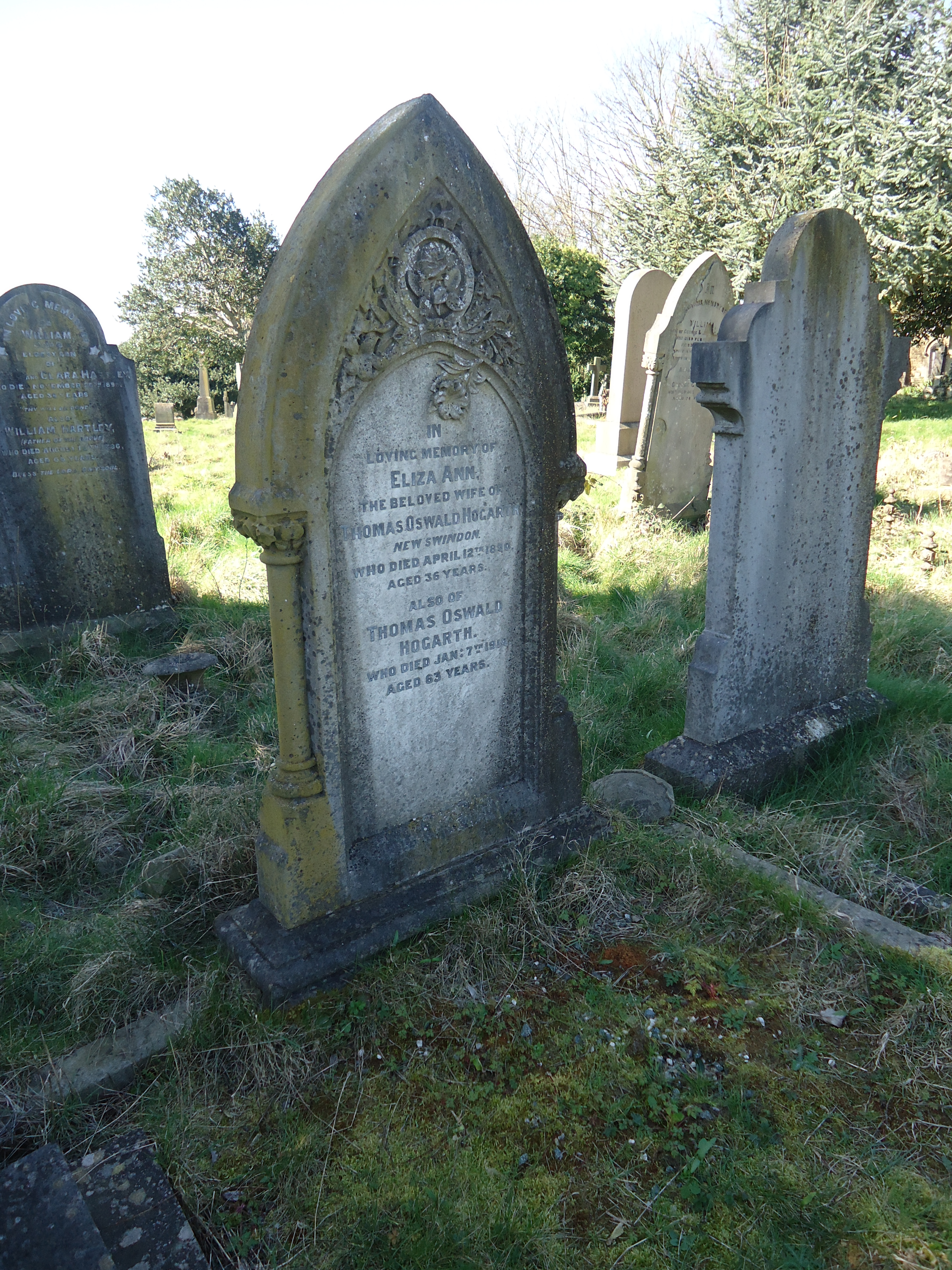
Thomas married Eliza Ann Morgan, a neighbour from Taunton Street, in 1874 in the Cookham, Berkshire registration area. They began married life back in Taunton Street where they had their four children. Eliza died on April 12, 1890 and at the time of the 1891 census the widowed Thomas was living at 1 Rolleston Crescent with their four children. In 1901, the year before Thomas left Swindon for Cheshire, he was living at Woodlands House, a property allocated to GWR managers.

Old Railway Servant

News was received at Swindon on Friday of the death at Chester of Mr Thomas Oswald Hogarth a prominent Great Western Railway official who retired two years ago.  Mr Hogarth, who was 64 years old, was born at Swindon, and entered the service of the Great Western Company as an apprentice in 1866. He became a draughtsman and rose to the position of assistant manager in the carriage and wagon works, retiring two years ago. Mr. Hogarth was a prominent Freemason and his father was the first foreman in the smith’s shop of the company’s works at Swindon.

The Midland Daily Telegraph, Saturday, January 10, 1914

Mr Thomas Oswald Hogarth of The Groves, Chester, engineer, manager of the Great Western Carriage and Waggon Works at Saltney for ten years £1,794.

The Manchester Courier Thursday February 19, 1914.

Hogarth Thomas Oswald of 20 the Groves Chester died 7 January 1914 Probate Chester 6 February to Ethel Pearman (wife of Thomas Edward Alliman Pearman) and William John Hogarth clerk in the Great Western Railway Company. Effects £1794 6s 1d. Resworn £1874 18s 10d.

Eliza A and Thomas Oswald Hogarth

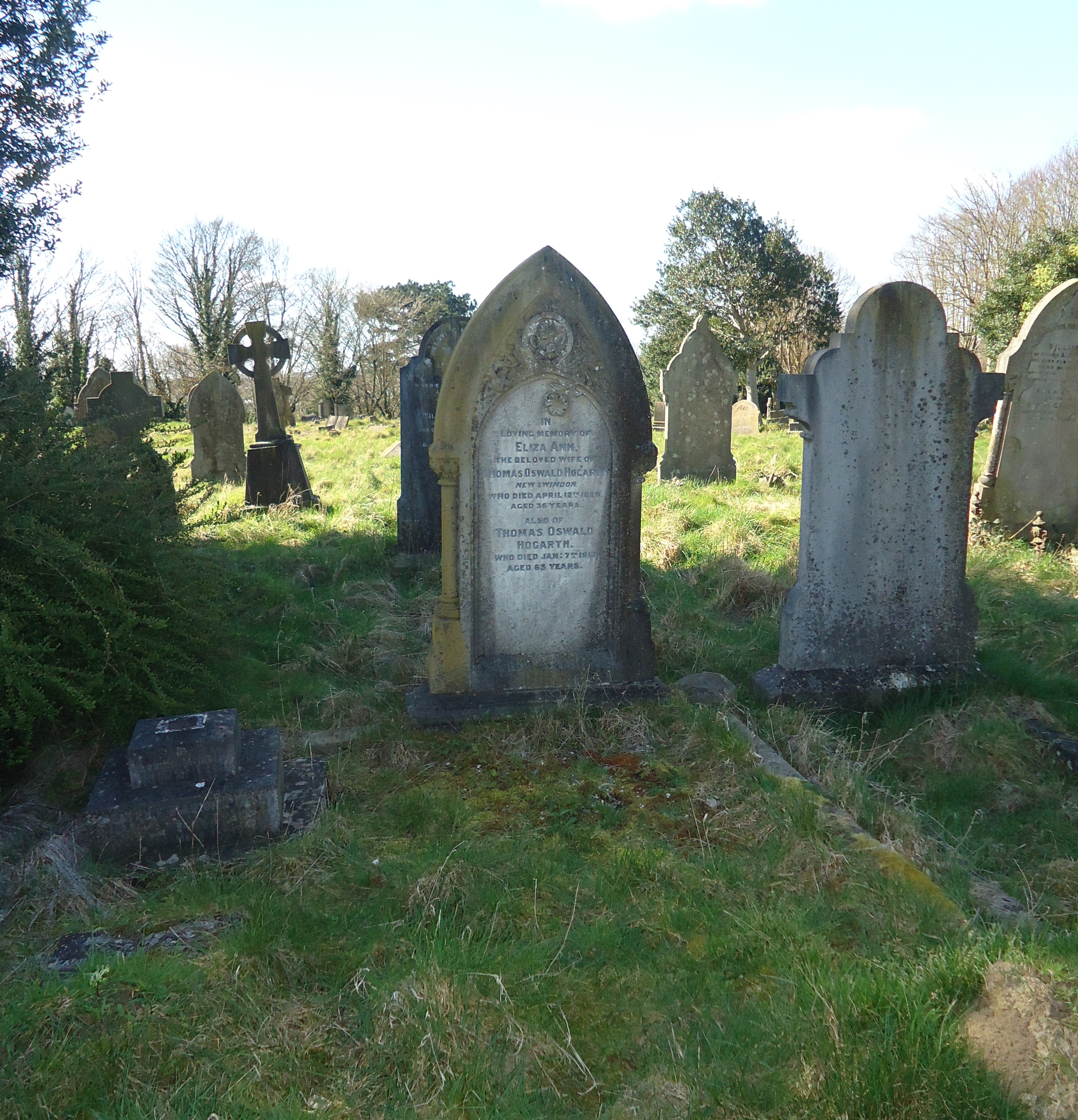
Thomas died at his home in Chester. The family returned his body to Swindon where he was buried on January 10, 1914 in plot E8245 joining his wife Eliza. Their daughter Beatrice, her husband Henry and two of their children John Robert and Harriet Elizabeth Pease are buried in the neighbouring plot E8246. 

Eliza A and Thomas Oswald Hogarth (2)

You may also like to read

William and Isabel Hogarth and the old days

John Webb – builders’ merchant

The re-imagined story …

If you were a builder, where would you build your own house? When I was a child it was always my dream to live in one of those Victorian red brick villas on Bath Road. I had a couple of favourites; properties I would buy if I ever won the pools. Dad always let me do a line on his coupon. I used to have my favourite teams as well, ones I picked every week. I could tell by the expression on dad’s face we wouldn’t be collecting our winnings anytime soon.

Mr Webb had built the house I had my eye on – an elegant property named Fairhaven, close to the Bath Road Methodist Church. It was everything you’d expect a fairhaven to be – beautiful with a fantastic view; a safe place to raise a family.

When Linda and I got married we bought a three bedroom terrace house in Dover Street. An old lady had lived there all her life – it needed a lot of work doing on it. No bathroom and an outside toilet, an old fashioned scullery and you could smell the damp as soon as you opened the front door. We ploughed every penny we had into renovating that little house, doing most of the work ourselves. We were young, fit and in love. I wouldn’t attempt a project like that now – not that I don’t still love Linda, of course!

When we eventually finished we decided to give the house a name; of course it had to be Fairhaven. Our own beautiful place in which to raise our family. And would you believe it, John Webb had built our house in 1882.

The facts …

John Webb was born in North Nibley, Gloucestershire in 1850, the son of Henry Webb, an agricultural labourer, and his wife Lucy. At the time of the 1871 census he was still living at the family home and working as a wheelwright. However, he soon struck out on his own, moving to Swindon in the early 1870s.

Through the 1870s and 80s John was busy across town building houses in Regents Circus (c1872) Page Street eight cottages (1876) Princes Street, house (1879) Station Road house (1881) Dover Street houses (1882) and so it continued.

He married Edna Whiteman at ‘the Wesleyan Methodist Chapel near the market place Swindon’ on April 13, 1876. He was 26 years old and describes himself as a carpenter and joiner living at 5 Henry Street, Rodbourne Lane. Edna[h] was 22 years old, the daughter of Jesse Whiteman, a farmer from Gorse Hill.

At the time of the 1881 census John Webb employed 12 men and 3 boys. Between 1881 and the mid 1890s John and Edna lived at 13 Station Road, sadly not a fairhaven as here two of their children died – Ellen Lucy in 1887 age 3 months and Jesse Henry who died in 1892 age 15.

And then in 1911 John changed tack. Hereafter he worked as a builder’s merchant. Perhaps he found it more profitable. Perhaps he found the years of heavy labour were taking their toll.

John died on May 31, 1927 aged 78 years. He was buried in plot E8528 with Edna who had died in April 1923 aged 69 years. Their two young children are buried in the neighbouring grave where Edith Annie, their second eldest child, was also buried when she died in 1948 age 69.

Charlotte Lawes and Sarah Nicholas – looking good, ladies

The re-imagined story …

The path from the Dixon Street cemetery gate to the one at Kent Road was steep and she usually had to pause half way up to catch her breath. It was a nice spot, her resting place, and she quite liked the one chosen by Charlotte Lawes and her neighbour Sarah Nicholas as well – not that she was planning on joining them anytime soon. Although many more journeys up Deacon Street carrying shopping might well finish her off, she thought.

She wondered what their funerals had been like. Did they have the full works, black coach and plumed horses? She had rather fancied a funeral like that herself until her daughter asked – “What, like an East End gangster?” That had rather put her off.

There were not many headstones in this part of the cemetery and some of those that remained were badly weathered. She wondered who they all were – the people buried on this, the steepest part of the cemetery. She sympathised with the funeral director and his men who had to carry the coffins up this steep slope. Two bags of shopping were quite heavy enough.

Right, she took a deep breath; not much further to the Kent Road gate. Goodbye Charlotte and Sarah until next week – looking good, ladies.

The facts …

When the cemetery opened in August 1881 the first burials took place in Section A. Perhaps the methodical Victorians planned it that way. Perhaps the families burying their loved ones had no choice. Perhaps Section A was the first area ready to receive burials in the hastily constructed cemetery.

August 6 – Frederick Gore, 54, a house painter plot A140; Albert Edward Wentworth, 1 month old, an infant plot A139 and three days later, Mary Grave Hill, 8 years old, a child A138. So many burials in August 1881 – Edwin Hemmings, undertaker; Benjamin Smith, auctioneers’ clerk; Thomas Basson, labourer and so many babies and children.

Section D and E boast many memorials. Some large and impressive – guardian angels, maidens weeping – some more modest, kerbstones around the plot bearing a name. In Section A there are few surviving headstones. There were probably never many anyway as this is where the early railwaymen and their families were buried. Difficult enough to pay for a funeral, let alone a gravestone. Difficult enough to live.

Charlotte Lawes lies alone in plot A539. She died on April 2, 1883 leaving a personal estate valued at £123 5s 6d to her sister Elizabeth Palmer. Perhaps Elizabeth paid for the headstone out of her inheritance.

Charlotte was born in Bath and baptised at St. James’ Church on February 8, 1818. Her mother’s name was Jane and her father John was a tailor. Charlotte had at least one sister, the aforementioned Elizabeth, and the family lived in Bathwick. By 1851 sister Elizabeth was married but Charlotte was still single and working as a barmaid in Bath.

On March 9, 1857 Charlotte married William Arundel Lawes in St Mark’s Church, Lyncombe. William was an engine fitter living in Swindon and considerably younger than Charlotte. The couple had no surviving children.

By 1861 the couple were living at 32 Westcott Place. Ten years later they were living in the railway village at 41 Taunton Street where William died the following year. He was buried in the churchyard at St. Mark’s, the church in the Railway Village, where Charlotte saw to it that he had a fine headstone, too.

Charlotte remained living at 41 Taunton Street where at the time of the 1881 census she is recorded as a widow aged 64 sharing her home with a boarder, John Newman 31, a draughtsman in the Works.

Like New Swindon itself, Section A was a busy place with people arriving all the time. John Crane, a 63 years old labourer from 20 Queen Street was buried in the plot next to Charlotte on March 13, 1883, shortly before she moved in. This grave plot appears to be a public one – no sold sign written in the burial registers.

It would be almost twenty years before anyone else joined Charlotte and John. Then on February 25, 1901 Sarah Nicholas was laid to rest next to Charlotte and another gravestone was erected. Sarah had died aged 81 at her home in Cheltenham Street. She left effects valued at £138 18s 1d to Edmund Jones, a builder, enough to erect this fine gravestone.

And so, the two women have lain in rest side by side for more than a century. Looking good, ladies.

Cottell Brothers- marking time

The re-imagined story …

I once asked my pa if I could have a watch for my birthday. After a brief silence he replied: “Isn’t the hooter loud enough for you lad?”

The Works hooter punctuated our days, its blast heard across the town, even out into the countryside as far as Lydiard Park. Old Lord Bolingbroke fought a long battle with the GWR in his attempt to have it silenced. He said it disturbed his sleep. It disturbed ours as well – that was the whole point of it!

My heart’s desire as a fourteen year old was to own a pocket fob watch. I would wear it in my waistcoat pocket attached by a gold chain. Before you scoff, I did have a waistcoat, all of us lads did. It was a part of the Works unofficial uniform in my day; not the old fashioned white ducks nor the boiler suits that came much later. No, we wore trousers, a jacket and a waistcoat – and a cap, mustn’t forget the cap.

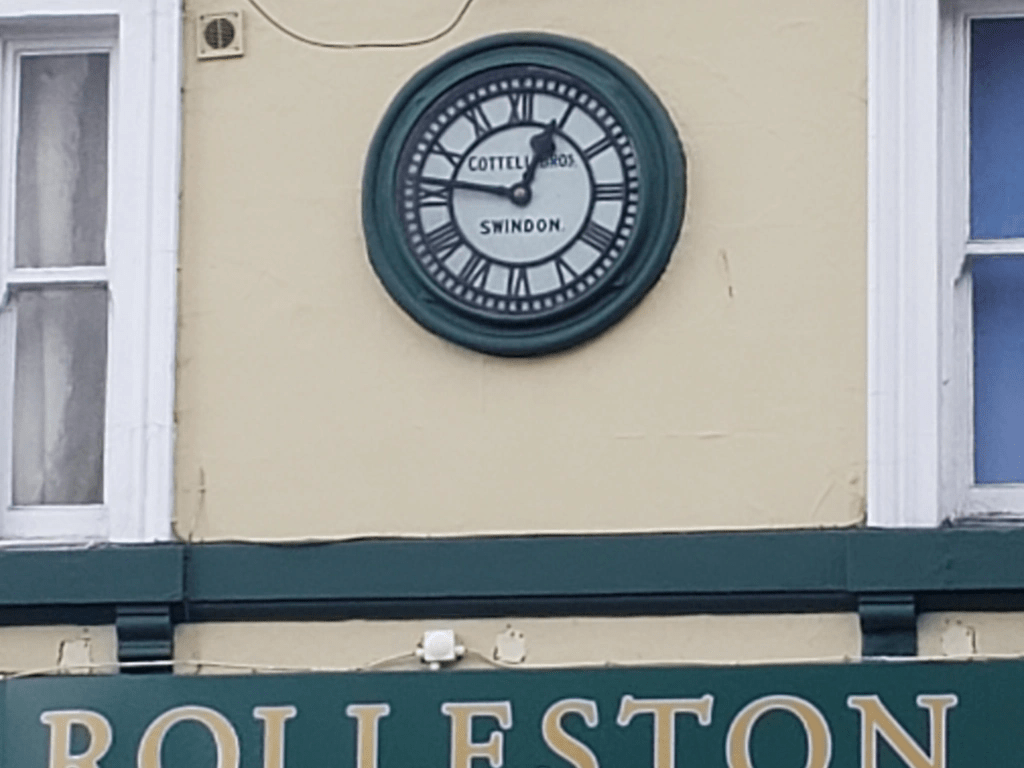
The clock on the Rolleston Arms keeps poor time these days. I’ve just checked it against my pocket watch and its running five minutes slow. That would never have happened in Mr Cottell’s day.

The facts …

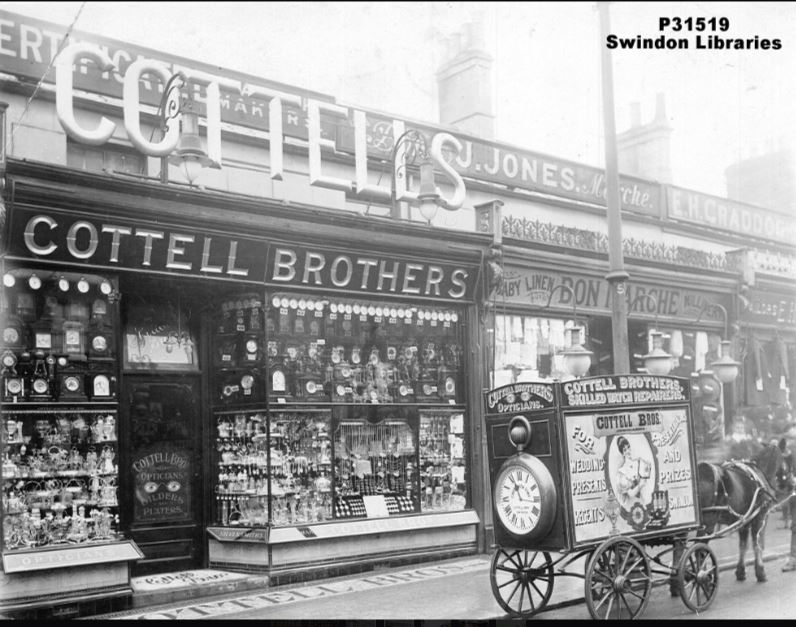
The Cottell family have left an enduring legacy with their clocks and watches, which occasionally appear for sale online, but unravelling their burial history has been less straightforward.

Image published courtesy of Local Studies, Swindon Central Library.

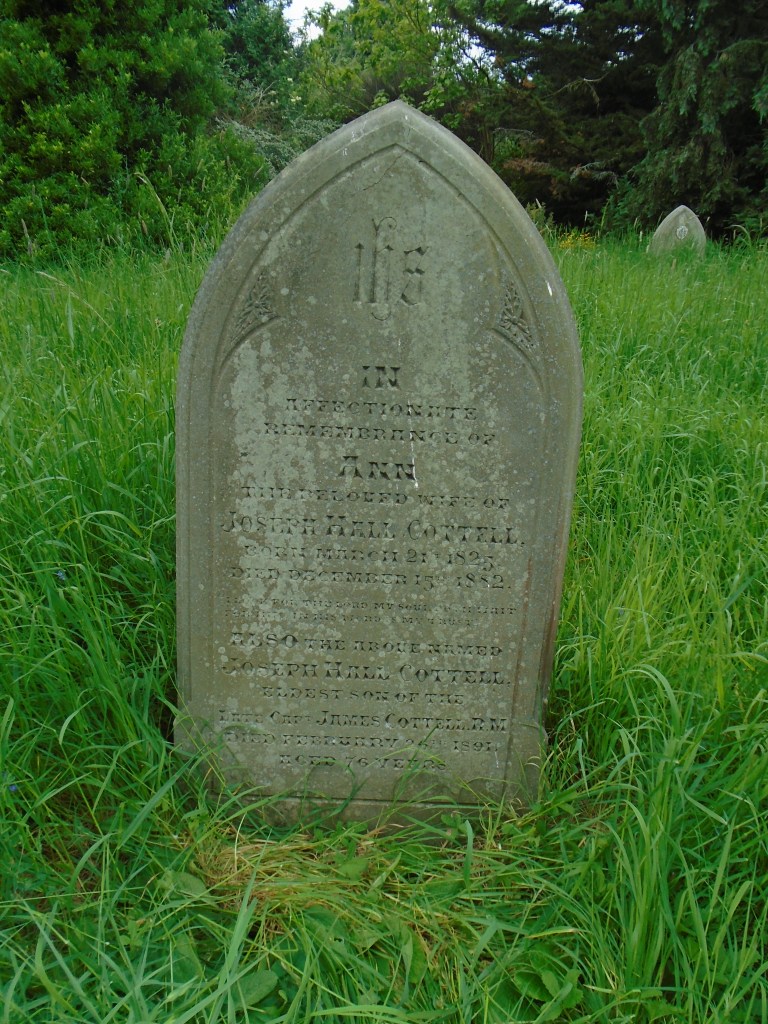
Buried in plot A174 is James Hall Cottell and his wife Ann. The family does not appear to have a long association with Swindon nor the clock and watch making industry come to that. James worked as a clerical assistant most of his life, later becoming a brewer’s manager. He died in February 1891 at Bedminster, Bristol. His father, James Cottell, was a Captain in the Royal Marines, as is mentioned on the headstone – see below.

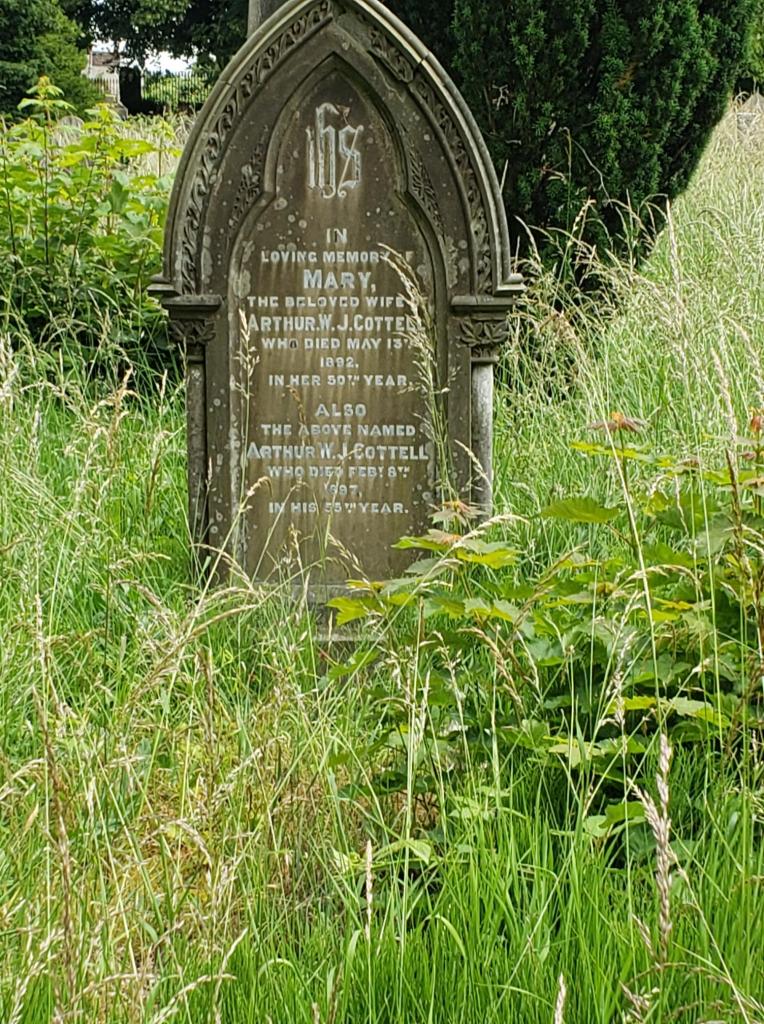
Joseph’s son Arthur William Joseph Cottell pops up in Swindon on the 1881 census living at 32 Carfax Street. He is working as a Railway Clerk as is his eldest son also named Arthur William Joseph. The younger children are Charles 15, Lydia 12, Walter 10 and Frederick 7 who are all still at school.

By 1891 the census reveals that the family are now living in Regent Street where Charles and his younger brother Walter are both working as Watchmakers & Jewellers.

When Mary and Arthur died in 1892 and 1897 respectively they were buried in grave plot E8150.

Their son Charles James of clock and watch making fame died in 1916 and was buried with his grandparents in plot A174. His name was not added to the headstone, presumably because there was no room on the front.

Their only daughter Lydia married first Henry Herbert Oswald and secondly Frederick William Roger Williams. She died in September 1925 in Clapham Park. She is not buried in Radnor Street Cemetery.

Youngest son Frederick died in Swindon in 1953 but he is not buried in Radnor Street Cemetery.

Eldest son Arthur died in Worthing, West Sussex in 1958 and he is not buried in Radnor Street Cemetery either.

Arthur and Mary’s third son, Walter Henry, an engineer, died in 1968 in South Africa where he had lived for a number of years, apparently having forsaken the clock and watch making business, too.

For a family who once marked time in Swindon their individual deaths passed with little notice.

Martha Hale – a small life

The re-imagined story …

I bought Martha’s little oak gate leg table that always stood in her hall. I remember a vase of seasonal flowers always stood there; daffodils in the spring, sweet peas in the summer, dahlias and chrysanthemums in the autumn and evergreens in the winter.

It would break her heart to see her home being picked over like this, but what else could he do. Martha’s youngest son Owen took over the farm after she died but now he was retiring and moving away. He was taking just a few personal possessions with him.

His six cows stood mournfully lowing in the stalls as the auctioneer sold off the livestock while the furniture gathered across generations of the Philmore family was examined by neighbours who barely remembered them.

The ten-acre farm on Hook Street had been home to the Philmore family for more than four generations and a hundred years. Martha had been baptised and married in St Mary’s Church and in turn had brought her babies there to be baptised. Her parents were buried in the churchyard and her husband and daughter next to them.

This image has an empty alt attribute; its file name is charles-hale-3.jpg

I sat by Martha’s bedside in the bedroom beneath the eaves of the thatched roof; the room where she had been born. Her life had been a small one, intimately interwoven with farm and church, family and friends. She had barely moved out of the parish throughout her life, but in death she was to be separated from all this. There were no more burial spaces in the churchyard, when Martha died, she was buried alone in Swindon Cemetery.

I never went to the funeral. It was just too sad, I couldn’t bear it. I offered instead to get a tea ready for the mourners. They would need something to revive their spirits, Swindon Cemetery was a bleak place in January. I put a small pot of snowdrops on the hall table, just as Martha would have done.

This image has an empty alt attribute; its file name is martha-hale-lydiard-tregoze.jpg

The facts …

Once part of the Midgehall estate, Creeches, the ten-acre holding close to the Old School House, belonged to the Earls of Clarendon until 1860 when the Clarendon properties at Lydiard Tregoze were sold to Henry Meux, head of the Meux brewery. In 1906 Lady Bolingbroke bought the farm for £995 9s 8d.

Creeches was included in the Lydiard Park Estate sale of 1930.  The farm was described as a very desirable small holding of rich meadow land, the house was built of stone with a thatched roof, six rooms and usual offices.  The farm buildings included a cowstall and yard, stable and cart shed.  The property was let on a Michaelmas Tenancy to Mr A.H. Lopes at a rent of £45 a year.

With no interested buyer, the farm was retained by the St John family until after the death of Lady Bolingbroke in 1940 when what remained of the estate went on the market.  A copy of the sale catalogue bears a pencilled note that the property sold for £1,275 although other sources say it was bought by Amy Woolford for £1,405.

Martha was baptised at St Mary’s on June 9, 1816. She married Charles Hale at St Mary’s on October 18, 1836. The couple had six children, Thomas, Ann, Mary, Charles, Jane and Owen.

After her marriage to Charles Hale the family lived first at Toothill Cottages and then in a cottage next to the Sun Inn at Lydiard Millicent before returning to Creeches to look after Martha’s elderly parents.

By the time Martha died in 1890 the churchyard at Lydiard Tregoze was closed, and the burial ground at Hook not yet opened. Martha was buried at Radnor Street Cemetery in Swindon. Her gravestone is exactly the same design as the one on her husband and daughter’s grave at St Mary’s.

The spelling of the  name of the 10-acre farm on Hook Street, close to the Old School House, varied across the 19th century cemetery. In 1805 it was known as Cruises, in 1828 as Cruches and by 1888 it appears in records as Creeches.

Creeches Farm pictured in the late 19th century published courtesy of Lydiard Park.