Walter William Palmer was born in 1878, the son of Stephen Palmer, a general labourer, and his wife Selena, and he grew up at 70 Gooch Street.
He first enlisted with the Coldstream Guards, later transferring to the Grenadier Guards, on September 4, 1894 as an 18 year old when he gave his occupation as an engine cleaner. His height is recorded as 5ft 11¼ inches.
His military records remain largely intact and we can learn all about his service and his medical history.
He served for 12 years and along with periods at home he served in Gibraltar, Egypt and South Africa. He was awarded the Queen’s Soudan Medal for service in the Soudan Campaign 1896-1897 and the Khedives Sudan Medal with Khartoum clasp for action in the Mahdist War in Sudan in 1897. He also received the South Africa Medal with Cape Colony clasp for service in the Second Boer War 1902.
He married Jessie Duprey at St. Mark’s Church on December 21, 1901 and they had one son, Frederick Walter Palmer. On the 1911 census Walter, Jessie and their 7-year-old son were living at 24 Deburgh Street, Rodbourne. Walter was employed as a boilerman in the GWR Works.
As a former soldier Walter was called up as a reservist at the outbreak of the Great War. He enlisted with his old regiment on September 12, 1914 and left for France as part of the Expeditionary Force on November 11.
His medical record is long and detailed. He was treated for a wound to his leg, which is described as an accident but by February 1916 his medical records reveal that he was suffering from Tubercle of lung (tuberculosis). His appearance was described as very wasted and that he was a tired and depressed looking man who was always hungry and thirsty. He was so ill that not only was he declared unfit for military service it was thought he would be unable to get any kind of job. He was discharged with a pension of 25/- (£1.25) a week with an additional 2/6 (12½p) as he had a child to support.
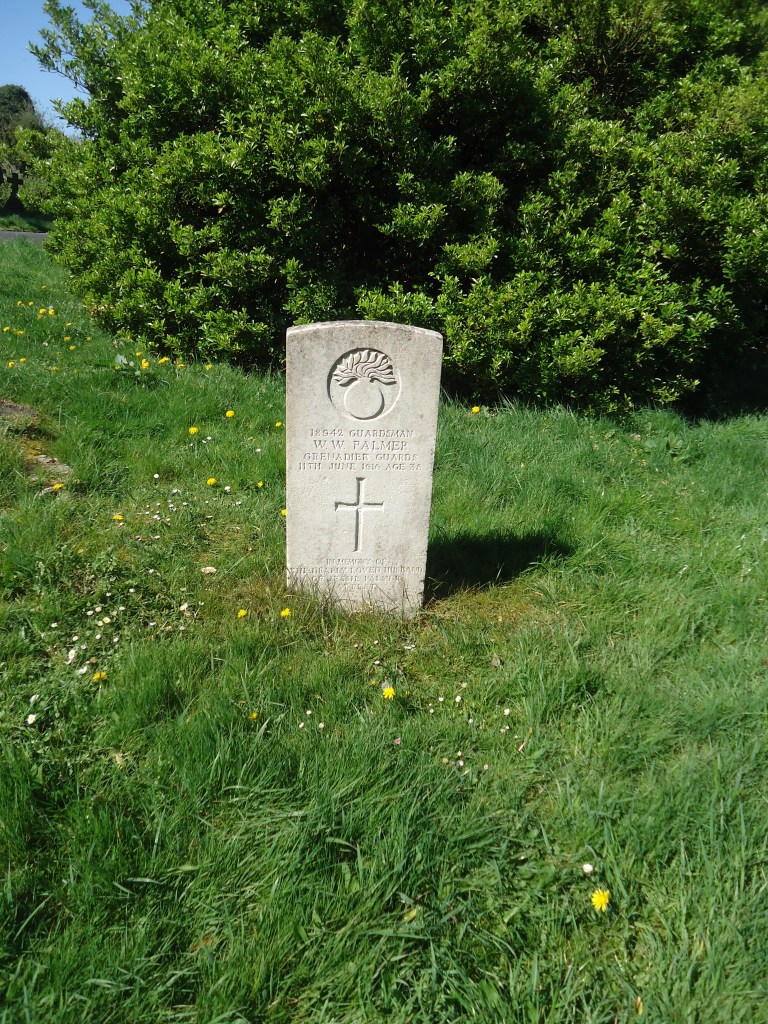
He was home for less than three months when he died. He was 38 years old. His cause of death was attributable to his military service as recognised by the Commonwealth War Graves Commission and he was entitled to an official headstone.
As fans of Time Team and Digging for Britain will know, grave goods are essential for dating pre-historic burials. From jewellery found recently in a Bronze Age tomb in the sand dunes at Cape Trafalgar on the Cadiz coast to the unpublished book of poetry Dante G. Rossetti buried with his wife Lizzie in Highgate Cemetery (he later exhumed her body to retrieve the book), we have buried significant and sentimental items with our loved ones. And in 1905 Hannah West was buried in Radnor Street Cemetery with her collection of class tickets* collected over more than 70 years.
Hannah Ride was born on October 14, 1815 the daughter of John Ride and his wife Martha. As a young child Hannah left for a brief stay in America with her family where her mother died of a fever. John returned to England and dedicated his life to the work of God after meeting Hugh Bourne and William Clowes, co-founders of Primitive Methodism.
Hannah converted to Primitive Methodism at the age of 17 and pursued a lifetime of devoted service to the cause. In 1842 she married the Rev Samuel West and the couple had eight children. Hannah and Samuel’s last home together was in Kingswood, Bristol where Hannah remained following the death of her husband in 1867. In 1903, by then aged 88, Hannah moved to Swindon to live with her eldest daughter Mary Williamson, the wife of a draper with a shop at 24 Regent Street.
The obituary written by W. Scruby and published in the Primitive Methodist Magazine describes Hannah as follows:
‘When visited she was always bright and quietly confident of her acceptance with God. Her trust was beautiful in its simplicity. Although so far advanced in life her memory was most tenacious; she would recall events of the last eighty years with the greatest accuracy. To the last she retained an intelligent interest in all that was passing, and would converse on social, political, and religious events with great zest. Her Bible and Hymnal were her daily companions, and the daily paper was carefully read. She had her political preferences, and with the condition of the working classes previous to the abolition of the Corn Laws vividly before her mind, she concluded that Mr. Chamberlain was a very bad man. Until within a short time of her death she hoped to get to services again, and desired to attend another old fashioned Camp Meeting.’
Hannah West died at her daughter’s home in August 1905 and was buried with her class tickets in plot E7652 on August 15. Her youngest daughter Emma was buried with her on August 31, 1932.
*A class ticket was a certificate of membership of the Methodist Church, and was first issued by John Wesley in 1742. Hugh Bourne revived this tradition when he issued the first Primitive Methodist class ticket in May 1811.
When Alice Fairclough married Thomas Arman in 1896 the couple joined together two families. Alice had two children by her first husband William Fairclough – William and Mary while Thomas had five children by his first wife Elizabeth Jane Webb – Elizabeth, William Thomas, Alfred Richard, Mabel Alice and Rose Mary.
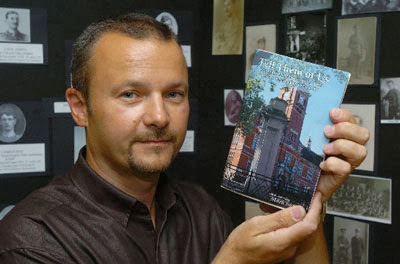
In his definitive book ‘Tell Them of Us’ about the Swindon men who served in the Great War, Mark Sutton records that Sapper W. Arman served with ‘B’ Coy 6th Batn Royal Berkshire Regiment, attached to the Royal Engineers.
Mark reproduces a letter written by William Arman in France dated September 1915, to his father and stepmother at 15 Lowestoft Street, Swindon.
‘Dear Father and Mother,
I am writing you a few lines hoping you are in the best of health. It is grand weather out here at present, though rather cold nights and mornings. We have been in action. Last Wednesday night, our battalion, the Royal Berks had it pretty warm for a lot of the Germans started shelling us in all directions for about an hour. The Germans, thinking we were all done in, started to advance towards our trenches in massed formation. They came within 20 yards of our trenches and they had it hot from our rifles, machine guns and artillery. You ought to have seen them falling down like chaff before the wind. There were not many that escaped. It was like hell for a short time. We had a few casualties, but the Germans lost nearly a battalion of men. We called them the Saxons. They were half German and half English. They have been very quiet since that night. They thought they had a soft job on, but they were mistaken for once.
I am getting used to bully beef and biscuits now. I am getting short of a razor. I can’t get one for love or money. You ought to see my face! I have not had a shave for three weeks. We get a pay this week – 15 francs, that is about 4s 2d to a franc. If God spares me, I will send it home because I can’t spend it out here. Could you send me a razor out? It looks so bad asking everyone for the loan of a razor. It would not cost much for postage.
We are sleeping in old dug-outs what the French used to sleep in. We never have our clothes off, but always sleep in them. I have not much more to say at present. I wish you all good luck and good-bye for the present.
Remember me to *Will and tell him I wish him a safe and speedy passage across the water.’
*Will is William Fairclough, his stepbrother.
William Thomas Arman survived the war. He died in 1943 in the Bridgend district of Wales in 1943. You can read more about Alice Arman here.
‘Churchyards and cemeteries are scenes not only calculated to improve the morals and the taste, and by their botanical riches to cultivate the intellect but they serve as historical records.’
J.C. Loudon – On the Laying Out, Planting and Managing of Cemeteries and on the Improvement of Churchyards1843
I wonder how many times you’ve walked past this notice without reading it.
The sign displays some important information about the status of the cemetery as a Local Nature Reserve and outlines some dos and don’ts.
During Covid we all came to recognise the importance of nature and green spaces to both our physical and mental well-being. (Well, some of us knew this already). In lock-down, when we were only allowed a limited amount of time outdoors, everyone went in search of beautiful places to walk and suddenly people discovered cemeteries (well, some of us had already).
Is there a conflict between respecting an historic burial ground and creating a Local Nature Area?
Mr Loudon had something to say about the continued function of burial grounds.
‘All burial grounds whatever within the precincts of towns, when once filled, that is, when the whole ground has been buried in, even if with only one body in a grave, should be shut up as burygrounds, and a few years afterwards opened as public walks or gardens …’
Many local residents gain a great deal of pleasure from walking through the cemetery, especially, as we have mentioned, during the difficult two to three years we have all experienced. A small team of volunteers at Radnor Street Cemetery preserve and promote the stories of those buried in the cemetery while our gardening volunteers maintain the Commonwealth War Graves (and others with a military reference) as well as helping people find family graves, so I think we pretty much have it covered!
Image published courtesy of P.A. Williams and Local Studies, Swindon Central Library
The re-imagined story …
There was no easy route to the cemetery on the hill, as he soon discovered. The steepest was the walk from town up Deacon Street, and this was the one he seldom used, not wishing to arrive out of breath, the sweat on his brow.
Usually he walked from the vicarage around the cricket ground and up Cambria Bridge Road. The only disadvantage with this route was that he met many parishioners who wished to stop him and chat. On these occasions he allowed longer to get to there.
He had little realised how much time he would spend at the cemetery. The parish of New Swindon was large and growing when he joined the team of clergy but, perhaps naively, he had not expected so much death.
Sometimes he accompanied the funeral party, but he soon realised there would be many occasions when he made that long walk alone to stand at a grave beside a grieving father. He never grew accustomed to the burial of infants. How could he give thanks for a life that numbered in weeks? How could he offer consolation to parents that their child was with God when it had been with them such a short time?
That first time he left the cemetery by the Dixon Street gate and walked down Deacon Street to the town centre. He was grateful there were few people about on that wet day at the end of October 1891.
The facts …
Alexander George Gordon Ross was born in 1866 and baptised on April 14,1866 at Trinity Church, Westminster. He was the younger of two sons born to Alexander Henry Ross and his wife Juliana Moseley.
The Rev Ross’s name appears frequently in the Radnor Street Cemetery burial registers, the first time on October 29, 1891 when he attended the funeral of William Crocker aged 48, a solicitor’s clerk who lived at 28 Read Street.
The following day he was at the cemetery again to conduct the service at the burial of twin babies. Ada Kathleen and Agnes Hilda Thompson were two months old.
Death of Canon A.G.G. Ross
Swindon Vicar for Many Years
A Keen Chessman
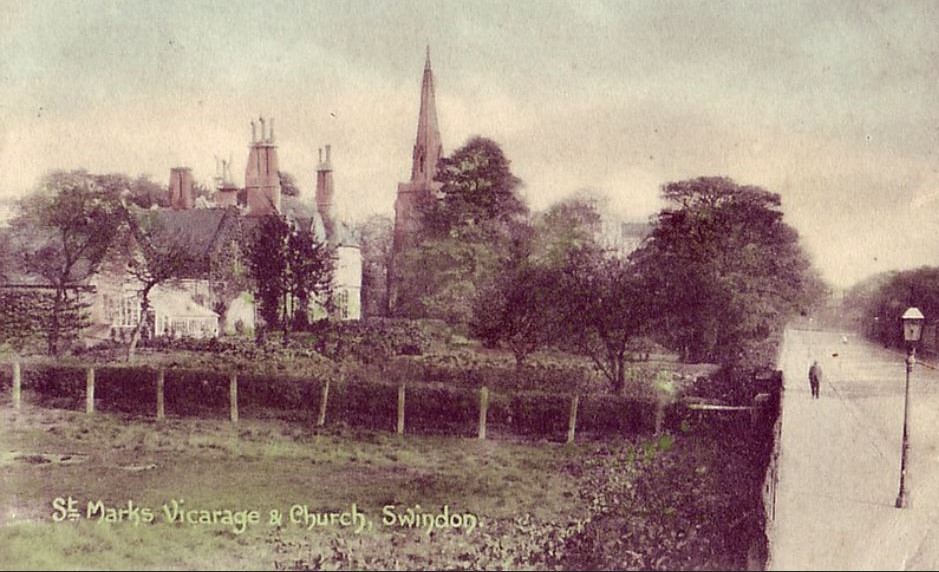
Canon A.G.G. Ross, Vicar of St Mark’s, Swindon, until September of last year, died suddenly at Oxford on Tuesday. For 47 years he worked at St. Mark’s, which was the only parish to which he was ever attached. He was the son of a former Member of Parliament for Maidstone, and was educated at Eton and New College, Oxford. He was trained at Wells Theological College, and ordained deacon by Bishop C.J. Ellicott, at Bristol in 1891. He came to Swindon the same year.
For 12 years he was assistant priest at St. Mark’s under Canon the Hon. M.J.G. Ponsonby, now Lord de Mauley. He had much to do with the rapid expansion and increasing activities of the growing parish, and he was one of the first to introduced amateur theatricals in Swindon on a large scale.
For some years he was in charge of St. John’s district church, and when Lord deMauley left Swindon, on his appointment as Vicar of Wantage, Canon Ross was appointed Vicar of St. Mark’s in his place. The office of honorary Canon of Bristol Cathedral was conferred on him in 1909.
St. Luke’s Built
The principal extension of the parish with which Canon Ross was connectedwas the building of the district church of St. Luke’s. Services were previously held in the buildings which are now used as schoolrooms.
The spiritual work of the district increased greatly during Canon Ross’s incumbency, although during the war the parish had to suffer the reduction of the clergy from eight to five. When he retired Canon Ross had many tributes paid him. The Bishop of Malmesbury wrote: “We all thank God for his ministry.” And the Rev. Lord de Mauley referred to his “long and good time” in the parish.
A Chess Enthusiast
One of Canon Ross’s main interests outside his work, was chess. He was president of the British Chess Federation and his knowledge of the game was of great value to the Swindon Mechanics’ Institution Club, to the Wilts County team and to the St. Mark’s Chess Club.
When he had been 25 years as vicar of the parish, the parishioners presented him with an illuminated album as a memento of the dedication of a beautiful oak rood screen which was set up as a thanksgiving for the 25 years of his vicariate.
Since his retirement, Canon Ross had spent a good deal of his time at Maidstone, where he went to live. At the time of his death he was staying with the Rev. Trevor Jalland, Vicar of St. Thomas’s, Oxford, and formerly of St. Luke’s, Swindon.
There will be a Requiem Mass at St. Mark’s, Swindon, on Saturday morning.
North Wilts Herald, Friday, 13 May, 1938.
The late Canon Ross
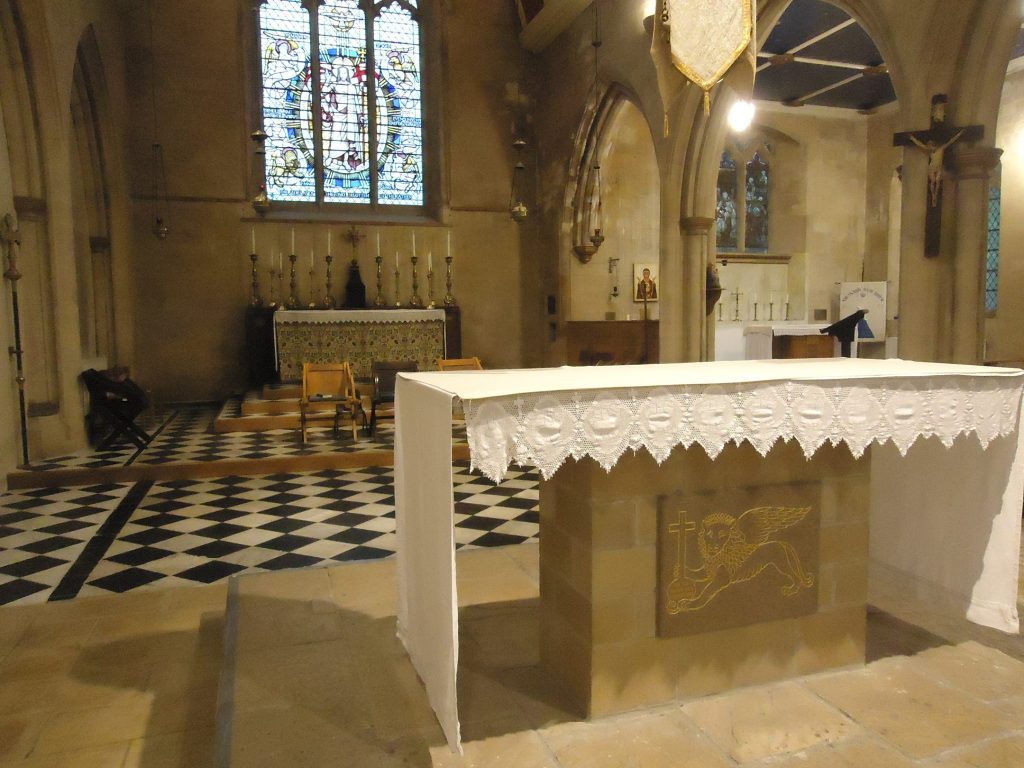
The funeral of Canon A.G.G. Ross, former Vicar of St Mark’s, Swindon, who died suddenly at Oxford on Tuesday, will take place at Swindon on Saturday. The body will be brought to Swindon to-day (Friday) and will rest in St. Mark’s Church, where watch will be kept. On Saturday morning there will be Requiem Masses at 7, 7.30 and 8 o’clock, and a solemn requiem will be sung at 9.30. The funeral service will take place at St. Mark’s at 2.30 the same day, and the interment will be in Radnor-street cemetery.
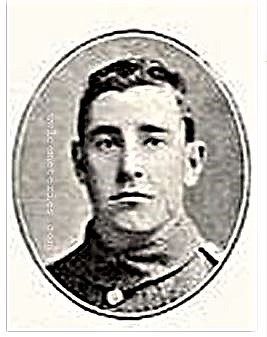
Archibald Edward Knee was born in Stroud in 1892, the son of Francis and Rose Knee. The family later moved to 123 Albion Street where Francis worked as a railway carriage painter in the GWR Works and Rose cared for their seven young children. Archibald joined his father in the GWR Works on leaving school, working as a railway carriage painter and sign writer; a job he could safely expect to hold for life.
Archibald enlisted in the Wiltshire Regiment in July 1915, when a war initially anticipated to be over by Christmas 1914 approached its first anniversary. He embarked for France on New Year’s Eve 1915, part of desperately needed reinforcements at the front.
Archibald Edward Knee
The British army began preparing for the ‘big push,’ in the Spring of 1916. It was believed this allied offensive would finish the war. The Battle of the Somme, in which more than 57,000 British soldiers were killed, wounded or reported missing during the first 24 hours of action, was yet to come.
The 1st Battalion of the Wiltshire Regiment was at Pylones, three kilometres north of the German held Vimy Ridge. The German army bombarded this section of the Western Front on May 21, firing everything at their disposal, including gas and lachrymatory (tear gas) shells.
The men of D Company were in battle by day and making running repairs to fencing and trenches throughout the night.
Lt Col W.S. Brown recorded the events of May 24 in the regimental war diary:
“In the trenches. The enemy were able to reach the Birkin Crater post with Cylinder stick bombs and some casualties were caused.
Many rifle grenades were fired at the outpost line of P73: those fired in retaliation appeared to do considerable damage. After 5 p.m. the enemy fired several heavy trench mortars at P74 and P75 and also at the head of Grange C.T. Snipers claimed three Germans. Repairs to the P line were carried out and a large amount of wire was put out along the whole front during the night of 24th/25th.”
Private F. Daniels of A Company was killed outright. Lance Corporal Knee was among 10 other casualties that night.
Archibald was taken to the 22nd General Hospital at Etaples where he received emergency treatment. He had suffered a gunshot wound to his left thigh, which in itself would probably not have proved life threatening. It was the effect of the German gas attack that proved fatal. Archibald developed gas gangrene and died at 11.20 on the morning of May 29. He is buried in the Etaples Military Cemetery.
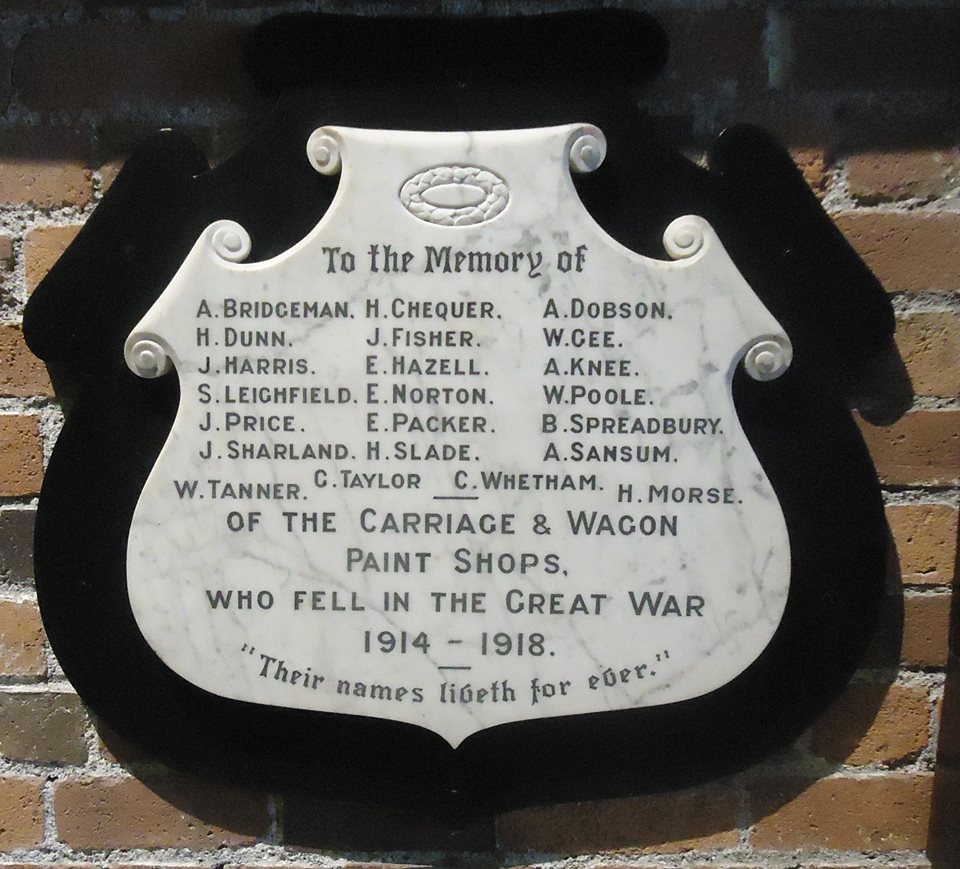
Archibald’s name appears on the memorial dedicated to the memory of those from the Carriage & Wagon Paint Shops who gave their lives in the Great War. This plaque can now be seen in the STEAM Museum.
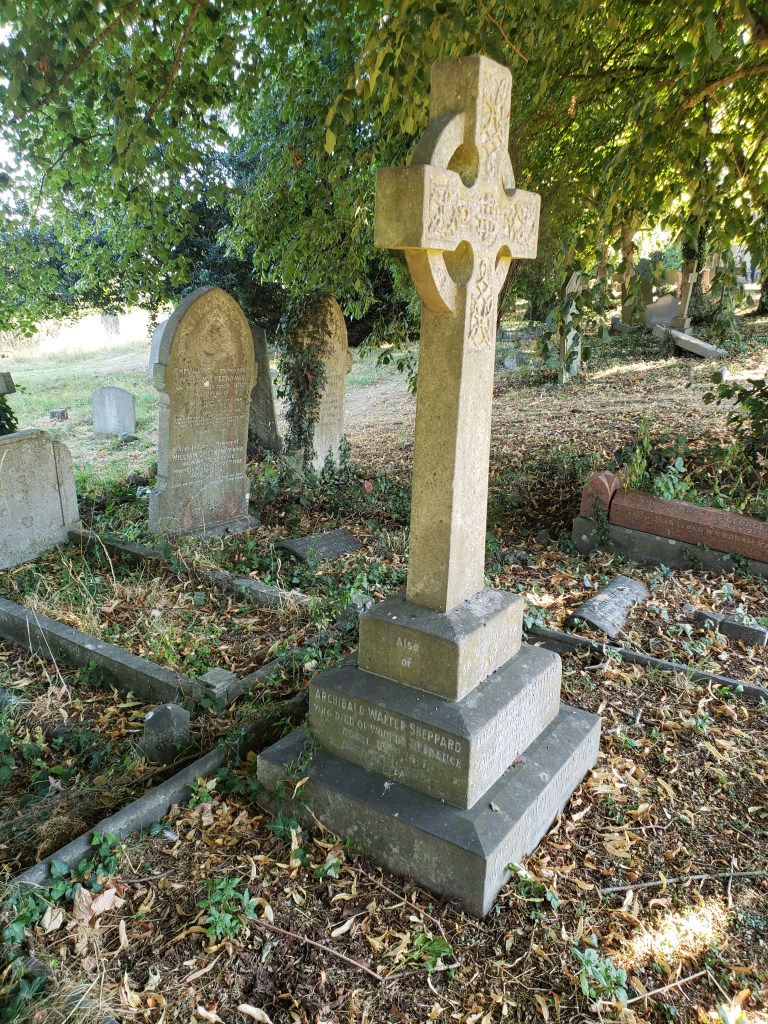
The Commonwealth War Graves headstones stand out proud across Radnor Street Cemetery, the area around them kept clear and accessible by our dedicated team of volunteers. But these are not the only war dead commemorated by Swindon families. Many family memorials carry the name of a lost loved one buried on the First World War battlefields. Were those grieving families able to visit their graves; probably not. So they came to their local cemetery and remembered them here.
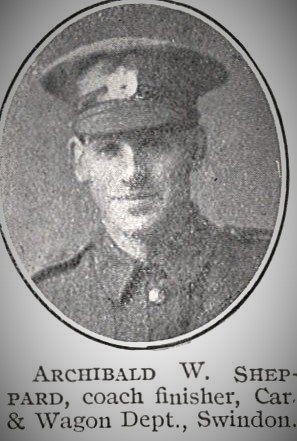
Archibald Walter Sheppard was born on May 4, 1888, the youngest of William and Eliza’s seven children, and grew up in the busy family home in Clifton Street. He began work aged 14 years old as an office boy in the GWR Works and then completed a 6½ year apprenticeship in the Pattern Making Shop, receiving his certificate on May 20, 1909.
Sadly, his military records have not all survived, so we do not know when he enlisted. We do know that Sapper Archibald Sheppard was serving with the Royal Engineers 455th Field Company at the Battle of Arras in April 1917. It is believed he was wounded during fierce fighting at Monchy le Preux. He died of his wounds on April 18 at the 19th Casualty Clearing Station at the village of Agnez le Duisans and is buried in the Duisans British Cemetery Extension.
His parents William and Eliza both died in 1931. They are buried in this large double plot C1999 and C2000 with their sons William Henry who died in 1908, and Albert Leonard Sheppard who died in 1963 and his wife Ellen Gertrude who died in 1935.
And remembered on this fine memorial is the name of their youngest son Archibald who is buried in a grave far from home.
Princess Helena Victoria visited Swindon on April 21, 1923 published courtesy of Local Studies, Swindon Central Library.
The re-imagined story …
When I told mum the Mayor had selected me to meet Princess Helena Victoria when she came to Swindon, she said nothing at first.
I joined the Girl Guides when I was 12 and went on to become a Ranger. It was in this role that the Mayor, Cllr Harding, had invited me to meet the Princess when she came to town to open the Boys’ Red Triangle Club.
I loved everything about being a Guide. I loved the fellowship and the feeling that I was making a contribution to society. I had made some good friends. Where we met was the only place I could relax and have fun and laugh and be myself. There wasn’t much laughter in our house. Mum’s grief was all consuming, to laugh seemed to be making a mockery of her sadness.
She hadn’t always been a serious kind of person, it was dad who was the sombre character. She would tease him and tickle him when he refused to smile and I can hear her tinkling laughter somewhere in my memory.
“I’d rather you didn’t meet her, Sylvia.”
I was stunned. The Mayor had paid me a huge honour, selecting me to meet the Princess.
“It’s a real privilege mum. The Mayor has only asked George Akins from the Scouts and me to meet her.”
“She’s German,” said mum, blunt just like that. ‘She’s German.’
“She’s Queen Victoria’s granddaughter.” I was incredulous.
“And she was German, too. I’ll not have a daughter of mine shake hands with a German.”
I couldn’t argue with her, that would have been too cruel. She had lost dad and my uncle in the war. Sometimes it felt as if the war had been in another age, at other times it felt as if we were still living through it. Some people would bear the scars for a lifetime, limbs lost, faces disfigured, minds broken. My mum had a broken heart and I doubted whether she would ever recover.
Everyone was excited about seeing the Princess. There was to be a luncheon at the Queen’s Royal Hotel first before she opened the Boys’ Red Triangle Club and a Civic Gathering in the Town Hall afterwards.
I explained to the Mayor why I couldn’t greet the Princess. I thought he would be angry, but actually he seemed to understand.
Sometimes it felt as if the war had been in another age; at other times it felt as if we were still living through it.
Mayor A.E. Harding
The facts …
Princess Helena Victoria visited Swindon on Saturday, April 21, 1923. The Princess was the elder daughter of Prince Christian of Schleswig-Holstein and Princess Helena, the daughter of Queen Victoria and Prince Albert. She was born at Frogmore House in 1870 and lived her entire life in Britain. During the First World War she visited British troops in France and afterwards worked to promote and support the YMCA and the YWCA. During the war King George V relinquished the use of German royal titles for himself and his numerous cousins.
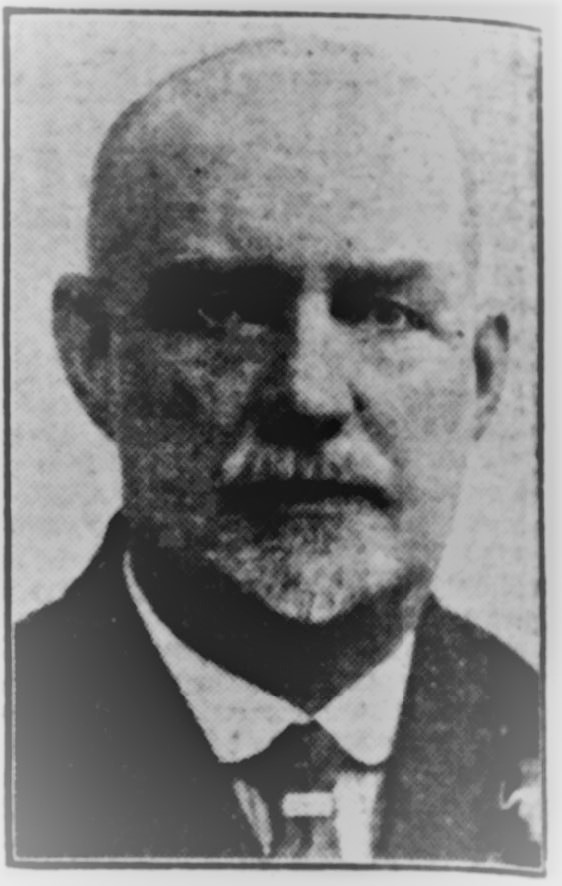
Albert Edward Harding was born in London in 1865. At the time of the 1881 census he was working in the railway factory as a clerk and lodging with the Hunt family at 38 Prospect. He married Agnes Westmacott in 1889 and the couple had three children, Stewart Jasper, Myrtle Marion Westmacott and Albert Edward Benjamin Harding.
The family first lived at 115 Princes Street where in 1898 Harding was the divisional secretary to the National Deposit Friendly Society, in addition to his job as a Clerk in the railway works. The family later moved to their long-time home at 56 Victoria Road.
Albert Edward Harding was a Councillor representing the East Ward from about 1911 and served as Mayor of Swindon in 1922/23, the year that Princess Helena Victoria visited Swindon.
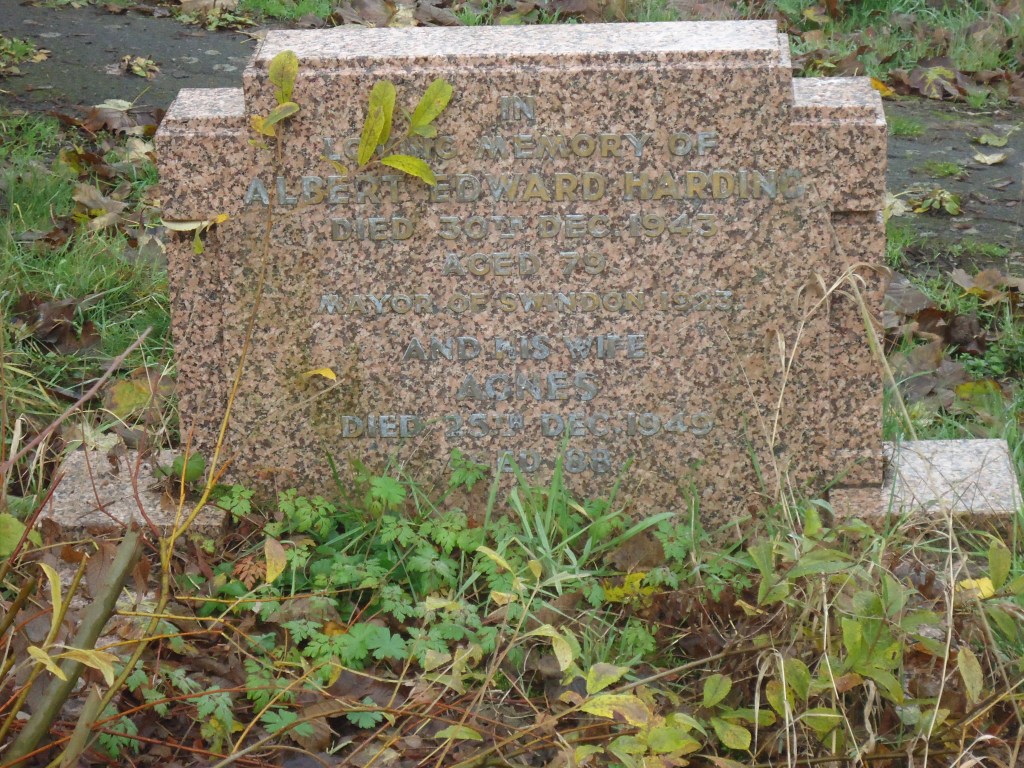
Albert Edward Harding died at his home on December 30, 1943. He is buried in plot E8568 with his wife Agnes, their son Albert Edward Benjamin Harding and daughter in law Kathleen.
Their eldest son Stewart Jasper Harding is buried in the neighbouring grave plot E8569 with his wife Gladys.
The following words were published in the North Wilts Herald in 1939 as part of a much longer article celebrating the Golden Wedding anniversary of former Mayor A.E. Harding and his wife Agnes. Of course the article concentrated on the work of the Mayor but his wife was more than an equal in this partnership.
Agnes Westmacott was born in Somerford Keynes into a staunchly Primitive Methodist family. Her father, Samuel Westmacott, was a baker and grocer who moved to Swindon by the time of the 1871 census. He became a member of the Regent Street Chapel with which Agnes would be involved throughout her life.
Agnes married Albert Edward Harding, a railway clerk in 1889 and the couple had three children, Stewart, Myrtle and Albert. The family’s long time home was ‘Apsley.’ Not Apsley House, former home of the Swindon Museum and Art Gallery, but a property called Apsley at 56 Victoria Road.
Albert entered politics in 1907 serving as a councillor representing the East Ward on the Swindon Town Council and in 1922 was appointed Mayor. However, family life continued to centre around Primitive Methodism and the Regent Street chapel where Agnes served as a Sunday School teacher for many years. She was also the first secretary of the Brinkworth and Swindon district branch of the Primitive Methodist Women’s Missionary Society.
Agnes Harding died at her home and was buried with her husband, who had died six years previously, in Radnor Street Cemetery in grave plot E8568 on December 30, 1949. The couple were later joined by their youngest son Albert and his wife Kathleen. Buried in the neighbouring plot is their eldest son Stewart, who predeceased his parents, dying in 1931. He is buried in plot E8569 with his wife Gladys who died in 1968.
Married for Fifty Years
Golden Wedding of Mr and Mrs A.E. Harding of Swindon
Mrs Harding’s Record.
Mrs Harding was born at Somerford Keynes and came to Swindon with her parents in her youth. She was a scholar in the day school at the Regent street Primitive Methodist Church, and one of the first scholars to attend the College street school. For many years she was a teacher in the Primitive Methodist Sunday School, Regent street, with which church she has been associated all her life. She was elected to teach a class of unruly youths – and then for many years taught the infants class of some seventy children. During this period she was presented with the diploma for long service.
For many years she has been a class leader, with at one time 95 members on her book, but of late years has had to have more assistants.
Mrs Harding was one of the first pupils of the Art School which was held in the old Town Hall, The Square, whilst the College was being built.
When the Primitive Methodist Women’s Missionary Society was established she was one of the first to form a branch in Swindon, and was secretary of the Brinkworth and Swindon district branch. At the conference at Cardiff in 1924, Mrs Harding was elected national president of the society; she represented the District Sunday School at the triennial conference at Liverpool, was a delegate to the annual synod at Aylesbury and to the conference at Sheffield.
During her year of office as Mayoress, Mrs Harding was presented by the branch with a silver purse and an album of the members’ names. As Mayoress she helped to form the Nursing Association and has continued as a member.
A member of the Red Triangle Club at its formation, she still continues her association with the women’s section.
When the Linen Guild at the hospital was formed, Mrs Harding became a member, and still continues with the weekly meetings. She is president of the sewing circle of the Regent street Church and in connection with these organisations, she has made hundreds of articles and is still an active member of all these societies.
At her silver wedding she was presented with a silver salad bowl by the British Women’s Temperance Organisation.
Councillor and Mrs A.E. Harding were presented to Her Highness Princess Helena Victoria at the opening of the Red Triangle Club; in 1933 to their Majesties King George the Fifth and Queen Mary, when they visited Swindon, and to the Duke of Gloucester on his recent visit when opening the Civic Offices.
Extract North Wilts Herald, Friday, 17 March, 1939
It cannot be denied how important the growth of Primitive Methodism in Swindon was to the development of the town itself. It has been argued that nonconformity arrived in Swindon with the establishment of the Great Western Railway as railwaymen came from across the country bringing with them a tradition of working class, chapel attendance, but this is not the whole story. Evidence of nonconformity was present in the area long before and in 1924 the Primitive Methodists celebrated the Centenary of the Brinkworth and Swindon District Synod.
By 1828 there was a growing Primitive Methodist membership in what was then known as Eastcott, an area around where Regent Circus would later be built. Open air meetings were delivered by travelling preachers until a plot of land was gifted by Thomas and James Edwards in fulfilment of their father’s bequest. It was here, on what would later become Regent Street, that the Primitive Methodists built a chapel.
Charles Morse, a pioneer of Primitive Methodism in North Wiltshire, said ‘that it was like building a Chapel in some foreign land, scarcely a house was near, there was a road through the field, but not a stone to be seen upon it.’
Rev. G. Pilgrim, Minister of the Newport Street Congregational Church, attended the inaugural meeting and he commented that there were very few people there, and of them the greater part were old women and he was at a loss to know how the Primitives were to build a Chapel and pay for it.
But build it they did, and what’s more they rebuilt twice more as their membership grew and out grew three buildings. The first modest chapel was demolished and rebuilt in 1863 followed by a third Chapel providing accommodation for 600 built in 1876 at a cost of £3,110.
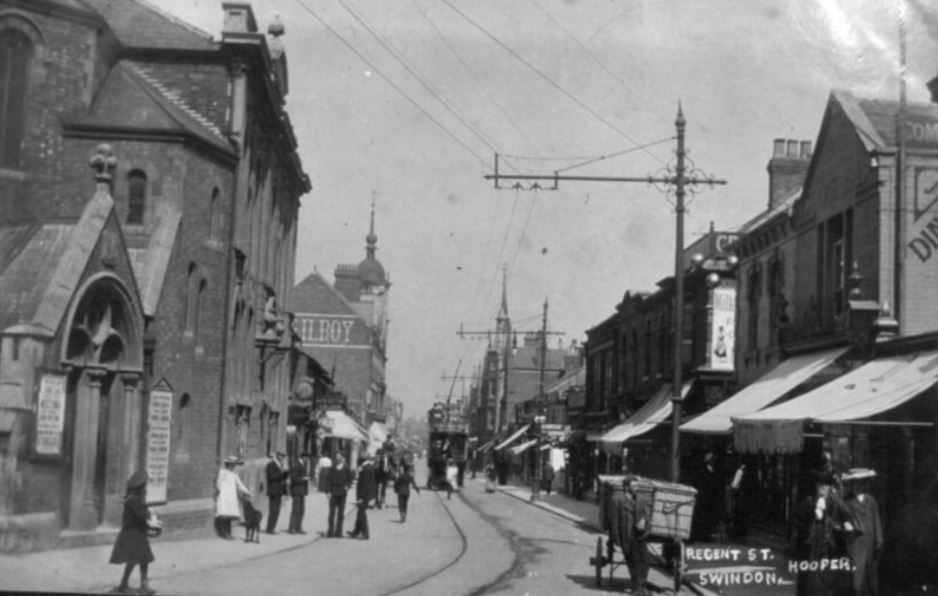
Regent Street with Primitive Methodist Chapel on the left of the image. Published courtesy of Local Studies, Swindon Central Library.
The Regent Street chapel became the parent church of the Second Circuit. However, its situation on Swindon’s busy shopping street became increasingly problematic. Sadly, it was demolished in 1957, its funds used to improve other Methodist churches in Swindon.
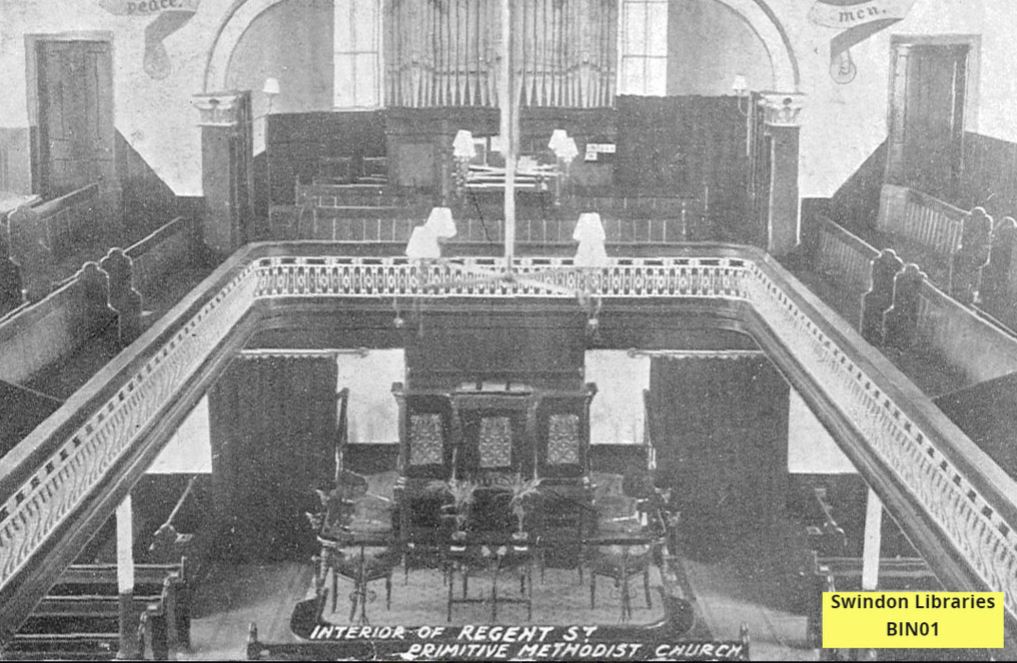
Image published courtesy of Local Studies, Swindon Central Library.
A public health report and an urgent need for burial space in the rapidly developing town along with the growth of nonconformity contributed to the building of a new cemetery in 1881. Now the nonconformists could bury their loved ones without the strictures or rites of the established church. Radnor Street Cemetery, an area of unconsecrated ground, became the last resting place of some notable nonconformists including Mayors, Councillors and Alderman alongside others who worshipped in the numerous churches and chapels. You might like to read more by following these links …









 Radnor Street Cemetery